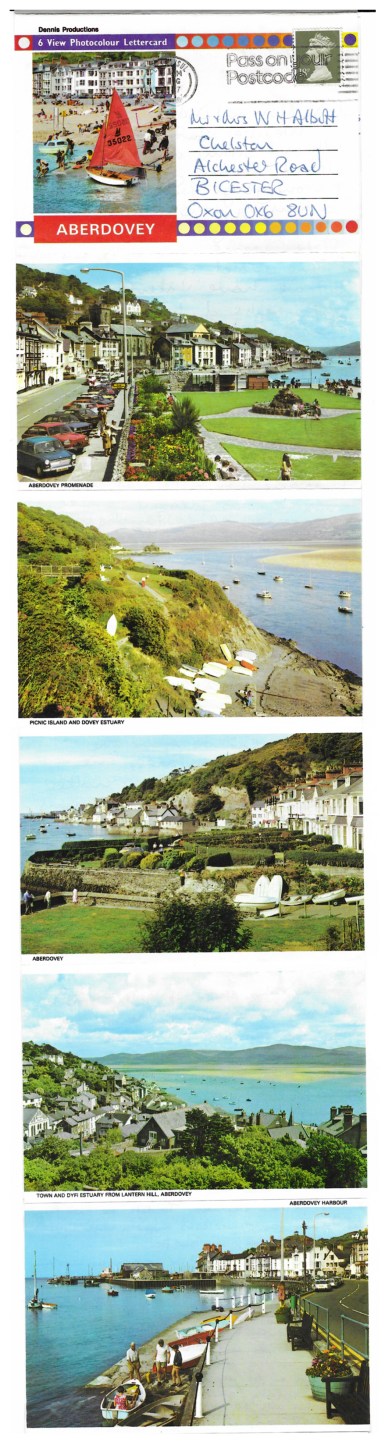
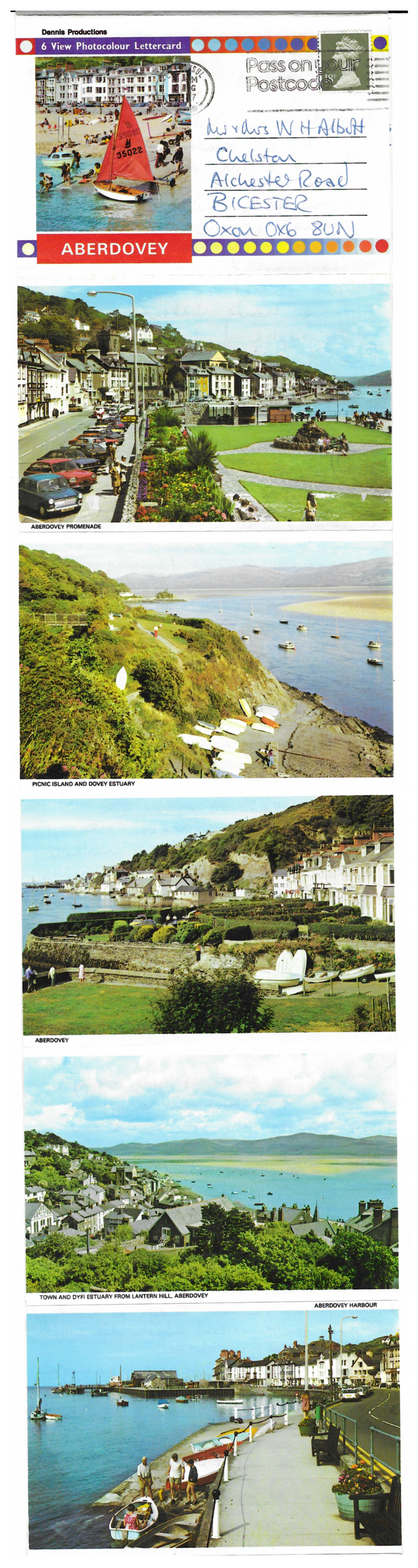
Sent in 1977, produced by Dennis Productions, which only closed in 2000. I absolutely love the cars parked along Sea View Terrace, all looking as though they belong in a museum of the 70s. I think that my Mum had the blue Austin 1100 before we left the UK in 1972. The card was posted from Llandysul in Ceredigion, where the family of four who were on holiday in Aberdovey went on Sundays to Cross Inn for Sunday worship at the Holy Trinity church where, the letter says, there were visitors to the church from Stowbridge, Birmingham, Broadway, Leicester and Tonypandy. It was sent to an address in Bicester
If you are coming to the postcard series late and want to go back and see what other postcards have been featured, I’ve provided an index of the entire series on the Heritage page, in chronological order (by approximate date of the postcard itself). Alternatively you can click on the “Postcard” category in the right hand margin to see all the postcards in the series, in the order in which they were published, excluding all other posts: https://aberdoveylondoner.com/category/postcard/.
I knew absolutely nothing about vintage postcards when I bought a job lot on eBay. The pictures are completely compelling in their own right, but turn the postcard over and, when they have been used, there is a wealth of information about when the postcard was manufactured and sent, and what sort of people were sending them. A note to self has been that it is by far more useful to buy used postcards rather than pristine unsent ones, because the stamps, postmarks, addresses and even the messages contain useful information. The histories of the postcard companies are also fascinating. I had no idea that the postcard was such an important source of commercial income, and was clueless how such companies worked. Postcards are only a partial record of architectural, economic and social history, but they contribute a surprising amount. Multiple personal, social and economic histories are tied up in these microscopic snapshots of life. Of course, as insights into the past of Aberdovey and the surrounding area they are quite simply terrific.
Reading the Hugh M. Lewis books and booklets it is clear that the character of the village has shifted dramatically over the centuries from a rural fishing village with a single water pump to a shipbuilding hub, which became a local outpost of the industrial revolution. Religious institutions appeared like mushrooms. An 18th Century turnpike was followed in the 19th Century by a railway connecting north Wales, mid Wales and England. A tourist industry was established in the 19th Century that continues to thrive today. Gas lighting was installed and then replaced with electric lighting. Land, foot and horse were first supplemented by bicycle. The first cars began to appear in the early 20th Century, and were clearly a real novelty. Although the building of sailing vessels ceased after the 1880s in Aberdovey and sailing ships were the most common sight at the Aberdovey jetty well into the 20th Century, steam ships visited the port regularly, becoming part of the local economic routine. During the war Aberdovey’s industrial importance decayed, and the tourist industry became increasingly important to the local economy. The wharf and jetty were rebuilt to reflect this change in the 1960s, a new car park was built in 1970, new houses and community structures have modified the landscape of the village, particularly on the hill above Copper Hill Street, and continue to do so.
In spite of all these changes, what amazes me is how little the core of Aberdovey has changed in its essential architectural character over the last century. As Aberdovey resident Helen Williams pointed out, there’s not much in the way of expansion that can happen along the seafront, due to its position between the sea and the cliff, which prevents any serious expansion even in the width of the roads. Gaps between buildings have been filled, but the original buildings are so solidly crafted that replacements have been rarely necessary, and apart from dormer windows that extend the usability of buildings upwards, there’s not much expansion along the seafront. Instead, newer buildings worked their way uphill, heading up and beyond Copper Hill Street, Gwelfor Road and Balkan Hill, as well as along the hillside overlooking the golf course. It is remarkable how much of the 19th Century village has been retained intact.
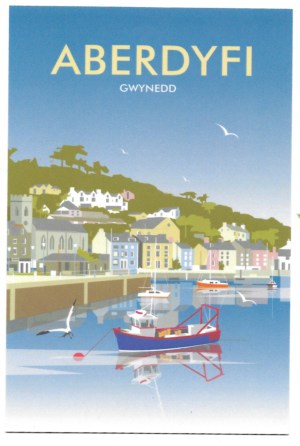
There are some lovely modern photo postcards for sale in the village, by Robin Goodland, Jeremy Moore, Glyn Davies and others. The one here is a bit different, sold during the summer at the Information Centre on the wharf, painted by Dave Thompson (www.davethompsonillustration.com) and produced by Star Editions (www.stareditions.com). It is a rather rather different take on Aberdovey than the photograph postcards, with a 1950s retro travel poster feel to it. In the foreground is the ‘Dai’s Shed’ fishing bat.
Perhaps the most conspicuous difference between past and present in Aberdovey, not visible in the postcards, is cultural. The Welsh language is still heard in shops, restaurants, pubs and at the Neuadd Dyfi, but since the 1950s there has been an ongoing influx of English people who have holiday homes or settle here permanently. Beyond sunbathing and watersports, and in so far as any village can be, it is a really rather cosmopolitan place. As well as an excellent butcher, a post office, a pharmacy, two convenience stores, a dry cleaner, three pubs, numerous cafes, restaurants, ice cream parlours, hotels, holiday lets and b&bs and a number of places of worship, there are more unexpected places to visit. These include two art galleries, a community hall with a theatre, fashion shops, two hair-dressers, a yacht club, a bowling club, tennis courts, the Outward Bound centre, a Snowdonia National Park information centre and of course the Pen Y Bryn shelter. There’s a lot going on in such a small place!
Printed picture postcards were first established in the 1870s but became very popular in the 1890s across Europe and America. In 1902 the current format was ratified by the Post Office, with a picture on one side, and the reverse divided into two, half for the message and half for the address and the stamp.
Using postcards as chronological markers is by no means straight forward. Photography had become increasingly popular, and photographers had been building up sizeable filing systems that were used in successive decades for postcards, meaning that an image and its incorporation into a postcard might be many years apart from one another. Postcards might be sold for a decade or more after they were first printed, so this too can add ambiguity to the date of the image. A postal mark might have a solid date, which tells us when the postcard was sent, but the image itself might be years or even decades old. One postcard in this series, showing the school on the slopes of Pen-Y-Bryn, had a 1909 postmark, but the company that produced the card had gone out of business in 1904. In this particular case, the main building in the photograph was built in 1894, which gives a time range for when the photograph was taken, but in other examples where there are few diagnostic features, such as landscape photographs and modern photographs of the village, there may be little to help narrow down a date range. For example, in the set of five at the top of this post, the penultimate photograph also shows the school at Pen-Y-Bryn, but seen in isolation from its more diagnostic companions, it would be difficult to judge when, between the common use of colour photographs for postcards in the 1950s and the 1977 postmark, that photograph was taken. The postal mark just provides a terminus ante quem, an indication of a date before which the card must have been manufactured. That can be a useful starting place.
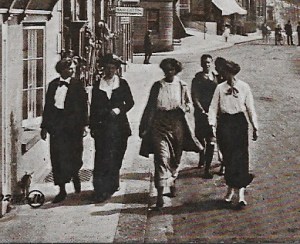 I thought that fashion would be a helpful pointer, but that theory was partially scuppered by two factors. First is that people are absent from a lot of postcards, and second is that Dai Williams tells me that to make old postcards look more current, people wearing contemporary fashions were dark-room pasted into older photographs. He showed me one extraordinary example where two almost identical postcards had a group of people walking down the road, but in one the adults were holding the hands of two children and in the second the children had been removed. Although I have confidence that postcard producer Gwilym Williams, who appears to have been a local photographer, was capturing life just as it was, photographs by the big national postcard producers may have been seriously tampered with. Vintage cars might have been more useful for dating images, if I knew anything about them.
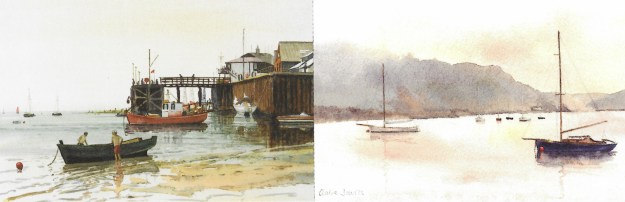
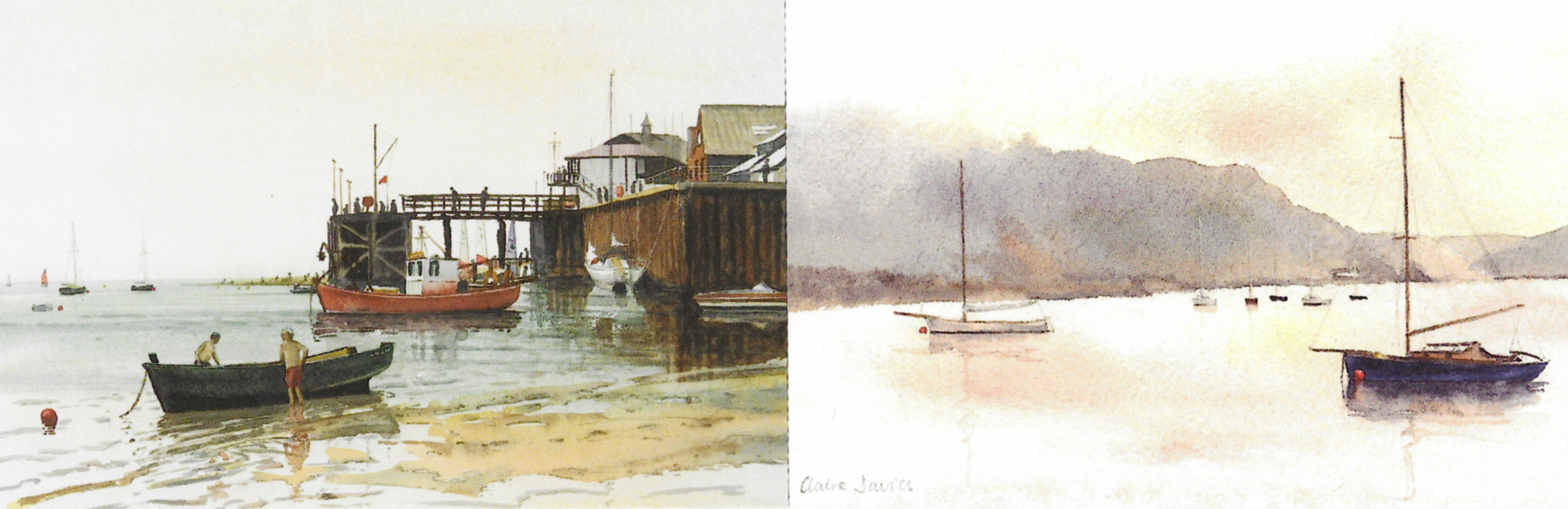
Another different take on the standard photo postcard is the collection produced by Glyn and Claire Davies based on their original paintings and sold in their shop, The Gallery, in Aberdovey (http://www.galleryaberdyfi.co.uk/cms/). Delicately executed watercolours provide evocative views of Aberdovey, some showing day to day bustle, some showing a more peaceful scenes in and around the village. Above are two scenes on postcards, on the left by Glyn Davies and on the right by Claire Davies. I have sent more of the postcards in this series than any others.
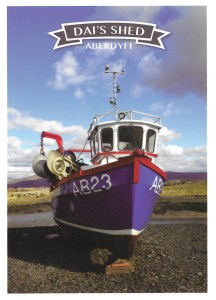
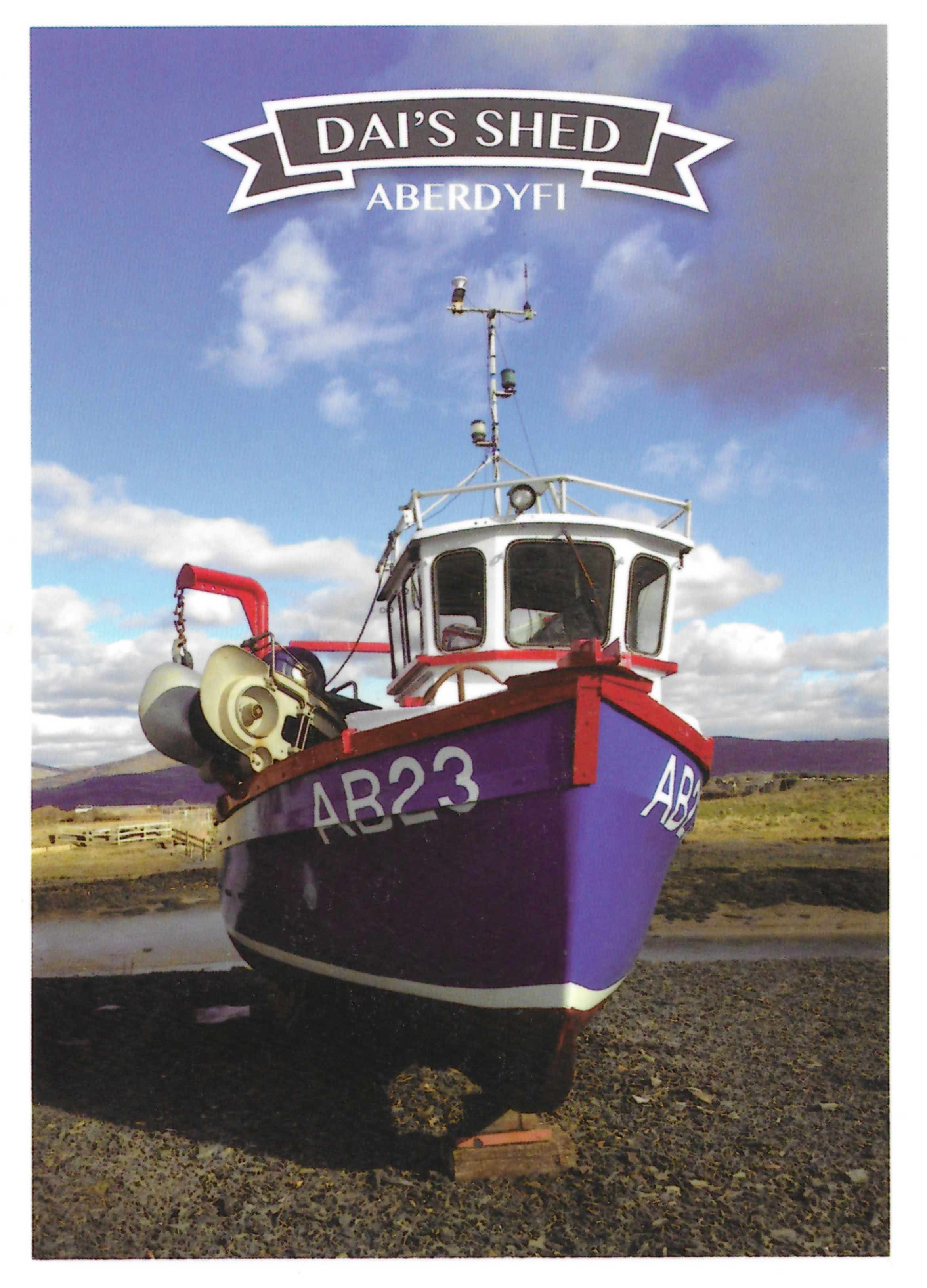
This card from “Dai’s Shed,” selling superb locally caught seafood from Easter until Autumn, is both a souvenir postcard and an advert (www.daisshed.co.uk). Dai’s fishing boat is shown in the photo at low tide against a backdrop of the hills over the estuary.
If the postmark is not legible, the stamp can give a time range, and there are a couple of websites that specialize in this. I had assumed that the collecting of postcards, deltiology, would have a massive online presence, but resources turn out to be very fragmented and incomplete. There are a number of websites that specialize in providing information about different manufacturers to help collectors find out the essentials about general background and specific postcards or postcard series, most importantly dates. Unfortunately, some postcards are not included in those databases and several manufacturers are barely mentioned online. The two best resources that I found are the MetroPostcards website, which is a mine of information about postcard manufacturers and printing techniques, and the enormous and searchable Frith’s database, which is as invaluable collection of as many postcards in the Frith’s catalogue as they have been able to pull together.
My brief flirtation with the picture postcard is over, unless I see anything particularly unusual, but I have very much enjoyed finding out about aspects of Aberdovey that I didn’t know before, and experiencing a real sense of continuity between past and present.
My sincer thanks to Dai and Helen Williams for introducing me to vintage postcards, for talking to me about Aberdovey’s history and for allowing me leaf through their collection. Also for that fabulous pre-Christmas chocolate biscuit from Fortnum’s!
Many, many thanks too to Sierd Jan Tuinstra for taking the time to have an independent look at the postcards and other posts, using his expertise from investigations into the Aberdovey section of the Cambrian Railway to clarify some points, expand details, refine dates and provide new information and insights, not just about rail but about all aspects of Aberdovey’s economic infrastructure. My post on the flour mill will be rewritten shortly with new information, entirely thanks to Sierd Jan.


















 Aberdovey Londoner