Author Archives: Andie

Eating well from what’s to hand, just for fun – Week 3

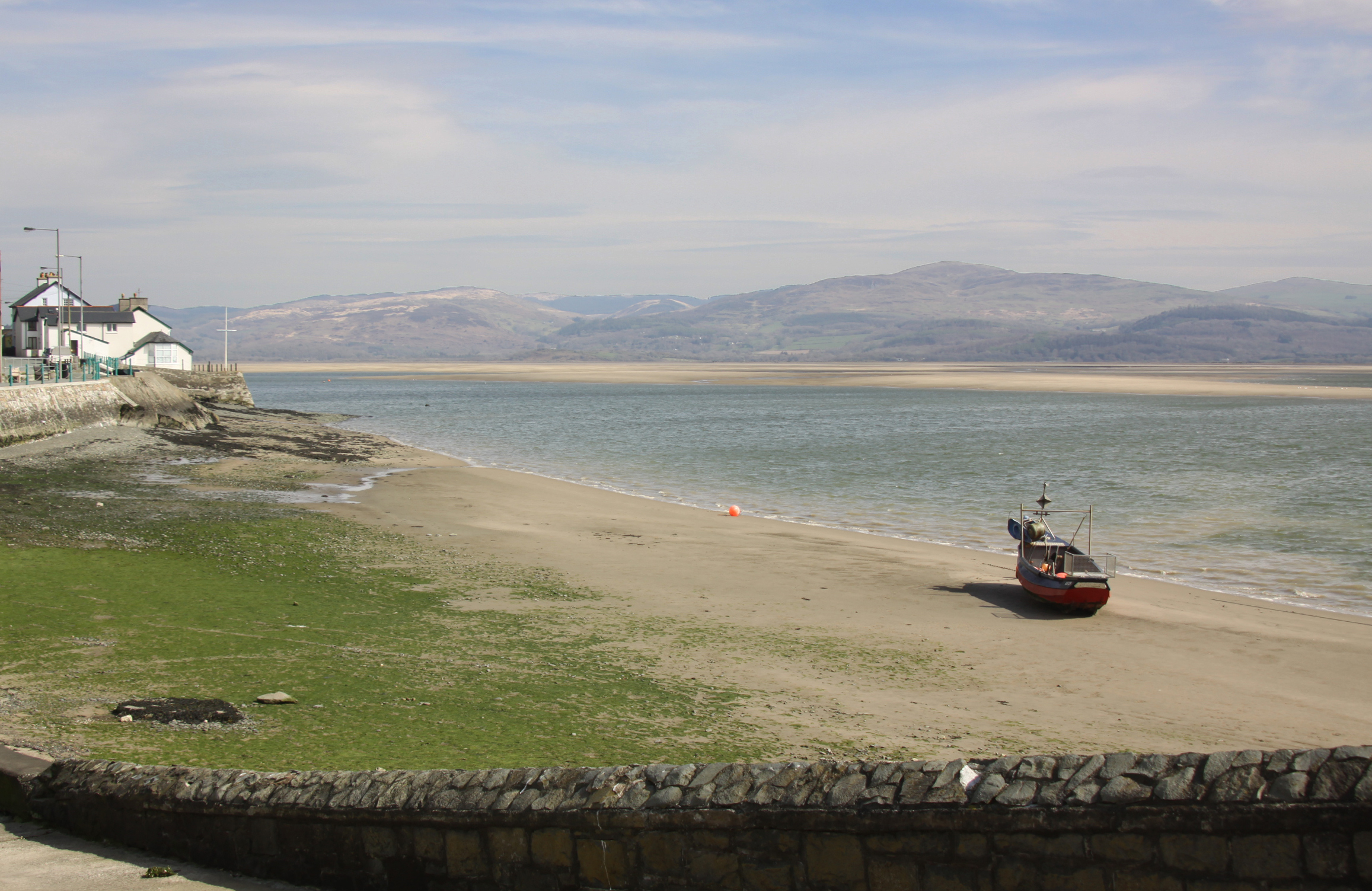
The weather was stunning last week, sunny with bright blue skies and first blossom on my cherry trees.  Everything looked absolutely normal from up here on the hill, the water of the estuary and Cardigan Bay beyond glistening and twinkling, very beautiful.  Easter weekend and the following week are usually a mad-house, with tourists flooding in, eating ice creams, munching chips and catching unsuspecting crabs from the jetty, with the beach crammed with families, wind-breaks and sand castles.  By contrast, the silence continues to be truly deafening.  The lock-down continues to be observed, and face masks, visors and latex gloves are increasingly commonplace.   I continue to play with my new cooking regime, and it is an interesting challenge that amuses me, but although the tone is light, the reality is very much on my mind. 

Saturday

On Friday I made myself a lamb shawarma on the bbq, along with two sausages and a couple of chicken thighs.  I kept the sausages for brunch on Sunday, dipped cold into Levi Roots Reggae Reggae sauce (we all have our vices!).  I used the chicken thighs, beautifully smokey, to make a chicken Caesar salad.  I cheated.  I have never actually summoned up the courage to make my own Caesar salad dressing, and always buy the Cardini bottle version.  Fortunately for me, the Aberdyfi Village Stores sells it, so I was able to slosh it all over the place as usual.  I like my chicken Caesar salad with Romaine lettuce, salted anchovies and wedges of par-boiled egg, as well as little cubed crutons painted with olive oil and done under the grill.  I forgot to take a photo.

Sunday
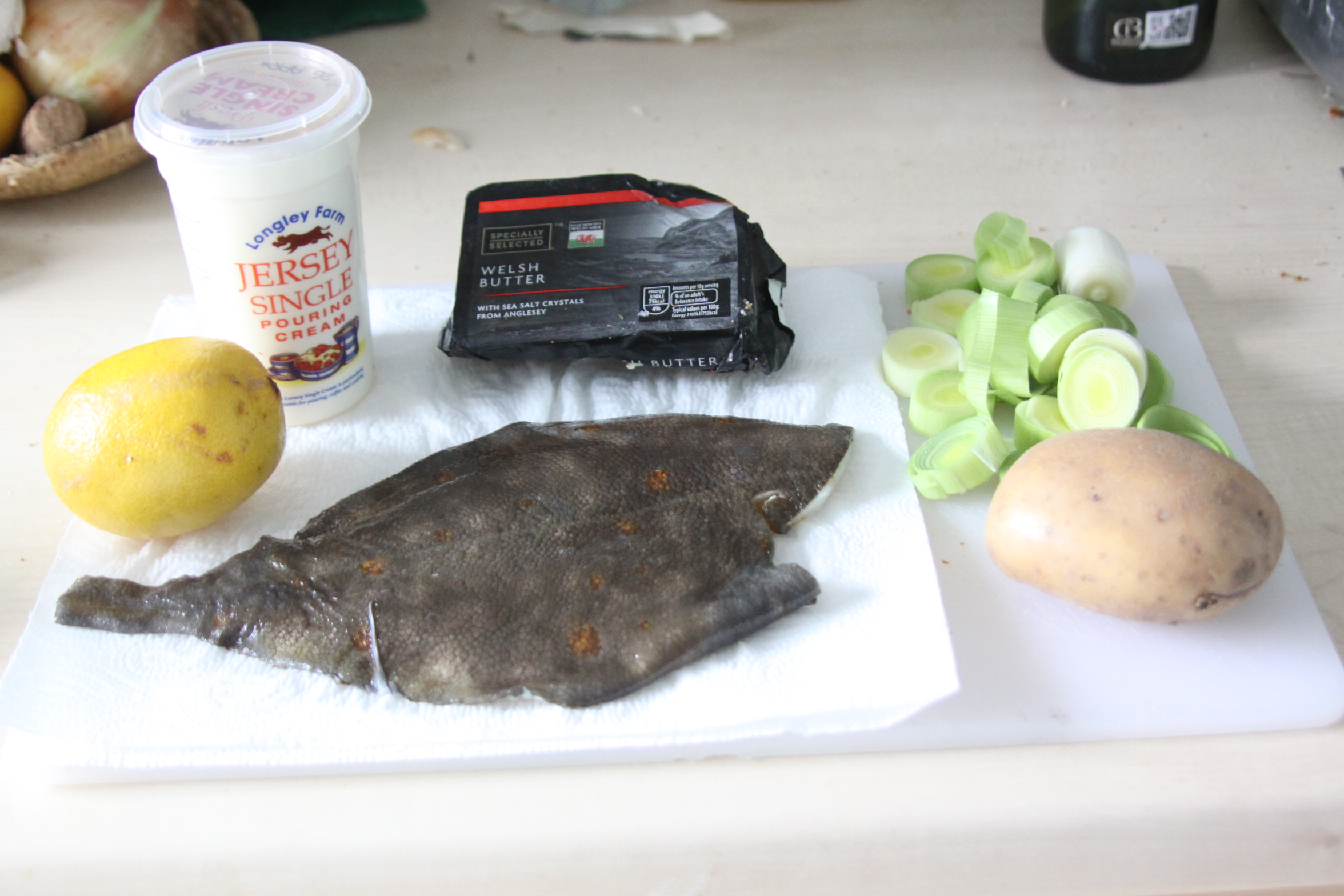
Pan-fried plaice fillet with capers, served with creamed leeks, lemon zest, peas and bacon pieces, and some shallow-fried semi-circular “chips.”  I love the distinctive flavour of plaice, subtle but unmistakeable.  I find that any cooking method other than poaching works a treat.  Poaching drains the flavour and does nothing for the texture, whereas frying, grilling or roasting all lend real depth to the flavour and firm up the texture.
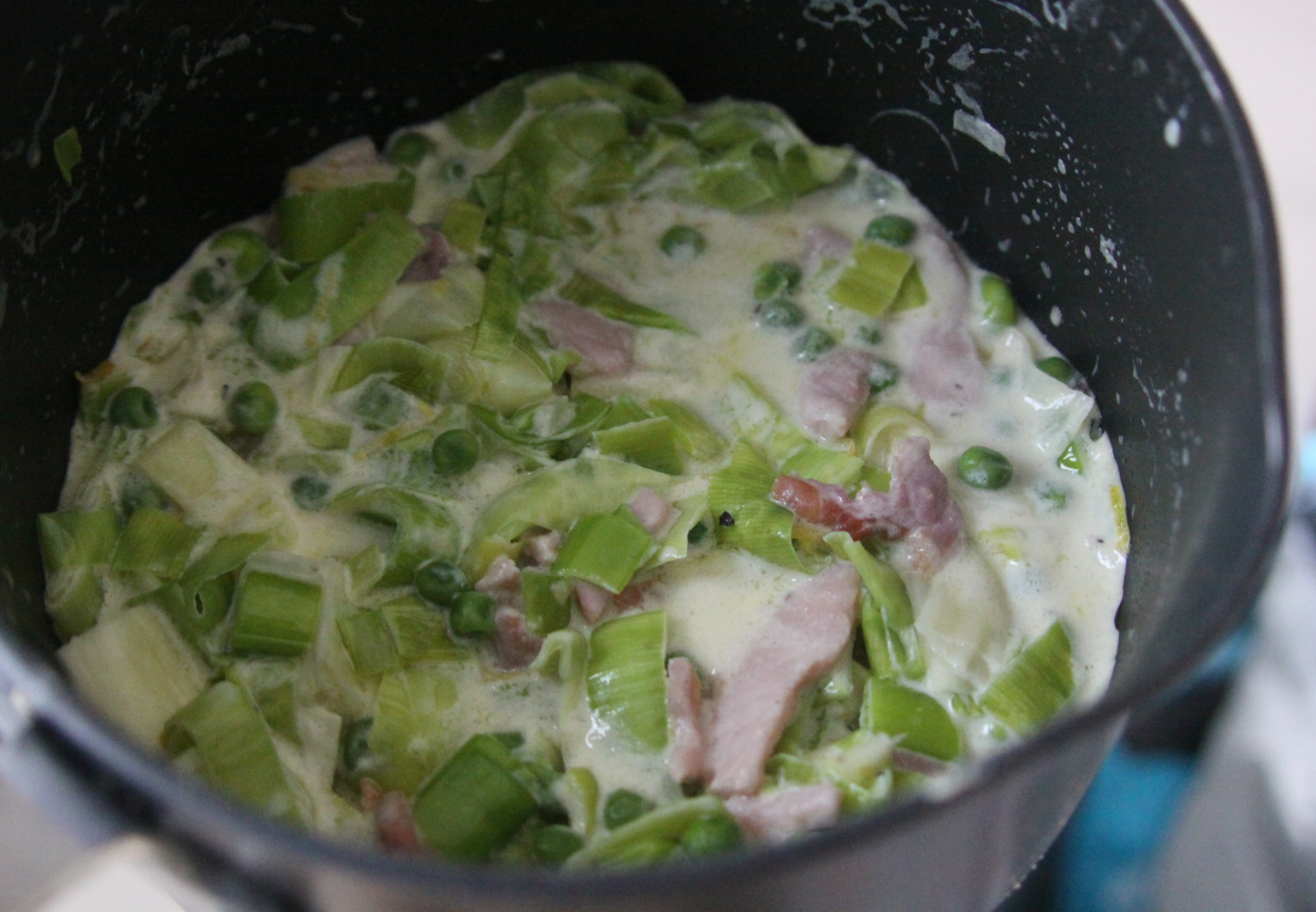
Normally I would dredge the fish in egg and then flour, but I am short of both so just fried it directly in butter with a scattering of capers, allowing the butter to go brown and nutty.  The creamed leek part of the meal is so easy.  The bacon bits are gently fried in a little butter, the leeks, peas and lemon zest are added and left soften in a lidded saucepan for a few minutes before adding a splash of wine and a good slosh of single cream.  Heat gently until nearly ready to serve and then raise the heat to bubble the wine and cream, which will thicken it up.  I rarely eat chips at home, because I don’t have room in my kitchen for a deep fat fryer, and I am a bit wary of a pan of boiling oil in my kitchen, but my Mum used to do the following, something that was very like a chip but shallow-fried.  A spud is sliced into oval discs about 1cm thick, and these can be halved into semicircles.  These are  parboiled for 5 minutes, during which time about 2-3cm (1 inch) of cooking oil is heated.  To test if it is hot enough, put in one of the slices, and if that starts to sizzle, put the rest in.  If they have been par-boiled they take about five minutes after the heat has come back up to sizzling strength.
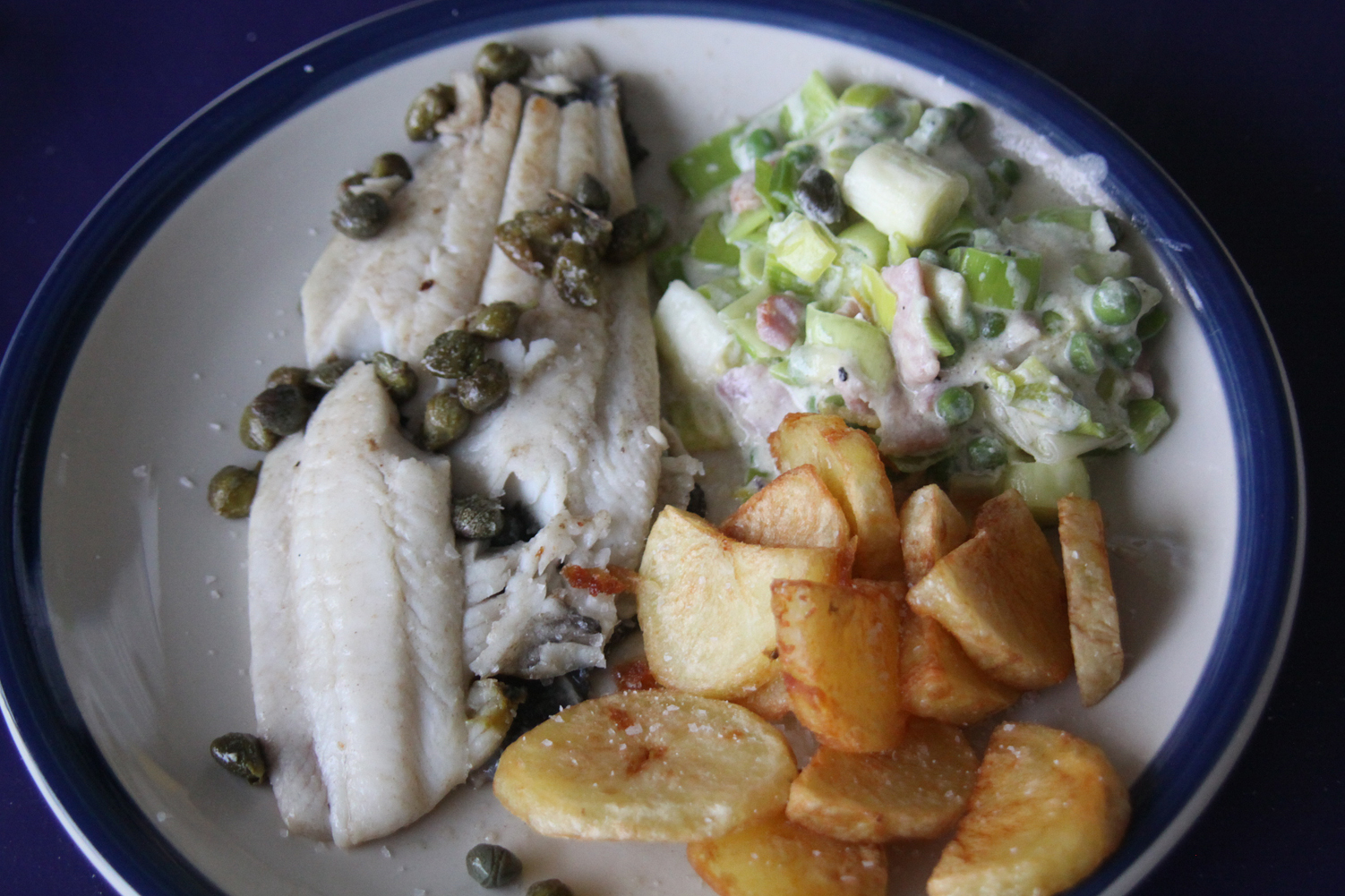
In the excitement of having my first chips in months, I served myself far too many, but the leftovers were frozen down for incorporation into a mash I am planning for next week.

I love all types of fish, but it is remarkably difficult to get hold of here, which seems mad for two neighbouring seaside villages.  The only local supplier of fish is excellent, usually operating in Aberdovey between Easter and October (when the weather allows him to go out in his boat), but obviously has a limited variety of stock, confined to what he can catch locally.  At the moment, of course, he is closed for the duration.  Vacuum-packed salmon, cod and haddock are usually available in the small supermarkets, but anything else is rather beyond their scope.  I got into the habit of buying my seafood in the Chester and Wrexham areas when over in my father’s direction and returning them here to put in the freezer, and today’s plaice fillet was bought elsewhere and frozen down, but obviously that’s not practical right now.  I am still eating my way through the freezer, but when I have enough space I will see if I can buy online from specialist seafood suppliers, although if other online food shopping is anything to go by, that may be impossible.

Monday
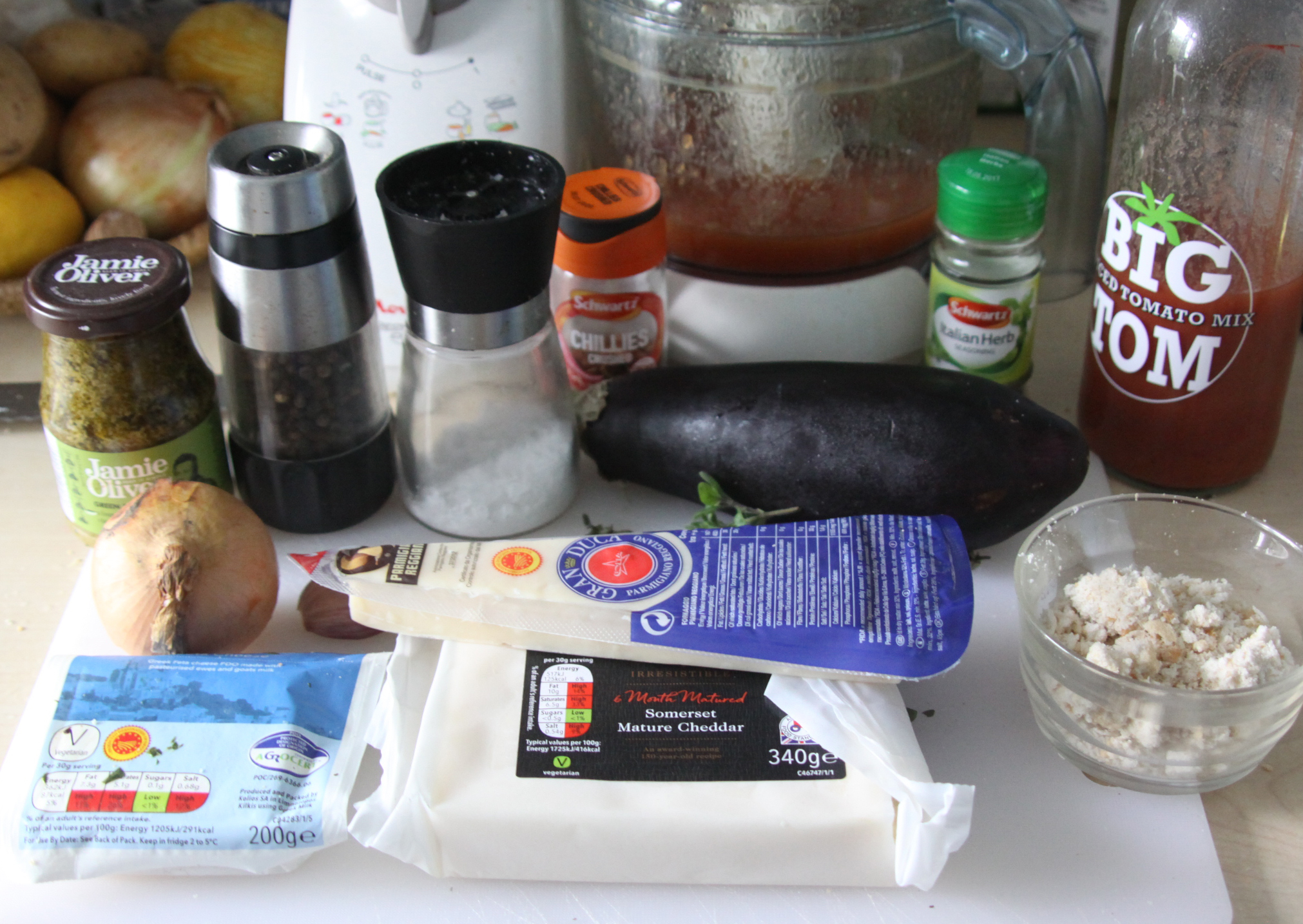
Melanzane alla Parmigiana (aubergine in parmesan cheese).  One of my favourites and one of my occasional vegetarian dishes.  Perhaps surprisingly I can buy aubergines locally.  I didn’t have the right ingredients for a classic Melanzane alla Parmigiana in the fridge, but this alternative version worked remarkably well.  The main ingredients missing were mozzarella, which is wonderful in this dish, and fresh basil for the topping.  I replaced the basil with bottled basil pesto, added in blobs as I built up the layers in the ovenproof dish (which I will do in the future, as it worked brilliantly), and added fresh oregano on top, and replaced the mozzarella with leftover feta (which gives a very welcome touch of brightness and freshness to the dish) and cheddar.  It wasn’t as great as mozzarella, but it was pretty good.  Fortunately, I had plenty of Parmesan, purchased on my last shopping trip.  It is cooked in two parts.

First, the sauce.  I put some halved tomatoes in boiling water for a couple of minutes, plunging them into cold water to remove the skins.  Then the garlic and onions are sautéed in olive oil until the onion is soft, about 5 minutes.  The tomatoes, garlic, onions and, in my case, a big glug of Big Tom are whizzed up in the food processor and poured into a pan.  Next, finely sliced fresh chilli or dried chilli flakes, and some serious grindings of black pepper are added to the mix.  The resulting sauce is then simmered for around 15-20 minutes.  At this point pre-heat the oven to Gas 6/200C/390F.
Second, the aubergine needs to be cooked.  Slice the glossy, dark-skinned aubergines into disks about 5mm-1cm thick.  Pour some seasoned flour into a bowl and toss the aubergine in the flour.  Heat some olive oil in a frying pan, making sure that the oil is very hot so that the flour stays on the aubergine and it cooks quickly rather than sucking up all the oil.  Fry til golden-brown on both sides and drain on kitchen paper and allow to cool.

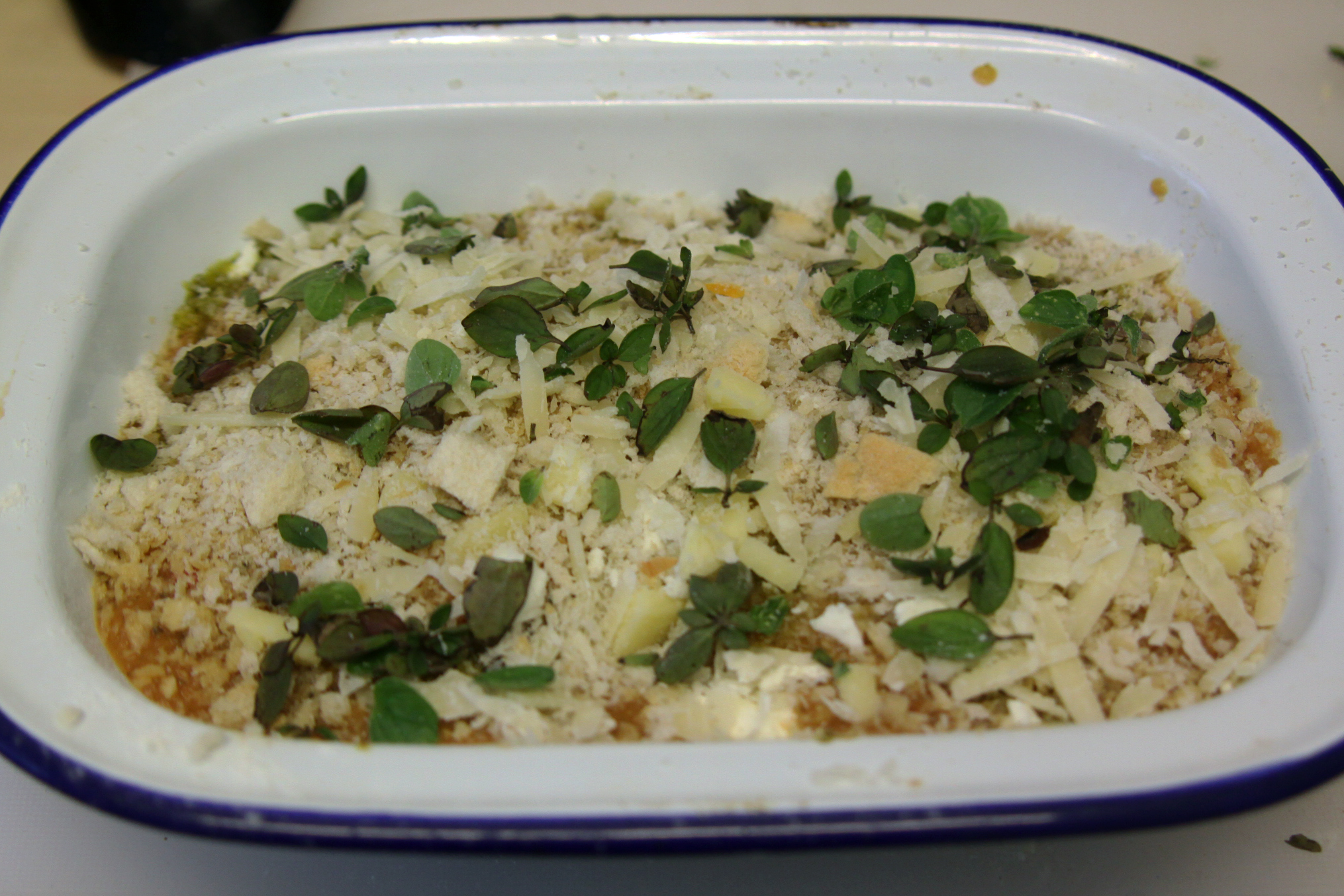
The final stage is to layer the aubergine with the sauce, blobs of basil pesto (if using) and cheeses in alternating layers in an ovenproof dish.  First the aubergine, then the tomato sauce and pesto, then the mozzarella and parmesan if you have it, or other cheeses if you don’t, pushed down into the sauce, followed by the next layer of sliced aubergine. You simply repeat the layers until you reach the top layer of aubergine.  Add a thin layer of the sauce, cheese and a good sprinkling of parmesan.  If you want added texture, you can mix the parmesan with breadcrumbs, which is what I did tonight.  If you have no fresh herbs to serve when it comes out of the oven, you might want to sprinkle some dried herbs in with the breadcrumbs.  Then pop it in the oven for around 25 minutes, but keep checking towards the end of the cooking time to make sure that it comes out when bubbly and golden brown, before the top burns.  Serve with fresh basil on top, or whatever you have as an equivalent.  I put one lot of oregano on top before I put it into the oven, because I like them crispy, and another lot of fresh just prior to serving.
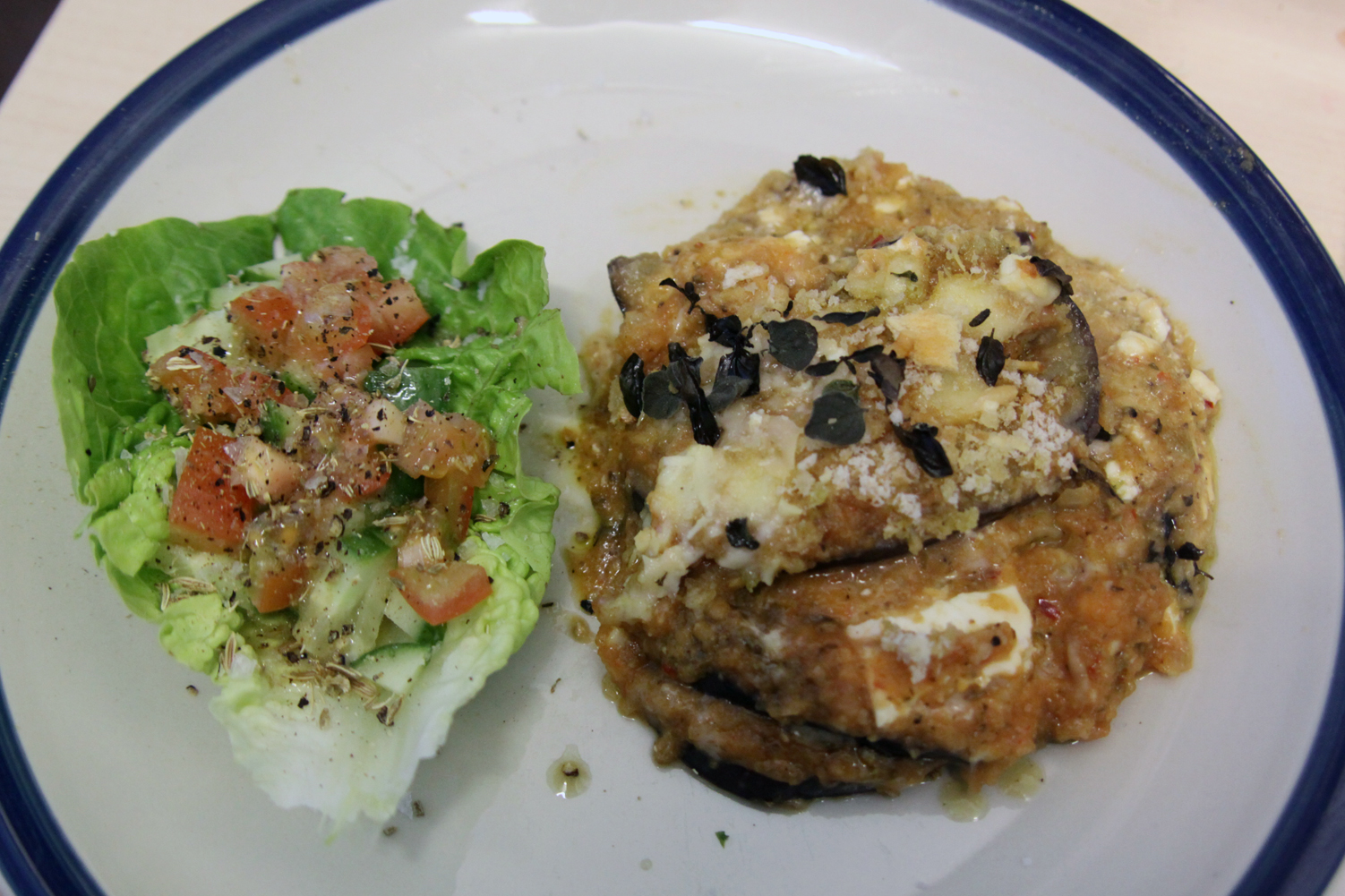
It is difficult to retrieve a portion from the oven dish tidily, and it looks like a disorganized heap on the plate (at least, it does the way I do it), but the flavours are great.  I served it with a small salad of diced cucumber and tomato in a little gem leaf, with ground fennel seed over the top, a serious hit of black pepper and sea salt, and a French vinaigrette dressing based on tarragon vinegar.  The tarragon vinegar is simply made by stuffing a pack of fresh tarragon into a big bottle of white wine vinegar and resting for a couple of weeks for the flavours to develop.  Tarragon is usually available from the Tywyn Spar, which almost always has an excellent selection of fresh herbs.  Feta would have been a good addition but I needed the last bit in the fridge for the melanzane itself.

I often serve this as an accompaniment to another dish when I’m cooking for more than one;  it works very well as a side dish with just about any meat or white fish dish.  I made nearly double what I needed and will be having the remainder with as an accompaniment to Tortilla Española later in the week.

Another version of this dish adds crisped Parma ham layer to the last layer of aubergine, which then has the rest of the top level added to it as above.  Alternatively, the same combination of vegetable ingredients are also very good when finely chopped or roughly whizzed in a food processor and used as a sauce over pasta, with or without meatballs, with the cheese dotted here and there, and baked or grilled until the cheese melts.

Tuesday
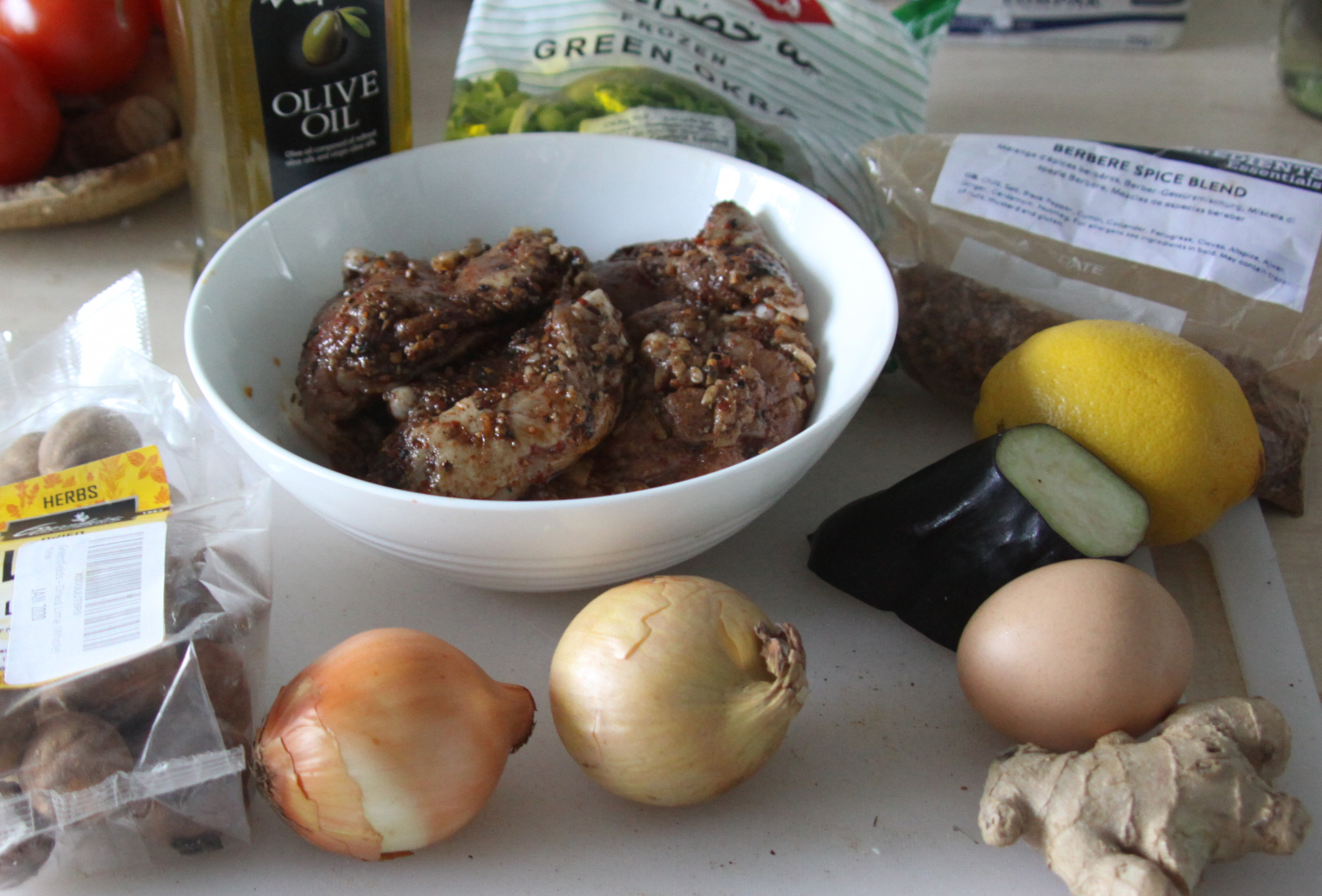
Ethiopian chicken curry (Doro Wat).   The Ethiopian national dish is a top favourite of mine, a very simple one-pot meal.  It is made with berbere spices.  The Co-Op in Tywyn does a Bart tin of berbere spice mix, but it is also easy to buy online.  My favourite blend is sold by a third party on Amazon.  Berbere is basically made up of chilli, cumin, coriander, fenugreek, cloves, allspice, paprika, carom, ginger, cardamom, nutmeg and black pepper.  Seeds and pods, rather than ground spices, are used wherever possible.  It has a warm, aromatic punch with a bit of heat, and this permeates whatever is cooked with it, especially when marinated overnight.  As well as chicken, it is traditionally made with hard boiled egg, which is spectacularly good.  The soft but solid texture and blandness of the egg is a wonderful contrast to the rest of the curry’s textures and its rich flavours.  I chucked in a couple of dehydrated limes and some okra into mine, because I love them, but they are not part of the traditional recipe.  I also had some aubergine left over from the melanzane alla parmagiana, so that was also thrown in, chopped, and fried with the onions.  This is a slowly cooked dish, so I do it in the slow cooker (pre-heated for half an hour on high and then dropped to low), but it can be done in a casserole dish on a very low heat on the hob just as easily.
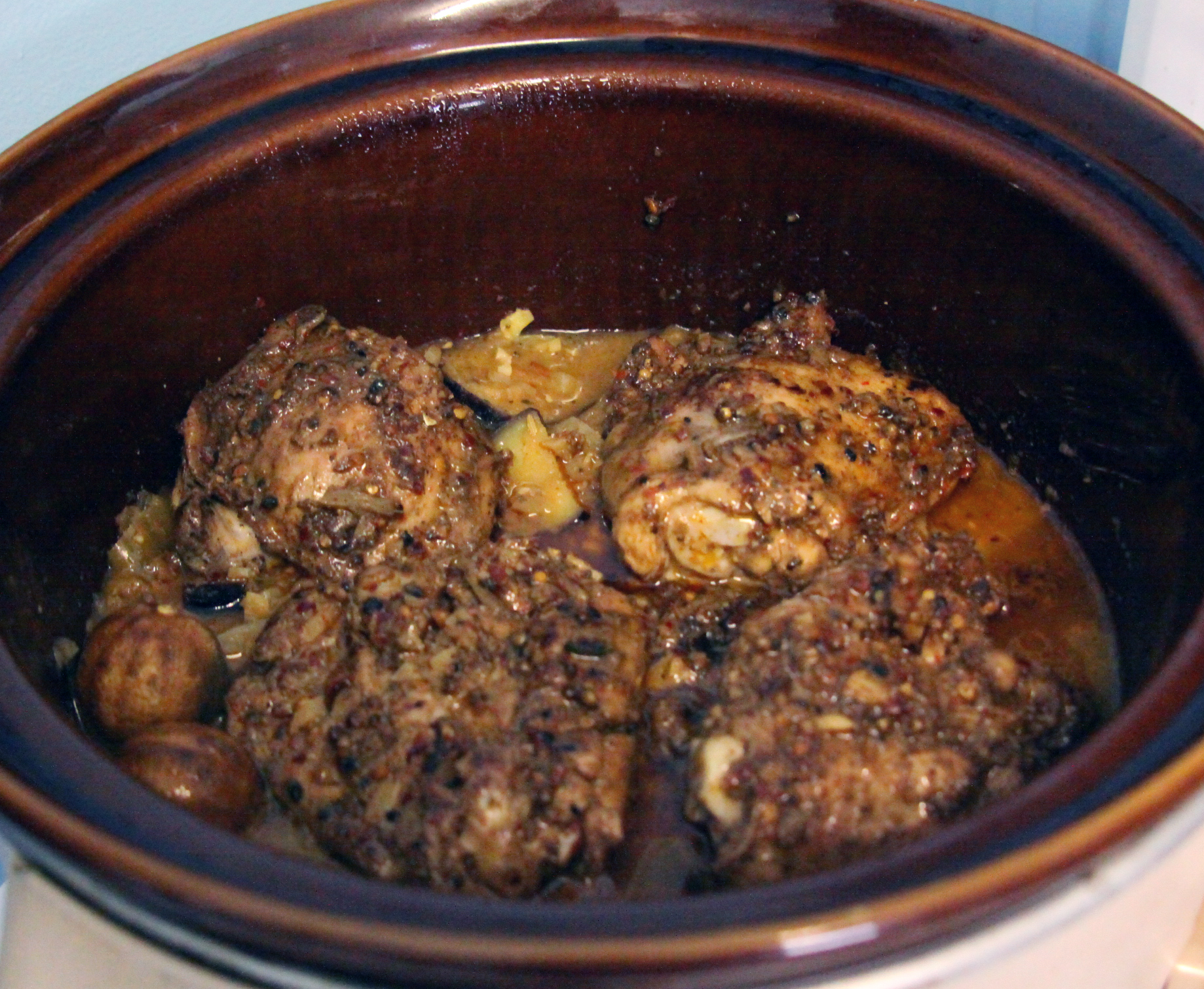
I use bone-in chicken thighs because I like the flavour, but I remove the skin beforehand and render it down for frying the onions.  It’s a simple dish if, as I do, one avoids making one’s own berbere spice mix and Niter Kibbeh (spice-infused clarified butter, although it’s on my to-do list because it looks wonderful).  First the chicken is marinated in the berbere spice mix with olive oil, sea/rock salt, sliced ginger, crushed garlic and lemon juice overnight.

When ready to cook, heat some olive oil in a frying pan, chop an onion, some garlic and sliced ginger and fry it.  When it has heated through and is just beginning to brown, tip it into the pot with a small glass of white wine, a spoon of honey and enough stock to create a sauce.  Into the frying pan, add the marinated chicken thighs and allow the entire dish to heat gently, turning to ensure that both sides are warmed through, and then tip into the slow cooker or casserole.  If it is in the slow cooker, and you are using four thighs that you have warmed through in the frying pan, five hours on low will do fine.  If you are heating on the hob, two hours on a very low setting should be fine.  This allows all the flavours to mature and blend.
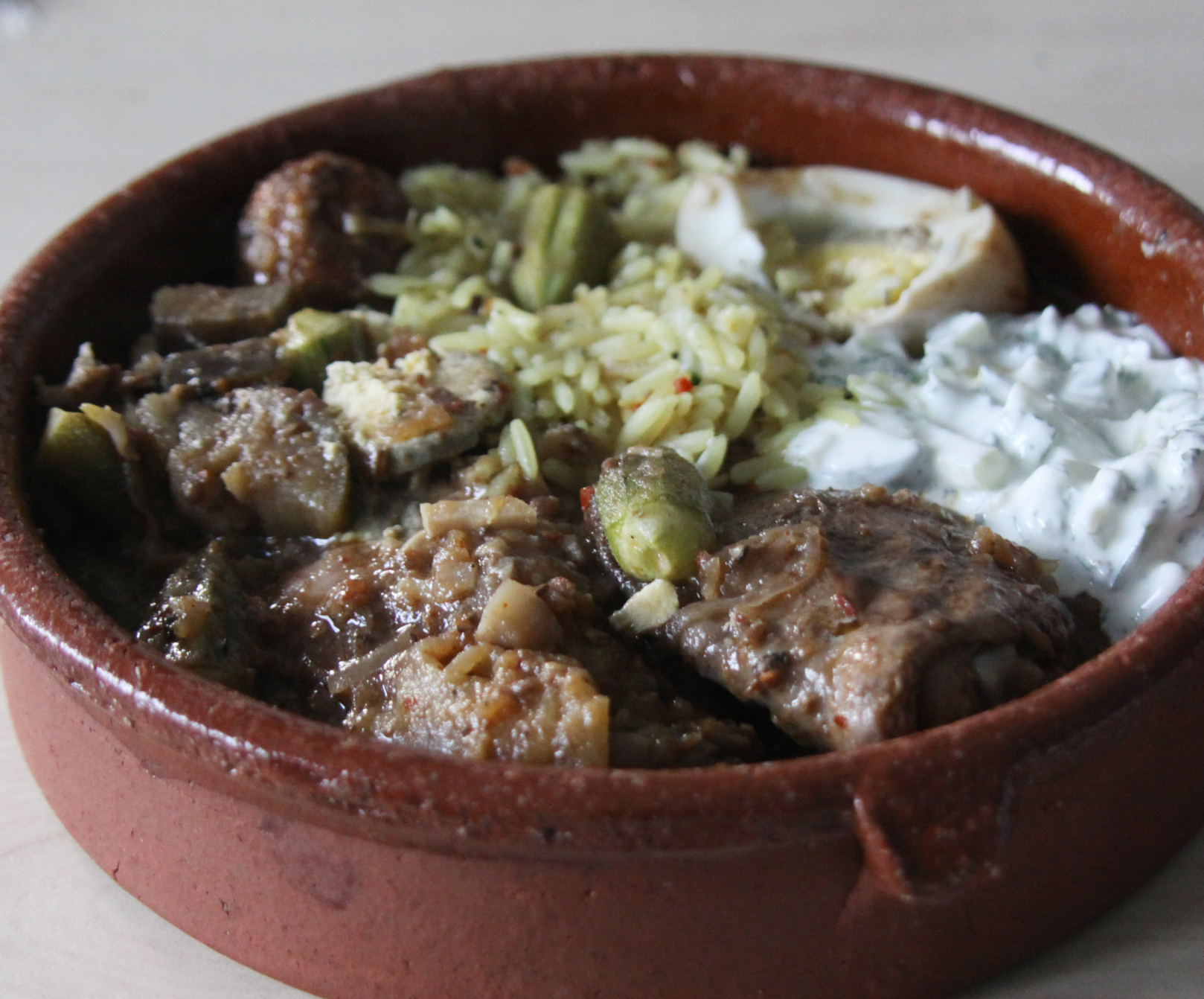
Traditionally Doro Wat is served with very thin flat-bread called injera.  It would probably work well with rice or cous cous too.  I am a complete salad addict, so love this served with a fresh green salad, with feta when I have any (unfortunately used up now), as many herbs as possible, with a major mint component.  I also made my usual Greek yogurt, mint and cucumber mix to serve alongside it.

I made two batches, one for me and one for the freezer.

Wednesday
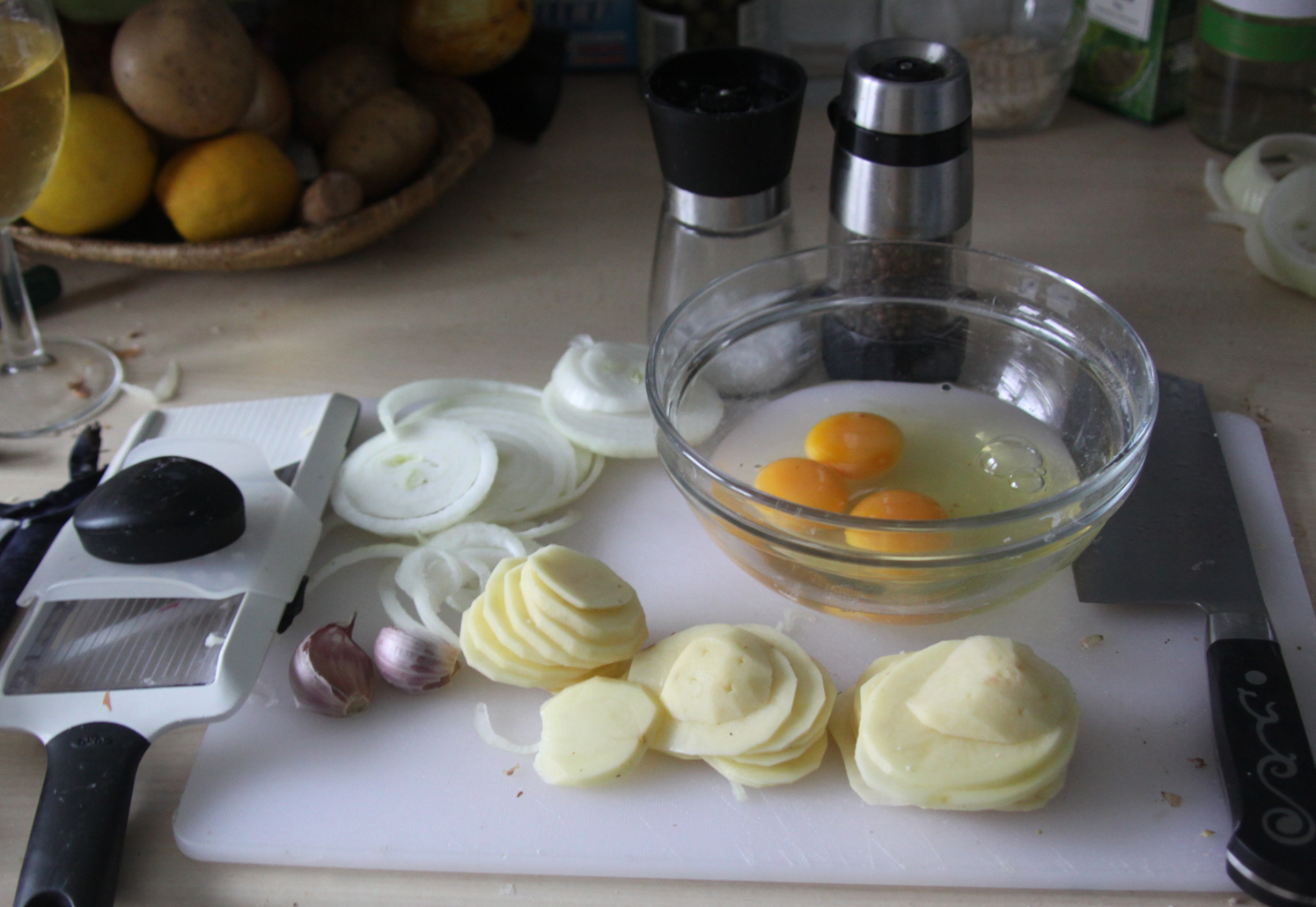
Multi-national tapas:  Tortilla española and melanzane alla parmigiana.  In England a Spanish Omelette is often made with mixed veg, and is very good, nowadays usually referred to as a frittata and great for using up leftovers, but the traditional version in Spain, where my family lived in the 1970s, is made just with potatoes and onions, which is what I have done here.  In Spain tortilla española (pronounced torteelya espanyola)  is eaten hot, warm or cold, and all work for me, usually served with herb salad but here with leftover melanzane.  They are often served in cake-like slices as tapas, which are eaten either singly as quick snacks or with other tapas to make up a meal.  If I am cooking for more than one, I like to make them small in diameter but thick in depth, which is how they were served where I lived.  Every time I make one I am propelled back in time nearly four decades to the hills beyond Barcelona, where we spent many summer weekends riding horses or collecting blackberries in the sunny, dry and deeply aromatic countryside, wrapping up our activities with a deep slice of freshly made warm tortilla, at least 3 inches thick, before returning to the city.

Whether you slice or dice your spuds is a matter of personal choice.  I slice them because I like the laminated texture that it creates.  They are parboiled for around 5 minutes and drained in a sieve until all the steam escapes.  Again, dicing or slicing onions is down to personal preference.  I like them sliced, and quite thickly so that the onion retains its texture.  The onions are fried (with garlic if using).  The parboiled potato slices are then browned.  Eggs are whisked together lightly.  The egg mix is simply seasoned with salt and pepper.  You can either tip the onions and potatoes into the egg mix and pour into the pan, or mix the potatoes and onions in the pan and pour the egg over the top.  The more onion and spud you have, the less egg you need to fill the pan, but you still need enough to cover the contents.  But more egg makes it more of an omelette. It’s a matter of preference.  Milk can be added to make the egg go further, but the resulting tortilla is blander.
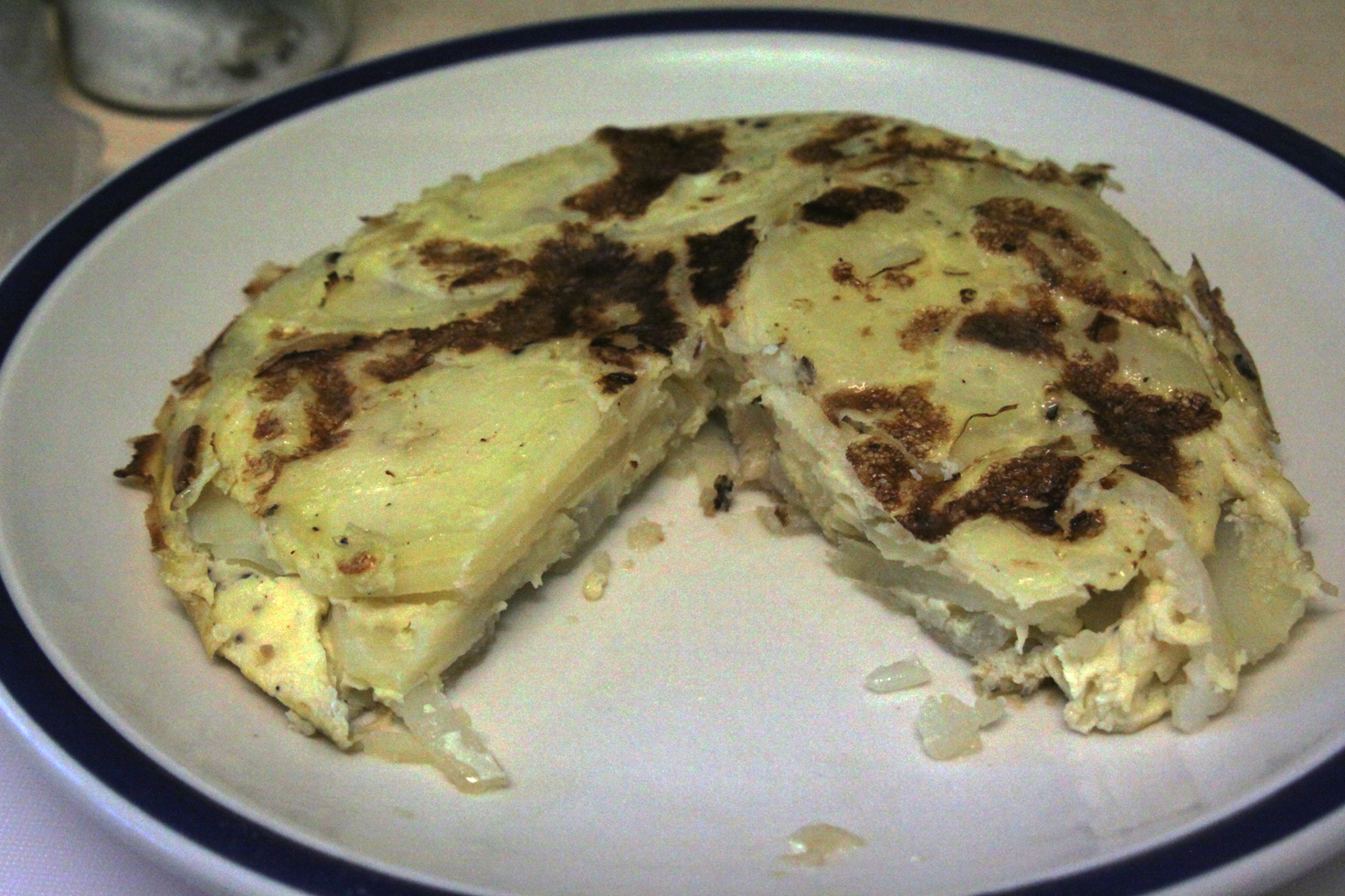
The tortilla is made in a small frying pan or skillet.  The traditional method is to cook it through on the hob, very slowly.  When the top is still a little runny, slide it onto a plate, place the empty frying pan over the top and flip the two together so that the undercooked top lands on the bottom of the frying pan.  This will create an evenly cooked tortilla.  When ready, just a few minutes later when you think the base will be golden, slide the omelette out on to the plate.  Job done!

I had a slice warm with the leftover melanzane alla parmigiana from Monday, heated through in the oven.  Two tapas-type portions, and boy did I enjoy it.  Anything tomato-based goes well with anything egg-based, with textures and flavours offering good contrast to one another.  In Cataluña square slices are served in French-style bread, the classic Bocadillo de Tortilla Española.  My school was a lovely old pink villa on the outskirts of Barcelona, and its tiny tuckshop sold the some of the best Bocadillo de Tortilla in the city.  The rest of the tortilla will be breakfast tomorrow instead of my usual toast, and my evening meal on Friday.

Thursday
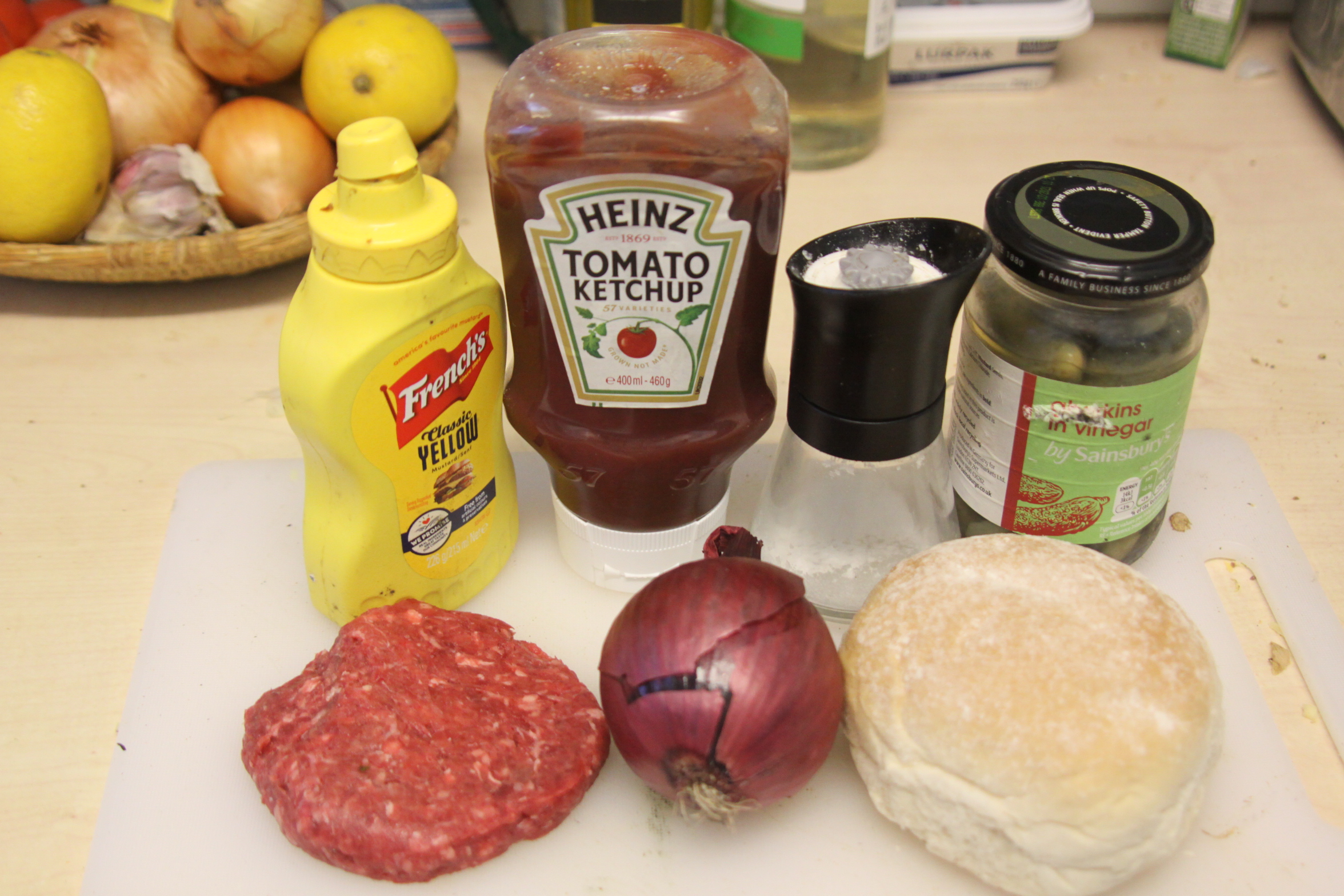
Burger in a bun with toppings.  Burgers are so personal.  I like mine made of plain, good quality mince, lightly seasoned, with an egg to bind it together, and left for at least half an hour to consolidate in the fridge, so that it doesn’t fall apart.  Other people like onions, Worcester sauce and/or herbs in theirs, even a cheese filling.  Whatever the component parts, the beef must be of very good quality.  Accessorizing a burger with sauces, relishes, pickles, salad etc, is even more of a matter of individual preference.  I like mine with pickled gherkins, French’s American mustard, Heinz tomato ketchup, and raw onion slices, usually in a super-fresh soft or crispy white bun (mine came out of the freezer, but still not bad).  Part of me knows that it is completely disgusting but oh, it works so well!  This is my most guilty food secret, but fortunately I only fancy it very rarely. I sometimes have a salad on the side to alleviate some of the guilt, but today it was pure self-indulgence.  I placed the burger in my George Foreman grill to cook, and the rest is just a matter of assembly.  It is the ultimate fast food, very oozy and messy, which is  usually my idea of hell!  But for some truly bizarre reason it is heavenly.

Friday
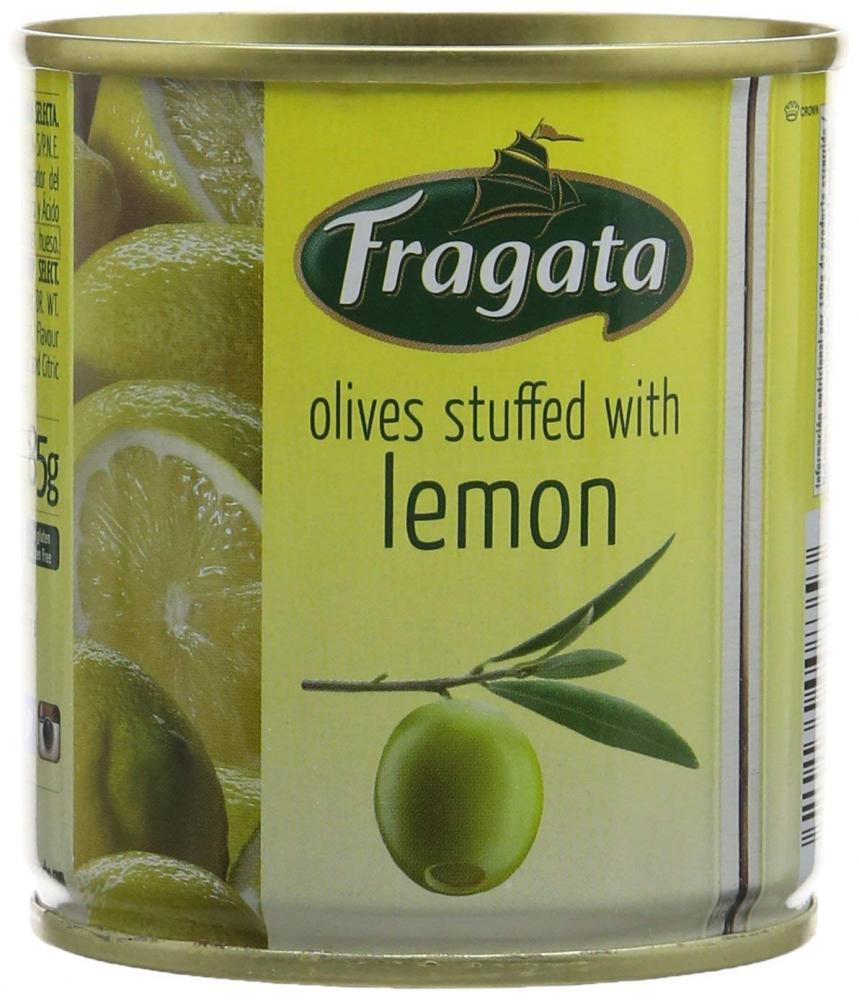
Today was a total abdication of cooking responsibilities, even worse than yesterday’s in terms of effort expended, but a lot healthier.  I had cold tortilla española with a green salad liberally accessorized with Fragata olives stuffed with lemon (which I am trying to mete out as I only have two cans left), capers and salted anchovies.  I ate early as I had skipped my usual slice of morning toast and was walking in the sand dunes for over three hours, coming back hungry.  The sun was still shining and was gloriously warm, and it was wonderful to sit outdoors eating my tortilla and salad with a glass of chilled Chablis in the sun.  Bliss.

This week’s conclusions:
There’s not a lot to add to the last two weeks, but here are a few additional thoughts.

  1. Although proper cooking is excellent and rewarding, even when dumbed down for the available ingredients, it turns out that sometimes a burger in a bun is just what’s really needed.
  2. Substitutions really are excellent.  I’m beginning to get into the swing of it, and although I was really not enjoying having to substitute perfectly matched ingredients for whatever happened to be in the fridge, I have found that some of my substitutions have given a real lift to dishes that I had never considered changing.
  3. Store cupboard spices and herbs change the way anything tastes.  You could have a freezer full of nothing but chicken, but if you also had a cupboard with a good mix of herbs and spices you could change how it tastes every day of the week and never get bored.
  4. Making enough for two or more meals has been a life-saver.  I love cooking, but it’s time consuming to do it every day, and making enough for later in the week or depositing in the freezer really lightens the load
  5. Milk, cream, egg whites and soft cheese like Brie and Perl Wen can be frozen.  Cheese doesn’t ripen any further when you take it out of the freezer, so it has to be perfect when you decide to freeze it down.
  6. Thanks to Jan for this thought. If vegetables begin to look sad and old, or you simply have an excess of them, they can be frozen down for making sauces and soups later.
  7. And thanks to Lisa for this thought.  If elderly or excess vegetables are compatible they can be made into a sauce there and then in the blender and then and frozen down to be used over pasta or as a base for casseroles and stews later.
  8. I miss fish!


Aberdovey sand dunes and sunshine in mid-April

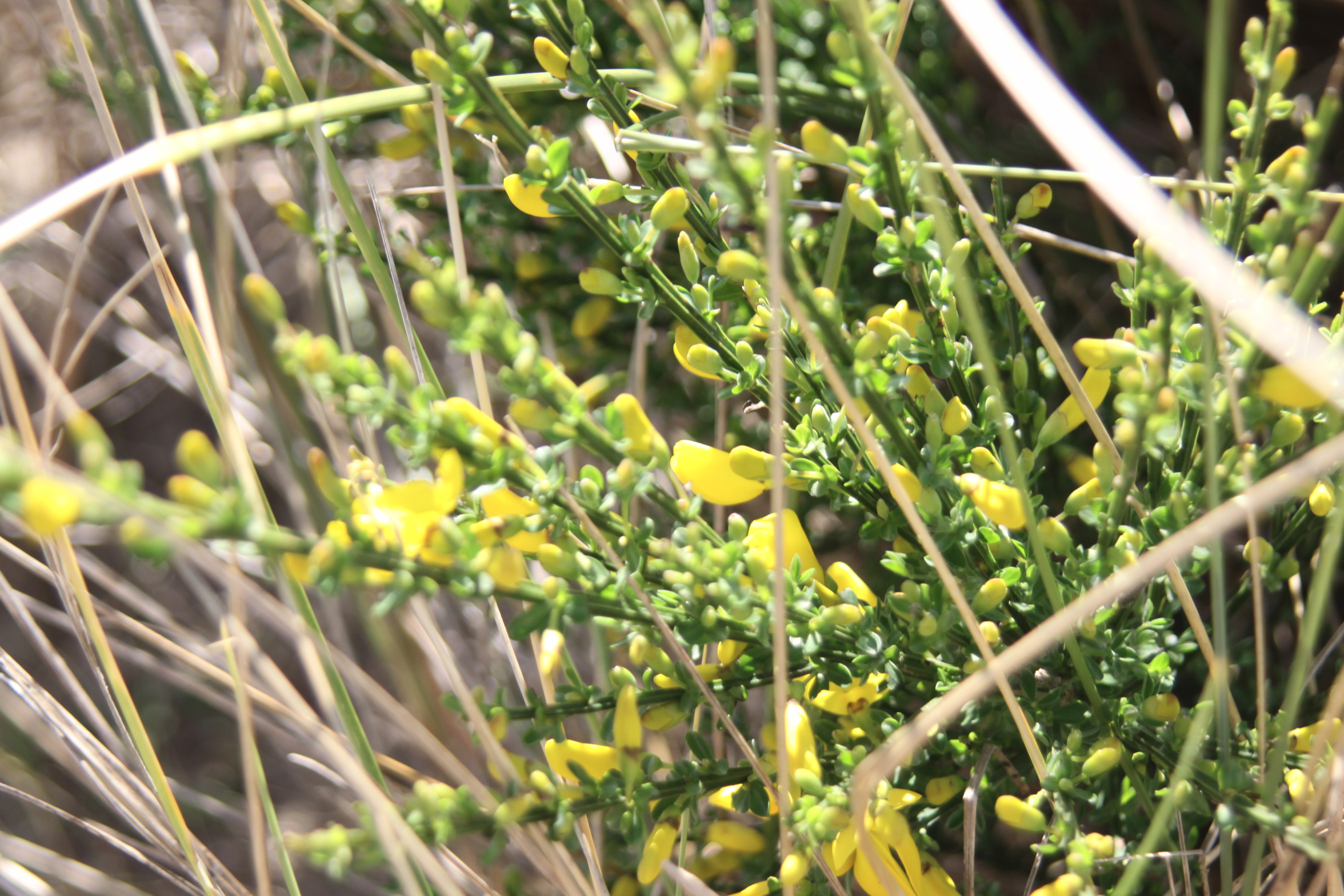
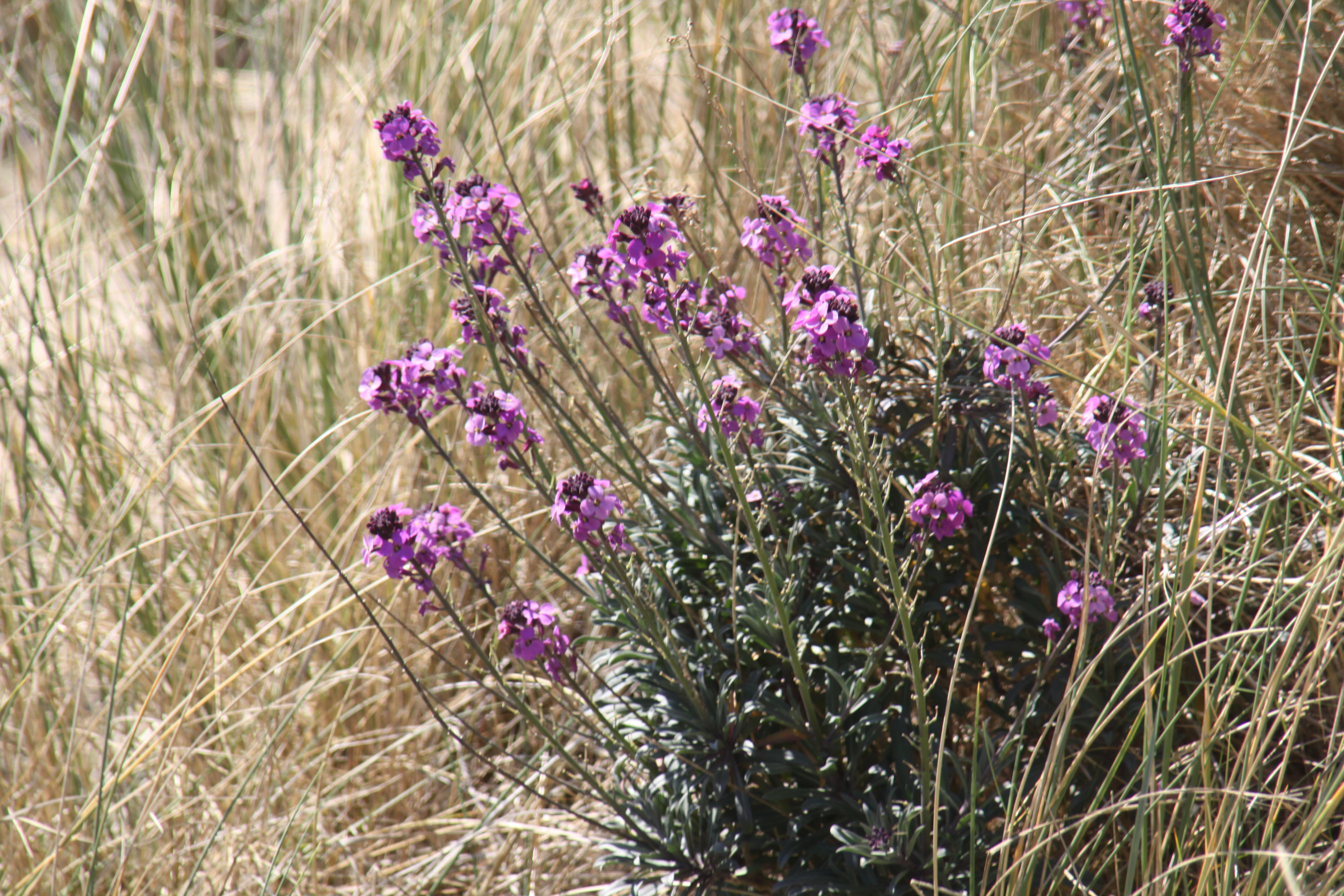
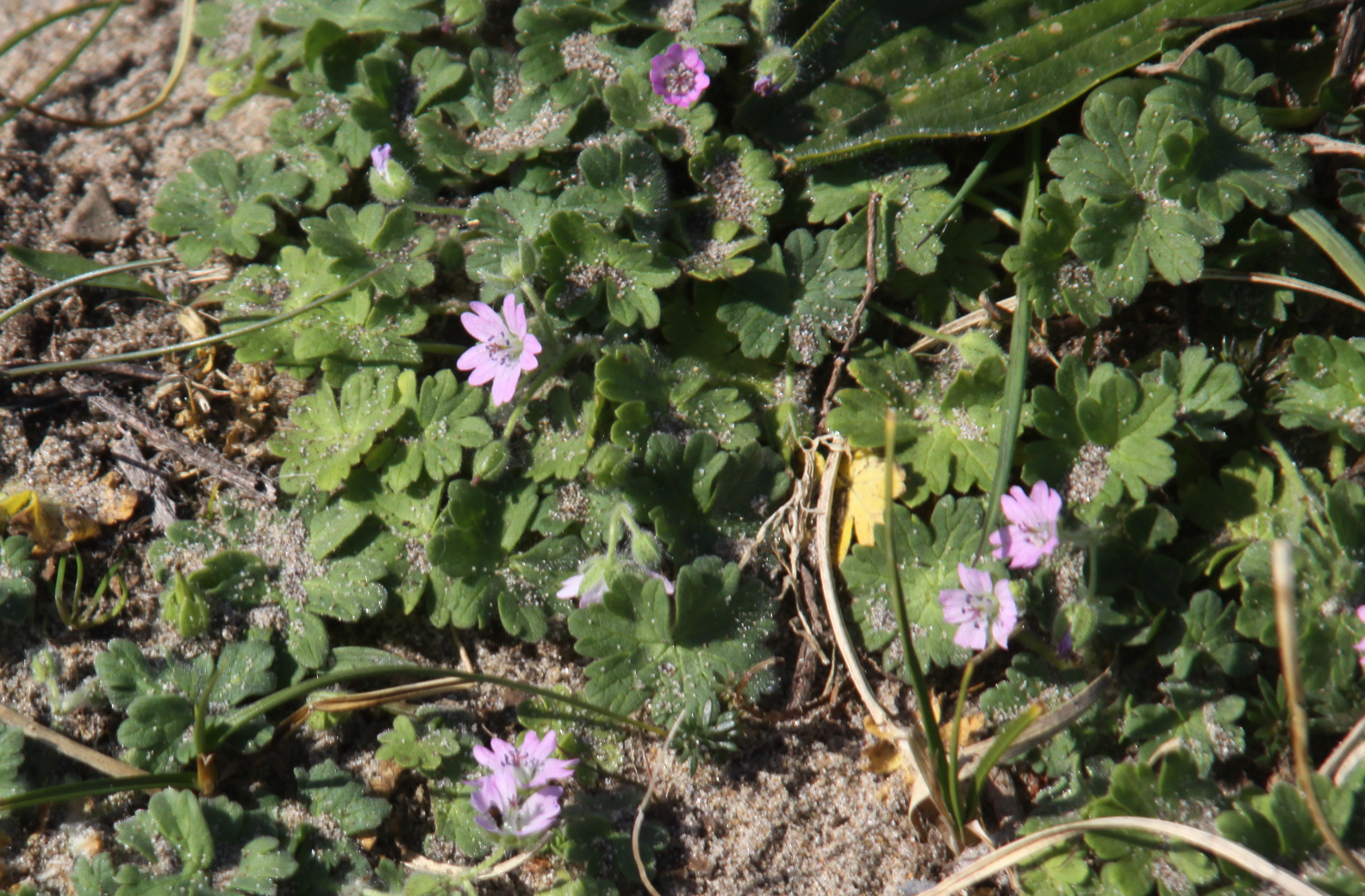
I set out for my usual exercise circuit today.  Walking down Gwelfor Road towards the sea front, it was lovely to see so many wild flowers providing a colourful display.

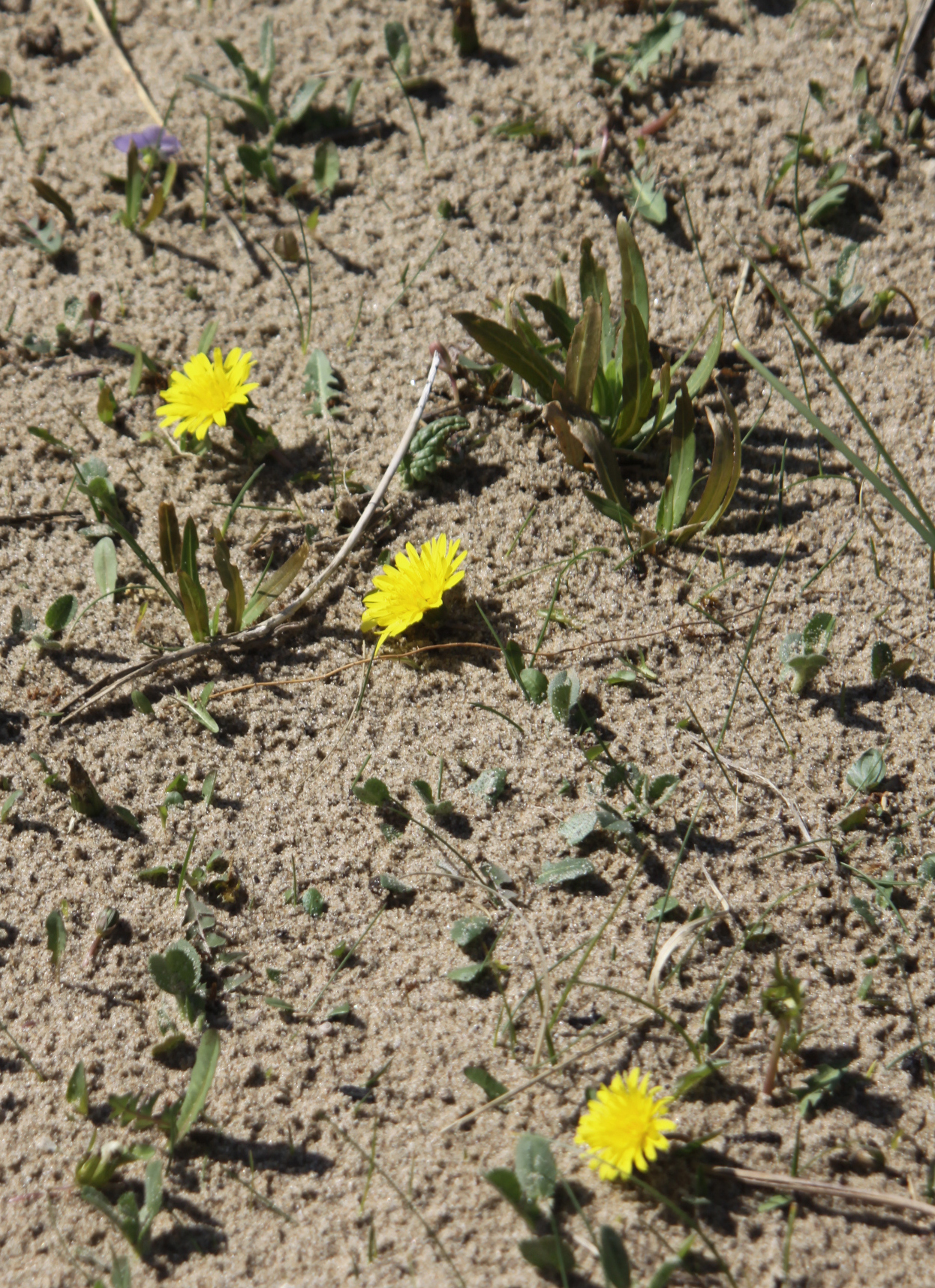
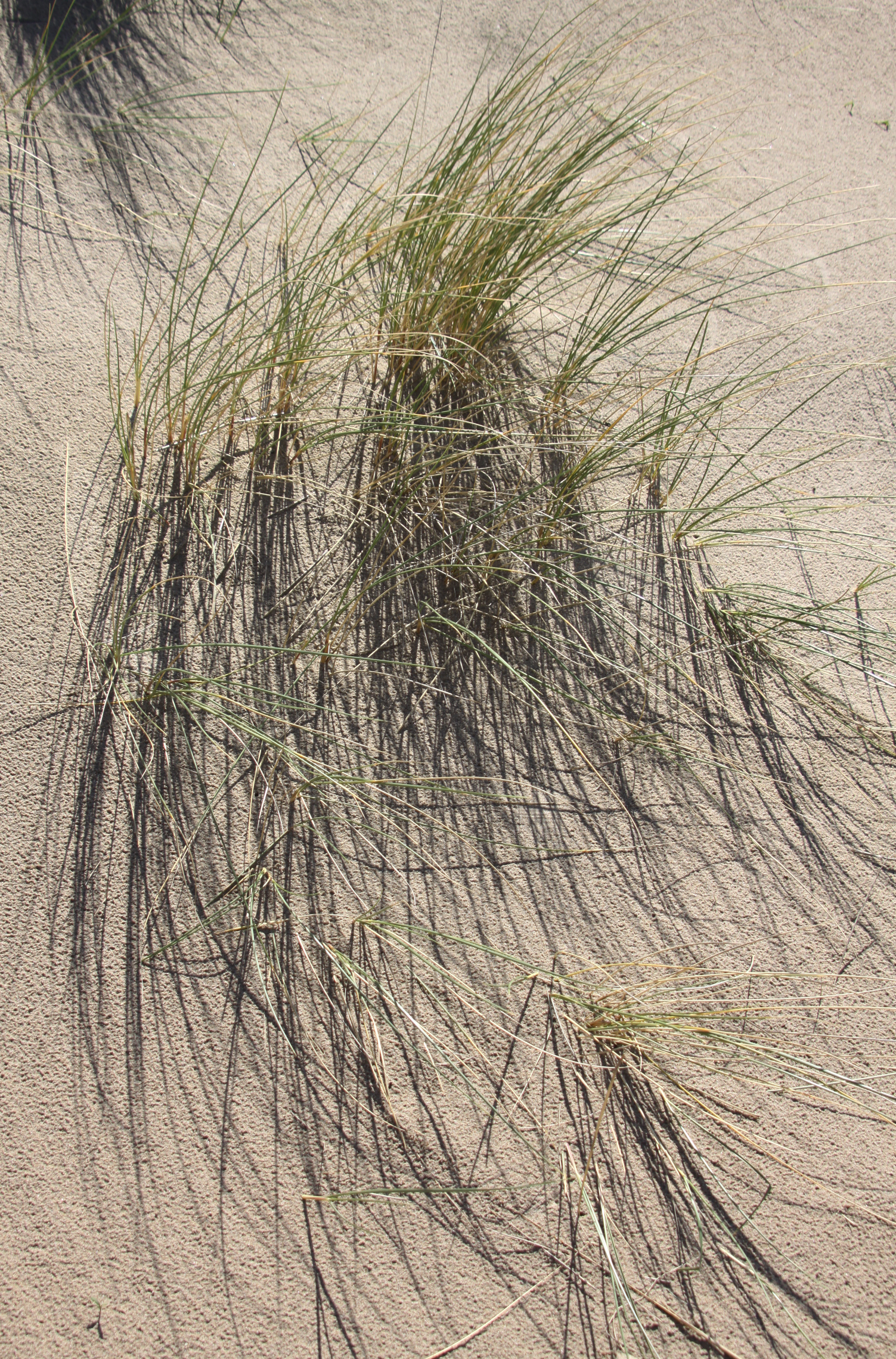
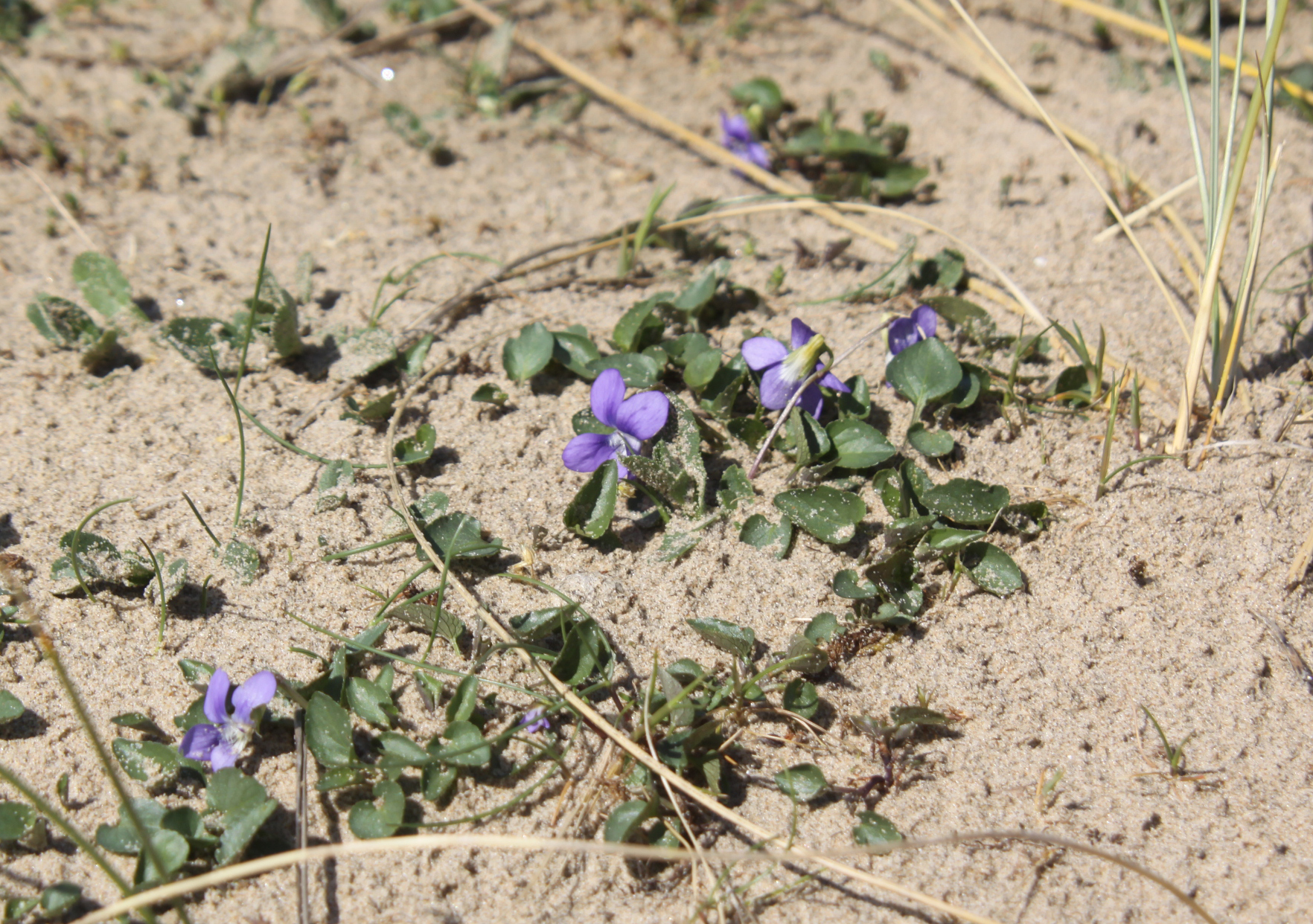
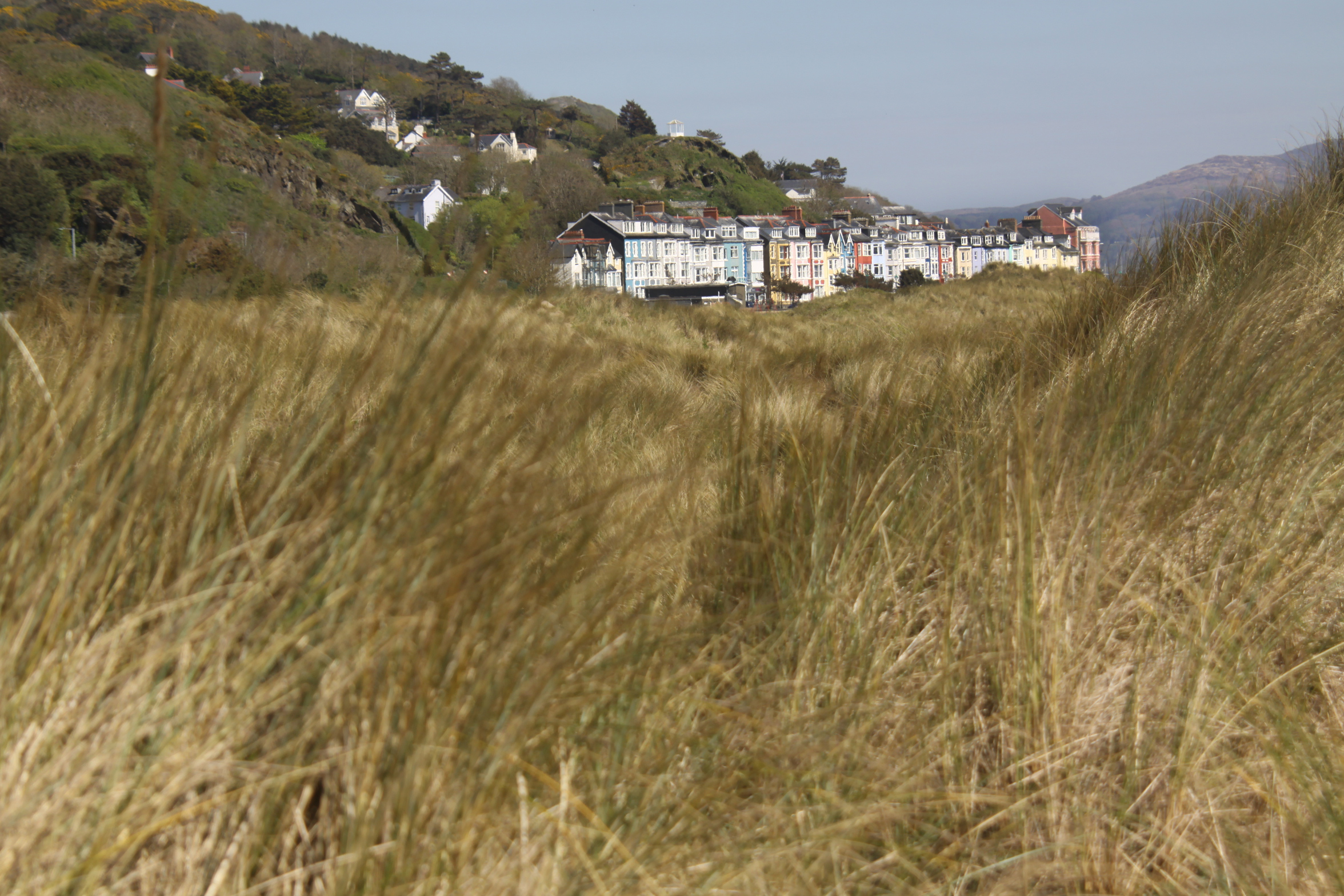
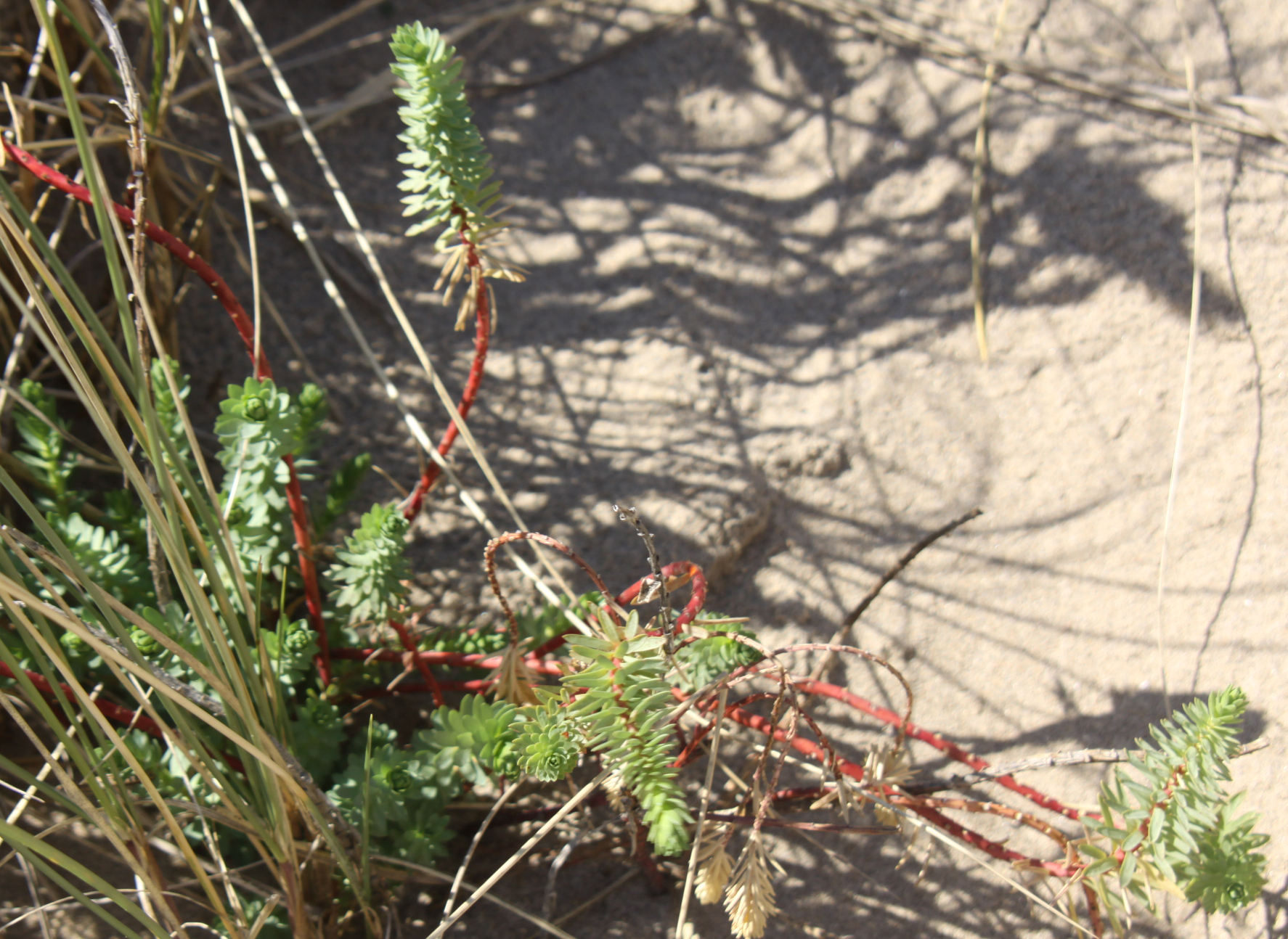
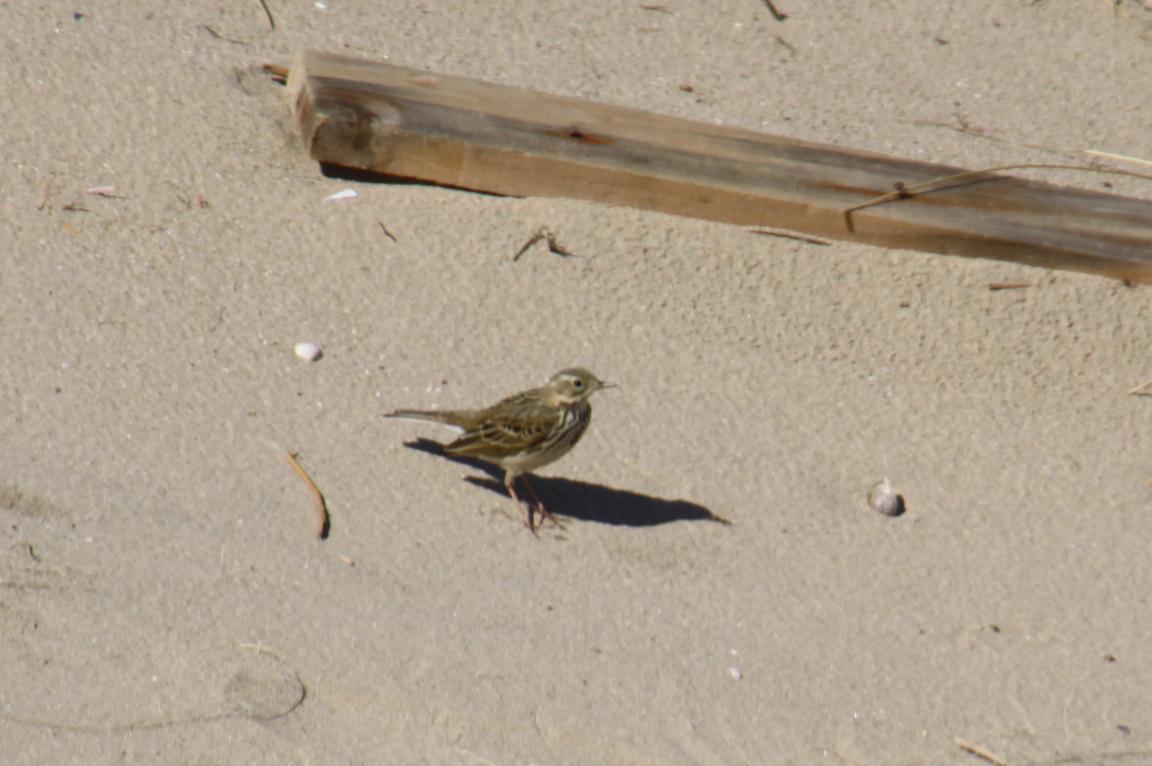
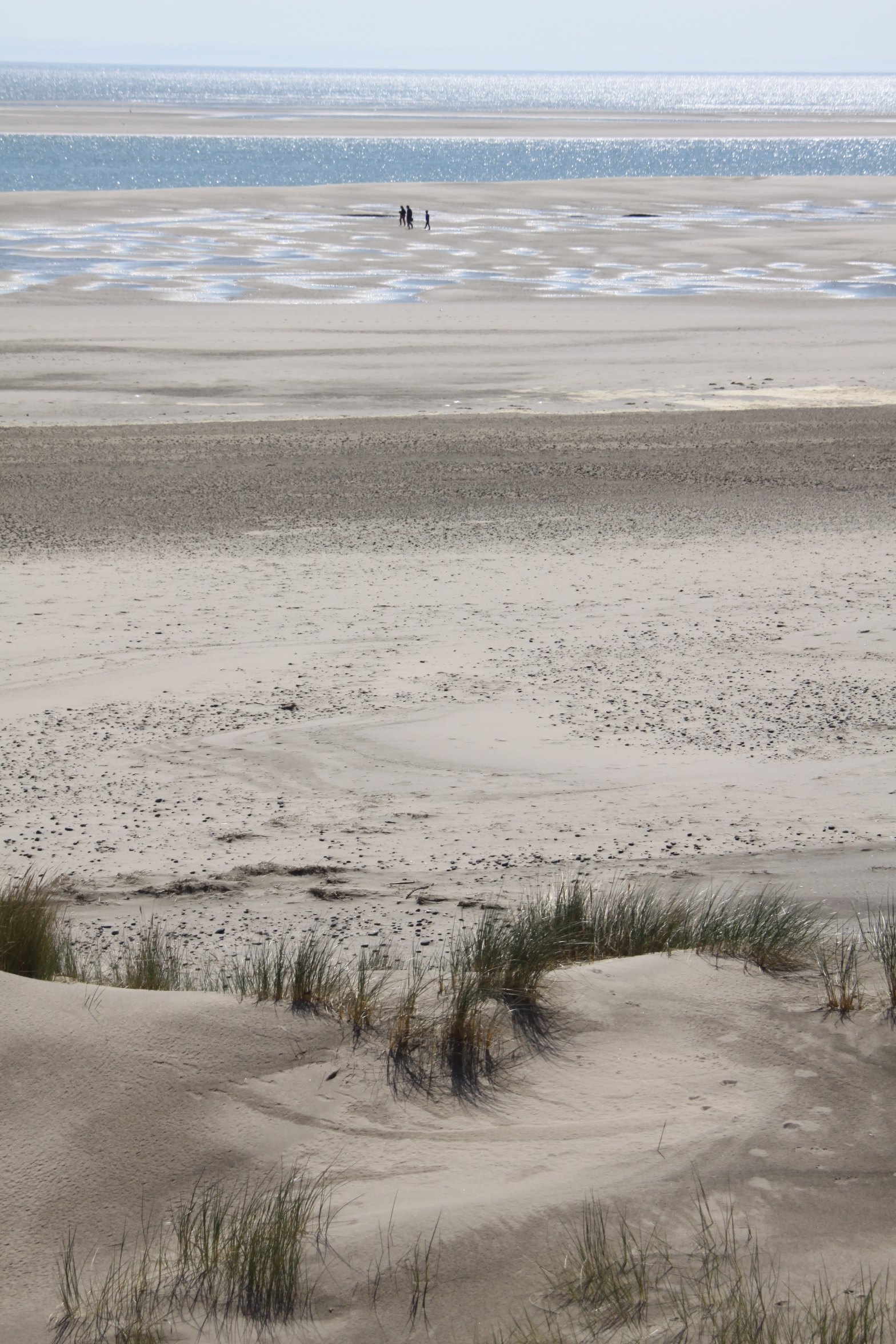
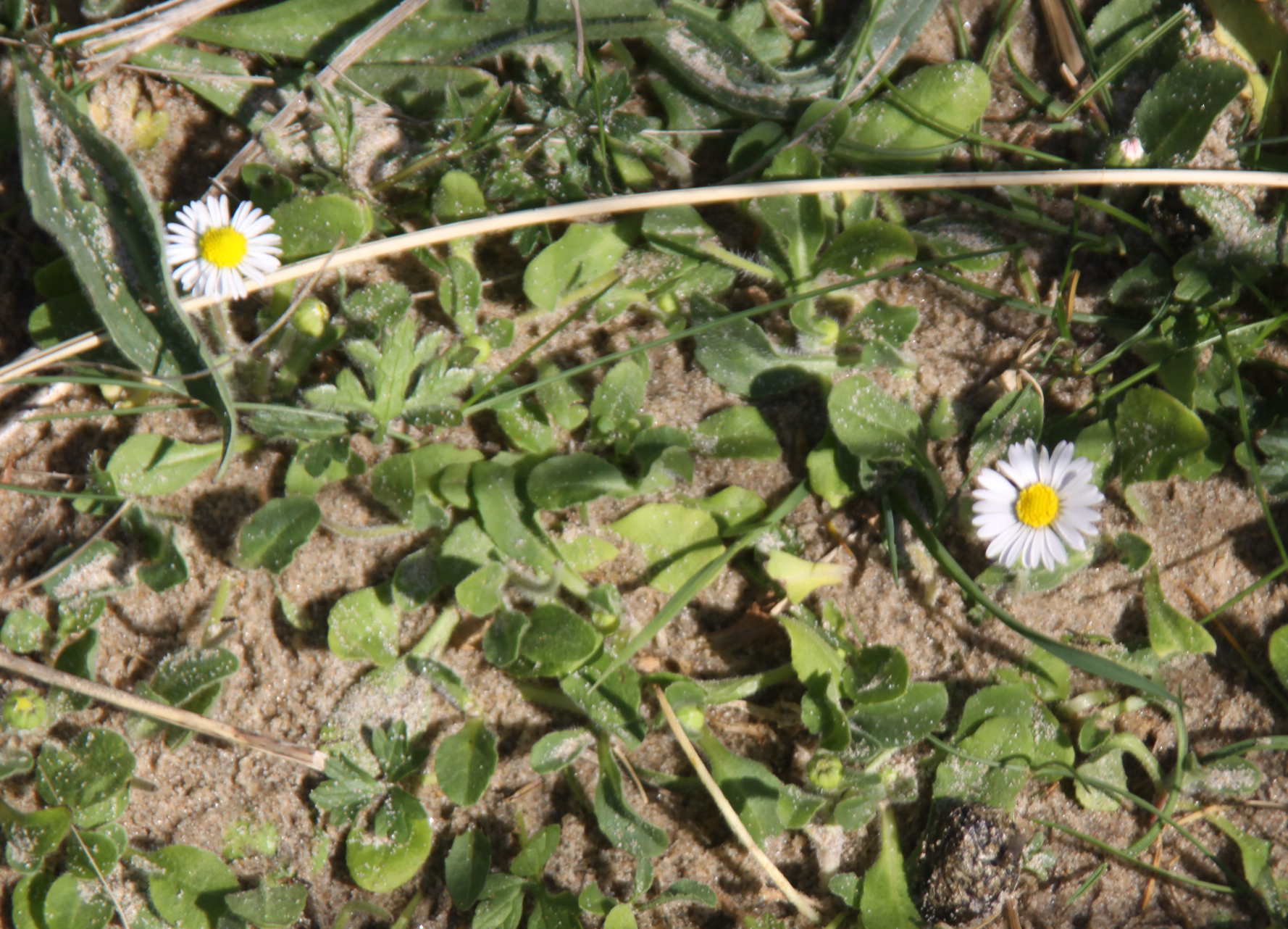
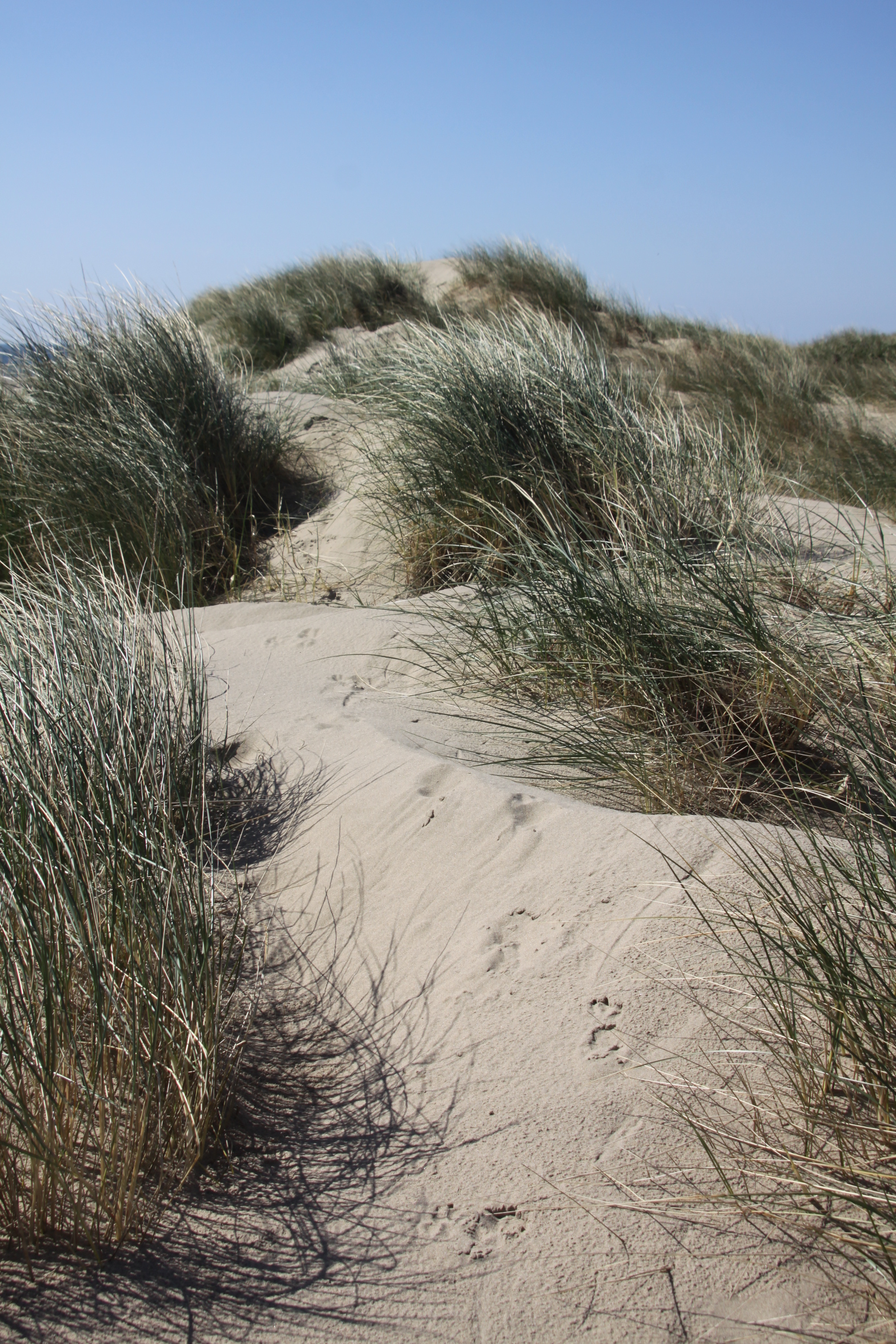
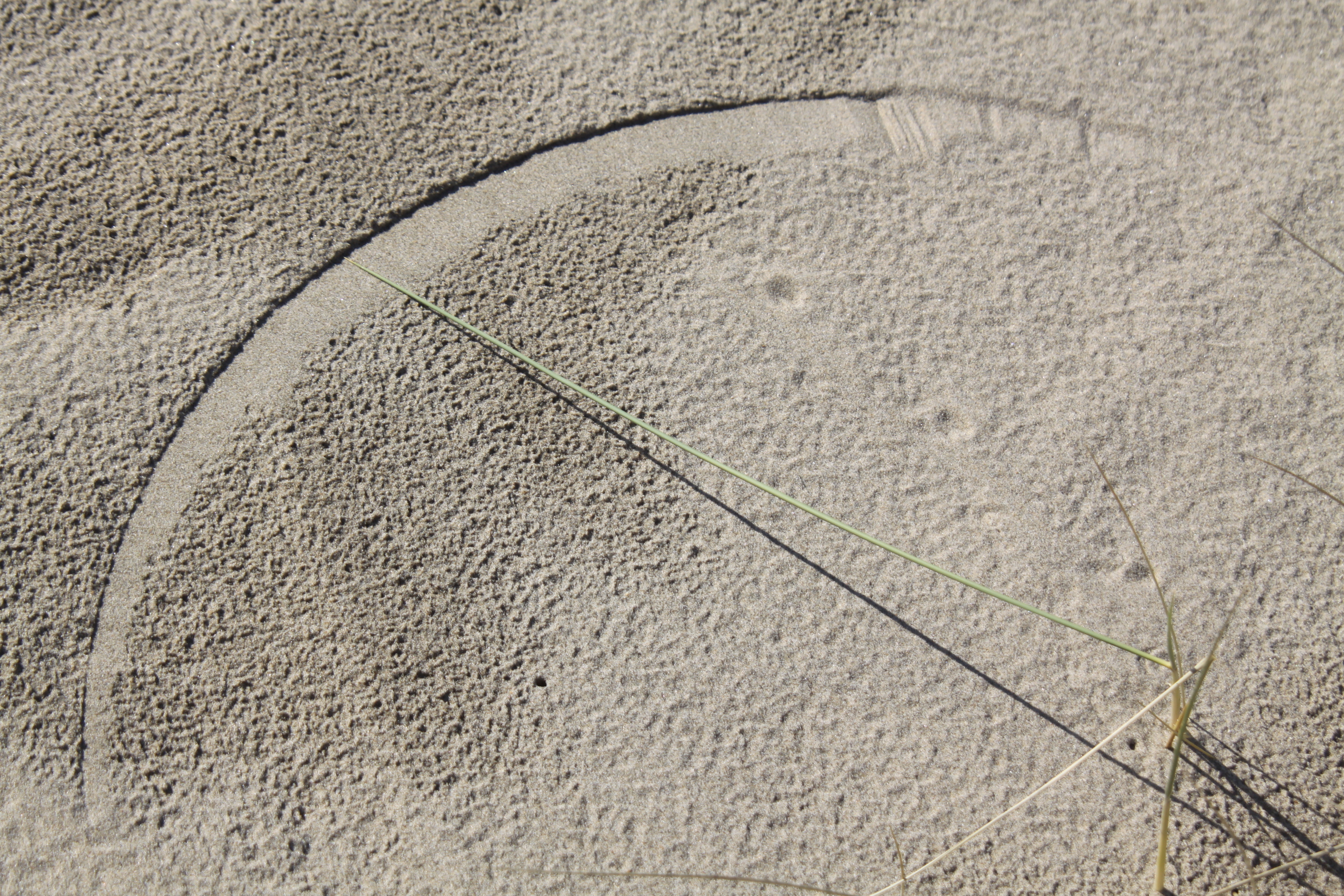
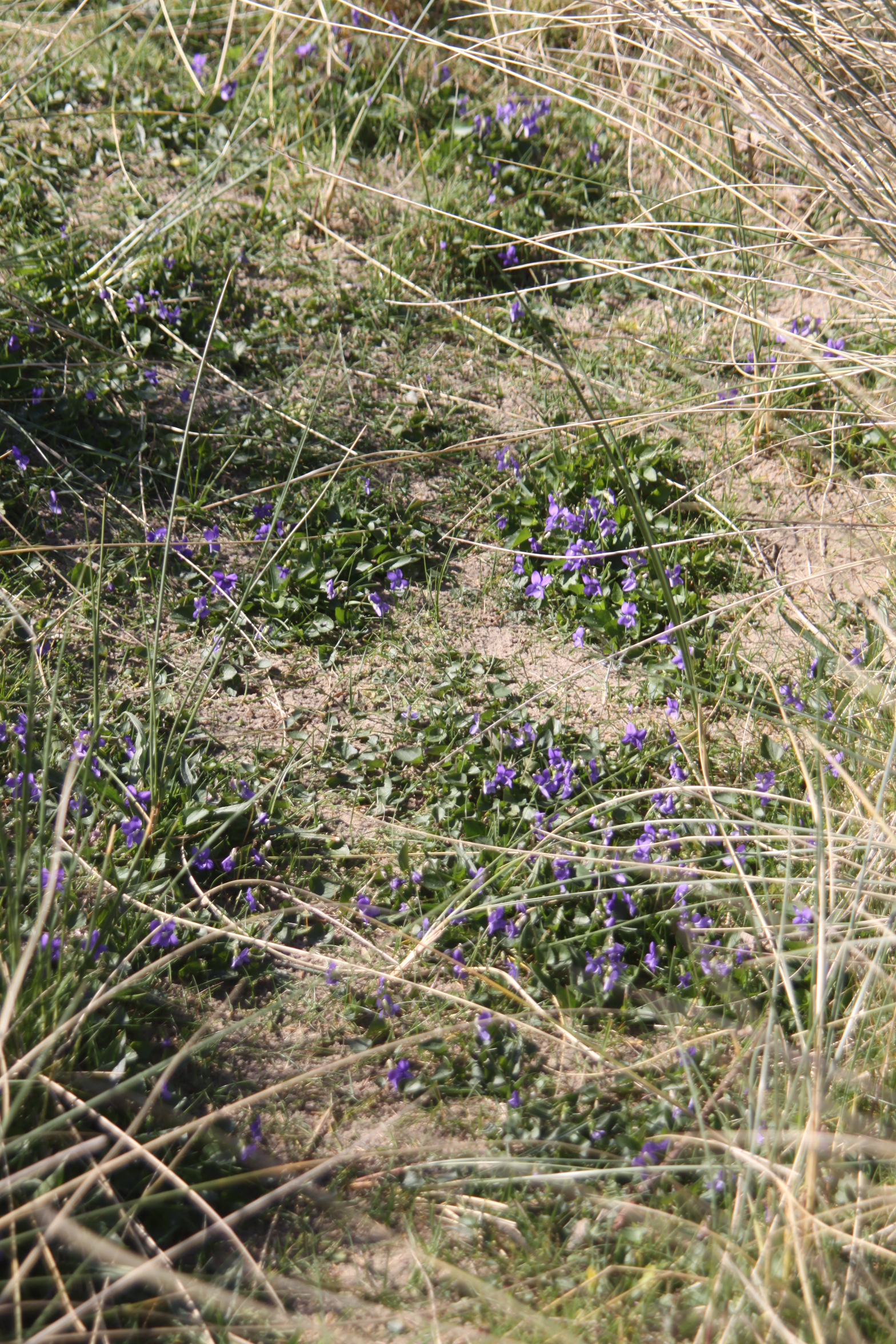
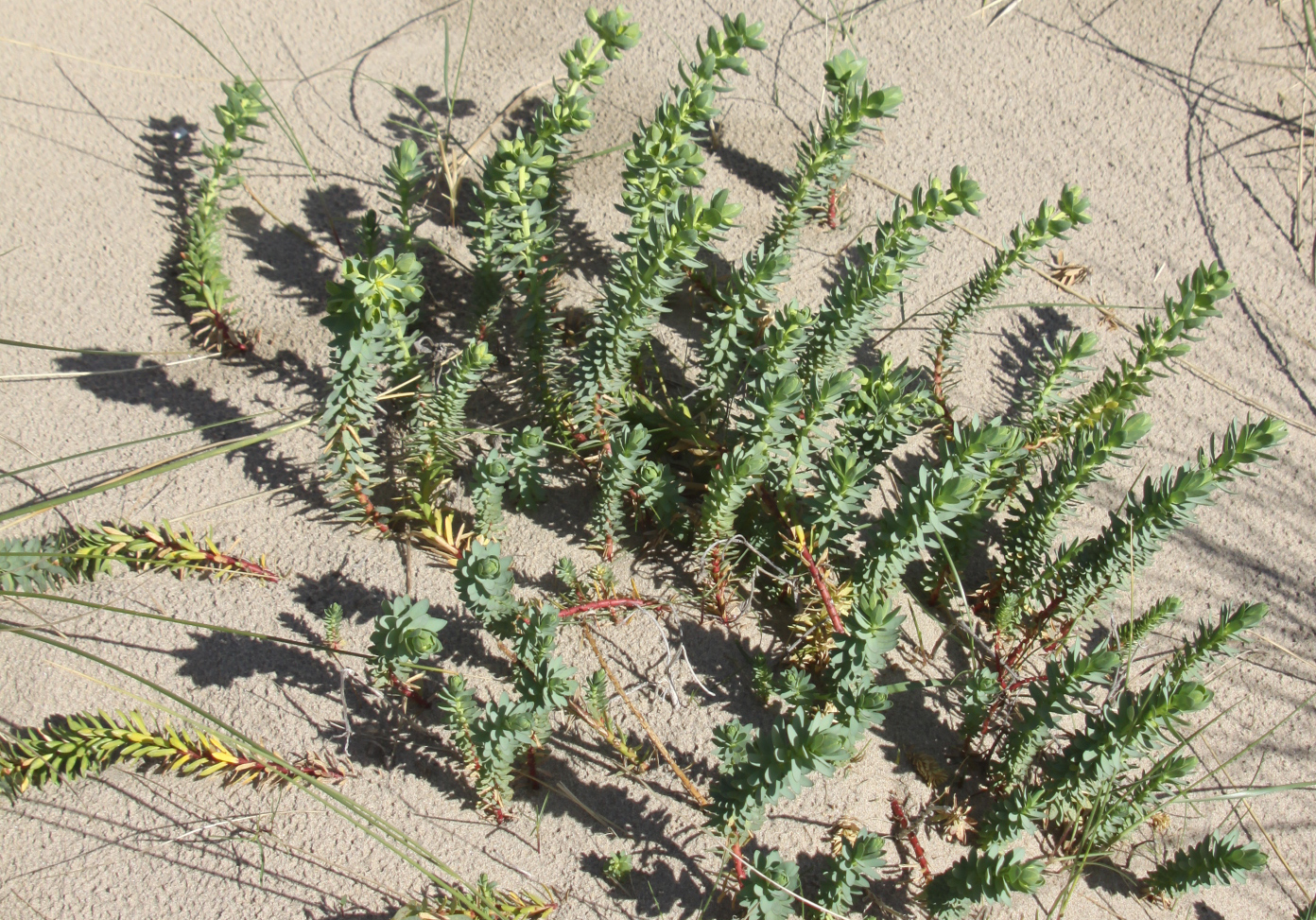
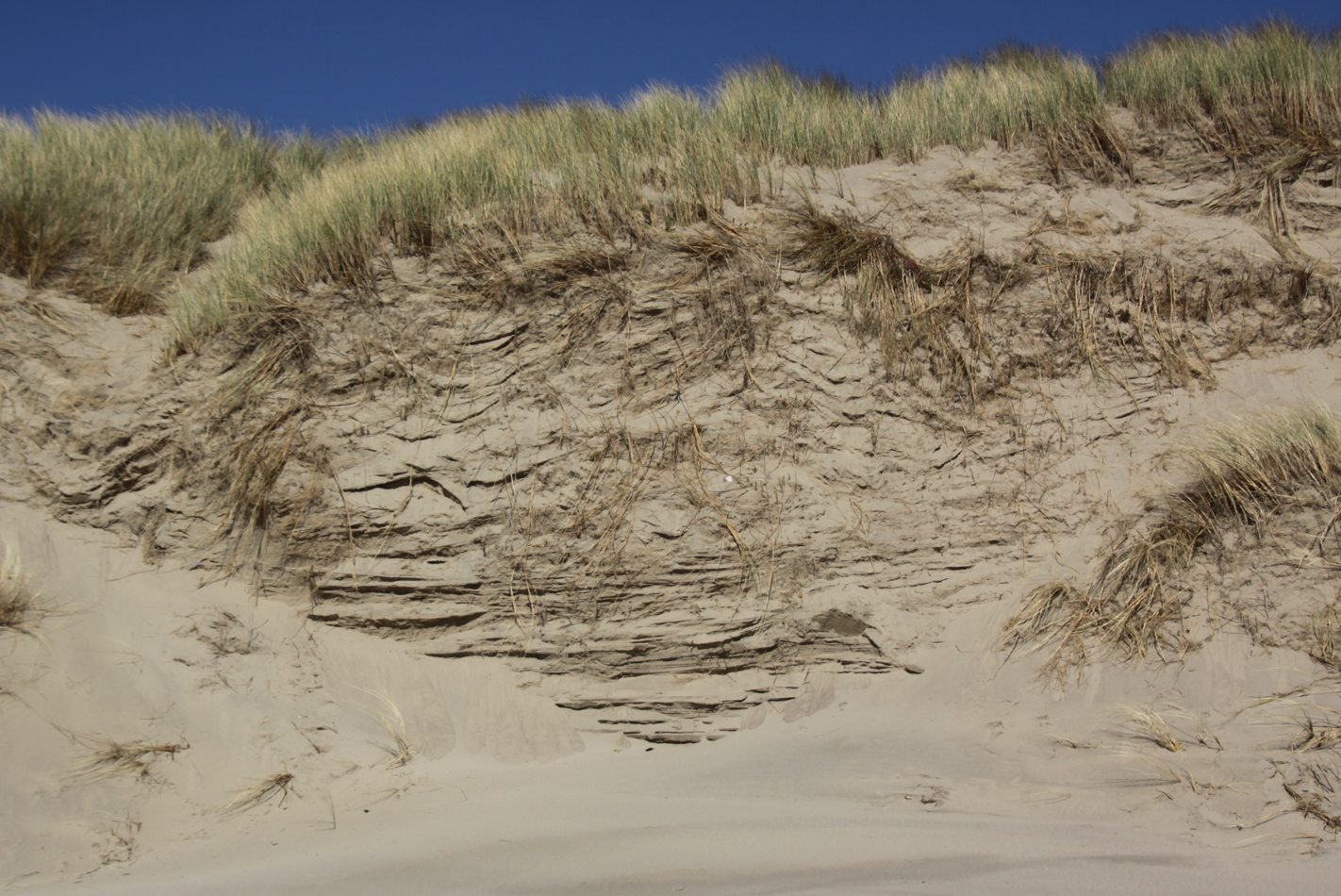
Instead of turning left at the bottom of Gwelfor Road, past the Neuadd Dyfi, through the tunnel and left along the beach to return up Copper Hill Street, I found myself turning right into the sand dunes and walking in the direction of Tywyn.  I am so glad I did, because it was a lovely walk.  In the sand dunes the story was quite different from the hedges and verges of Gwelfor Road, with only occasional dots of colour in an otherwise attractive but fairly unvarying selection of shades of green over the powdery ivory sand, dominated by marram grass.  Marram grass is super.  It casts spiky shadows, sways so elegantly in the breeze and carves out perfect circles in the sand.  The occasional dots of colour came mainly from small dandelions, daisies and, to my great surprise, huge and simply stunning colonies of violets.  Peacock and red admiral butterflies kept me company, and there were plenty of bumble and honey bees.  The dandelions were doing a particularly good job of keeping the bees and butterflies busy.  Little meadow pipits erupted out of the grass, taking to the sky with much angry peeping.

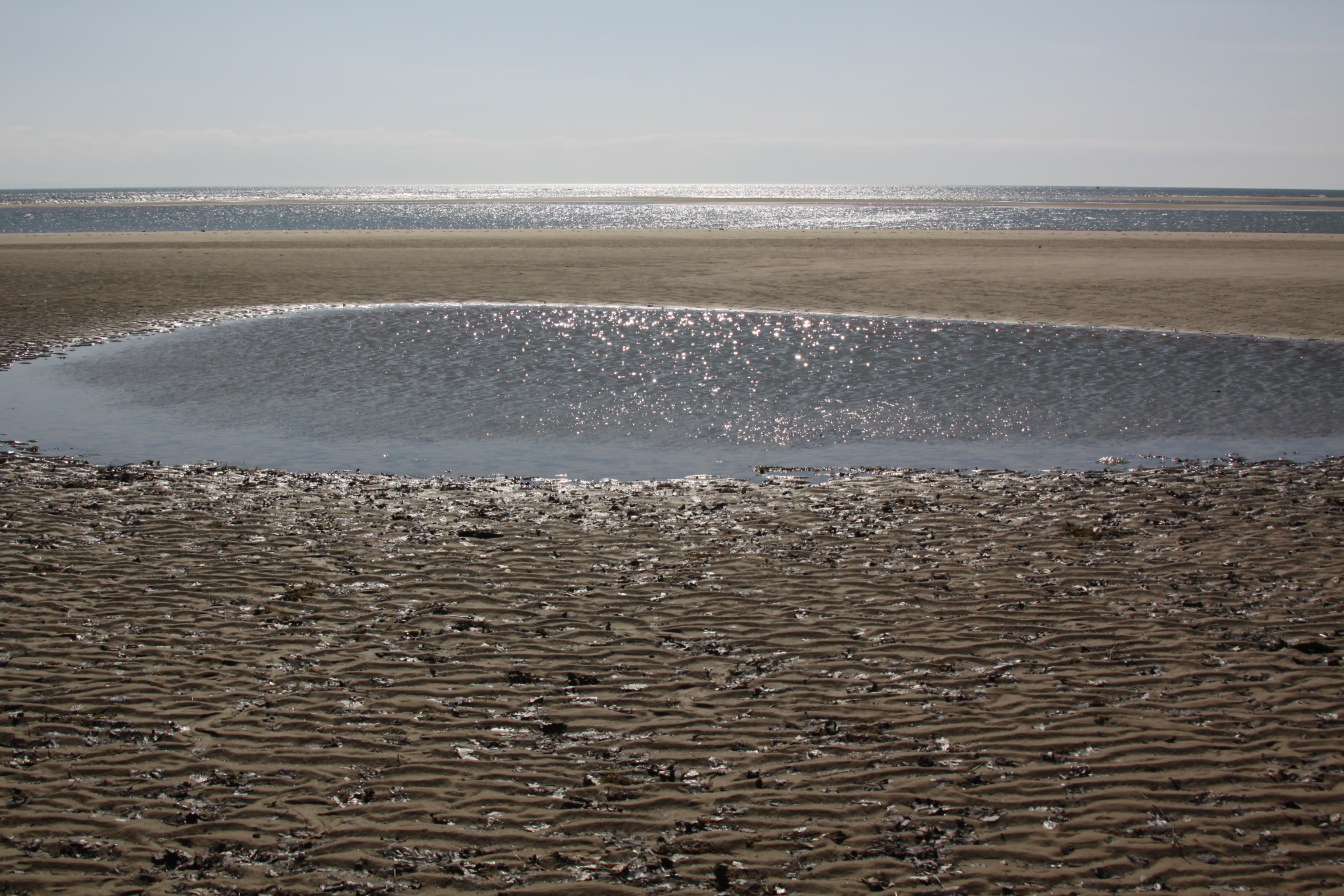
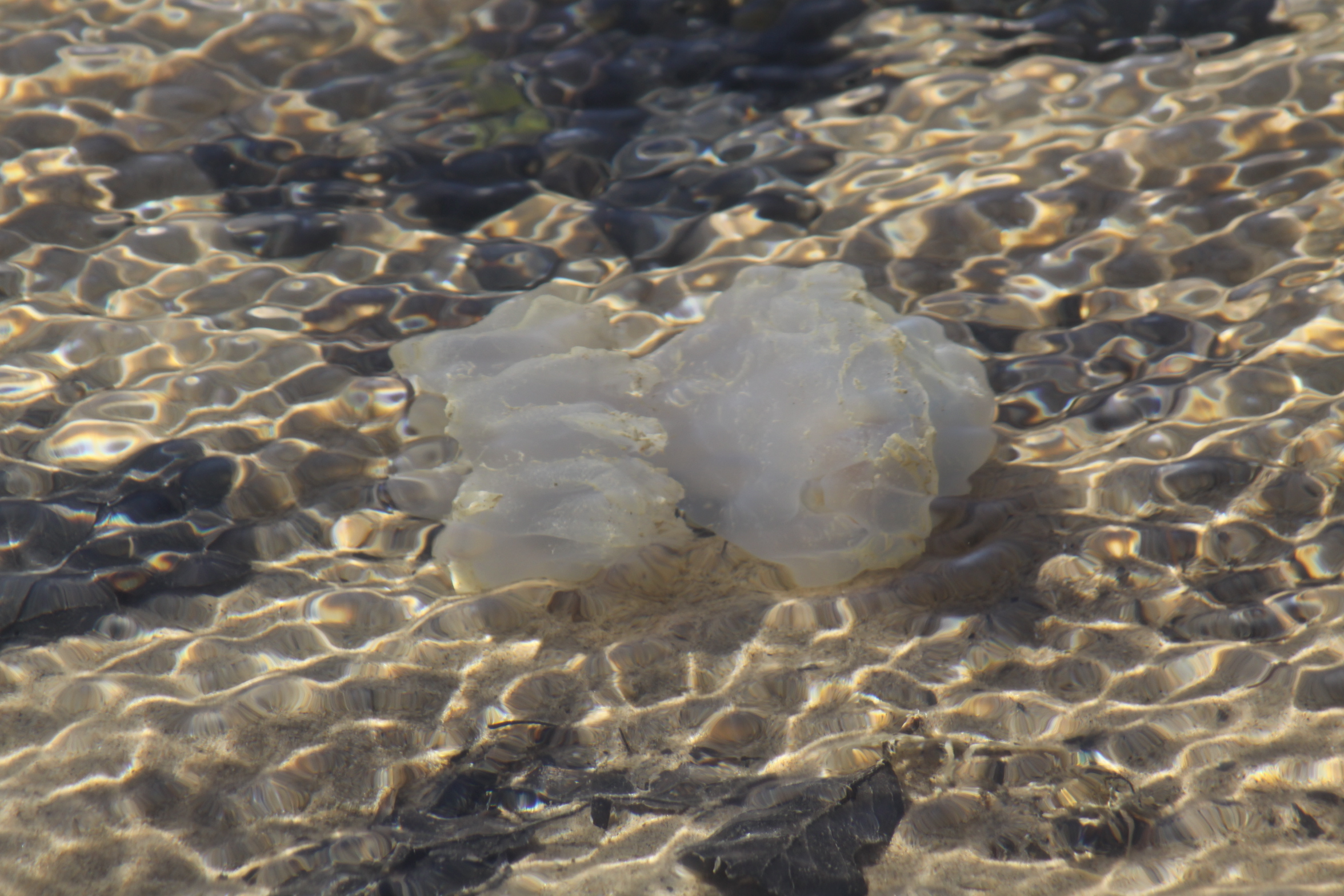
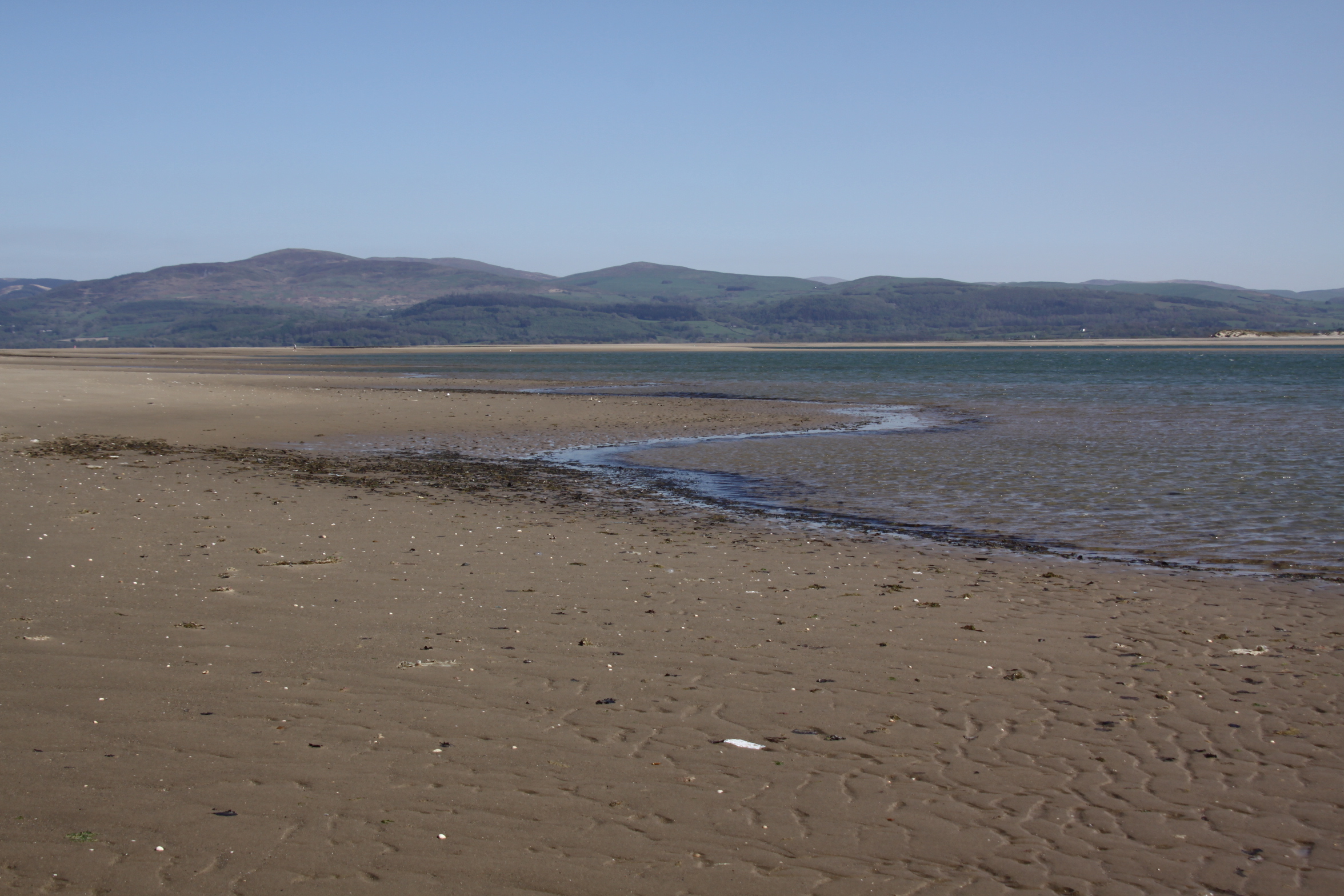
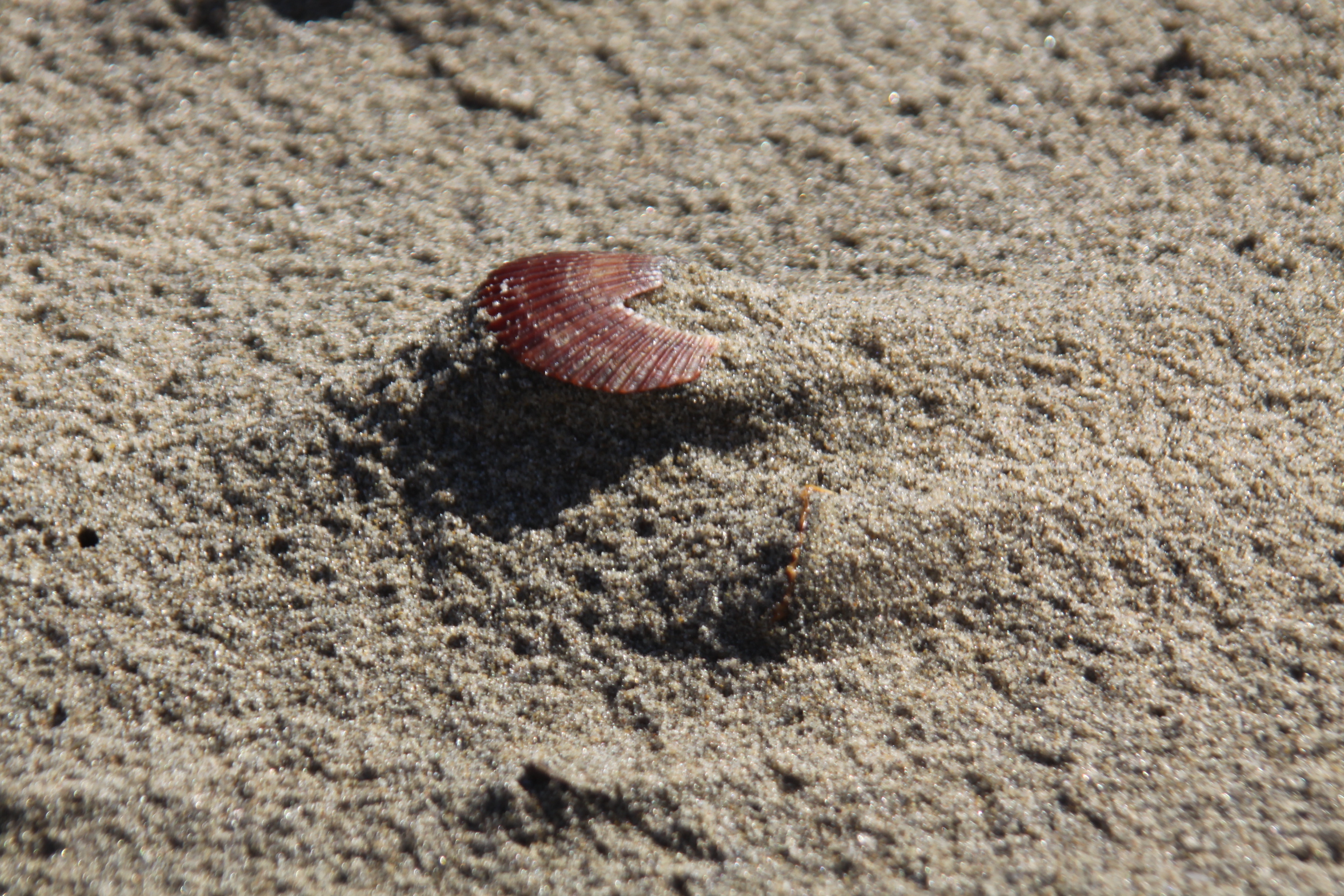
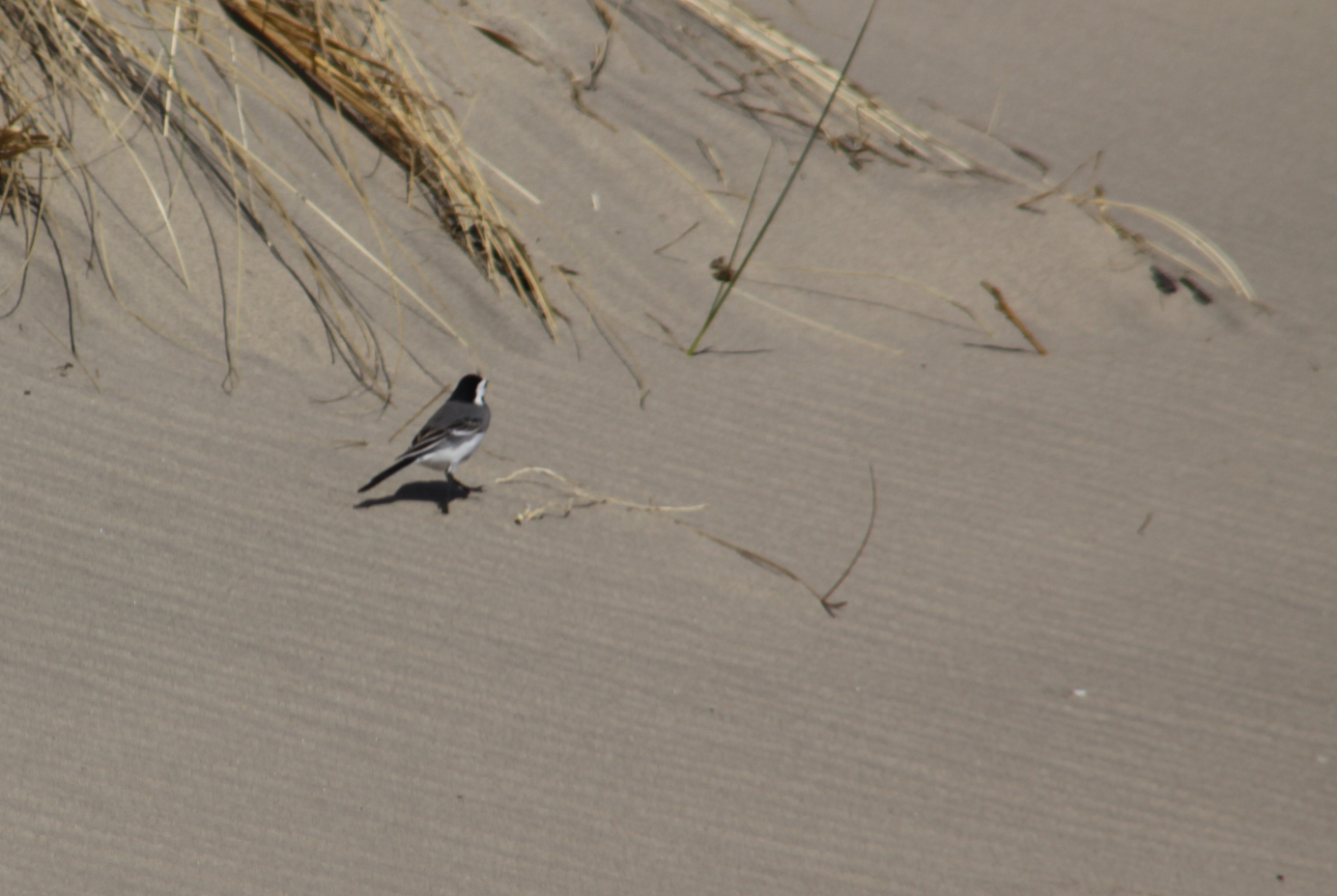
Walking back along the beach, countless dead jellyfish, a translucent myriad of opal colours, had been washed up, but there was not much else of interest on the strandline.  The sparkling sea, however, was a wonderful almost Caribbean blue, very clear.  In spite of a strong and slightly chilly wind, it looked untroubled and still.  Very peaceful.  A single white fluffy cloud interrupted the endless flat blue of the sky.  The wind had built up thousands of little sand ramps, raising shells and pebbles on customized, sloping plinths, utterly fascinating.  A pied wagtail stayed a few jumps ahead of me for maybe 15 minutes.

There was no-one in the dunes, there were very few people around on the vast sands and as I walked along the silent shop fronts and turned up Copper Hill Street there was no-one else visible.  Oh for a salted caramel ice cream 🙂

The auxiliary steamer Aberllefeni Quarrymaid, launched in Aberdovey, 1858

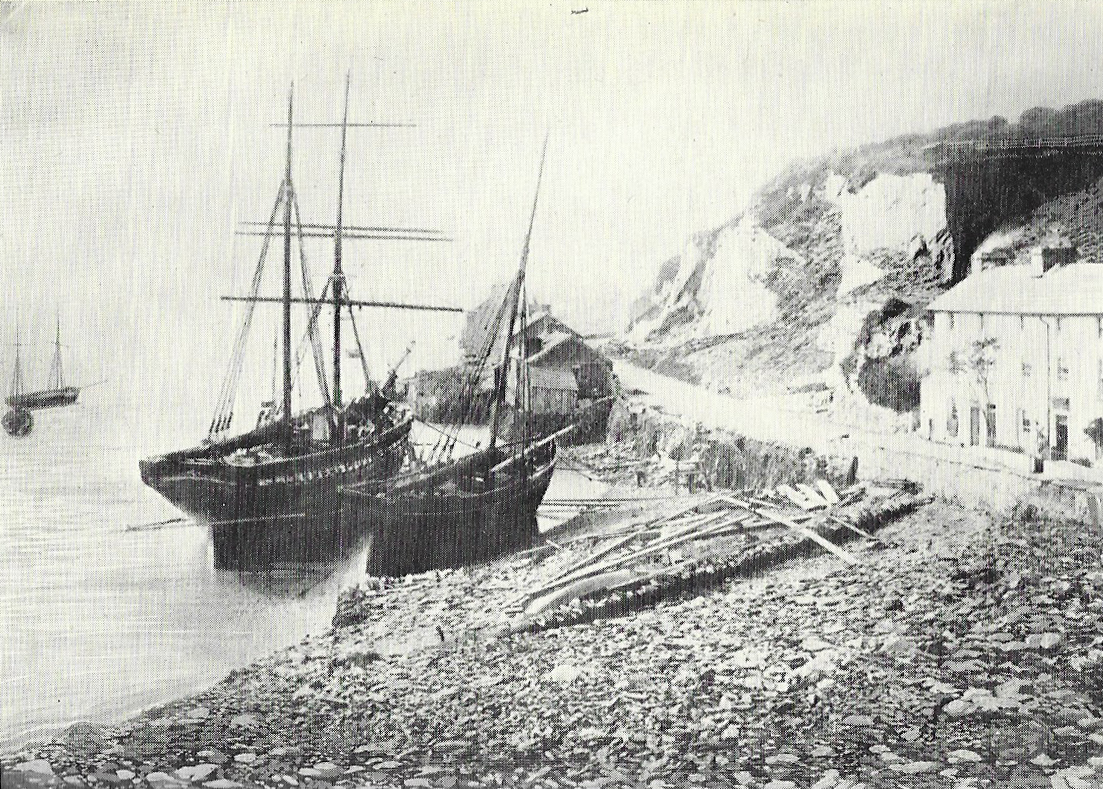
I have been unable to track down an image of Quarrymaid, but this is Roger Lewis’s shipyard.  Source: D.W. Morgan’s Brief Glory, pl.39

The s.s. Aberllefeni Quarrymaid, unsurprisingly known usually simply as Quarry Maid or Quarrymaid, has two distinctions.  First, she is the only steamer to have been built in Aberdovey, and second, renamed Orcadia, she was the first steamer to serve the North Isles of Orkney.

She was built by Roger Lewis (1815-1906) who Lewis Lloyd describes as a “maverick” and “an outstanding character.” According to Lewis, he came from Llanon in Cardiganshire, “a small but vigorous maritime community” where he was a master mariner (uncertified).  He not only built vessels, but often commanded them, and was a coxswain of the Aberdovey Lifeboat for many years.  Lewis says that whilst he was clearly a skilled seaman and had some experience as a carpenter, he never trained as a shipwright, and his instinctive approach led to results that were not always completely desirable.  In spite of this, or perhaps to reassure other investors, he retained shares in most of his ships.

Roger Lewis had a long-standing shipbuilding business devoted to sailing ships, based on Penhelig beach, just outside the Penhelig Arms (see photograph above).  It is interesting that Lewis went straight from sail to screw propulsion (propellers), bypassing the intermediary paddle steamer stage. Aberllefeni Quarrymaid was named for the three Aberllefenni slate quarries.  According to Wikipedia Aberllefeni was the longest continually operated slate quarry in the world until its closure in 2003.

Quarrymaid was built by Roger Lewis to serve as a coastal vessel.  According to Morgan she had a wooden hull, 83.1ft long, 58 tons.  She was launched in October 1858 and sailed to Caernarfon where she was fitted out with two De Winton 50hp engines and associated machinery at Thomas and De Winton’s Union Foundry.  I have have been unable to find an image, so have no idea about the arrangement of funnel and masts, but she is described in a number of contexts as an auxiliary schooner, presumably with two masts.  Auxiliary ships usually still looked like sailing ships, with the funnel positioned between the two masts, and they could switch between sail and steam as required.  Ships could save fuel when there was wind, but could fire up engines when they were sailing against the wind, in stormy conditions or when conditions were becalmed.  This meant that steamers could stick to a timetable and maintain reliable schedules even when the weather was bad, which was particularly valuable to customers sending perishable goods and livestock and for passengers.  Quarrymaid was registered at Aberystwyth, no.25.

The first shareholders were as follows (listed in Lloyd 1996, Appendix V, p.124-5):

    • Robert Davies Jones, Trefri, Esq – 16 shares
    • Roger Lewis, Aberdyfi, builder and master mariner – 10 shares
    • Robert Gamlen Sweeting, Soutlan, Warwickshire, Gentleman – 8 shares
    • Ann Pughe, Aberdyfi, widow – 4 shares
    • James Webster, Aberdyfi, Gentleman – 4 shares
    • Hugh Jones, Gelligraian, Farmer – 4 shares
    • Evan Anwyl, Llanon, Gentleman – 4 shares
    • Elizabeth Jones, Crosswood, Montogomery, Spinster – 4 shares
    • Joseph Sheppard Draper, Haselbury, near Crewkerne, Somerset, Gentleman – 4 shares
    • George Jonathan Scott, Shrewsbury, Shropshire, Gentleman – 4 shares
    • David Jones, Machynlleth, Montgomery, Agent – 2 shares

There are often a diverse set of occupations listed, and widows are frequent shareholders, but what is surprising here is the sheer geographical scope of Quarrymaid‘s shareholders.

Quarrymaid undertook her maiden voyage from Aberdovey to London in April 1859, with several of the owners on board, some of whom disembarked at Aberystwyth.  The Carnarvon and Denbigh Herald had this to say about her maiden voyage on April 20th 1859:

The steamer started on her first voyage to London on Saturday.  Several of the owners and gentlemen were on board.  Also some ladies who went as far as Aberystwyth.  Robert Davies Jones, Esq., Trefi, and Lady R. Webster, Esq., Aberdovey etc, were on board.  The Quarrymaid steamed beautifully out of the harbour and made about nine knots an hour.

9 knots is just over 10mph/16.6kmph.  Steamships did not become commonplace in Aberdovey until the 1860s, so she must have been something of a novelty.

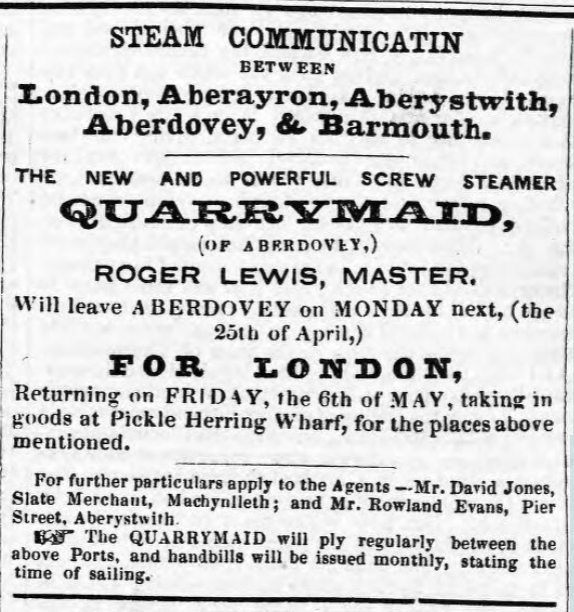
Initially, Quarrymaid‘s standard route was between Aberdovey and London, averaging a round trip per fortnight, stopping at Barmouth, Aberystwyth and Aberaeron as well.  An advert was placed in  The Aberystwyth Observer on the 23rd April 1859 just after she was built, announcing her first commercial voyage on 25th April 1859.   D.W. Morgan says that at one point her engineer was Tom Hughes of Gogarth, who had been an officer on the fabulous London tea clipper Cutty Sark and that at some stage she was lengthened by Roger Lewis.  Her first master was also her builder, Roger Lewis, and she was managed by David Jones and Rowland Evans of Machynlleth.

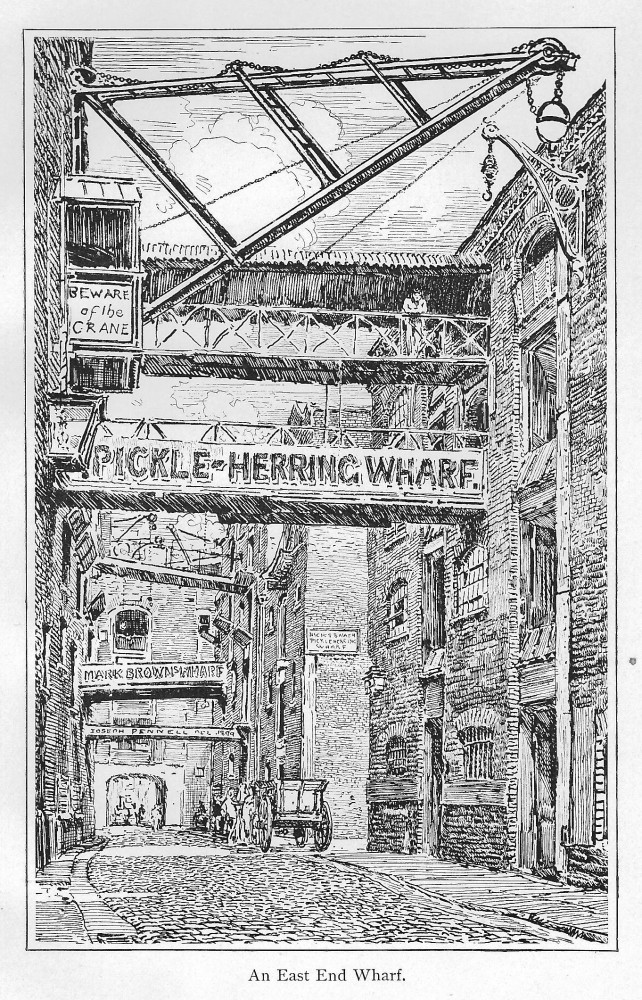
Pickle Herring Wharf, Bermondsey, in 1899 by Joseph Pennell. Source: Frontispiece.

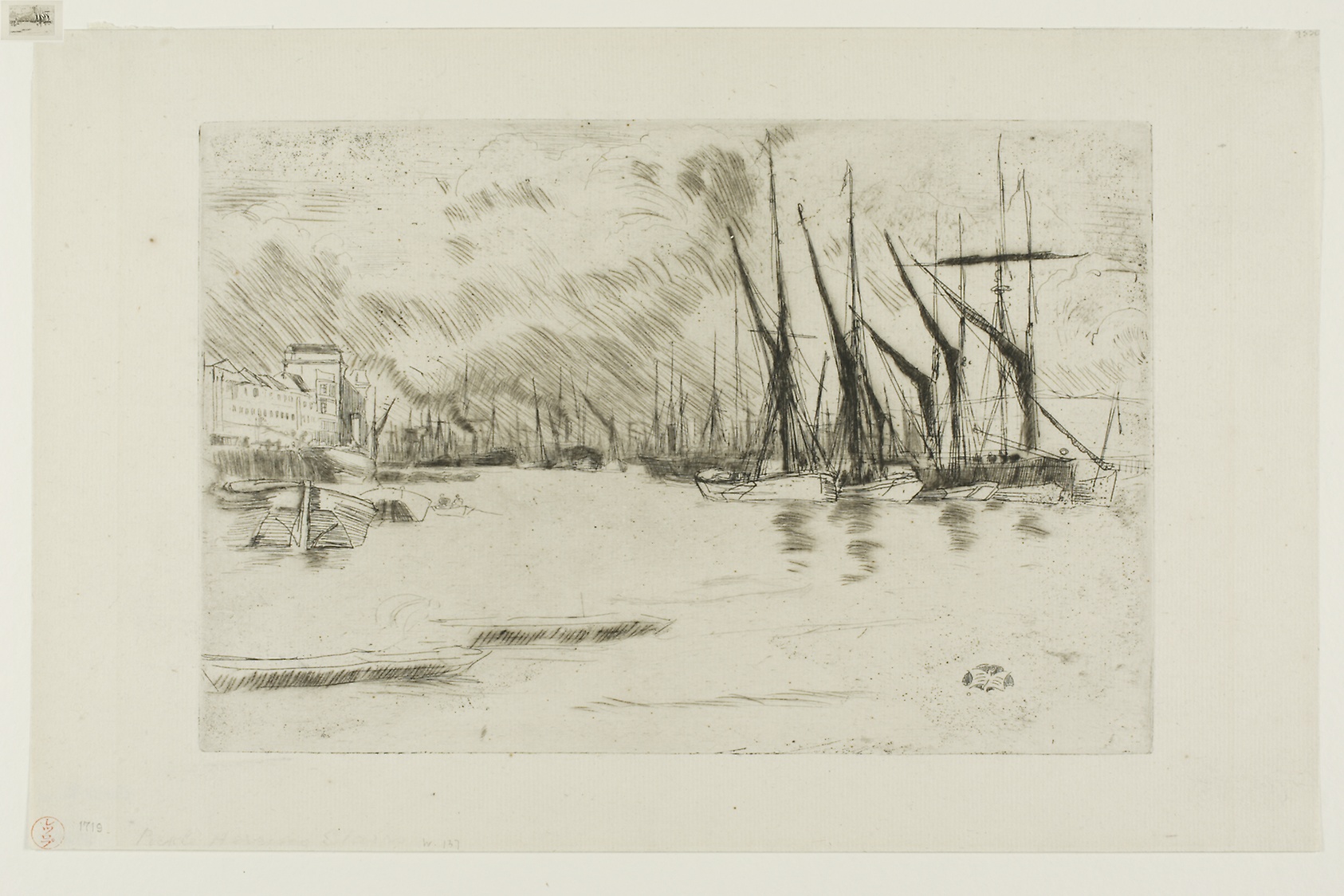
Pickle Herring Wharf, Quarrymaid‘s destination in London, was in Bermondsey, part of a vast complex of wharves that lined both sides of the Thames.  The etching on the left, by well known artist Joseph Pennell, shows how the warehouses were linked to the waterside wharves across the cobbled road.  Where it once stood is now the section of Thames Path in front of the HMS Belfast.  However, it looks like a clone of the contemporary Butler’s Wharf, which survives today as a major tourist destination just upriver from where Tower Bridge (built 1886 -1894) is now located.  The warehouses were great terraced blocks of multi-storey buildings, and for the general public and watermen to reach the river, staircases were provided, the watermen’s stairs.  Those that ran down to the river were just behind this image, to the left, and were marked on contemporary maps as the Pickle Herring Stairs.

Pickle Herring Wharf from the river, by J.A.M.Whistler. Source: Art Institute of Chicago

Later, Quarrymaid switched routes at some stage before 1862, running between Aberdovey and Liverpool.   Although it is not explicitly stated anywhere what her cargo may have been, it seems likely that she was carrying slate, at least when she was running into London, but may have switched to perishables when she switched to Liverpool.  Steamers were comparatively expensive to run, costs being accrued both in fuel and additional crew requirements. Their cargo carrying prices were therefore higher, meaning that they were often used mainly for time-sensitive cargoes, when the risk of spoilage merited the extra cost of reliable steamers. that were far more predictable to scale, and arrived to schedule.

Lewis Lloyd gives details of the Crew Agreement for the Aberdovey to Liverpool half year ending 30th June 1862.  He says that it is the only one that was available at the Dolgellau Record Office, from which he derived the following information:

    • Captain:  David Lloyd of Cardigan, aged 24
    • Mate:  Richard Davies of Merioneth, aged 25
    • Engineman:  William Davies of Anglesey, aged 30
    • Stoker: Griffith Evans of Merioneth, aged 28
    • Able Seaman: Thomas Jones of Merioneth, aged 30
    • Able Seaman: John Griffith of Merioneth, aged 23
    • Cook: Evan Lloyd of Cardigan, aged 13 (possibly the younger brother of the captain)

Lloyd says that during the period covered by this contract, Quarrymaid made 13 voyages between Aberdovey and Liverpool, about one per fortnight.

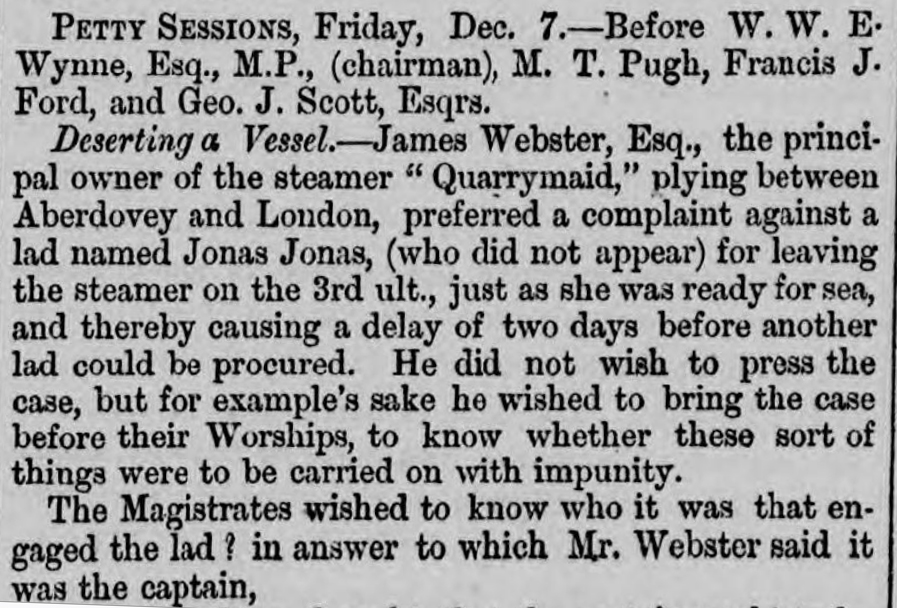
In 1860 it was reported in the North Wales Advertiser and Chronicle of 15th December, that the captain of the Quarrymaid was pursuing a case against a deserter, more to make a point than to pursue any heart-felt grievance:

James Webster, Esq., the princi- pal owner of the steamer Quarrymaid,” plying between Aberdovey and London, preferred a complaint against a lad named Jonas Jonas, (who did not appear) for leaving the steamer on the 3rd ult., just as she was ready for sea, and thereby causing a delay of two days before another lad could be procured. He did not wish to press the case but for example’s sake he wished to bring the case before their Worships, to know whether these sort of things were to be carried on with impunity.

On February 9th 1861, Quarrymaid collided with the Ann Jones from Porthmadog, the cause apparently being a particularly strong tide.  The Carnarvon and Denbigh Herald reported that both ships were damaged, the Quarrymaid losing her jibboom and the Ann Jones losing ropes and the gaff, which fell on deck, striking the mate.  There were no fatalities but there were two casualties, one on each ship, both taken away for medical care. Later in the same year, the 14th September edition of the North Wales Advertiser and Chronicle‘s review of the Petty Sessions of Friday September 6th contained this fascinating and amusing story about the second mate stealing bottles of wine from a hamper that had been loaded in Liverpool for one Miss Griffiths of Trefri, although perhaps not so amusing for the accused, who was sentenced to two months imprisonment with hard labour:

Stealing Wine.—Mr. D. Pughe appeared for the prosecution. Roger Lewis, captain of the steamer Quarrymaid, of Aberdovey, preferred a charge of felony against the second mate Hugh Davies. It appears that a hamper of wine, consigned to Miss Griffiths, of Trefri, had been put on board in Liverpool, on the 20th of May last. It was a two dozen hamper.  The captain stated that he stove it away himself in the hold, in Clarence Basin Dock, and that on his arrival at Aberdovey it had disappeared. The prisoner’s berth was in the forecastle, and there was an access from there to the hold without coming on deck. The vessel was not full at the time. The hamper was put on the starboard side, and was approachable for any one. Thomas Morgan, a sharp lad, about 17 years of age, who had evidently imbibed some strong potations previous to coming into court, stated that he was on board the Quarrymaid, but never recollected seeing the hamper stowed away. Remembers seeing Hugh Davies, the prisoner, coming up out of the hold one day with four bo-tles before they left Liverpool. We were about half laden at the time. We were the only two on board at that time. The Captain and others had gone ashore. I saw him tap one of the bottles; and as he had no cork screw he did it with his finger and thumb. He gave me some of the wine, but I did not know then that he had stolen it. I thought perhaps he had some of his own, until he said “mind and don’t split,” then I smelt a rat. He gave some to Daniel Davies, and told him it was teetotal stuff, and Dan drank some then. I saw four bottles on his bed at supper time, but had no more of it after I left Liverpool. John Richards swore having seen eight bottles on Hugh Davies’s bed the day the vessel sailed. Thos. Smith, fireman, recollected having something to drink out of a bottle at Aberdovey from Hugh Davies, but could not say whether it was wine or not, for he never accustomed himself to drink it. He could manage porter as well as any man. (Laughter.) Cross-examined—Can’t say it was wine; knew it was not porter, nor gin, nor brandy, nor physic, nor ink. Could not say what it was; it went down very nice. Daniel Davies swore that he saw bottles on the bed of the prisoner. Had tasted the wine because he told him it was teetotal stuff. After reaching Aberdovey the Captain went to Machynlleth, when the prisoner said it was a good chance to dispose of the hamper; he said, what hamper; and he answered, the wine hamper, he would throw it overboard. Believe prisoner cut the hamper with his knife. P.C. Roberts deposed that he apprehended the prisoner on Thursday. Told him the charge. He asked what imprisonment he was likely to get, and acknowledged he had done it. Prisoner was then asked whether he was guilty, which he owned, and was sentenced to two months imprisonment with hard labour.

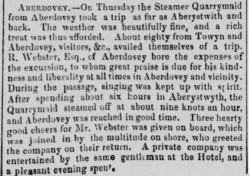
On one occasion, very late in her life, she was chartered for a pleasure cruise to Aberystwyth and back, as reported in the North Wales Chronicle and Advertiser:

ABERDOVEY.—On Thursday the Steamer Quarrymaid from Aberdovey took a trip as far as Aberystwyth and back. The weather was beautifully fine, and a rich treat was thus afforded. About eighty from Towyn and Aberdovey, visitors, &c., availed themselves of a trip, H. Webster, Esq,, of Aberdovey bore the expenses of the excursion, to whom great praise is due for his kindness and liberality at all times in Aberdovey and vicinity. During the passage, singing was kept up with spirit. After spending about six hours in Aberystwyth, the Quarrymaid steamed off at about nine knots an hour, and Aberdovey was reached in good time. Three hearty good cheers for Mr. Webster was given on board, which was joined in by the multitude on shore, who greeted the company on their return. A private company was entertained by the same gentleman at the Hotel, and a pleasant evening spent.

In 1865 she was sold, renamed Orcadia, and entered service in the Northern Isles of Orkney on March 29th 1865, remaining in service until 1868, when she was replaced by a larger steamer.

There is no record of where or when she was broken up or lost.  Perhaps she was scrapped after going out of service in 1868, but the above story about her taking a group of people on a jolly to Aberystwyth is dated 3rd September 1869, so perhaps she returned to Aberdovey to be be broken up, and this was the party to commemorate the event.  A guess.

If anyone knows of an image of her, please get in touch!
Update:  Thanks to  Dai Williams for the information that an earlier and bigger Quarrymaid was built at Pwlleli by William Jones.  Just to avoid confusion, here are a few details about the earlier ship.  She was a sailing schooner built in 1840, was 116 tons, and foundered in 1866 off Flamborough Head.  Jones built another ship, Quarryman, in the same year (source:  rhiw.com).


Sources:

Welsh Newspapers Online: https://newspapers.library.wales 

Carnarvon and Denbigh Herald
North Wales Chronicle and Advertiser
The Aberystwyth Observer

Deayton, A. 2015.  Steamers and Ferries of the Northern Isles.  Amberley Publishing Ltd
Hague, D.B. 1984.  A Guide to the Industrial Archaeology of Mid-Wales.
Lloyd, L. 1996.  A Real Little Seaport.  The Port of Aberdyfi and its People 1565-1920. Volume 1. ISBN-10 1874786488
Lloyd, L. 1996.  A Real Little Seaport.  The Port of Aberdyfi and its People 1565-1920. Volume 2. ISBN-10 1874786496
Morgan, D.W. 1948. Brief Glory. The Story of a Quest.  The Brython Press
Richards, J. 2007.  Maritime Wales.  Tempus

Eating well from what’s to hand, just for fun – Week 2

Glorious daffodils, the tiniest of the narcissi providing an amazingly powerful and lovely, heady scent.

I enjoyed my experiments with a new approach to shopping and cooking last week and learned a few things about myself.  Chief amongst these is that without knowing it, my basic approach to shopping and cooking has always been very ad hoc, and random, which is another way of saying that as a shopper and cook I am generally a seriously disorganized heap, very unsystematic.  Last week I sat down and planned a week’s worth of menus for myself based on what I had in the fridge, freezer and cupboards.  It’s how my Mum used to organize things, planning a week’s worth of menus, which must be vital when managing family dining, but not something I’ve really ever tried, except at Christmas.

The horrors of the coronavirus are there on the news every day, and I am very aware that this is a frightful, agonizing time for a lot of people.  I am trying not to add to that, and changing my disorganized shopping habits seemed essential, but I was surprised that it was something I enjoyed doing – for which I am deeply grateful.  So, onwards and upwards.

By Sunday I had, over a period of about a month, run out of spuds, carrots, broccoli, cheese, Greek yogurt, mushrooms, cream, cooking wine, bread and milk (the latter not a disaster, as I’m not a tea or coffee drinker), with a single lemon left to play with (sob!) and only a small amount of plain flour left, half a pack of cornflour and no other types of flour in the house.  By Wednesday I had also used up all the fruit but for one pear, salmon, olive oil, the last lemon, the remains of a heroic courgette (bless it, it carried on for three weeks and was still in great condition), asparagus, eggs, bread, and lemon squash (my equivalent of tea and coffee).  So I went shopping in Tywyn on Wednesday, just under two weeks after my previous shopping expedition.  As I used to shop around twice a week, that seems to count as some sort of achievement.  Those purchases, combined with the stuff still in my freezer,  should see me clear of shops for another fortnight, which helps with the social distancing.

Saturday

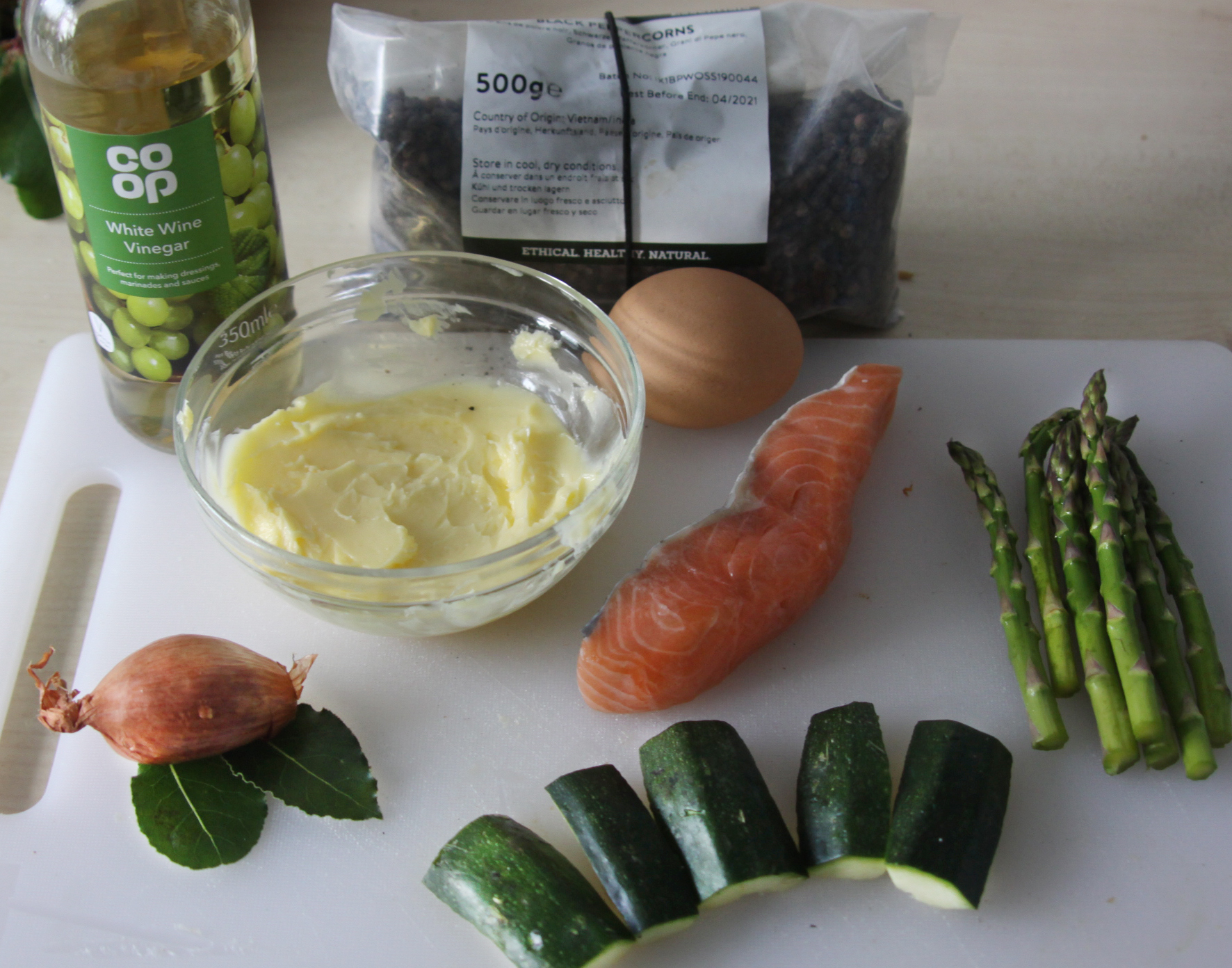
White wine vinegar, peppercorns, butter, an egg (from which only the yolk is required), a shallot, small bay leaves, a salmon fillet, asparagus tips and sliced courgette.

Poached fillet of salmon served with griddle asparagus, bacon bits, courgette and an Hollandaise sauce.  A small fillet of salmon was one of the unexpected finds when I did an inventory of the contents of my freezer.  A rumble in the fridge produced the last of some elderly asparagus and about a third of a courgette.  Asparagus and salmon are a marriage meade in heaven.  Usually I wrap the asparagus in Parma ham, but I didn’t have any.  So I decided to substitute a rasher of bacon, and slice it into strips after cooking, just to add some additional flavour.  I had a block of Welsh butter that was past its sell-by date, so this was an ideal choice.  Hollandaise is incredibly fattening, but pure luxury, and it ties together the salmon and the asparagus brilliantly.  A reasonable substitute would be mayonnaise.

An impromptu bain marie, at the back, with a glass bowl over a small saucepan of simmering water heats the sauce, reducing the chance of splitting, very much like cooking with chocolate.

Hollandaise is something that my Mum taught me how to do, using a traditional method, and it has only ever split on me once, ironically when I was on holiday in France and using a salt-free butter.  I have since found that you can use salt-free butter, but it must be added far more slowly than salted butter.  It is a bit of a faff doing it the traditional way, although it works, so you might want to have a look around for quick versions using melted butter, which a lot of chefs recommend.

Mum’s method is a two-part job, first reducing a combination of white wine vinegar, lemon juice, white wine, bay leaf and crushed peppercorns to a third of its volume.  Then, the reduced liquid is mixed in a glass bowl with egg yolk, placed over a pan of simmering water, and the butter is then added by chunks, incorporating each before adding another, until it emulsifies into a sauce (about five minutes).  Keep an ice cube to hand if you’re going to try this for the first time, because if it does start to split due to over-heating, you can rescue it by chucking in an ice cube and stirring until it rights itself, whereupon you retrieve the ice cube.  If it gets too thick, stir in small spoonfuls of cold water until it is the right consistency.  This recipe on the Leiths website is pretty much the same as mine, except that my glass bowl sits on a small saucepan of simmering water, ensuring that the bowl does is a good distance from the water (see my photo; the glass bowl sits on a small pan at the back of the hob).

Other than that, it’s dead simple.  I griddled everything in the one pan – the salmon, courgettes, asparagus and bacon, but a frying pan or grill are just as suitable.  In fact, there is always a danger with the griddle sticking, so make sure that everything is lightly coated with butter or oil before it goes on to a griddle, that the griddle pan itself is lightly oiled, and that the griddle is very hot.  It always slightly alarms me to see the griddle pan smoking, but it works perfectly.  The bacon strips were a bit of a wild experiment, and looked out of place on the plate, but were delicious with all the other ingredients.  Lucky!  I forgot to photograph the finished product, but the Hollandaise was a daffodil yellow, thanks to the combined colouring of a particularly rich egg yolk and the butter, and the texture was superbly silky.
Sunday

Chopped pork and laverbread sausages (skinned), low salt stock cubes, parmesan cheese (which I didn’t actually use in the end), garlic, tortellini, chopped onion, chopped skinned tomato, fennel, chillies and black pepper.

Deconstructed sausage, fennel seed, tomato and chilli sauce over pasta.  Years ago I saw this Jamie Oliver recipe in a food magazine and gave it a whirl.  His pregnant wife was addicted to it at the time, and he called it Jools’s Pregnant Pasta.  This version of it has been a quick-to-table favourite of mine ever since, especially when I am feeling lazy. The last of my stock of the Aberdovey butcher’s pork and laverbread sausages were the stars of this meal, although they were deconstructed (the sausage is extracted from the cases) to combine with the other sauce ingredients.  Again, it’s an easy meal, one of the easiest.  It would be even easier with tinned chopped tomatoes, whereas I use skinned fresh tomatoes whizzed up in a food processor.  Tinned ones are far too sweet for me, just a matter of preferences.

I think that Jamie Oliver does it with rigatoni but although I usually use tagliatelle, I needed to use up the tortellini that I used for the wild garlic pasta last week.  So it was just a matter of frying the onion, garlic and deconstructed sausage meat, sprinkling over some dried chillies, ground fennel seeds and some dry thyme (I don’t have dried oregano, but that’s better), and then adding the tomatoes and letting it simmer.  I also added a serious glug of Big Tom, a tomato drink with chilli and celery, because the tomatoes were rather tasteless even though they added useful texture.

Then I boiled the pasta and added it the sauce with a couple of spoons of the pasta water to loosen up the sauce, and it was job done.  I usually sprinkle fresh basil over it, or fresh oregano from the garden, but I have no basil and my oregano plant is looking very sorry for itself after the winter.

I had enough sauce left over for a second meal, so decided to have that on Wednesday, with two days in between to provide a reasonable gap.

Monday

Chicken, bacon and mixed vegetable casserole.  After a rumble in the freezer last week, I found the contents of a chicken, bacon, carrot, mushroom and frozen pea pie (i.e. leftovers).  Happily it worked just as well as a casserole. I made it about a week before the lockdown kicked in.  The chicken is browned with the mushrooms and chopped bacon and the veg.  Once softened slightly, flour is sprinkled over the top and stirred well to incorporate the flour.  White wine, chicken stock or water is then added.  It bubbles for 15 minutes with a large bay leaf, then a dollop of cream, some parsley and oregano.  All terribly easy, plonked into the freezer and ready to plonk into the oven when I wanted it.  I originally intended to top it with mash, but I had run out, so instead I served it with pointy cabbage, which seems to last forever in the salad draw of the fridge, and afterwards munched a beautiful William pear.

Tuesday

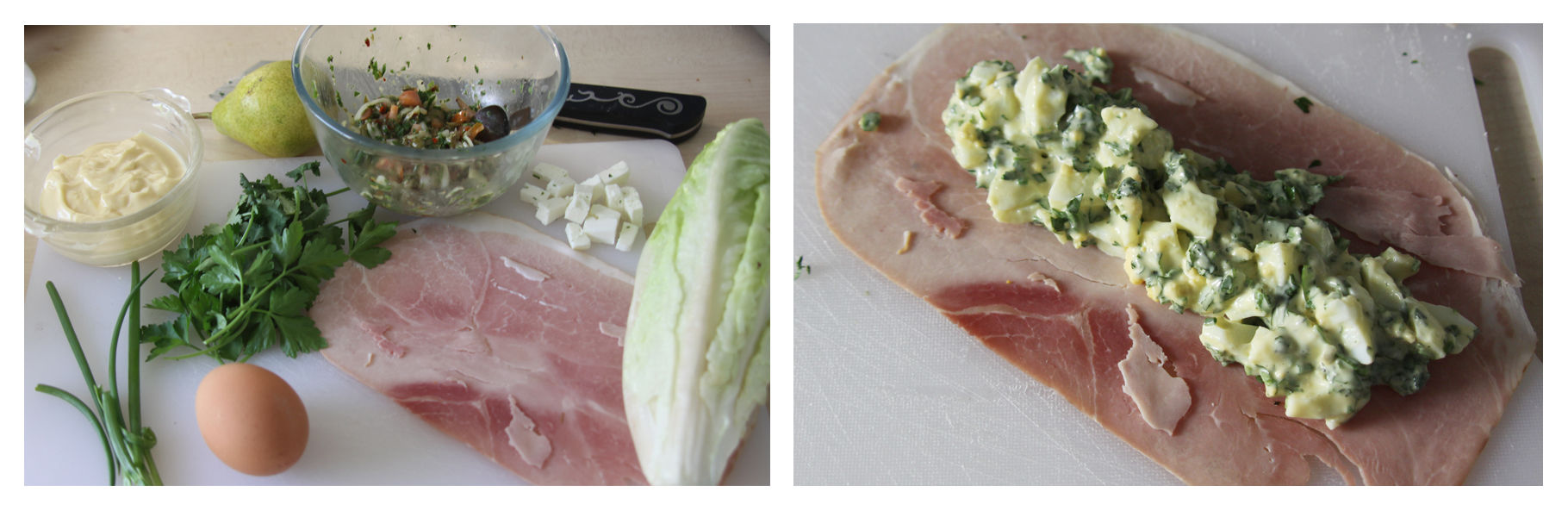
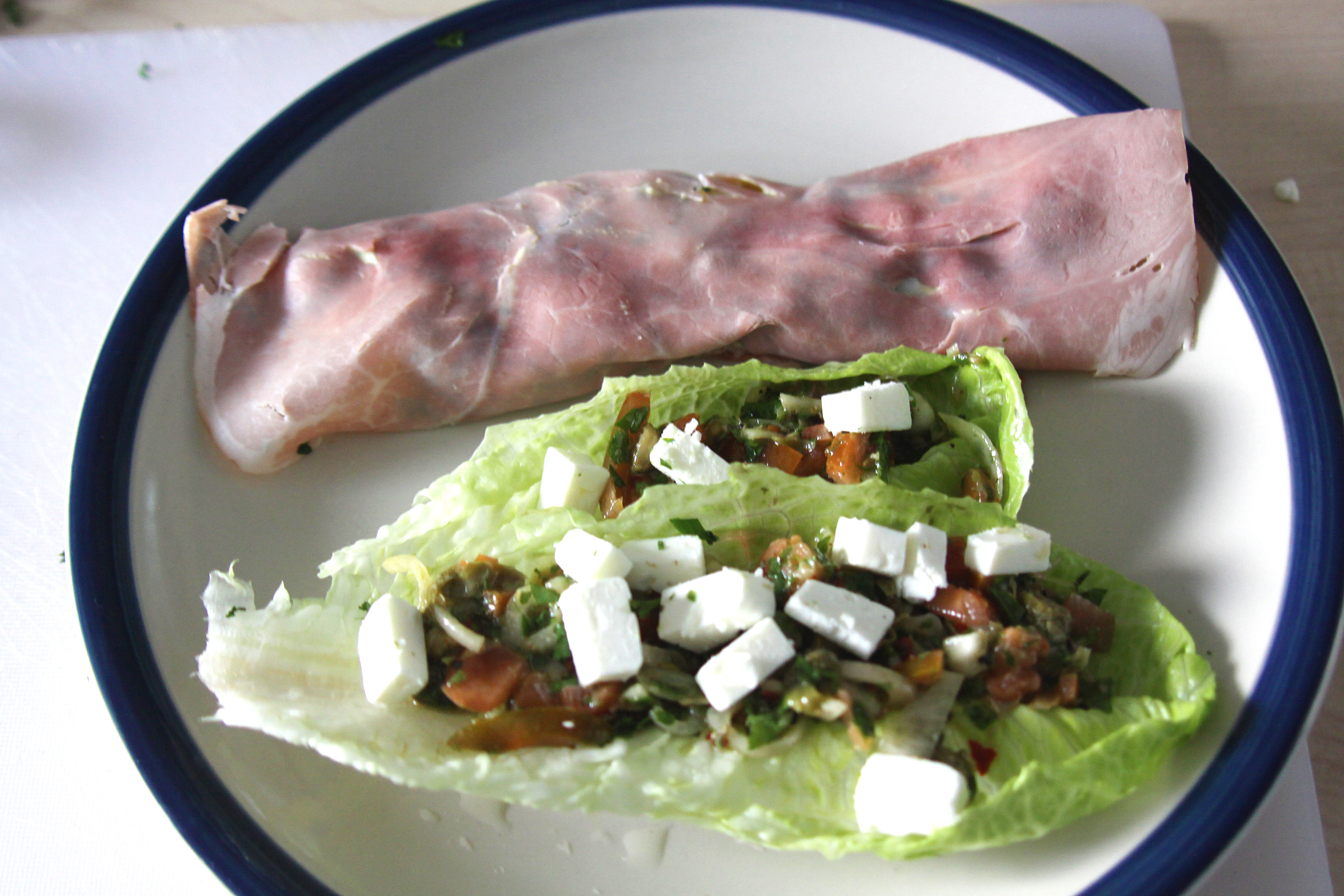
Ham horns with a diced salad on a bed of Romaine lettuce.  I bought romaine lettuce the week before last, and it had been sitting obediently in my fridge looking perfect, but I knew that it wouldn’t last forever.  It was perfect salad weather, sunshine and blue skies, so it time to switch gear from cooking hot dishes and getting on with assembling salad materials.

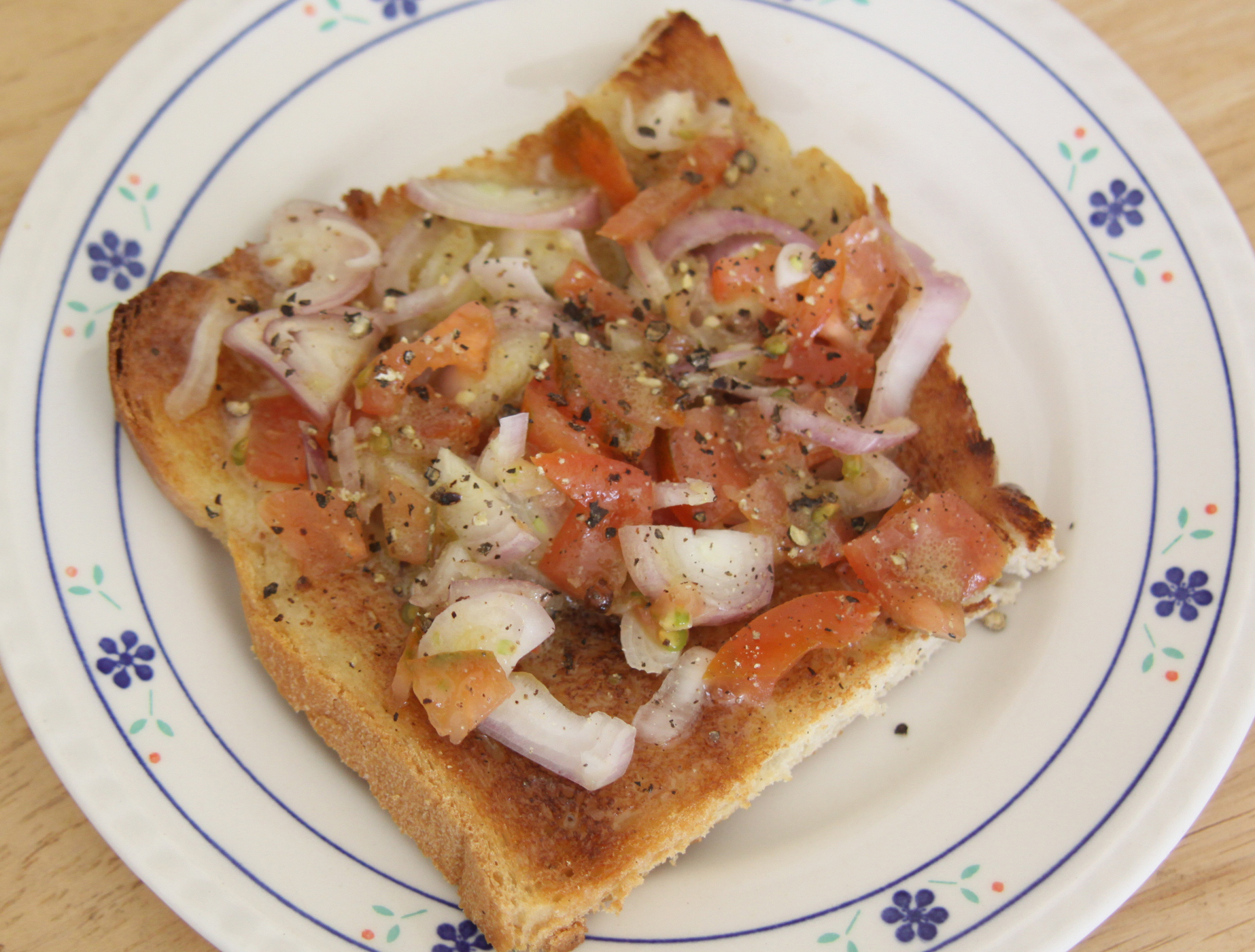
I usually have a slice of toast for breakfast and then something small for mid-afternoon if I feel like it, but often I go from toast to the evening meal without anything in between.  For some reason, on a Sunday I usually have brunch instead, and it is sometimes a simple tomato, raw onion (purple, Spanish or shallot) and caper mix plonked on toasted French or Italian bread (given the current situation, last Sunday it was a slice of Village Bakery Large Tin!).  The toasted bread is brushed with olive oil, and the salad mix is topped with a drizzle of vinaigrette made with German mustard, loads of black pepper, and basil if it’s available.  But that mix also makes a great salad when the bread is replaced by the sort of lettuce leaves that hold the other ingredients, like Romaine or little gem, which is what I did here.  Two Romaine leaves provided beautiful little vessesl for the other salad ingredients, including all of the above, plus chopped mint and cubes of feta.

Ham horns are an invention of my mother’s, and when she did them they were wider at the front an narrower at the back, hence horns, and looked great on the plate.  I can never get it right and have given up, so mine are simple tubes.  I made my own mayonnaise, but often use a good shop-bought mayo that I keep in the fridge for when I’m being lazy or don’t have any eggs.  Then it’s just a case of hard-boiling an egg and chopping it into a bowl of mayonnaise with as much parsley, chervil or coriander as you fancy, seasoning it (salt, pepper, perhaps paprika, cayenne or fennel seeds), spooning it into the middle of the ham, pulling the sides together and flipping it over so that the edges are underneath and the horn holds together.  The ham horns are incredibly filling so, apart from the salad, not much else is needed.

Wednesday

I extracted the second part of Sunday’s deconstructed sausage pasta, and enjoyed it just as much as I did when I first made it.  The chilli packed more of a punch, and the flavours had blended beautifully.   I made no changes, but if I had had a handful of spinach or wild garlic to hand, and basil to tear and throw over the top, I would have included them for both flavour and colour.  Tortellini always expands surprisingly during cooking, and I only just remembered on time, throwing in less than I had initially put out to use, which was just as well or there would have been a lot left over.

Thursday

Cauliflower, mushroom, bacon and pointy cabbage in a cheese and mustard sauce, with a crunchy breadcrumb topping.  It was a gloriously sunny day, and I really wondered whether such a winter-style meal was a good choice, but it all needed using up, so I went ahead.  In the event, at this time of year when the sun goes down the temperature drops dramatically, and a good hot one-pot wonder was ideal.  I always use this particular dish for using leftover vegetables and other odds and ends like ageing mushrooms, bits of ham and bacon, all of which were chucked in.  It can be cooked on the day or the day before.   It’s easy, but the cheese sauce needs a close eye keeping on it, and the cauliflower must be very well drained if it is not going to turn the gooey sauce to liquid.

I fry the mushroom and bacon in advance and let them cool.  The cauliflower (together with cauli leaves), cabbage, and any other leftover veg are steamed or boiled.  The cheese sauce starts with a butter and flour roux, to which chicken stock is slowly added until it is good and thick, making a velouté.  A good glug of milk is added, and then the cheeses go in.  I had some almost tasteless orange stuff (Leicester?  Gloucester?), an excellent cheddar, some very old parmesan and some sharp, citrusy feta.  I diced it all and chucked it in, and a gorgeous sauce emerged.  The cabbage and cauli were drained for 15 minutes to allow the steam to be released.  Then the cauli and cabbage were added with the bacon, mushrooms and sage, and it was all stirred together.  Beadcrumbs were sprinkled lavishly over the top, parmesan was grated over the top of that, chilli flakes were sprinkled, black pepper was grated, and a few dabs of butter were added to the top to help it brown in the oven, for 25 minutes.

To cut through the smooth richness and unctuousness, I made a small salad with cherry tomato, romaine lettuce, sliced cucumber, capers, mint leaves, basil leaves, loads of salt and pepper and an acidic mustard vinaigrette.  I always mean to eat my meal and salad simultaneously, but usually I end up eating them consecutively, with the salad making up a second course.

Friday

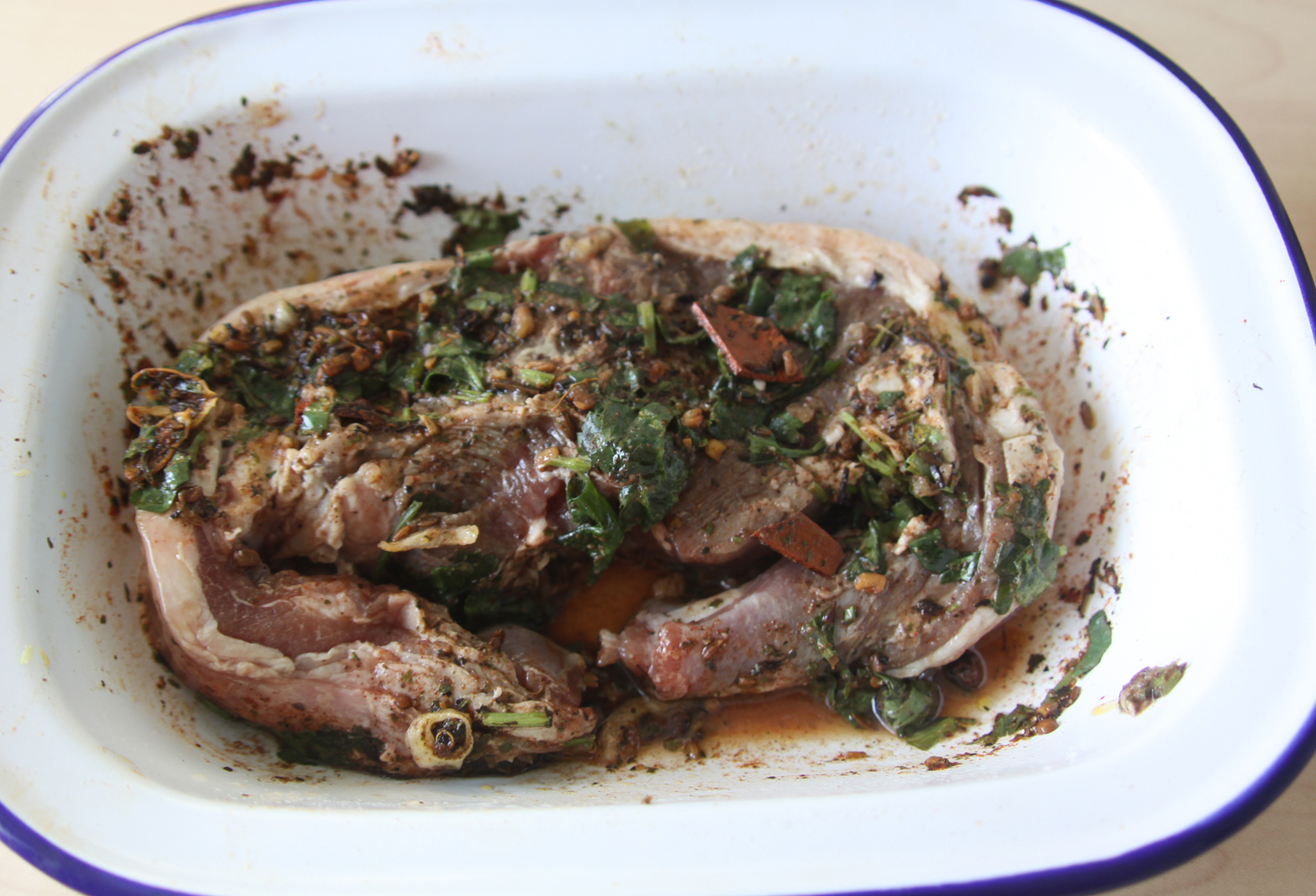
Lamb Shawarma.  Another ersatz meal.  It’s a simplified and scaled down version of a Yottam Ottolenghi recipe, from his excellent book Jerusalem, and needs to be prepared the day before you want to eat it, because the lamb needs to marinate in the spices overnight.  I found a disposable bbq in my garage so and was only cooking for one I used a double lamb chop from the freezer, instead of the long slow roast and a leg of lamb in Ottolenghi’s recipe.  The list of spices, shorter than Ottolenghi’s, looks intimidating if you don’t do this sort of cooking often but fear not – the Coey in Tywyn sells a Co-Op branded version of a Shawarma mix that is simpler than the usual mix, but is a good substitute; I like it for seriously cheering up chicken in a chicken salad.  However, here are the spices that I usually use, which are a shorter list than the original recipe:  cloves, cardamom pods, fennel seeds, cumin seeds, peppercorns, fenugreek seeds, star anise, chilli flakes, cassia bark (Ottolonghi uses cinnamon instead), paprika, ground ginger, ground sumac, fresh coriander and garlic.  Most are available, remarkably, in the Tywyn Co-Op.

The seeded spices are dry-fried or dry-roasted for a few minutes, then ground using a pestle and mortar and added to a small roasting tin with the powdered spices, fresh garlic and ginger.  I mix them with a small amount of olive oil and rub into the lamb, and leave in the fridge to marinate overnight.  If you like it hot, a good hit of Tabasco or an equivalent gives it more of a hit.  Then, when you want to eat it, it’s a simple matter of putting it on the bbq or in the oven. I barbecued mine, with chicken and sausages for quick wins during the week.  It is usually cut into pieces and served wrapped in flatbread or pitta, but I think that the bready wrap dulls the flavours and I like it served as it is, well seasoned, with a mixed Mediterranean salad, the same as yesterday’s, with added feta.  Lamb and feta are a blissful combination.  The whole lot, lamb and salad, is sprinkled with fresh coriander but if it’s not available, parsley and a serious squeeze of lemon juice are good.

Conclusions

I replenished my supplies on Wednesday and still have some other ingredients to be getting on with.  All of the older veg that was sitting in the fridge over the last couple of weeks was used up, either to eat fresh or to contribute to meals for the freezer, with some more still in the fridge and in respectable condition, so I think I’m winning so far. The problem for me was always going to be vegetables, as my freezer was already well stocked with meat and fish, and a couple of other odds and ends (frozen peas, ginger, okra, breadcrumbs etc).

My culinary ponderings at the end of this week are as follows.

  1. Substituting ingredients is surprisingly effective.  I’ve never put my mind to it before.  On a normal day, for the salmon meal I would have popped down to the shop and bought Parma ham and baby new potatoes.  But the courgettes were brilliant instead of the spuds, slightly caramelized, and the bacon, cut into strips, was surprisingly delicious.
  2. I used an egg yolk for the Hollandaise sauce, and should probably point out that the egg white can be used in another meal (for example, whisking the egg whites to peaks for cheese soufflé or a puffier French omelette, or for making my favourite, tempura batter).  Alternatively, it freezes perfectly, so it can be frozen down for future use.
  3. Again with the salmon meal, I intentionally cooked too much asparagus, as it as it was on its last legs.  I froze down what I didn’t eat for use in a future soup.  Cooked vegetables often give greater richness to soup than raw veg.
  4. If you don’t have either frozen pastry or the ingredients for making pastry for a pie, good alternatives are mashed potato over the top (as used in cottage pie) or sliced potato (for example in Lancashire stockpot).  In the absence of either pastry or spuds, breadcrumbs can turn the meal into a gratin, and failing all of that, the usual pie contents still make up a great casserole.  All new thinking to me.
  5. Right now, it is a good practice to hang on to stale bread, whizz it up in the food processor to make breadcrumbs and freeze them, and not just for gratins and crumbles or coating fish for frying.  In Spanish cuisine, breadcrumbs are a standard thickening for sauces and casseroles/stews, so if you’re short of flour or cornflour, it might be worth giving it a whirl.  The BBC Food website has loads more ideas: https://www.bbc.co.uk/food/breadcrumbs
  6. Tomatoes are always a problem for me.  I really dislike tinned tomatoes because they are far too sweet for me, so I usually make tomato-based sauces by skinning over-ripe fresh vine tomatoes and whizzing them up in the food processor or finely chopping them, but even doing that, the ones that are sold in the UK are often fairly bland.  Tomato paste, passata or sun-dried tomatoes can give bland tomatoes a useful lift.  More unusual solutions are bottles or cartons of tomato juice, sold in the drinks section, and Big Tom (a bottled tomato drink with celery and chilli).  These would need thickening up for most uses, but they are surprisingly effective as a fall-back, which I’ve used many times before.  Big Tom was used very successfully in last week’s Chicken Bamya and this week’s deconstructed sausage pasta, because the salad tomatoes that I was left with were useful for texture and colour but almost completely tasteless.

As the lockdown continues, many sincere thanks to our local infrastructure providers

Coronavirus has moved in and we have all had to move out of our usual patterns of life to accommodate it.  This would have been so much more difficult if certain essential services had not been maintained, as the weekly sound of the bins being emptied this  morning reminded me.  A very reassuring sound.

Whilst the NHS, health services and carers are doing such a splendid job for those in medical need, the rest of us would have come to a chaotic standstill without our other excellent local services.  These include impressively well-organized local food stores and pharmacies, the busy, super-efficient post office, our superb postmen (experiencing workloads comparable to Christmas), the invaluable drivers from the courier companies, and our absolutely splendid binmen.  All of them are carrying on seamlessly, lending an air of at least partial normality to these otherwise very peculiar times.

Thank you!


Aberdovey Twiddly Bits #10 – last one

Archaeology extrapolates from tiny details, individual objects and features, to engage in holistic discussions of livelihoods, societies, technologies, communal ideas, beliefs and long term change.  The constant shifting of thought and theory along a continuum from individual objects to generalizing overviews over time is not unique to archaeology, but is one of its defining features.  Similarly, with the “twiddly bits” series micro-details have been put at centre stage, highlighting individual elements that by themselves say very little about the context in which they were created, but when assembled together have an awful lot to say about the personality of Aberdovey as a whole.

Having found that I had enough photographs for 70 different images of diverse Aberdovey details (and more, but I judged it time to stop), I discovered that they had coalesced into a comment on Aberdovey that is a real compliment to its inhabitants from at least the 18th Century to the present day.  I am truly charmed and impressed by how much effort has been expended by individuals and institutions to give Aberdovey a really personal touch that encourages villagers to stay and newcomers to settle.

The term “twiddly bits” sounds, with hindsight, like a trivialization of all these little touches, but the series itself was intended to celebrate architects who built ornamental flourishes into buildings, businesses and institutions that added admirable public buildings and communal spaces to contribute to the identity of the village and, above all, those residents who added their own subtle decorative enhancements to homes and gardens to give Aberdovey warmth and character, and sometimes humour.  Together, these embellishments represent a lot of love and care, and they make the difference between a generic, insubstantial tourist resort and what we actually have, which is a splendid, functioning village supported by its residents.  These many tiny details are all the evidence one needs to state with confidence that residents invest both individual and collective pride in Aberdovey.  This is not a flimsy, candyfloss, summer-only tourist resort, it is a solid, feet-on-the-ground community, which has an amazing amount going on in the winter.  Aberdovey eclipses the image of an average seaside village precisely because so much personal investment has provided it with a very substantial, distinctive and utterly charming character.

I wrote all the above many weeks ago, and scheduled the post to go out at a future date, as I did with all the Twiddly Bits posts.  Coronavirus was not even a blip on the monitor, and we were all looking forward to a busy Easter followed by a great summer season.  My comments above seem to be even more pertinent, given how Aberdovey has pulled together and practised social distancing, whilst offering friendly support to neighbours.  It’s an odd atmosphere, but the community remains a community.  Second home owners have largely stayed away, and that’s a real kindness.

I have been asked to provide a “key” to the photographs by a couple of people, which I’ll produce shortly.

If anyone wants to walk and find these features, It might be something to do with older children?  Like the teddy bears in windows, but a lot more challenging.  I didn’t have any such thing in mind when I started the twiddly bits series, but if it would be helpful, it would be easy to convert the images into a document for printing off, with the key at the end. If anyone would like me to do so, please get in touch.

Each of these images represents a story, and it might be a fun community project to write the stories behind either some of these or other images that residents already have.


Aberdovey Butcher – phone orders

A great initiative from the Aberdyfi Butcher, shared from the Visit Aberdyfi Facebook page, with thanks:

Photograph sourced from Wikimedia.

Aberdyfi Butcher
ORDER AND COLLECT!
We are open Monday to Saturday 8am to 4pm
We are happy to take orders and payment over the phone, you can then pick up your order from outside the shop if you’d prefer (you can pull up in your car right outside the shop) then we’ll bring the order out to the car for you.  We have the usual meats, including our award winning sausages and home cured bacon, local cheeses, butter, eggs and vegetables.
Please phone 01654 767223
Please SUPPORT LOCAL in these difficult times, but foremost TAKE CARE of yourselves and others
Diolch

A very quiet walk on the Aberdovey beach

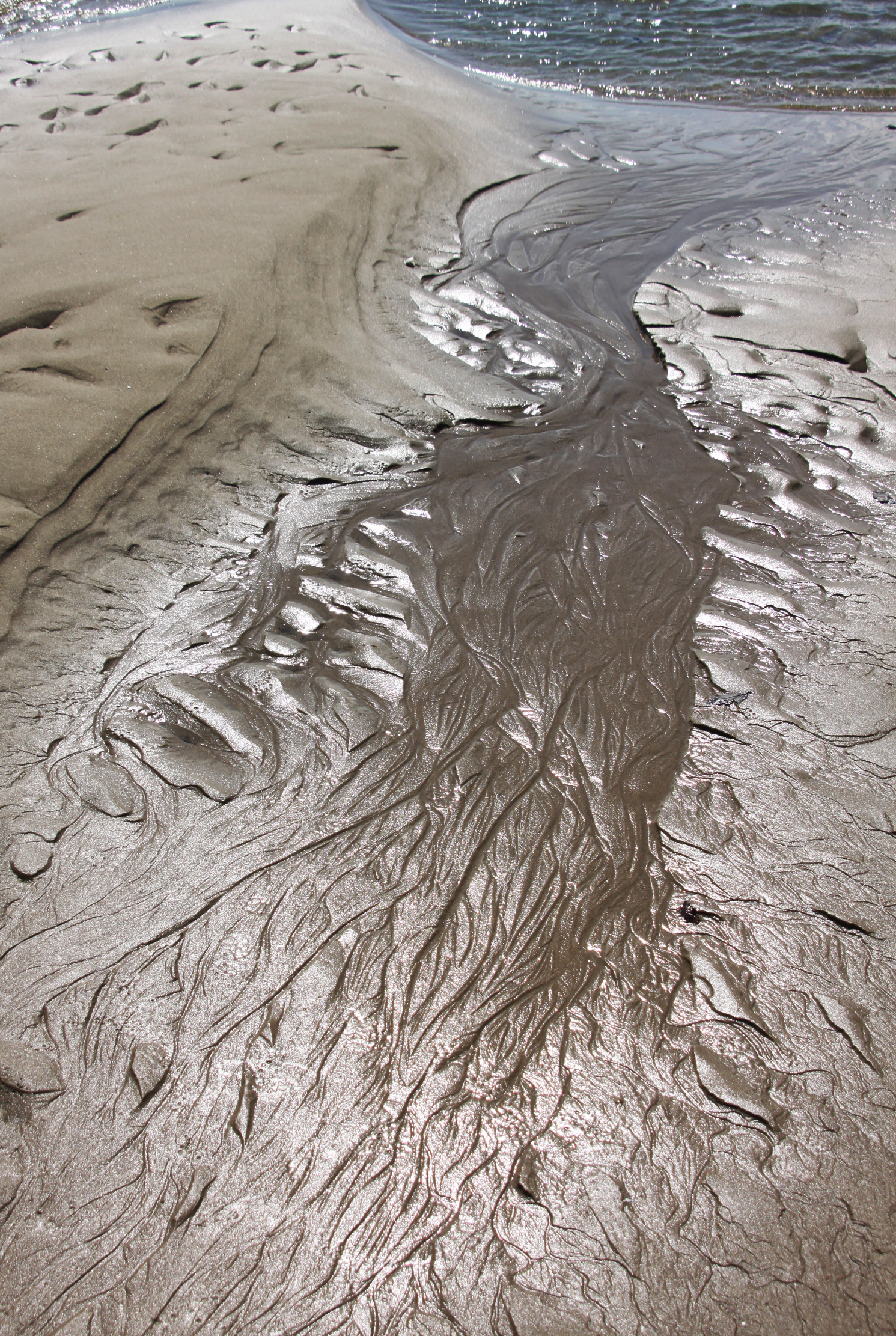
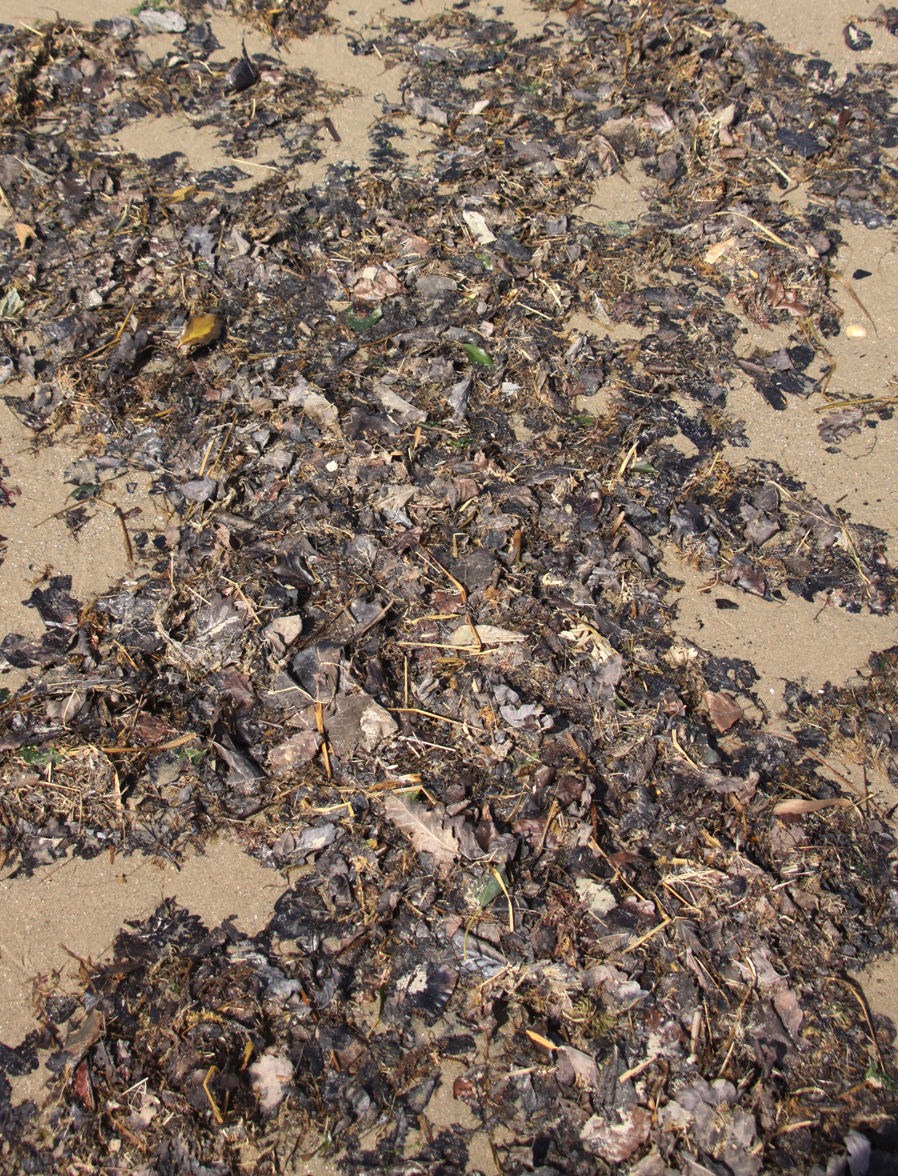
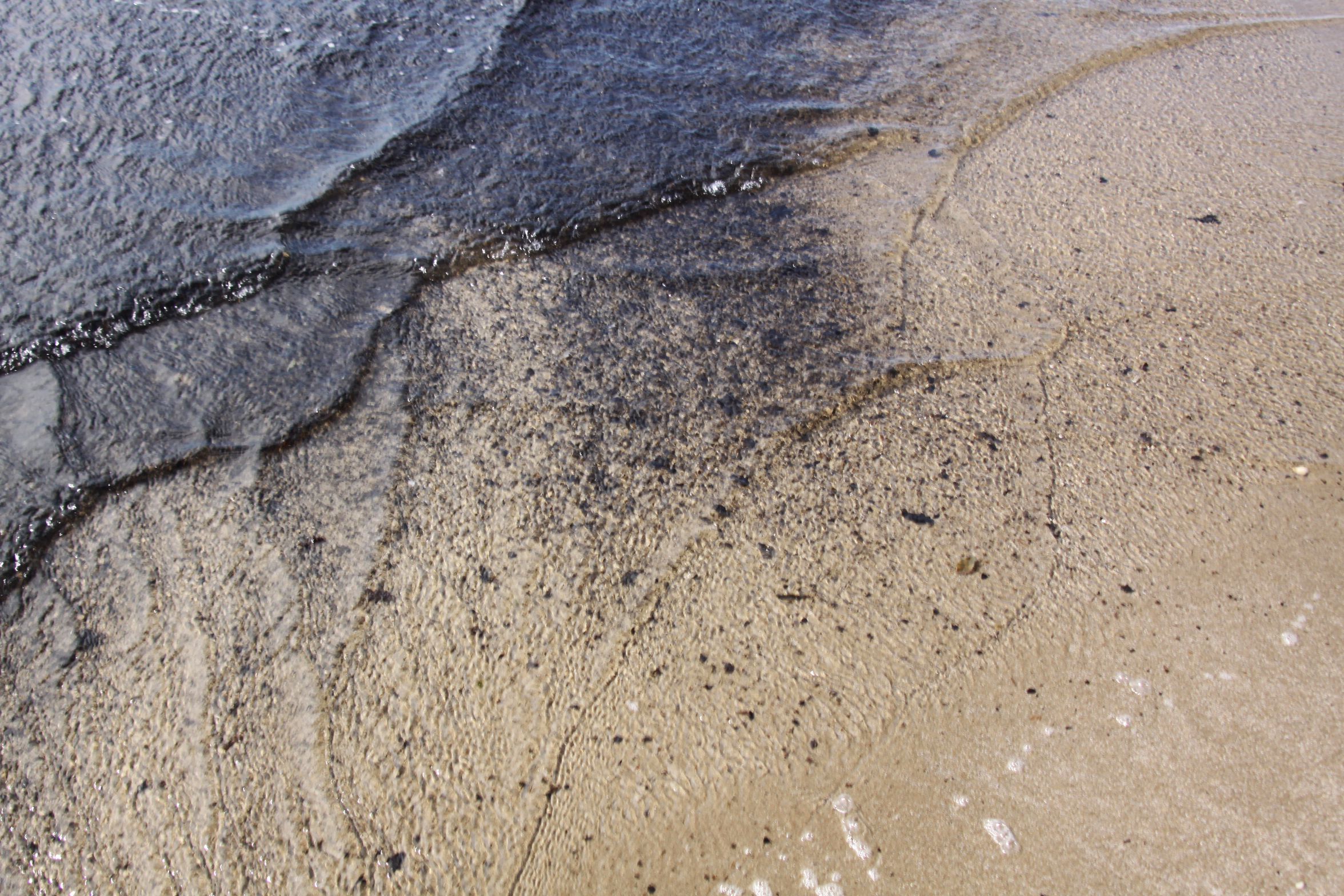
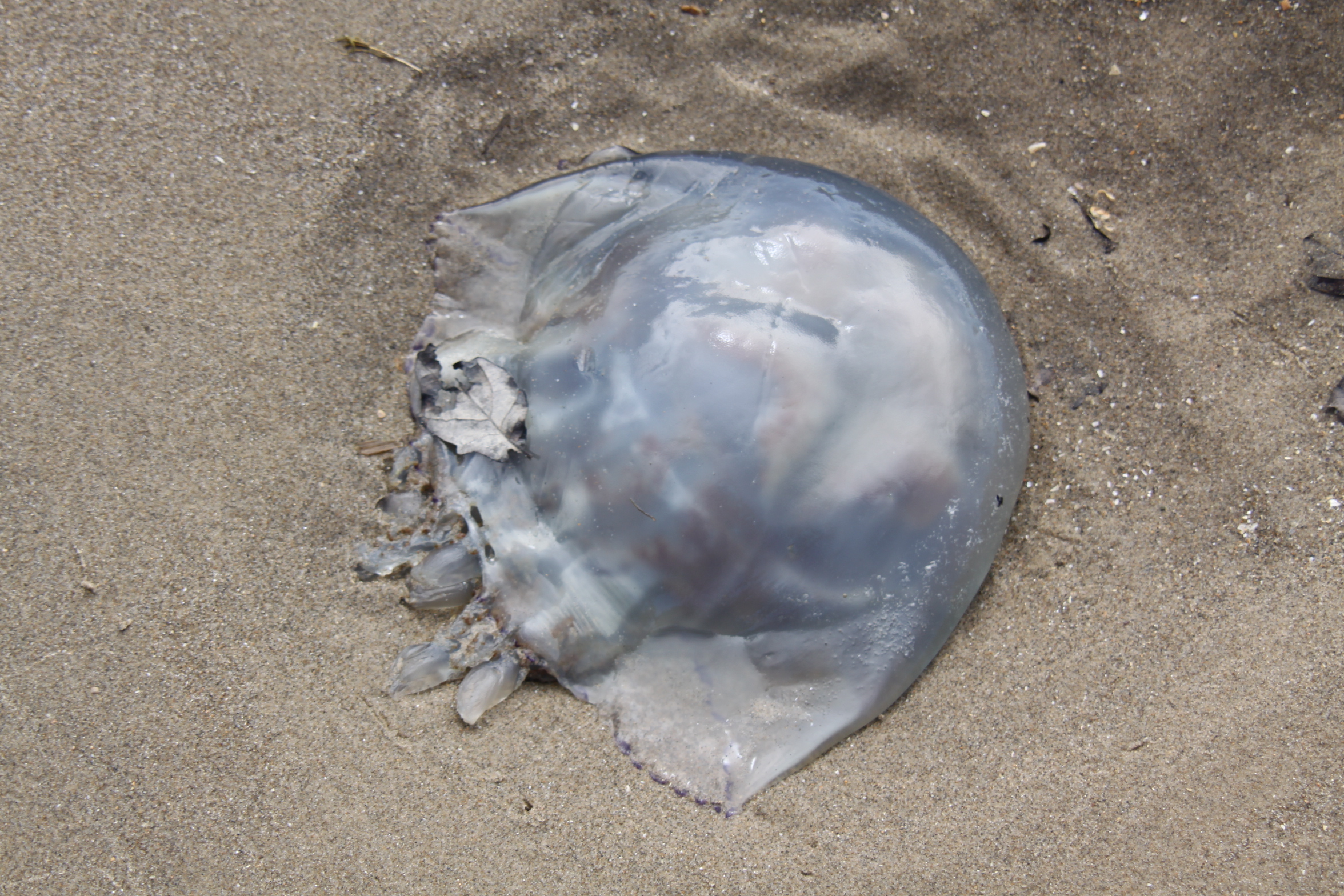
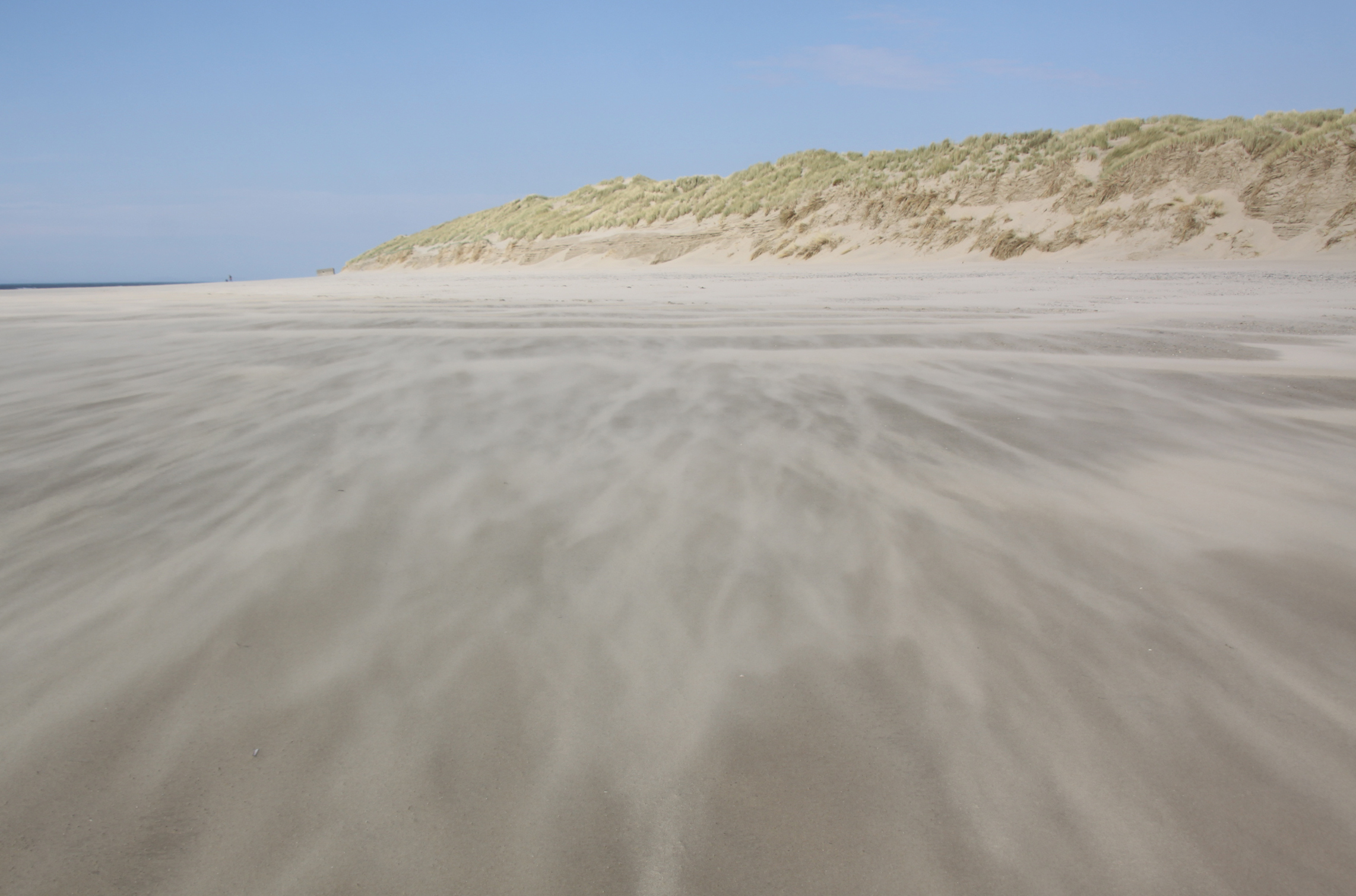
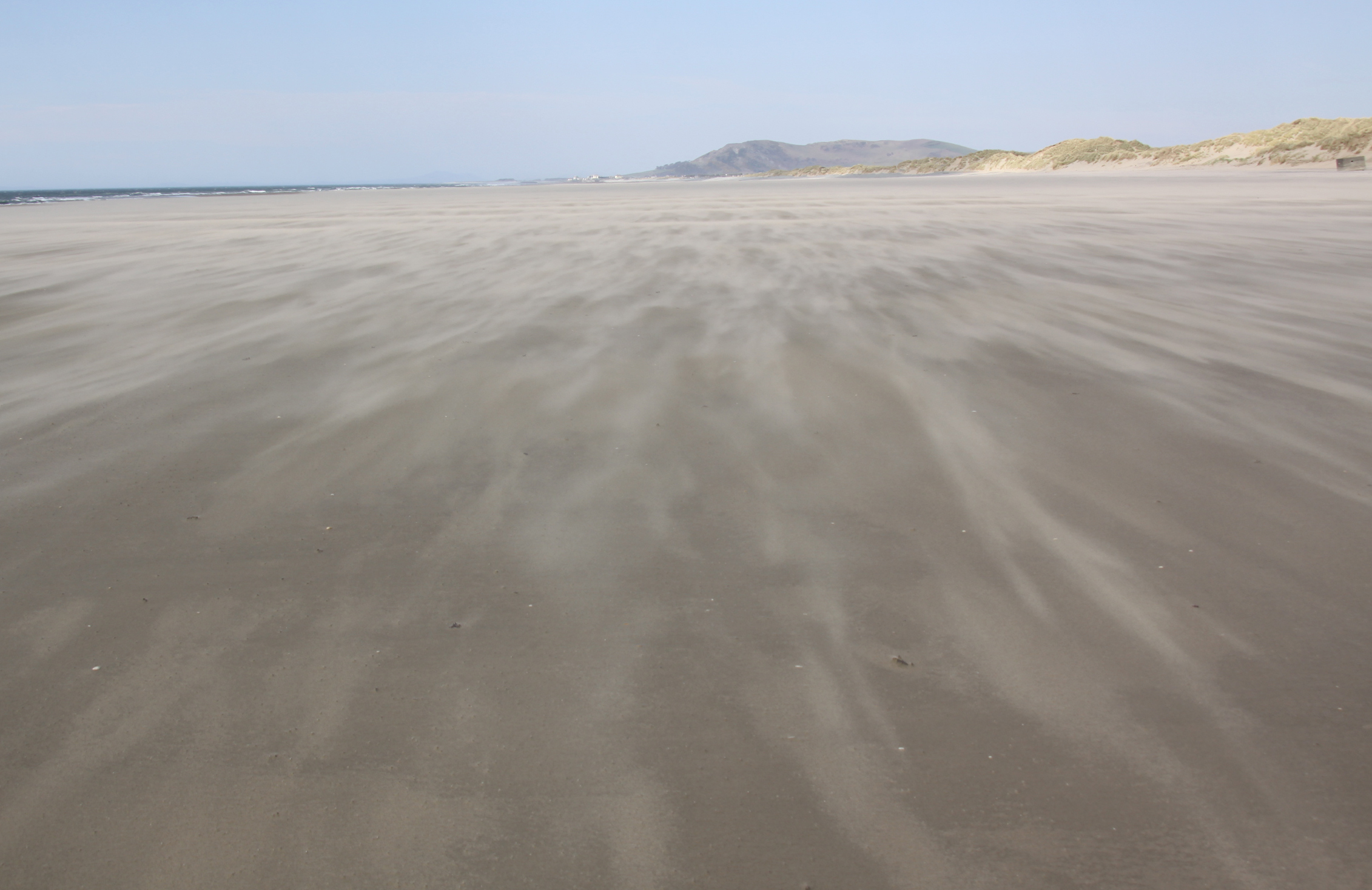
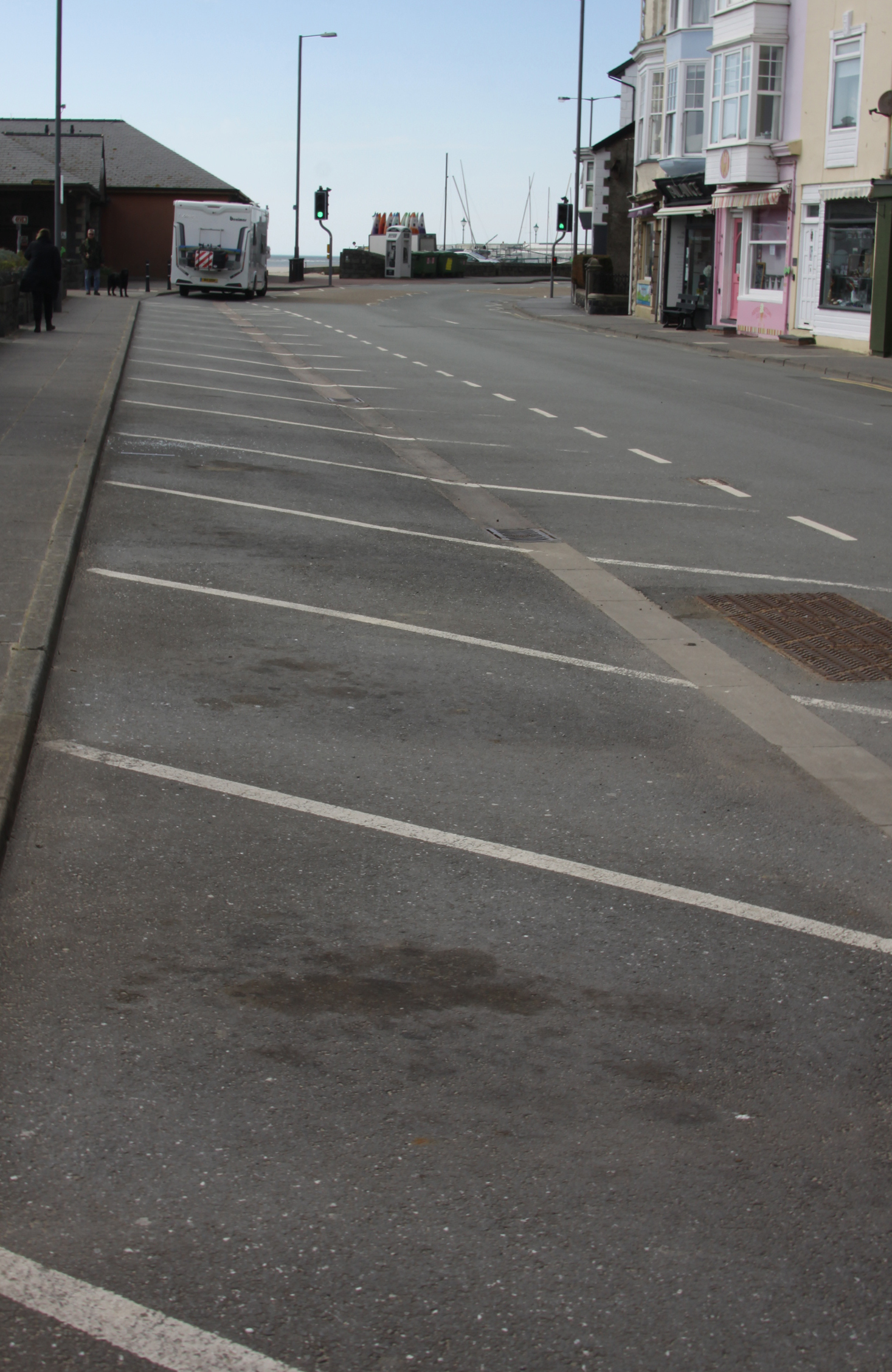
My usual exercise, not daily but a few times a week, is a simple circuit from where I live, wending my up to the top of Gwlefor Road, down onto the the main road and back up Balkan Hill.  I do like to do a longer walk at least once a week, and yesterday I decided to walk down Copper Hill Street and see if the beach was busy.  The line of diagonal parking places in front of the Snowdonia Information Centre was almost completely empty, something I have never seen before.  In spite of the sun, the beach was incredibly windy and there was absolutely no-one there.  As I went along the beach, reaching and turning back by the WWII pillbox, there were a four or five dog walkers and a couple who were clearly walking all the way to Tywyn, but it was eerie how empty it was on such a bright day.  The warm wind was so strong that all my clothes were flapping, and on the walk back I was leaning in to the wind, pushing my way back along the sand.  The dry sand was drifting in great tendrils a few inches across the beach, very beautiful.  The strandline was dominated by huge numbers of rotting leaves, mainly oak and beech, with some ivy.  At one point along the waterline the water was completely black as the leaves broke down in the water.  There were a lot of dead jellyfish, probably a barrel jellyfish (Rhizostoma pulmo).  It seems early, as they are usually a summer phenomenon, but last year I found one in mid-February.


Opening hours of the village shops

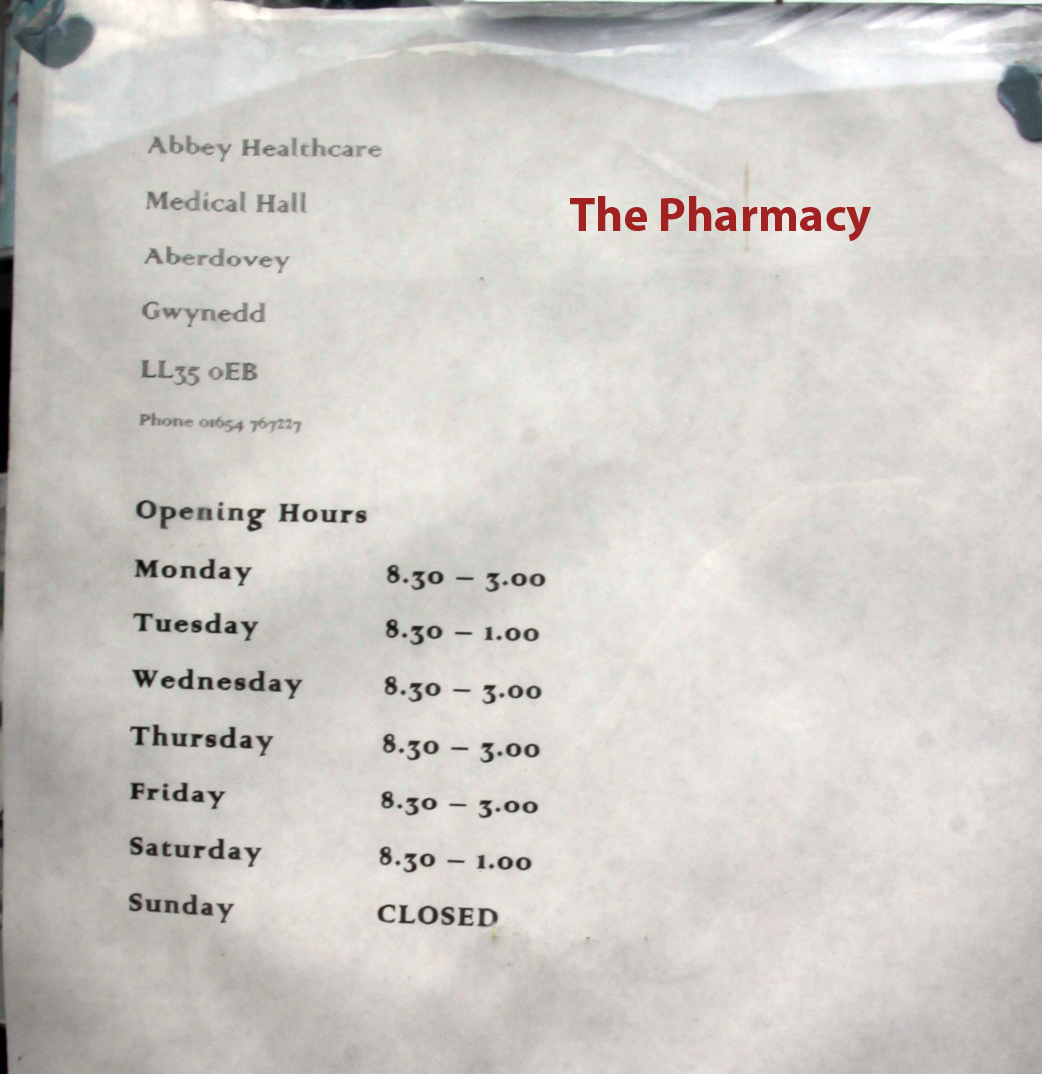
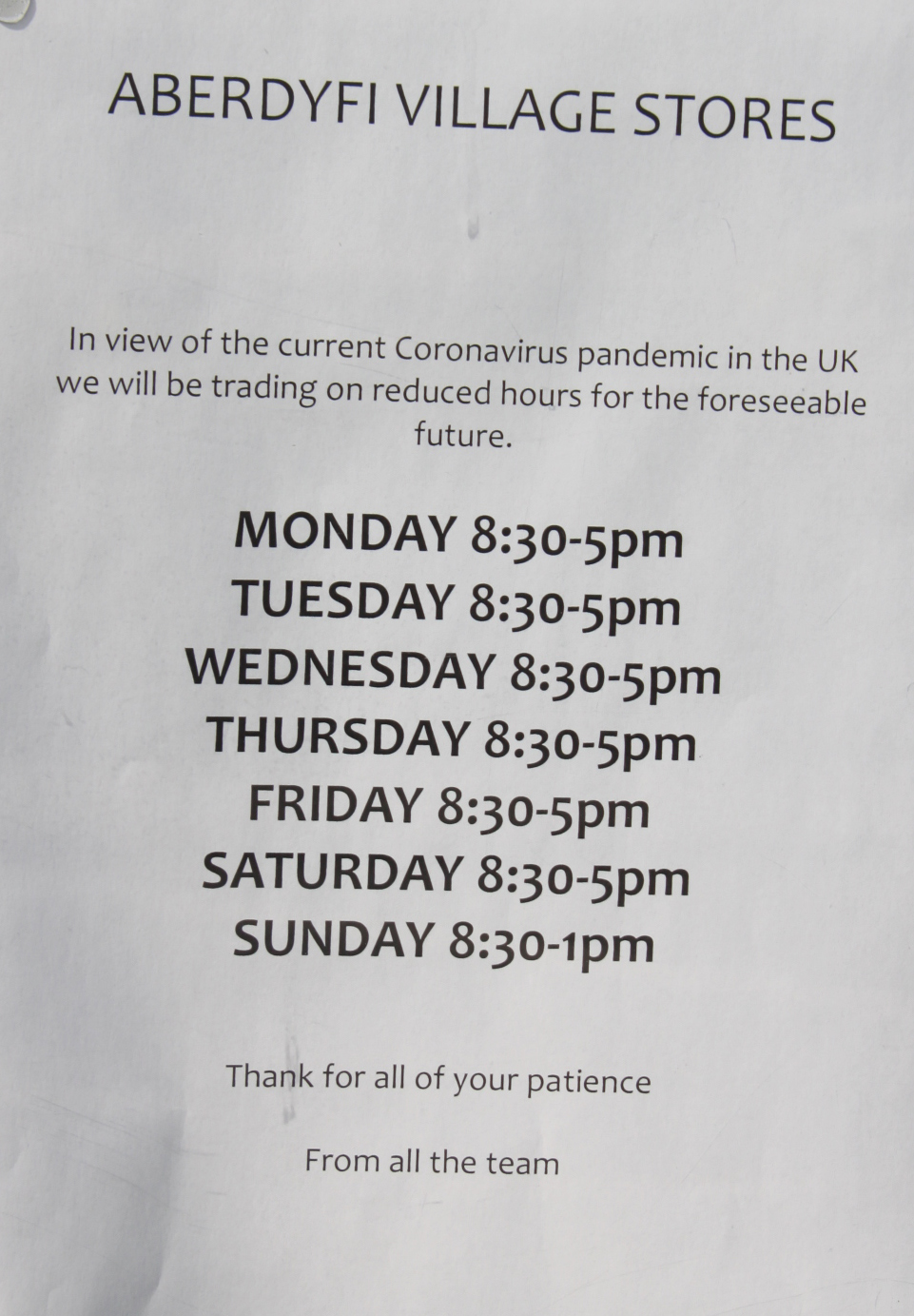
I only went past three food shops today in Aberdovey, and missed the Spar/Post Office, but here are some useful opening times, stuck to their front doors.  Of course they are subject to change.  Many thanks to them for continuing to provide an excellent service during trying times.