Author Archives: Andie

Eating well from what’s to hand, just for fun – Week 1

I thought that it might be fun to share some of my “use it up at all cost” experiments here, making use of just what happens to be in my fridge, freezer and/or store cupboard.  Although I rarely plan ahead regarding food, for me the game right now is to try and make everything I have last as long as possible so that I don’t have to shop again any time soon.  I’m not self-isolating but I have seriously bought into the social distancing message and the easiest way to reduce risk to everyone is minimize trips to supermarkets.  This is going to be more of a challenge as time goes on, and my freezer empties and I over-use my potted herbs, but I am intending to enjoy that challenge.

The freezer part of my fridge-freezer is not really big enough for my needs, particularly as I have always had the habit of batch-cooking meals and freezing them for days when I don’t feel like spending time in the kitchen.  It’s a matter of making sure that whenever I take something out and make a space, I cook something from items in the fridge to put back in the freezer, which is a good way of ensuring that fresh food is used and not thrown away.
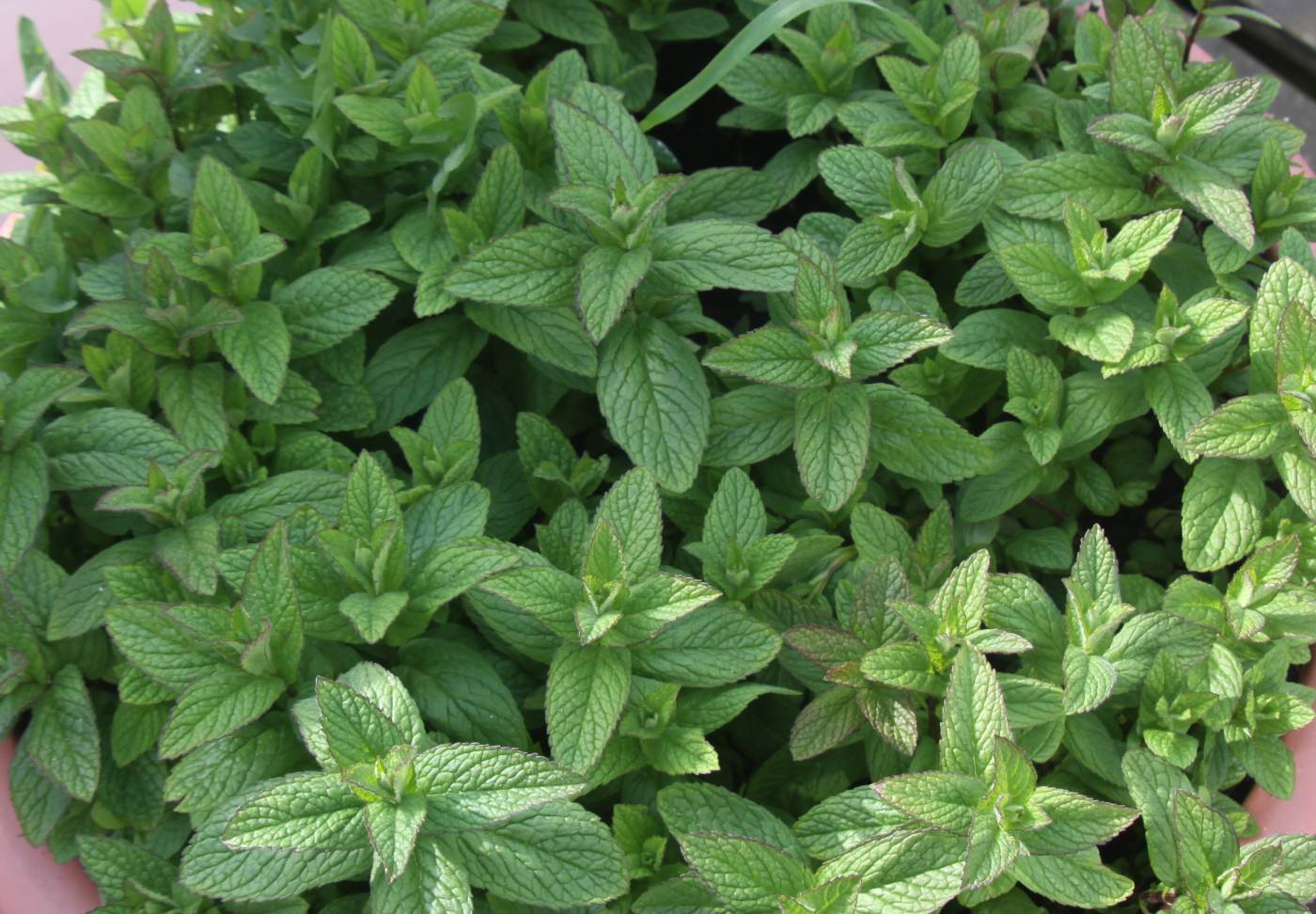
For the first time in a fortnight, I was compelled to go food shopping for on Friday, sporting latex gloves and maintaining a rigid 2m distance from all other shoppers, and everyone seemed to be acting responsibly.  I had been doing okay for meat and fish in the freezer but was very short of fresh veg and dairy, and there was plenty of both available.

As I already had some very old veg kicking round, just sad, random odds and ends that I needed to use up, my priority was to find ways of using those.  For one thing I haveMaris Piper spuds that are sprouting terribly (even though I keep them cool and in the dark) because you can only buy them in huge packs and I don’t use them that often.  Two rather superannuated leeks, a bit dry at the ends, and some just-starting-to-wrinkle mushrooms were still usable.  A single courgette was perfect, but well past its sell-by date.  If you are staring at some rather sad, must-be-used and apparently incompatible ingredients in your fridge, and wondering what on earth to do, you might try typing some of those ingredients into the BBC Food website’s search facility, an absolute mainstay of mine to find recipes that use up random ingredients:  https://www.bbc.co.uk/food/search.

Friday
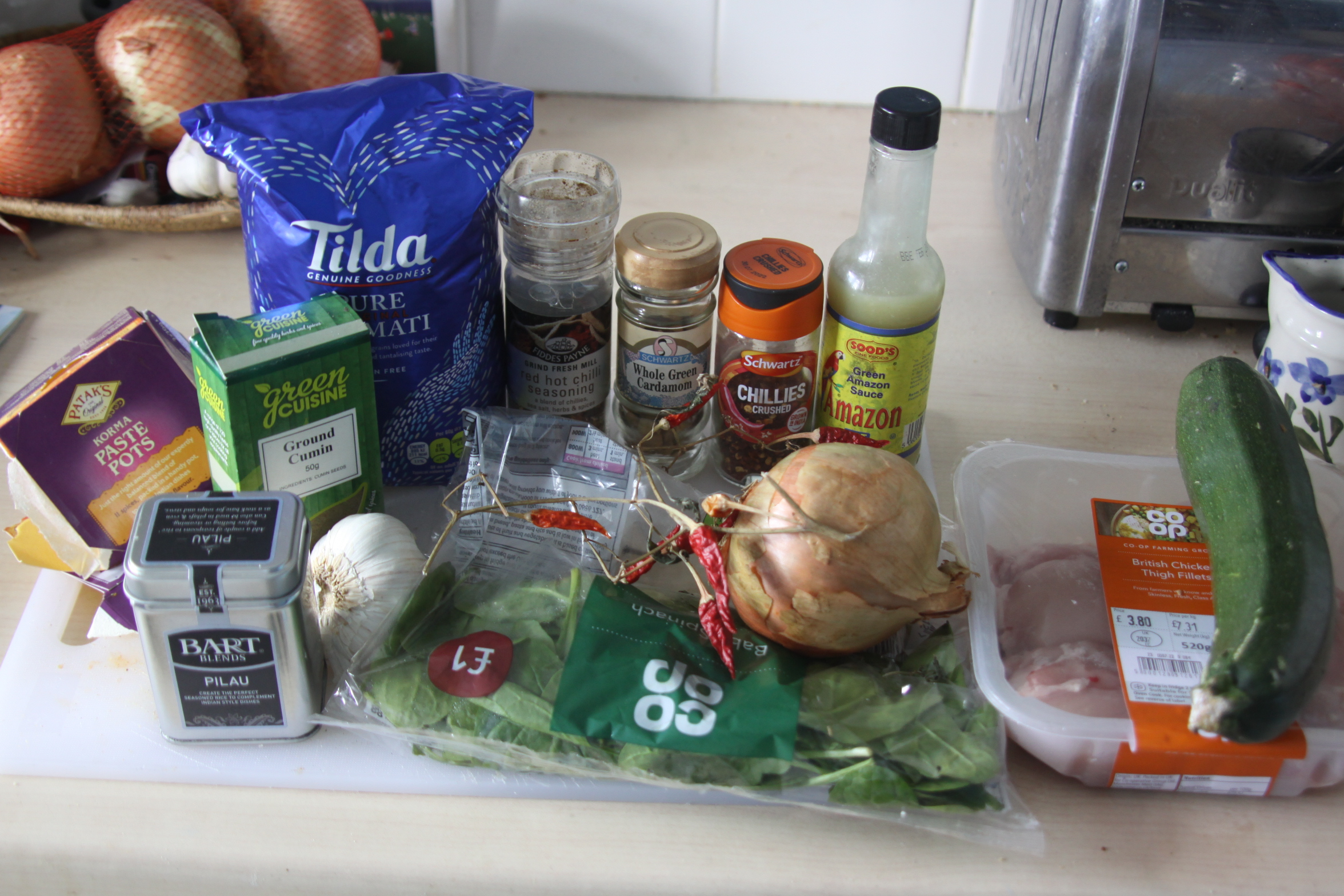
Ersatz chicken curry.  A curry seemed to be called for.  So today’s extravaganza was an ersatz chicken curry, Patak’s Korma paste from a jar, which is such a cheat but is a very handy store cupboard ingredient.  I messed around with it to make it a lot spicier, hotter and un-Korma like, and added Greek yogurt instead of coconut, which I detest.  It could be done equally well with lamb, beef, pork, king prawns or mixed veg.

After tossing the chicken thighs in oil, browning, I added six cardamoms and seriously good amount of cumin to the pan, then the roughly diced onions, courgette, an elderly spud and and two stray mushrooms that I found, bewilderingly, in the salad draw.  Courgette is a wonderful component, as it soaks up the flavours terrifically and has a lovely texture of its own.  Usually I reduce the onions to a pulp prior to adding, but as I had the paste, and to make the meal go further, I diced them to use them as a veg rather than a base.  There was a tiny thumb of dried ginger left over in the fridge, so that went in.  I tossed it all together for a few minutes, and then added the korma paste and water.  No fresh chillis, but the dried ones did the trick, and there was hot chilli sauce on standby.  Half an hour before the end I tipped in a dollop of the yogurt and some leftover baby spinach leaves.
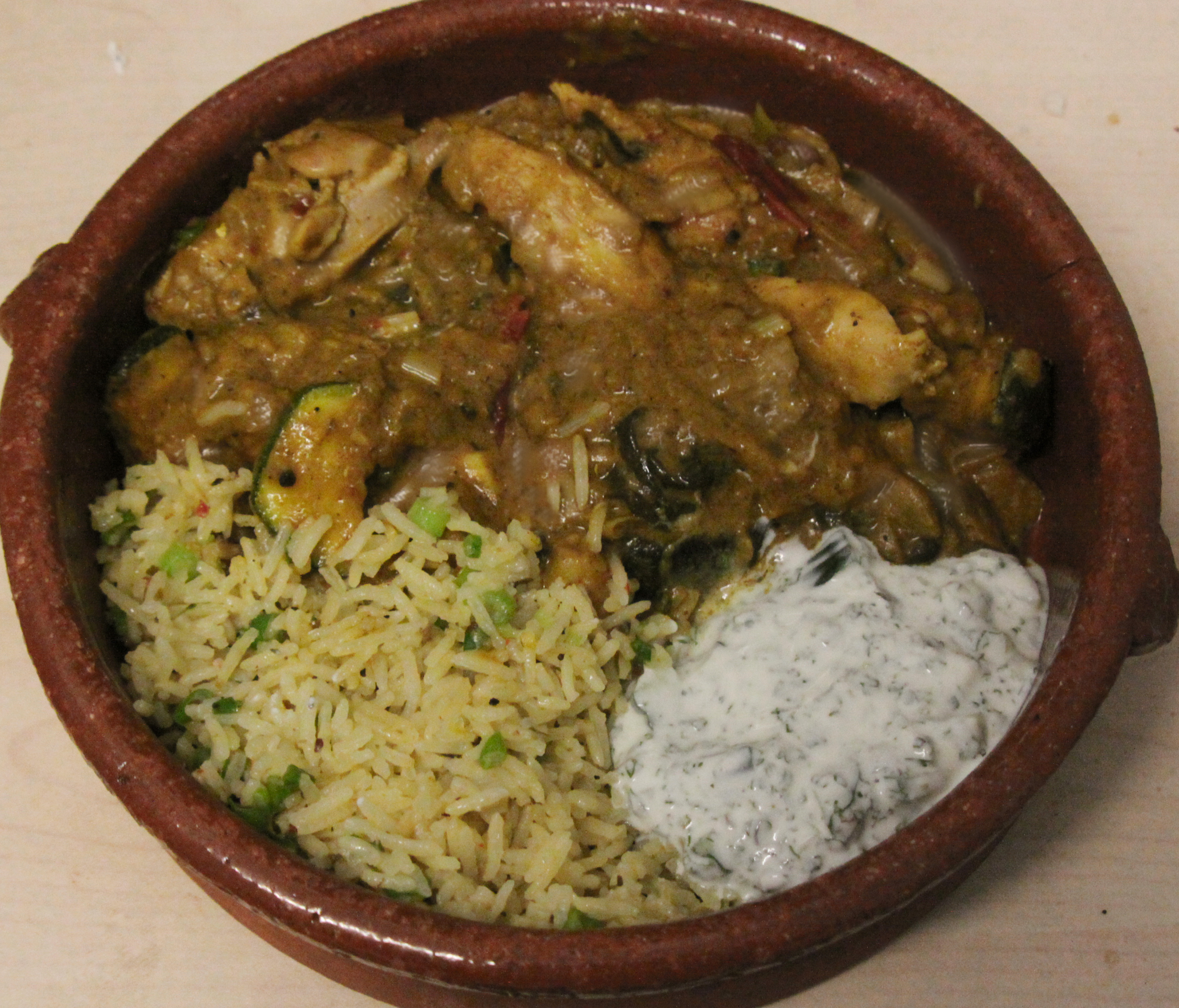
The rice was fried with a good amount of the Bart mix of pilau spices (available from the Tywyn Co-Op) before boiling.  Just before serving I tossed in some home-grown chopped chives.

In spite of the lack of fresh coriander, the result of all this somewhat arbitrary activity was really rather delish, with a good squeeze of lemon juice over the curry, and all served with a dollop of divinely creamy Greek-style yogurt (from a producer in North Wales, Llaeth Y llan) mixed with mint and finely diced cucumber, a sort of Greek-Welsh raitha.  The Spar in Tywyn is usually a very good source of mint and other fresh herbs, not sure how they are coping at the moment.  The whole thing was incredibly faux, but I seriously enjoyed it.  By having used the extra odds and ends of leftover geriatric veg to fill out the chicken, I have enough for another meal.

Saturday
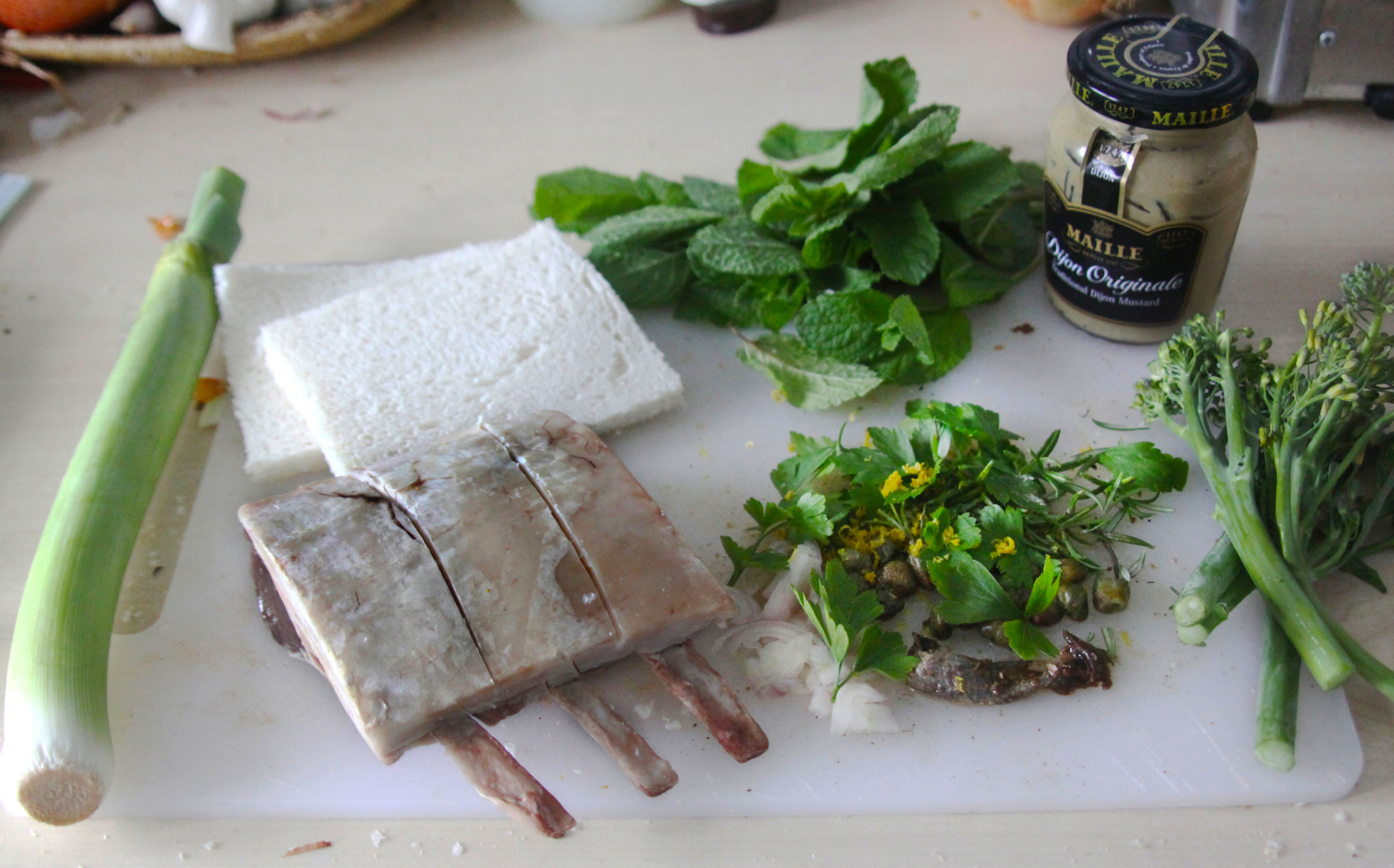
Roast rack of lamb with herb and mustard crust, served with leeks, tender stem broccolli, Chantenay carrots and roast potato.  Saturday was my birthday, and I usually celebrate by going out to dinner, but under current conditions the best of the remaining options was to stay put, so I treated myself to a roast, which is not usually a one-person meal.  I had a rack of lamb in the freezer, mint growing in a pot in the garden (spectacularly early for its height and spread, but full of flavour), an ancient spud for roasting, a leek, leeks being obligatory as an accompaniment to lamb in my book, a pack of slightly yellowing tender stem broccoli (it is quite new but doesn’t last well in the fridge), two Chantenay carrots, halved (which do last brilliantly in the fridge but were distinctly on the edge), an old spud for roasting, and some lamb stock from the freezer.
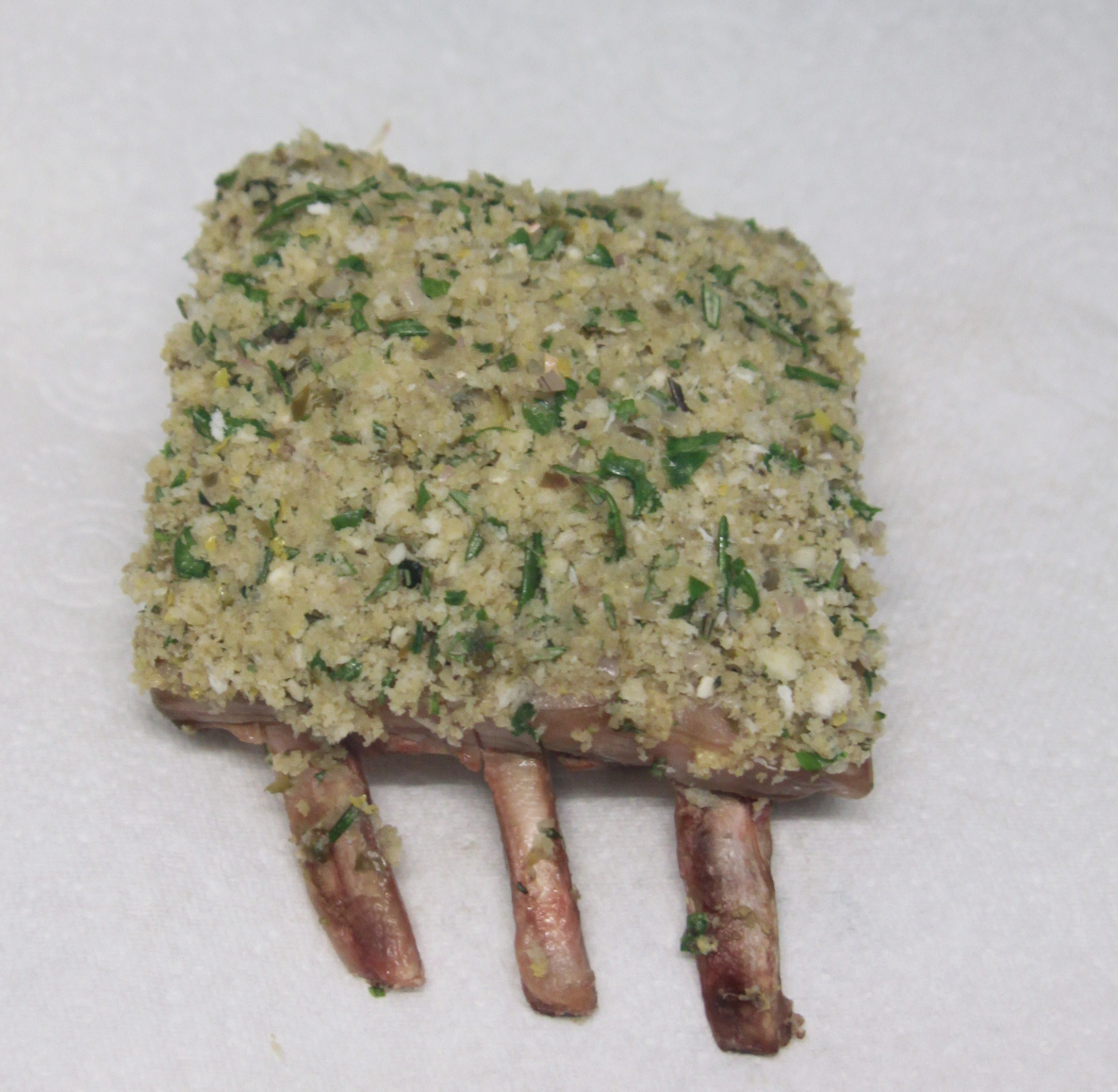
The briefly pan-fried lamb was provided with a crust (whizzed-up fresh and panko breadcrumbs, lemon zest, anchovy, parsley, rosemary, a clove of garlic and capers), stuck on to the lamb with Dijon mustard.  When I run out of lemons, I am going to try replacing lemon zest with sumac, a dried and ground berry from the Mediterranean that has a strong citrus hit and is great on salad and chicken.

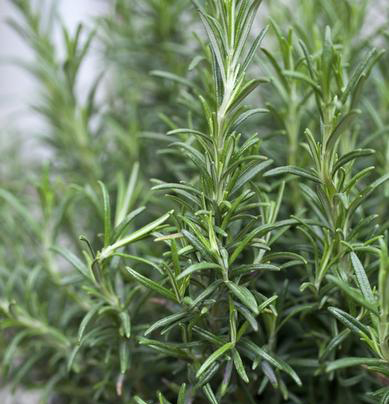
The mint and caper sauce, with a dollop of wholegrain mustard was swiftly compiled, and the lamb was roasted in a medium oven for 20 minutes, emerging pink in the middle.  The home made lamb gravy came out of the freezer, and I put in a sprig of rosemary for extra flavour.
There was plenty of lamb left over for another day, and I made too much mint sauce so froze the rest down.  It freezes really well as a back-up for when fresh mint is unavailable.  The lamb bones also went into the freezer, for making stock when I have enough other ingredients.

Whilst the lamb was cooking I boiled up the rest of my ancient spuds, mashed them with butter, milk, home-grown chives and parsley, and batch-froze them.  Then I simmered and peeled some ageing and squidgy tomatoes, mushed them in the food processor and put them in the freezer to use as a base for Mediterranean sauces.

Basically, I spent most of my birthday cooking :-).  I haven’t done that for a long time, and it was terrific fun.  A very Happy Birthday to me!

Sunday
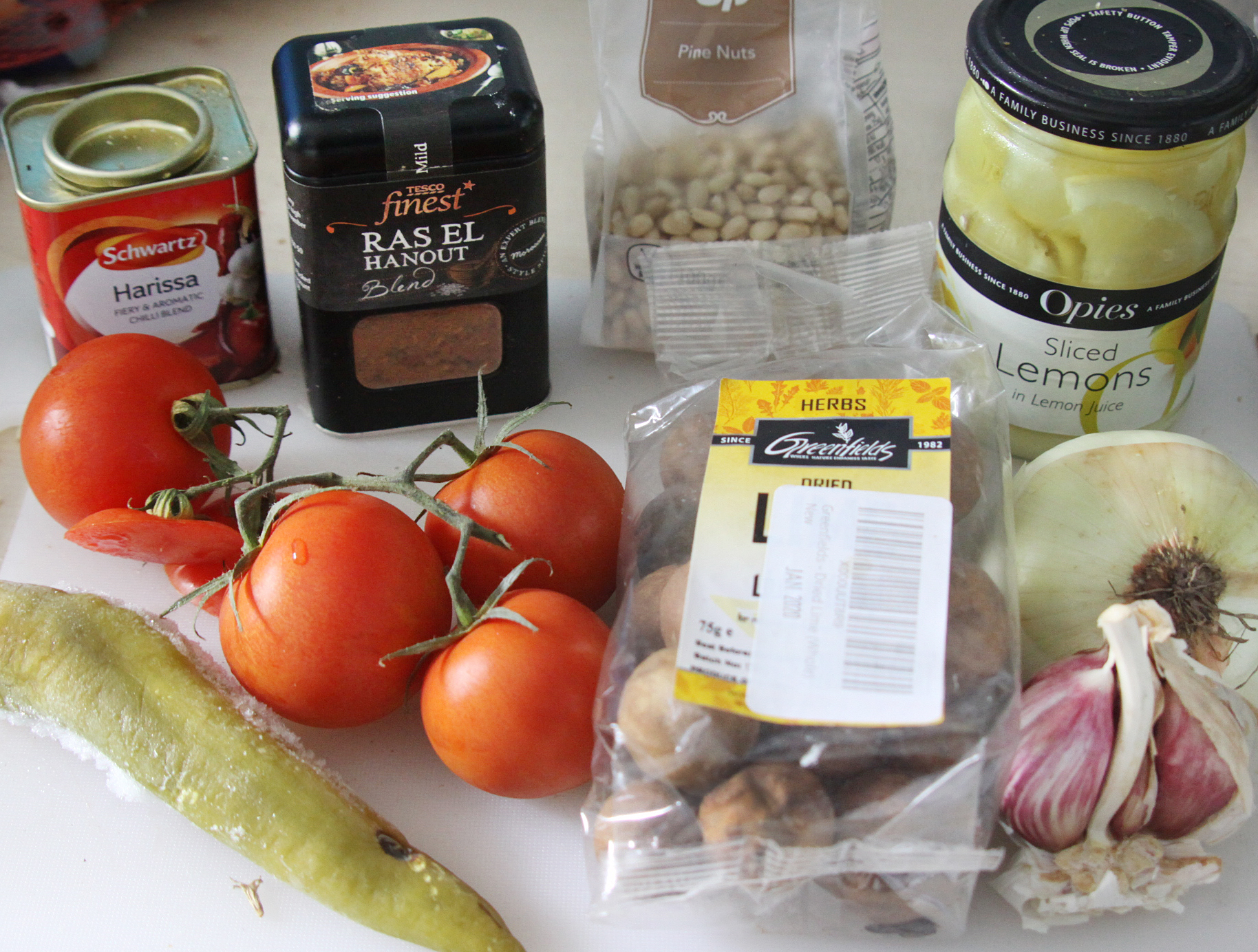
Chicken bamya.  Although I have used chicken here, this is usually done with lamb, but a vegetarian version with aubergine, courgette and potato chunks, hard boiled eggs and mild chillis is also good.  I had two filleted chicken thighs that I needed to use up so did a meal that Iinstead of lamb.  It’s a dish I first fell in love with in Egypt and, when I returned, re-invented for myself.  It should be marinated overnight, but the chicken needed using so it only had a couple of hours.  It still tasted great.  The great advantage of it is that it is peasant cooking, one-pot and easy, superb done in the slow cooker.  Bamya means okra/bhindi, but a common substitute is green beans.  As it happens, I had some frozen Turkish okra in the freezer, but when they are gone they are gone, because my father buys them for me from a specialist shop near where he lives.  Ditto for the last mild green giant Turkish chilli that went in.  The spices, a harissa mix and a ras al-hanout mix are all usually available in supermarkets, and I cannot imagine that there’s a rush on them even at the moment.
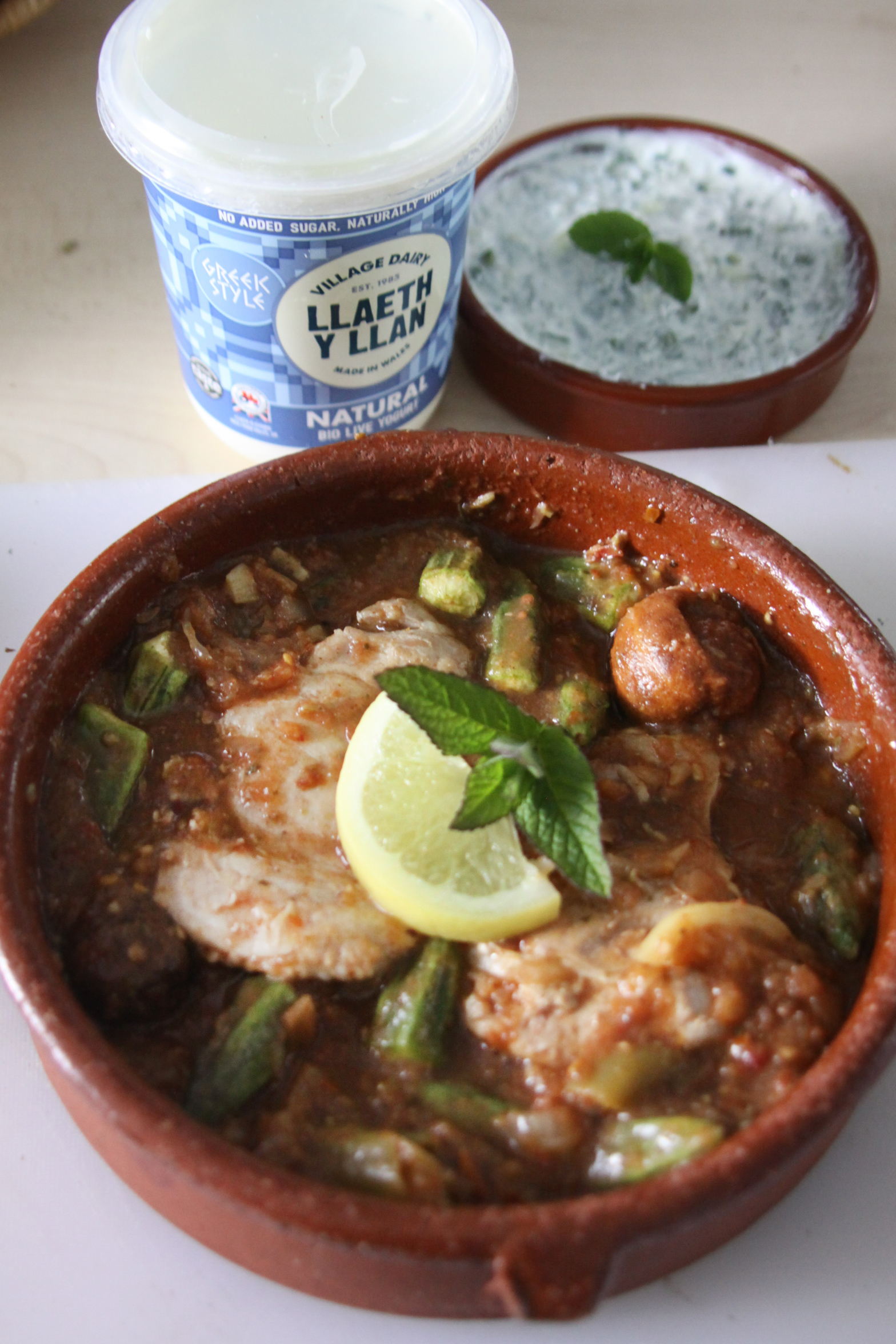
The chicken thighs are browned whole and then added to a baking dish or the slow cooker.  Onion, garlic and chillis are diced and cooked in oil until translucent, when the spices are added.  After a few minutes, whizzed-up or finely-chopped skinned tomatoes are added to the pan. These are heated for a few minutes to allow the flavours to merge, and then join the chicken.  A crushed ginger cube to stand in for fresh ginger  (fabulous, from the frozen section in Morrison’s if you ever get to one) was also stirred in.  The additions of dried limes and preserved lemons are just a matter of taste, but if I leave them out I wouldn’t dream of eating this without a big squeeze of lemon juice over the whole thing. The okra, fresh or frozen, go in just 15 minutes before the end of the cooking time.   Fresh okra should be topped and tailed.  If using green beans instead, they need about an hour.
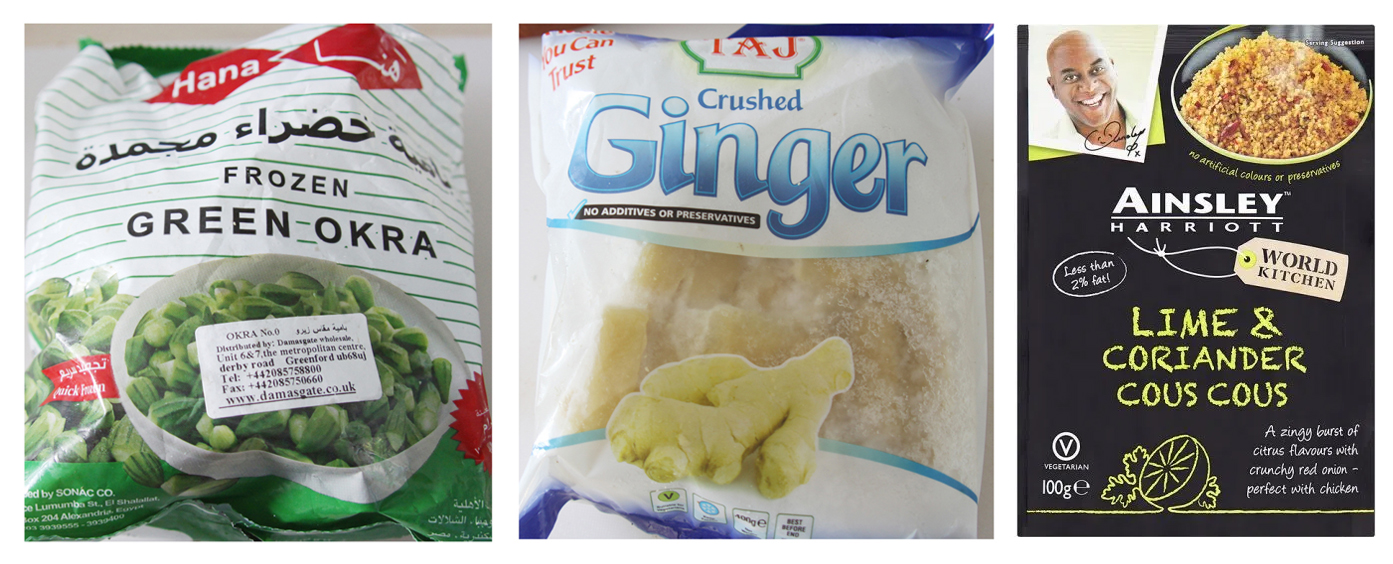
Excellent freezer and store cupboard ingredients

Great served with couscous (I buy Ainsley Harriot packs that take just a couple of minutes to cook), plain white rice or a Greek type salad with lots of mint.  I like coriander sprinkled over the top of the bamya too, but it’s not everyone’s taste, and mint is a good substitute with this dish.  A topping of dukkah or pine nuts provides some additional texture.  My addiction to Greek yogurt means that a dollop that always goes well, but if I have  mint and cucumber I always take the time to make a raitha/tzatziki.  I only ate half of it, so put the rest in the freezer

Monday
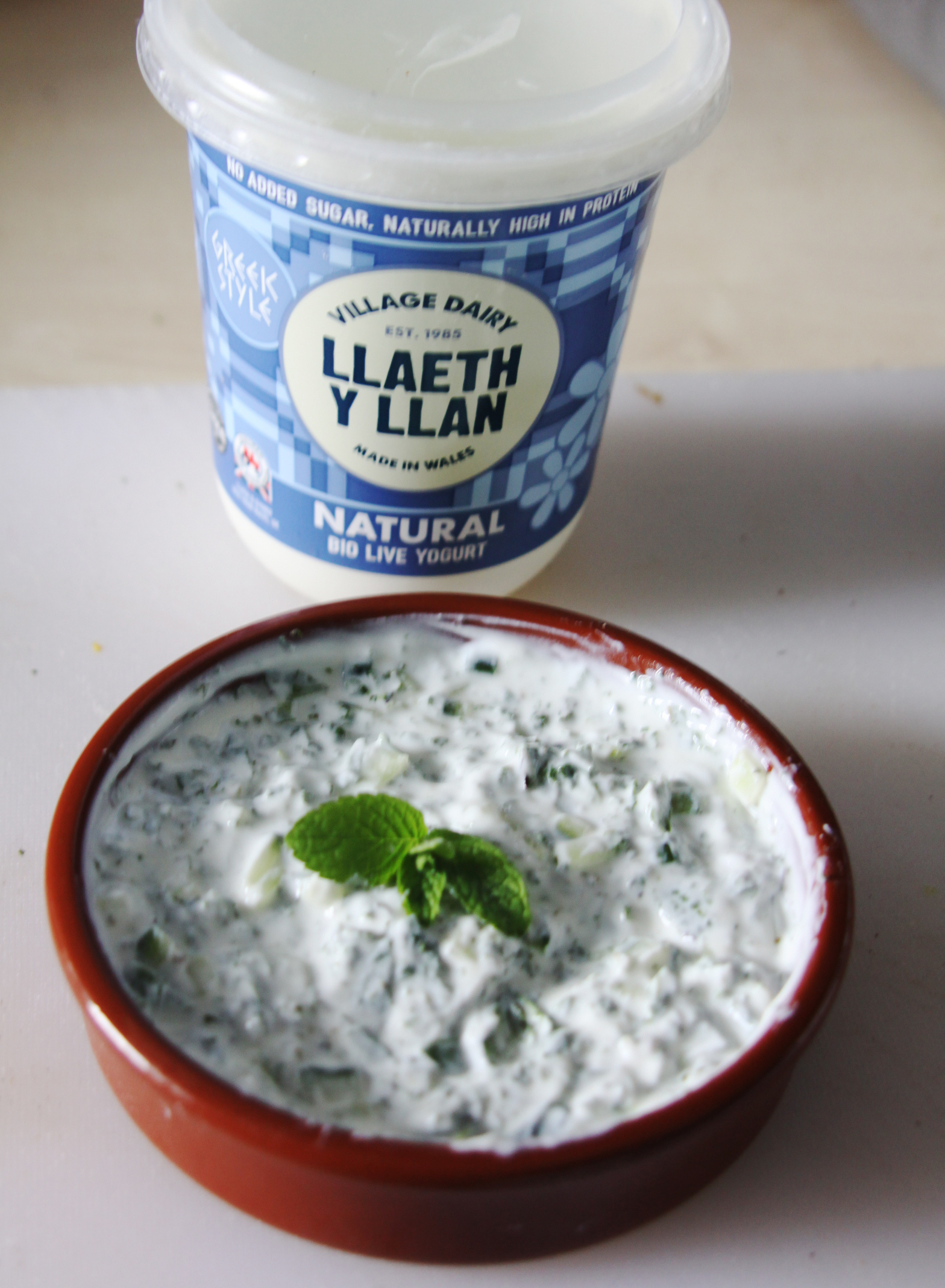
Chicken korma  #2 with raitha.  I dined on part 2 of Friday’s fun curry, served simply with rice and the rest of the mint and cucumber raitha  (finely chopped mint and cucumber in good Greek yogurt).  As there was rather less than half of the curry left over, I hard-boiled an egg, halved it, and heated that up in the curry.  A hard-boiled egg in a curry is always a knock-out and is great for making up volume, as are green beans, courgettes, potatoes and, of course, okra if you can ever get hold of them.  The spinach had melted into the sauce, imparting its deep flavour, and everything else had survived perfectly.  The flavours had matured, and it was just as good as, if not better than, Friday’s original.

Tuesday
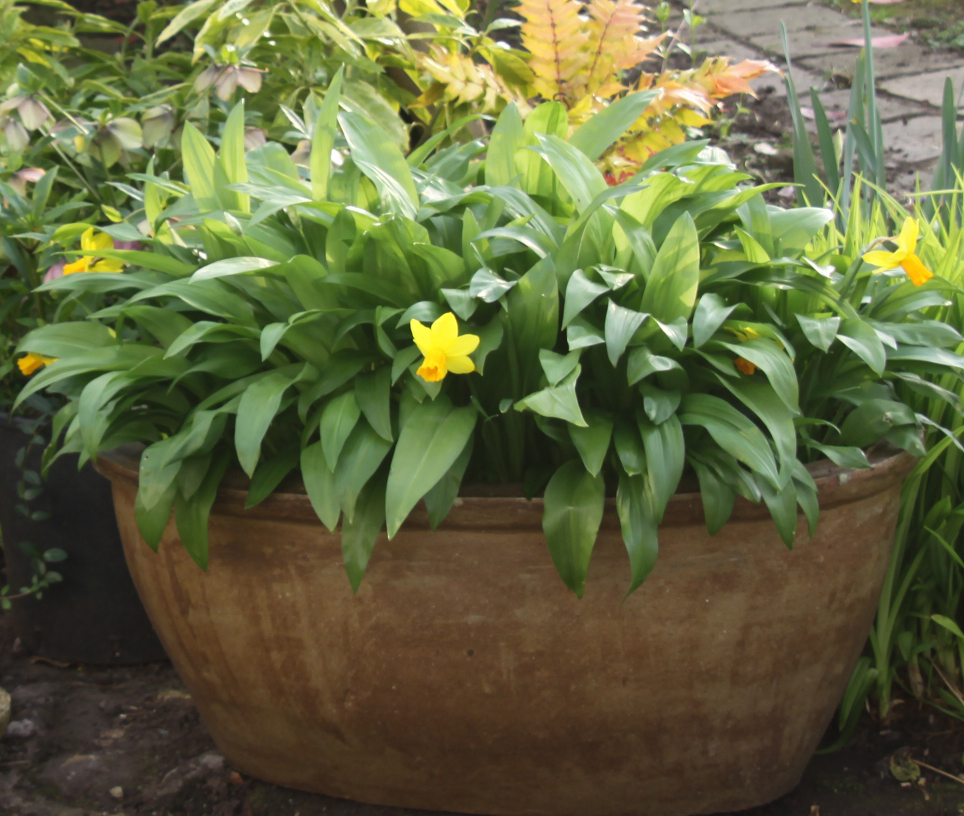
Wild garlic, with some friendly daffodils

Wild garlic pesto stirred into pasta with crispy bacon and parmesan cheese. Lovely to have wild garlic at the moment, and it can be used for all sorts of things.  It is excellent in soups and stews, can be used wherever you use spinach, and is excellent made into a pesto, just like basil, which can be stored in the fridge or freezer.  I grow it in a pot, because it can take over your garden like a small army.  Tossed as pesto into good quality pasta (mine was Famiglia Rana mushroom and mascarpone tortellini, originally bought some time ago from the Aberdyfi Village Stores and lobbed in the freezer), I had it with some finely chopped very crispy bacon on top, just one rasher, and parmesan grated over the top (another item that lasts well in the fridge).  On the side I had a small tomato, wild garlic and onion salad, with a sprinkling of capers over the top.  It was all so simple but seriously hit the spot.

Wednesday
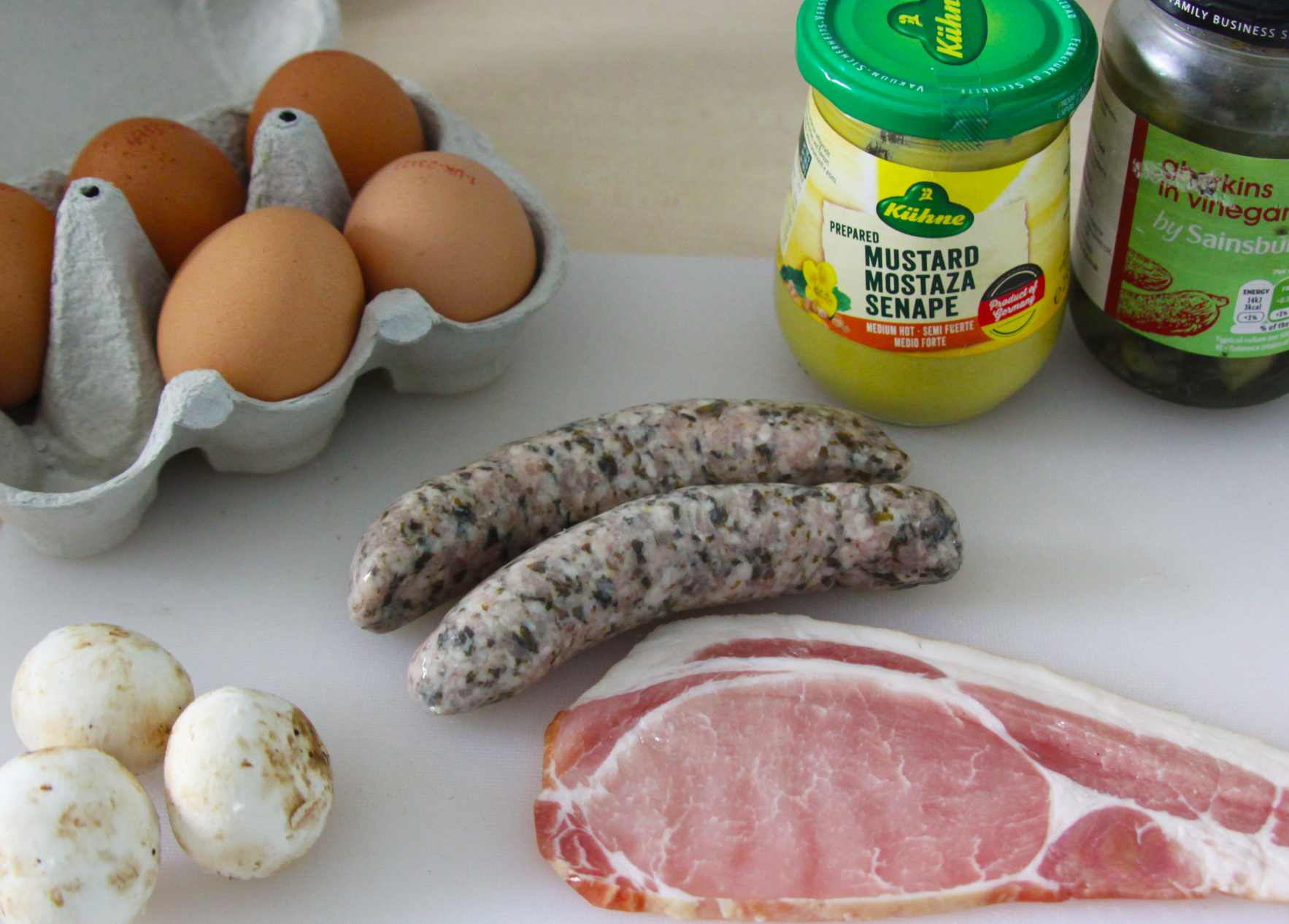
Laverbread sausages, bacon, mushrooms and a poached egg.  On Wednesday I felt like something dead simple, very British, very understated.  Sausages, an egg, a rasher of bacon and a few mushrooms, with a huge dollop of German medium-strength mustard.   A special edge was that the sausages were pork and Welsh laverbread, from the Aberdovey butcher, an absolute favourite of mine.  They are long, very slender sausages, so it’s important not to over-cook them.  Happiness on a plate.

Thursday
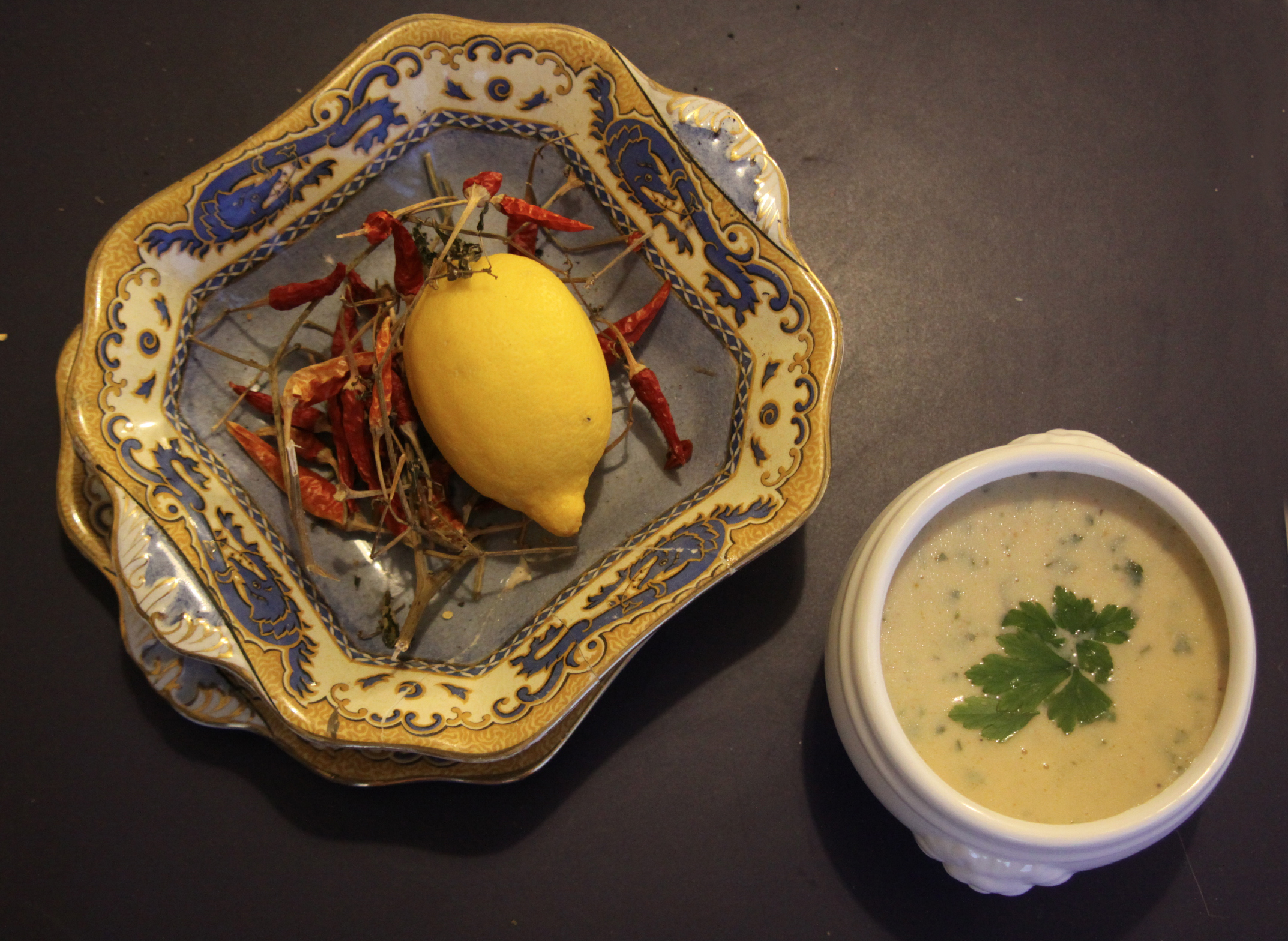
Avgolemono soup.  Big soup.  Avgolemono, which in Greek means egg-lemon, is surprisingly filling, and I always struggle to get through a bowl of it, even though I serve it as a meal on its own and is a lifetime favourite.  It is made with good quality chicken stock.  I used one from the freezer that I had made from a leftover roast chicken carcass, but the usual way of doing it is to poach fresh chicken.  The other key ingredients, if you base this on one serving, are three tablespoons of lemon juice, an egg, loads of parsley and (the element that makes it a main meal), a handful of rice.  Rick Stein chops poached chicken into his, but I prefer it without.
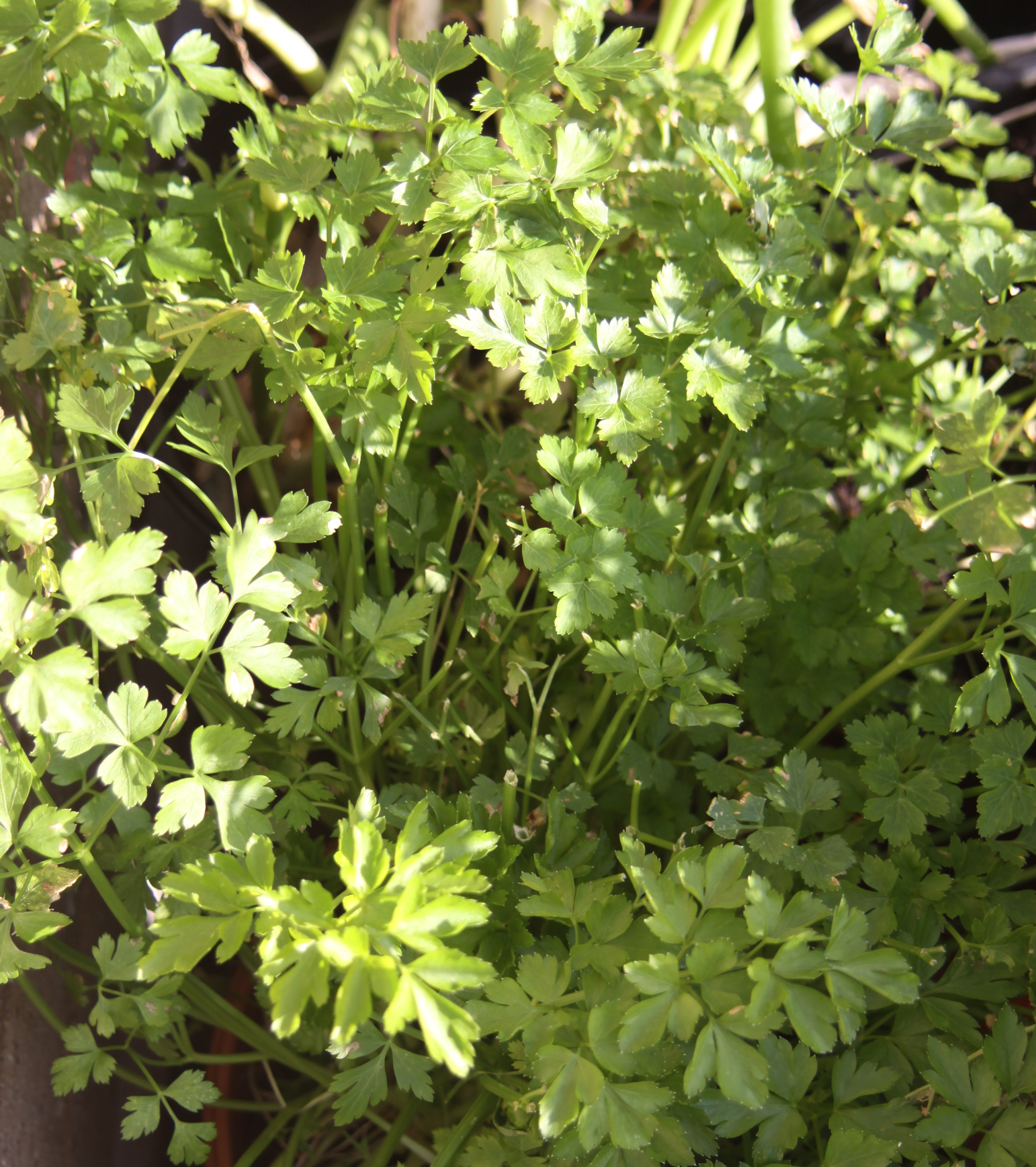
Home grown parsley

The rice is cooked in the stock, with a lid, until ready.  Whilst the rice is cooking, the lemon juice and egg are whisked together with a hint of cayenne, a little salt and a pinch of sugar to balance the lemon.  I usually do this with just the yolks, but I noticed that Rick Stein does it with the whole egg and a bit of butter, so I tried it and it worked well, thickening the soup more efficiently.  The trick with this dish is to add spoonfuls of the hot stock to the room temperature egg and lemon mix, stir it well, repeat, stir well and repeat until the egg and lemon is warmed through and won’t separate.  Then pour the whole lot back into the stock and rice pan and heat very gently with the chopped parsley, being careful not to bubble it, or it will separate.  It is so easy to make, has been a favourite of mine forever, and it hit the spot today after a day bullying the garden into shape.

The lemons are running out fast!

Friday
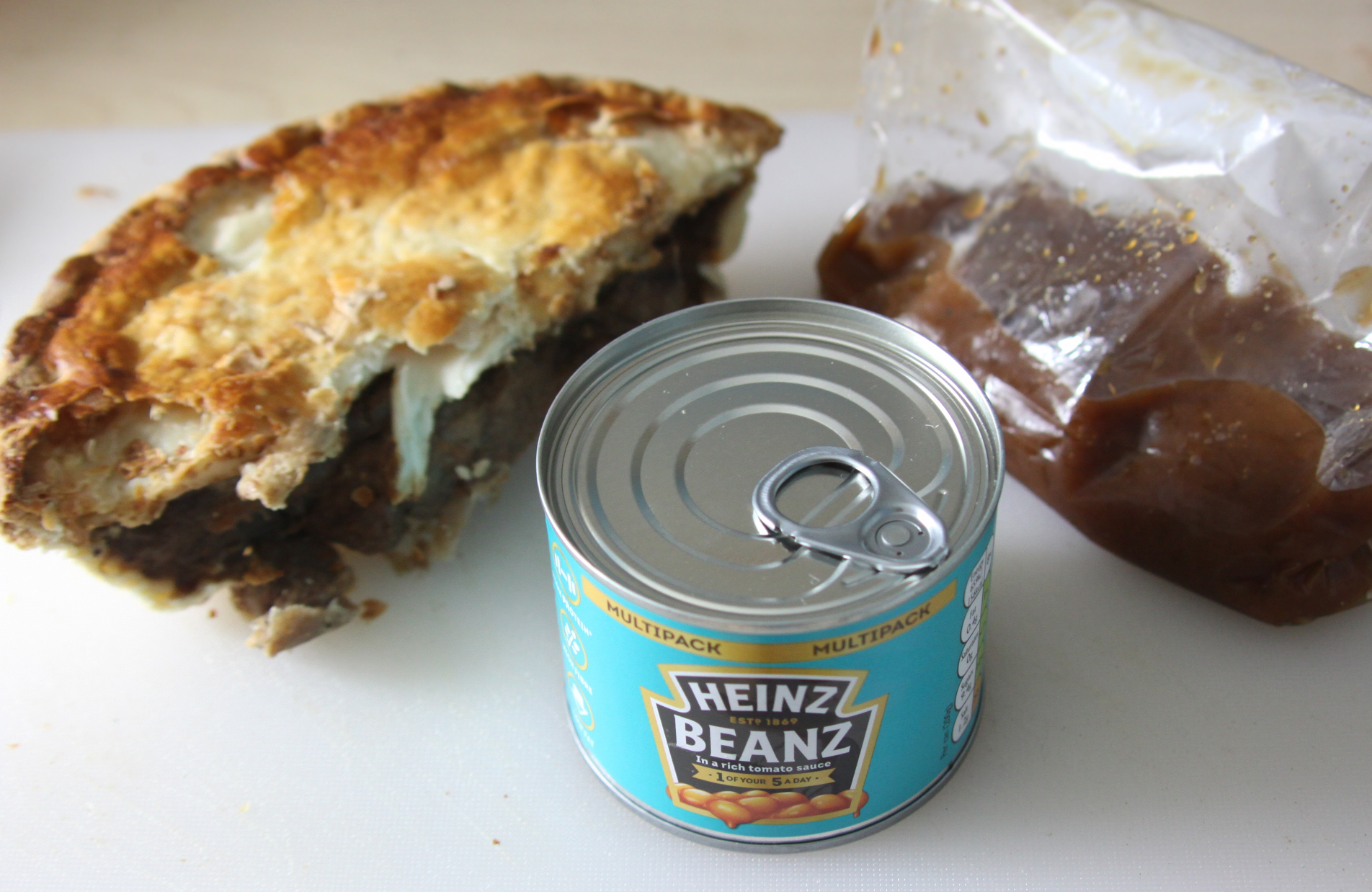
Steak and ale pie, gravy, Heinz baked beans and HP sauce.  Today I cheated. I had spent the afternoon scraping moss off my garage driveway with a trowel, and I seriously didn’t have the energy to cook anything.  Aberdovey fish and chips would have been my go-to solution.  Instead I cheated in a different way.  In my freezer was half a sizeable beef and ale pie.  I married that with a rich beef gravy and, because it was irresistible, a simple side order of baked beans and HP sauce.  Bliss.  There is something very decadent about baked beans, and I always eat them with a mixture of pleasure and guilt.  Guilty pleasures are often the best.  An infrequent but much loved treat.

Conclusions

A more than averagely British week on the cooking front.  Normally my cooking is dominated by Middle Eastern and Mediterranean food, but from a purchasing point of view, the excellent fresh veg available the week before last, and the need to select stuff that would last in the fridge, suggested that traditional British fare would be best, and I think that my curry comes into that category as I cannot see a native of India recognizing it as remotely related to the real thing.  It has made a surprising and pleasant change.  Thinking about the week, having changed overnight from an ad-hoc whenever-I-need-to shopper to a once-a-fortnight-except-in-emergencies shopper, I have come to the following conclusions.
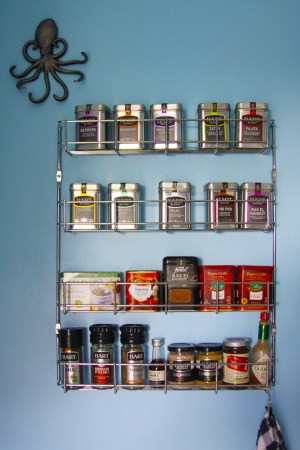
  1. Thank goodness for a freezer that, small as it is, resembles a Tardis.  Doing an inventory of everything that it contained was essential to forward planning and matching freezer contents against fridge and cupboard contents. Amazing the items I found stuffed into the very back.
  2. I ended up eating or cooking (for the freezer) a lot of chicken because I had put a whole pack of six thighs into the freezer instead of splitting them into separate bags.  I have nothing against eating a lot of chicken, but it would have been a lot less hassle to be able to take out just what I wanted to use.
  3. Tender stem broccoli does not keep well in the fridge, cauliflower and mushrooms are a lot better, but leeks, pointy cabbage, baby carrots and onions are the real keepers
  4. With one-pot meals like stews, casseroles, curries and pies, cooking more than you need and freezing down the rest is great for saving time later on and ensures that fresh ingredients are used up.
  5. In an effort not to deplete supermarket shelves, I bought half my usual number of eggs (usually 12) and lemons (usually 8), and bought fewer other items too, which with hindsight was probably a mistake as there was no shortage of either in that particular store.  Had I used common sense, I would probably have avoided the shops for another week.
  6. Worse, I left my shopping list at home, meaning that I forgot fresh ginger, chillis, potatoes, flour and spring onions, or substitutes.  Aaargghh!  My shopping list is more important than ever, and needs to be updated as soon as essential ingredients are used up.
  7. Pots of herbs rock.  If the supermarkets are still selling them, just re-pot them into bigger pots to give them room to grow, and give them food and water, and you’ll have them for the entire summer if you treat them kindly.
  8. Life without bacon would/will be seriously difficult to negotiate 🙂  It’s inexpensive, great in its own right, and can be chopped up and chucked into so many things for additional flavour.
  9. The BBC food website search facility is wonderful for finding ideas for using up leftovers
Wandering Pigs in Tywyn

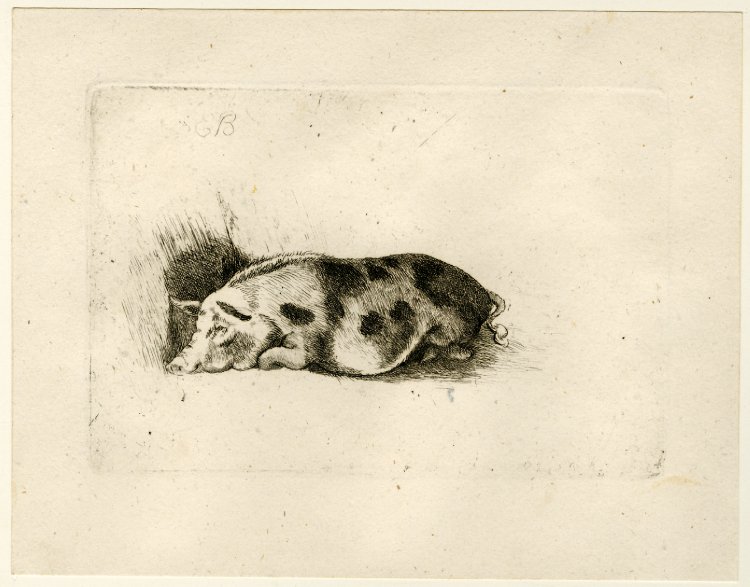
Etching of a pig with spotted markings. Source: British Museum (Museum number 1871,0812.2907)

As the title indicates, the emphasis in this post is on Tywyn.  There are also some fascinating references to the insalubrious dominance of pigs in Aberdovey, which I really must investigate further.   The ongoing thread of pig-based conflict in Tywyn, lasting several decades, amused me at first.   But the more I read about it, the more I realized that this was a very serious problem, a conflict between individual household needs and the demands of larger scale economic progress.  Householders with a single pig were trying to supplement income and provide themselves with additional security.  Smallholders with more livestock were trying to make a living.  Both were keeping down overheads by using pigs as a low-cost but highly productive solution to impoverished circumstances.  At the the same time, at the other end of the economic scale the town’s authorities were attempting to attract visitors to Tywyn, to improve the well-being of the town as a whole, to improve standards of living for everyone.  These goals, both of which were legitimate and intelligent, were in long-term conflict.

In volume 2 of Lewis Lloyd’s 1996 A Real Little Seaport, Appendix VIII (full reference below) the author reproduces miscellaneous newspaper and other reports relating to Aberdovey and Tywyn.  I was looking for ship-related topics, but noticed that the subject of unruly pigs popped up repeatedly.  This post reproduces those reports and letters, and adds several others found on the National Library of Wales website.  The reports tell their own story.  Another world, and I do wish I could have seen it!  But perhaps I should be thankful that I did not have to inhale it :-).

The first story that I have found dates to 1854, and provides the title for this post.

Wandering Pigs in Tywyn
Carnarvon and Denbigh Herald, April 8 1854

TOWYN – The Pig Nuisance.  The local board of health have at last resolved that a stop shall be put to the nuisance of pigs strolling about the streets.  Every one found after April 5th will be placed in a pinfold, and a fine levied on the parties owning the same.

Lloyd comments (p.266): “Tywyn was by no means alone in this regard.  Foraging appears appear to have offended visitors rather than residents.  The remedy was quite effective when strictly enforced.”

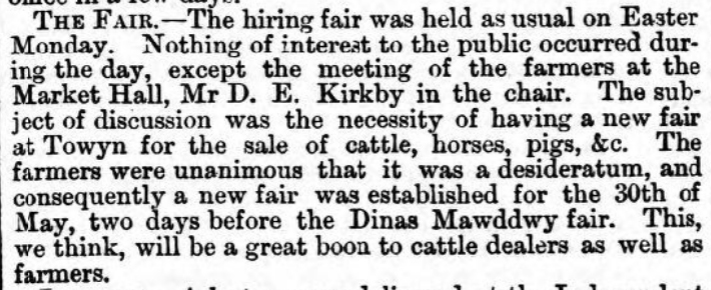
The establishment of a fair in Tywyn may have exacerbated the problem of locally raised pigs

The Aberystwyth Times Cardiganshire Chronicle and Merionethshire News, 23rd April 1870

The pig situation certainly continued to deteriorate, as this animated and somewhat adversarial piece from 1870 demonstrates. The Chairman and the Surveyor seem to be anything but close friends 🙂

Practice of Killing Pigs on the Highway – Towyn and Aberdovey Local Board
The Cambrian News and Merionethshire Standard, 10th December 1870

Practice of Killing Pigs on the Highway.—The Chairman:  I have had complaints made to me about people killing pigs on the highway. —The Surveyor:  They do kill them on the streets.  The Chairman I know they do, and I was going to ask you. as surveyor, why you allow them?—The Surveyor: I don’t see them.—Mr Daniels, jun., said that the Board need not interfere, if harm was done to no one. — The Chairman said that the practice was one the Local Board had tried to stop at Aberdovey. Some time ago the Board would not allow pigs to be kept in Aberdovey. One member stated that he knew a man at Aberdovey who had turned the privy belonging to the house he occupied into a pigsty, and kept two pigs there. —The Surveyor:  I didn’t know of it. —The Chairman:  As surveyor, you are supposed to know by going round the place. Complaints are made to me repeatedly. —The Surveyor: Am I to go to every spot and corner in the place ? – The Chairman Of course; it is your duty. Pigs are springing up everywhere in Aberdovey, and they are kept in a most disgusting state. Some few years ago we would not allow pigs to be kept within some yards of a dwelling-house.— The Surveyor:  Pigs have been very high lately. (Laughter.)  Everybody that could would keep, one. – In the course of further discussion, the Chairman said he was in favour of building a public slaughter-house, to do away with the nuisance.—An allusion was then made to pigs having been killed on the highway by a member of the Board. – The Chairman said there had been complaints about it.—One member stated that the police knew of it, and blamed Mr Wm. Lloyd for killing his pigs in the street.—Mr Lloyd said he killed them upon his own premises in a passage.—The Chairman said the greater nuisance was caused by dressing the pigs in the street. -The Surveyor:  They did it regularly before the Board was formed. (Laughter.)—The Chairman I should like to deal with this nuisance, but it is useless to talk about it.- Mr Daniel: Don’t break your heart, Mr Chairman.— The Chairman Oh no. But I really think that instead of getting better we shall get worse, as a Board of Health. —The subject then dropped.

The following two pieces from the same edition of the Cambrian News and Merionethshire Standard suggests that Aberdovey had become an even more chaotic local centre for pig-raising, possibly following the establishment of the market in Tywyn, and officials in Tywyn were seriously concerned that Tywyn could go the same way, and were urging that pigs should be kept to a minimum:

Suppressed Report – Filth in Aberdovey
The Cambrian News and Merionethshire Standard, 17th May 1872

The prosperity of towns on the Welsh Coast depends on their attractiveness and freedom from unpleasant sights and smells, and therefore no more suicidal policy can be adopted than to save the rates by neglecting drainage and the removal of nuisances. Aberdovey is one of the poorest places on the Coast, and the Chairman of the Towyn Local Board said, at the last meeting, that Aberdovey was quite a pig-breeding establishment, in fact they ‘possessed as many pigs as inhabitants’. Everybody knows, of course, that where pigs abound visitors are scarce, and if Aberdovey refuses to get rid of its notoriety for pigs, and consequently for filth, it must be content to see Towyn, Barmouth, Borth, and Aberystwyth eclipse it in prosperity. This unfortunate apathy at Aberdovey is all the more to be regretted, as Aberdovey, on account of its natural advantages, might easily be made a favourite resort for invalids who need a mild and equable temperature. We are pleased to see that Towyn by prompt action and wise expenditure of public money may still retain its position as a healthy and pleasant watering place

Pigs taking possession of the back streets of Aberdovey
The Cambrian News and Merionethshire Standard, 17th May 1872

The Chairman on Pigs – Application was made on behalf of Mr Pugh, ironmonger, Towyn, to make a pig-stye at the back of bis garden in High-street.—The Chairman I hope you will not get into the same condition at Towyn as Aberdovey is with regard to pigs. We have quite a pig- breeding establishment there In fact we have quite as many pigs as we have inhabitants. They (the pigs) have taken possession of the back streets, and perhaps they will have possession of the front streets shortly. They are constantly parading the back streets. (Laughter.) It is not the keeping of pigs that becomes a nuisance; it is on account of the disgracefully dirty state people allow them to remain in.-It was decided that, on account of the position of the proposed pig-stye, permission be not given for its erection.


Pigs and Other Nuisances
The Cambrian News and Merionethshire Standard, 18th May 1883

Pigs and other Nuisances – The Clerk read a letter from the Local Government Board calling attention to paragraphs in the Medical Officer’s report on nuisances caused by the keeping of pigs and the accumulation of manure as in the vicinity of Red Lion-street.—Mr Kirkby thought that pigs should not be kept in a town, and proposed that no pig should be kept within 100 feet of a dwelling house. —The Clerk stated that sixty feet had been adopted at Dolgelley, and it had had the effect of driving nearly all the pigs out of the town. —The Chairman and other members thought that 100 feet was too far, and on the motion of Mr John Williams, seconded by Mr William Lloyd, sixty feet was agreed upon.


By the late 1880s, the pigs, now no longer roaming the streets and now unable to be kept less than 60ft from a dwelling, were a thriving business, but their owners weren’t happy at some of the changes to Tywyn’s sanitation measures.

Pigs in Tywyn
Cambrian News July 19th 1889

TOWYN. PUBLIC SPIRIT – The remarkable success of the movement in favour of pig keeping has infused much additional courage into the hearts of the demonstrators, who now demand full restitution of all ancient privileges, one of which is the right of taking water from the sewers.  The means of access to the sewers for this purpose were closed some years ago . . . and on Tuesday evening, the 16th of July, one of the the leaders in the recent demonstration took the law into his own hands and broke into the sewers at the place where water used to be drawn when the rill running along the street was not covered.”


Another two years passed, apparently without incident, and then another article was featured in Cambrian News, complaining once again about the prevalence of pigs, an echo of the grumbles of 1854.

Visitors, Pigs and Tywyn’s Limitations as a Seaside Resort
Cambrian News.  May 22nd, 1891

Jesus exorcising the Gerasene demoniac, from the Hitda Codex manuscript.  Source:  Wikipedia

TOWYN. REGULAR VISITORS – Many of those who come yearly arrived with Whitsuntide on Saturday and Monday last.  Some expressed their surprise on the little change that has taken place since this time last year.  There is the broad esplanade, handsome in its loneliness, not a single additional house overlooking it.  The remnant of the old pier stand still to remind people of the transient and illusory start which Towyn made some years ago.  But the pigs remain and their unwholesome stench greets the nostrils of the visitors at all the entrances to and at many places in the town.  It may be that beings which long ago rushed the swine to the lake of Gennesaret will oblige Towyn in the same way.  It does not appear that this nuisance will be got rid of by the action of earthy authorities now in existence, therefore let us pray for assistance from another region.

You just have to love the Biblical reference and its accompanying optimism.  It’s actually a rather sad story for pig enthusiasts. The Miracle of the Swine was, according to the New Testament, a miracle performed by Jesus.  Jesus exorcised demons from a man, which were then transferred into a herd of swine.  All of the animals in the herd launched themselves into the lake to drown themselves, thereby eliminating the demons. I am not entirely convinced that the artist who painted the scene in the Hitda Codex, above, had ever actually seen a pig.

Only a few days later, more was to follow (which is to say pig complaints, not exorcisms).


Nuisances at Tywyn:  Chimney Firing and Pigs

Cambrian News,  May 29th 1891.

TOWYN.  NUISANCES – The police, with commendable zeal are dealing successfully and most impartially with the nuisance of chimney firing and there is a fair prospect that this remnant of Welsh savagery . . . will be stamped out in the near future.  Is it not possible to have other nuisances as objectionable and dangerous dealt with in the same drastic manner?  There is something hideous in the very though of the winds wafting the odours of foul piggeries even to the site of a town that is to be distinguished for cleanliness and sweetness.  Some strong firm hand is required to deal in a prompt and determined manner with these pet nuisances.

Lewis Lloyd speculates that the complainant must be a newcomer, because any local would have been accustomed to the idea that “the family pig remained an essential part of the domestic economy of the domestic economy of the people at large,” and that “vagrant odours” were part of local life (p.364).

1891 continued to be a big year for pig debates, as the following lengthy heartfelt and anxious piece demonstrates so clearly:

Towyn Pigs
The Cambrian News and Merionethshire Standard, 3rd July 1891

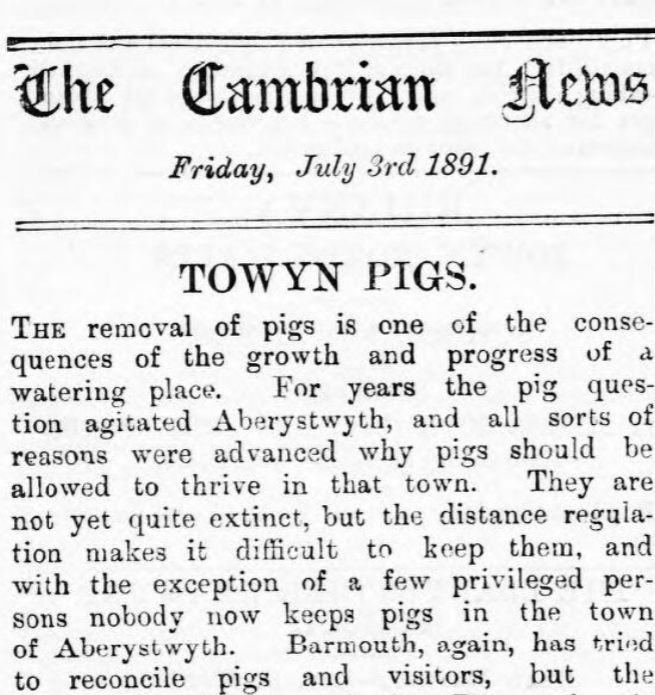
The removal of pigs is one of the consequences of the growth and progress of a watering place. For years the pig question agitated Aberystwyth, and all sorts of reasons were advanced why pigs should be allowed to thrive in that town. They are not yet quite extinct, but the distance regulation makes it difficult to keep them, and with the exception of a few privileged per- sons nobody now keeps pigs in the town of Aberystwyth. Barmouth, again, has tried to reconcile pigs and visitors, but the attempt has failed, and the Barmouth pig is doomed, although after the manner of his kind he may die slowly and amid much noise. At the last meeting of the Towyn Local Board the pig-keepers of that town presented a. memorial in favour of erecting a piggery somewhere in the district where pigs °°could be kept without being a nuisance to visitors and without detracting from the sanitary condition of the town. The Towyn memorialists were very moderate in their representations, but we appeal to them whether it is not a fact that more than half the value of a pig depends on power to keep it quite close to the dwe ling so that, so to speak, it is almost one of the family. A pig kept at a piggery away from the town would cost more in time and labour than it would be worth. We fear the Towyn pig-keepers, who sent their modestly-worded memorial to the Local Board, are ingenious individuals who only seek to gain time and have no real intention of getting rid of their pigs until they are fat, and will then start young ones on whose behalf the same plea for time will be put in. Look at the Penyparke pig. He is still to the fore. He has survived all sorts of attacks and still grunts contentedly within a few feet of his owner’s front door. What could be more satisfactory than the following extract from the Towyn pig-keeper’s memorial.   “We are all wishful that all nuisances should be abated and that our rising little town should be made as sanitary as any in the Kingdom.”  This is a beautiful sentiment, but how can practical effect be given to it if all the Towyn pigs are to be allowed to live until they grow fat?  The people of Towyn must choose between pigs and visitors. Visitors come from towns where pigs are not kept and where nuisances are removed, not abated. What a long and weary struggle has had to be waged against pigs, cesspools, rubbish heaps, and t5 other nuisances, and the struggle is not yet over. There are always memorialists who honestly believe that pigs are not a nuisance, just as there are always people who see no harm in dirty water, defective drains, accumulated filth, and other health destroyers. The time has gone by when advocates of municipal cleanliness can be hooted through the town, but there are scores of people who would not abstain from keeping a pig, which costs them half-a-crown a pound, to en- sure the permanent success of their town as a summer resort. We trust the members of the Towyn Local Board will be strong. However long the removal of pigs is delayed somebody will always plead for a little more delay. Let the law take its course, and Towyn will never have cause to regret its firmness. Not only must pigs be got rid of, but the inhabitants of watering places in this district must pay attention to order and beauty. Visitors like to see prettiness and order, and both public bodies and private residents should I aim steadily at getting rid of that raggedness and disorder which are so characteristic of some towns of considerable pretensions.


The Pig War

The Cambrian News and Merionethshire Standard, 26th June 1891

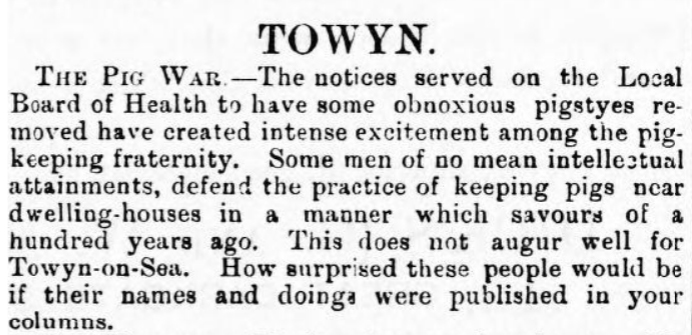
TOWYN. THE PIG WAR—The notices served on the Local Board of Health to have some obnoxious pigstyes removed have created intense excitement among the pig- keeping fraternity. Some men of no mean intellectual attainments, defend the practice of keeping pigs near dwelling-houses in a manner which savours of a hundred years ago. This does not augur well for Towyn-on-Sea.


The Pig Warfare

The Cambrian News and Merionethshire Standard, 18th November 1891

THE PIG WARFARE.  The recent decision of the Local Board to prohibit the keeping of pigs within certain distances of dwelling houses at Towyn has caused quite a furor among a section of the inhabitants, but as the resolution was passed unanimously, with one exception, at a meeting at which all the members were present, it is probable that no more wavering and laxity will be shown.


I was seriously amused by the following insight into a measure of how times had changed in Tywyn.  At the beginning of this post I started with a story about pigs roaming the streets.  This paragraph in the of December 1991 refers to a time which such things were indications of a distant past.

Since the days pigs dwelt unmolested on the Streets
The Cambrian News and Merionethshire Standard, 11th December 1891

THE WEATHER.—Such weather, such continuous rains, such consequent mud on streets and roads, such complaints of cold and rheumatism, such general inertia and grumbling, and that so near Christmas have not existed, it is believed, since the days pigs, cattle and ducks dwelt unmolested on the streets of Towyn


This is a lovely report of a hearing at the Petty Sessions in November 1898, abbreviated with several references to laughter from the assembled company.  It is an absolute treat:

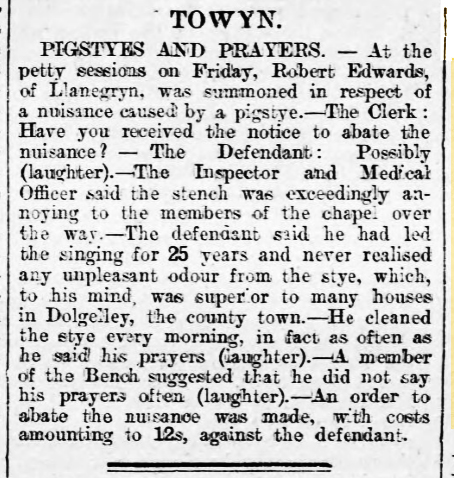
Pigstyes and Prayers
Carnarvon and Denbigh Herald and North and South Wales Independent, 11th November 1898

PIGSTYES AND PRAYERS. — At the petty sessions on Friday, Robert Edwards1, of Vanegryn, was summoned in respect of a nuance caused! by a pig stye.  The Clerk:  Have you received the notice to abate the nuisance ? — The Defendant: Possibly (laughter).—The Inspector and Medical Officer said the stench was exceedingly annoying to the members of the chapel over the way.—The defendant said he had led the singing for 25 years and never realised any unpleasant odour from the stye, which, to his mind, was superior to many houses, in Dolgelley, the county town.—He cleaned the stye every morning, in fact. as often as he said’ his prayers (laughter).—A member of the Bench suggested that he did not say his prayers often (laughter).—An order to abate the nuisance was made, with costs amounting to 12s, against the defendant.


It is a truly interesting insight into the area’s past that pigs were such a fundamental part of the local economy, and that they were deemed to be counter to the interests of the development of the tourist industry in both Tywyn and Aberdovey.  Whether people were for them or against them, they were important to individuals and smallholders as supplements to their incomes, an extension of the concept of the cottage industry.  It is easy to understand why pigs were favoured over any other livestock, in spite of the fact that they do not produce milk for human consumption.  For one thing, they gave birth to large litters, meaning that they were less expensive to purchase and could be used for breeding.  Most importantly, they converted just about anything edible into meat, and were the mobile dustbins of many communities well back into prehistory. This made them almost cost-free to feed and raise.  Pig manure could be used as an excellent source of nutrients for soil, if composted first.  A pig could be sold for meat or slaughtered by its owner for consumption.  In either case, it was an excellent source not only of fresh meat and fat, but of cured or smoked products that would last for a considerable time and could be eked out in times of hardship.   Unfortunately, pig-keeping was in direct conflict with other economic demands.  If Tywyn was to establish itself as a desirable destination and develop as a tourist resort, pig-keeping had to be moved out of the town itself, and confined to a respectable distance.  This was not always easy to implement, but the necessary steps were taken, and the town did develop a successful tourist industry.

I will leave the last word with a Tywyn correspondent who expressed himself in a rather embittered piece entitled Towyn Characteristics (The Cambrian News and Merionethshire Standard, 13th June 1890):

As it was in the beginning it is now, and ever will be, pigs, smoke and talk.

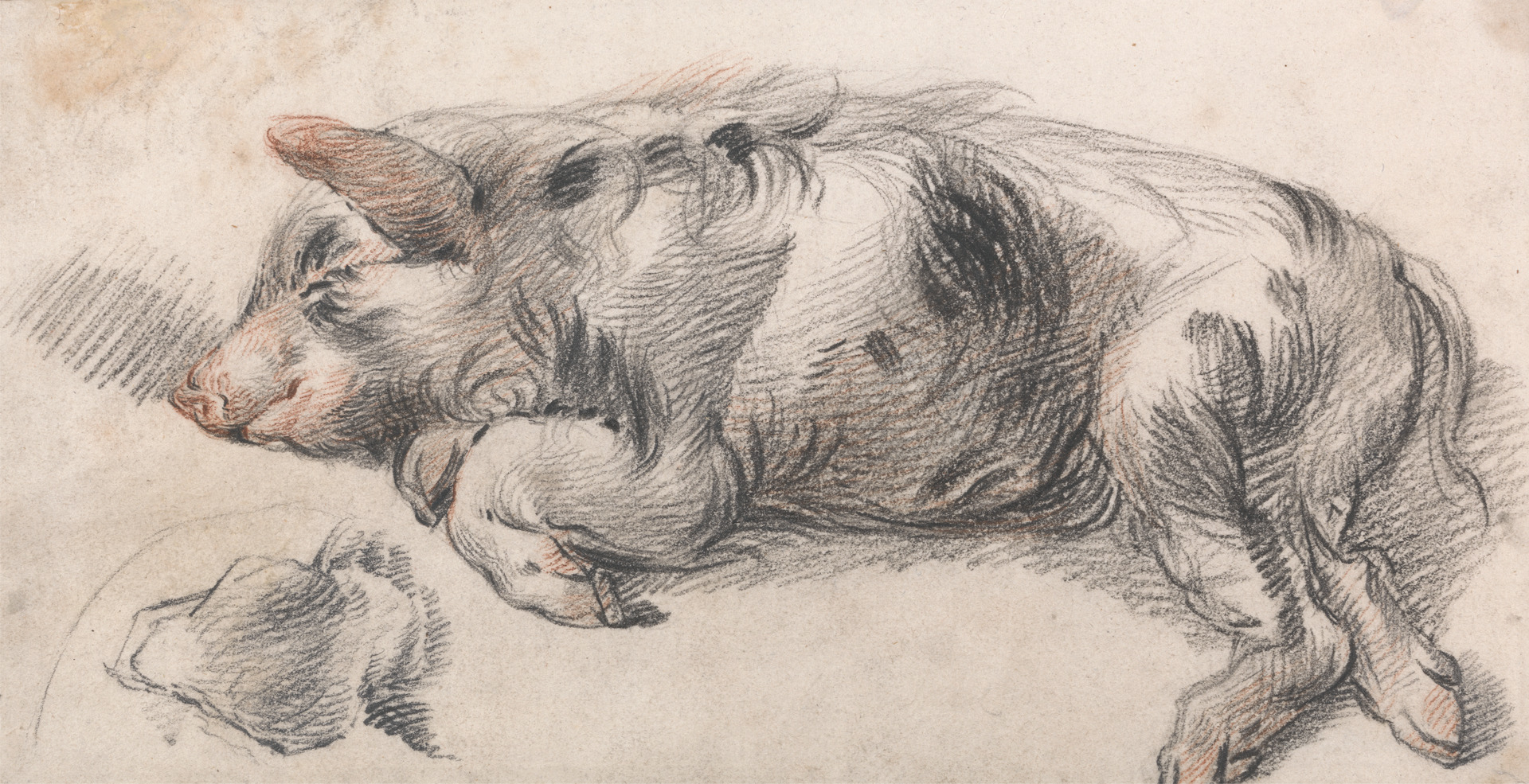
Sleeping Pig by James Ward, 1769–1859. Yale Center for British Art, B1986.29.266.


References:

The National Library of Wales website (a fabulous resource):
https://newspapers.library.wales

Lloyd, L. 1996.  A Real Little Seaport.  The Port of Aberdyfi and its People 1565-1920. Volume 2. ISBN-10 1874786496 (Appendix VIII- Miscellaneous newspaper and other reports relating to the Harbour, town and Townspeople of Aberdyfi, to the Town and Parish of Tywyn generally, and to other relevant matters, 1823-1920)


Regrow your supermarket spring onions / salad onions

The latest crop from a shop-bought packet of spring onions that I planted last year, still providing me with lots of lovely flavour.

I’ve been regrowing shop-bought spring onions / salad onions for about 10 years.   If you buy a pack that has those spindly little white roots still attached (most of them have them) you can place them in water and regrow them.

It occurred to me today that at this particular time, this can be done very easily even if you are self-isolating, to make your spring onions go further.  Kids would probably love to do it. Best of all, after you cut your first crop, they will grow back!  You should get several crops in a single season.  They will be dormant in winter but will come back in spring.

Note that these will not grow into the same solid spring onion that you originally purchased, but they will produce giant, hollow chives, which are utterly delicious in salads, mashed into spud, or fine-chopped and sprinkled over stews and casseroles.  You can see mine in the photo to the left.  I first planted them last year and they are still going strong in their pot this year.

I don’t actually have any shop-bought spring onions at the moment, or I would photograph the process, but it’s dead simple and here’s how I’ve been doing it for years:

Buy spring onions that have their little white hair-like roots still attached, such as the ones in the picture on the right (which I’ve borrowed from the Ocado website).  If they have been cut off, this won’t work.

As soon as you have your spring onions home, cut off the last 3-4cm (a bit over an inch) that have the roots still attached.  Place these in glass or jar of cold water (a glass or jar is better than a cup so that you can watch what’s happening).  You only need enough water to cover the roots and a bit of the stem.

In a couple of days new, healthy white roots will appear and start growing.  When the new roots reach a good size (I find that anything over 3-4cms / an inch long works) you can plant them out into your garden or into pots (or the bottoms of used plastic bottles, with holes made in the bottom for drainage).

When you plant them, make sure that whilst the roots are under the surface, a bit of green remains, sticking up.  Water well, and keep moist, but don’t drown.  In only a couple of weeks they will begin to grow and when they reach a good height you can cut them and eat them.   Best of all, they will regrow!  The photograph at the top of the page shows the ones I planted last year and am still eating today (quite literally – they are going to be sprinkled over tonight’s home-made curry to give it a bit of zing in the absence of any coriander).


Reminder that the clocks go forward tonight

The clocks go forward tonight, Saturday 28th /Sunday 29th 2020.  It is easy to lose track of this sort of thing at the moment.  Enjoy the lighter evenings, always something to look forward to.  Sunset was at around 7pm tonight, so it will be 8pm tomorrow.  Even under the current circumstances, it’s a bit of a silver lining.  The last few days, so incredibly sunny and warm, were astonishing for March, and the promise of things to come.


The Loss of the 1857 Aberdovey Schooner Frances Poole


There are a lot of newspaper reports about groundings, collisions and total losses in 19th Century newspapers centred on north and mid Wales.  I stumbled across this story about the loss of the Aberdovey-built schooner Frances Poole whilst looking for something else, and it was less the loss of the ship and crew that startled me than the remarkable brevity of the report.  The story was published in the 27th March 1869 edition of the Cambrian News.  It is a nod at a total loss, and in its very brevity is a comment on how regularly coastal ships foundered with partial or total fatalities.  Ship accidents and tragedies were a dreadfully common occurrence.

I went back through various sources to find out more about the ship, her background and her crew.  The Frances Poole was built in Aberdovey and her senior officers lived in Aberdovey.  There is nothing that particularly stands out about the ship.  She was an average cargo carrying ship going about here daily tasks when she fell foul of a gale on the Cornish coastline when she was just 12 years old.  A reliable ship that made several voyages to eastern Spain, she was well-built, admired for her speed and generally well thought of.

The John Jones schooner Catherine. Source: Lloyd 1996, volume II

Frances Poole was a, 84-ton schooner built in Aberdovey in 1857 by John Jones.  She was 75ft long with a 20ft beam, fitted with the figurehead of a woman.  Sadly there is no known picture of her, or of her builder John Jones.  The photograph to the left is another John Jones schooner, the Catherine Jones, 76 tons (8 tons lighter than Frances Poole and built 12 years later), but gives an idea of the type of schooners that John Jones built.

John Jones, “Jac y Taeth” was the most prolific of the Aberdovey shipbuilders.  He probably settled in Aberdovey in the 1840s, having been born in Llanfihangel-y-Traethau in around 1816, and was accompanied by his wife Catherine with whom he had seven children.  Lewis Lloyd  suggests that John Jones had probably served an apprenticeship in Porthmadog as a ship carpenter.  All his ships were built on the river Dyfi, most at Aberdovey and some at Llyn Bwtri near Pennal and at Derwenlas.  He often had more than one vessel on the go at once, and Lloyd says that he laid 16 keels between 1857 and 1864, and some 29 throughout his shipbuilding career, specializing in schooners.  Of these the smallest of his schooners was c.45 tons and the largest were Sarah 106 tons and Eliza Jane, 131 tons, which seems to have been converted into a schooner.  He also built a small smack, Morben 28 tons, a 209 ton brigantine Rebecca, and the 258 barque Mary Evans, amongst others.  He was clearly a man who could put his skills to whatever type of sailing ship was needed, small or large.  Two of his sons, Robert and Evan, also entered the business.  As shipbuilding declined he seems to have shifted from building ships to repairing them instead, a common solution for former shipbuilders faced with the difficulties of the shipbuilding industry towards the end of the 19th Century.

Frances Poole was registered in Aberystwyth, no.17350.  Her managing owner, the agent for the shareholders and responsible for overseeing it as a business venture, was David Jones, resident in Machynlleth. The first shareholders for the ship (listed in Lloyd 1996, p.143) are as follows:

  • 16 shares – Griffith Jones, Farmer, County of Merioneth
  • 8 shares – Master William Lewis, Master Mariner (no certificate), Aberdovey
  • 8 shares – John Lewis, Master Mariner, Aberdovey
  • 6 shares – Mary Brees, spinster and shopkeeper (owned shares in a number of ships), Machynlleth
  • 4 shares – David Jones, clerk and managing owner of the Frances Poole, Machynlleth
  • 4 shares – Edward Morgans, farmer, County Merioneth
  • 4 shares – William Jones, coal merchant, Machynlleth
  • 4 shares – Robert Williams, grocer, Aberdovey
  • 4 shares – John Jones, flour dealer, Machynlleth
  • 4 shares – Thomas Edwards, farmer, Cardigan
  • 2 shares – Thomas Llywelyn, clerk, Machynlleth

As Lloyd points out, the large number of shareholders from Machynlleth is an indication of how important the commercial ties between Machynlleth and Aberdovey were.  It is notable that John Jones, the builder, is not amongst the shareholders.  Unlike many shipbuilders, he never owned shares in the ships that he built.

The Frances Poole‘s master since the date of her launch was one of her owners, Captain William Lewis (1827-1863), who was born in Borth in 1827 but had moved to Aberdovey.  She was built partly to meet the needs of the slate trade.  Slate was an important material in rapidly expanding industrial areas, and neighbouring Tywyn and, further afield, Corris, had an excellent supply.  The slate was transported to Aberdovey’s wharf, and was loaded onto small coastal ships, offloaded at suitable ports for carriage inland.  Having dropped off her slate, often in London, Frances Poole then loaded cargoes at those ports for other destinations before returning to Aberdovey.  When she was unable to source an ongoing cargo, she headed to the next port that offered the best potential for a return cargo, known as being “in ballast.”  Although she was initially destined for coast-hugging work, after a decade of coastal work, she began to engage in the Spanish and French trades, suggesting that she was a very robust vessel.

Crew records sourced by Alan Jones (2010, p.52-68) for the year 24th July 1861-17th July 1862 provide a useful insight into the sort of distances that the Frances Poole covered:

The destinations of the Frances Poole in 1861-1862. Source: My Welsh Ancestry, John Jenkins.

  • July 1861, Aberdovey to London with slate
  • London to St Valery at the mouth of the river Somme, unknown cargo
  • In ballast (meaning no cargo loaded) back to Newport
  • Newport to Aberdovey, probably with coal
  • Aberdovey to London with slate
  • London to Penzance, unknown cargo
  • Penzance to Newport, in ballast
  • Newport to Aberdovey, arriving December 1861
  • 11 February 1862, Aberdovey to Bangor
  • Bangor to London
  • London to Whitehaven
  • Whitehaven to Newport by 29th April 1862
  • 2nd May 1862, Newport to Aberdovey
  • Aberdovey to London
  • London to Whitehaven
  • Whitehaven to London by 17th July 1862

The crew for these voyages consisted of:

  • The Master (no certificate), Captain William Lewis of Borth, resident in Aberdovey
  • The Mate, Thomas Jones, age 29, of Borth
  • AB (able-bodied) seaman John Davies, age 20, of Aberdovey
  • OS (ordinary seaman) John Jenkins, age 21, of Borth
  • Ship’s boy Thomas Edwards of Borth, age 16, on his first voyage

The seaside town of Borth was not a trading port in its own right, although it had a long fishing tradition, but it supplied a lot of the Aberdovey trading coasters with crew, and several of the Aberdovey-based Masters came from Borth, much like Captain Williams. Captain Williams sailed with the ship until his death on board at Newport in October 1863 from “a rupture of a blood vessel” at the age of 36.

Captain Williams was replaced the next day by Captain John Evans, aged 43, who held a Certificate of Service (no. C.S. 701507), a native of Bangor but resident in Aberdovey, and the Master of Jane Gwynne (also built by John Jones, and of a similar size).  Under Captain Evans, the ship engaged in the Spanish trades, calling at Valencia, Lloret de Mar, Malaga, Tarragona and other ports, sailing mainly from Newcastle.  She also visited French ports, including Boulogne, Dunkirk, Dieppe, Quimper and St Valery.

Captain Evans was succeeded by John Williams (no certificate) from Aberdovey, by 1867.  From then on here trips were mainly along the British coastline, again, but included at least one visit to St Valery.

Captain John Williams was in turn succeeded as Master by John Morris, aged 35, of Aberdovey in 1868 (no certificate), the same year in which he became managing owner for the Frances Poole.  He had formerly sailed on Mountain Maid, and took on William Morris, aged 33, as Mate, also formerly on Mountain Maid.  By 1869 he had been replaced by Hugh Pugh of Aberdovey, having previously served on the Mary Jane. A common port of call was Runcorn.

The Frances Poole was still sailing and trading until March 1869.  The Cambrian News and Merionethshire Standard reported on the loss on 27th March 1869 (the short report is shown on the left).  Frances Poole had set out from Cork, heading from Liverpool, then Runcorn before heading down to Faversham with a mixed cargo.  She was wrecked during a gale against the rocks of “Godvery” (probably Godfrevy) Head near St Ives in Cornwall, with the total loss of the ship, the Master and other unnamed crew members.   The captain, John Morris, and crew member Hugh Pugh both came from Aberdovey.  The Mate, William Morris, may have been the elder brother of John Morris.  The captain’s widow was pregnant with three children.  Pugh had worked on the paddle steamer Elizabeth, which provided a ferry service between Aberdovey and Ynyslas when the final leg of the Cambrian Railway was being built to connect Aberdovey, Machynlleth and Aberystwyth.  He left a wife and child. Frances Poole was not the only ship wrecked in the area that night, but the other ship’s crew were fortunate enough to survive.

As I said in my introduction, it is the brevity of this report that is so startling, not just because all lives were lost, but because it is clear that this was not an unusual event.  Ships and crew were lost on a distressingly regular basis, and rarely merited an in-depth analysis in newspaper reports.


References:

The National Library of Wales
https://papuraunewydd.llyfrgell.cymru/view/3305862/3305866

Jones, A. 2010.  John Jenkins of Borth – A Welsh Master Mariner’s Story.  Maritime Wales/Cymry A’r Mor 31, p.52-68.  Available online at: http://www.mywelshancestry.co.uk/John%20Jenkins/John%20Jenkins%20Story.html

Lloyd, L. 1996.  A Real Little Seaport.  The Port of Aberdyfi and its People 1565-1920. Volume 1. ISBN-10 1874786488

Lloyd, L. 1996.  A Real Little Seaport.  The Port of Aberdyfi and its People 1565-1920. Volume 2. ISBN-10 1874786496

Some *good* news: Aberdovey is one of “The Best Places to Live 2020” (The Times)

According to The Sunday Times, which has done a survey of the Best Places to Live in the UK 2020, Aberdovey is given a superb write-up in the Welsh category.   The full write-up is here, but you have to be a Times subscriber.  I’m not a subscriber, so you’ll just have to talk nicely to someone who is!  However, a short summary piece actually is available to read, and you can find that here.  Here’s an excerpt

So beautiful, yet so modest: there’s not a hint of bling in this exclusive resort, and the community comes together for the annual panto and in the queues for plaice and chips at the Bear of Amsterdam or a caramel ice cream from the Sweet Shop. Yes, there are a lot of holiday homes, but they are well loved and well used by owners who mostly live within a couple of hours’ drive — it’s 2½ hours to Birmingham and three to Manchester — so this is no out-of-season ghost town.  Local characters include Carlos the dog whisperer and Dai the fisherman.

Aberdyfi’s attractions are natural and bountiful. Reports of a Mediterranean climate are best taken with a pinch of sea salt, but the glittering night skies are unsullied by light pollution and the rugged mountains of Snowdonia are a suitably dramatic backdrop for the four-mile sandy beach. If what’s on offer at the butcher, the pharmacy, the village stores and the Coast deli isn’t enough, there’s a supermarket, a GP surgery and a cinema four miles up the coast in Tywyn, where you’ll also find the nearest primary and secondary schools.

I felt almost embarrassed by my own good taste in living here 🙂  I was glad to see Dai of Dai’s Shed getting an honourable mention – I’ve eaten serious amounts of the fish he catches, and the same applies to the excellent butcher.  And of course, The Sweet Shop sells my favourite ice cream in the UK.

Terrific to have some good news in this particularly difficult period.  Thanks to family friend and bee-keeper Kelvin Heywood for alerting me to it.

Contrasting attitudes to tourism and Covid-19

I had no intention of talking about Coronavirus on the blog, but I was seriously struck by two contrasting attitudes today.  The first concerns the excellent approach of local holiday business Dyfi Cottages, and their online Coronavirus statement, which is impressive because of its simple common sense.   Here’s an excerpt but see the link for the full statement:

Increasingly this week, with continued lack of clarity on what the social distancing measures meant for self-catering cottages, we are now realising that our friends in the community including health care professionals, police and other essential services, are now asking for us to help them by asking people to stop travelling on holiday in the near future. Visit Wales has now also posted advice on their website regarding visitors to Wales: https://www.visitwales.com/coronavirus?fbclid=IwAR0W4XAWOu0S-iM24G3iO5mvo8pATiN48HUAeXvCBF4PVQruwOGUZ-KfFX0

It is for this reason, we are ceasing taking new bookings for the period up to 15th June 2020, we are also asking that any customer with a booking in the properties listed by us and due to depart between now and 30th April 2020 defers their booking or move it to a date later in 2020 or 2021. We are also asking all of our owners to continue to support us in deferring these dates. We expect that we may need to extend this period at some point in the next few weeks, and we will continually monitor and review the situation.

Serious congratulations and thanks to this successful local enterprise run by Paul Fowles for turning away much-wanted business in the short term, because it is the right and sensible thing to do.

The Royal National Lifeboat Institution shop, a favourite of mine, has also made the tough, but sensible decision to close its doors at least in the short-term.  It is an excellent cause, a splendid shop run by terrific people.  I look forward to it opening once again when things are safe.

..

By contrast, there’s a report today on the BBC website, from which I have lifted the following photograph in Bala, which highlights how day-trippers have been pouring into Wales ignoring all the social distancing protocols that we all know about and should all be observing.  This is short excerpt so do check out the BBC website for the full report: https://www.bbc.com/news/uk-wales-51994504

Car parks and trails could be shut to stop people from visiting Snowdonia National Park after “unprecedented scenes”, according to bosses.  There were so many people on mountain summits on Saturday it was “impossible to maintain effective social distancing” . . . . Welsh ministers are considering their legal powers to force people to stay away during the coronavirus outbreak.

Deputy Economy and Transport Minister Lee Waters said some people were “pretending everything is normal” at a time when hospitals were “turning canteens into spillover intensive care units”.  It comes as seven more people in Wales died after contracting the virus, taking the total number of deaths to 12.

There have already been calls from local politicians and medics to encourage second home owners and caravan owners to stay away from Wales’ holiday hotspots, where some people have travelled to self-isolate.  They also urged them to adhere to guidance on social distancing to prevent the spread of Covid-19.

Local residents of Bala, only an hour’s drive away, were quite clearly very upset by the influx, and took peaceable measures to inhibit it, as the above report, and the photograph showing a vehicle and a trailer parked across the entrance to the lake’s main carpark, demonstrate.

I didn’t venture down into Aberdovey today, although I seriously enjoyed the sunshine on my balcony, so I don’t know whether it was any better than the rest of Wales, but I suspect that it will be difficult to keep the crowds away when the weather is like this, unless the government, local community groups, businesses and responsible members of the public can ram it home that social distancing will save lives.

.


Walking above Aberdovey, returning along the beach.

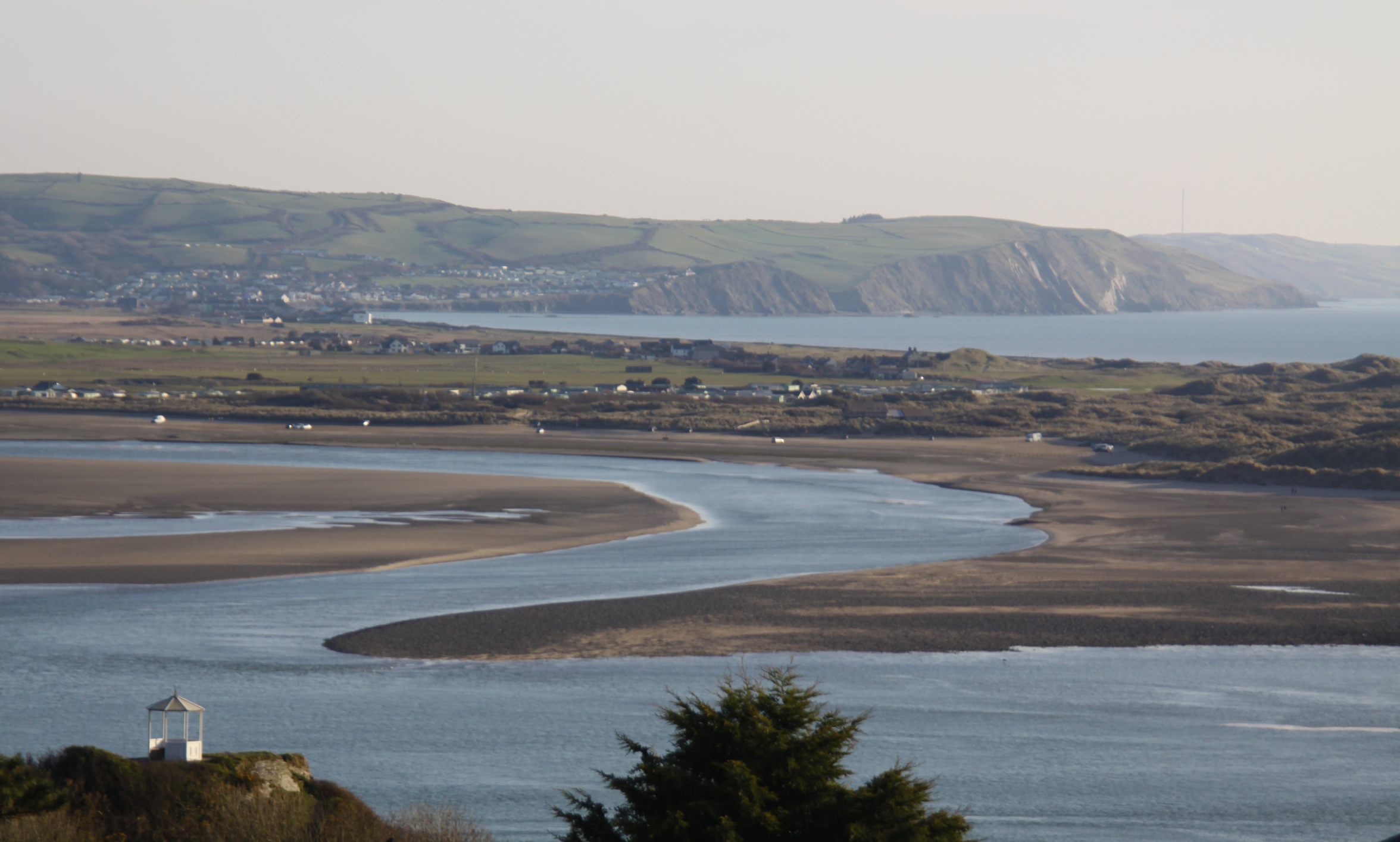
With thanks (again) to Caroline for yesterday’s super walk.  We took the footpath at the top of Gwelfor Road towards Tywyn, which has some great views over the estuary and Cardigan Bay.  Young lambs were lovely to see, leggy and alert whilst their peaceable mothers grazed.  The walk emerges at the cemetery on the main Aberdovey to Tywyn road, which is full of gorgeous primroses at the moment.  A brisk walk back along a very windy beach was superbly fresh.

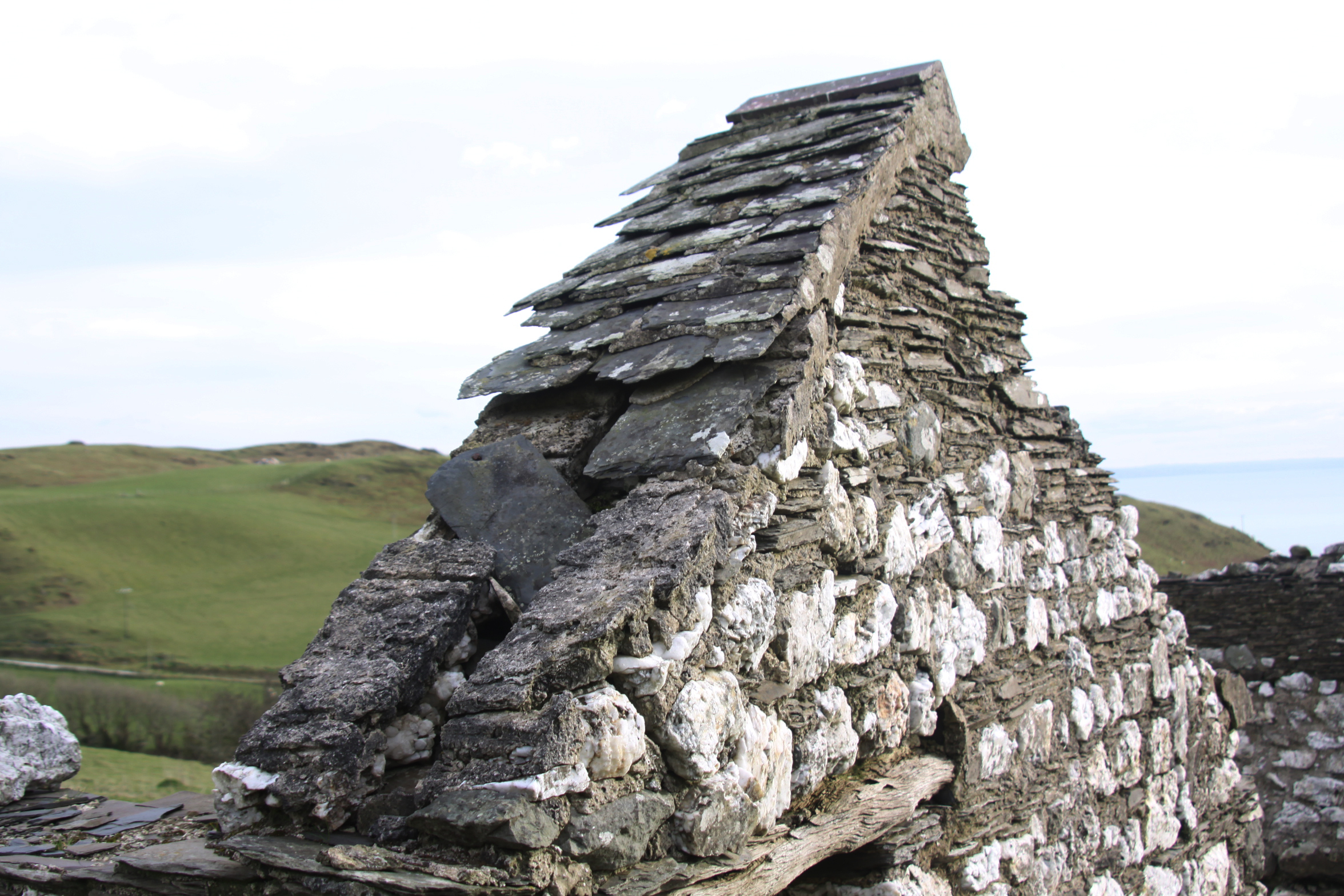
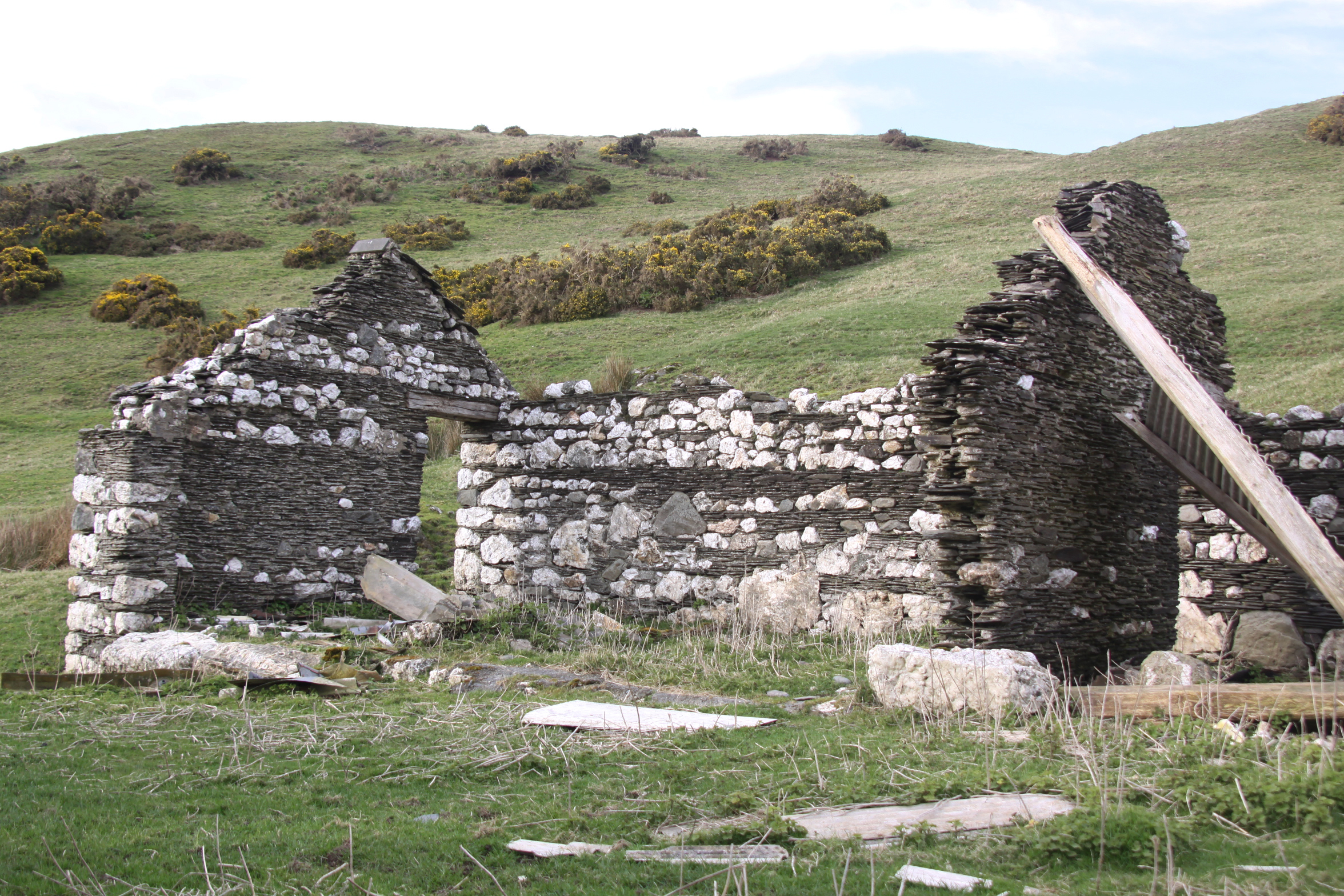
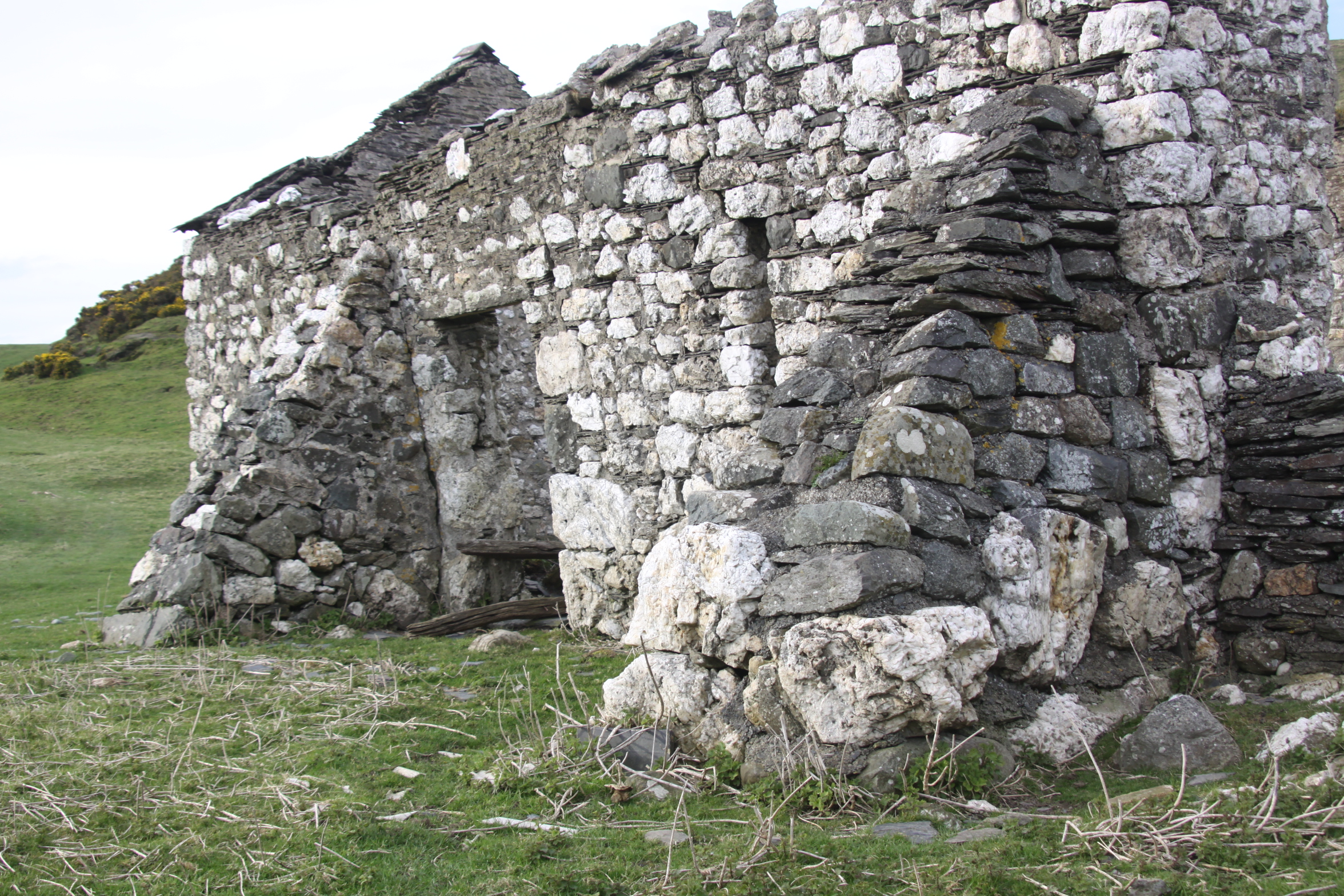
Passing some abandoned farm buildings in a sheltered dip surrounded by low hillsides, we stopped to look in detail.  Brilliant white quartz and black slate/shales and mudstone were arranged differently on both buildings, the contrast remarkable and rather beautiful.  Door lintels were made of wood, still in situ, and roofs were tiled with slate, although only tiny pieces of the roofs remained.  One of the walls of the lower of the two buildings had begun to fall outwards, and was propped up with vast buttresses.  An attempt to restore the upper building’s wall with breeze blocks was accompanied by a corrugated asbestos roof that is now disintegrated.  The thickness of the stone-built walls, the heavy buttresses, and the tiny slits for windows are all somewhat reminiscent of Mediaeval castle construction, as is its derelict condition.

Information about mermaid’s purses (egg sacks of small native shark species) can be found on an earlier post. This one, a cuckoo ray that I found on the beach yesterday (Leucoraja naevus), has been reported to the Shark Trust to contribute to their data collection project.