Category Archives: Economic history

Some final comments on vintage postcards (#30)

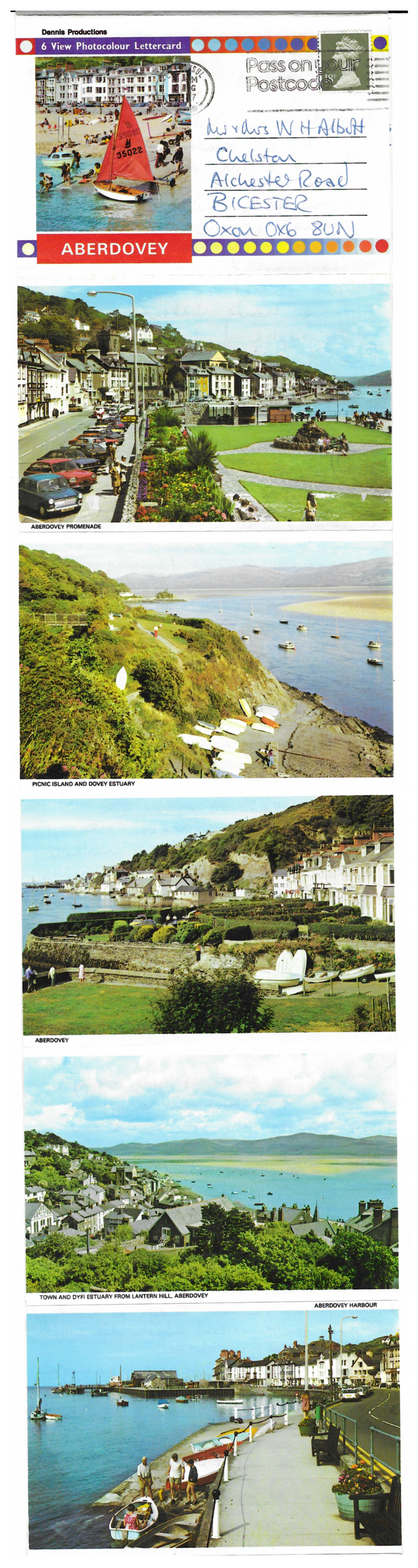
Sent in 1977, produced by Dennis Productions, which only closed in 2000. I absolutely love the cars parked along Sea View Terrace, all looking as though they belong in a museum of the 70s. I think that my Mum had the blue Austin 1100 before we left the UK in 1972.  The card was posted from Llandysul in Ceredigion, where the family of four who were on holiday in Aberdovey went on Sundays to Cross Inn for Sunday worship at the Holy Trinity church where, the letter says, there were visitors to the church from Stowbridge, Birmingham, Broadway, Leicester and Tonypandy.  It was sent to an address in Bicester

If you are coming to the postcard series late and want to go back and see what other postcards have been featured, I’ve provided an index of the entire series on the Heritage page, in chronological order (by approximate date of the postcard itself).  Alternatively you can click on the “Postcard” category in the right hand margin to see all the postcards in the series, in the order in which they were published, excluding all other posts: https://aberdoveylondoner.com/category/postcard/.

I knew absolutely nothing about vintage postcards when I bought a job lot on eBay.  The pictures are completely compelling in their own right, but turn the postcard over and, when they have been used, there is a wealth of information about when the postcard was manufactured and sent, and what sort of people were sending them. A note to self has been that it is by far more useful to buy used postcards rather than pristine unsent ones, because the stamps, postmarks, addresses and even the messages contain useful information.  The histories of the postcard companies are also fascinating.  I had no idea that the postcard was such an important source of commercial income, and was clueless how such companies worked.   Postcards are only a partial record of architectural, economic and social history, but they contribute a surprising amount.  Multiple personal, social and economic histories are tied up in these microscopic snapshots of life.  Of course, as insights into the past of Aberdovey and the surrounding area they are quite simply terrific.

Reading the Hugh M. Lewis books and booklets it is clear that the character of the village has shifted dramatically over the centuries from a rural fishing village with a single water pump to a shipbuilding hub, which became a local outpost of the industrial revolution.  Religious institutions appeared like mushrooms.  An 18th Century turnpike was followed in the 19th Century by a railway connecting north Wales, mid Wales and England.  A tourist industry was established in the 19th Century that continues to thrive today. Gas lighting was installed and then replaced with electric lighting.  Land, foot and horse were first supplemented by bicycle.  The first cars began to appear in the early 20th Century, and were clearly a real novelty.  Although the building of sailing vessels ceased after the 1880s in Aberdovey and sailing ships were the most common sight at the Aberdovey jetty well into the 20th Century, steam ships visited the port regularly, becoming part of the local economic routine.  During the war Aberdovey’s industrial importance decayed, and the tourist industry became increasingly important to the local economy.  The wharf and jetty were rebuilt to reflect this change in the 1960s, a new car park was built in 1970, new houses and community structures have modified the landscape of the village, particularly on the hill above Copper Hill Street, and continue to do so.

In spite of all these changes, what amazes me is how little the core of Aberdovey has changed in its essential architectural character over the last century.  As Aberdovey resident Helen Williams pointed out, there’s not much in the way of expansion that can happen along the seafront, due to its position between the sea and the cliff, which prevents any serious expansion even in the width of the roads.  Gaps between buildings have been filled, but the original buildings are so solidly crafted that replacements have been rarely necessary, and apart from dormer windows that extend the usability of buildings upwards, there’s not much expansion along the seafront.  Instead, newer buildings worked their way uphill, heading up and beyond Copper Hill Street, Gwelfor Road and Balkan Hill, as well as along the hillside overlooking the golf course.  It is remarkable how much of the 19th Century village has been retained intact.
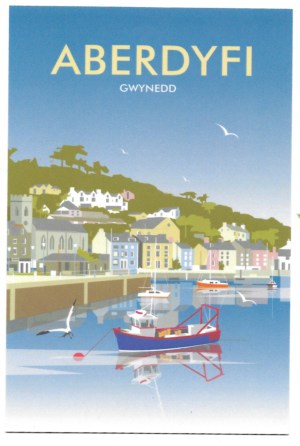
There are some lovely modern photo postcards for sale in the village, by Robin Goodland, Jeremy Moore, Glyn Davies and others. The one here is a bit different, sold during the summer at the Information Centre on the wharf, painted by Dave Thompson (www.davethompsonillustration.com) and produced by Star Editions (www.stareditions.com). It is a rather rather different take on Aberdovey than the photograph postcards, with a 1950s retro travel poster feel to it. In the foreground is the ‘Dai’s Shed’ fishing bat.

Perhaps the most conspicuous difference between past and present in Aberdovey, not visible in the postcards, is cultural.  The Welsh language is still heard in shops, restaurants, pubs and at the Neuadd Dyfi, but since the 1950s there has been an ongoing influx of English people who have holiday homes or settle here permanently.  Beyond sunbathing and watersports, and in so far as any village can be, it is a really rather cosmopolitan place.  As well as an excellent butcher, a post office, a pharmacy, two convenience stores, a dry cleaner, three pubs, numerous cafes, restaurants, ice cream parlours, hotels, holiday lets and b&bs and a number of places of worship, there are more unexpected places to visit.  These include two art galleries, a community hall with a theatre, fashion shops, two hair-dressers, a yacht club, a bowling club, tennis courts, the Outward Bound centre, a Snowdonia National Park information centre and of course the Pen Y Bryn shelter.   There’s a lot going on in such a small place!

Printed picture postcards were first established in the 1870s but became very popular in the 1890s across Europe and America.  In 1902 the current format was ratified by the Post Office, with a picture on one side, and the reverse divided into two, half for the message and half for the address and the stamp.

Using postcards as chronological markers is by no means straight forward.  Photography had become increasingly popular, and photographers had been building up sizeable filing systems that were used in successive decades for postcards, meaning that an image and its incorporation into a postcard might be many years apart from one another.  Postcards might be sold for a decade or more after they were first printed, so this too can add ambiguity to the date of the image.  A postal mark might have a solid date, which tells us when the postcard was sent, but the image itself might be years or even decades old.  One postcard in this series, showing the school on the slopes of Pen-Y-Bryn, had a 1909 postmark, but the company that produced the card had gone out of business in 1904.  In this particular case, the main building in the photograph was built in 1894, which gives a time range for when the photograph was taken, but in other examples where there are few diagnostic features, such as landscape photographs and modern photographs of the village, there may be little to help narrow down a date range.  For example, in the set of five at the top of this post, the penultimate photograph also shows the school at Pen-Y-Bryn, but seen in isolation from its more diagnostic companions, it would be difficult to judge when, between the common use of colour photographs for postcards in the 1950s and the 1977 postmark, that photograph was taken.  The postal mark just provides a terminus ante quem, an indication of a date before which the card must have been manufactured.  That can be a useful starting place.

I thought that fashion would be a helpful pointer, but that theory was partially scuppered by two factors.  First is that people are absent from a lot of postcards, and second is that Dai Williams tells me that to make old postcards look more current, people wearing contemporary fashions were dark-room pasted into older photographs.  He showed me one extraordinary example where two almost identical postcards had a group of people walking down the road, but in one the adults were holding the hands of two children and in the second the children had been removed.  Although I have confidence that postcard producer Gwilym Williams, who appears to have been a local photographer, was capturing life just as it was, photographs by the big national postcard producers may have been seriously tampered with.  Vintage cars might have been more useful for dating images, if I knew anything about them.
Glyn and Claire Davies

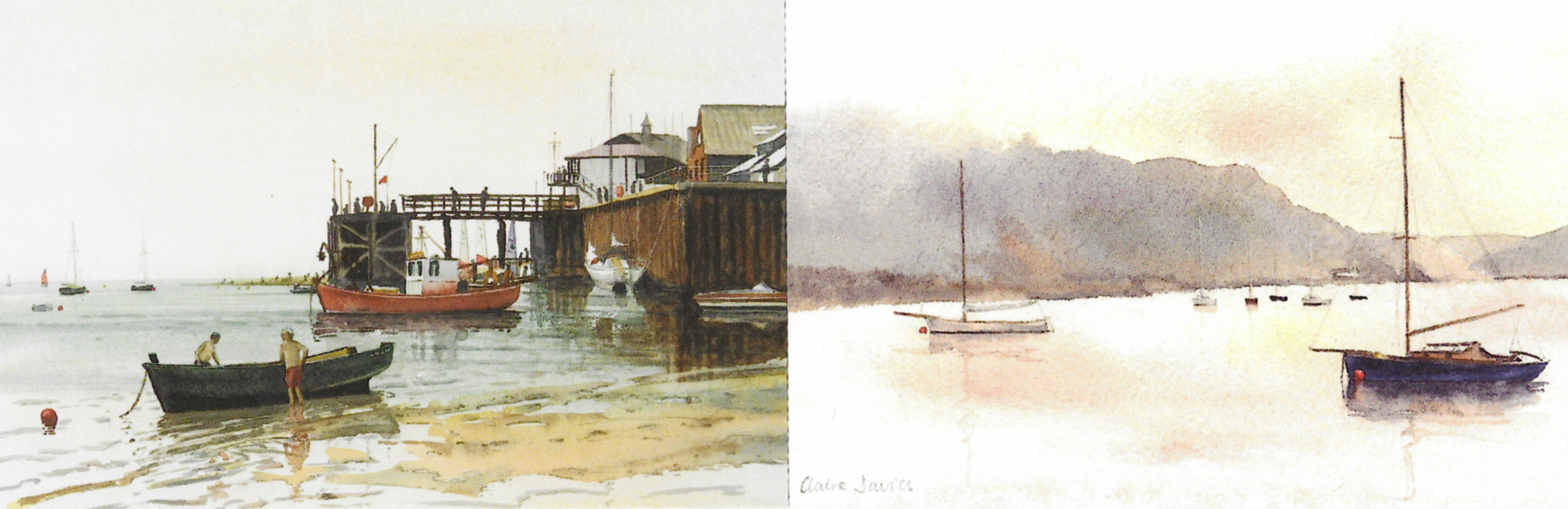
Another different take on the standard photo postcard is the collection produced by Glyn and Claire Davies based on their original paintings and sold in their shop, The Gallery, in Aberdovey (http://www.galleryaberdyfi.co.uk/cms/). Delicately executed watercolours provide evocative views of Aberdovey, some showing day to day bustle, some showing a more peaceful scenes in and around the village.  Above are two scenes on postcards, on the left by Glyn Davies and on the right by Claire Davies.  I have sent more of the postcards in this series than any others.
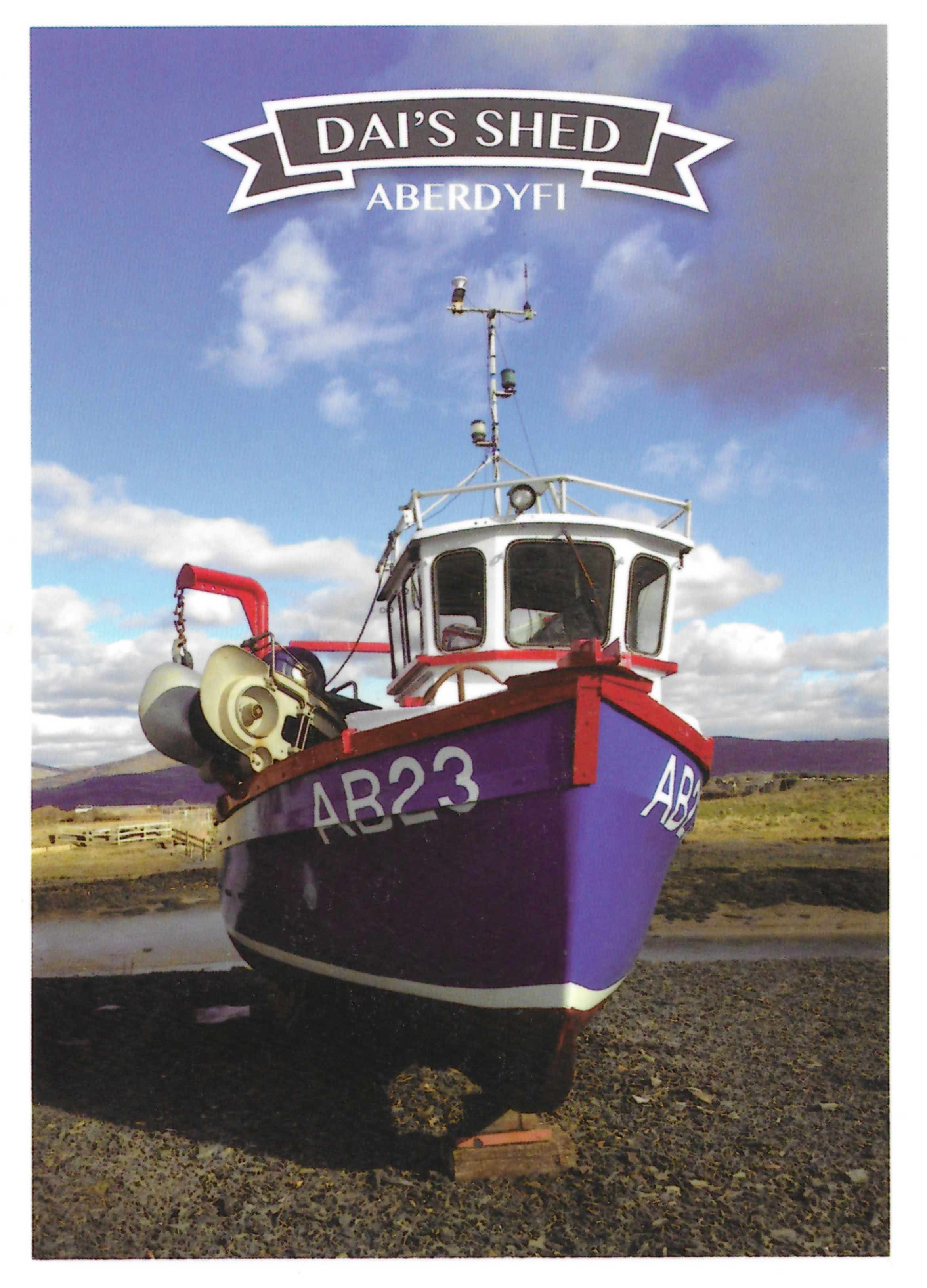
This card from “Dai’s Shed,” selling superb locally caught seafood from Easter until Autumn, is both a souvenir postcard and an advert (www.daisshed.co.uk). Dai’s fishing boat is shown in the photo at low tide against a backdrop of the hills over the estuary.

If the postmark is not legible, the stamp can give a time range, and there are a couple of websites that specialize in this.  I had assumed that the collecting of postcards, deltiology, would have a massive online presence, but resources turn out to be very fragmented and incomplete.  There are a number of websites that specialize in providing information about different manufacturers to help collectors find out the essentials about general background and specific postcards or postcard series, most importantly dates.  Unfortunately, some postcards are not included in those databases and several manufacturers are barely mentioned online.  The two best resources that I found are the MetroPostcards website, which is a mine of information about postcard manufacturers and printing techniques, and the enormous and searchable Frith’s database, which is as invaluable collection of as many postcards in the Frith’s catalogue as they have been able to pull together.

My brief flirtation with the picture postcard is over, unless I see anything particularly unusual, but I have very much enjoyed finding out about aspects of Aberdovey that I didn’t know before, and experiencing a real sense of continuity between past and present.

My sincer thanks to Dai and Helen Williams for introducing me to vintage postcards, for talking to me about Aberdovey’s history and for allowing me leaf through their collection.  Also for that fabulous pre-Christmas chocolate biscuit from Fortnum’s!

Many, many thanks too to Sierd Jan Tuinstra for taking the time to have an independent look at the postcards and other posts, using his expertise from  investigations into the Aberdovey section of the Cambrian Railway to clarify some points, expand details, refine dates and provide new information and insights, not just about rail but about all aspects of Aberdovey’s economic infrastructure.  My post on the flour mill will be rewritten shortly with new information, entirely thanks to Sierd Jan.
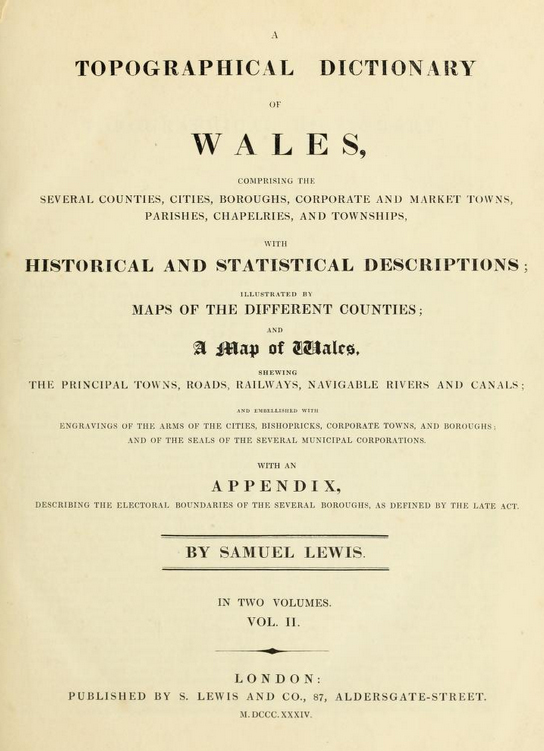
 

Aberdovey in “A Topographical Dictionary of Wales” 1849

An extraordinary book produced in the early to mid 19th Century by Samuel Lewis,  A Topographical Dictionary of Wales, contains detailed topographical accounts of places, parishes, counties and key features in Wales, arranged alphabetically.  The first edition was produced in 1833, followed by new editions in 1837, 1843, and 1849. The 1849 fourth edition, originally published in two volumes, has been digitized and is available in full on the British History Online website at:  https://www.british-history.ac.uk/topographical-dict/wales.  Copied below is the Aberdovey section, but there are also sections on Towyn and Machynlleth.

Aberdovey (Aber-Dyvi)

ABERDOVEY (ABER-DYVI), a sea-port and bathing-place, in the parish of Towyn, union of Machynlleth, hundred of Estimanor, county of Merioneth, North Wales, 4 miles (S. S. E.) from Towyn: the population is returned with the parish. This place is pleasantly situated on the northern side of the mouth of the river Dovey, which here empties itself into Cardigan bay, and from which it derives its name. It stands on the road from Machynlleth to Towyn, and is rapidly rising into estimation as a bathing-place: the beach is highly favourable for bathing, being composed of hard firm sand; and several respectable houses, and a commodious hotel, have been erected of late years, for the accommodation of visiters. In the year 1827, a new line of road was opened from Pennal, which, proceeding along the northern bank of the Dovey, among scenery beautifully picturesque, and embracing a fine view of the opposite coast of Cardiganshire, and the estuary of the river, passes through Aberdovey, and is continued along the shore to Towyn. For nearly the whole of its extent from Pennal to Aberdovey, it is cut through the solid rock, which, in many places, exhibits its naked side, of different elevations, forming a pleasing contrast to the wooded declivity of the hill, which, from the base to the summit, is thickly clothed with trees and shrubs of various kinds, presenting, in conjunction with the broad estuary of the river, and the vernal blossoms of the mountain heath, a scene of picturesque beauty. The ride from Aberdovey to Towyn, along the sands, at low water, is extremely delightful. The road from Pennal to Machynlleth has also been much improved, thereby increasing the facility of access to this rising place, which, for these and other advantages, is greatly indebted to the exertions of A. Corbett, Esq., of Ynysymaengwŷn, in the parish. A chapel has been erected, which is in the gift of the Vicar of Towyn; and there are places of worship for Calvinistic and Wesleyan Methodists, with Sunday schools attached. Petty-sessions for the hundred are held here, alternately with Pennal, once in two months.

The port, which is a member of that of Aberystwith, possesses a considerable coasting-trade: the imports are coal, culm, grocery, limestone, bricks, timber, &c., and the exports, timber poles for the collieries, bark, lead-ore, and slates. The harbour is excellent, but there is a bar on the north side of the entrance to it, which is said to have assumed its present position in consequence of the wind blowing so frequently from the south: two buoys, the outer black and the inner red, were fixed upon this bar by the Corporation of the Trinity House, in March 1831. The river, which is here crossed by a ferry to the opposite shore of Cardiganshire, is navigable up to Derwenlâs, within two miles of Machynlleth. There are extensive slate-quarries in the neighbourhood, and mines of lead and copper, but the latter are only worked in proportion to the demand. In making the new road, a considerable number of early English coins was found; and a vase of the Tuscan shape, capable of holding about two quarts, was picked up on the sands opposite to the port, in 1824: it is composed of burnt clay, and is nearly covered with an incrustation of oyster and other marine shells. The district called Cantrev Gwaelod, or the Lowland Hundred, traditionally reported to have been inundated by the sea, as commemorated in some of the Welsh poems, is said to have been situated between this place and Harlech: it was a tract of great fertility and beauty, containing sixteen fortified towns and cities, subject to a petty prince, called Gwyddno Goronhîr; and is stated to have been swallowed up about the year 500. Ieuan Dyvi, a celebrated bard, who flourished about the close of the fifteenth century, was a native of Aberdovey.

From:  Samuel Lewis, ‘Abbey – Aberfraw’, in A Topographical Dictionary of Wales (London, 1849), pp. 1-12. British History Online http://www.british-history.ac.uk/topographical-dict/wales/pp1-12 [accessed 25 November 2019].

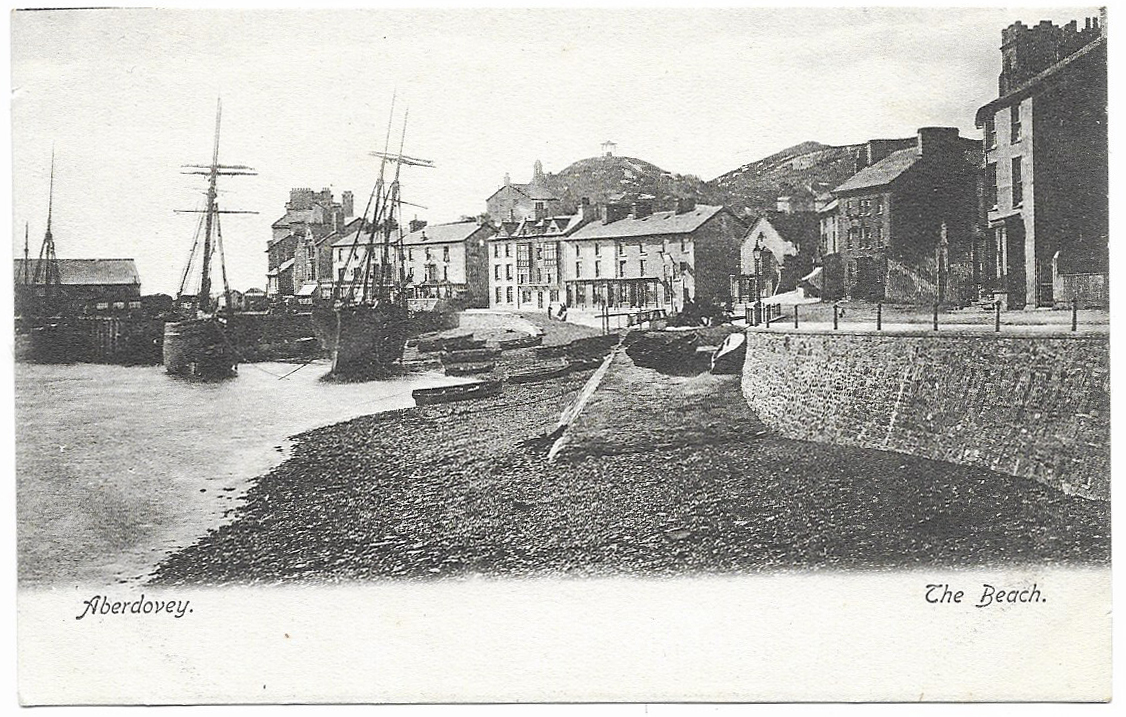
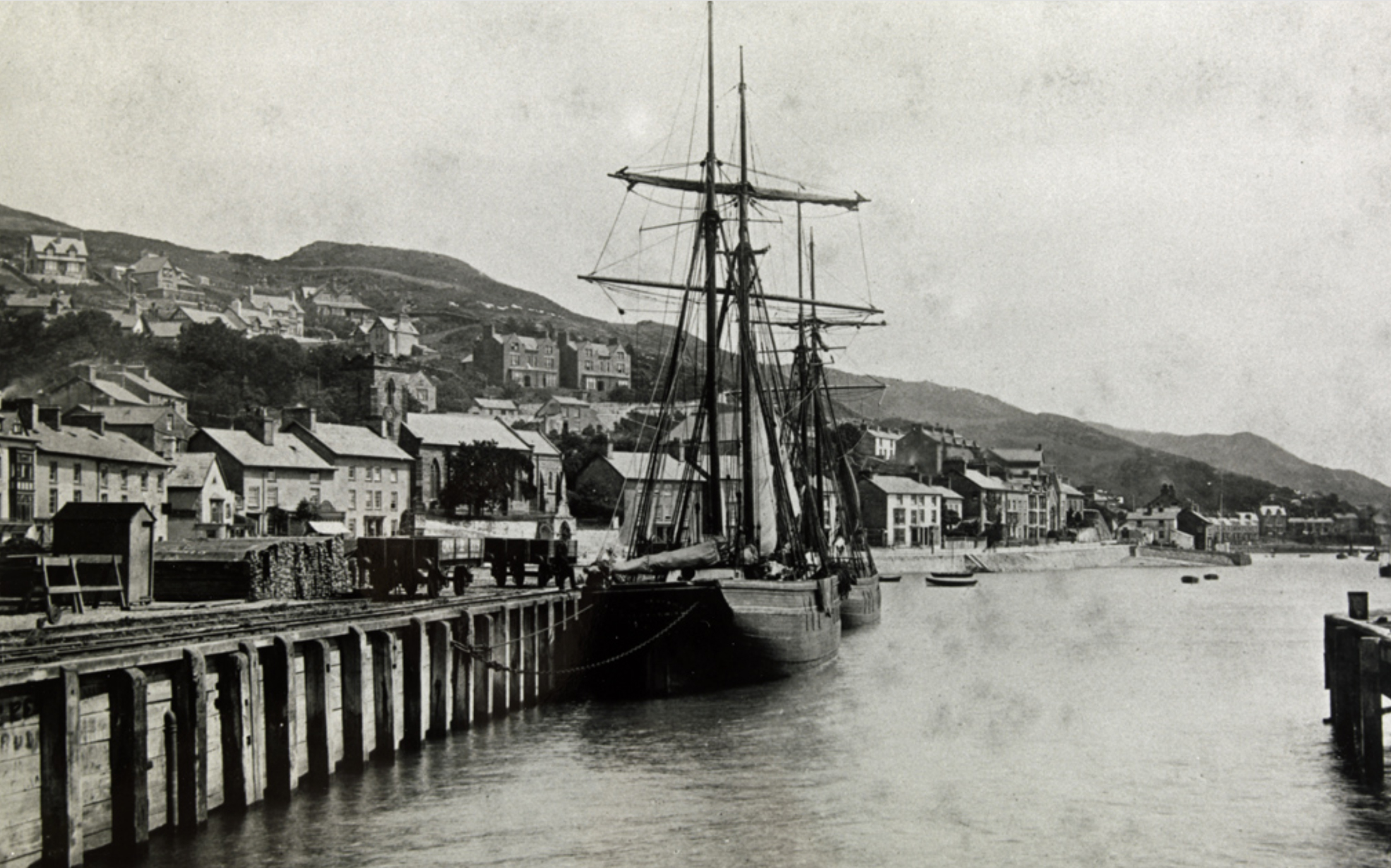
Vintage Postcards #25: Two-masted schooners at Aberdovey wharf

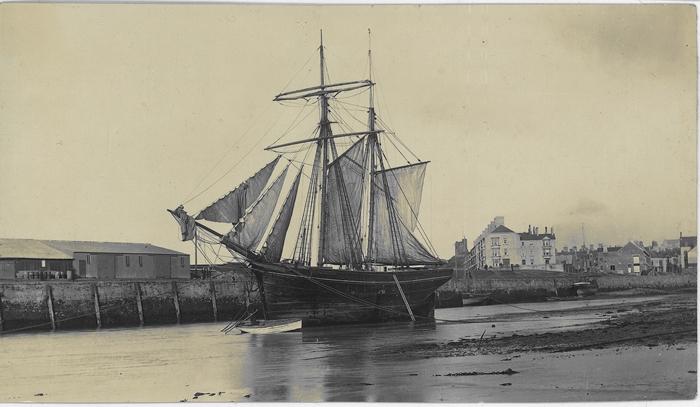
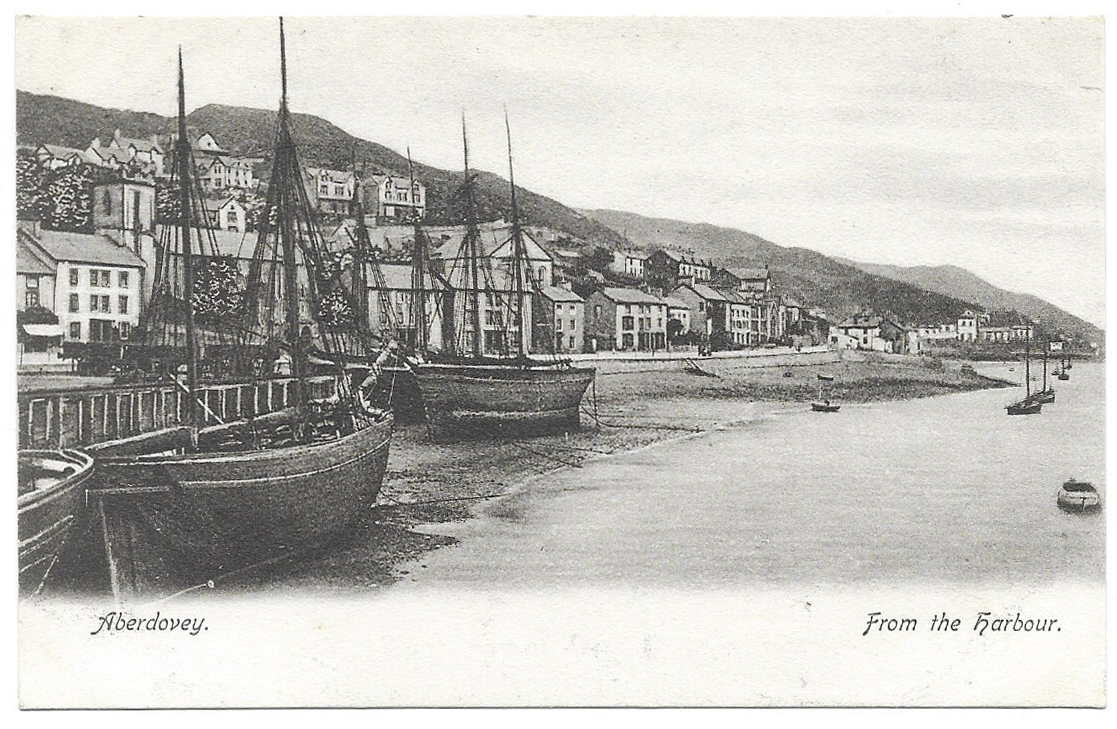
Two lovely postcards showing sailing vessels at Aberdovey, moored against the wharf.  I have no information about either.  The names of the vessels are not visible and there is no information on the postcards themselves, not even a postcard manufacturer name.  As to a date, the postcards post-date the building of the wharf and jetty in 1885 and predate the conversion of the Pen Y Bryn chapel into a school inn 1894.

In spite of the lack of additional information, I love them.  They are incredibly evocative of 19th Century and early 20th Century Aberdovey, when the village was an important trans-shipping port for for exports and imports.  The symbiotic relationship between Welsh sailing ships and the growing network of railway lines, the juxtaposition of old and new, was all about using the best possible solutions for the growth of trade and communication both within Britain and across the Atlantic.

Both postcards were unused, and apart from the fact that they were printed in Saxony, there are no further details.

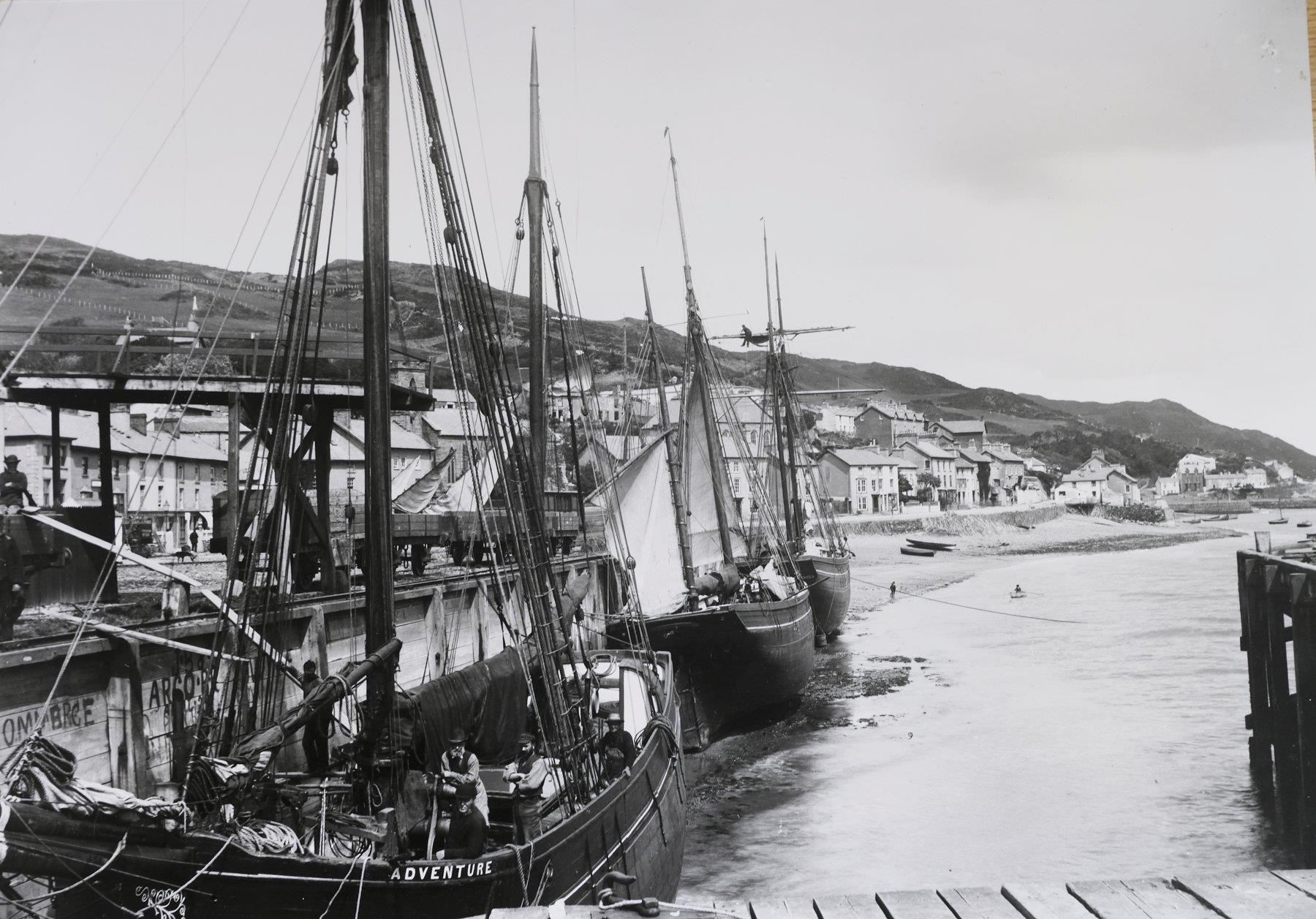
19th Century John Thomas photograph of cargo vessels at the wharf, Aberdovey

Thanks very much to the Visit Aberdovey Facebook page for posting this photograph of Aberdovey in the final years of sail.  It is in the National Library of Wales archives, where it is listed as “The landing stage, Aberdyfi.” It is thought to date to about 1885 and was taken by Ceredigion-born John Thomas (1838-1905).

The landing stage, Aberdyfi. Source: National Library of Wales (used under terms of licence)

The schooner nearest to the camera is called Adventure.  She is not mentioned in Lewis Lloyd’s book so she was probably not built at Aberdovey but, like the Ellen Beatrice, discussed on a previous post, was probably a coaster that visited various ports on the Welsh coast.  The Crew List website lists over 40 vessels named Adventure between 1857 and 1940, but none of those clustering around the mid to late 19th Century seem to fit the bill.  I’ll continue to look into it, and update the post when I have more information.

All three vessels are beached on the sand at low tide.  If you click on the image to enlarge it and look behind the ships and you can see the rails that ran along the wharf, with some trucks in situ, with a man sitting on one at far left of the shot, and a linkage between the truck and Adventure.   There is a mobile gantry next to the trucks, which would have been shifted along the tracks to assist with the loading and unloading of ships.  I haven’t seen the gantry in other photographs.  Beyond the trucks are what appear to be sails drying.  On the whole, this wonderful photograph poses more questions than it answers.

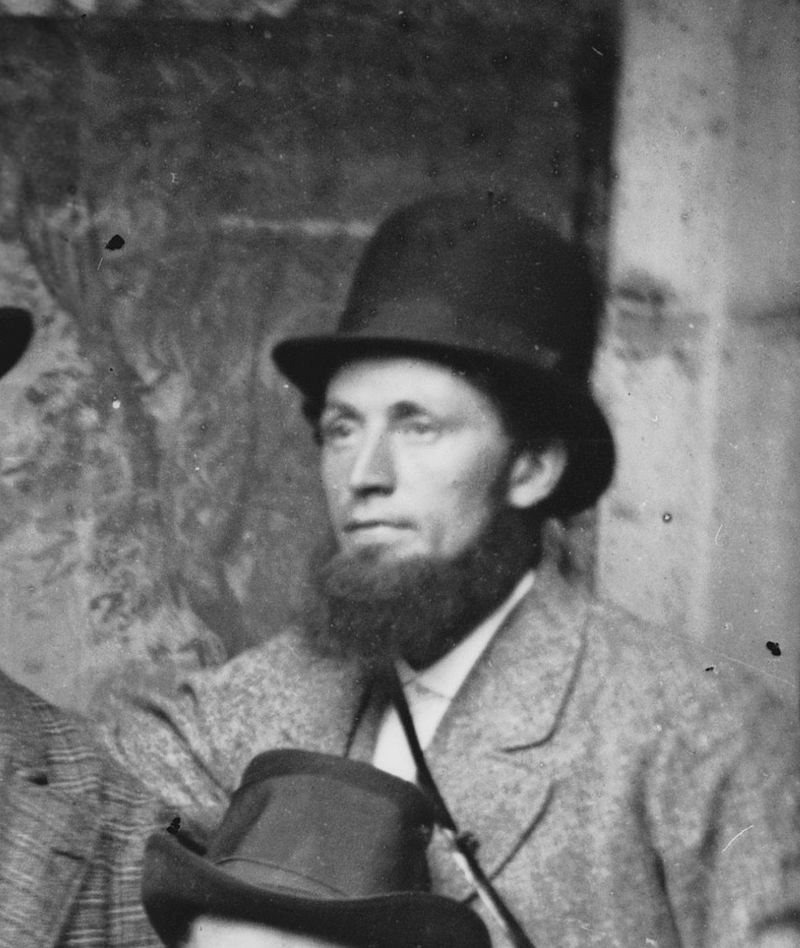
The People’s Collection Wales website has the following details about Thomas:

John Thomas, excerpted from a group photograph. Source: Wikipedia (from National Library of Wales, where the entire group photograph is shown)

Born in Cellan, Ceredigion in 1838, John Thomas was the son of labourer David Thomas and his wife Jane. Following his education in Cellan, first as a pupil and then a pupil-teacher, Thomas began an apprenticeship at a tailor shop in Lampeter. In 1853 he moved to Liverpool to work in a draper but was forced to leave after ten years to find work in the open air due to ill health. It was due to this that he began work as a traveller for a firm dealing in writing materials and photographs of famous people. Small photographs of celebrities, known as ‘carte-de-visite’ photographs, were extremely popular at that time and made for a very lucrative business.

But, during his travels, John Thomas noticed that there was a lack of photographs of Welsh celebrities. This was inspiration enough for a new business and so, having learnt the rudiments of photography, he began taking photographs of famous Welsh people. He began by asking well-known preachers to sit for their portraits.

His venture was a success and in 1867 he established his own photographic business, The Cambrian Gallery. Travelling the length and breadth of Wales, he photographed celebrities, ‘characters’, chapels, churches, homes and buildings and landscapes, though he remained based in Liverpool throughout his career. Undertaking photography of this style, and on such a scale, was not an easy task. Photographic techniques remained rudimentary for the purposes of external photography, and travel was not easy at this time.  Despite this, John Thomas succeeded in capturing individuals, landscapes and buildings in every corner of Wales during his thirty-year career. The worth of his vast collection was great. He realised its importance and chose some 3,000 glass plates which he sold to O. M. Edwards for a very reasonable price. Thomas had worked for O. M. for many years, supplying him with images for the magazine Cymru and his images would continue to illustrate the magazine even after his retirement.

John Thomas died in October 1905. The negatives bought by O. M. Edwards now form part of the photographic collection of The National Library of Wales and are an important contribution to People’s Collection Wales.

Truly fascinating.  Later this year I hope to post more of his photographs of Aberdovey here, with accompanying information when I can find it.

“Ellen Beatrice” (built in Aberystwyth, 1865), in Aberdovey Harbour c.1903

The Ellen Beatrice, via the Peoples’ Collection Wales website (Copyright Llyfrgell Genedlaethol Cymru).

I have been working my way slowly through the Peoples Collection Wales website since before Christmas, finding what it has in the way of photographs about Aberdovey and other places of interest.  I have a particular affinity with 19th Century ships, so when Adrian Lee posted the photograph on the Aberdovey/Aberdyfi Past and Present Memories Facebook page asking for information, I recognized it instantly from the Peoples Collection website, which mercifully provided the name of the ship and its port of registration.  From there it was only a few steps to finding out some more details.

This solidly built visitor to Aberdovey, moored up on the wharf is the 88-ton Ellen Beatrice, registered in Aberystwyth, number 49664.  She was built in 1865 by John Faulk Evans of Aberystwyth, whose father John Evans was also an Aberystwyth ship builder.  John Faulk Evans built a number of schooners and at least one brig and one barque.  Her first Managing Owner, who retained the title for many years, was William Owens of Aberystwyth.  The name of the ship is something of a puzzle.  It probably refers to the second daughter of Sydney H. Jones-Parry, Ellen Beatrice Jones-Parry.  Captain  Jones-Parry had joined the East India Company is a boy and served in India, Burma and the Crimea but returned, with his wife and six children, to Ceredigion to turn his hand at farming on the Tyllwyd estate that he had inherited.  I have not managed to find out quite how the family was connected to William Owen, but it may be that Jones-Parry had a share or a number of shares in the vessel.

Photograph of Ellen Beatrice, showing her in Aberystwyth. This was found on the MyWelshAncestry website (original source unknown).  There’s a slightly sharper version here.

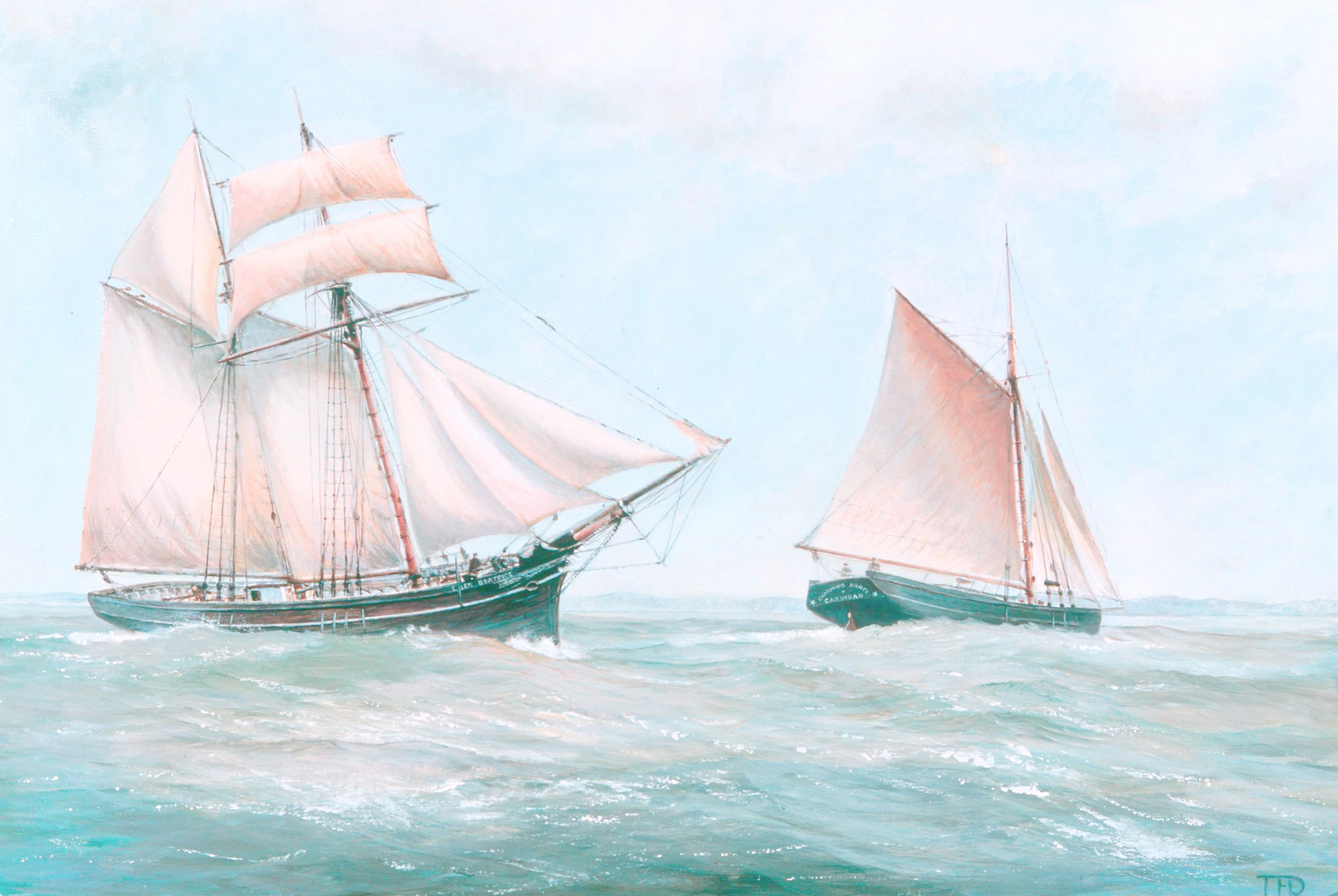
Both views are revealing, and both necessary for a full grasp of the ship’s design.  The first photograph shows off that uncompromisingly square stern, whilst the second one shows her beautiful hollow bows and classic schooner lines, and her fine rigging.  The first photograph shows Ellen Beatrice from the rear, giving a clear view of her transom (square) stern.  Although rounded sterns offer greater overall strength to a vessel, particularly important on the open sea, a coaster was usually less prone to stress, and could take advantage of the additional cargo space and deck area that a transom stern conferred.  The second photograph enables a look at her rigging and sails, identifying her as a topsail schooner.  Topsail schooners combined the benefits of sails that were perpendicular to the ship’s sides (square sails) and sails parallel to the ship’s sides (“fore and aft sails”).  The deep sea full-rigged tea clippers and East Indiamen, merchant ships of the same century, were rigged with square sails on all masts in order to pick up the trade winds, but coastal ships had much more complicated winds and breezes to confront.  Two square sails hanging from the yards (cross beams) at the top of the fore mast of Ellen Beatrice enable a following wind to provide speed as the sails billow out and power the ship through the water.  Fore and aft sails are, however, much better for manoeuvrability and tacking, allowing a ship to sail efficiently both downwind and close to the wind.  She also had jib sails (smaller triangular sails) extending from the fore mast to the bowsprit to add to lend extra flexibility and versatility.  An artist’s impression of what she looked like under sail, the painting below left of “The Charming Nancy and Ellen Beatrice” by Terry F.J. Rogers, painted during the 1970s (with Ellen Beatrice on the left), gives a good idea of how she may have looked when at sea.

From the day of her launch, her Managing Owner was William Owens of 21 North Parade, Aberystwyth.  Managing Owners were often the business managers for ships, based on land and running the commercial side of things whilst appointing a Master to take the ship concerned to sea.  The further the ship went from her own port, the more complex this relationship.  William Owens, however, seems to combined the roles of Managing Owner and Master himself.  He was listed as the Master of Ellen Beatrice for many of her voyages between 1866 and 1872, with Glyn Botwood usually acting as Mate until 1870, reappearing in 1873.  After 1872, 50-year old William Owens is replaced as Master by Robert Evans, but is listed as Boatswain.  For a few years Owens returned as Master and even when Richard Davies Jones took over for the rest of the 1870s into the 1880s, Owens often acted as Mate, only vanishing from the roster in the 1890s.

Painting by Terry F.J. Rogers: “The Charming Nancy and Ellen Beatrice,” painted during the 1970s. The Ellen Beatrice is on the left of the painting. Source: National Museum Wales

Apart from master and mate, the crew retained some consistent names from year to year, but there were also numerous changes.  Looking at the Aberystwyth Shipping records for Ellen Beatrice from the 1860s to the 1890s, again on the Taklow Kernewek website, it is clear that most of the temporary crew signed up for short contracts of between four and eight weeks.  The Taklow Kernewek website lists the crew for a large number of her journeys, and although many sailors and mates came from Aberystwyth, and a few from Borth (a supplier to many sailors to local shipping), they also came from far and wide.   The National Archives provides some details of her crew in 1881, a list that shows just how much men moved from ship to ship, in this case coming together on Ellen Beatrice from as near as Aberystwyth and as far away as Rotterdam in the Netherlands and Sydney, Australia.  Perusing the crew listings for Ellen Beatrice on the Taklow Kernewek website, it is clear that very few sailors give their place of birth as Aberdovey.   There are exceptions.  William R. Morris, Ordinary Seaman, born in Aberdovey in 1871 joined the ship at Newport and left it at Cardiff.  David Williams Lewis, born in Aberdovey in 1872, joined the ship at Aberdovey as an Able Seaman and left her at Portmadoc.  Hugh Ezekiel Davies (sic), born in Aberdovey in 1874, joined the ship at Aberdovey in 1894 as Ordinary Seaman an and also left her at Aberdovey nearly two months later.  Ezeciel Davies (sic, possibly the same person as the previous, but listed as born in Aberdovey in 1876) joined she ship from Aberdovey in 1894 as an Able Seaman and left two months later in Portmadoc.  These names turn up every now and again on the ship, but often with a year or more between journeys.  Most of those who remained with the ship from one job to another were from Aberystwyth.  What is interesting, however, is that the port of Aberdovey was a real hub for sailors.  No matter what their places of birth or where they lived, sailors joined and left the ship at Aberdovey again and again.  It is clear that Aberdovey was a good place to find new ships to join during the latter part of the 19th Century, something of a hub for jobbing sailors.

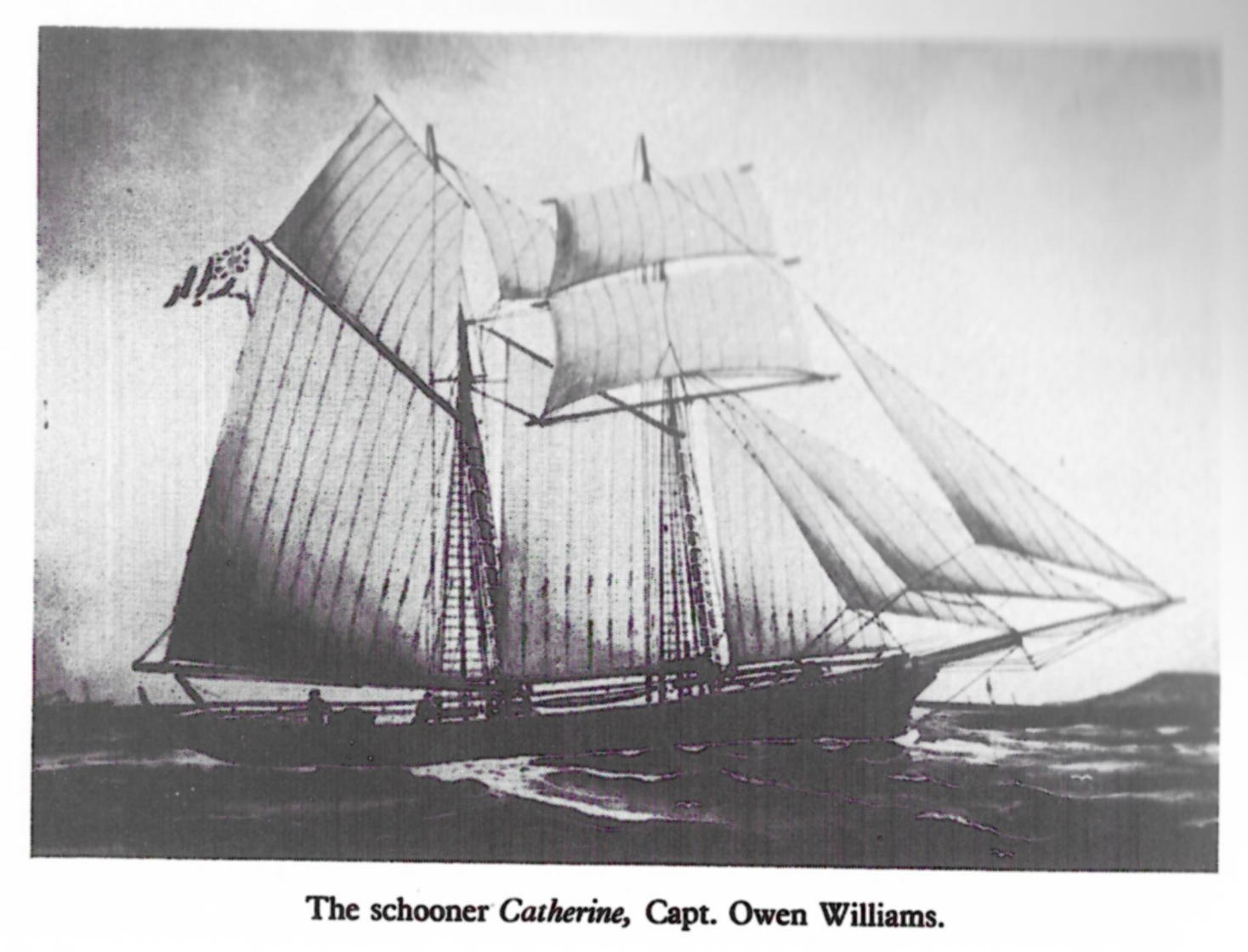
The Aberdovey topsail schooner Catherine. Source: Lewis Lloyd, A Real Little Seaport, volume 2

Aberdovey shipbuilding ended with the launch of the last ship to be built on the Dyfi, the 1869 76-ton 75.2ft schooner/ketch Catherine built by John Jones at Llyn Bwtri near Pennal.  It had been the same story in Borth, across the estuary, and Barmouth to the north. When the Aberystwyth and Welsh Coast Railway arrived in the 1860s maritime trade went into decline, together with the shipbuilding industry.  This was just a year before the last sailing ship to be built on the Thames was launched, the 1870 794-ton tea clipper Lothair, part of a trend throughout Britain.  Although the new Dyfi railway bridge, the west coast railway itself and Canadian-built ships were challenges to shipbuilding and maritime trade in the Aberdovey area, there was a much bigger threat to all builders of wooden sailing ships in Britain.  Steam power was slowly taking over the sea, and many steamships and long distance sailing ships were now iron-hulled.  Shipbuilding in Aberystwyth had not quite been defeated by the railway and the arrival of steam, although it was teetering on the edge.  Shipbuilding persisted into the 1870s, although only 15 ships were built. The last big sailing ship to be built was the schooner Edith Eleanor in 1881.

The Ellen Beatrice, via the Peoples’ Collection Wales website (Copyright Llyfrgell Genedlaethol Cymru).

In the photograph at the top of the page, and copied right, Ellen Beatrice is moored at the Aberdovey wharf alongside a big pile of shaped timber, possibly deals (pieces of timber shaped to a standardized 7 ft × 6 ft × 5/2 in) and parallel to the rail tracks that bought slate in to the port of Aberdovey for trans-shipping elsewhere. There is nothing in the photograph to say whether she was, for example, loading slate or off-loading timber.  It is probable that she simply ran various locally produced cargoes into ports along the coast, picking up return cargoes where she could.  The Aberystwyth Observer noted that in the winter of 1890 she was carrying a cargo of firebricks when she ran aground trying to enter Workington harbour in Cumbria during a bad storm.

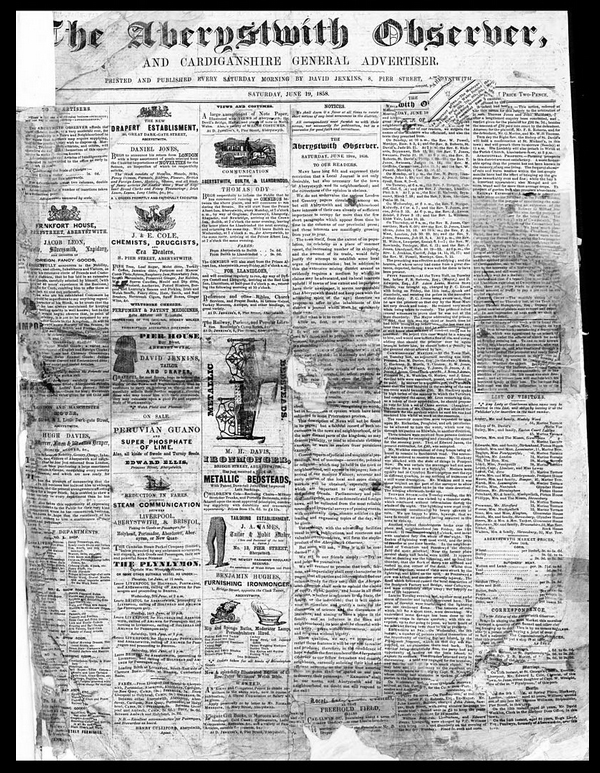
The Aberystwyth Observer reported the incident on 15th November 1890 when Ellen Beatrice was 25 years old. “The huge waves were sweeping her for stem to stern and the crew must have suffered greatly.”  Conditions were so rough that the lifeboat sent to her aid was was unable to her, forced back by “terrific” breakers at the pier head.  Instead, a rocket brigade made several attempts to fire a line on to the ship, and this eventually worked.  The line was taken on board and made fast, and the crew were taken off by breaches buoy.  The owner William Owen, Captain R.D. Jones from Pembury, his son Oliver “a lad” and his son-in-law Mr Thomas Williams, all from Aberystwyth, were removed safely.  The ship was refloated when the storm dropped, and taken into Workington Harbour.  Another incident is recorded in the Aberystwyth Shipping Records.  In 1910 Thomas Oliver Jones from Aberystwyth, master of the ship, was killed when the Ellen Beatrice was at Cowes “by an iron hook falling on his head, from the boom, whil in collision with ketch Alford.”

The Mercantile Navy List includes her up until 1924.  During that period she changed hands several times.  Her Managing Owner from 1865 was William Owens who was registered at 21 North Parade, Aberystwyth.  The vessel’s registered tonnage was 88 tons when she was launched, but was changed to 76 tons in 1892.  Between 1902 and 1914, presumably on the death of William Owens, the title and responsibilities of Managing Owner passed to Mrs M. Owens of 41, North Parade, Aberystwyth.  It’s a different address, but she was probably his wife, unmarried sister or daughter.  Between 1915 and 1917 her Managing Agent was Ernest Brown, Tintagel View, Port Isaac.  Between 1918 and 1920 she was in the hands of The Weymouth Diving and Touring Company at 17A King Street, Weymouth.  Finally, between 1921 and 1923 (now registered 73 tons) her Managing Owner was William T Cundy of Lipsom Road, Plymouth.

I don’t know why her registered tonnage was reduced from 88 tons to 76 and then 73 in the Mercantile Navy List.  It is possible that there were errors in the record, or that the way in which tonnages were calculated changed.  This did happen from time to time, because duties for cargoes were based on various measurements including tonnage, but it may also be that the ship was physically altered in some way, and that her actual tonnage was reduced as a result.

There is no record of her in the Mercantile Navy List after 1923 but I have been unable to find any record of a wreckage or sale.  As she was by then 59 years old, after a reliable but strenuous career, she was perhaps too old to be seaworthy without costly repairs.  It seems plausible that the decision was taken to break her up but it would be good to have a definitive end to her story.

There are so many gaps in this, a huge frustration.  Who was William Owen, what was his background and how did he manage his business?  Was he the sole owner of the ship, or were there other share-holders?  Did he own and manage other ships?  Did the vessel get her name as a result of a connection with Jones-Parry, and if so what was this connection?  Who were the Aberdovey sailors that sailed on her, and did they remain based at Aberdovey or did they move away?  What were Ellen Beatrice’s regular cargoes and routes, how long did they take and how did she meet her end in 1923/24?  So many other questions besides.  If anyone has any of the answers, please get in touch.

I had fun doing the reading for this post.  Thanks to Adrian Lee for setting me off down this particular path.


Main sources:

Lloyd, L. 1996.  A Real Little Seaport.  The Port of Aberdyfi and its People 1565-1920. Volume 1. ISBN-10 1874786488
Lloyd, L. 1996.  A Real Little Seaport.  The Port of Aberdyfi and its People 1565-1920. Volume 2. ISBN-10 1874786496

Aberystwyth Harbour, Shipbuilding and Ships (C.1850-1880)
http://www.mywelshancestry.co.uk/John Jenkins/Aberystwyth Harbour and Shipping/Aberystwyth Harbour and Shipbuilding.html

The Aberystwyth Observer
https://newspapers.library.wales/view/3045806/3045811/33/ellen%20moulsdale

The Mercantile Navy List
http://www.maritimearchives.co.uk/mercantile-navy-list.html

Peoples’ Collection Wales
https://www.peoplescollection.wales/items/405446?fbclid=IwAR1Tx6nySDcE23NtQD0XdvhSV4hgGNTUePO4oW3MspRQOGMWizl0GGZfzp0

Taklow Kernewek
https://taklowkernewek.neocities.org/abership/crewlists/vessel184.html

Vintage postcards #22: The TalyLlyn Railway

In spite of the big car park at Dolgoch, I have often taken the train to Dolgoch to walk the falls, instead of the car, because it has such charm.  I have also enjoyed sitting back on more lazy days with visitors, taking the train to Abergynlowyn for the pleasure of the superb views along the valley and towards Cadair Idris, drinking coffeee and munching cake at the station’s cafe.

The TalyLlyn Railway was built in 1865 along the south side of Fatthew Valley, to bring slate down from hills along the valley as far as Nant Gwernol into Tywyn, a distance of over seven miles, a trip of just under an hour.  Before the railway, from 1840, the tons of slate and slabs excavated from the Bryn Eglwys slate quarry at at Nant Gwernol, were carried by pack animals, carts and sledges to Aberdovey, where it was loaded on to ships bound for the building industry in cities across Wales and England.

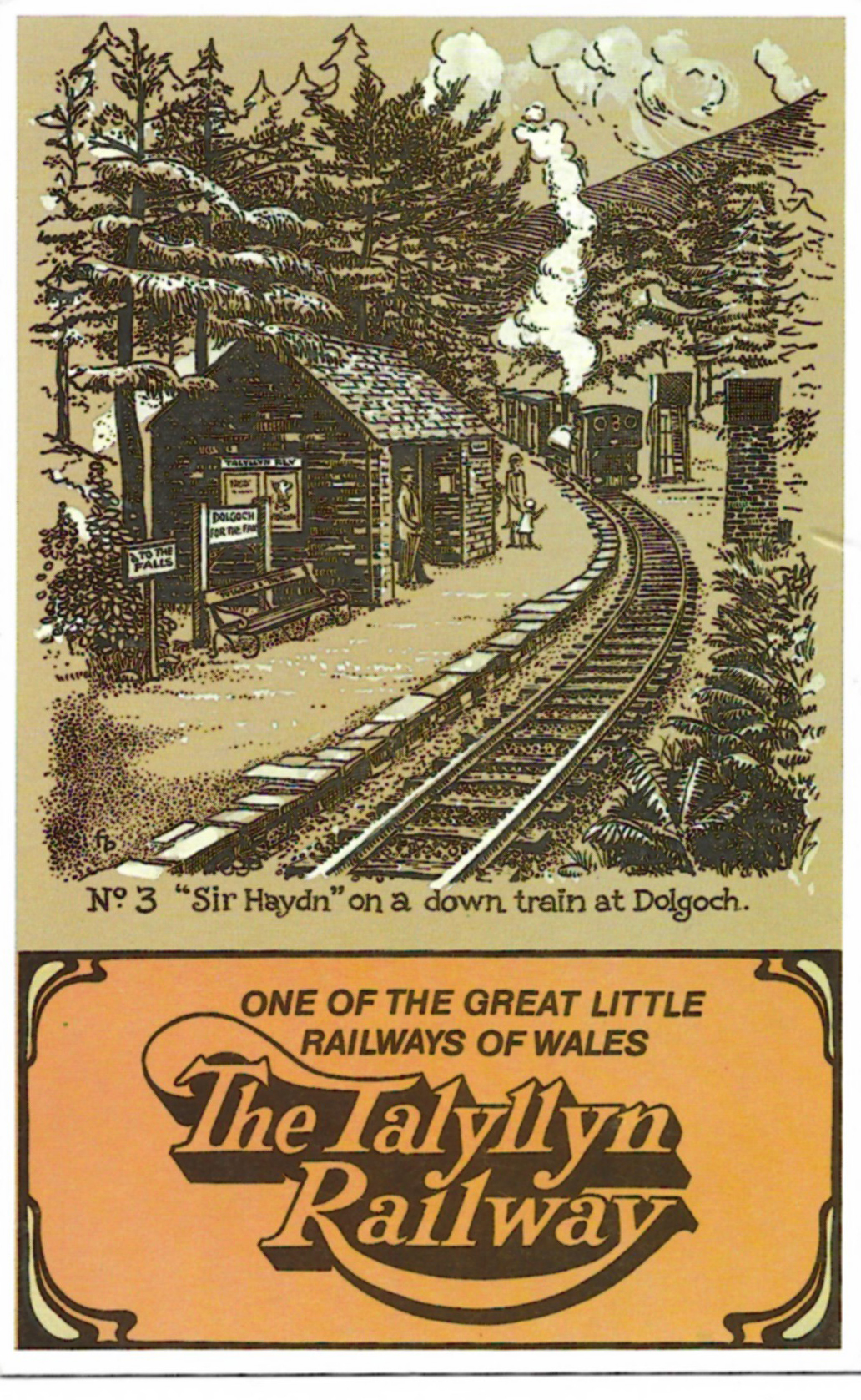
The text printed on the back of the postcard reads: “No.2 ‘Sir Haydn’ rebuilt in the 1890s as an 0-4-2 Saddle Tank was originally constructed in 1878 as an 0-4-OST for their neighbours the Corris Railway. Purchased in 1951 for the Talyllyn Railway for the princely sum of £25. It was then named after the General Manager of the line from 1911 to 1950, Sir Henry Haydn Jones.”  On one side of the tracks is the platform and on the other are two water towers. Dalkeith Picture Postcards (no.417)

By the end of 1866 it had been adapted to carry passengers as well.  Although ongoing investment in the railway continued to improve it, the capital investment was high and the immense profits hoped for did not follow.

The mine was closed in 1909.  Purchased by local MP Henry Haydn Jones in 1911 it had a brief resurgence but after the First World War it held on by a thread and eventually closed in 1946 following a serious slate mine collapse.

Haydn Jones continued to run the train as a passenger service until 1950, when he died.  It looked as though the railway’s life was over, but in 1951 the Talyllyn Railway Preservation Society was formed with the help of the well known engineer and author Tom Rolt, and the Talyllyn Railway became the world’s first preserved railway, continuing the service whilst simultaneously working on the restoration of both tracks and engines.  There is a history section on the Talyllyn Railway website, from which the above information was taken, with many more details and some great photos.

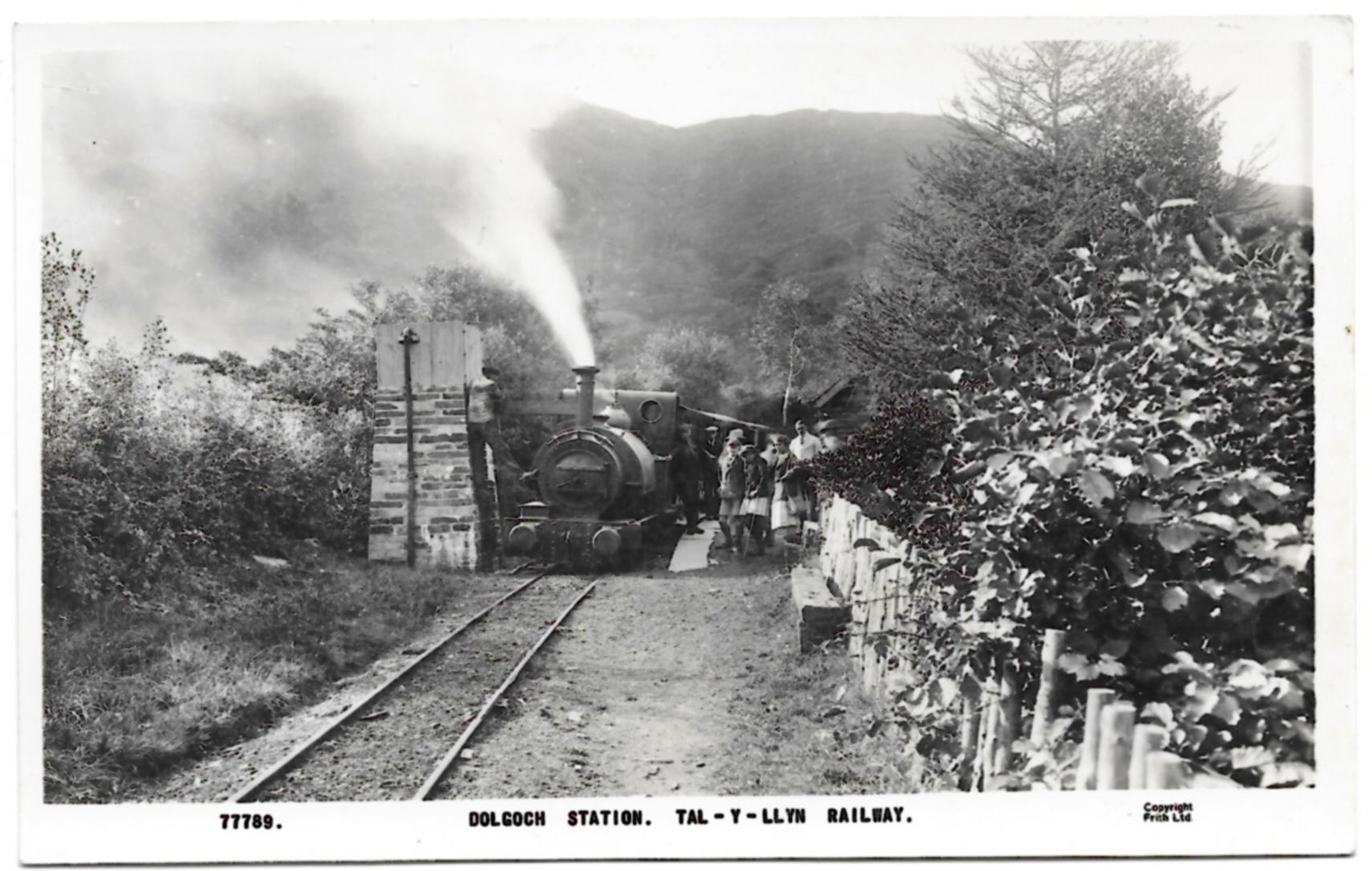
The black and white Frith postcard at the top (number 77789) shows an engine at the water tower at Dolgoch, where it took on water for its trip along the valley.  On the platform there is a small group of people waiting to board the train.  Each engine was numbered and named, and my thanks to Richard Greenhough for the identification of the engine as No.1, Talyllyn.  It was built in 1866 and ran until 1952, when it was removed from service or an overhaul, not returning to service until 1999. There is more about the engine on a dedicated page on the Tallyllyn Railway website.  The unused postcard is not listed on the Frith website, but postcard 77791, also of Dolgoch, dates to 1925, so it seems safe to place it in the mid 1920s.

The Talyllyn Railway Centenary commemorative cover.

In 1870 and for decades afterwards, the Talyllyn railway carried post between Tywyn and Abergynolwyn, the fulfilment of an official agreement with the General Post Office (GPO).  The first Talyllyn train of the day carried mail bags from Tywyn to Abergynolwyn.  The last train of the day took all the local post down into Tywyn.  This was an early precursor of the 1891 arrangement between the GPO and a number of railway companies to which the Talyllyn railway had also signed up.  The 1891 arrangement enabled people to send urgent post via the railways, which delivered them quickly between railway stations.  A small additional postage cost was added to the standard charge, so two stamps would be fixed to the letter:  a normal stamp showing the standard postage rate and a special stamp for the additional amount.  Although this system ended when  British Rail was formed and individual railway companies were either closed or nationalized, Talyllyn had neither closed nor been nationalized, so when it re-opened as a preserved railway in May 1957, in continued to hold the right to send mail.  It takes advantage of this today to help raise funds for the line.

Queen Elizabeth II’s Silver Jubilee, commemorated by the Talyllyn Railway

Visitors can send souvenir postcards and letters featuring a Talyllyn stamp, which can be purchased from Wharf station, and can be posted at in the Guard’s van, handed in at Wharf and Abergynolwyn stations, or popped in the postbox at Tywyn’s Talyllyn station.  Special cards are produced to mark major Talyllyn events or Post Office special occasions like  First Day and Commemorative Covers, like the examples here.  You can find out more about these stamps and cards on this information leaflet from the Talyllyn website.

The Talyllyn “great little railway” souvenir postcards on this post are all in a series produced for the TalyLlyn railway by Dalkeith Picture Postcards.  Dalkeith specialized in postcard sets of this type, many with transport themes.  Although inexpensive, they are apparently very popular with collectors.  All three shown on this page were unused.


Vintage Postcard #21: Rolling stock on the tracks, Aberdovey beach

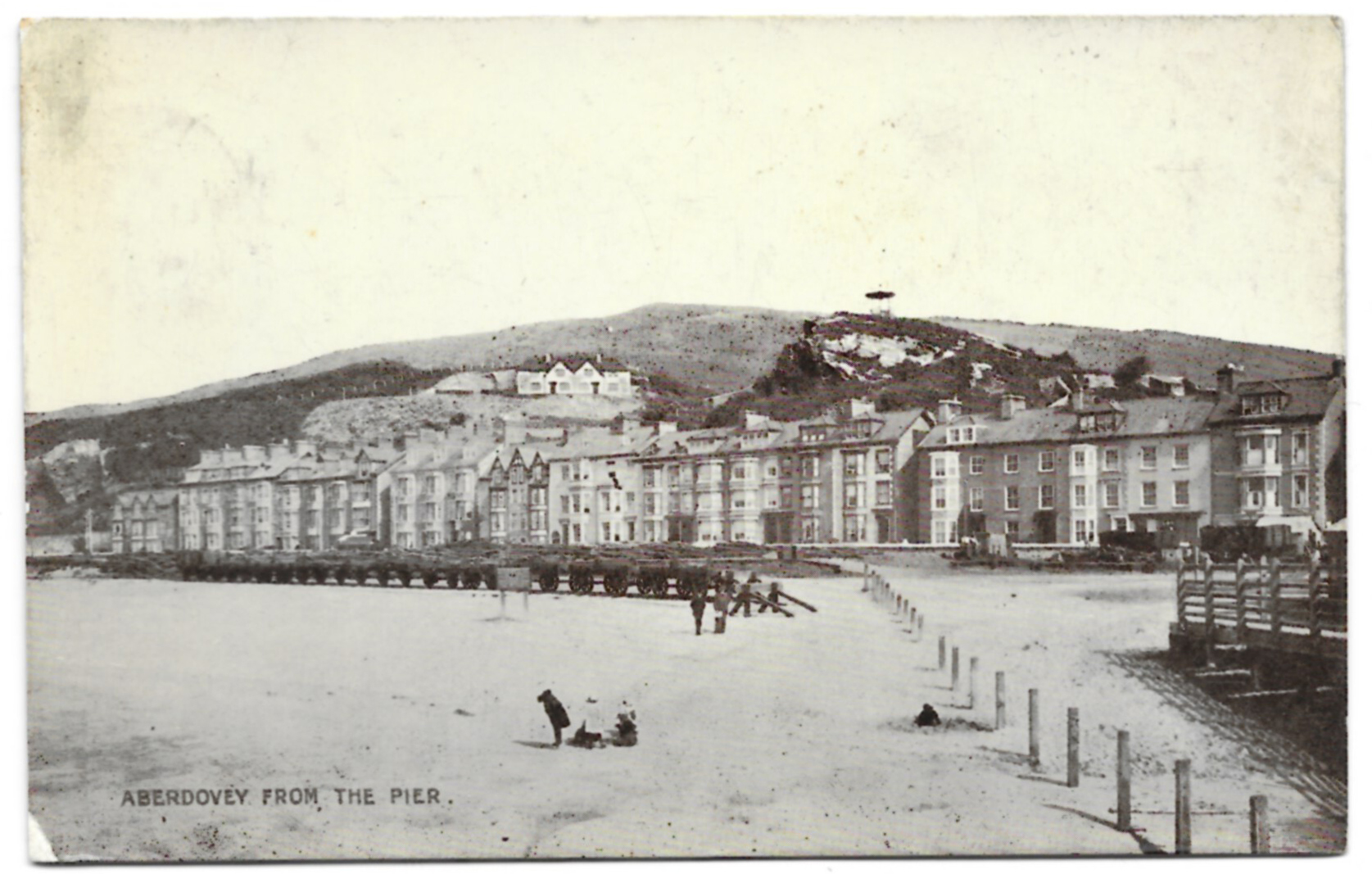
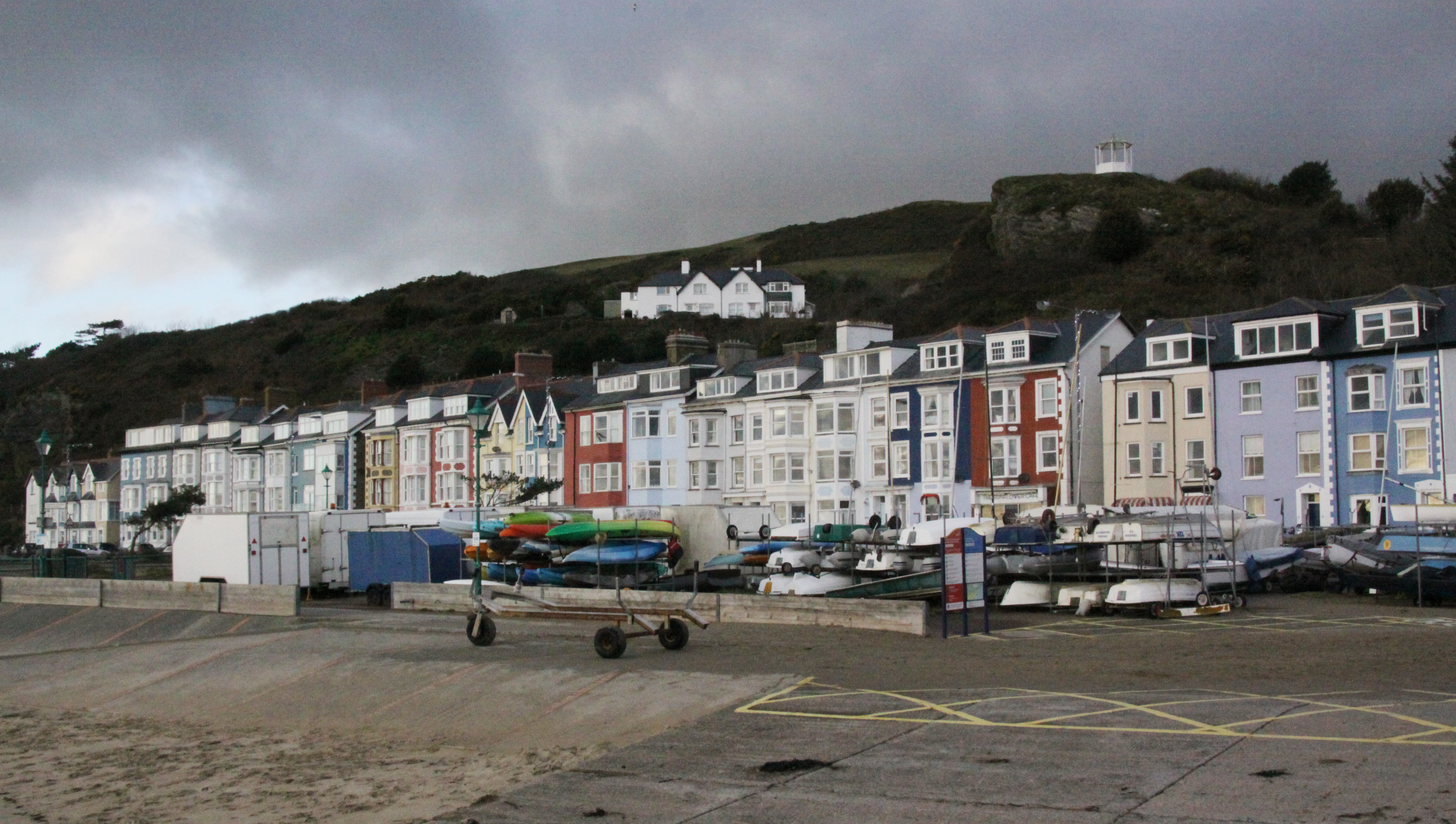
Where the big 1970 car park is now located, railway tracks used to cross the beach in front of Glandyfi Terrace.  There is more about the rails and the jetty in an earlier post, and there isn’t much else to say about this postcard here, but I like it very much.  The row of freight trucks with their big wheels divides the tourist beach from the houses, and tell their own story about the various economic imperatives of Aberdovey in the earlier 20th Century.  As ever, the 1897 shelter on Pen Y Bryn looks out over the scene, the village’s most conspicuous landmark and one of it’s most visited tourist attractions.  The photograph was taken from the jetty and I have tried to reproduce the same viewpoint.

Typically for such an everyday scene, this was a “Gwilym Williams, Aberdovey” postcard.  It was posted from Llandderfel, near Bala, in July 1912 to an address in Nelson, Lancashire.

Vintage Postcards #20: Aberdovey beach huts (and Melin Ardudwy)

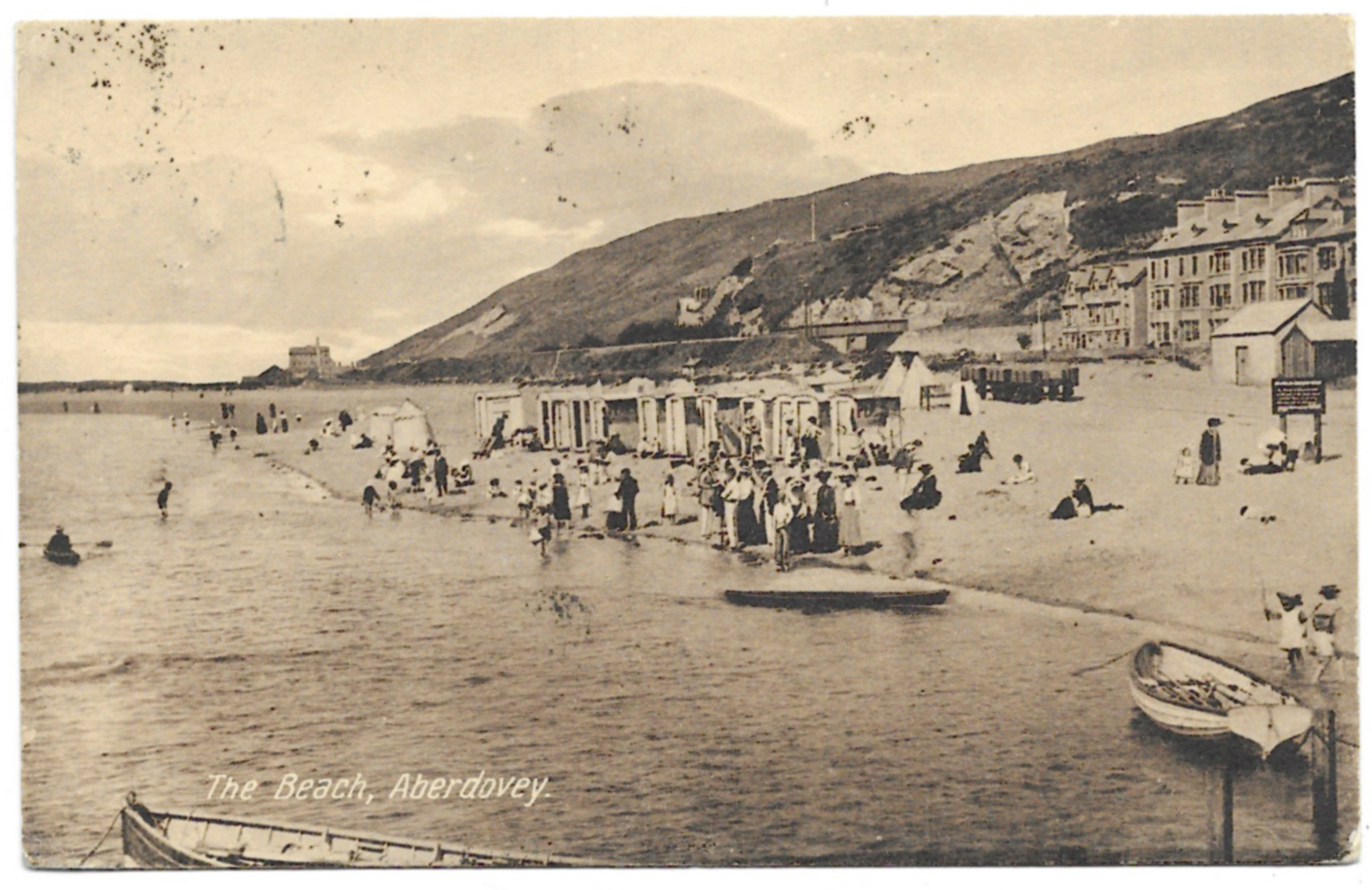
When I first glanced at this postcard I was focused on the busy beach scene, with the row of bijou beach huts and the slightly exotic tents that are rather reminiscent of Rudolph Valentino desert scenes.  Then I noticed the mill in the background.  In spite of the distance of the mill from the camera and the lack of detail, I was chuffed to bits to see it there because this is only the third photograph of the mill I have found.  The steam-powered roller mill, Melin Ardudwy, has been covered on a previous post.

The postcard shows 11 beach huts, and several tents.  The visitors gathered at the water’s edge, women, men and children, are all elaborately dressed in fashionable outfits with hats.  Just like previous postcards that show railway tracks on the beach, this photograph, showing beach huts summer visitors in the foreground, rail tracks at the back of the beach, the Cambrian Railway bridge beyond and the flour mill on the horizon, are all a reminder of two of Aberdovey’s important but sometimes conflicting income streams – industrialization and port trade on the one hand, and tourism on the other.  Having said that, I am sure that most visiting children will have loved to see all the goings-on on the wharf and jetty, with vessels of all size and trains with their cargoes.  It’s a busy scene.  Few have been brave enough to venture into the sea, but a few are paddling in a rather gingerly way.  None of it looks even slightly relaxing.  Visitors at this time probably arrived in greatest number by rail, but the Aberystwyth.gov.uk site says that a steamer offered trips to Aberdovey from Aberystwyth during the summer, allowing day-trippers the novelty of a cruise and the diversion of another resort.

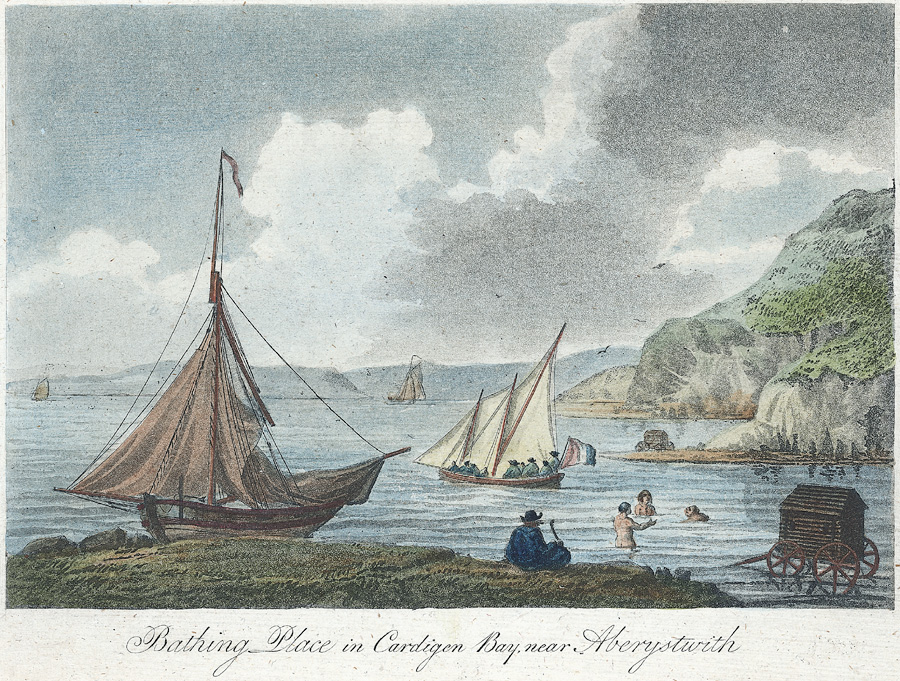
Bathing machines near Aberystwyth c.1800. Source: Wikipedia, which in turn sourced the image from the National Library of Wales

The origins of the beach hut lie with medical professionals of the 18th Century.  Just as warmer climates were believed to be beneficial for alleviating some ailments, and the waters from natural spas at places like Bath and Harrogate were recommended for an assortment of conditions, in the 1700s, immersion in sea water began to be recommended by the medical profession as a cure-all for various health problems.  Just as ailing people began to migrate to spas to take the waters, combining the hope for a cure with the enjoyment of local entertainments, there was a gradual flow of people to the seaside, requiring both facilities for entering the sea and entertainment when back on shore.  In order to enable these early health tourists to immerse themselves in the sea whilst retaining modesty, horse-drawn bathing machines were introduced to beaches, enabling people to dispense of their clothes in privacy while the bathing machine was pulled to the water’s edge.  Initially people entered the sea naked, as in the painting of a scene near Aberystwyth, left.  Soon specially designed beach wear was designed.  By the time Victoria came to the throne in 1837, bathing machines were well established and seaside holidays were becoming increasingly popular, aided by the growth of the railway network. Queen Victoria had her own personal bathing machine at her home on the Isle of Wight (there’s a photograph of it on Wikipedia).

Initially men and women were segregated, and the bathing machines delivered men and women to the designated parts of beaches.  As beach holidays became commonplace, and all-encompassing swimwear eliminated the need for people to be delivered to the water’s edge, the need to divide men for women diminished and mixed bathing became the norm.  The upshot of all this was that bathing machines were joined and eventually replaced by fixed beach huts, which offered people the same facility to change in privacy, but also gave them somewhere to return to as a base for their day on the beach.  Once established, beach huts could be hired by the hour, the day, the week.  Eventually they could be hired by the year or purchased outright.  Beach huts today exchange hands for fairly eye-watering sums.

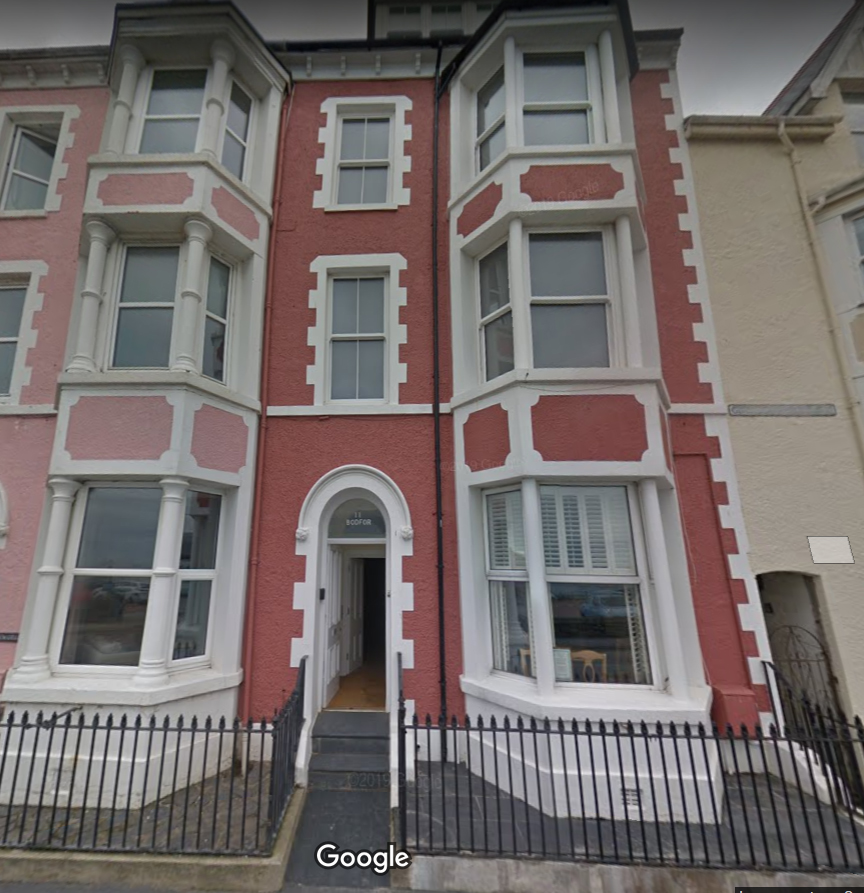
11 Bodfor Terrace. Source: Google Maps Street View

The reverse of the postcard gives the information that the card was posted in June 1913 from Aberdovey, the year before the First World War. The visitors were staying at 11 Bodfor Terrace, which is still rented out for holiday accommodation today.  Unlike the people in the postcard, these visitors had been swimming and the writer concludes that she and her companions were “very happy.”  It was sent to Lymm in Cheshire.

The postcard itself was one of James Valentine’s but surprisingly isn’t numbered, so no production date is available but the clothing in the photograph is consistent with the postal mark.

Main sources for this post:

A Short History of Beach Huts
https://www.beach-huts.com/history-of-beach-huts.php

The History of the Humble Beach Hut Unveiled
(For those interested in verifiable factual information, the Daily Mail is perhaps the antithesis of a research tool.  It does, however, have a review of a new book about beach huts by Karen Averby, and there are some really splendid beach hut photos on the page).
https://www.dailymail.co.uk/news/article-4418120/The-history-humble-beach-hut-unveiled.html

Aberdovey Vintage Postcard #18: Christmas Greetings!


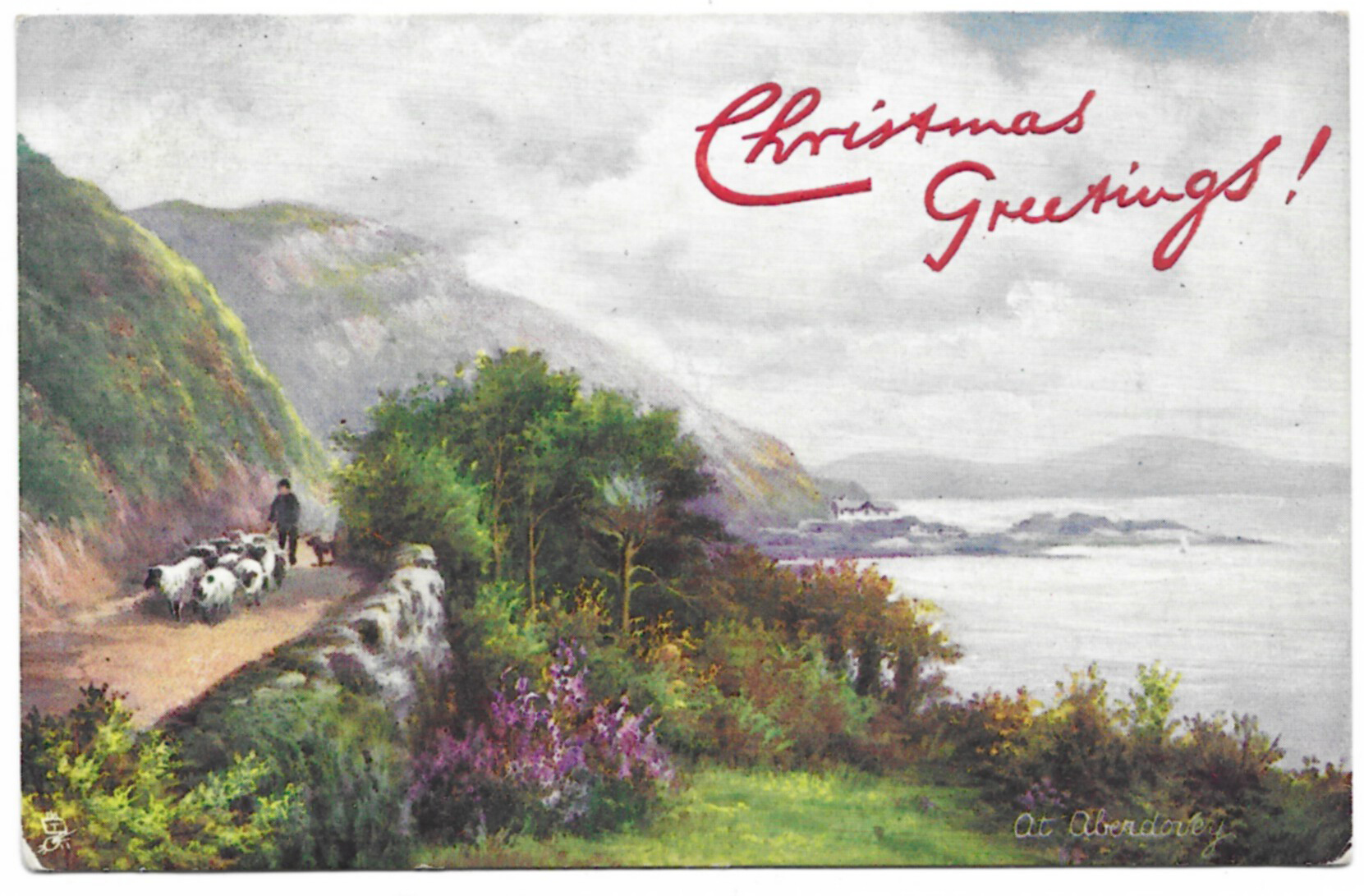
This is the colourized version of the second vintage postcard that I posted, showing sheep being driven down the Machynlleth-Aberdovey road towards Aberdovey village. The sepia one was dated  to 1903 but according to the Tuck’s database, the colour version was issued later, appearing in the 1908/1909 and 1911/1912 Tuck’s Postcard Catalogue.  All the information about the scene, together with some details about what Aberdovey was like at that time, information about Frederick William Hayes, the artist who painted it, and Raphael Tuck and Sons, the company that produced it, are on that post.

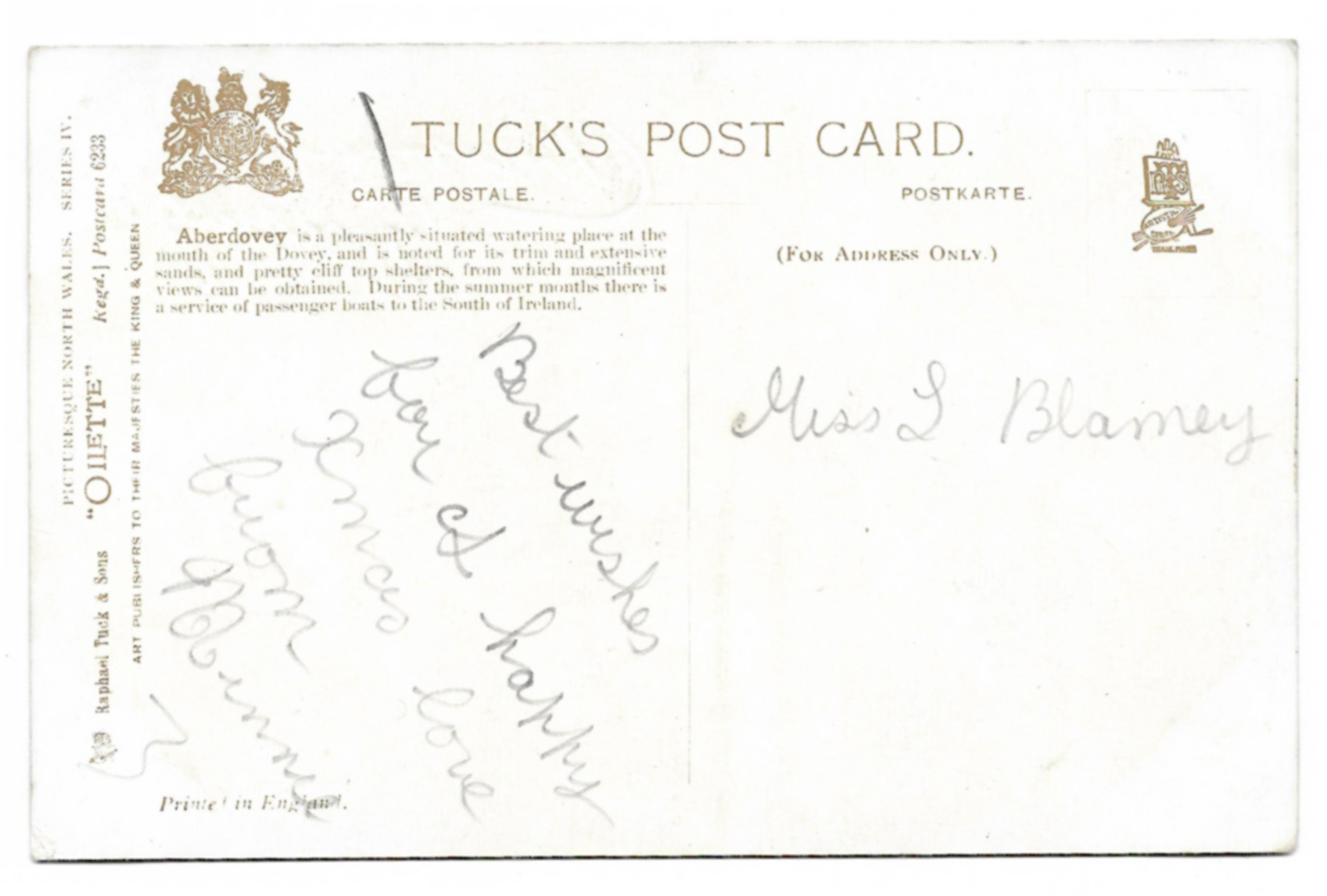
The description on the reverse of this postcard says “Aberdovey is a pleasantly situated watering place at the mouth of the Dovey, and is noted for its trim and extensive sands and pretty cliff top shelters, from which magnificent views can be obtained.  During the summer months there is a service of passenger boats to the South of Ireland.”

This card, registration number 6233, was in the Oilette series, which came in during 1903, was one of a series of postcards of which each image was either designed to look like an oil painting or was a reproduction of an actual oil painting.  Most of Tuck’s chromographic (colour) printing was done in Germany, but this one was printed in England.  The red letters “Christmas Greetings” stand proud from the surface of the card.

I hope that everyone has a very Happy Christmas!


Vintage postcards #17: A special train on the Cambrian Coast Line

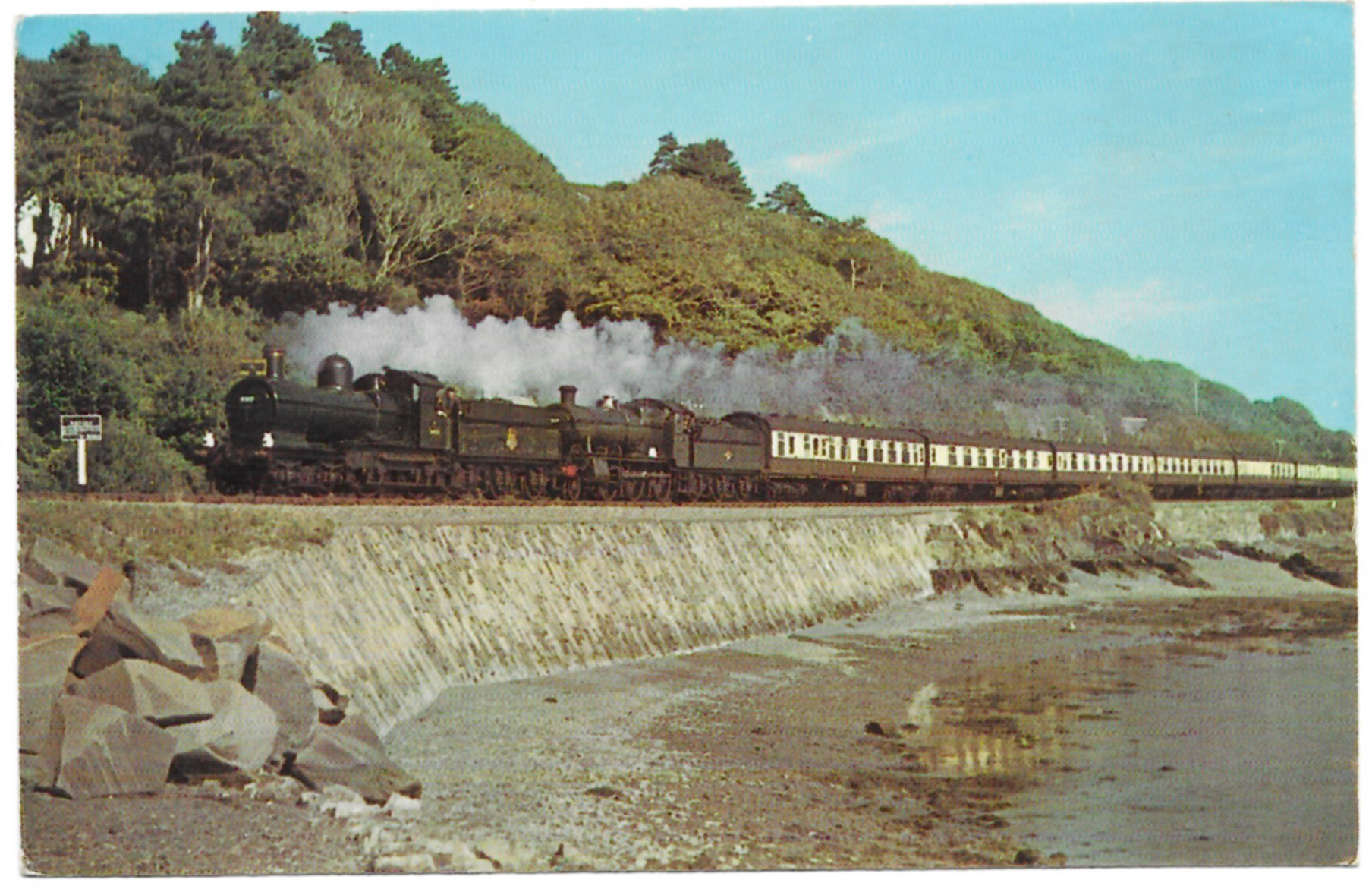
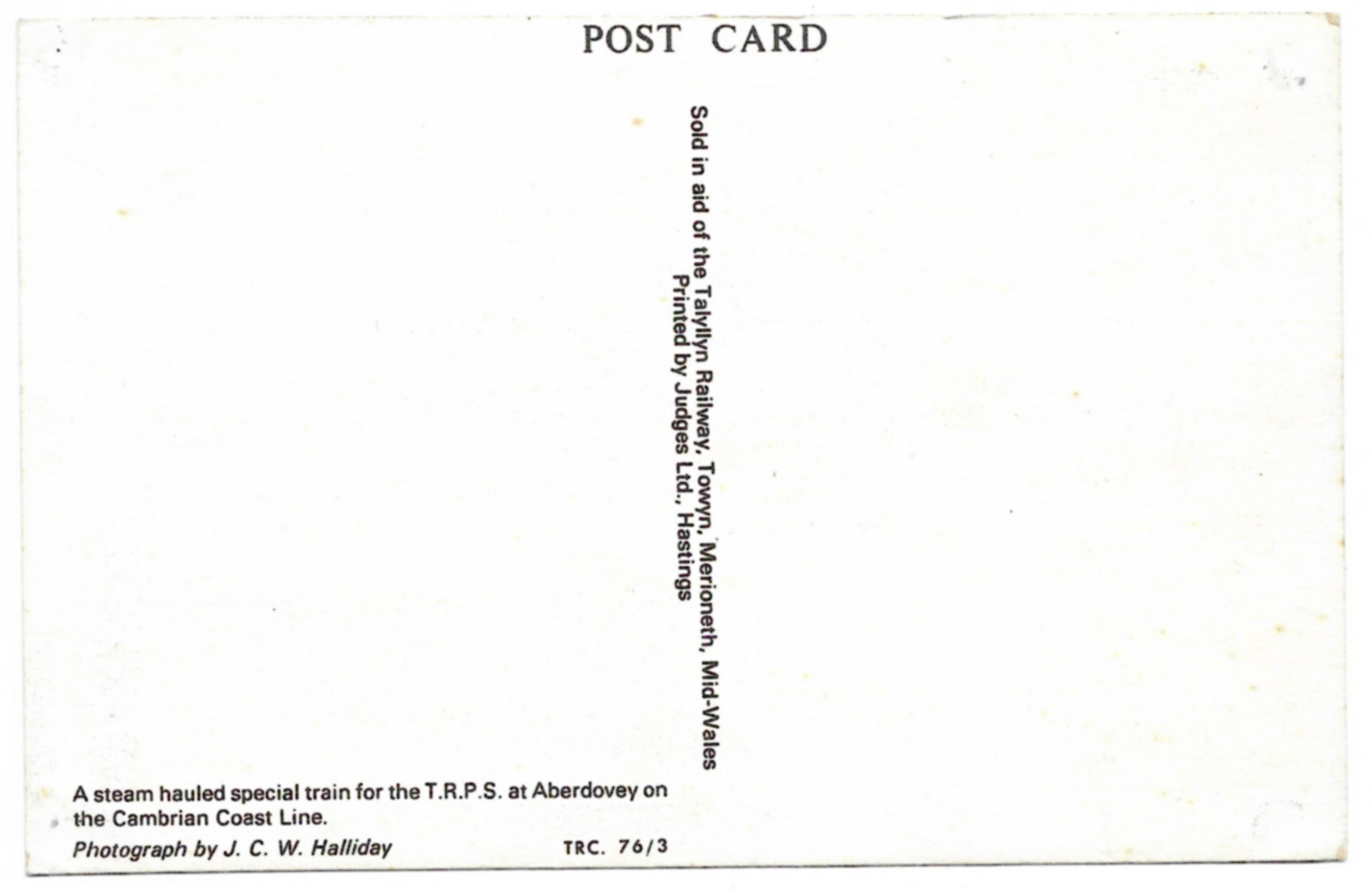
This must have been a wonderful sight – a steam-hauled special train on the way into Aberdovey along the side of the estuary on the Cambrian Coast Line.  The reverse of the postcard says that it was sold in aid of the Talyllyn Railway in Tywyn.  The Aberdovey stretch of the railway was established in 1864, connecting via Machynlleth to the south in 1867 (the subject of an earlier post) and the last steam engine run along the route was in 2017, marking the 150th anniversary of the Grade 2 listed Pont Y Bermo (Barmouth Bridge), that carries the line over the Mawwdach estuary.

I naively thought that it would be easy to find a date for what I thought must be an unusual event, but my assumption was wrong.   Thanks, therefore, to Sierd Jan Tuistra, via RMWeb member Martin McCowgill, who provided the information that this is one of the annual AGM weekend specials from Paddington to Towyn, 24th September 1960.  It was a double-headed special, with two engines pulling the carriages from Shrewsbury to Towyn, each pulling a coal truck before the passenger carriages. The engine at the front is 9017, otherwise known as the Dukedog class, which was the nickname for the Great Western Railway Earl Class.  Behind it is engine 7330 in the Mogul (GWR 4300) class.

Steam was not an uncommon sight on the Cambrian coast, a lot of regular services were steam hauled until 1966. Double headed train were less common, but quite a number of Cambrian Coast express summer Saturday specials were double headed because of the number of passengers & carriages.

Apparently there also used to be occasional summer steam trips on a Sunday from Aberystwyth to Pwllheli, so although this was a fabulous sight, it was not actually as rare as one might have expected.  Halliday, the photographer, specialized in vintage train photographs in the 1950s, mainly black and white.

Produced by Judges, about whom more on an earlier post.