Category Archives: Aberdovey

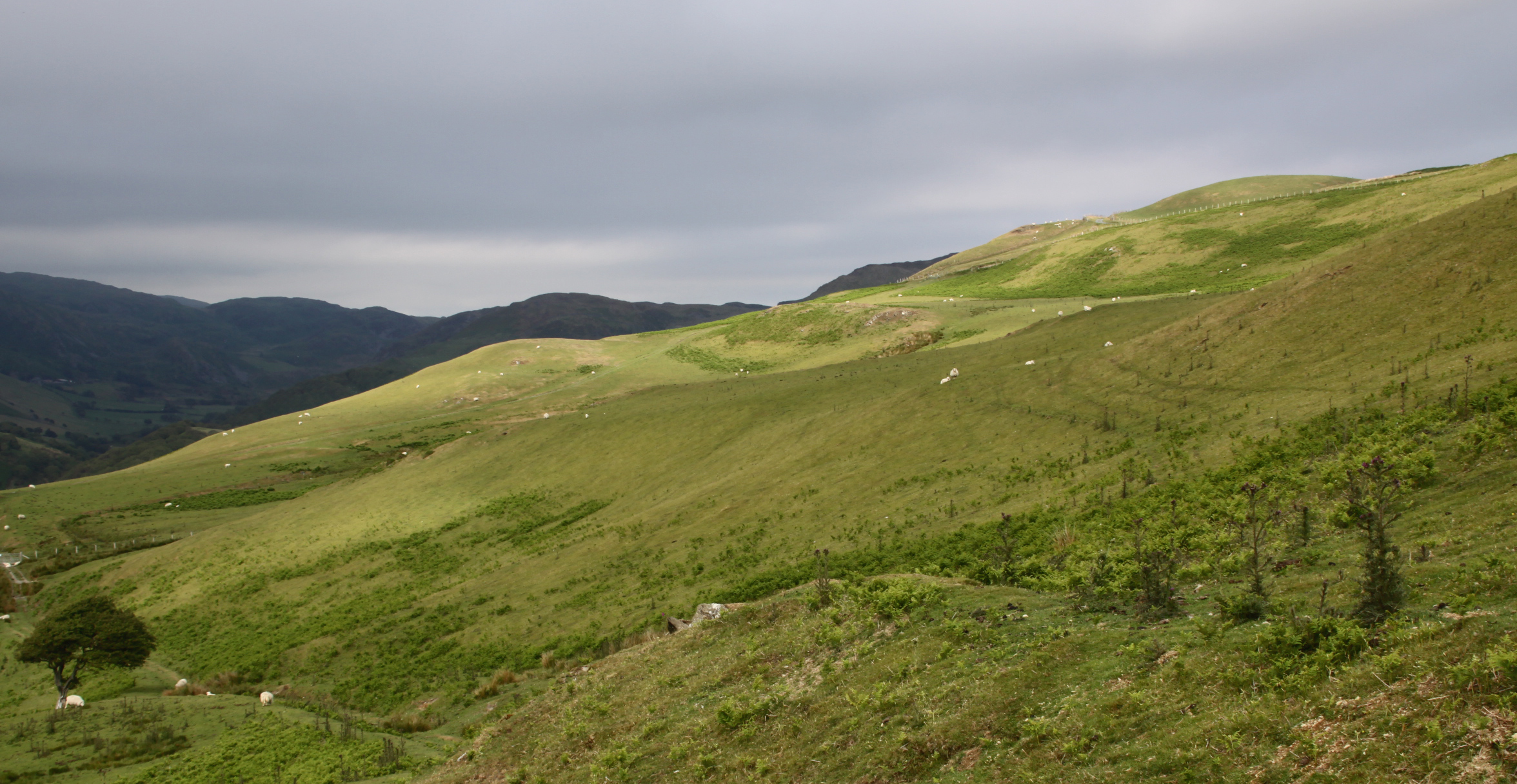
A late afternoon stroll in the hills behind Aberdovey, with wildflowers

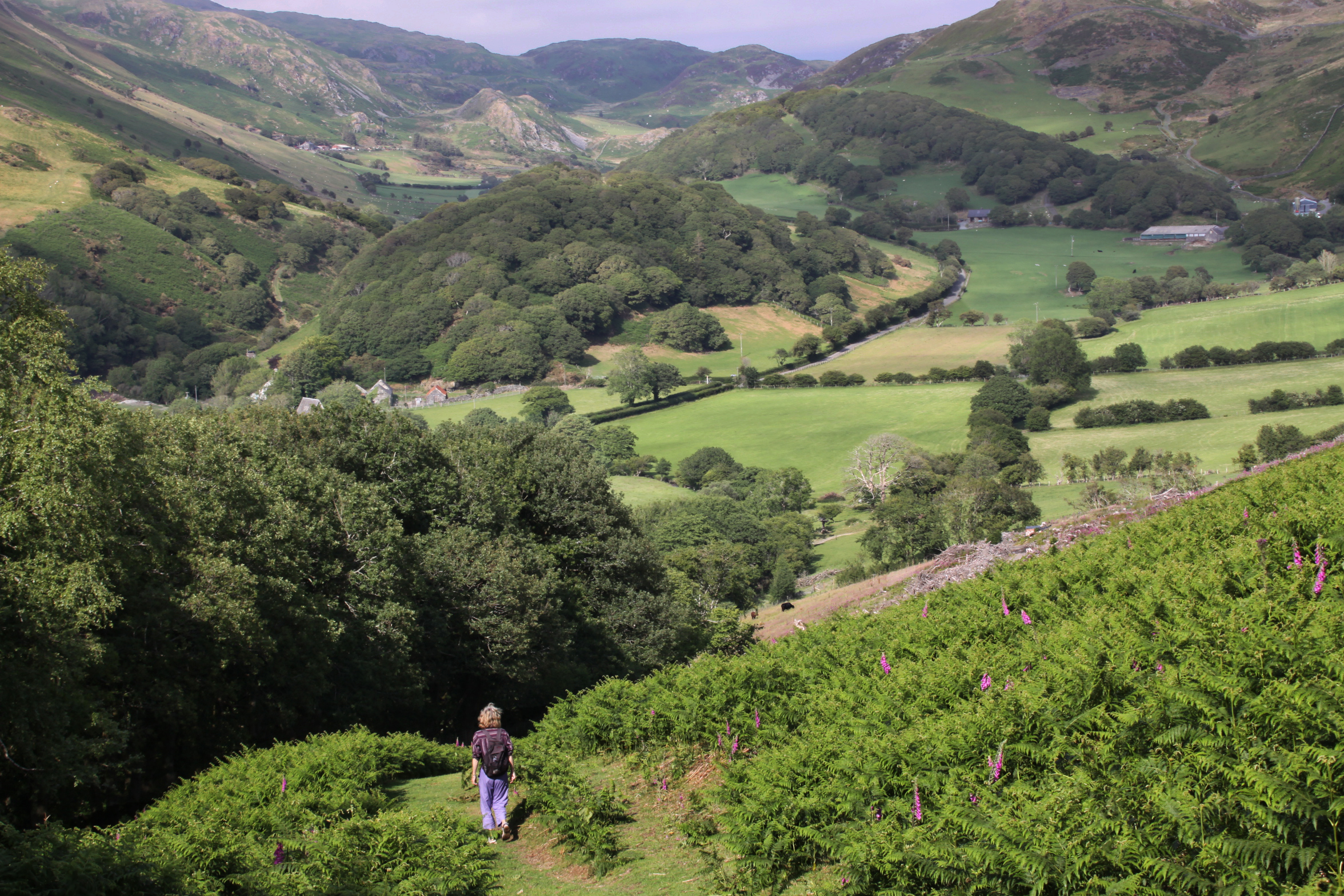
Monday at 4pm was looking dicey.  I started out in a light rain coat, because it was spitting fairly firmly and the sky looked ominous, but thankfully it stopped.  I rolled up my coat and put it in my rucksack, the sun came out, and we had no rain for the rest of the two and a half hour walk.  The combination of sun and cloud in the late afternoon made for some very nice contrasts in the scenery, and the wild flowers were splendid.  The foxgloves, which have been rampant for weeks, have truly come into their own in the hills behind Aberdovey, and were really rather spectacular.  Another terrific walk without another person in sight.  There were a lot of sheep and lambs around, the lambs now fairly stocky.  On the other side of the valley, cattle were grazing on the hillside.  We saw several tiny frogs in a narrow stretch of water where there had been tadpoles earlier in the year, and a couple of rabbits on the return leg of the journey at the top of the hill, and could here the larks singing.  Apart from the glorious views, the main source of interest was the wildflower population.

The foxgloves dotted around in the new green bracken provide lovely splashes of colour at the moment.

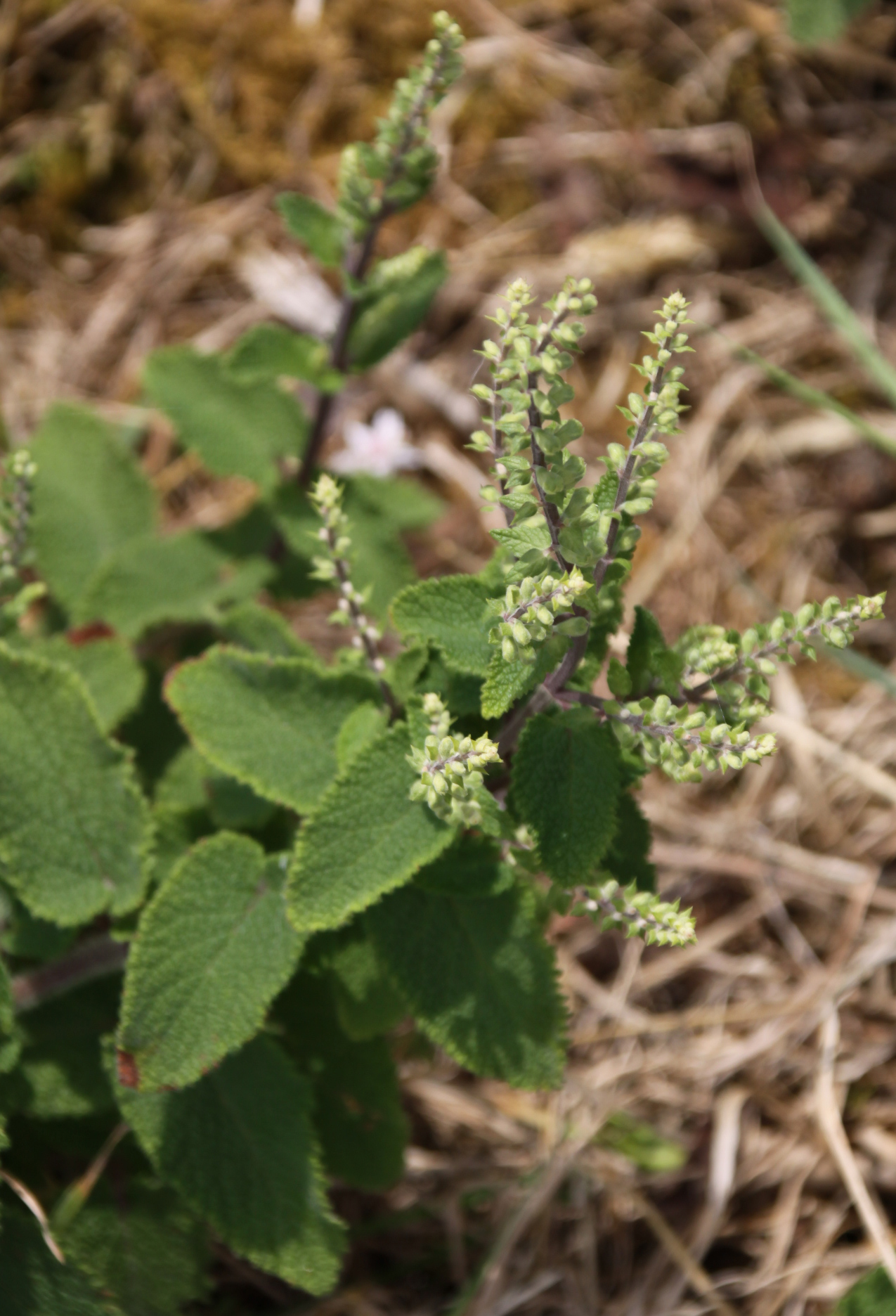
This is not in flower yet, but looks from its leaves and its spikes like wood sage (Teucrium scorodonia).  It should flower between July and September, producing creamy-yellow lipped flowers.  It is a member of the mint family.  It is drought tolerant, and is often found in coastal areas including sand dunes.

English stonecrop (Sedum anglicum)
A succulent acid-loving 5-petalled perennial, flowering from May to August.  Retaining water in its waxy leaves allows it to tolerate dry environments and poor soil and to survive drought conditions.  The leaves may turn red if it is exposed to a great deal of sun, a protective chemical response to sunlight, which can damage green chlorophyll.  To protect itself from wind-scorch, it grows very low to the ground.
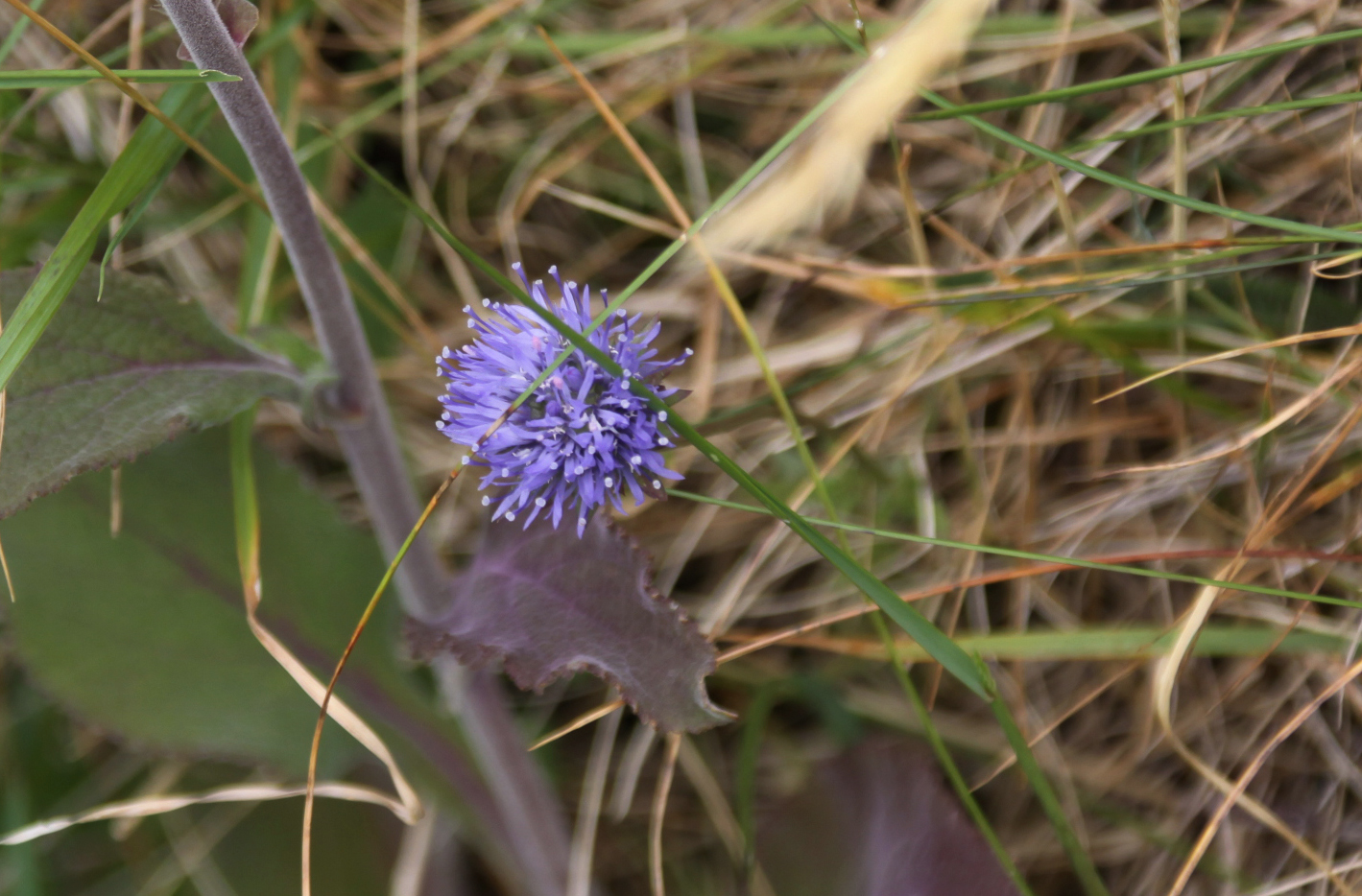
Sheep’s-bit (Jasione montana)
Sometimes called Sheep’s-bit scabious, this is actually a perennial member of the campanula family, even though it has no obvious resemblance to the usual bell-flowered character of campanulaceae and at first glace looks much more like a true scabious.  Unlike scabious, it has small, alternate hairy leaves. and tiny narrow petals.  According to the Wildlife Trusts website, pollinating insects, which see a different light spectrum to humans, find it highly visible under ultraviolet (UV) light, and use the patterns and colours on the petals to guide them to the nectar and pollen.  It usually starts flowering in July, but thanks to the remarkably warm spring, a lot of species are flowering early.  It likes a wide variety of environments, including dry grassland, and is often found in coastal areas.  It is an excellent pollinator.

Rosebay willowherb (Chamerion/Epilobium angustifolium).
Also known as “fireweed” because it colonized burned and scorched sites, and “bombweed” due to its expansion on World war I and II bomb sites.  Heat from this type of site assists with the germination process.  It has rhizomes, so a single large patch can be one plant. Its seeds also establish themselves freely, each fitted with cotton-like ‘parachutes’ that carry them over long distances. The Latin “angustifolium” simply means narrow-leaved.  It is a biennial that flowers from June to September.  Its leaves are edible and have a wide range of uses.  For more on the multiple uses, see the Wikipedia page dedicated to Rosebay willowherb.

Self-heal (Prunella vulgaris)
One of my books says that the dark violet flowers have a hooked upper lip that in the 16th century was supposed to look like a sickle, so according to the doctrine of signatures, it was believed to men wounds from sickles and billhooks.  Although there were one or two isolated examples in verges, this perennial has creeping roots and in open grassland and on heaths usually grows in patches from June to November.  The Latin “vulgaris” means common.  They are pollinated by long-tongued bees.

A tiny frog, about 3cm long, in a very small stream where we had seen tadpoles earlier in the year.  There were several of these little amphibians, and they would have been completely invisible if they hadn’t hopped around, their damp skin catching the light.  It’s a lousy photograph, because I was trying to hold back some grass with one hand and steady the camera and focus it with the other, but you can just about make it out.

Marsh Thistle (Cirsium palustre)
Like most thistles, this has spiny protection both around its clusters of flowers and along its stem, and even has spiny leaves.  It looks fairly lethal to unprotected hands and judging by its proliferation, it is a good defense against being eaten by sheep, cattle and rabbits.  It was spread all over the hillsides, and it is easy to identify from a distance due to its distinctive form.  As its name indicates (“palustris” means of marshes), it prefers damp conditions and meadows, but seems to be doing well at the moment, even after the recent drought conditions.  It is biennial, pollinated by bees and butterflies, and usually flowers between July and September.
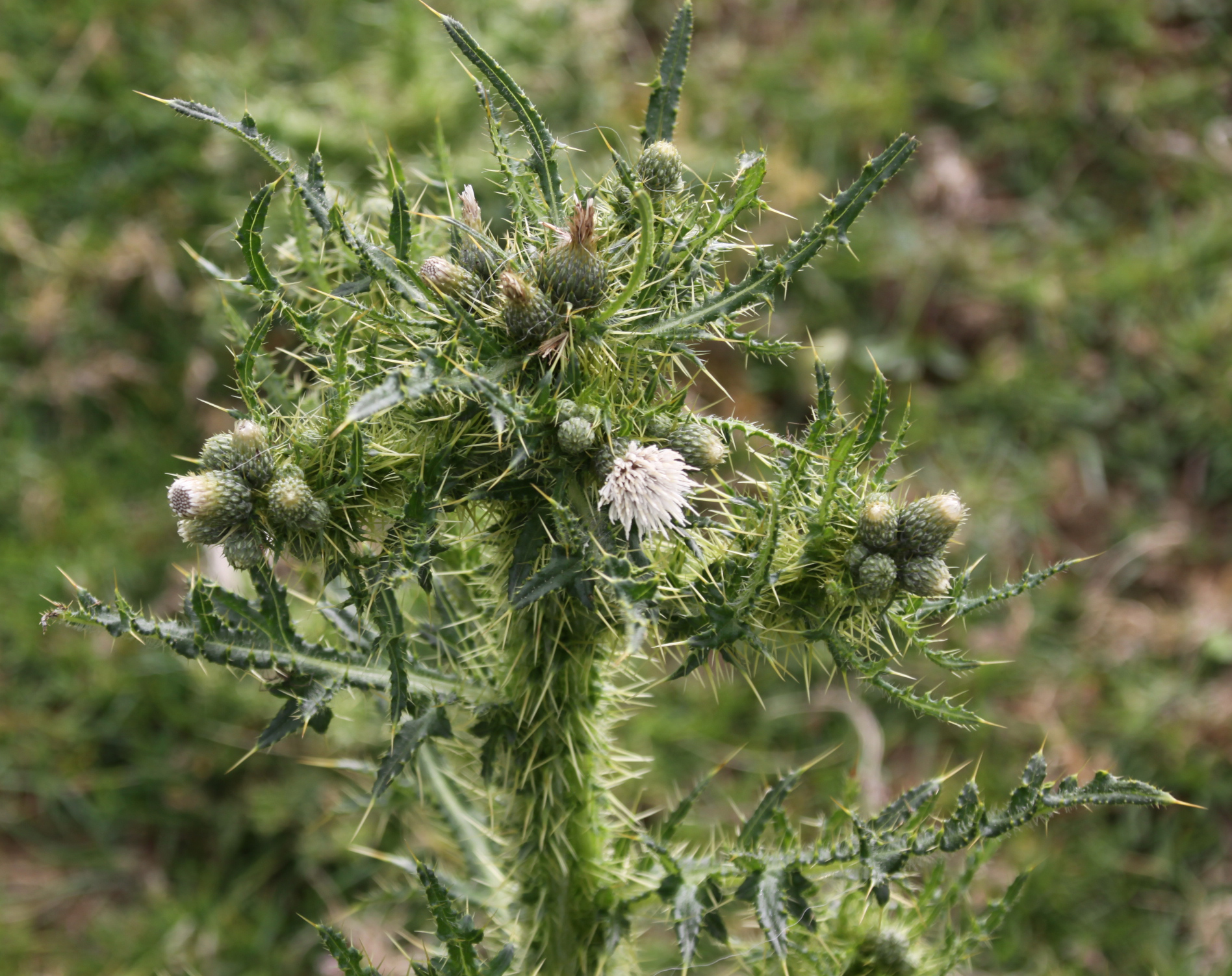
Occasional white examples of the purple marsh thistle were dotted around.

Foxglove (Digitalis purpurea)
Foxgloves are going mad at the moment, in verges, in amongst the bracken or as here, on disturbed ground.  They began flowering in early May, although they don’t usually appear until June, and flower until September.  The foliage is poisonous, which is probably why in Wales it is known as elves’ fingers or gloves, and in Ireland it is called fairy thimbles.

Bittersweet or woody nightshade (Solanum dulcamara)
All parts of the plant are poisonous but in humans usually cause only upset stomachs.  The latin species name “dulcamara” means sweet-bitter, which describes the bitter taste, followed by a sweet after-taste.  In Germany physicians used it as a cure for rheumatism and it was hung around the necks of cattle to ward off evil.   It flowers from June to September and is happy in hedgerows and woods.  After flowering it produces egg-shaped berries that start off green, as above, and slowly become a bright, shiny red.

This is tiny, just a few millimeters across.  I still haven’t tracked it down but will update this page when I do.
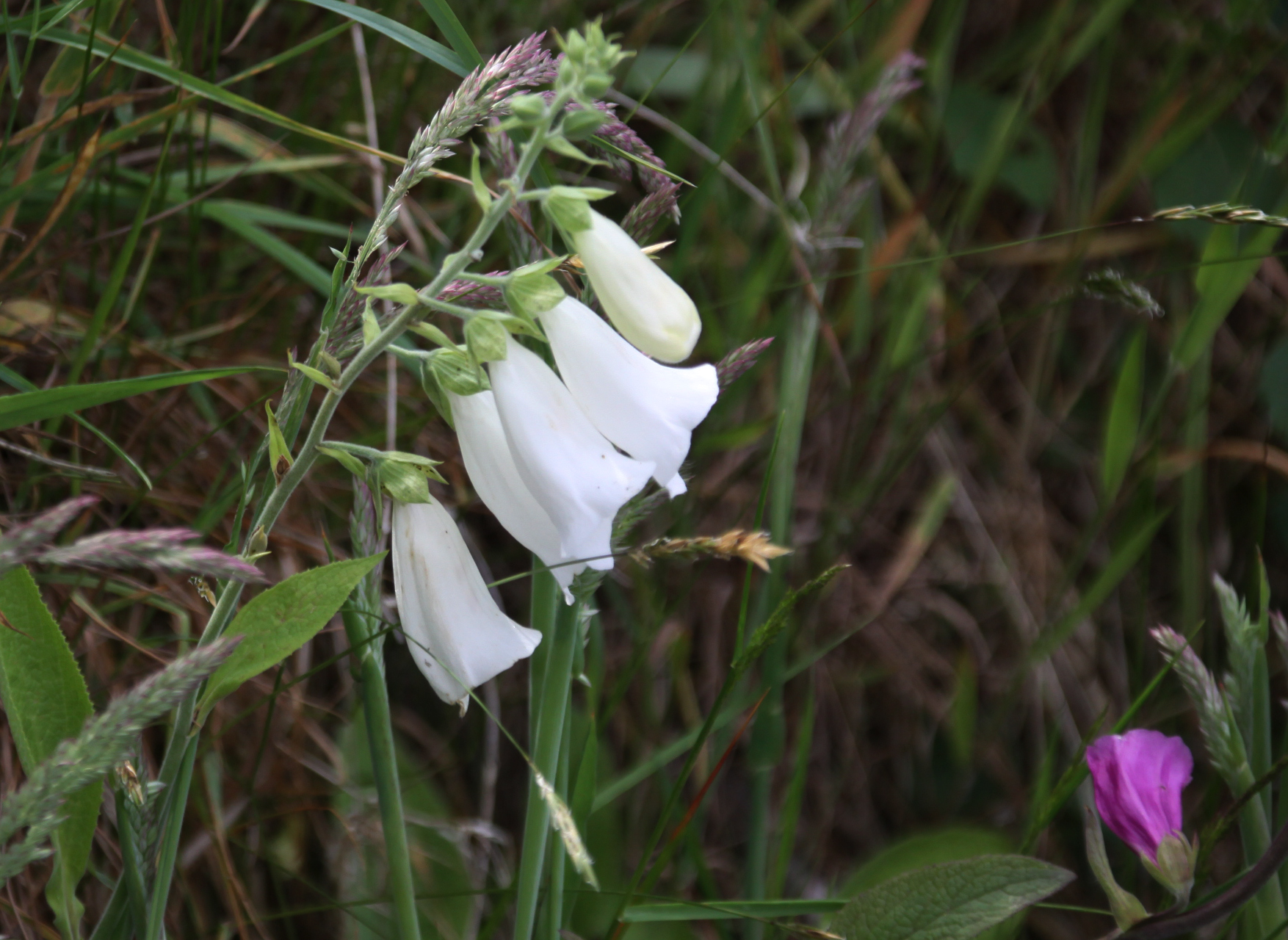
White foxglove (Digitalis)
The hills are covered in the distinctive purple spikes of Digitalis purpurea (“purpurea” means purple) at the moment, so the appearance of a single, pure white foxglove, near the stream in Happy Valley, was something of a novelty.
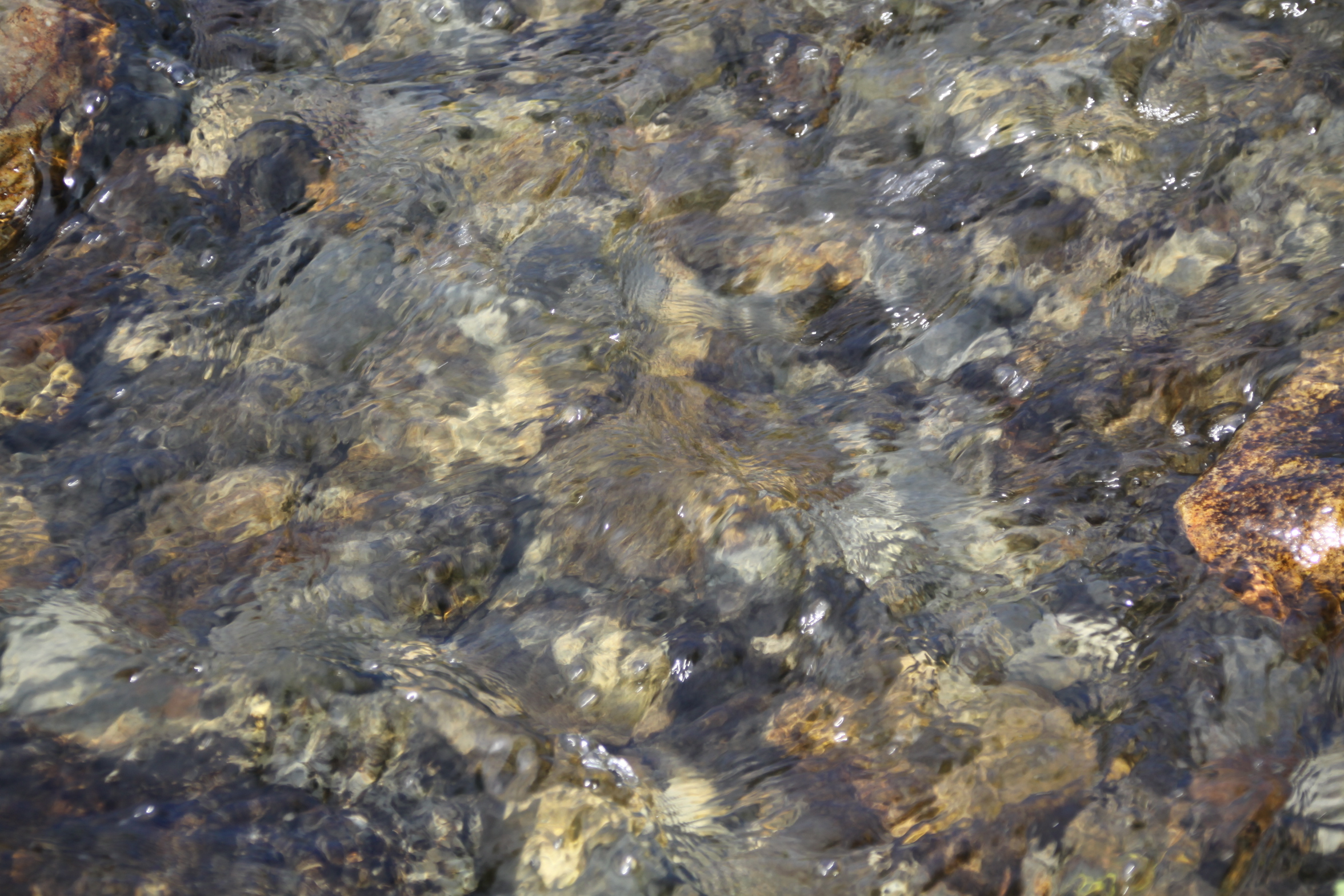
Afon Dyffryn Gwyn in Happy Valley.  Afon means river, but it’s more like a big stream. Dyffryn means valley, and Gwyn can mean white, fair or blessed.  The water is always beautifully clear.  In the shallow stretches by the ford, where the plunging track meets the valley floor, well-camouflaged fish can be spotted maintaining position in line with the flow, as below.  Most of them were about an inch long, but this one was about four inches.

The stream was being visited by cows and their calves, all calling to each other in loud, low, resonating voices.

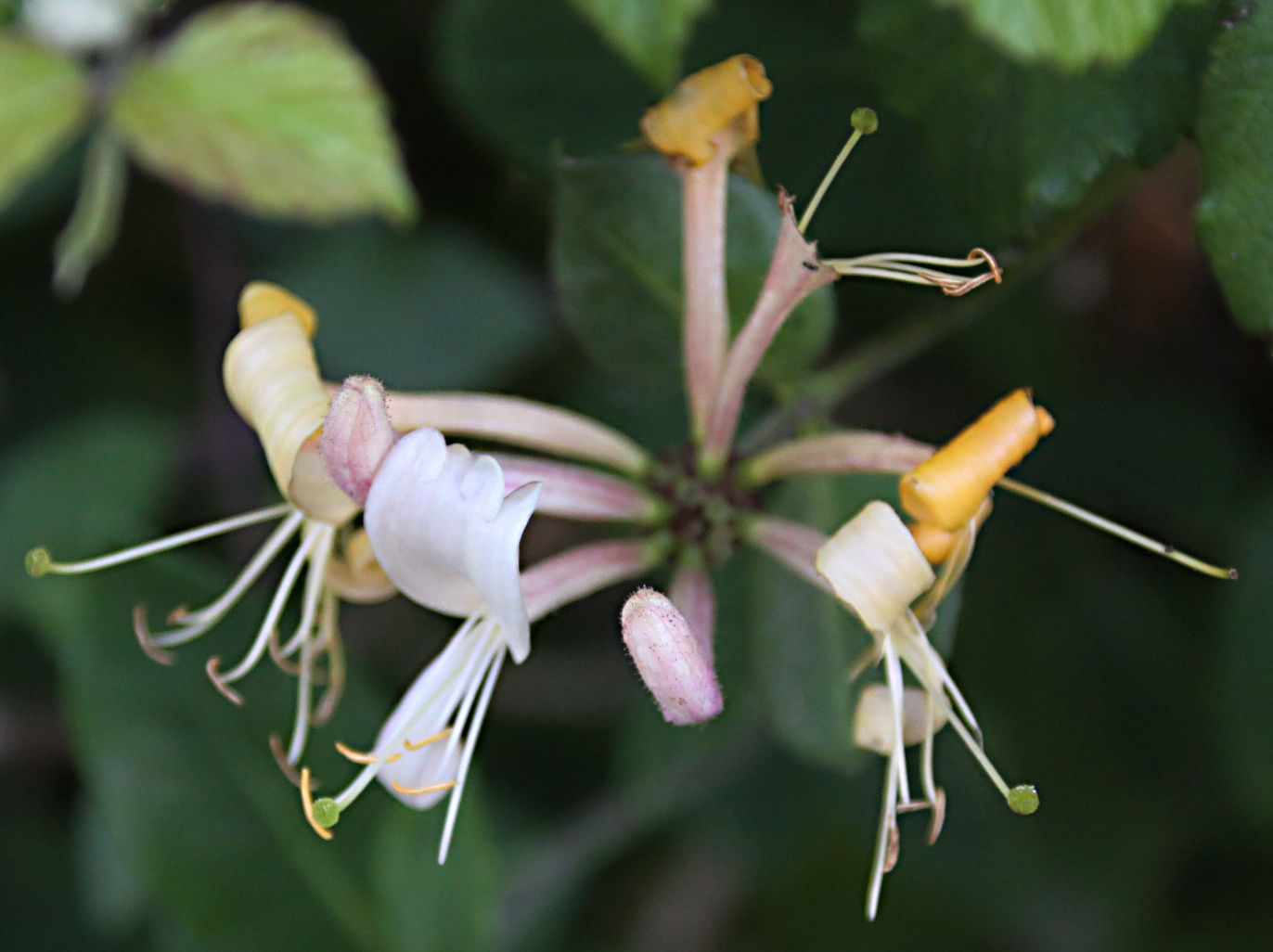
Honeysuckle (Lonicera periclymenum)
Beautifully-scented, honeysuckle has evolved to attract pollinating moths.  When the flowers go over, clusters of red berries replace them.  They flower from June to October.  This was was growing in a hedge by the side of the road leading up to the Panorama.  Lonicera is named for the German botanist Adam Lontzer (1528 -1586), and periclymenum is the term for honesuckle, derived from Greek.
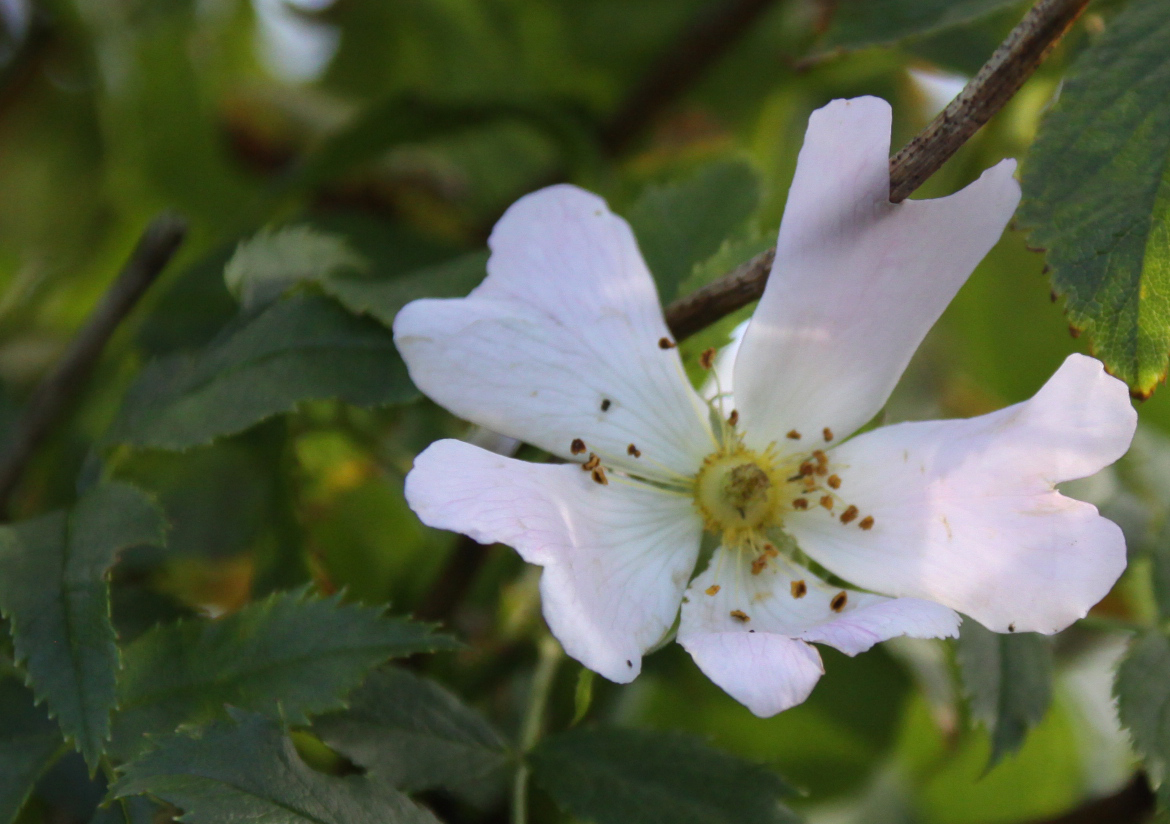
Dog rose (Rosa canina)
Although similar in appearance to the bramble flower, the distinctive heart-shaped petals of the dog rose make it easily distinguishable.  It climbs through hedges and bushes, lending colour to otherwise unremarkable shrubs.  The white petals are often tinged with pale pink, as in this example.  After flowering a red rosehip is produced, and as well as being eaten by animals and birdds can be used to make rose-hip syrup, which has high quantities of vitamin C, and can be used to produce wine and liqueur.  It flowers from June to July.
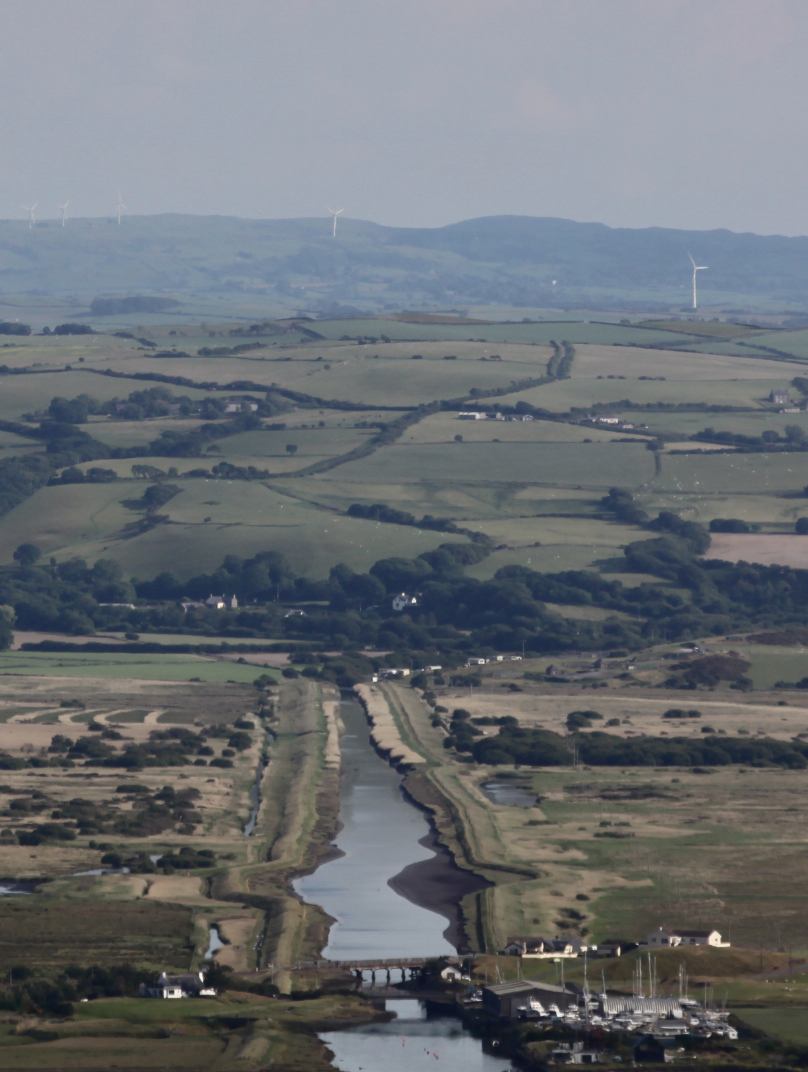
The Afon Leri and the 5000 year old Cors Fochno peatland with the hills of Cerdigion rising behind.  A shame about the disfiguring wind farm on the otherwise undisturbed hillsides, but you can’t have everything!

View from the top of the hill across to the cliffs of Ceredigion, looking very beautiful under the gathering clouds

Wildflower information sources used in this post:

The Wildlife Trusts – Wildflowers
https://www.wildlifetrusts.org/wildlife-explorer/wildflowers

Grey-Wilson, G. Wild 1994. Flowers of Britain and Northwest Europe.  Dorling Kindersley

Fletcher, N. 2004. Pocket Nature Wild Flowers.  Dorling Kindersley

Spencer-Jones, R. and Cuttle, S. 2005.  Wild Flowers of Britain and Ireland.  Kyle Books


Eating well from what’s to hand – week 11

The weather was interesting last week.  Wind, rain, a thunder storm and bright sunshine all took their turns.   There were some days when I couldn’t wait to be outside, and other days when I didn’t bother unlocking the door.

Aberdovey continues to be quiet, in spite of the further relaxation of social distancing rules by the English government.  I watched the news yesterday morning, and saw people lining up outside Primark in Manchester and Cheshire Oaks outlet centre in Ellesmere Port, all desperate to return to non-essential shopping.  The mind boggles.  Here’s hoping that the shops are managing social distancing as well as they have promised.

My cooking last week was a mixture of new and old.  I did a chicken and leftover veg pie in pastry, which I haven’t done in years as I always find pastry too filling, but I was really in the mood for it.  A wonderful piece of lamb shoulder in the freezer was an identical repeat of something I did a couple of weeks ago with a piece of leg of lamb.  The huss was full of familiar Middle Eastern flavours, but I had never done it with aubergine before.  On Thursday I halved an avocado, had half for lunch instead of my usual slice of toast, and had the other half on Friday evening, followed by pate on toast to make up a full meal. A good mix, nice to have the variety.

Saturday

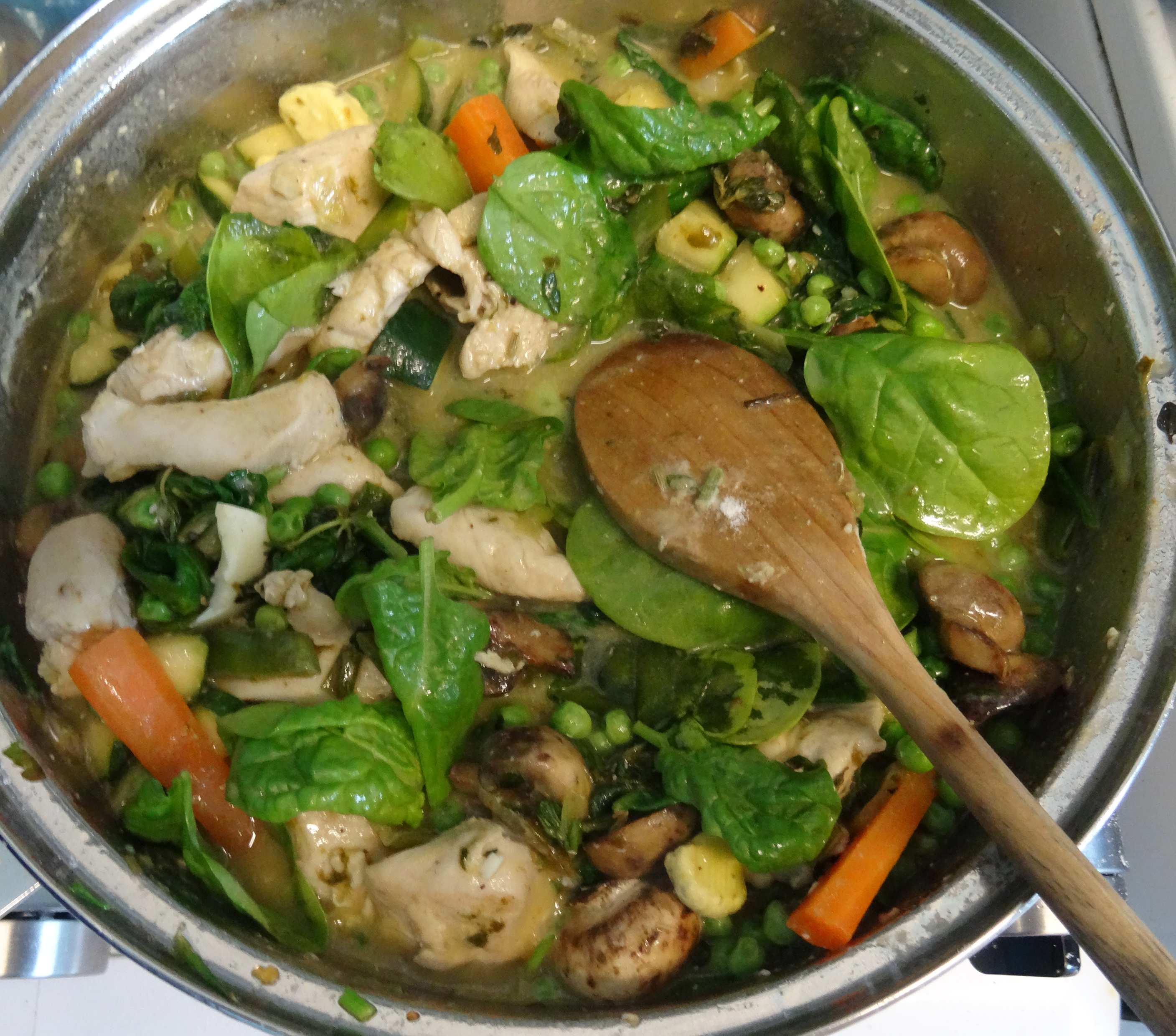
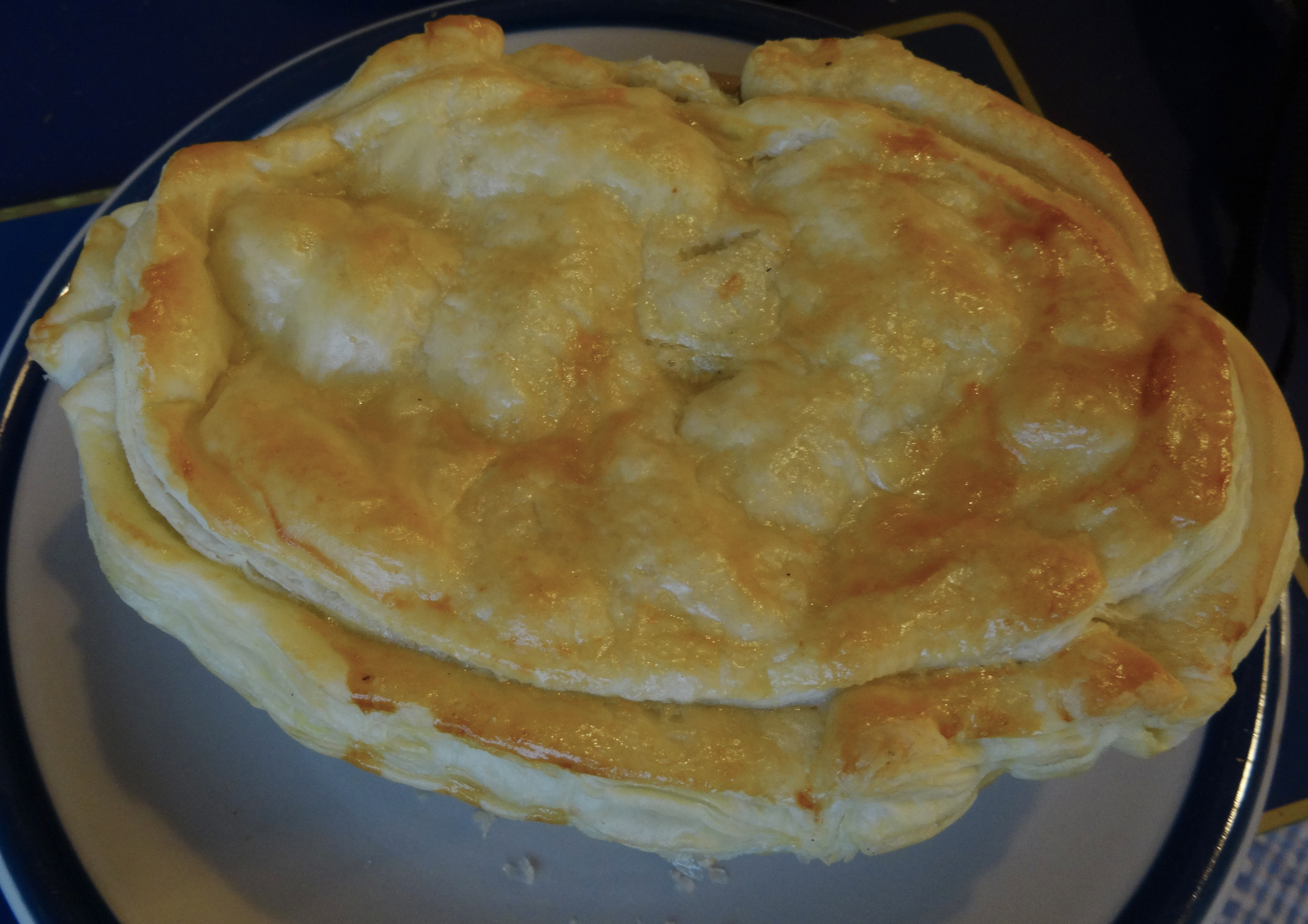
One-person chicken and leftover vegetable pie.  This pie was brought about by the spontaneous purchase of a roll of puff pastry, and the entire process was entirely ad hoc. It was composed of a chicken breast, sliced runner beans, carrot batons, diced courgette, frozen peas, finely sliced spring onion, spinach, mushrooms, parsley and a chicken and parsley stock, the latter made from bolted parsley and wild fennel stems stems.  I fried the chicken and mushrooms, whilst cooking the vegetables lightly in the stock.  Then I added the veg to the chicken, scattered some flour over the top and stirred well to mix it in.  I then added some stock a little at a time until it formed a sauce.  Meanwhile, a small pastry-lined pie dish was blind-baking in the oven, and I had the pastry lid ready to go, brushed with egg.

I almost never eat pastry, so I really enjoyed it, although it wasn’t perfect.  I had bought the chicken breasts when the shop had sold out of thighs, and I really noticed the difference.  Thighs have much better flavour, and the breasts didn’t impart much flavour to the sauce, so it was a bit bland and I wish I had added more chicken stock to the parsley and wild fennel infusion.  I also failed to blind bake the pastry for long enough, so it had a rather soft base.  On the other hand, the taste of parsley and fennel that threaded through the pie mix, coming from from the simmered stalks was great.  There was plenty of unused pastry and leftover pie mix for the freezer.

Sunday

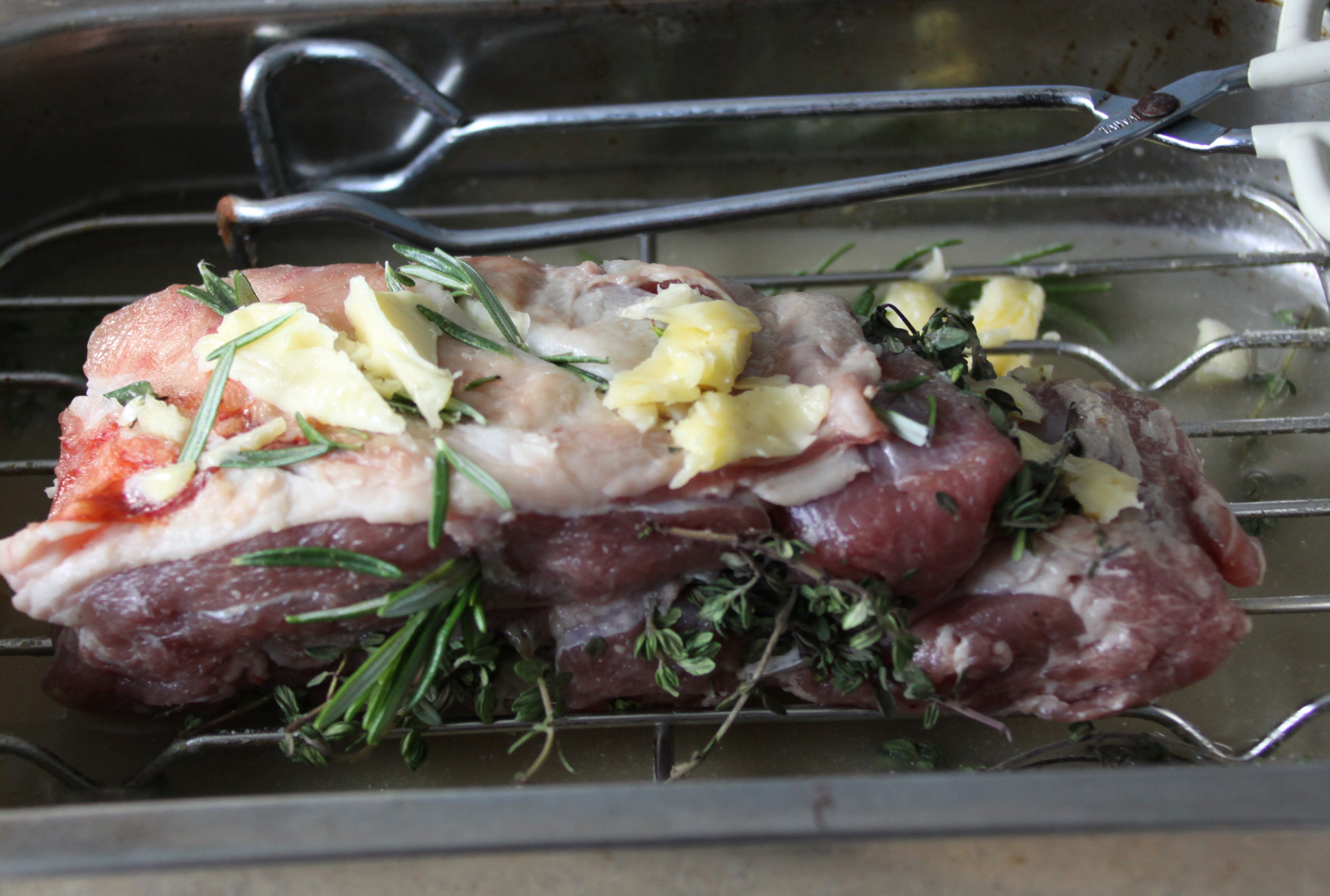
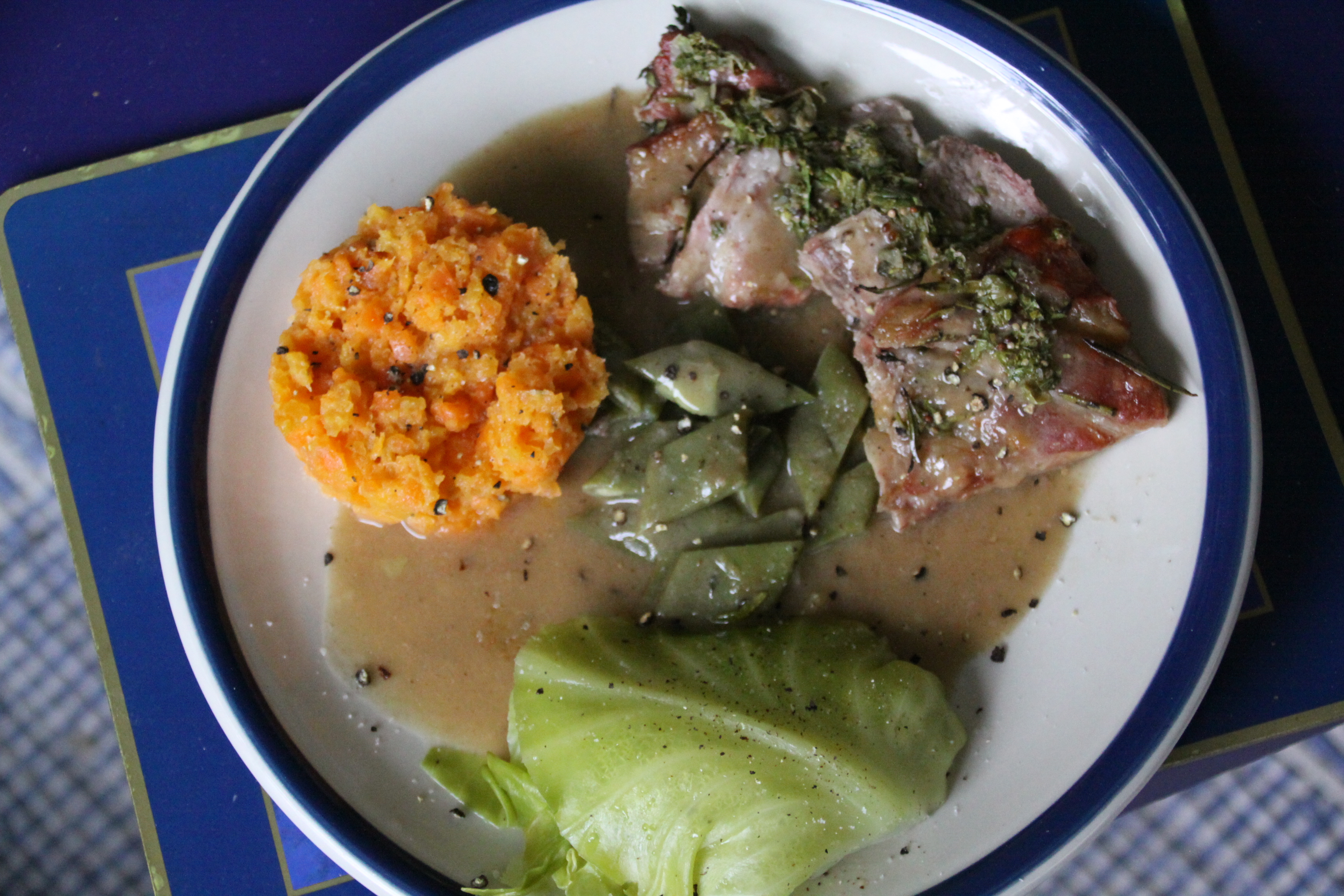
Roasted lamb shoulder with the usual trimmings.  I have cooked a couple of other roast lamb joints since the lockdown, and this was no different, and just as enjoyable.  This was spring lamb, with the bone in.  Spring lamb never has a huge amount of flavour but with the flavour from the bone, and studded with thyme, garlic and rosemary it was given every chance to shine and was delicately delicious.  Being shoulder, it required a longer, slower cook than a similarly sized leg would have done, but was still gorgeously moist, just pink at the bone but crispy on the outside.  The trick is to either brown it in the oven on a high heat first, or brown it in a pan before placing it in the oven and then cover it with foil for the rest of its cooking time.

After scoring the layer of fat on top and studding it with the garlic and herbs, I dotted it with butter to help it along, and browned it in a pre-heated oven on high for 10 minutes and then cooked it on gas mark 3 for an hour, which was perfect.  It was very tender and the delicacy of the flavour went beautifully with a light rosemary gravy, a mint and caper sauce and the steamed sweetheart cabbage and runner beans.  The carrot and swede mash was as good as usual.  I had leftover gravy in the freezer from my last foray, and combined this with the juices that accumulated during roasting, and drained off the fat from the gravy before serving.

There was plenty of lamb left over to serve cold or freeze down, half of the carrot and swede mash to freeze down, and more gravy to go into the freezer.

Monday

Cold meat and salad.  My family always call this “cold plate.” Sometimes it consisted of Spanish, German and Italian sliced meats with salad, and at others it was leftovers.  On this occasion I had some leftover lamb from the roast, and leftover chicken breast from the pack of two that I had used for the chicken pie.  I marinated the chicken in sumac, zatar, olive oil and lemon juice and lobbed it on the griddle for a few minutes each side.  I had been walking in the dunes with my friend Caroline (maintaining a rigid six ft distance at all times) and had picked some wild fennel, so I made a wild fennel mayonnaise.  I have a tiny food processor that I use for making mayonnaise, with a hole in its lid.  I finely-chopped the fennel fronds by hand and added them to the processor with a dollop of mustard, a serious squeeze of lemon juice, a little vinegar, some sea salt and an egg yolk.  Then, whizzing, I fed light olive oil very slowly through the hole in the top and whizzed it until the mix had emulsified into mayonnaise.  The salad was much simpler than usual, without herbs, consisting of some super little gem leaves from my father’s garden, cucumber, tomato, spring onions, capers, chilli slices, feta and vinaigrette.  I don’t know how I forgot the fresh herbs, but it was good even without them.  To finish it off, I sliced some lamb and chicken and added them to the plate.  I drizzled some leftover mint sauce over the lamb, and put a good dollop of mayonnaise next to the chicken and egg.  Super, and seriously filling.

Tuesday

Huss, seafood, baby aubergine, olives and feta in tomato, spinach and herbs, served with salad.  Huss is a lovely fish, with a no-fuss central bone.  It is a beast to fillet the fish when raw, and quite frankly, why bother?  It detaches from the single central bone so easily when it is cooked.  So I usually chop it into chunks with a very sharp knife, with the bone left it.   My piece was about six inches long so I chopped it into four and cooked it in the sauce with the bone in, removing the skin before serving.  I had some baby aubergines, and that seemed like a good excuse for giving the huss a Middle Eastern lilt.

I set the slow cooker to auto, which on this machine means it starts out hot for a while and then drops to low.  I had some mashed up tomatoes in the freezer, so fried some finely chopped onions, sliced red chilli and garlic, added the tomatoes, and stirred in some smoked paprika and  when it was all heated through, put it into the slow cooker, with some dehydrated limes, and poured over a little stock before adding the fried huss. Chopped salted anchovies (for richness rather than flavour), and some sun-dried tomato pesto also went in.

An hour before serving, with the slow cooker now on low, I put in a couple of handfuls of spinach. 15 minutes before serving I griddled some halved baby aubergines, and put those and some black olives, some whole mint leaves and a small handful of oregano leaves in to the sauce.  Fifteen minutes later it was ready to serve with some chunks of feta and accompanied by a small side salad.

There was plenty left over to form a base for a Middle Eastern flavoured seafood stew, and it is ready and waiting in the freezer.

Wednesday

Garlic mushrooms, pancetta and courgette on toast, topped with a poached egg.  Mushrooms and garlic are a classic combination.  Some diced courgette rounds it off beautifully.  The mushrooms and courgettes are fried in butter until beginning to brown.  The finely chopped garlic is added, and when cooked through, some flour is sprinkled over the top and stirred into the mixture until it is invisible. This will help to thicken the stock.  At this point, a little stock goes in, accompanied by finely sliced spring onions, chopped parsley and oregano and a few turns of the pepper mill. I also like to add a slosh of sherry at this stage.  Mushrooms and sherry are a frequent combination in Spanish cooking, and work deliciously together.

You need enough stock to deglaze the pan, cook the ingredients through.  It is better to go with a little and keep adding it, so that when it is ready to serve it is well reduced but still liquid enough to serves as a sauce.  Whilst this is gently heating through, the egg is poached and the slice of rustic bread or sourdough griddled or toasted.  At the last minute, a small dollop of whatever cream you have to hand goes in to the mushroom mix, is heated through gently, and then the mushroom mix goes on top of the toast and the poached egg is placed carefully on top of the mushrooms.  Sea salt scattered over the top of it all, and another turn of the pepper mill over the egg finishes it off.

Lots of alternatives are possible.  If you have access to wild mushrooms, that makes it even better, but I used supermarket button mushrooms and that was fine.  Instead of sherry, Marsala wine, which is utterly divine in all sorts of sauces, is excellent with this dish.  It is not always easy to get hold of, and must be used with care or it takes over entirely.  If you don’t fancy toast as a base, you could cook a big mound of spinach separately and serve the mushrooms on top of the spinach – or courgette ribbons.  If you fancy something more substantial, you could add handfuls of spinach, which I usually do, or for bigger appetites it could be served alongside chicken, gammon or pork, or over pasta

However you do it, it’s incredibly filling, so I don’t serve it with anything else.

Thursday

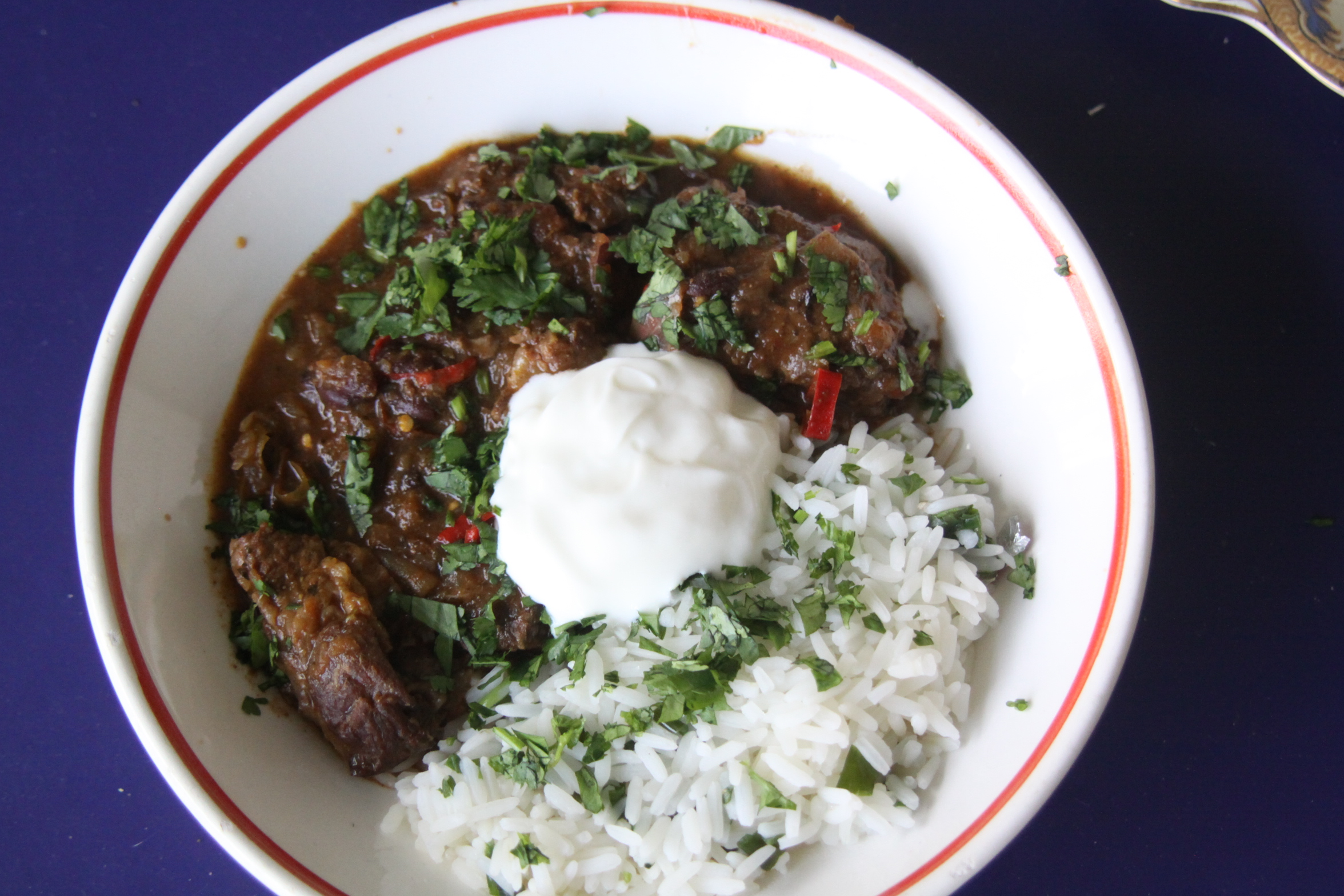
Slow-cooked chilli con carne with black beans, rice and sour cream.  A few weeks ago I cooked a huge batch and put a couple of portions in the freezer.  This is one of those portions.  It was a simply recipe.  Finely chopped onion, sliced chillis and finely chopped garlic are fried until translucent and just beginning to brown.  The following are then added:  cayenne, smoked paprika, ground cumin, ground coriander, a good sprinkle of dried coriander, some fennel seeds, a fresh or dried bay leaf and either some cinnamon or a piece of cassia bark (the latter my preference) and some dehydrated lemon slices.  Once heated through they are removed to the slow cooker.  The beef chunks are fried on high heat until browned all over, flour is sprinkled over the beef, given a good stir to coat, then added into the slow cooker, and given a good stir to mix with the other ingredients.  Peeled and chopped tomato are added together with some beef stock to cover, and the whole lot is left to its own devices for several hours for the chuck steak to tenderize and the spices to blend.  Kidney beans are more traditional, but I love the flavour of the black bean, and the ebony shine looks wonderful against the reddish mixture and the green of the coriander (or parsley if coriander is unavailable). I served it with plain boiled rice and chives, and a heavenly dollop of sour cream.

Friday

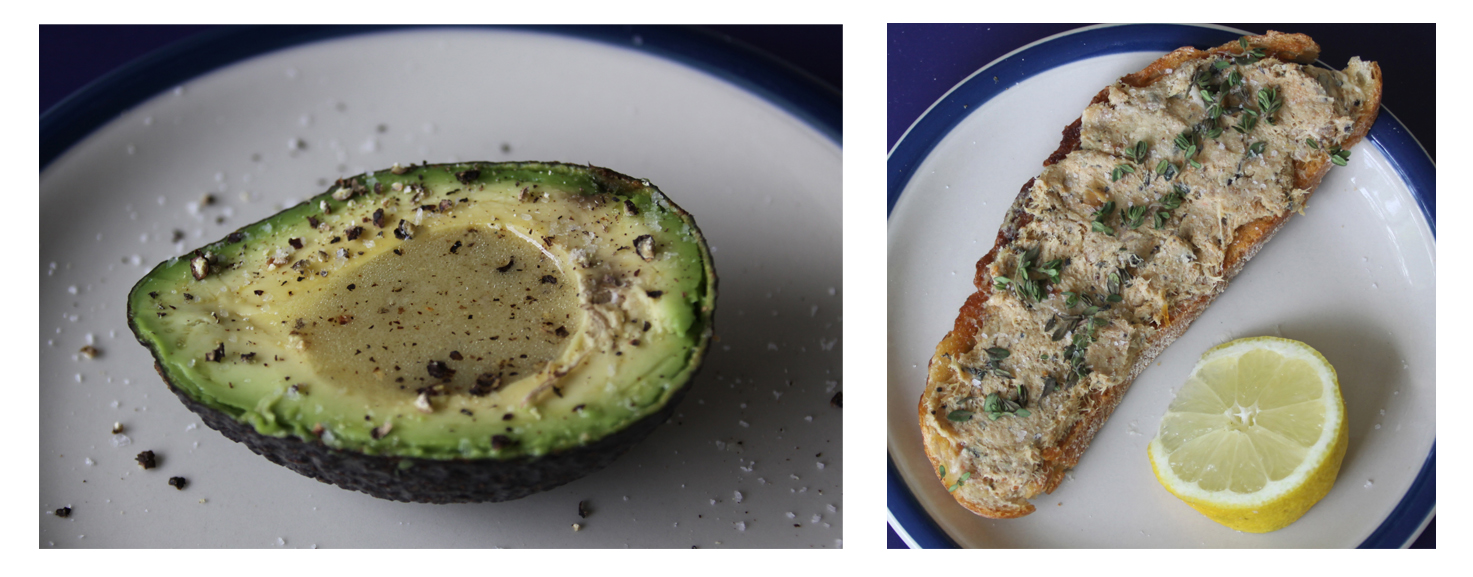
Avocado with vinaigrette followed by smoked mackerel pate on toast.  For the avocado  I simply made a vinaigrette (three parts good olive oil to one part white wine vinegar, German mustard although Dijon works just as well, a crushed garlic clove, black pepper and sea salt), gave it a good shake and poured it into the cavity left by the stone.  A perfectly ripe avocado is a beautiful thing, quite unlike anything else, and softly luscious.

By contrast, the toasted white cob was crispy, and the home made smoked mackerel pate had a spicy edge.  The recipe is my mother’s.  The smoked mackerel is skinned and then mashed with a fork.  Soft butter is mashed into it, again with a fork, and herbs and spices are added:  fresh thyme or sage (I used thyme), cayenne for heat and Tabasco if the cayenne isn’t hot enough, ground cumin, garam masala, a little white wine vinegar, quite a bit of lemon juice and freshly ground pepper and sea/rock salt.  The vinegar and lemon juice not only add flavour of their own but also bring out the other flavours.  Fresh thyme, sage or oregano sprinkled over the top and a good squeeze of lemon juice complete the flavour sensation.

Conclusions

I haven’t much to add, this week, except that it was nice to have a few dishes that I haven’t had in a while, and that being able to eat excellent quality fish once more is a delight.  A real treat was a salted caramel ice cream from the The Sweet Shop on the sea front, and another was being able to pick wild fennel, which I used in all the stock that I made.  A bit of variety is always seriously welcome.

Wild fennel growing in the sand dunes. The stalks are great for making stock, and the fronds go well in salad, sprinkled over fish and incorporated into mayonnaise.


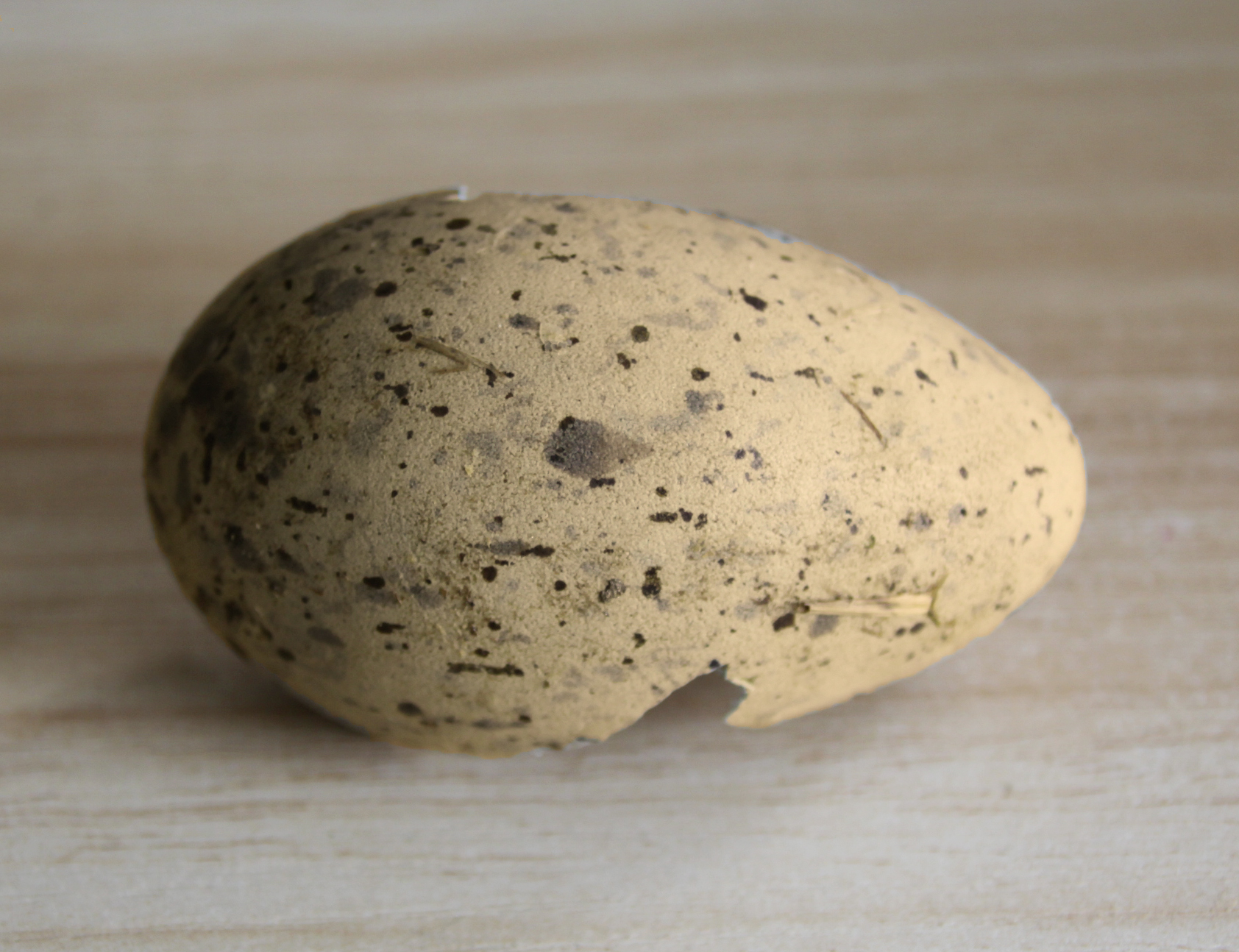
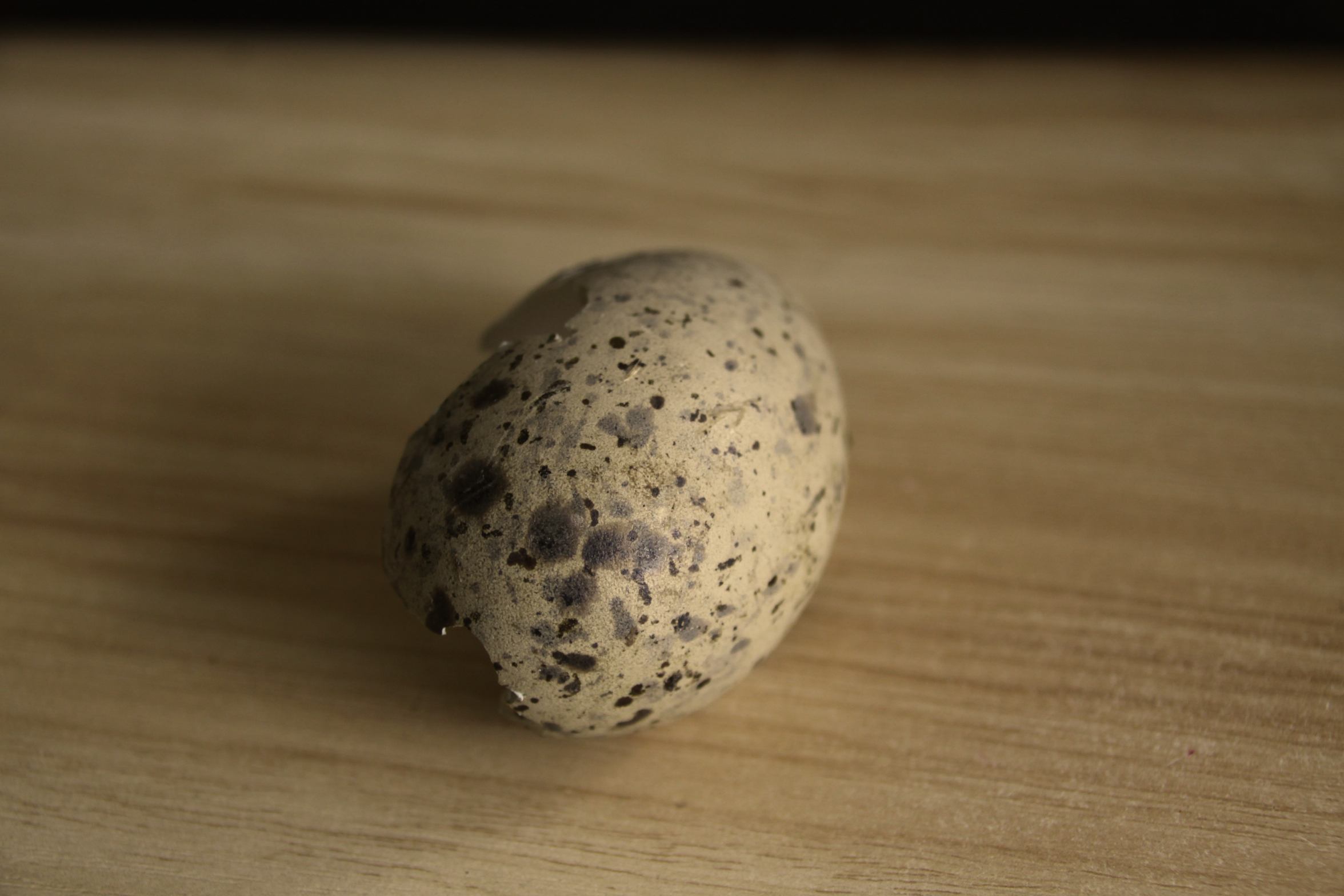
A gull’s egg in my garden – how eggshell pigment is formed

I caught sight of this broken egg shell when I was checking my back lawn for stones and large twigs prior to mowing.  Quite what it was doing in the middle of my lawn I have no idea, but it is beautiful, with a remarkable set of muted colours.  I had never seen one before.  It took me a while of following hyperlinks (most of which were about eating gulls’ eggs) before I found an explanation of how the colours are formed, on the All About Birds website in an article by Pat Leonard entitled The Beauty and Biology of Egg Colour:

An egg’s story begins in a female bird’s single ovary. When an ovum is released into the oviduct and fertilized, it is just a protein-packed yolk. The albumen—the gelatinous egg white—is added next. The blobby mass then gets plumped up with water and encased in soft, stretchy membrane layers. The first globs of the calcium carbonate shell are then deposited on the exterior, with the mineral squirting from special cells lining the shell gland (uterus). Pigmentation, if any, comes next, with an overall protein coating added before the egg is laid. It takes about 24 hours to build a single egg.

In his book, The Most Perfect Thing: Inside (and Outside) a Bird’s Egg, University of Sheffield zoologist Tim Birkhead compares the pigmentation process to an array of “paint guns.” Each gun is genetically programmed to fire at a certain time so that the signature background color and spotting of a species’ eggs is produced.

“Examination of birds’ oviducts at the time the color is placed on the egg suggests that the color is produced and released over a very short time frame,” Birkhead says, “usually in the last few hours before the egg is laid, and that makes it very hard to study.”

Despite the variety of egg colors and patterns, the palette is surprisingly small. Egg pigments are versatile substances made of complex molecules synthesized in a bird’s shell gland. Only two pigments are at work. Protoporphyrin produces reddish-brown colors. Biliverdin produces shades of blue and green. More of one pigment, less of the other, and the egg gets a different background color, spots of a different color, or a combination of both.

The speckling is thought to be camouflage, to disguise the egg and hide it from potential predators, and is common to nearly all foreshore birds.

There is loads more truly fascinating information in the article.  Did you know, for example, that an egg loses 18 percent of its mass, on average, between laying and hatching, mostly from water loss through shell pores. Or that up to 10 percent of the calcium used for shell formation can come from the female’s bones.  The article is well written and is well worth reading, so if you have a moment do go and have a look.


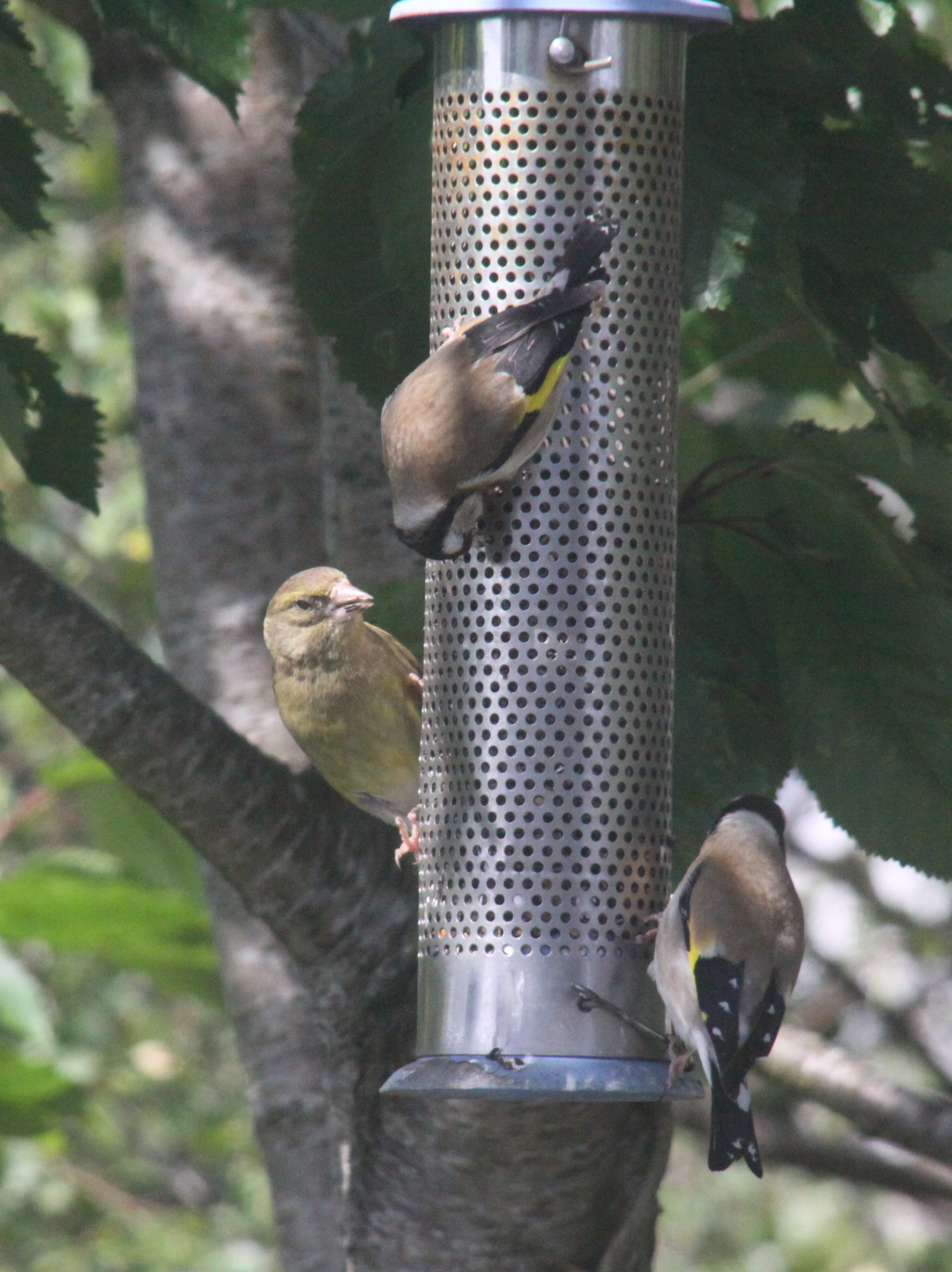
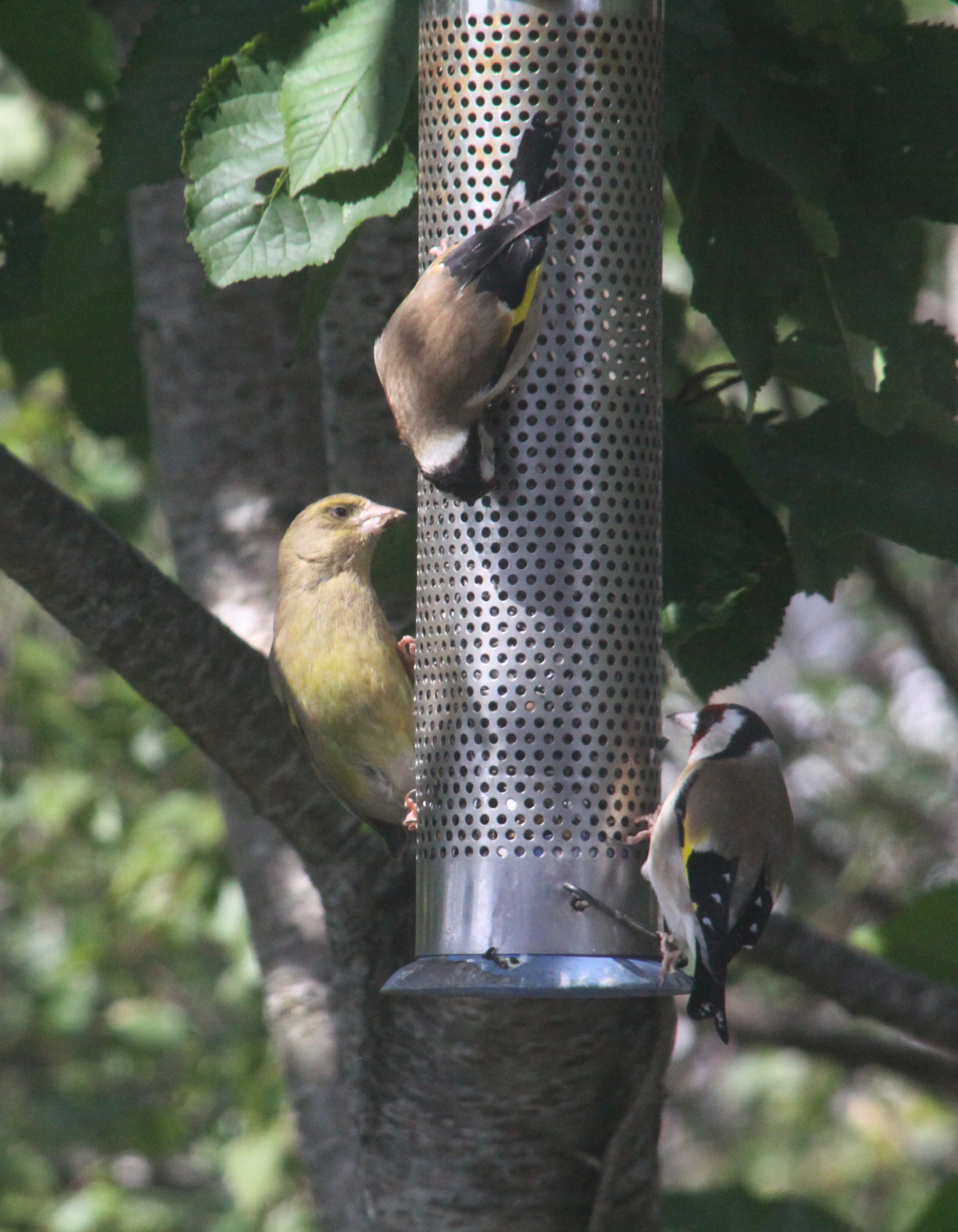
An interloper on the goldfinch feeder

Warfare often breaks out on the goldfinch feeder in the cherry tree.  This is usually the case when the seed runs low and four or more goldfinches are attempting to beat each other off in order to gain access to the last three inches.  Sometimes battle ensues because one bird is a particular bully and attempts to drive the others off to have the whole feeder to itself.   It never wins – the others gang up and stand up for their rights.  The signal for any dispute is a change of voice.  Goldfinches chatter all the time, a light, attractive and cheerful sound that one of my bird books describes as “tinkling.”  When battle ensues, the sound is a harsh, brittle, discordant squawking sound.  But I had never heard the likes of the noise that emanated from the cherry tree a couple of days ago, when all hell broke loose.

I was working at my desk, and the noise was so loud, so intensely shrill and angry and issued by so many birds that I was startled, and turned round to see what on earth was going on.  A greenfinch had landed.  Looking robust and unwieldy by comparison with the delicate, flitting goldfinches, it attached itself firmly to the bird feeder and remained stolidly unimpressed by all the fuss.  Eventually the riot eased, and a few goldfinches took up wary position on the feeder and began to resume their meals, whilst others remained perched on branches, watching.  In spite of the apparent resumption of peace, there was no sound at all.  The goldfinches were eating, but they weren’t happy.  They were there in an uneasy state of truce for around an hour.  The greenfinch left and hasn’t, as far as I know, returned.

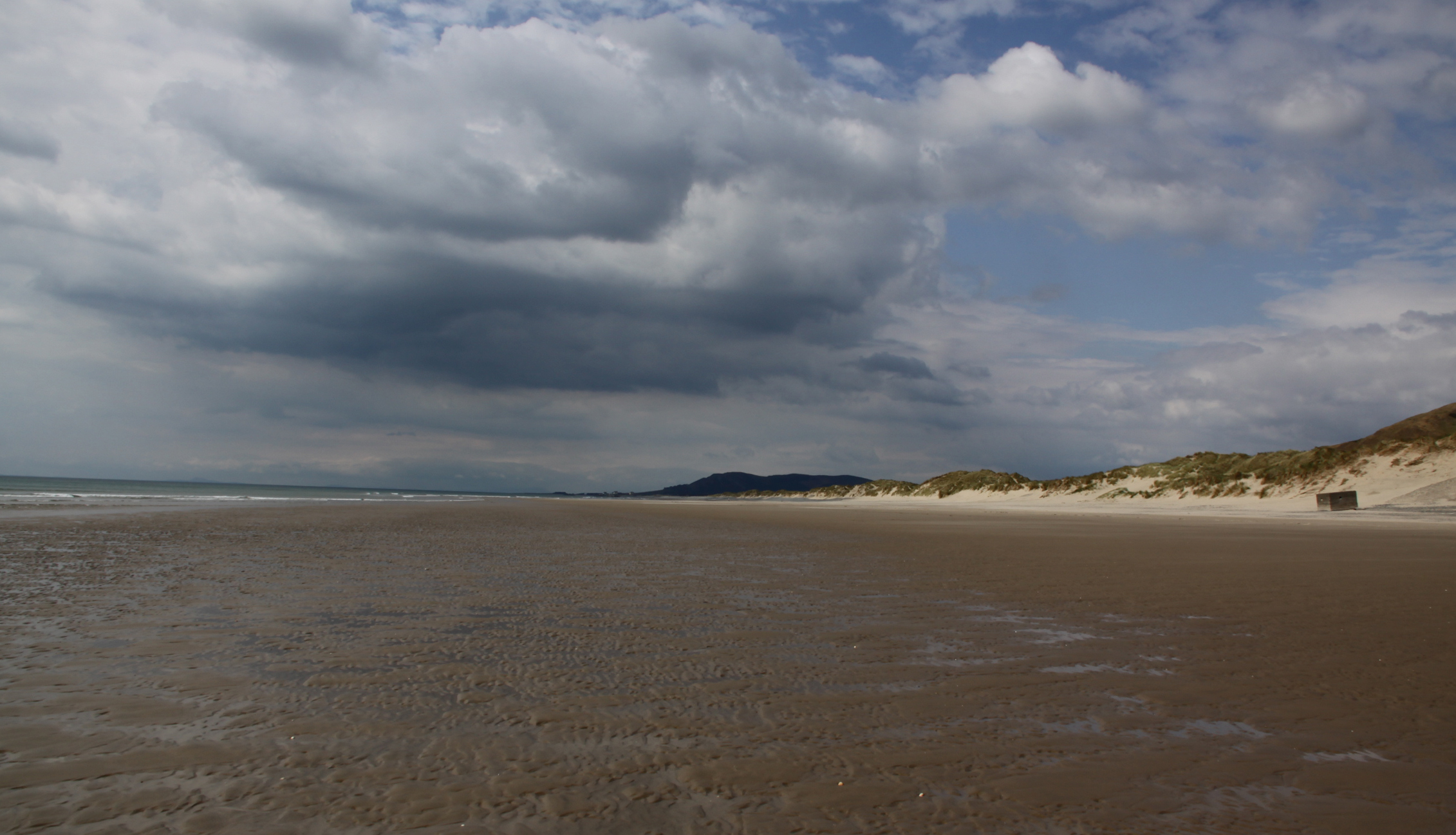
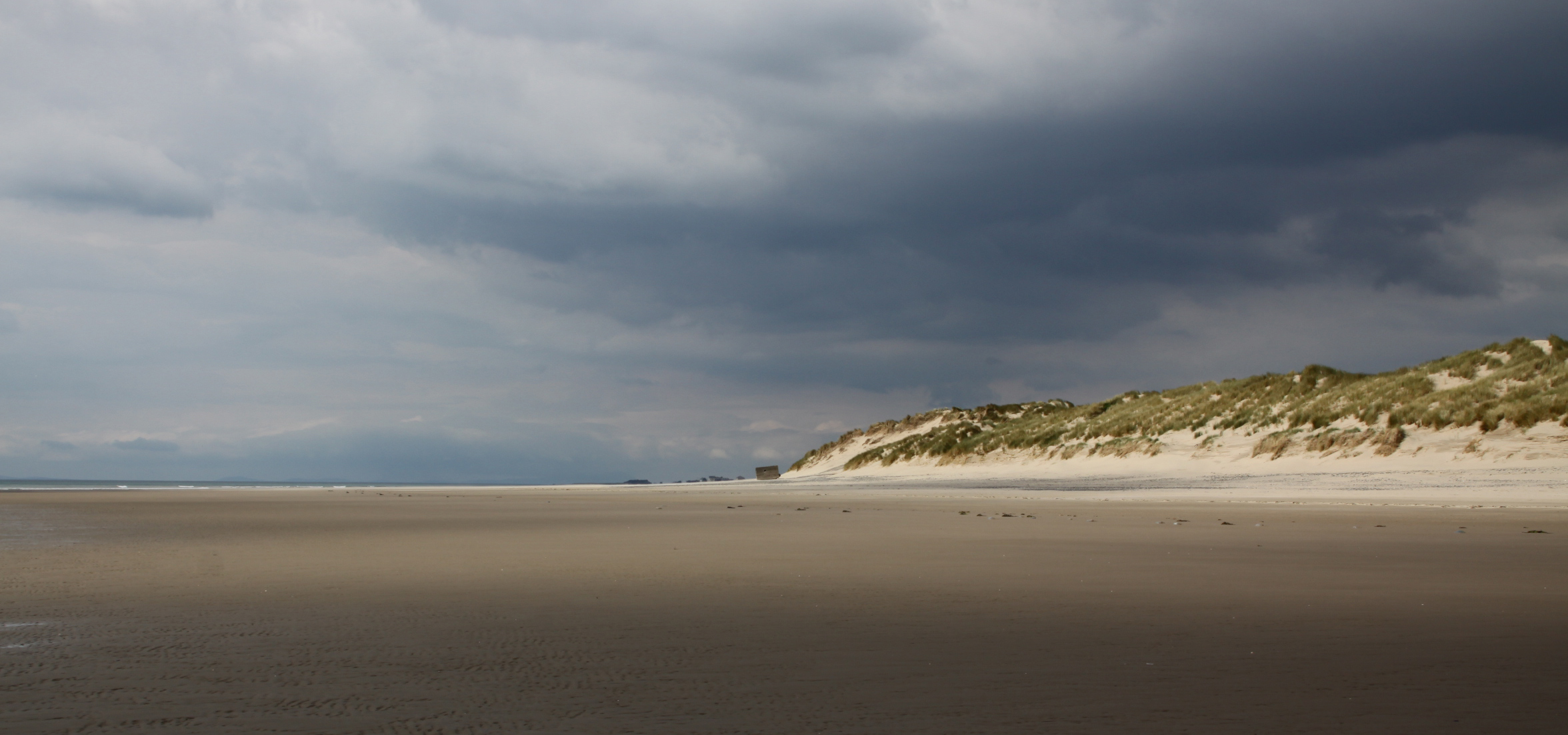
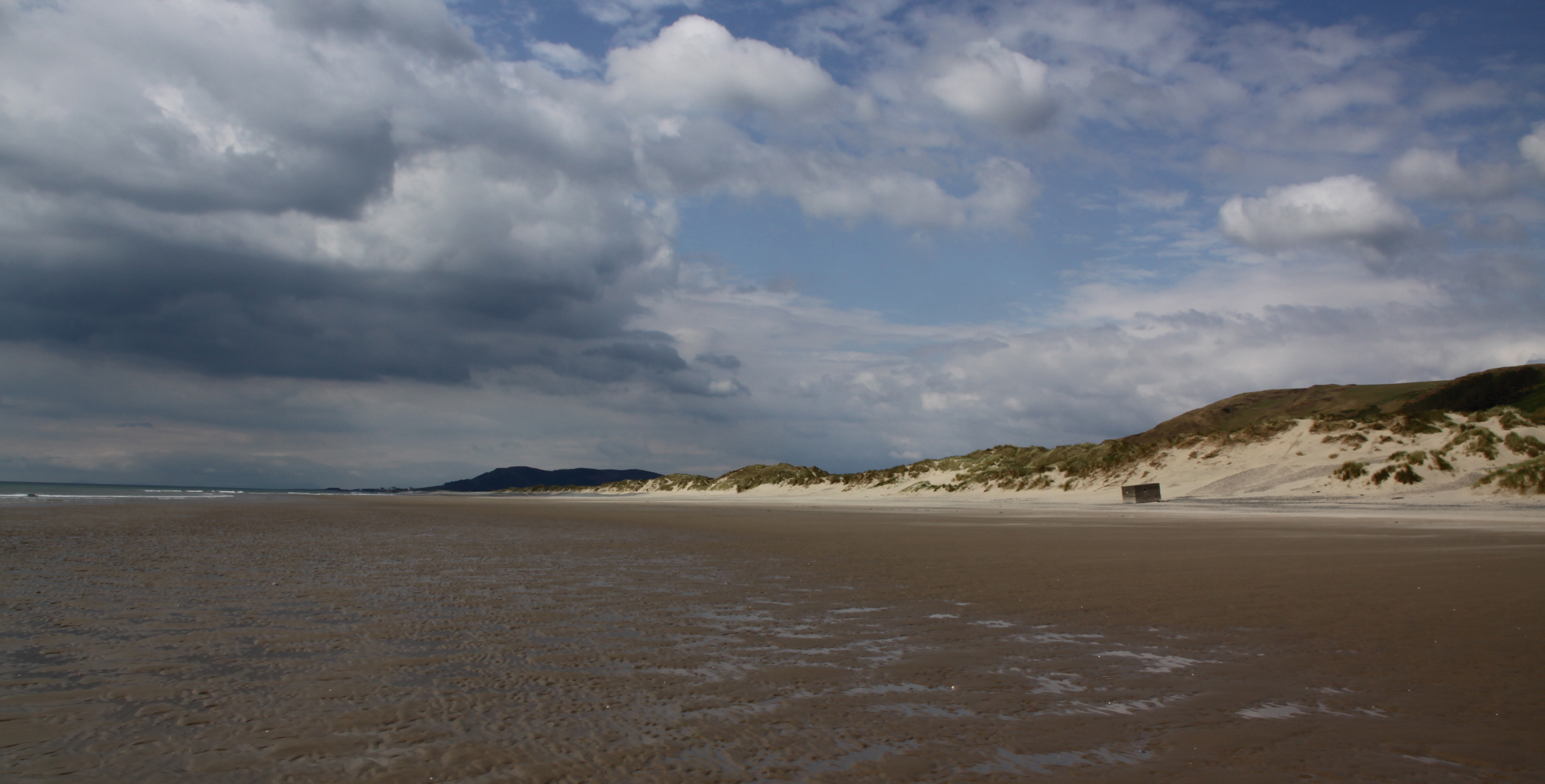
Aberdovey beach with the clouds gathering, wild orchids and good company

Pyramidal orchid (Anacamptis pyramidalis)

Thank goodness for my friend Caroline who came round to drop something off yesterday afternoon.  I was not at my best with a stinging eye infection, and when she asked if I wanted to accompany her on a walk I felt so grim that I wasn’t at all sure it was a good idea, but I was so fed up of being stuck in the house that I simply grabbed my sunglasses and bag, and went with both gratitude and relief.  As it happens, the salty breeze did my eyes a power of good, and by the time I returned to the house, things were amazingly improved.

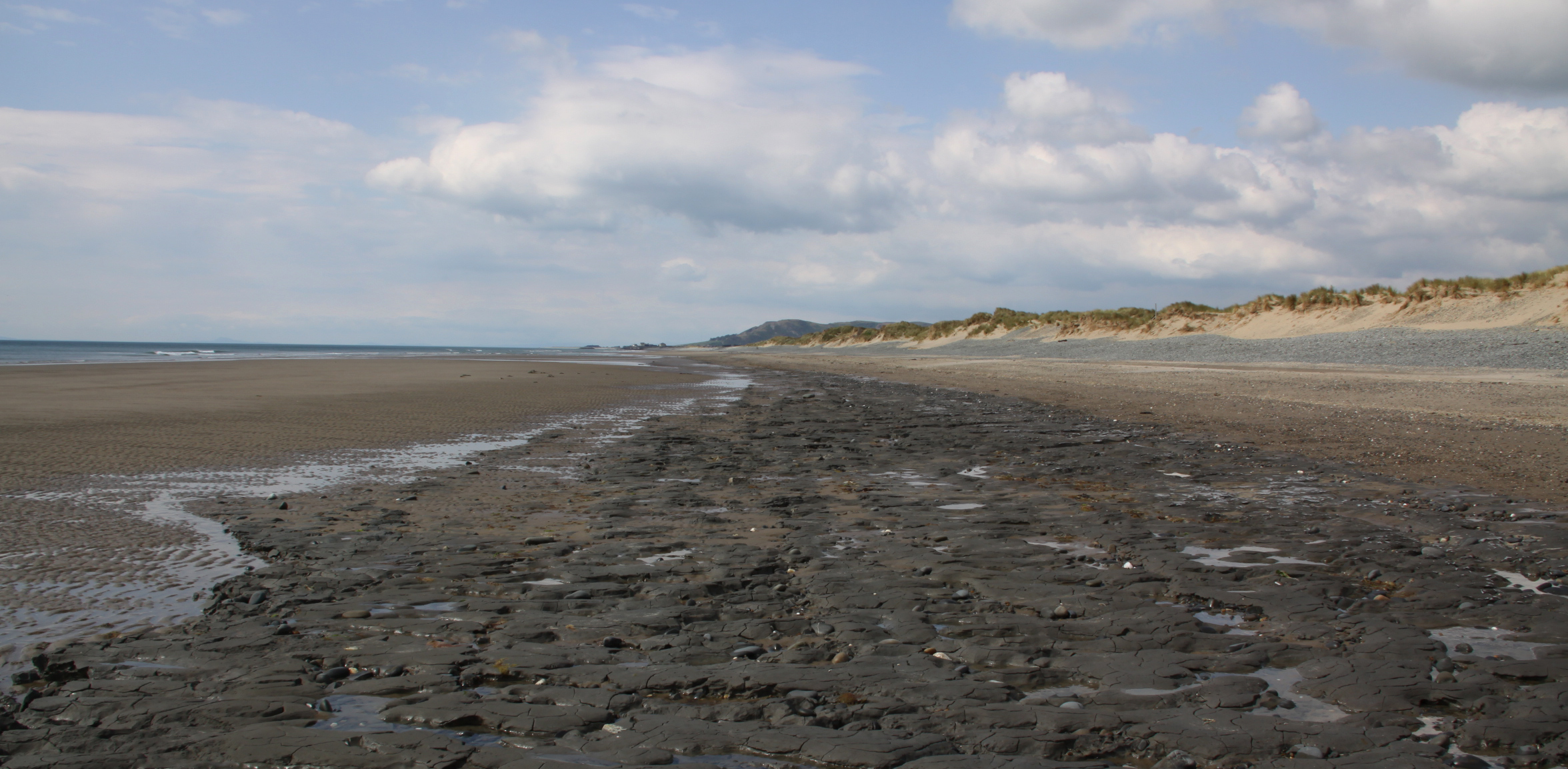
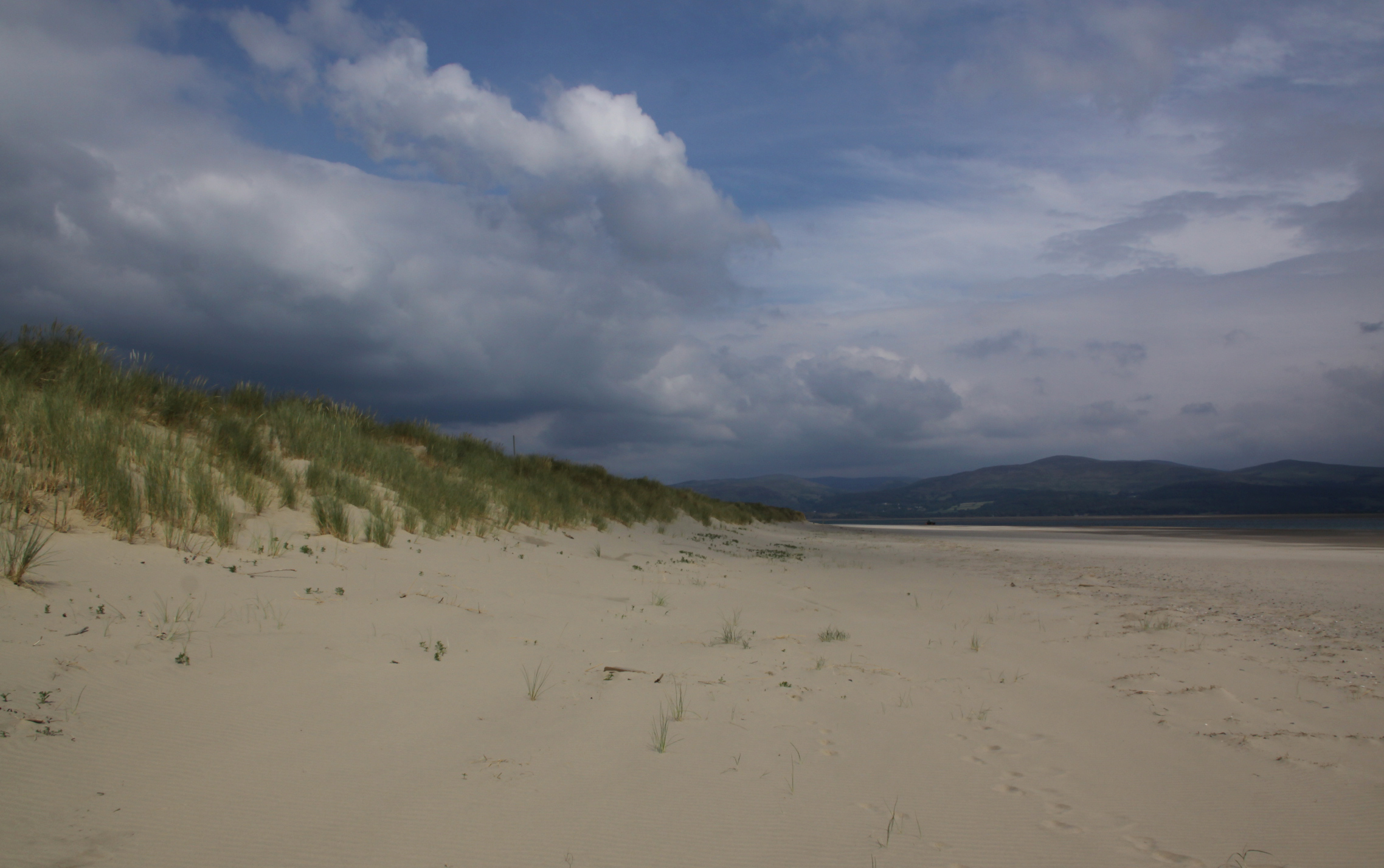
As we walked down the hill, maintaining diligent social-distancing, which we did for the entire walk, the weather looked iffy.  Although there were a few white fluffy clouds and some blue patches, the sky was dominated by deep blue-black monsters that were edging closer all the time.  We were lucky – it didn’t rain, and even though the wind got up it was relatively warm.  We started off with an ice cream each from The Sweet Shop, and then headed to the beach.  The lighting was stunning, with the sun blazing intermittently through gaps in the clouds, and the colours were wonderful.  As we threaded our way back towards Aberdovey through the sand dunes, the wild flowers were stunning.  The highlight was probably the wild orchids, which Caroline knew where to find, but there was so much else to see too.

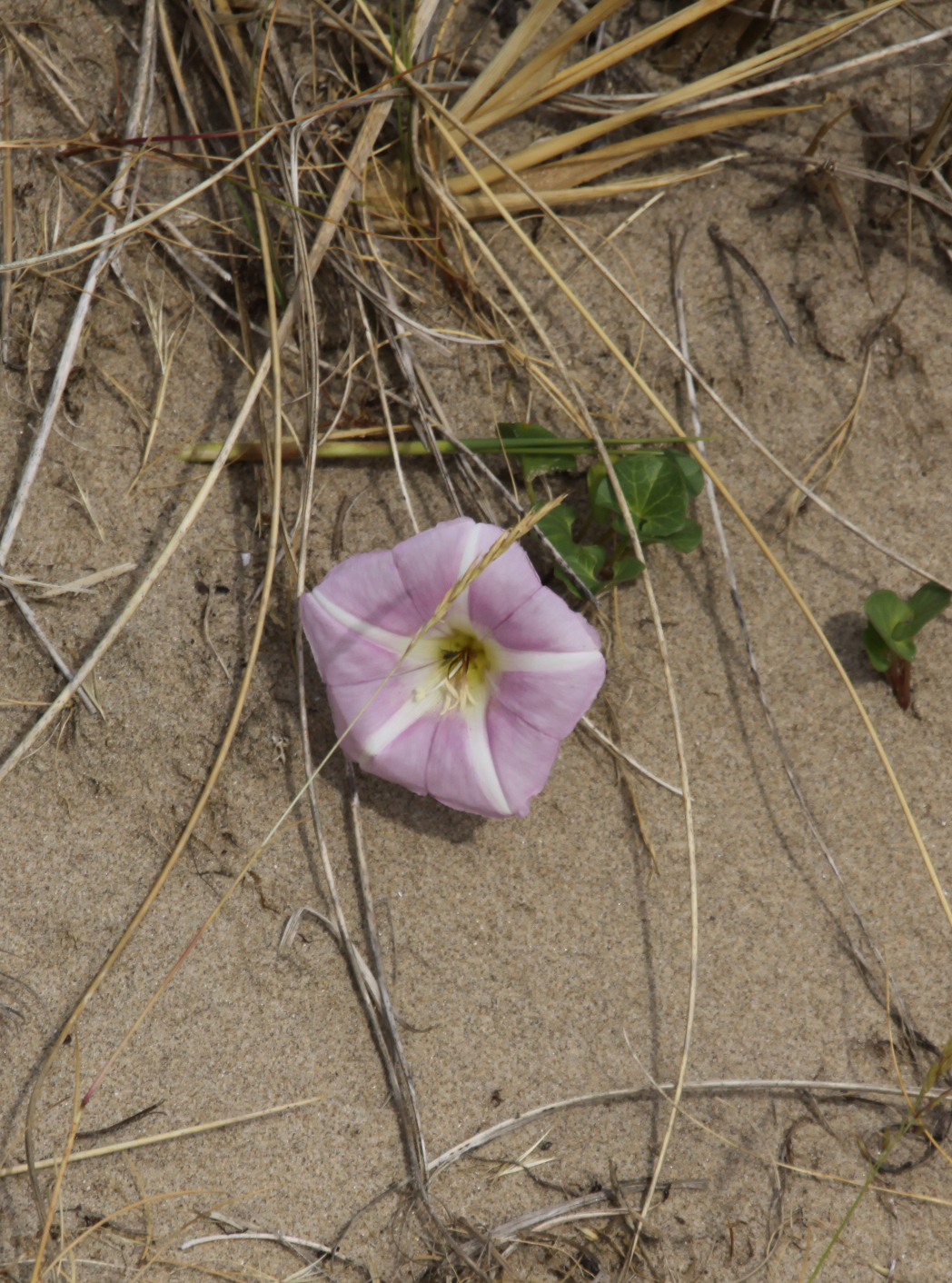
Sea Bindweed (Calystegia soldanella), with deep green, loosely funnel-shaped leaves that are fleshy and retain water.  A member of the convolvulus family.

Pyramidal orchid (Anacamptis pyramidalis).  I had never seen one before, but apparently it is one of the most common of the wild orchids, and can be found on just about any calcareous soil, including any sand that contains at least 1% CaC03 (calcium
carbonate) by weight.  Insanely pretty.

Lesser centaury (Centaurium pulchellum)

Lesser centaury (Centaurium pulchellum)

Female stonechat (Saxicola torquata).  There were a pair of them, a male and female, very vocal and jumping from bush to bush, presumably trying to draw attention away from their nest.

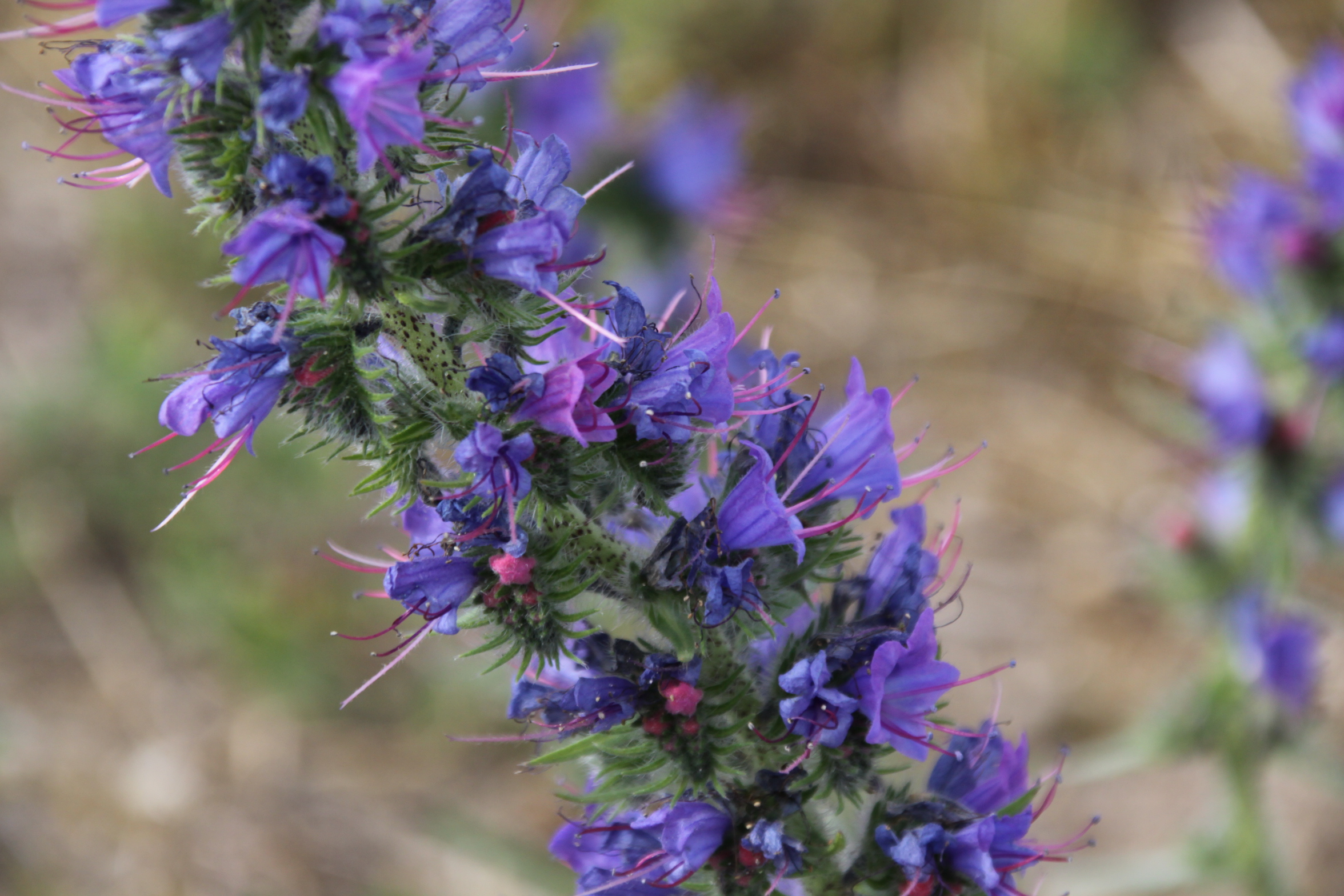
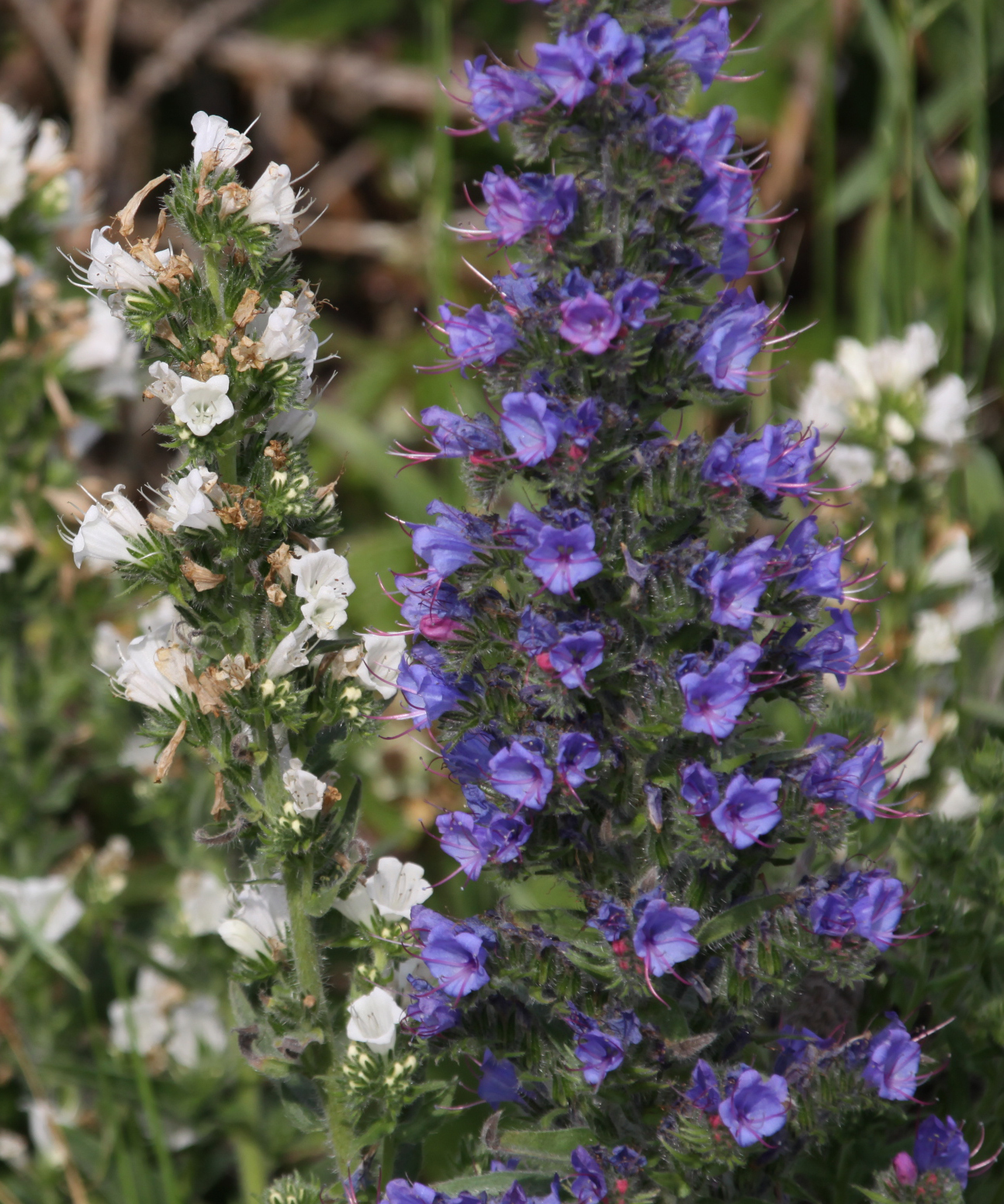
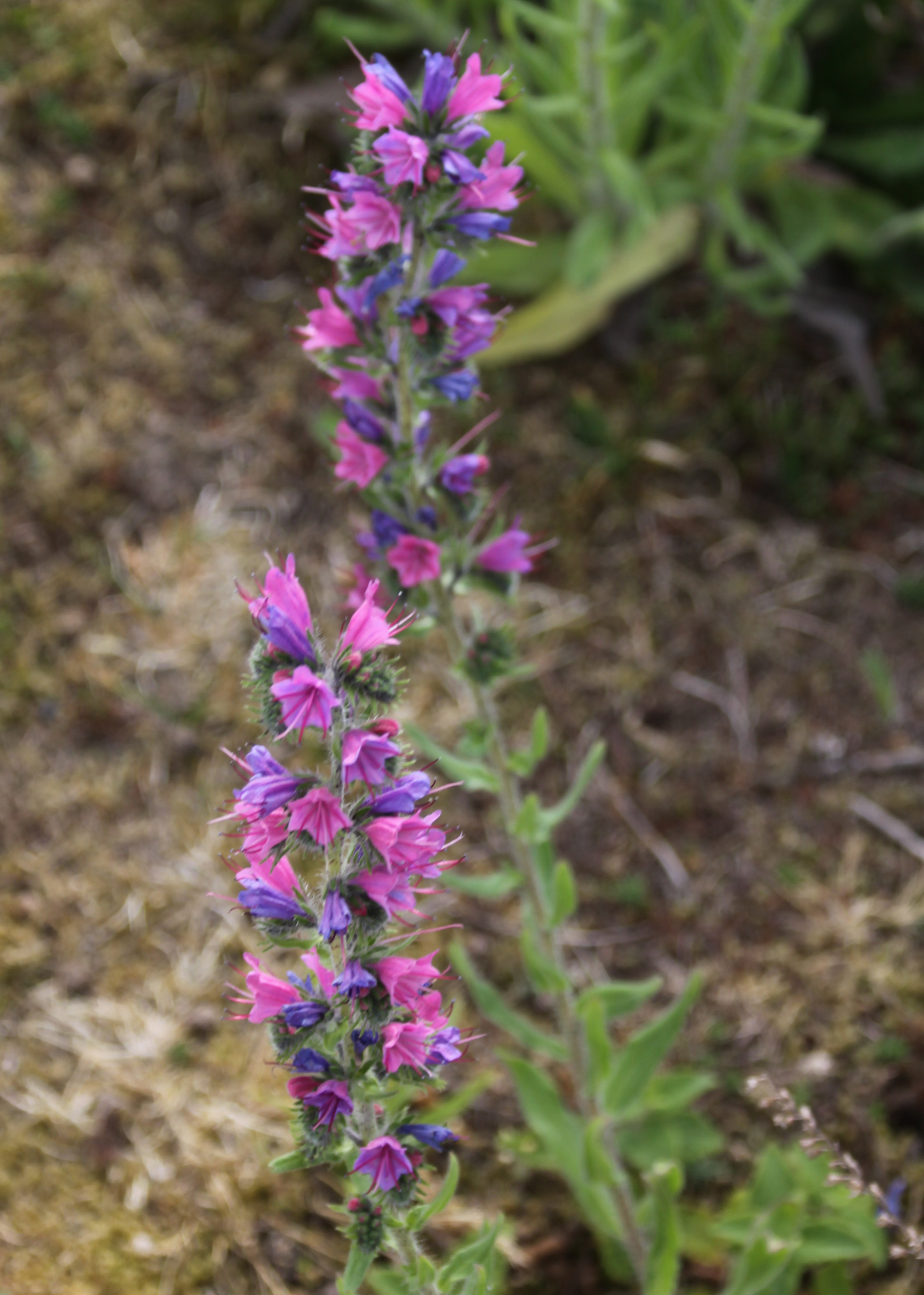
Viper’s-bugloss (Echium vulgare).  The flowers change from pink to violet as they mature. There were lots of them in the more open ground near the car park, which fits in with their preference for dry open spaces, sand and disturbed soil.

Viper’s-bugloss (Echium vulgare)

Viper’s-bugloss (Echium vulgare)

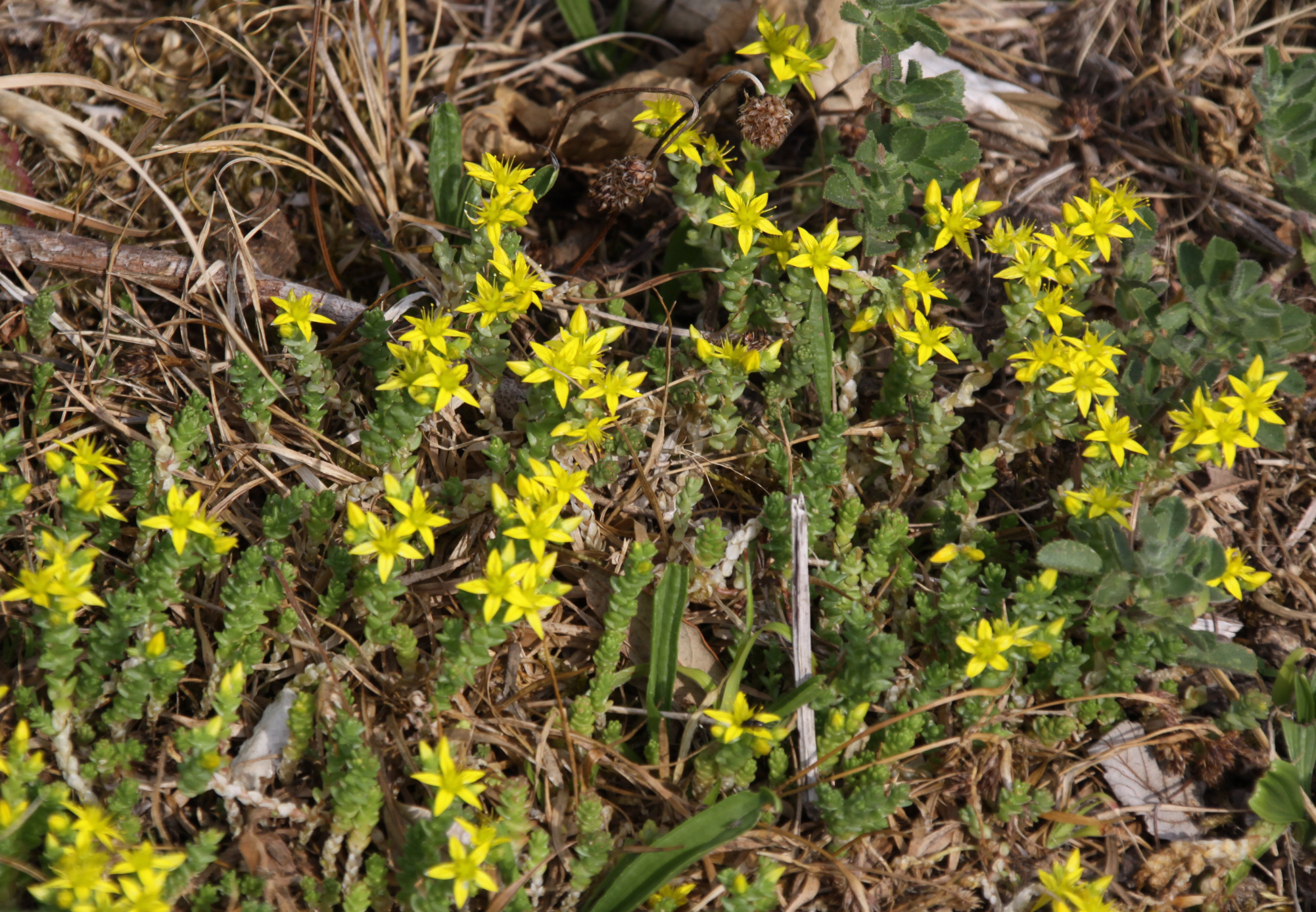
Biting Stonecrop (Sedum acre) are succulents, their leaves retaining moisture.

Viper’s-bugloss (Echium vulgare)

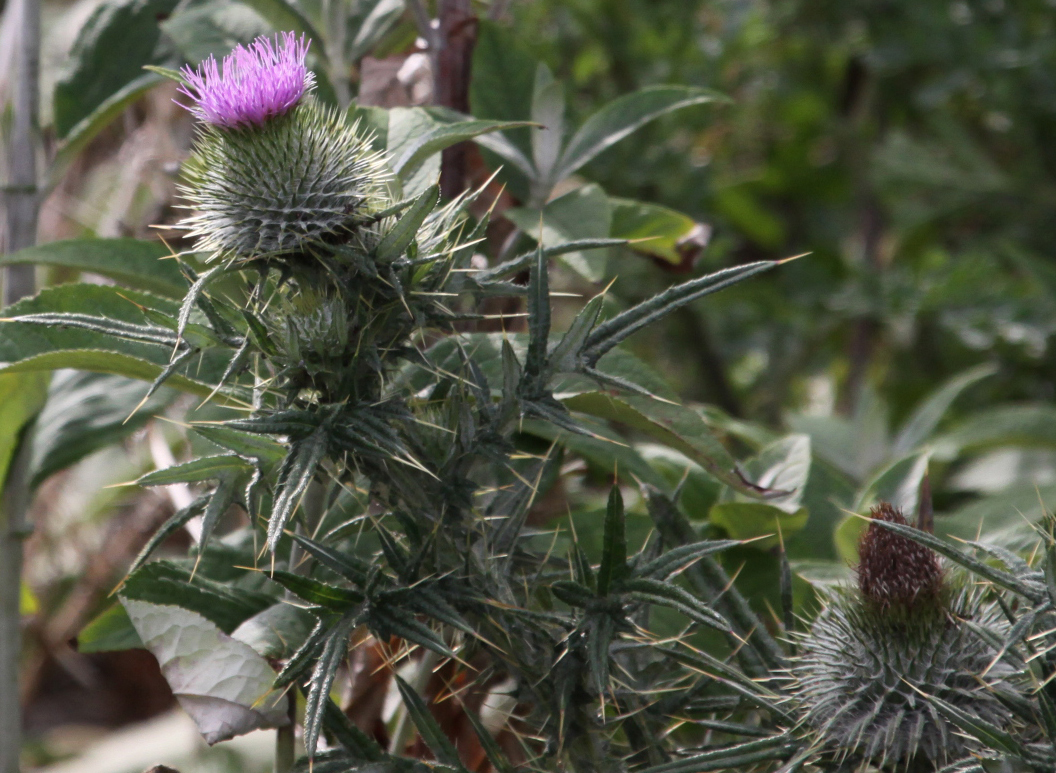
Woolly thistle (Cirsium eriophorum)

Common restharrow (Ononis repens).  The flower looks like a member of the pea (vetch – Fabaceae) family, but the leaves seemed all wrong.   It is in fact a vetch, creeping along the dune floor with small hairy leaves.  According to the Wildlife Trust website, “common restharrow has extremely tough, thick roots that spread in a dense network and, during the days of horse-drawn cultivation, could stop (‘arrest’) a harrow in its tracks.” Apparently, when eaten by cattle it taints dairy products. The roots are reputed to taste like liquorice when chewed.
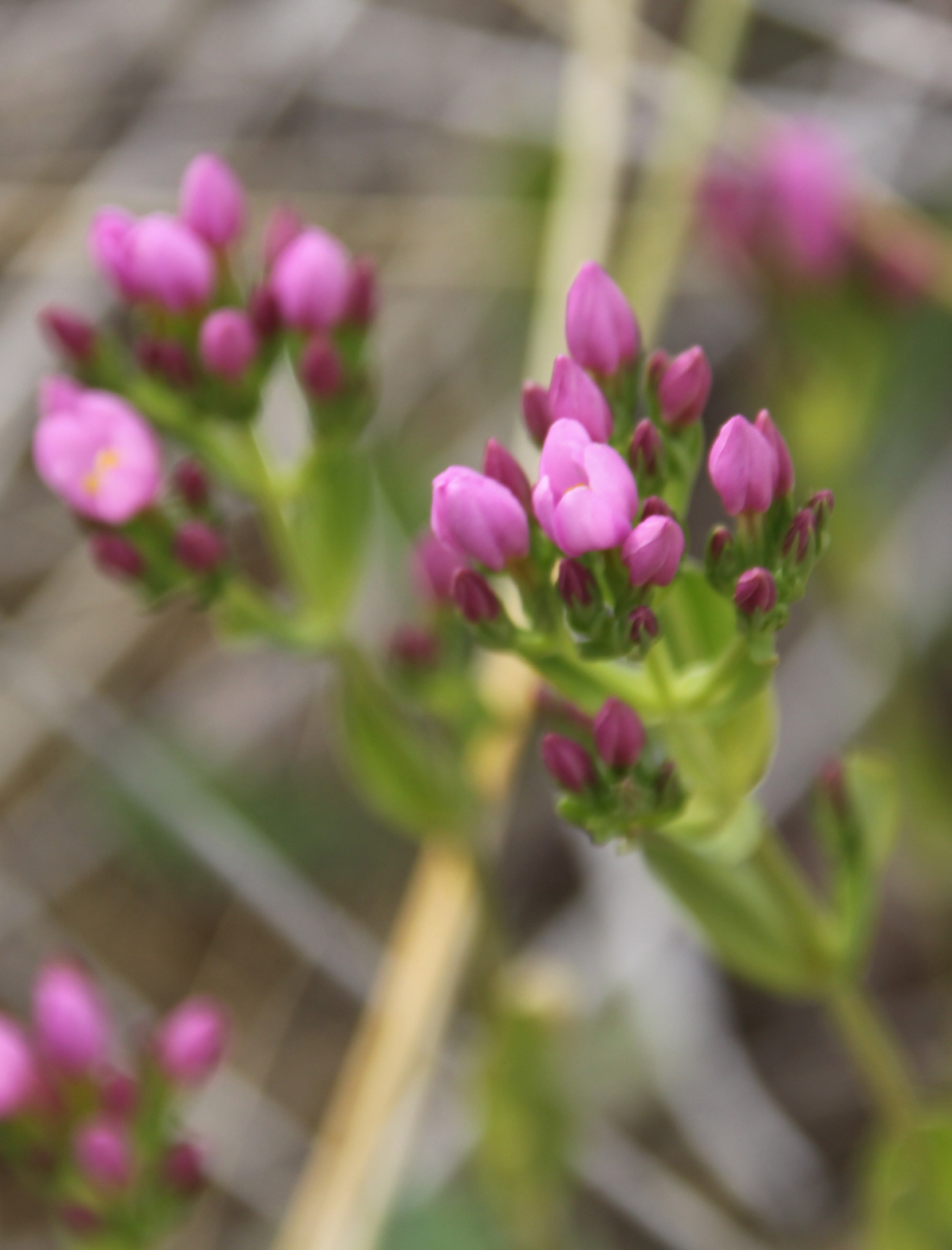
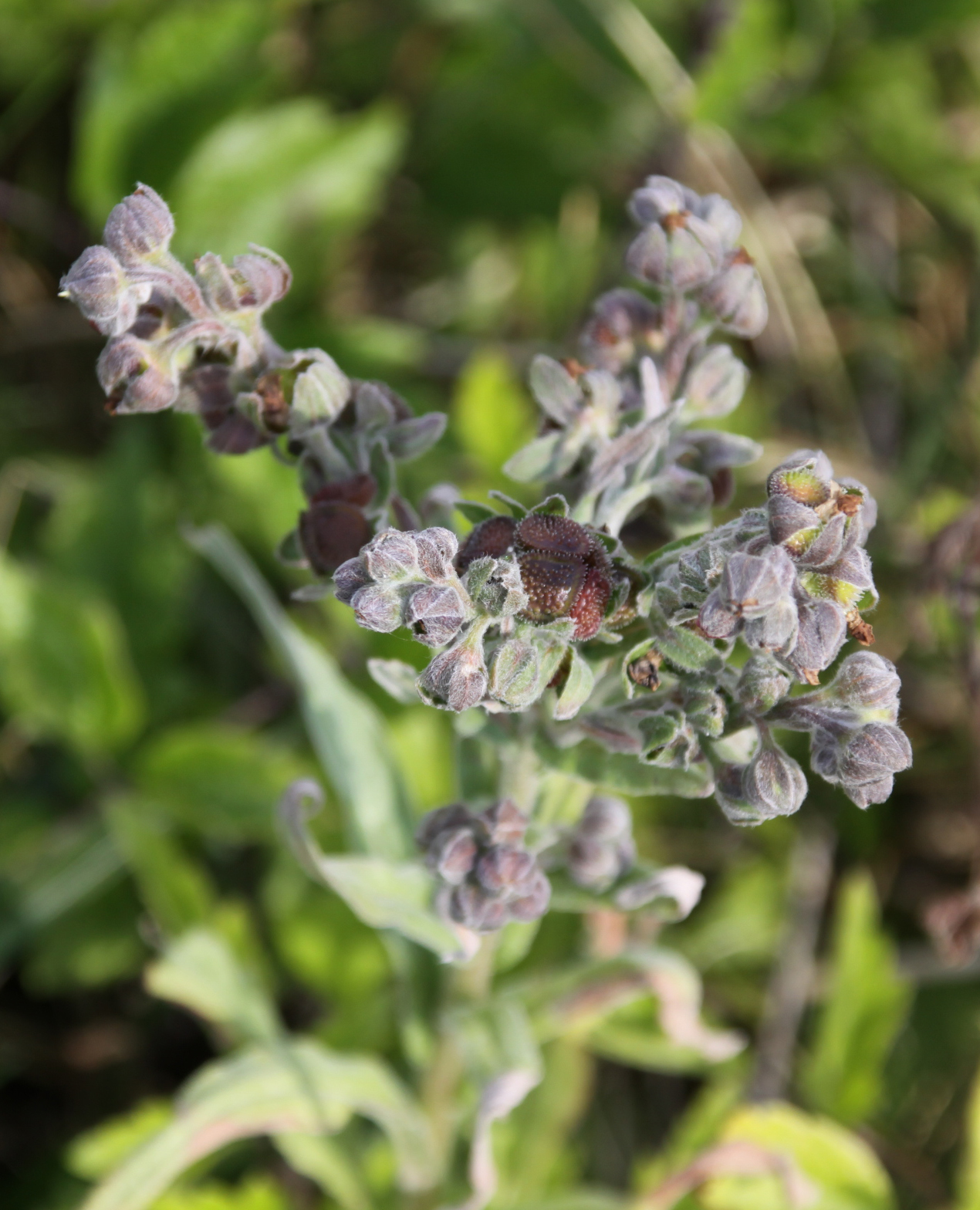
Unidentified at the moment, but when it flowers matters might become clearer.  It may turn out to be Hound’s Tongue (Cynoglossum officinale)

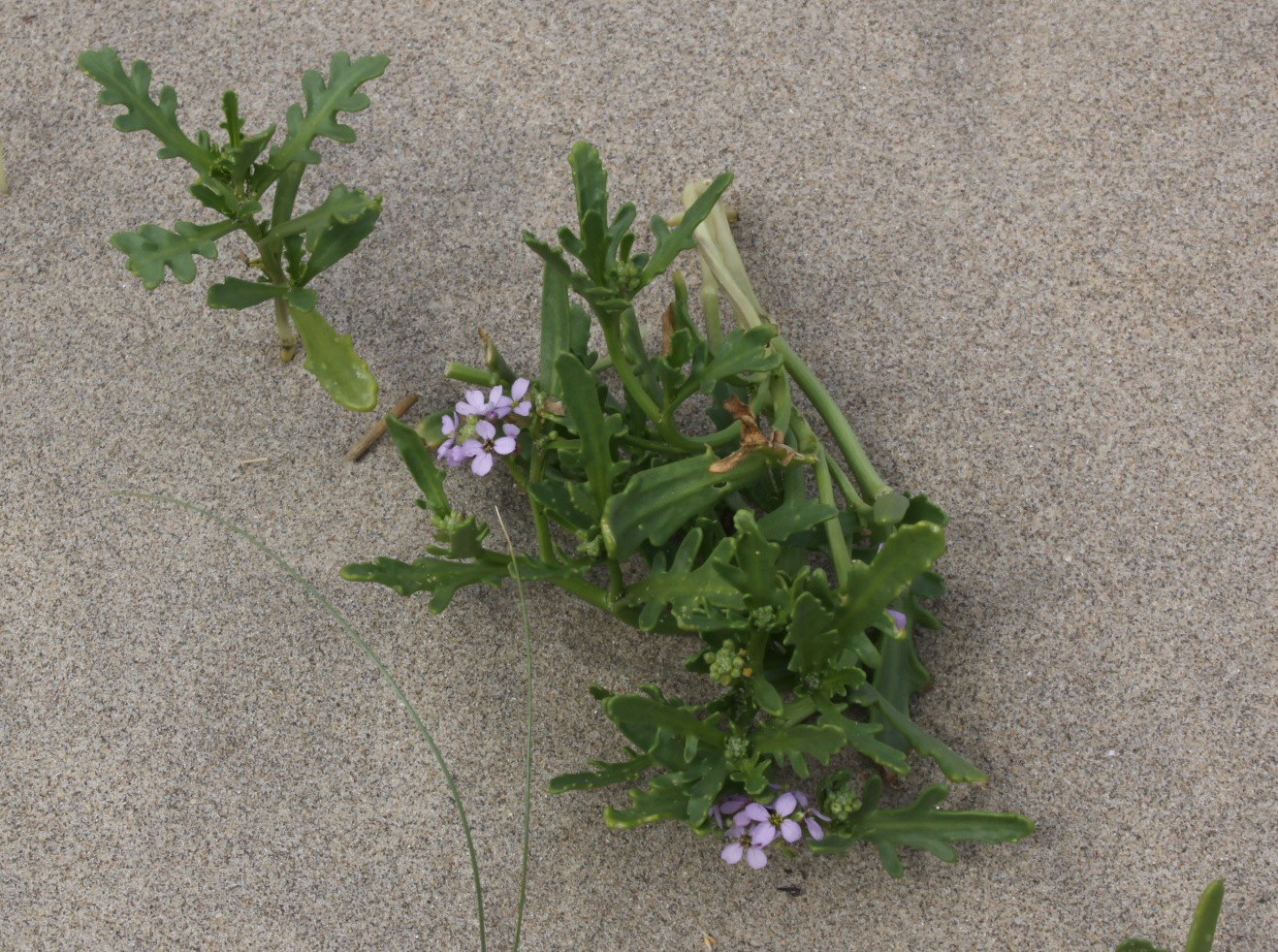
Sea rocket (Cakile maritima), a member of the mustard family.

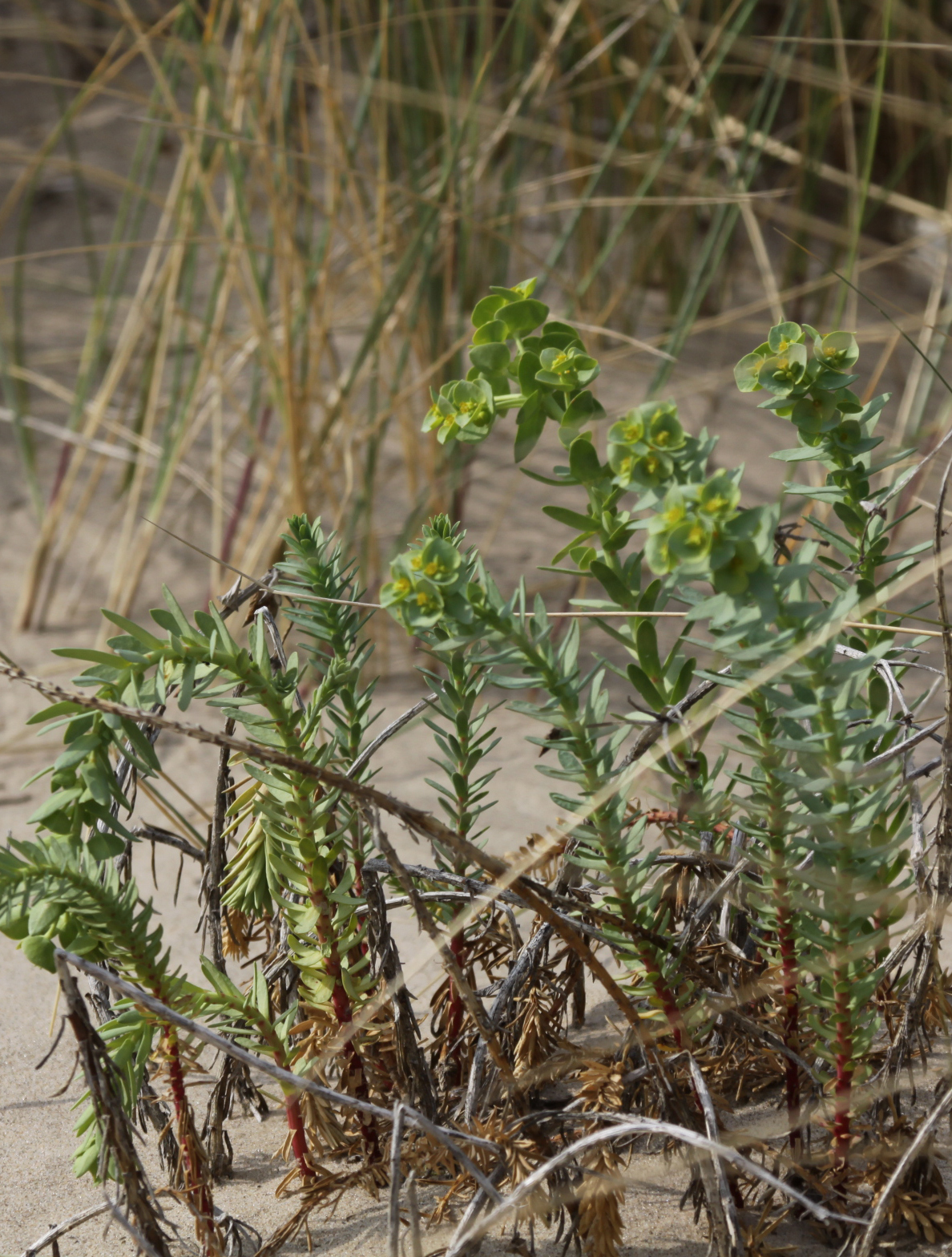
Sea spurge (Euphorbia paralias).


Video: Goldfinches feeding in high winds

The high winds recently have been a challenge for some of the local garden birds.  When I did this video the weather was dry but wow what a gale!  I had to strap my bins down with bungees to prevent them flying down the hill.  I am always entertained by the way that the goldfinches take all sorts of weather in their stride, but this was particularly fun.  The cherry tree looked like a whirlpool of movement, but the bird feeder was remarkably still, and the goldfinches were apparently oblivious to the the surrounding chaos, scoffing away with admirable dedication.  Sadly there are only muted sounds of the wind, because I’m not daft and was safely indoors when I shot this 🙂


Eating well from what’s to hand, just for fun – week 10

Last week’s wind and rain was a stark contrast to the sunniest spring since records began.  That amazing run of gorgeous spring sunshine was transformed, as though someone had flicked a switch, into high winds and torrential rain, and the temperature dropped accordingly.  Good for the garden, bad for the soul 🙂

The greatest happiness was that on the previous Friday Dai had managed to land an awful lot of skate, which is a fairly unusual catch in these waters.  Skate is one of my favourite fish, its flavour distinctive but delicate, its texture superb, and easily cooked.  It is perfect when floured and fried in butter, with the tips of the wings slightly caramelized.  Mackerel and sea bass are in short supply this year, but the skate more than made up for it, and Dai had huss and plaice too.  Unfortunately the poor weather for most of last week means that he couldn’t go out, so my skate and huss purchases will have to last me a while.

Saturday

Half a skate wing  with black butter sauce and capers.  Skate is one of my favourite things on the planet.  Someone mentioned to me that it was a so-and-so to fillet for serving, which seriously surprised me.  There is no need to fillet it.  The wing is made of parallel lines of cartilage, not bone, and you merely scrape the fish gently away from it.  No bones, no mess.  Delicious.  As a family, our favourite way of cooking it was always in black butter sauce with capers.   Dai (of Dai’s Shed) had been out in his boat,  and returned with a good catch of skate, which he had prepared ready for cooking.  I bought two large ones, and when I got home halved them, put two of the halves in the freezer and put the other two in the fridge for eating.

Black butter sauce is very simple, but it does need watching like a hawk.  Butter is heated in the pan and the skate is cooked through, basted regularly, about five minutes on each side.  You can flour it first if preferred, which I did (just dredge it in a plate with a shallow scattering of flour in it).  Once the skate is heated through, remove from the pan and keep warm.  Add more butter, turn up the heat and wait until it is brown, but not black (which would be burned) and add lemon juice and capers.  Heat all the way through and serve the skate with the sauce poured over the top.  Some people scatter over parsley, but I like it as is.  I served it with asparagus tips and shallow-fried potato discs.

I did far too much, and some of the cooked spuds and asparagus that I couldn’t eat were kept and added later in the week to a home made soup.

Sunday

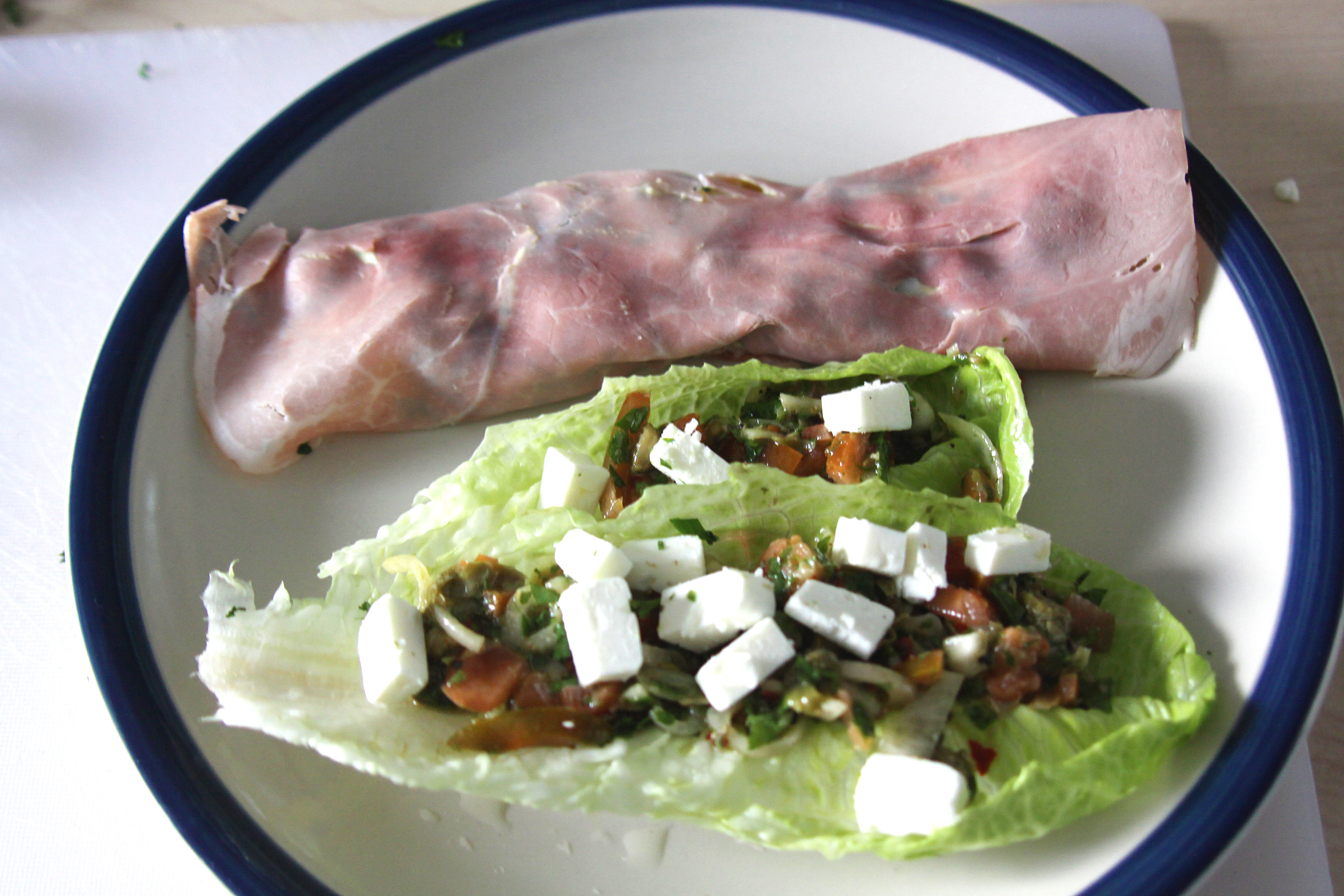
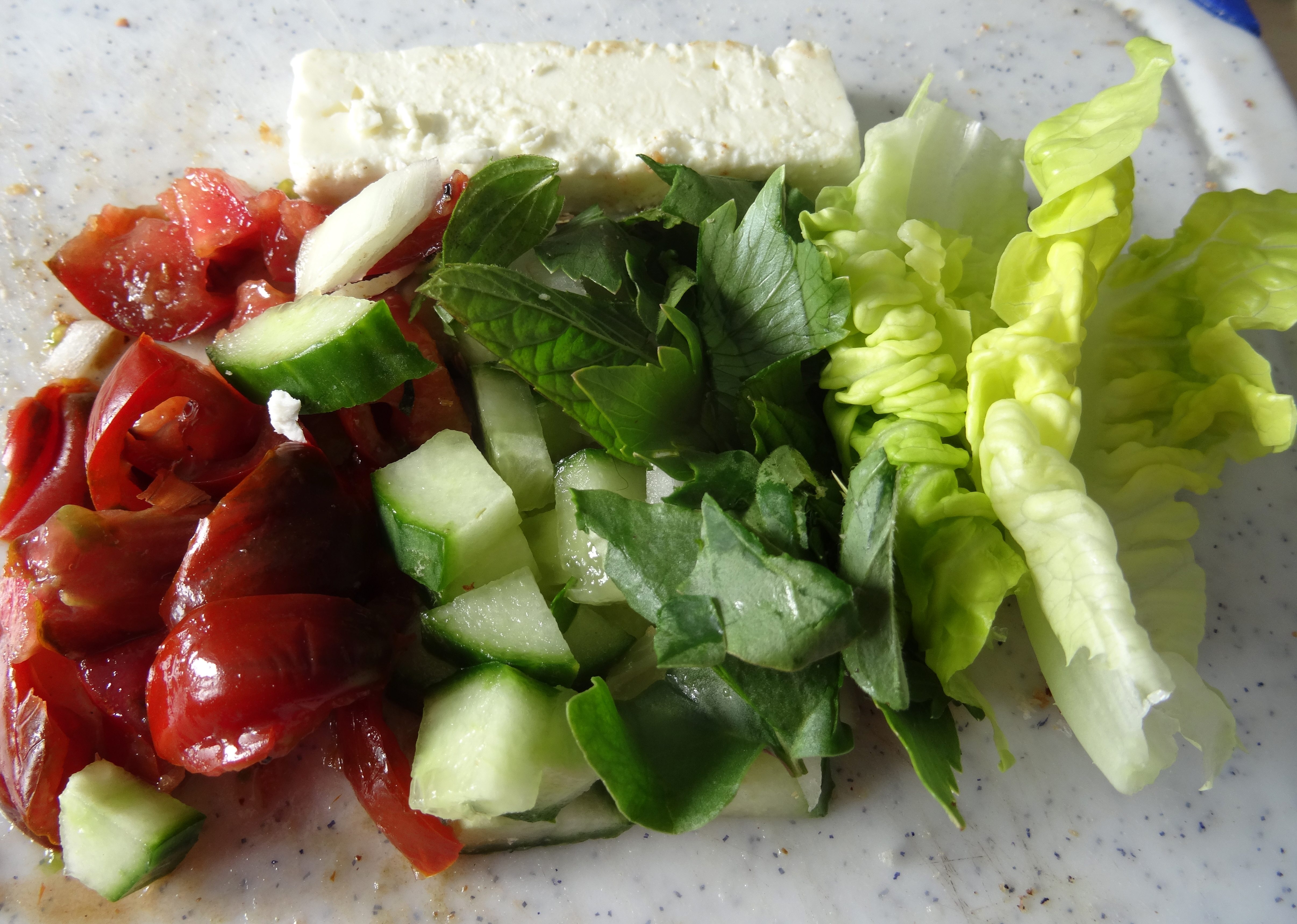
Ham horns with feta salad. This is an old favourite, which I’ve posted about before.  The thin-sliced ham, which I had in the freezer, is stuffed with a mixture of chopped hard-boiled egg, mayonnaise and whatever suitable herb or salad greens you have to hand – parsley, coriander, chives or spring onions all work really well, and a sprinkling of cayenne or paprika goes well.  Black pepper is a must.  It is accompanied here by little gem lettuce leaves filled with tomato, lovage, oregano, green olive, capers, cucumber and feta cheese, with a French vinaigrette.  It is a simple dish, and deserves the best ham and feta available.  The Co-Ops thin-sliced porchetta is good, or the Spar’s home-cooked ham at the deli counter is thicker but has excellent flavour.  Unfortunately, the locally available feta is decidedly third rate, but it is better than nothing.

Monday

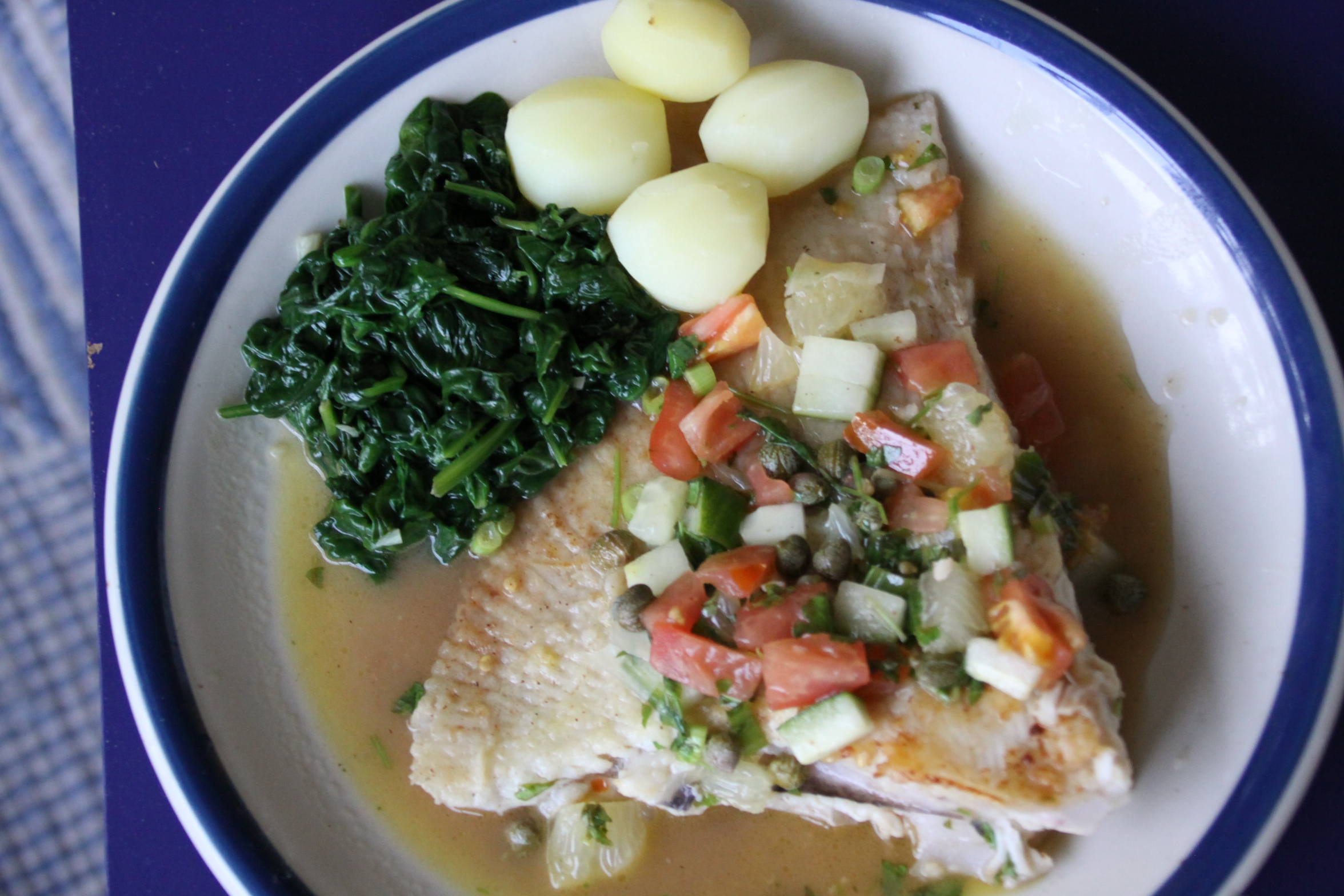
Skate Grenobloise.  I used the other half of the skate wing from Dai’s Shed to try to reproduce a skate wing (aile de raie) dish that I had in Lyon several years ago, on a truly superb gastronomic holiday.  If you cannot eat well in Lyon, you’re doing something terribly wrong.  I looked up the recipe on my return, and this was the nearest I could find to my notes.

The skate was quickly pan-fried and then poached in a fish, wild fennel and white wine stock, and served with diced lemon, diced tomato, capers and diced spring onions and, in this recipe (but not in the version I had in Lyon) diced cucumber, all gently heated through but not cooked in the poaching liquid.  It was served in Lyon with samphire, but I cannot get hold of that and my recipe recommended spinach.  Spinach turned out to be a stunning accompaniment.  Both the restaurant and the recipe agreed on peeled new potatoes cooked in chicken stock. I had only tiny baby new potatoes, and peeling them felt almost cruel, but I am glad I did as recommended, because it was excellent.  My original Lyon dish had croutons, as did the recipe, but I forgot to add them!  Next time I would add the croutons but leave out the cucumber.  The diced lemon pieces give this a wonderfully concentrated citrus hit that is quite unlike merely squeezing lemon juice over the top.

Tuesday

Spinach, watercress, rocket, wild garlic, frozen pea, asparagus and potato soup with a grated cheddar topping.  A couple of weeks ago I made myself a spinach, watercress, rocket, wild garlic and pea soup, consumed some of it and put the rest in the freezer in batches.  When I had some leftover cooked asparagus and potatoes, I dug one of the boxes out of the freezer, whizzed up the spuds and asparagus in the food processor with a little water and stirred it into the defrosted soup with a squeeze of lemon juice, a hint of nutmeg, a bit of sea salt and a lot of black pepper.  Once heated through, I stirred in a spoon of sour cream, and grated some Somerset cheddar over the top.  Bags of flavour, a good use of leftovers, and so easy.

Wednesday

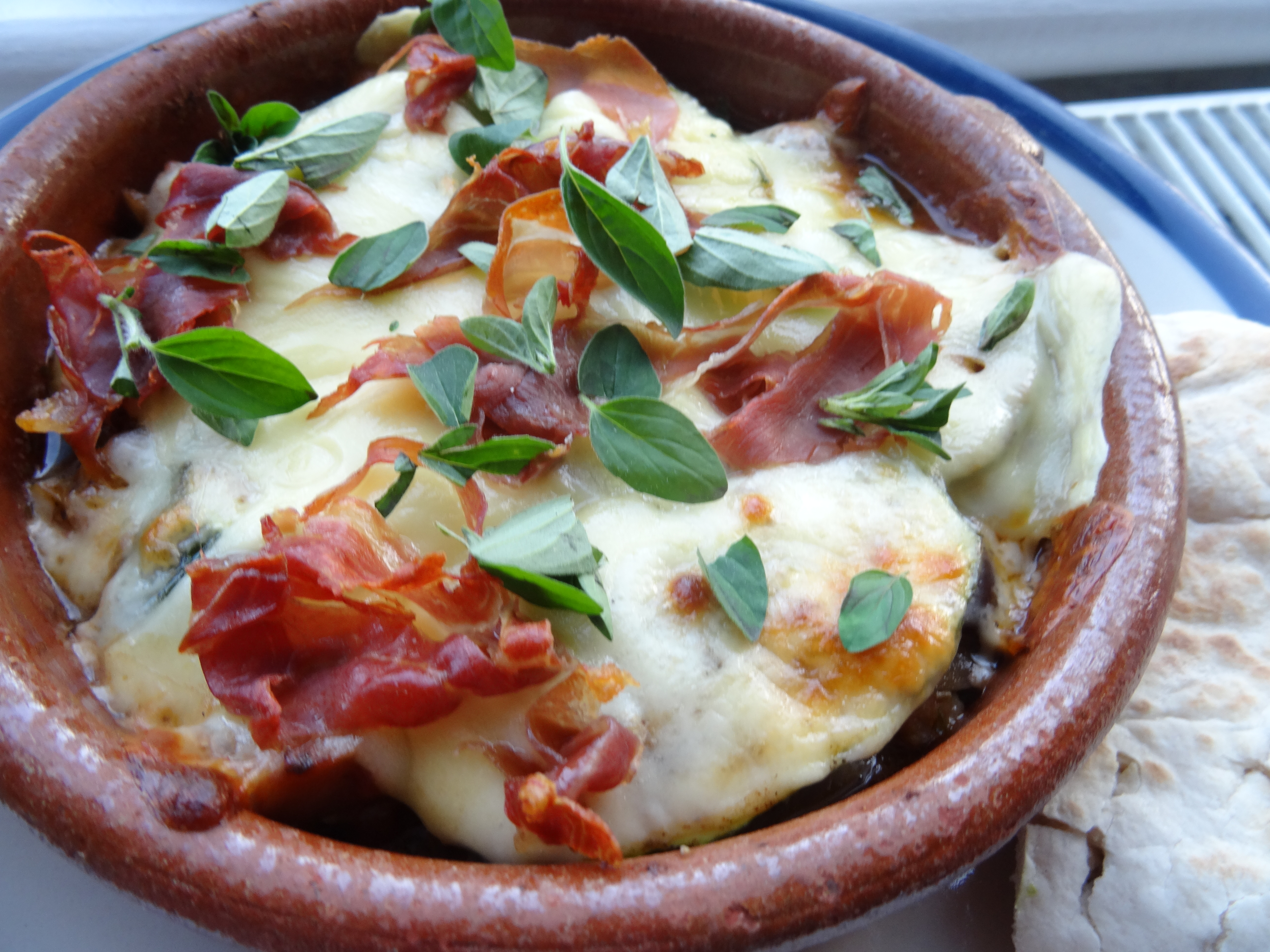
Leftover aubergine, olives and tomatoes with a courgette and cheese topping.  I had some leftover aubergine and tomato mix in the freezer, which needed using up to make room for other items.  In the fridge, my experimental purchase of mozzarella slices were also in urgent need of a swift solution, and there was a single piece of Parma ham and a rather wrinkled courgette.  There always seems to be a rather wrinkled courgette in my fridge.  The happy solution was to bung them all together, layered in a harmonious marriage of flavours.

I heated the aubergine mix in a saucepan and put it in a small pre-heated earthenware dish, topped it with a few slices of courgette, added a patchwork of torn slices of mozzarella and Emmenthal, and tore up the slice of Parma ham and scattered that over the top.  It all went into the oven for 15 minutes before being browned under the grill.  A few oregano leaves finished the ensemble, and it worked really well, slightly bigger than a tapas dish but easily scaled up for a bigger meal if required.

Thursday

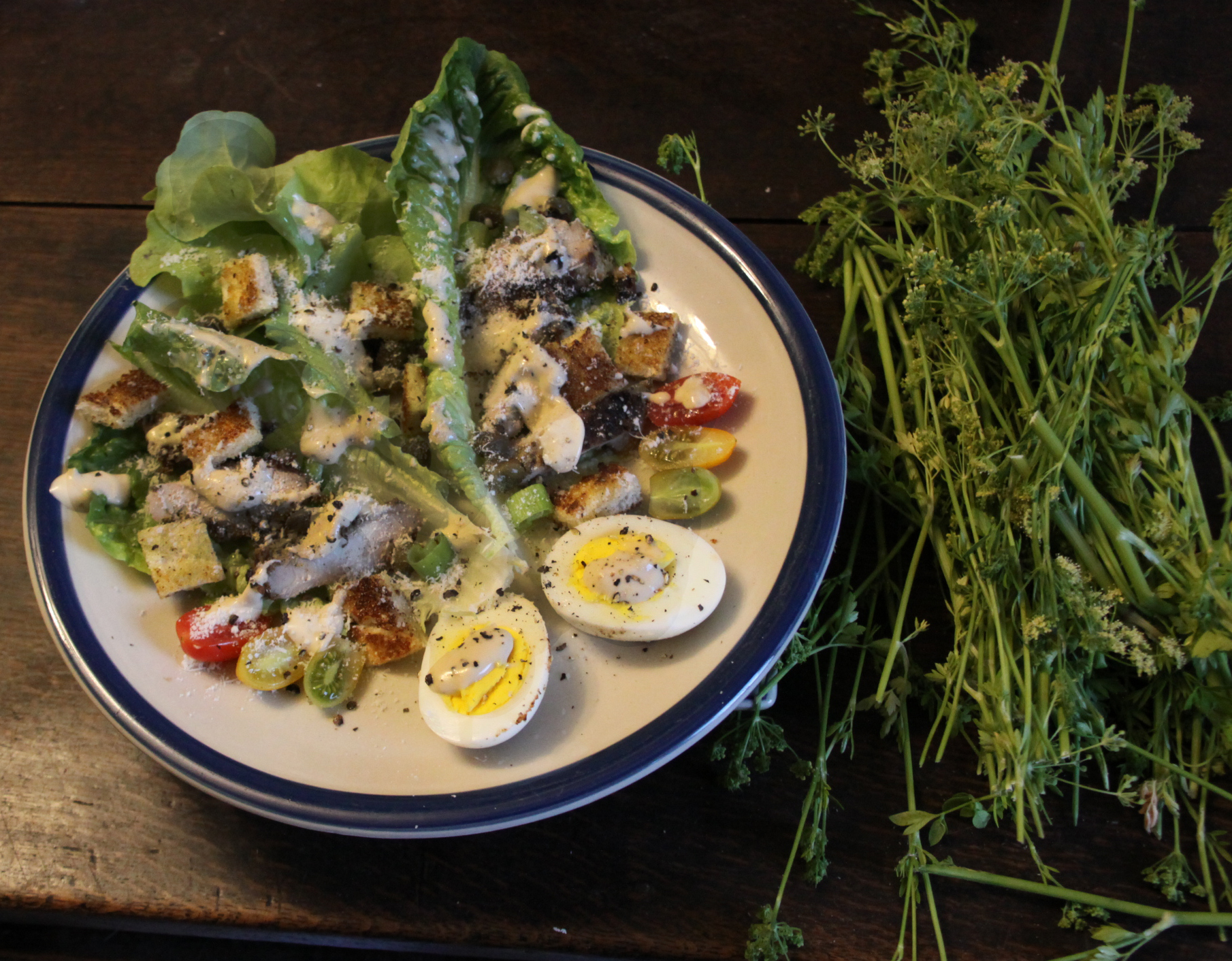
Chicken Caesar Salad Plus.  This started out as a simple chicken Caesar salad, but I hadn’t eaten a thing all day and was starving, so it became a rather more elaborate affair.  I had run out of anchovies (sacrilege) but had plenty of little gem, some excellent cut-and-come-again lettuce, some cherry tomatoes, a small hard boiled egg, some faux crutons (diced toasted sourdough bread, painted with garlic-infused olive oil) and some cold chicken that I had barbecued and frozen down especially for salads. The slightly charred smokiness of the barbecued chicken is always delightful.  To add some of the salty hit of the anchovies I used capers instead, and they worked wonderfully.  I had been unable to buy a wedge of parmesan, but fortunately my illustrious parent was able to help out with a bag of an excellent grated version.  Grated parmesan can be very dry, but this was really excellent.   I didn’t have the energy to make my own sauce, so used the tried and tested Cardini bottled sauce, which is mercifully not over-sweet, and has bags of flavour.

Friday

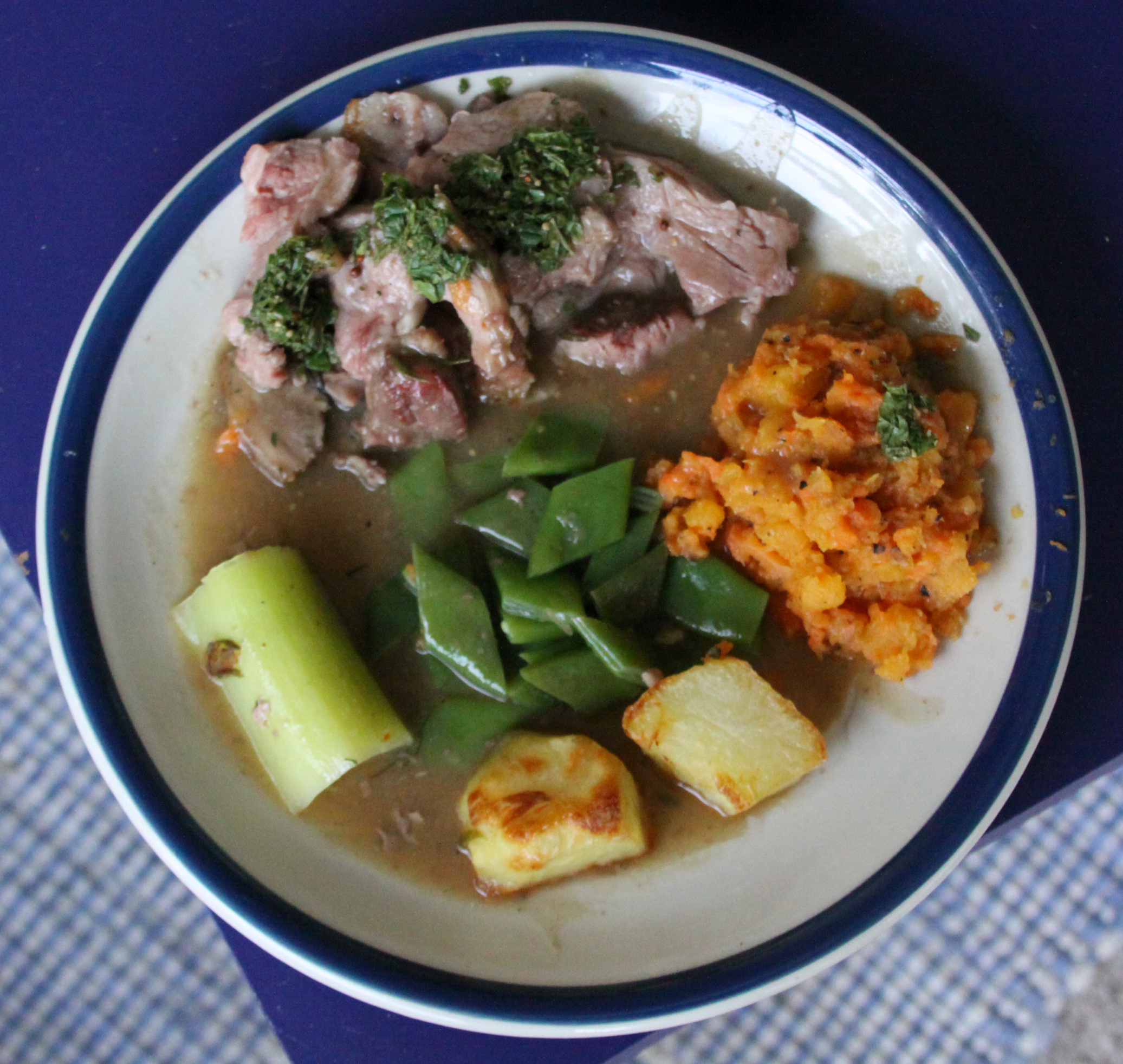
Roast lamb with mint sauce, runner beans, mashed carrot and swede, roasties and rosemary gravy.  There’s not a lot to say about a roast.  I bought a small leg of lamb, and my father and I shared it between us.  In other words, in these times of lockdown, when I pitched up at his house with the fortnightly  food parcel, I waited outside, stealing herbs and lettuces from his garden, whilst he sawed it in half and I cooked one half here in Aberdovey and he had the other half at his home near Chester.  I simply cannot wait until we can actually eat in the same house once again!  The utterly divine runner beans were also supplied by the parent, but everything else came from Aberdovey.  I grow my own mint for the mint sauce, the spuds were Maris Pipers, the leek is an essential accompaniement to lamb, and the pile of orange stuff is a mash of carrot and swede.  I don’t like swede on its own, am unexcited by carrots, but when the two are mashed together with butter and black pepper, nothing makes me happier.  I made the gravy on the hoof with a home made vegetable stock, a lamb stock cube and the juices from the roast itself.

Conclusions

I haven’t much to add this week to any of my previous comments.  The novelty of the fresh fish was superb, but the old favourites like chicken Caesar salad, home made soup and ham horns are always welcome.

My parsley has bolted (gone to seed), which means that my supply of parsley will soon be dependent on shops until I can purchase a new plant.  Potted parsley only lasts for a couple of years, and both my plants are two years old, so I bear them no ill-will, but in the future I will make sure that I buy a new one each year, so that when one bolts, another one will still be going strong.

If your parsley does bolt, and you are left with just a few leaves and some big, coarse stalks, you can use the whole plant to make parsley sauce.  Take off all the leaves and chop as usual.  Cut the stalks low, chop them into saucepan sized pieces and simmer them gently for half an hour or so with a stock cube, and you will have a wonderful parsley-infused stock as a base for a parsley sauce (made with a velouté base rather than a béchamel) or a base for stews and casseroles.


Video: For absent visitors deprived of the sea at Aberdovey

A little video (four and a bit minutes), to bring back the sounds as well as the sights of the seaside at Aberdovey.  The crystal clear waters of the estuary and the sea peaceful under a clear blue sky on a very peaceful May day.  Whenever I was absent from Aberdovey for long periods, long before I moved here, it was the the sea that I most missed, so I put this together for regular visitors who may be missing it as much as I did.


Late spring in the hills above Aberdovey

The hills behind Aberdovey are always particularly spectacular on fine day, with broad strokes of colour given a bright sparkle by the sun.  Eyes down, and there are wildflowers everywhere, tiny explosions of concentrated intensity.  It always astounds me how such delicate little things can stand up to their exposed position and the extremes of the weather.  Tiny pale butterflies replace the big, glossy garden species, and everywhere there is birdsong even though the birds themselves are often invisible.

Germander Speedwell (Veronica chaemaedrys)

A patch of Wild Pansy (Viola Tricolor), also known as Heartsease

Wild Pansy (Viola Tricolor)

Heath speedwell (Veronica officinalis)

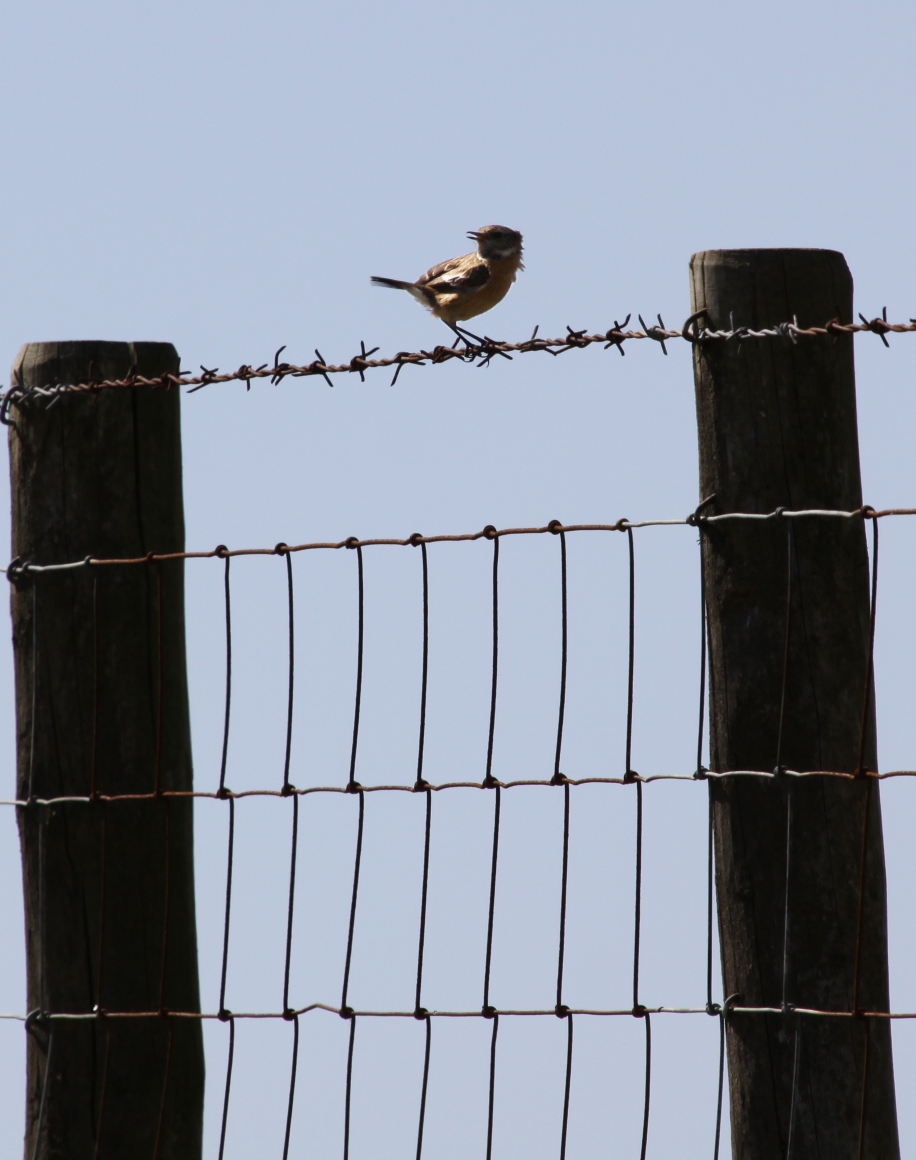
It is difficult to see what this is, but it may be a whinchat (Saxicola rubetra).  The colouring is right, with a flick of white at the base of the head (visible when I lightened the image in Photoshop), and its preferred habitat is open ground, moorland and mountain plains.  It is found throughout most of Wales, but is a summer visitor, migrating to central Africa.

Stonechat (Saxicola Torquata).  One of my books described its call as a metallic ‘whit sac sac’ which sounds like stones being smacked together.”  It favours low vegetation such as gorse and thickets.  I had never seen one before, so was particularly pleased to see it.

Small Heath (Coenonympha pamphilus).  Double-brooded, appearing in early summer and then again in late summer.  Found in unimproved grassland and coastal areas.

Dune Pansy (Viola tricolor ssp. curtsii).  Favours dry coastal grassland areas.

Sea mayweed (Tripleurospermum maritimum)


Eating well from what’s to hand, just for fun – week 9

I had this scheduled to go out on the 30th May, but for some reason both it and a number of other posts failed to publish themselves.  I’ve been so busy that I didn’t notice.  Leftovers were very much on my mind when I was writing this post the week before last.  On the upside, I am accustomed to using leftovers to make stock wherever possible, and do my best to make sure that both fresh and cooked food that are leftover from the cooking of other meals are incorporated into later dishes.  However, I am by no means innocent of food waste, often being left over with bitty odds and ends that defy my attempts to come up with creative uses, and which either get lost in my freezer or are thrown away.  I try to plan my cooking so that either I use everything up in one go, or I can use ingredients over two or more meals, but it doesn’t always work out that way.  Sometimes my planning can go awry and I over-estimate what I need for my meals, meaning that there are bits left over, cooked or uncooked.  Other problems come from occasionally having to buy vegetables in bags, when you only need a couple of something – like potatoes.  I know that a lot of people use leftovers for a cooked breakfast and/or lunch, but I don’t eat either.  So this week has been very much a matter of pressing leftovers and orphans in the fridge and freezer into service.  Some of my thoughts on the subject are in each day’s descriptions, others are in the Conclusions.

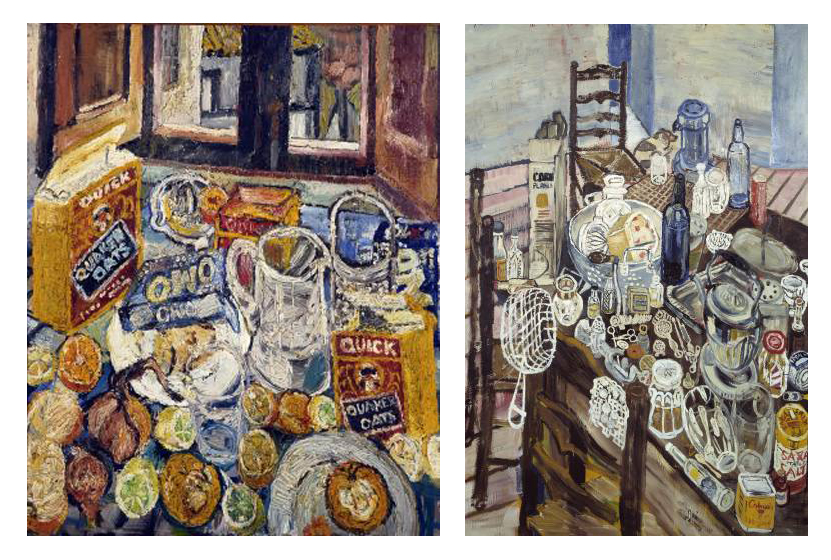
On Monday 25th May I was watching artist Grayson Perry’s hugely entertaining Art Club on 4+1, which is all about how different people, including artists, celebrities and the general public, respond to different lockdown themes, expressed through artworks.  This week was “Home.”  His webcam special guest  was Jenny Eclair (I didn’t know of her, but she was very entertaining and is described by Wikipedia as “English comedian, novelist and actress”).  She was asked to choose her favourite artwork on the subject of “home,” and she chose a piece by John Bratby (1928-1992), which she said struck a serious chord with her during lockdown, because of the sheer chaos in her kitchen.  It made me grin because it looked so like my own kitchen, not that I have room for a table and chairs, but the kitchen surfaces look like that all too often.  Bratby was the creator of a movement in painting known as Kitchen Sink Realism, and this often seems to get to the heart of much of my lockdown life, where objects are constantly bidding for freedom, busily filling peaceful space.  Things steal out of draws and cupboards, creeping across every available horizontal surface, conspiring in a co-ordinated offensive to achieve riotous assembly.  I have always been at war with objects but never more so than now, and the objects seem to be winning.

Saturday

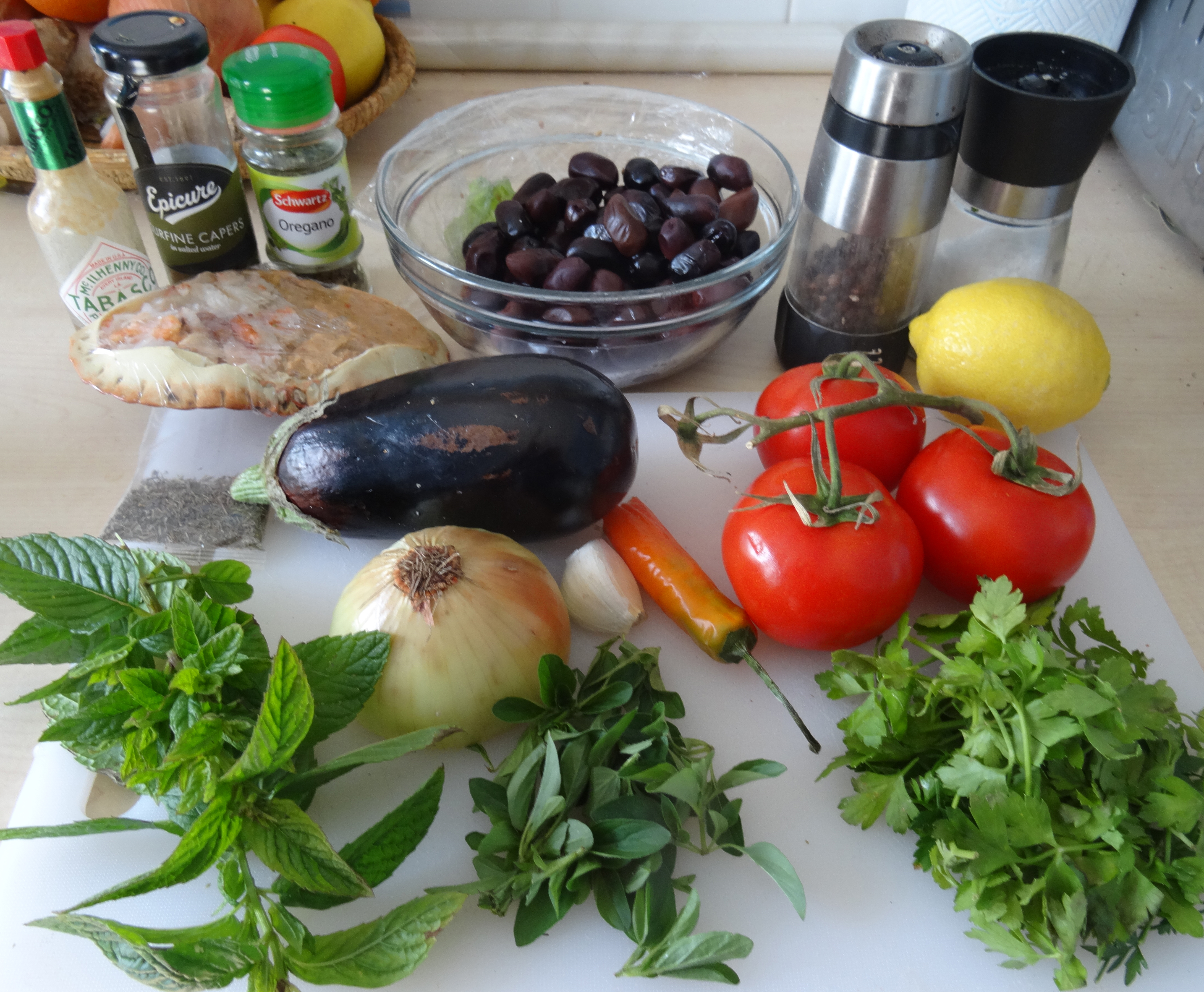
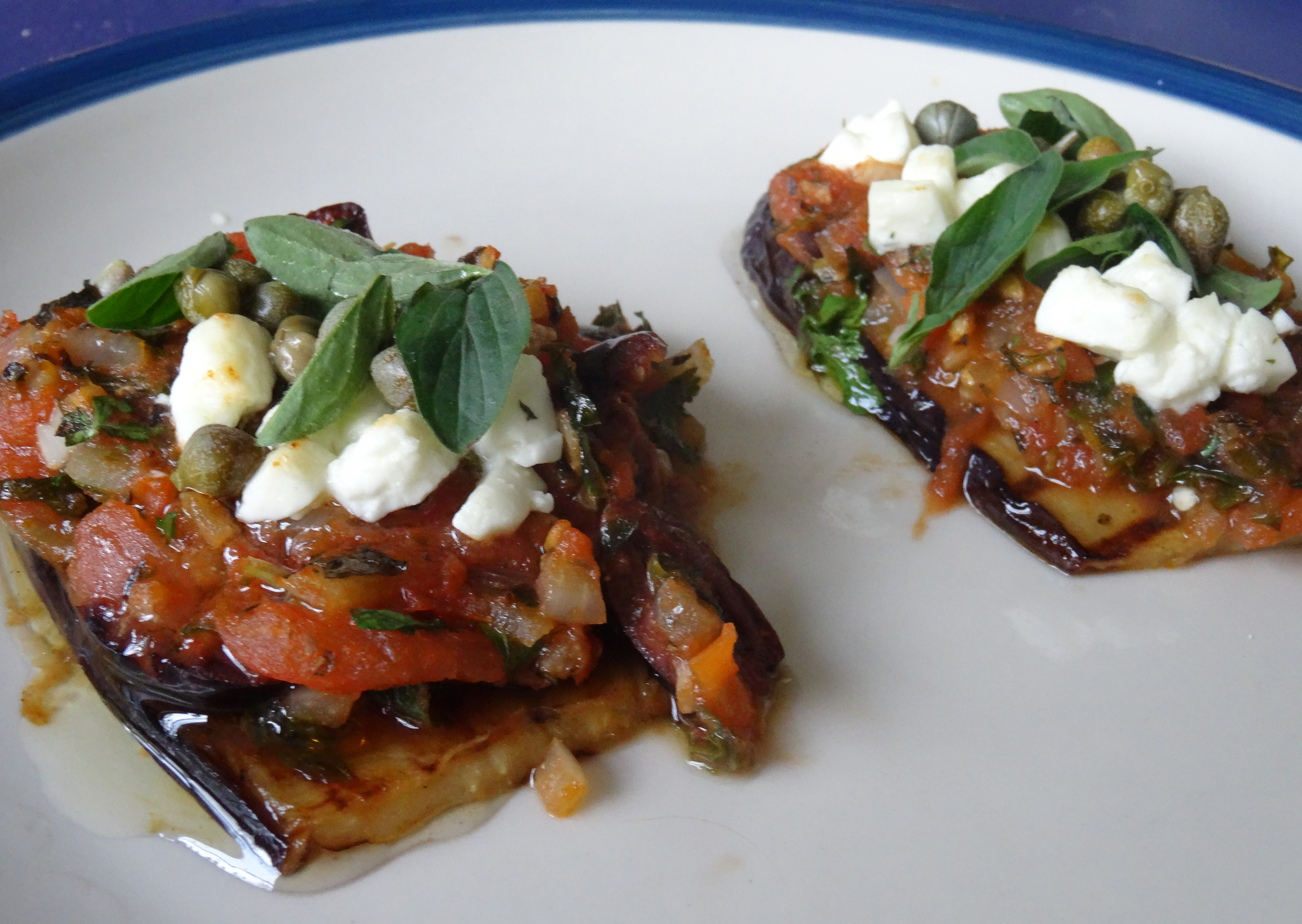
Imam bayildiI had intended to have a dressed crab before the Imam bayildi (which is why it is in the photo), but by the time it came to cooking, I wasn’t as hungry as I thought I was, so saved the crab for Thursday and did a bit more of the tomato mix in the Imam bayildi instead.  Imam bayildi (“the Imam fainted”) is a well known Middle Eastern dish, and this is an ersatz, smaller version.  The proper dish uses a full aubergine, scooped out and stuffed with the tomato mixture, but this version is good as a starter or for mezze.   Slices of aubergine (about 1cm thick) are griddled on both sides until cooked through and topped with a tomato mix:  onion, garlic, tomatoes, dried oregano and thyme, and parsley fresh oregano or coriander to garnish.

First, the tomatoes are stripped of their skin (boiled in water for a few minutes and then plunged into cold water, when the skins can be pulled off very easily).  Next, onions are sautéed in olive oil until golden, and then whatever you fancy goes in.  I used garlic, halved black olives and chopped red chilli.  These are cooked for a couple of minutes before the tomatoes are added with dried oregano and thyme.  I added fresh mint and parsley just after turning off the gas, giving it all a good stir.  I sprinkled finely diced feta over the top and put it all under the grill for a couple of minutes and served it topped with oregano and capers, and drizzled some extra virgin olive oil over the while thing.  This can be served at room temperature but I prefer it hot.

Sunday

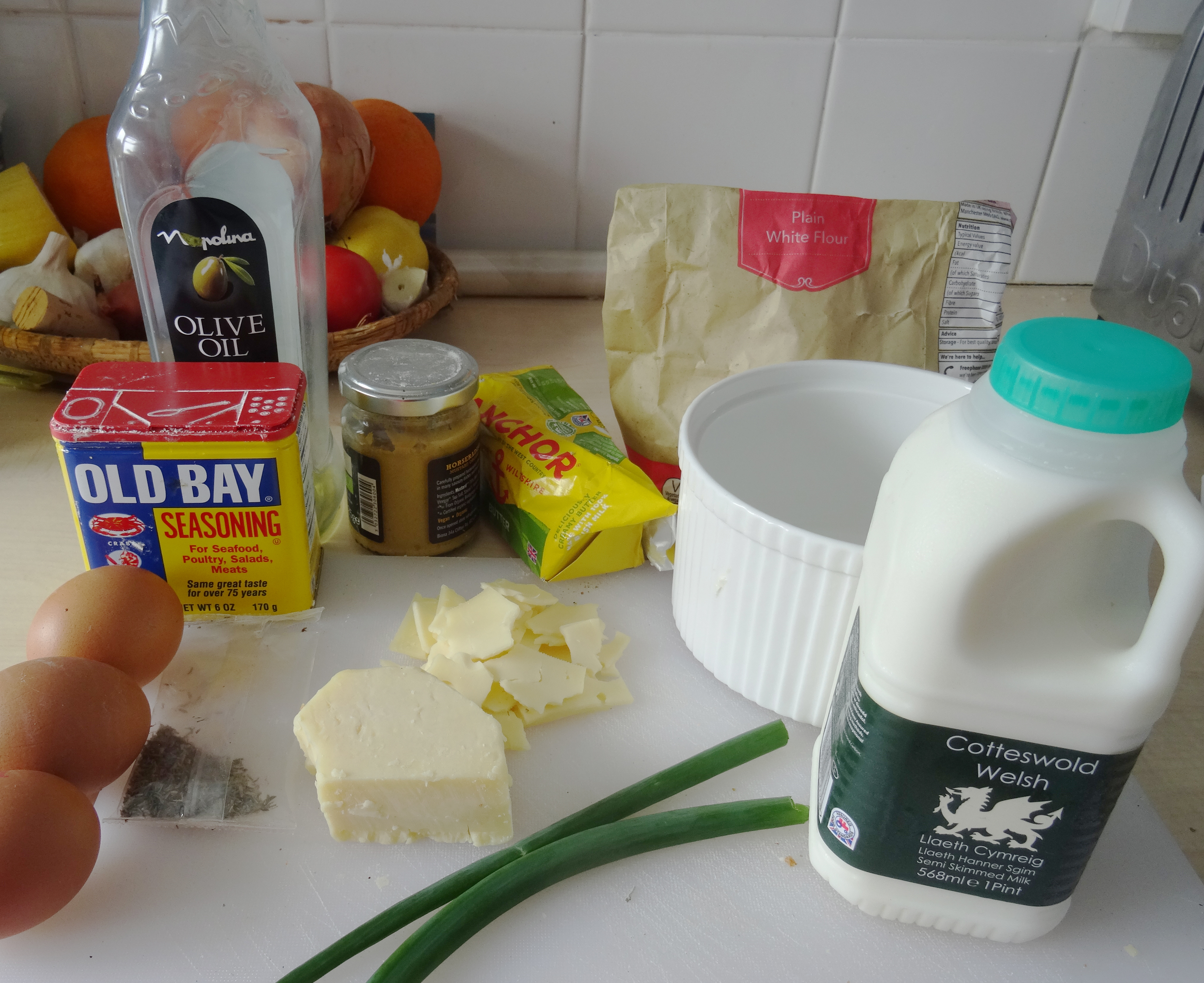
Small cheese soufflé.  With a lot of odds and ends of cheese to use up and some eggs that were drifting towards their sell-by date I decided on a cheese soufflé.  I have a tried and tested cheese soufflé recipe for a 14cm diameter soufflé dish (the one in the picture on the left) that has never failed, and which I eat as a main course in its own right, on one of a variety of bases (e.g. pancetta/bacon, mushrooms and parsley; diced tomato and onion), and I always mix finely chopped chives in to the souffle itself.  Today I wasn’t hungry enough for the full article so wanted to do one for one of my 10cm diameter x 6cm tall individual ramekins, and as my recipe is impossible to divide properly, due to an odd number of eggs, and soufflé isn’t a guessing business, I went hunting on the Internet and found a recipe for a single serving.

The WTF Do I Eat Tonight website has a one-person version that uses one egg yolk to two egg whites.  All soufflés need accurate measurements, so I followed Louise’s instructions to the letter.  I like that instead of breadcrumbs along the inner face of the ramekin she uses parmesan – it was lovely.  I used a mixture of Emmenthal and cheddar in the mixture itself, along with a seriously good shake of Old Bay Seasoning (paprika, cayenne, celery salt etc), which I buy online, but which I first bought in a trip to New York, and which gives it just a touch of spice and heat.  I usually serve souffle with a salad, but was in the mood for something smaller, so simply did a side order of sliced tomatoes and onions with chopped with lovage (I would probably have used basil instead if I had had any) and vinaigrette dressing.  Both the onion and tomato are great for cutting through the richness of the cheesy, eggy lusciousness.  Louise puts her soufflé in on Gas 6 for 18 minutes but my oven tends to run rather hot, so I left it for 16 minutes.

I laughed so much when I saw it – I was about 30 seconds away from having a disaster on my hands!  It had risen so beautifully that being left in for a little too long meant that having expanded upwards and browned beautifully, it was now also expanding rapidly outwards, and it looked rather like an enormous yellow flower in full bloom!  Nothing wrong with its texture or flavour though, so even though its appearance was a profoundly odd it was deelish, and Louise’s recipe is definitely a keeper, saved as a PDF in my computer’s Fud file.  I served the ramekin on a side plate because the pot was seethingly hot and it looked as though it might be messy to eat the “petals,” but it held together beautifully.

Monday

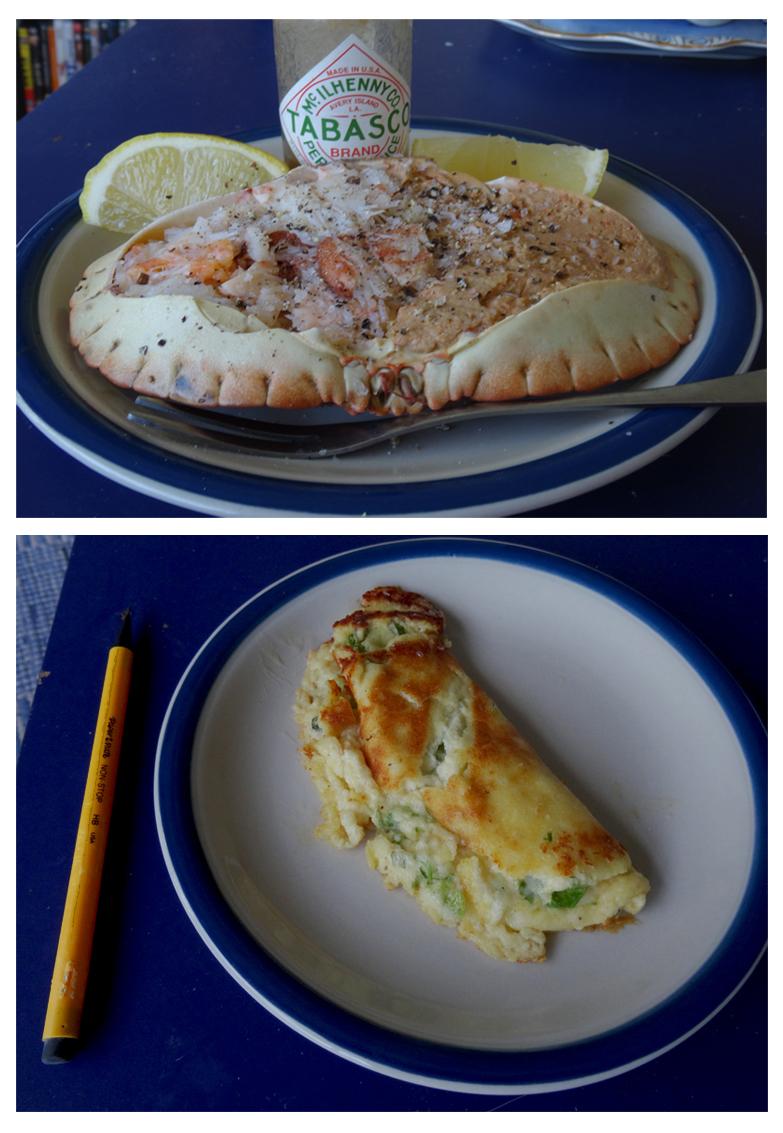
Dressed crab followed by baby soufflé’d omelette.  The freshly caught crab came, ready dressed, from Dai’s Shed on Aberdovey’s wharf, and I froze it down a week or so ago.  I served it with a slice of lemon, Tabasco and ground black pepper.  It was simply heaven on a plate

The cheese sauce and stiffened egg white mix that formed the basis of Sunday’s cheese soufflé was too voluminous for the ramekin, so I had some left over, stirred the leftover egg yolk into it (the souffle uses two whites but only one yolk) and put it in the fridge while I tried to think up a use for it.  So I decided to use it to make mini cheese, chive and parsley soufflé omelette to follow the crab.  As it already had cheese incorporated into it, all I did was melt some butter in a small frying pan, heat it through until the base was solid and toss a lot of chopped parsley and chives on top of it.  When the bottom was golden brown, I folded it over to serve.  It was small, fitting neatly on to a side plate, actually smaller than the dressed crab!  It was fluffy and light but with excellent cheesy flavour, and had all the freshness and bite of the chives and parsley, and worked well as a really good contrast to the crab.  A happy use of leftovers.

Tuesday

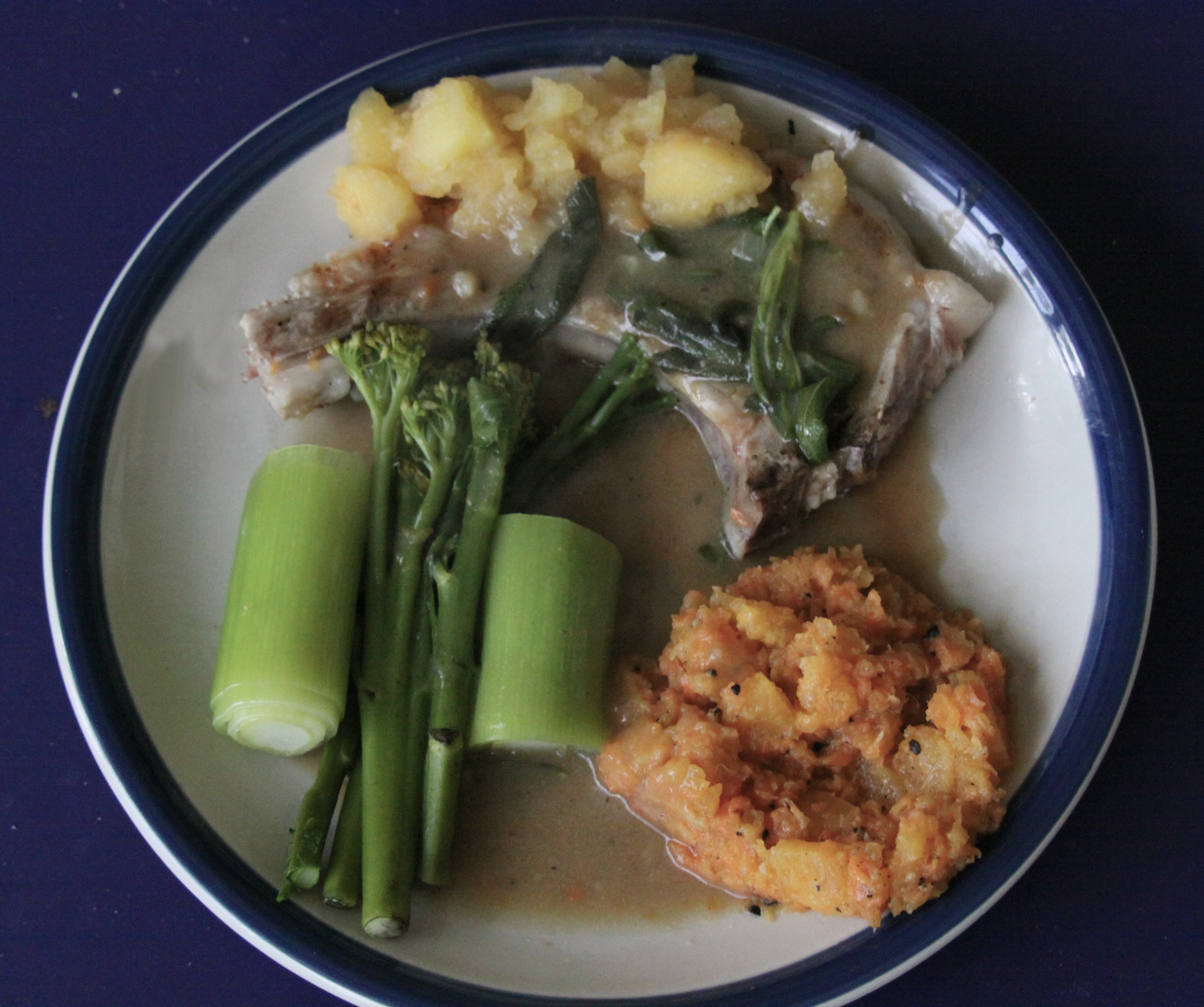
Pork chop and apple sauce with leeks, tender stem broccoli and mashed carrot-swede.  In the freezer were two very fine pork chops, wrapped together by the butcher, that I had irritatingly frozen down without separating.  So it was clear that this week would be partially porcine in character.

I had bought a baby swede on my last trip to the shops, and peeled and diced it.  This went in to a pan of boiling water with some rather elderly diced carrots, and the two were mashed together with butter and black pepper and put in bags in the freezer.  It was the same story for three leftover apples, which I peeled, cored and cut into slices and heated in a little water until they started to break down, at which point I froze them down.

Today’s simple dish was therefore a griddled pork chop with apple sauce, served with pre-frozen mashed carrot and swede, a bit of a rather battered leek, some ageing tender stem broccoli (both steamed) and a pork and sage gravy.

I brine pork because it can dry out on the griddle.  It’s a simple brine of water, sage leaves, bay leaves, cider or white wine and salt, all warmed through to release and blend the flavours and then, when it has lowered to room temperature poured over the pork and left for a few hours.

A bit of a chicken stock cube was pressed into service for the gravy, along with a splosh of white wine, a chopped new potato, the finely chopped unusable ends of  the leek that I was eating with the pork, a finely chopped shallot and the last of my father’s fresh sage.  Dried sage is a good substitute for fresh, one of the dried herbs that can actually hold its own in a stock.

This was incredibly simple, given that I had made the apple sauce and the mashed carrot and swede previously for the freezer.  The floral green head of the tender stem broccoli was going rather yellow, so I simply chopped off the tops and cooked the stems, which with tender stem broccoli is the part that has most of the flavour.  The brined pork was very tender.

Wednesday

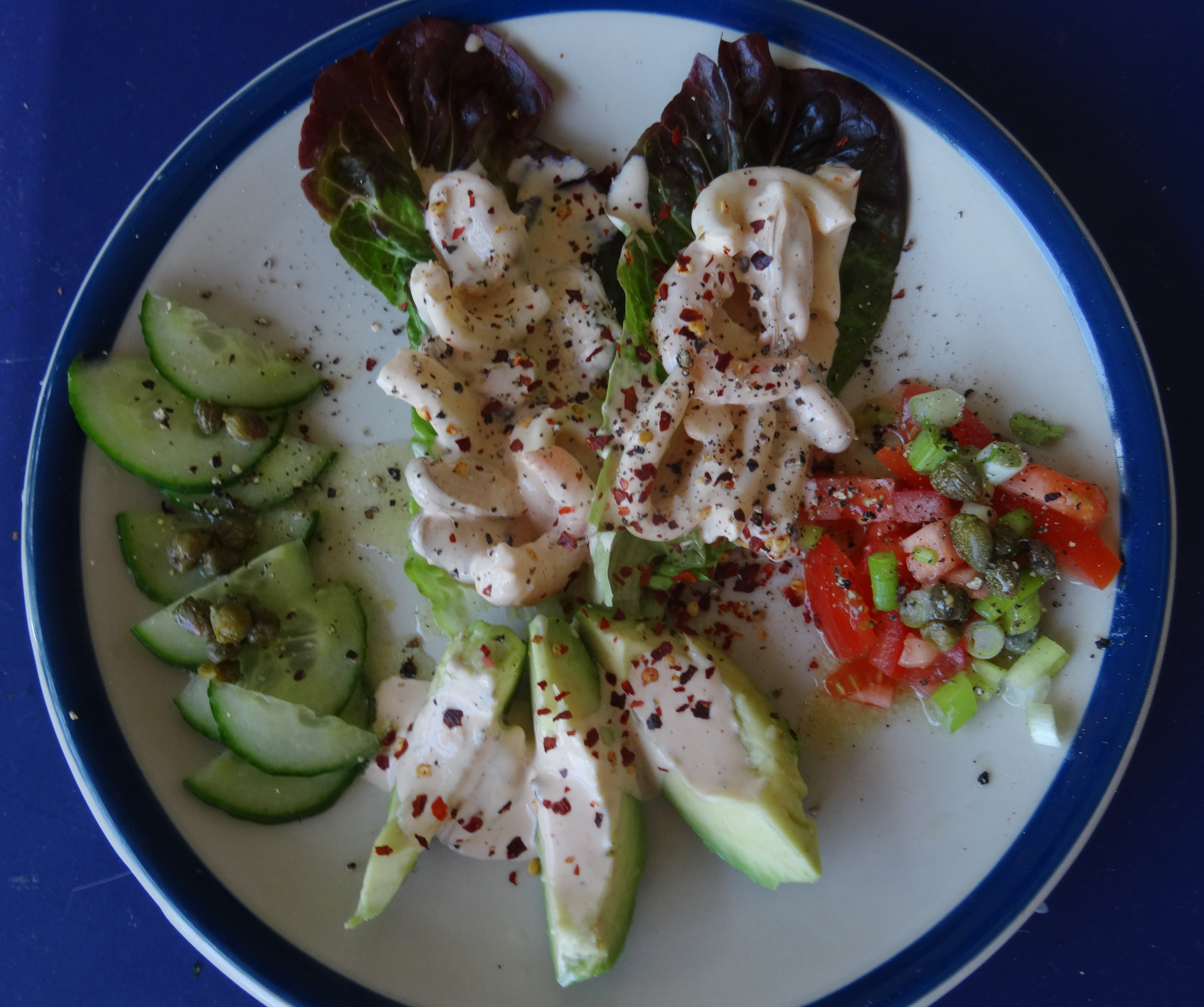
Seafood and avocado salad.  I found the shellfish pack in one of the Co-Op’s freezers, which was better than nothing, although raw is much better.  I also had an avocado that had remained persistently solid for a couple of weeks, but had suddenly ripened fully.  I had some little gem lettuce, with attractive purple tips, and a cucumber in the fridge door, plus some tomatoes, an elderly spring onion and some capers, so had all I needed for a seafood and avocado salad.  The Marie Rose sauce is essentially mayonnaise with flavourings, so out came the mini food processor that I always use for making mayo.  Along with the usual egg yolk, a couple of shakes of Worcestershire sauce, a good shake of cayenne pepper, some smoked paprika and juice from half of the lime that I intended to use in the jambalaya.  When this had been emulsified by trickling a thin stream of oil (whizzed into it), I added Greek yoghurt (should have been cream, but I didn’t have any and the Greek yoghurt worked perfectly) and a bit of tomato ketchup, and the job was done.  Seafood cocktail is usually presented in dish of chopped lettuce with a bit of other salad added for colour and flavour, but I like it split out into its component parts, with vinaigrette as a contrast, dribbled over the cucumber and tomato..

Thursday

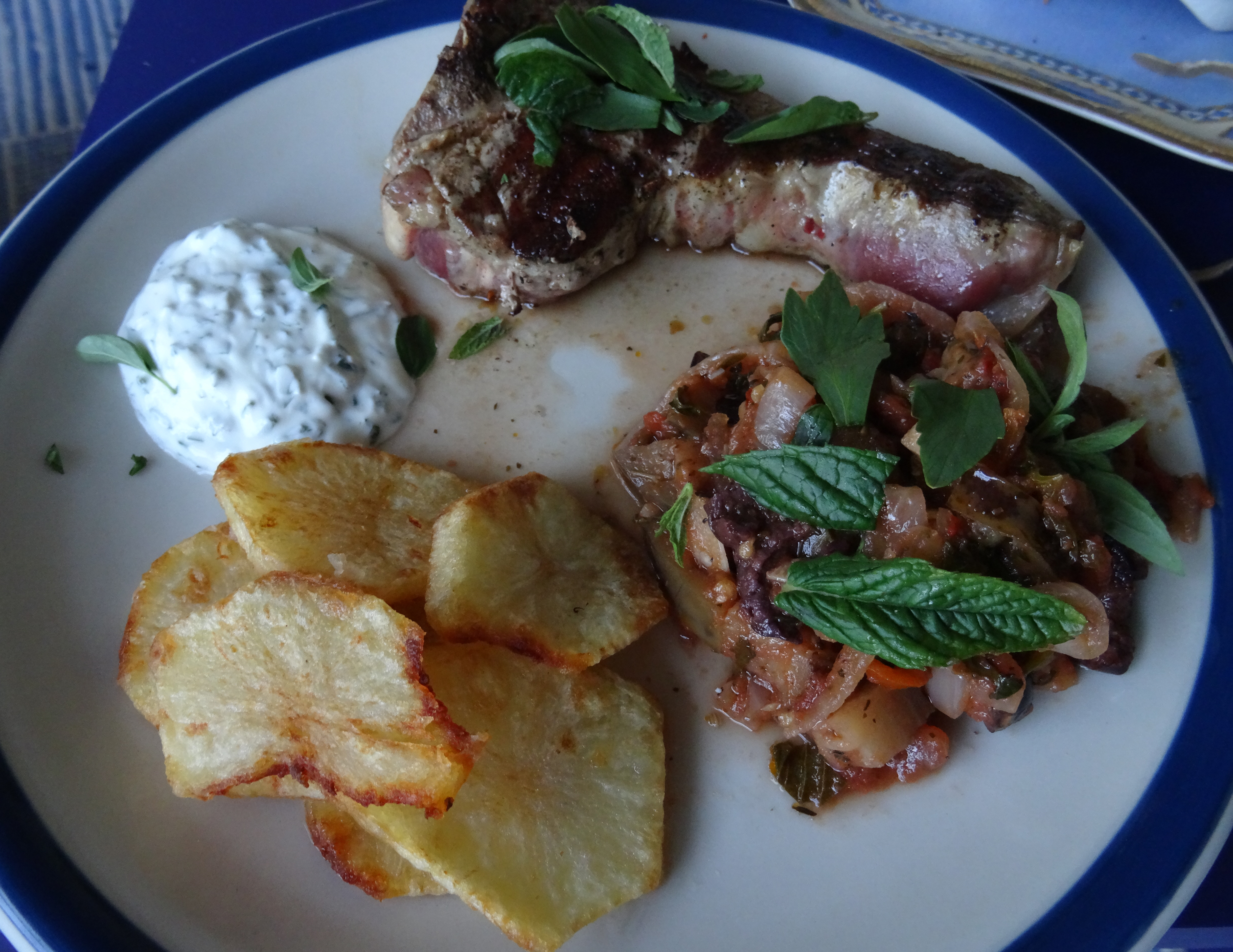
Lamb chop with leftover Imam Baylidi, shallow-fried potatoes and mint yoghurt.  The lamb chop was from Mr Rowland, the butcher in Tywyn, salt marsh lamb and a good thick piece, with lots of flavour and good texture.  At the moment it is difficult to get hold of anything except very small chops of spring lamb, which I find fairly flavourless so it was nice to be able to buy something that held its own against the other flavours on the plate.  The leftover Imam Baylidi vegetables were delicious.  Except for the mint, which was still making its presence felt, the once-fresh herbs that went into the tomato and aubergine mix had become absorbed into the general flavours, so to restore the hit of freshness to this leftover serving , I needed to add more fresh herbs just before serving, and I sprinkled a few over the top.  I mixed more mint into Greek yoghurt to serve on the side.  I parboiled a few slices of spud (Maris Piper), drained them well and then cooked them in an inch and a half of vegetable oil.  Happy.

Friday

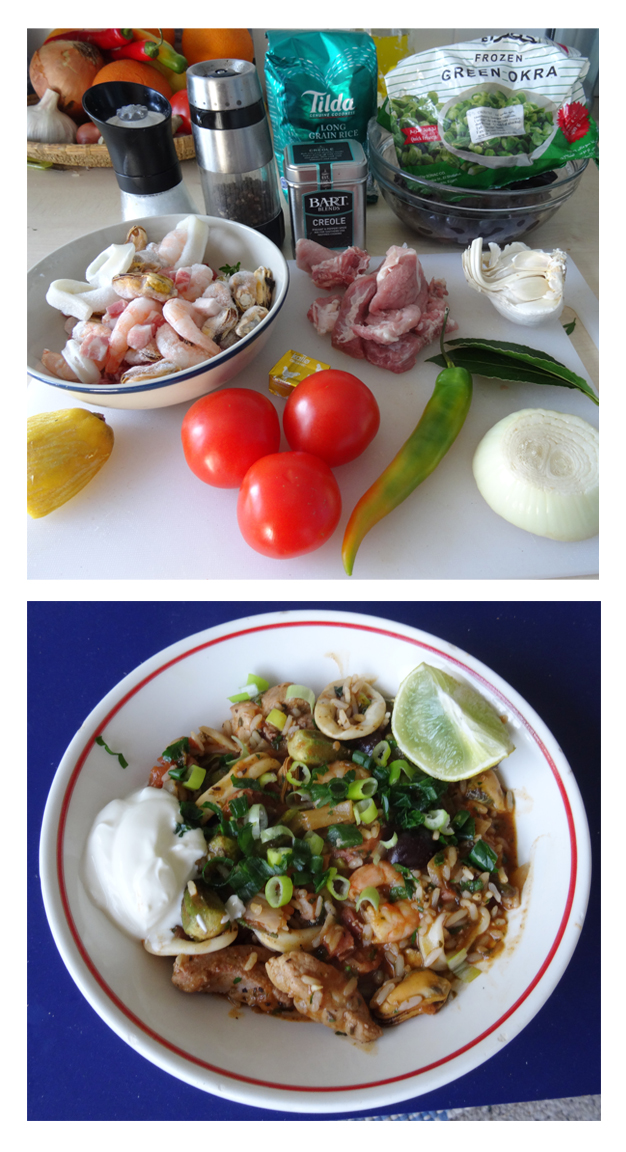
Pork, shellfish and okra jambalaya. I am sure that there are more subtleties to this than I have spotted, but as far as I can tell the main difference between a gumbo and a jambalaya is that with a gumbo the rice is served on the side, and with a jambalaya the rice is cooked into the sauce.  Please feel free to correct me if I’m wrong!  I nearly repeated the gumbo that I did a couple of weeks ago, because I enjoyed it so much, but in the interests of introducing a bit more variety into my eating habits, I went for a jambalaya instead.

The pork chop that I used in this dish had been frozen down with a companion, and I had had to defrost them at the same time, so both had to be used this week.  I sliced it into strips.  I fried pork, two tiny cooking chorizo sausages, onion, garlic and fresh chilli until the onion was golden and the meat brown, added Creole spices, which I stirred in to the onion mix before adding whizzed up tomatoes, fish stock, and a bay leaf.  When that had heated through I added long grained rice.  Just before it was ready I added a few frozen okra and part of the pack of pre-cooked frozen shellfish that I had used in the seafood salad to heat through (prawns, mussels and squid). The Bart Creole spices were a disappointment, as they are surprisingly very bland and lacked an aromatic hit, so I chucked in a substantial amount of the much better Bart Cajun spices to help out.  Fresh herbs went in just before serving (parsley, oregano and just a little mint), and I served it topped with chopped spring onion and chives, a slice of lime and, in the absence of sour cream, some creamy Greek yoghurt, which worked very well as a substitute.  It was nowhere near as good as the gumbo, but it still went down well.

Conclusions – Leftovers

  • Leftover chopped herbs can be repurposed for many different uses.  For example, they can be whizzed up, mixed into soft butter, rolled into a cylinder in cling-film and frozen, and used in slices for giving a bit more flavour to fish (e.g. dill, mint, chives, parsley, chervil, coriander, lovage), steak, lamb/pork chops (e.g. basil mint, sage, parsley, oregano, marjoram) or chicken (e.g. any of the above).
  • Another way of repurposing herbs is to add them to bottles of white wine or cider vinegar or oil, to extend the useful range of vinegars and oils both in cooking and in salads.
  • Herbs whizzed up and stirred into yogurt or mayonnaise provide excellent dressings and accompaniments to many dishes.
  • Leftover home made mint sauce can be frozen down, and although it is not as good as freshly made, is perfectly good infinitely better than shop bought, which is always cloyingly sweet.
  • Potatoes are a bit of a challenge for me, as they come in large bags and are difficult to use up, but every now and again I cannot resist so
  • I find it particularly useful to have ideas for using and preserving potatoes, because I can only buy them in big packs, and I really don’t want potatoes with every meal.  he BBC Food website has a page with 10 suggestions for using up mashed potato, and there are some very good ideas there: https://www.bbc.co.uk/food/collections/using_up_mashed_potato. In addition, home-made bread made mashed potatoes, or even with the water left over from boiling potatoes, is particularly light and well worth investigating if you have a bread-making machine or enjoy making it by hand.  I am particularly fond of fish cakes made with mash.  Mashed potato also freezes down quite successfully.
  • I also had a bag of carrots and a bag of apples, and a small (tennis ball sized) swede bought specially for the job.  The carrots and swede were diced, as was the swede, and boiled up together, mashed with black pepper and butter, and split into batches for the freezer.  I peeled and cored the apples that I hadn’t eaten, cut them into big chunks, simmered them with some butter and, when they were still chunky but soft, batched them up for freezing down.
  • Preparing other leftover vegetables for the freezer is a good idea if you want to assemble a meal in a hurry.  Ageing vegetables like broccoli or asparagus can be par-boiled and frozen on a baking tray or other flat surface (to keep them from clumping).
  • For the Imam bayildi I had a small aubergine, and took two slices out of the middle of it.  That left two useful bits of aubergine.  I covered the exposed surfaces in lemon juice, pushed them together and wrapped them in cling-film.  That kept it fresh for a couple of days.
  • The leftover Imam bayildi mix, which is very like ratatouille, can be used in all sorts of ways, including as a sauce for meat or fish, a stuffing for portobello mushrooms topped with cheese, layers for a vegetarian lasagne, a filling for French omelette, as a base for soufflé, or simply spread on toast or stuffed into pitta pockets with feta as a filling snack.
  • If yoghurt is pushing its use-by date, try making labneh, described above.  It is one of my favourite things and will stay preserved in oil for a couple of weeks.