Category Archives: Heritage

The Aberdovey Second World War pillbox

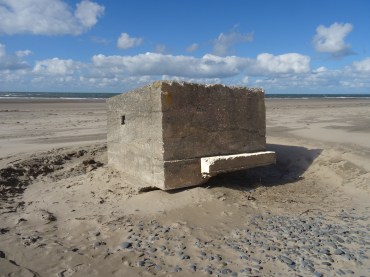
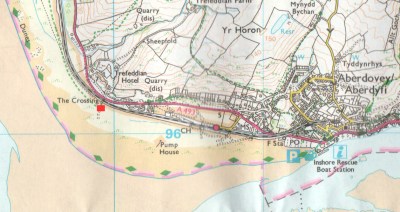
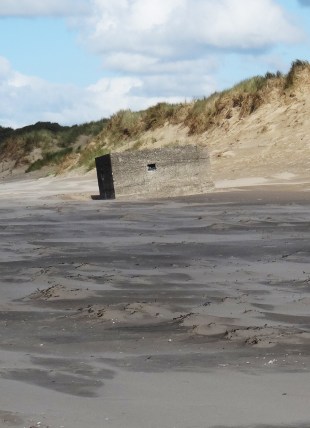
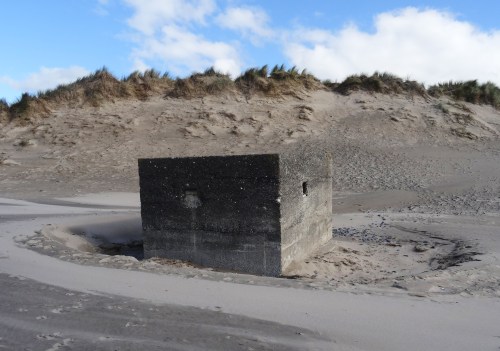
Walking towards Tywyn from Aberdovey you will come across a Second World War pillbox, an ugly concrete box with a small square hole in each side.  It has subsided unevenly into a dip in the beach at the foot of the dunes, an incongruous contributor to the area’s heritage.  It can be reached easily along the beach from Aberdovey.  It’s a fairly short walk from the car park, a little way beyond the Trefeddian Hotel, which is visible through a dip in the sand dunes.  If you prefer a short-cut there is a public footpath from a big lay-by on the A493 that takes you across the sand dunes and drops you very close to it.  Not that it’s a tourist destination, but it is certainly a local landmark, and sitting in an unspoiled stretch of eternal pale yellow sands with the rich blue sea beyond, it has an emphatic presence all of its own.  It is at grid reference SN59549635, at the end of the footpath known as The Crossing.

The pillbox is marked as a red box by The Crossing. Source: OS Explorer, Cadair Idris and Llyn Tegid. OL23. Ordnance Survey 2015

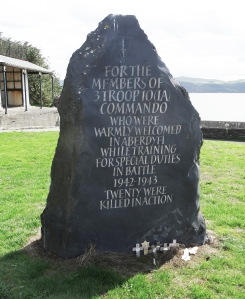
There are two war memorials in Aberdovey.  There’s a lovely 1999 memorial to 3 Troop 10(1A) who were stationed at Aberdovey during the war for their training (see my earlier post about this) and there’s a little shrine and plaque listing the dead from form both wards inserted into the wall of St Peter’s Church.

In some ways, the pillbox is an even more substantial monument to the bitter truth of war, mute but evocative.   The fact that it sits there, so out of place, so thoroughly ugly, is an appropriate shock to the system.  As detritus of war, it is something that demands a response and forces an  acknowledgement of the realities of the past in a way that a conventional memorial, however heartfelt, does not.  Although it was a lovely day for a walk, the sands endlessly beautiful and full of light, when I arrived at the pillbox it was just as dismal as I remembered.  Ugly, lop-sided, surreal, a scar on the landscape, a slap around the face.  A savage, palpable war memorial.

Pillboxes were part of a network of small defences that were put in place along the coastline, at road junctions and on canals to counter threats of Nazi attack on Britain.  The network consisted of a number of measures including offshore minefields; beach and manned seafront obstacles like barbed wire and landing craft obstructions, pillboxes and minefields; and cliff-top and dune defences including pillboxes and anti-glider obstructions.  The pillboxes, 28,000 of them, were sometimes round or hexagonal to avoid blind spots, but there were were seven different types in total (Types 22-28), with variants.  The Aberdovey one is a Type 26 prefabricated square with an embrasure in each wall and a door, now slightly subsided into a slight dip in the sand, 3ft or so deep.  Some pillboxes were brick- or stone-built but many, like this one, were made of concrete that was sufficiently thick to be bullet proof.   My thanks to the Pillbox Study Group for this excerpt, which explains the thinking behind pillboxes and other defence structures that were put in place in WWII:

On 25th June 1940, General Paget, Chief of Staff to the Commander-in-Chief Home Forces submitted General Ironside`s anti-invasion plan to the War Cabinet in the form of Home Forces Operation Instruction No.3.

SECTION 13 of the Instruction stated: “The general plan of defence is a combination of mobile columns and static defences by means of strong-points and stops. As static defence only provides limited protection of the most vulnerable points, it must be supplemented by the action of mobile columns. However mobile such columns may be they cannot be expected to operate immediately over the whole area in which it is possible for the enemy to attempt invasion by sea or air. It is therefore necessary to adopt measures for confining his actions until such time as mobile columns can arrive to deal with him. This will be done by means of stops and strong-points prepared for all round defence at aerodromes which are necessary to prevent the enemy obtaining air superiority, at the main centres of communications and distributed in depth over a wide area covering London and the centres of production and supply. This system of stops and strong-points will prevent the enemy from running riot and tearing the guts out of the country as had happened in France and Belgium.”

In total there were 6 pillboxes every 500m from south of the river Dyffryn Gwyn, which flows into the sea just south of Tywyn, to the entrance of the river Dovey.  Prefabricated pillboxes were built of concrete panels and were then bolted into place on site.  The pillboxes to the north of this one are badly damaged, perhaps in an attempt to destroy and remove them.  Aberdovey had an Observer Corps, a Home Guard and a Coastguard Station during the Second World War.

References:


The Tal-y-Llyn Iron Age hoard

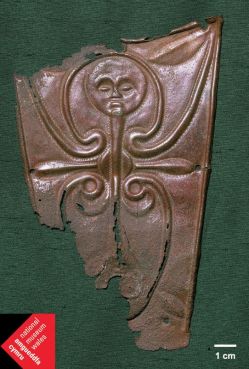
One of the two trapezoidal plaques showing opposing heads within a decorative scheme. Source: National Museum of Wales

One of the most extraordinary finds of late Iron Age art, in the La Tène (or Celtic) style, is the Tal-y-Llyn hoard, found near the Tal-y-Llyn lake, a 15 minute drive from Tywyn.  The term La Tène derives from European Iron Age research and takes its name from the type site (the site at which it was first identified), named La Tène in Switzerland, on the side of lake Neufchatel.  The style extends across most of eastern Europe as far as Ireland in the west.  In Britain the style is often described as “insular,” reflecting that fact that although it incorporates the distinctive elements of La Tène art, it developed a style of its own.  Many impressive examples have been found throughout Britain and Ireland. La Tène is the second major period of the Iron Age, following the Hallstatt period, and in Britain is defined not merely by its metal work and the accompanying style but by a geographically variable and complex social and economic profile.

The metalwork in the Tal-y-Llyn features both the La Tène curvilinear geometric designs that are popularly given the broad “Celtic” label, and more unusual human faces, all very beautiful.  Savory discusses how some of the Tal-y-Llyn finds are an early form of La Tène art in Britain, before the so-called “insular” style unique to Britain evolved, still reminiscent of the middle period of La Tène art in Europe, dating to around the 4th or 3rd Century BC.  The Tal-y-Llyn hoard has been mentioned in most summaries of the British La Tène ever since.  Iron Age Britain at this time seems to have been a harsh place, described by Darvill as “a period of aggression, unrest, uncertainty and tension.”  The climate was deteriorating and the population competing for resources, a particularly difficult combination.  One of the most obvious features of the period in Britain is the hillfort, which were usually hilltop settlements enclosed by series of banks and ditches, bounded by palisades.  There were, however, many other types of settlement, also usually defended.  Meirionnydd, however, is notably lacking in hillforts and it is far from clear what sort of occupation was here, if any, during the Iron Age.  Although the absence of hillforts seems to be part of a regional pattern that includes southwest England and southwest Wales I am not sure whether the absence of evidence for other Iron Age settlements is due to lack of settlement in the area during the Iron Age, which seems improbable, or lack of archaeological research in the area, and this needs to be determined.  The presence of the Tal-y-Llyn hoard is not itself evidence of settlement in the Tal y Llyn area, and seems more consistent with a separate but contemporary hillfort tradition associated with north Wales, the borders and the English south coast.

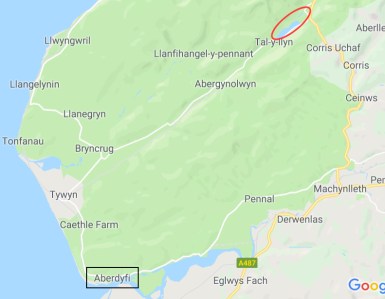
The hoard was found next to a steep path  at SH72702288, part of a walk to the peak of Cadair Idris that starts at the Minffordd car park on the B4405 road to Tal-y-llyn, just off the  A487 from Dolgellau to Machynlleth.  The path leads from the valley up the west side of Nant Cadair.  It was found by a couple having a picnic.  They noticed pieces of sheet bronze half buried beneath a large boulder. The owners of the land donated the hoard to the National Museum of Wales on permanent loan.   The find was written up and published by Dr Hubert Savory (Keeper of Archaeology in the National Museum of Wales, Cardiff) in the archaeological journal Antiquity in 1964, a year after its discovery, and discussed further briefly in the same journal in two short notes in 1966.

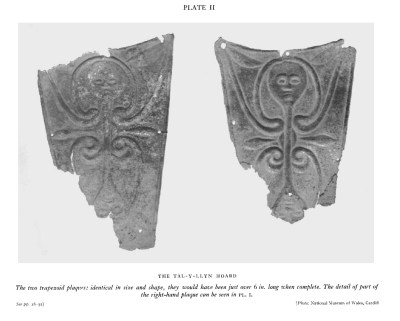
The two trapezoid plaques. Source: Savory 1964, plate II

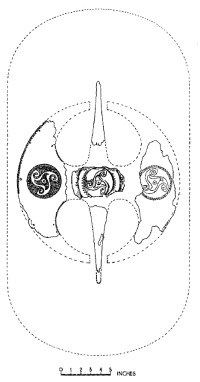
The hoard consisted of thin decorative sheeting made of copper alloys, all bound closely together.  When it was inspected, it was found to look less like a ceremonial deposit than a stash deposited for later collection.  In Savory’s words “the metalwork had evidently once decorated at least two different shields and possibly various other objects as well, it must have been dismantled and packed together as scrap-metal before being deposited under the boulder.”  The shield pieces were decorated with vertical ribs and curvilinear plaques that flanked a central shield boss (a knob set in a circular, often decorated plate) all of which had been riveted on to a wooden or metal shield.   A more fragmentary shield boss was also found in the hoard, as were two trapezoid plaques that don’t appear to connect directly to the other finds, four composite discs that had been riveted to a surface that was “probably not a shield but a bier or ceremonial vehicle,” and another, plain disc.

Much Iron Age art has been associated with river and lake contexts, but although the naming of the find as the Tal-y-Llyn hoard implies that it was associated with the Tal-y-Llyn lake, this may be misleading.  The hoard was not found overlooking water and only has a marginal relationship to the lake, as Toby Driver emphasizes in his 2013 discussion of the location of the find (reproduced on the Coflein website):

Savory’s reconstruction of Shield 1 from the Tal-y-Llyn Hoard. Source: Savory 1964, p.20

The find spot is marked by a prominent glacial boulder, naturally fallen into its present position and propped up on massive upright stones so as to resemble an artificial ‘burial chamber’.  Beneath the boulder is a dark, naturally formed ‘chamber’ which may have attracted Iron Age people to use the site as a place of deposition. The find spot lies alongside the modern Minffordd path up to Llyn Cau and Cadair Idris, suggesting considerable antiquity to this particular route. Across the path from the propped boulder, and below the line of the track, is a likely former spring head formed of rock slabs on three sides of a cleared, damp area. This spring head may have further influenced the hoard site. The boulder marking the find spot is the most prominent and impressive of its kind flanking the path as it ascends from the valley floor to the open mountain above. It is perhaps the only boulder formation which may have suggested an artificial construct or chamber to Iron Age people. It is likely that the corrie lake at Llyn Cau was the focus for any traveller climbing this path in antiquity, perhaps for ritual purposes, and therefore the attribution of the hoard to ‘Tal-y-llyn’ is potentially misleading in the interpretation of its landscape context.

Although the hoard could have been deposited to honour the spring, or the route to the corrie lake, Savory contends that the hoard was actually a secondary deposition, part of a larger hoard or burial site that had been plundered.  He suggests that if this was the case, the cache was not deposited for ceremonial reasons at the location where it was found, but was hidden far more mundanely and on a temporary basis for later collection.

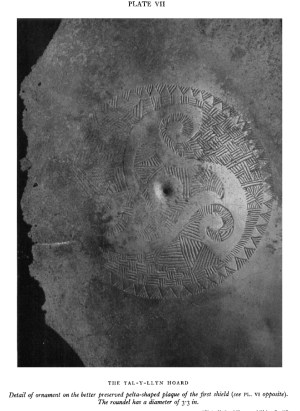
Detail of the zig-zag and basket-fill designs on Shield 1. Source: Savory 1964, plate VII

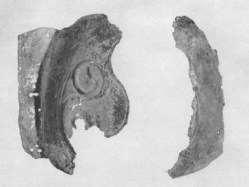
The ornamentation on the metalwork on the first shield contains similarities to continental examples, showing the influence of the European La Tène, particularly in the traditional rocked-tracer technique, but also shows departures, most significant of which is the basket-work background and the trumpet finial that became features of the insular style.  Savory suggests that the pieces could all derive from a single workshop or group of related workshops.  Although the reconstruction of one of the shields has striking similarities to the shield from Moel Hiraddug hillfort in Flintshire, Savory says that the Tal-y-Llyn example must be seen as a forerunner of both this and the one found at Llyn Cerrig Bach on Anglesey.  The second shield is represented by a shield boss, of which two fragments were found in the hoard, oval and domed and about 6 inches wide.  The curvilinear pattern is not distinct, but the ornamentation is clearly La Tène. 

The two trapezoid plaques are remarkable and have few parallels anywhere in Britain.  They are both 6 inches long and 4.1 inches wide at the top and 2.3 inches wide at the base, framed with embossed moulding.  They are made of a thin copper and and zinc alloy with only faint traces of tin and contain hole for rivets.  They are decorated with opposed human heads, top and bottom, sharing a neck, resembling continental examples.  The function of the plaques remains unknown.

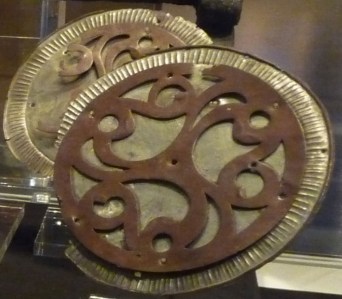
Two of the four composite discs in the National Museum of Wales. Source: The Modern Antiquarian

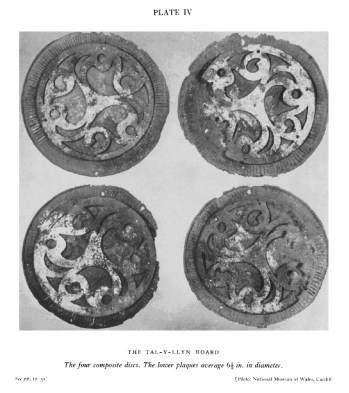
The four composite discs each consist of two pairs of metal pieces, with diameters of 5.5 (the upper) and 6.5 inches (the lower) respectively, one attached to the other with rivets.  Each disc in the pair was decorated, the smaller brass-coloured disc with an open-work pattern and the larger with La Tène curvilinear patterns, the larger with a decorated hollow rim into which the smaller disc is inserted, its surface covered by tin beneath the smaller disc, visible through the open pieces on the bigger disc, providing a contrast of colours.  They were attached to another, large flat surface by rivets, but it is not clear what.  The open-work pattern and the “whirligig triskele with lashing tendrils or streamers attached to its limbs” again reference continental designs, although Savory says that the streamers are a uniquely British addition to the motif.

The second shield boss. Source: Savory 1964, plate VIII

Megaw suggests that the faces on the trapezoidal plaques are far from benign and represent severed heads, an appropriate image for a warrior society.  Waddell has considered the Tal-y-Llyn hoard in terms of solar imagery, specifically the journey of the sun through the night sky, often associated with a solar boat, a concept perhaps more familiar from ancient Egypt.  For those who wish to explore this interpretation, his paper “The Tal-y-Llyn plaques and the nocturnal voyages of the sun” is available online.

The date of the hoard remains uncertain, partly because of the presence of objects from different periods and partly because the hoard may have been a secondary deposition.  In 1966 Spratling recognized that one of the items in the hoard was a Roman lock escutcheon, which made no difference to the dating of the Iron Age La Tène metalwork, but potentially sheds light on the date of the deposition of the hoard itself.  The Coflein website provides a useful summary of this issue:

The four Composite Discs. Source: Savory 1964, plate IV

The date of the Tal-y-llyn hoard has been a matter for debate. The decorative bronze work suggested a date in the Iron Age, but amongst the hoard was a piece of Roman bronze. This meant that the hoard could not have been deposited before AD 43. In addition to this, the decorative methods on some of the other bronzes used techniques that are only known to have been present at the very end of the pre-Roman Iron Age, and one of the items was made from brass rather than bronze. This was also very rare in the Iron Age.

As well as the sites mentioned above, other La Tène metalwork finds in north Wales include the hanging bowl/helmet of Cerrigydrudian and the Trawsfynydd tankard in Gwynedd, the necklace/collar from Clynnog on the Llyn Peninsula and the firedog at Capel Garmon near Conwy.  To the south of the river Dovey, examples are Pen Dinas Hillfort in Ceredigion and Croft Ambrey Hillfort near Leominster in Herefordshire.


References:

Darvill, T. 1987.  Prehistoric Britain. Routledge
Driver, T. 2013.  Field Visit. RCAHMW, 11th December 2013
Megaw, J.V.S. 1970. Art of the European Iron Age.  Adams and Dart.
Savory, H.N. 1964. The Tal-y-llyn Hoard. Antiquity Vol.38, Iss.149, p.18-31
Savory, H.N. 1966.  Notes and News: Tal-y-Llyn revisited.  Antiquity, Vol.40, p.305
Spratling, M.G. 1966. Notes and News: The Date of the Tal-y-Llyn Hoard. Antiquity, Vol.40, Iss.159, p.229
Waddell, J. The Tal-y-llyn plaques and the nocturnal voyage of the sun. In (eds) Britnell, W.J. and Silvester, R.J.  Reflections on the past : essays in honour of Frances Lynch. Cambrian Archaeological Association (available online).

Day Trip – The Royal Silver Mint and Dyfi Charcoal Blast Furnace in the village of Furnace

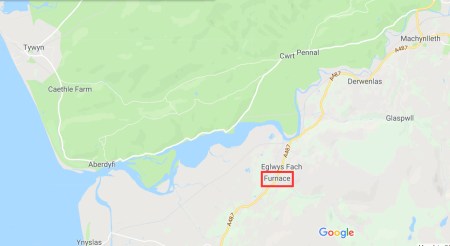
Today my father and I visited the site of the Royal Silver Mint and the restored Dyfi Charcoal Blast Furnace at the village of Furnace (Welsh Ffwrnais), only 10km southwest of Machynlleth on the south side of the Dovey river, in Ceredigion.  What an amazing place.   Some of my days out have nothing much to do with Aberdovey itself, but this one is positively bristling with linkages between the 18th Century Dyfi Furnace and the contemporary port at Aberdovey.

Learning of the existence of the Dyfi Furnace was a complete accident.  Last week my father and I drove into Aberystwyth to find out how long it would take to drive there from Aberdovey, and if there were retail facilities worth the trip.  The drive was surprisingly beautiful, mainly through lovely woodland and pastures, sometimes with views over the river Dovey, the estuary and Cardigan Bay, with a spectacular descent into Aberystwyth itself, the sea a staggeringly beautiful blue.  The reality of the eternally winding road meant that we were plagued with nervous and over-cautious drivers and very slow lorries, a frustrating experience behind the steering wheel.  On the other hand, discovering the Dyfi Furnace was an absolutely excellent outcome of the expedition.
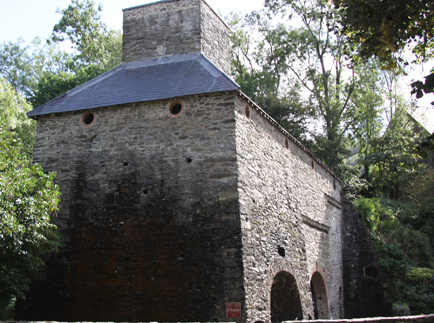
As we hurtled around a corner on our way to Aberystwyth, we both noticed a large water wheel on the side of an impressively solid stone-built building on the left/east of the A487, a few miles southwest of Machynlleth.  When we returned from Aberystwyth I fired up my PC to find out what it was, and having identified it as Dyfi Furnace, started investigating its past.  The two buildings that make up the site are managed by Cadw, and the site has a long and absolutely fascinating history dating to at least the 17th Century, spanning the reign of Charles I, the Civil War, the Industrial Revolution and the 19th and early 20th Centuries.  Today it has a valuable role welcoming visitors and providing information about the area’s industrial past.

There is a lot to say, so this is a long post, divided up as follows:

  • Introduction to the site
  • Archaeology and the history of the Dyfi Furnace
    • The early 17th Century lead works
    • The silver mill and Royal Mint c.1648-1670
    • The charcoal blast furnace c.1755-1810
      • Introducing the Dfyi Charcoal Blast Furnace
      • The job of a charcoal blast furnace, and how it works
      • How the iron smelting process translates into furnace architecture
      • The Dyfi Furnace in detail
    • The sawmill c.1810/1887-1920
  • The site today and visitor information
  • References

All sources used throughout the post are listed at the end.  You can click on images to see larger versions.


Introduction
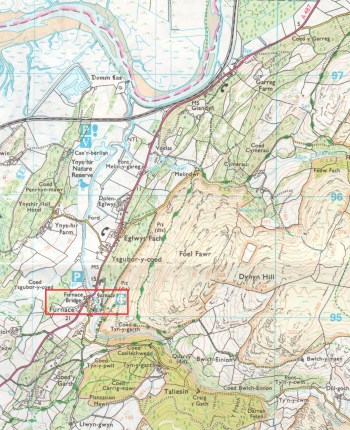
The site is located c.10kms south of Machynlleth on what is now the A487.  On the Ordnance Survey map, at  SN685951 it can be found on the edge of the village of Furnace, which took its name from the Dyfi Furnace.  The Dyfi Furnace is one of the last charcoal blast furnaces is to be preserved in Britain and is the best preserved in Wales.  It is now managed by Cadw, Welsh Government’s historic environment service.

The history of the Dyfi Furnace can be divided into five phases of use:

  • The early 16th Century lead works
  • The establishment of the Royal Silver Mills during the Civil War (1642-1651), when it shifted from Aberystwyth when Aberystwyth Castle was under threat of attack;
  • Its conversion to a charcoal blast furnace in around 1755, changing hands at least twice before its closure in 1810;
  • The conversion of the furnace into a sawmill
  • The use of the sawmill as an agricultural storage facility, mainly for root vegetables

All three phases of use depended on water power, employing water wheels of varying sizes to transmit energy to operate machinery.


Archaeology and History

The early 17th Century lead works

In the early 17th Century, Sir Hugh Myddleton was responsible for promoting the metal mining industry in Ceredigion, with remarkable success, although he is better known for his pivotal role in the construction of the New River, to supply water from the River Lea to London.  It is thought that the Ynsyhir lead smelting works, that were the first industrial works standing on the Dyfi Furnace site were part of his drive to bring industry to the area.  The lead works dated from around 1620, processing lead ore to produce both lead and silver.  As in later years, local wood was probably the main reason for siting the lead works in this particular place.  The finished products were distributed by sea via the Dyfi estuary, helping to establish Aberdovey as an important trans-shipping port.

The Royal Silver Mint

During the reign of Charles I (1600-1649) silver coinage was produced in the Royal Mint in London from silver produced in mines throughout Britain, including Wales.  The crown owned a number of silver mills in its own right, known as the Mines Royal.  A paper by the Reverend Eyre Evans describes a surviving petition from 1636  that states that on the 12th May 1625 Charles I had granted one Sir Hugh Myddleton with the rights, for 31 years, to all the silver mines in the county of Cardigan, to be sent to the Royal Mint in London.  By the end of 1636 silver had been sent to the Mint at a value of £50,000.  The petition was sent by Thomas Bushell, member of the Society of Mines Royal, who had bought the land on Myddleton’s death from from Myddleton’s widow and hoped to retain Royal patronage for the endevour.
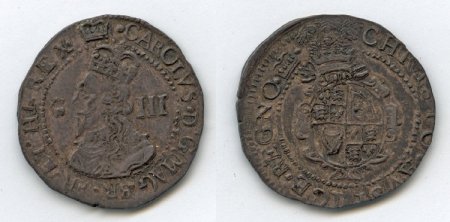
Threepence Charles I coins minted at Aberystwyth. Source: British Museum

Bushell was granted his petition, and now in the possession of the mines began to petition for a mint (a coin factory) in Aberystwyth Castle to manufacture coins exclusively from Welsh silver mines, citing the precedent of Ireland, where a Royal Mint had been established. Rather surprisingly, given strongly worded objections from the Royal Mint in London, on the 9th  July 1637 Bushell was again granted his wish, and was authorized to coin the half-crown, shilling, half-shilling, two-pence, and penny, all from Welsh silver.  In October of the same year the groat, threepence and half-penny were added to the list.  A set of accounts for the Aberystwyth Castle mint last up until 1642, when they cease abruptly, almost certainly due to the outbreak of the Civil War and the threat to the mint from Parliamentarian forces, and the castle was actually occupied briefly in 1648.

Tentative suggestions that during the Civil War (1642-1651) the Aberystwyth Royal Mint was moved to the site at Furnace were unambiguously confirmed during the 1986 excavations by James Dinn and his team, a great result.   Ceredigion silver was very highly valued and moving the Royal Mint to this location was a sound plan, particularly as Charles I was in urgent need of coin to pay his army.  This seems to have taken place in 1648 or a short time beforehand.

The silver mill had been described by Sir John Pettus and John Ray in 1670 and 1674 respectively, and a plan by Waller (1704) survives.  These between them describe furnaces, possibly up to five of them, the mint house and the stamping mill surrounding a courtyard, together with the mint house, a lead mill and a refining house.  Between them the buildings had four water wheels to operate four sets of bellows. One of the wheel pits was found during the excavations.  A cobbled surface was also found during excavations, apparently belonging to the courtyard of the silver mill.

Dinn says that the dates during which the silver mill was in use are uncertain, but that it may have operated in 1645-6 and 1648-9.  Activity was apparently suspended in 1650 but the works seem to have been in operation again in 1650.  1670 seems to mark the date for its permanent abandonment.

The Charcoal Blast Furnace

Introducing the Dyfi Charcoal Blast Furnace
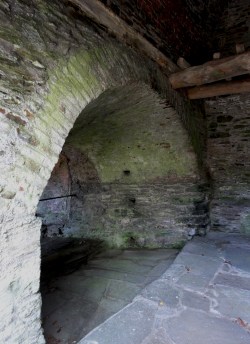
At the top of the Dyfi Furnace, the charging room, from where the furnace was fed.

The Dyfi Charcoal Blast Furnace was built in c.1755 and was in use for five years for iron smelting (the production of iron from natural iron ore).  The excavations found that later conversion to a sawmill had destroyed some of the blast furnace components but preserved others.  Charcoal blast furnaces had been introduced into Britain in the late 15th Century but it took another century for them to become widespread.

The furnace was initially leased in c.1755 from Lewis and Humphrey Edwards by Ralph Vernon together with the brothers Edward and William Bridge, who had been involved with the building of a furnace in Conwy, north Wales in 1750.   The furnace-master, who was accommodated in a house at the site called Ty Furnace, was Thomas Gaskell.  Vernon retired sometime between 1765 and 1770 and the Bridge brothers went bankrupt in 1773.  Dinn says that this “left members of the Kendall family in sole control of Conwyy and Dyfi furnaces.”  I am not clear on how the Kendalls, west Midlands iron-masters with interests throughout Britain, came to be in control, but the Kendalls may have invested in the furnace operation.  Ralph Vernon was a cousin of Jonathan and Henry Kendall and they had been in business together before.  Both Dyfi and Conwy furnaces were put up for sale in 1774.  No buyers were found and it is thought that John Kendall probably managed the Dyfi furnace himself until his death in 1791, but the Conwy furnace closed in around 1779.  In 1796 the lease again changed hands and was now in the name of Messrs Bell and Gaskell, the latter being the Thomas Gaskell who had been the furnace master at Dyfi Furnace under the Kendalls.   Dyfi Furnace went out of use as an iron ore smelting furnace in around 1810.
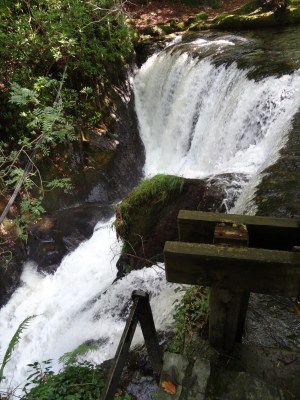
There were four reasons for basing the furnace at the foot of the River Einion waterfall.

  • First, the waterfall provided power for the water wheel, and with its source high in the hills, originating in Craiglin Dyffi near the summit of the remote Aran Faddwy, the tallest peak in the area, it was unlikely to dry up at any part of the year. The water wheel powered the bellows that gave the blast furnace its name.
  • Second, there was a road to the river village of Garreg, 2km away, that provided access to the navigable part of the River Dovey (Afon Dyfi), which provided easy access to the sea port of Aberdovey.  The furnace depended upon Aberdovey for transfer of iron ore (the natural material from which iron is extracted in the furnace) from Cumbria to river ships that could make the trip to Garreg, and for transhipping its pig iron (iron produced from iron ore that was now in a state ready to be worked in a forge by a blacksmith) to elsewhere in the country.
  • Third, it was surrounded by rich woodland that was exploited for the manufacture of charcoal to fuel the furnace.
  • Finally, it was immediately next to the turnpike road out of Machynlleth, providing access to the market town.

Both iron ore and limestone had to be imported.  The iron ore came mainly from Cumbria, but it is not clear where the limestone was sourced.  Limestone is available in north Wales, and there are records of imports to the furnace from the River Dee, so this is a plausible source.

The entire complex included the Furnace (blast furnace stack, the hearth at its base, a casting house, a bellows room, a counterweight room, a charging room), an external charcoal storage building and the iron-master’s house, Ty Furnace.
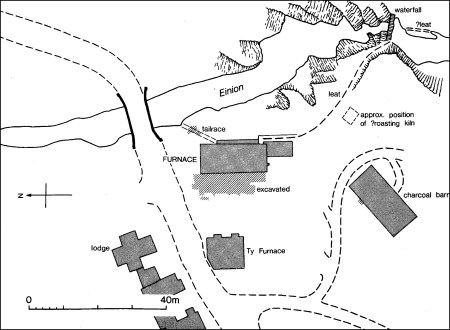
Plan of the buildings associated with the Dyfi Furnace. Source: Dinn, J. 1988, p.112


The job of the charcoal blast furnace, and how it works

Iron Smelting

A furnace is an impressive combination of chemical and mechanical engineering.

Iron ores are a mixture of oxides and sulphates of iron, predominantly haematite, ferric oxide (Fe2O3).  However, the haematite and other iron oxides come mixed with a variety of other minerals, containing such elements as silica, alumina, phosphorous, manganese and sulphur. The smelting process must accomplish two things.

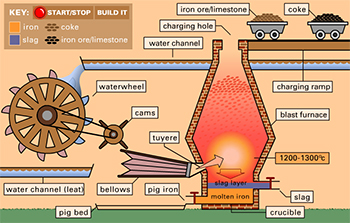
Blast Furnace simulation showing some of the components described in this post.  Please note that this simulation shows coke being used, but this is a later innovation; the Dyfi Furnace used charcoal. Sourced from the BBC History website, where it can be run as an excellent Flash animation.

It must split the molecules of the iron compounds so that the iron is separated from the oxygen.   This is done by the addition of heat and the supply of carbon in the form of (in this case) charcoal.   In this chemical and physical environment, the addition of heat energy divides the ore into iron and carbon dioxide, CO2.  The hot carbon dioxide exits through the chimney.  Notice that the charcoal is both the source of heat, and a chemical reagent combining with the oxygen in the ferric oxide.

The second thing the process must accomplish is remove the other minerals that accompany the haematite in the iron ore.  This is achieved in two ways.  First, the addition of intense heat acts in much the same way as it does with the haematite taking off some of the impurities as gases.   However, it also requires the addition of a limestone (primarily composed of calcite, CACO3) “flux,” which both lowers the melting point of the mixture and bonds with the impurities to make a silicaceous liquid, physically and chemically similar to a very impure glass.  Being silicaceous, it is light and floats on the iron, making it relatively easy to separate.

The addition of oxygen

Oxygen is added by use of bellows.  There are two features of the flow of air in a furnace which are worth noting.  First the bellows are much more effective blowing into a confined space.  Blowing into an open hearth, the air is quickly dissipated, as is the heat produced.  Second, the narrow funnel at the top of the furnace creates what engineers call a “venturi.”  It forces the hot rising gases into a much smaller space so that their speed increases, in the same way that like the narrowing of the nozzle size on a hose pipe, increases the speed at which the water squirts out.  When the velocity of a gas increases, its pressure falls, according to a physical law known as Bernoulli’s principle.  The low pressure at the top of the furnace pulls the air through the smelting mixture just as the air from the bellows is pushing it.  Together, they increase the amount of oxygen from the air which reaches the burning charcoal, radically increasing its temperature.

Bellows

Bellows are a device for taking a lot of air from an unconfined place and pushing it at high pressure into a smaller place.  To operate successfully the bellows need four features.

First, and most obvious, a bag into which the air can be sucked from the atmosphere.  At this time the bag were usually leather.

The second thing that the bellows need are a way of opening and closing the bag.  In this furnace opening is achieved by a cog with one side of each tooth rounded (see diagram), driven by a water wheel.  The opening is achieved by a counter weight connected to a lever which is pulled up by the same cog mechanism (see diagram). When the tooth of the cog passes, the counterweight falls to open the bellows.

The third thing is a valve on the leather bag which lets air be sucked in when the bellow are open, but not blown out when they are closing.

Finally, the bellows need a narrow nozzle to push the air at high speed into the furnace chamber to deliver oxygen to the charcoal and increase the rate of combustion.
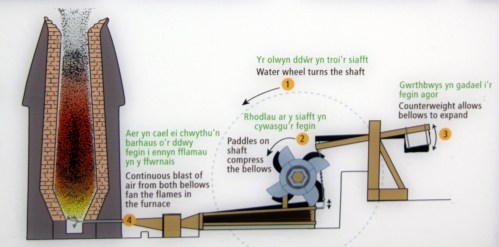
A Cadw sign from the site showing how the counterweights related to the functionality of the bellows

How the iron smelting process translates into furnace architecture

The furnace consists of a number of different rooms, each devoted to a different task:

  • The charge (charcoal, limestone flux and iron ore) is fed in from the charging room at the top of the furnace.  This room keeps the charcoal dry whilst it is being fed into the furnace.
  • The furnace itself is in a square stack, but is circular in form.  A small round opening at the top (the neck) flares out down the length of the stack to allow the materials to expand as they are heated from a blast from the bellows.  The stack suddenly narrows into a funnel, called the bosh.  Finally, the a tall cylinder at the base, the hearth, is where the molten iron and slag gathers.
  • The heat within the furnace is maintained by the bellows, which are contained within the bellows room and these are operated by a water wheel on the outside of the building.
  • A counterweight room contains the counterweights that raise and drop the bellows.  The bellows connect to the furnace via an pipe, c.3 inches in diameter, and a nozzle called a tuyère that are carried through a tuyère hole or blasting arch at about 1ft above the base of the furnace at the correct angle to give maximum impact.
  • The area in the hearth below the tuyère where the liquid metal comes to rest is called the crucible.
  • Molten slag, floating on top, and molten iron, below, pass through separate tapholes.  The iron passes through an arch, called a casting arch, into the the casting room.  This is where the iron hardens in clean and dry conditions.


Looking in detail at the Dyfi Furnace

When it was built in c.1755 the Dyfi Furnace appears to have consisted of a free-standing blast furnace, with other components added a little later.  The completed complex consisted of the furnace building made of local shale from the Silurian period Llandovery series and grey-white mortar, the charcoal barn 20m away from the furnace and the head ironmaster’s house.

A superb cut-away image of the interior of the Dyfi Furnace, showing how all the components relate to one another, upstairs and down. The furnace is at far left with the bellows to its right and the couterwights beyond, at far right. Upstairs is the charging room where the iron ore, charcoal and limestone were poured in, and at the bottom you can see men urging the molten iron into the pig moulds in the casting house, of which only the foundations were found during excavation. The water wheel is on the other side of the far wall, powering the bellows. The chimney vents all the released gases. Source: Cadw signage at the site.
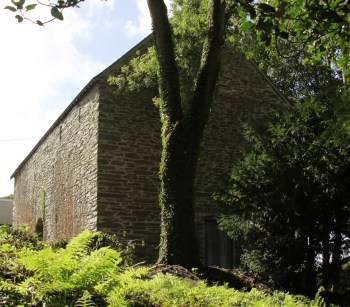
 

The charcoal store

The furnace building was split into the furnace stack itself (9.1m square at the base and 8m square at the eves, and 10m tall).  The furnace stack was was circular on the inside, which can be clearly seen from the ground floor.  The blowing house had a vaulted brick arch (the room measuring 5.1×7.7m).  The cast house measured 7.05×7.10m).  There was also a counterweight room and wheel pit, together with a wheel, to operate the bellows.  Two lean-to structures were added to the building, one housing the water wheel and the other apparently used for storage.
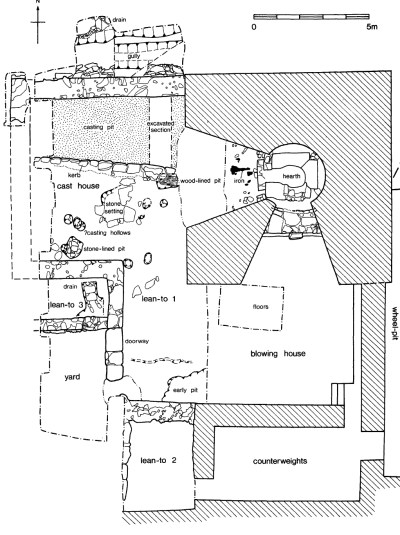
 

Site plan from the excavation report. Source: Dinn, J. 1988, page 122

The bottom of the furnace, the bellows room and the counterweight room can all be seen from the lowest level of the site down a small flight of stairs to the right of the building as you approach from the car park.

The excavations revealed the original cast house walls, of which only 0.80cm remained.   When you look in through the first arch at the furnace, you are standing where the cast house once was. Dinn says that “the variety of features in the casting area was much greater than that recorded at sites such as Bonawe  and Duddon, and the casting pit much deeper, suggesting a wider range of activities than pig casting was envisaged.”

It is not known whether the bellows were leather or the more modern iron blowing tubes that were installed in at least one contemporary furnace at Duddon in Cumberland.  Unfortunately there is nothing left to determine this.
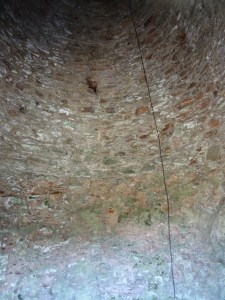
The interior, circular design of the furnace.

The furnace, circular on the inside, but set within a square chimney, was probably composed of at least two layers of brick, separated by a fill of light rubble, earth or sand to allow for expansion of the furnace lining as it heated.

The rooms that would have contained the charging house were locked up, but this is where the iron ore (high quality Cumbrian haematite), the limestone and the charcoal would have been tipped into the furnace.  A covered charging bridge also existed, leading into the charging room.

There are considerable similarties in the design to Craleckan in Argyll and Conwy in north Wales with overall similarities to both Duddon in Cumberland and Bonawe in Argyll, and it is possible that they were all designed by the same person.

Outside, the water was managed using a series of features, including at least one leat (a channel dug into the ground to direct water to where it is needed), a waterfall that was built up to give it extra power for turning the water wheel, and a tailrace to take the water away from the furnace.   None of these features was excavated.  The wheel and wheel pit at the site today both belong to the saw mill and are bigger than the ones for which fittings were recorded during the excavations, which were 3.60-5m, 7.5m and 7.9m diameter.  The excavation report does not mention if the original water wheels used for the furnace were overshot or undershot designs.

Extensive use was made of arches throughout the building.  The main components of the building are built of local shale and mortar, but some of the arches, notably the blowing arch and taphole entrance, were made of brick.
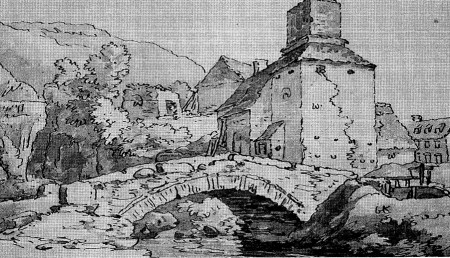
Pen and ink drawing of the Dyfi Furnace from c.1790180 by P.J. de Loutherbourg. National Library of Wales. Source: Dinn, J. 1988, p.120.  The crack shown in this drawing is still clearly visible on the north wall today.

The furnace could not have operated without being able to interface with coastal carriers at Aberdovey.   Cargoes destined for the Dyfi Furnace, and products produced by the furnace were carried by sea, but these ships were too large to navigate the Dovey river, so everything had to be trans-shipped via Aberdovey, which acted as an cargo handling hub between coasters and small river vessels.    Materials and supplies arrived at Aberdovey by sea and were loaded onto river vessels.  Pig iron manufactured at the Dyfi Furnace was in turn sent down the river to Aberdovey, where it was loaded onto seagoing ships and sent on its way.  The relationship between Aberdovey and the small river ports that lined the River Dovey was completely symbiotic.   Ore and ironstone shipments to the furnace are recorded from both Conwy and the River Dee, whilst the Aberdovey Custom House records shipments of iron ore from Ulverston in Cumbria.  Backbarrow shipping ledgers from Ulverston record many deliveries to Dyfi Furnace.
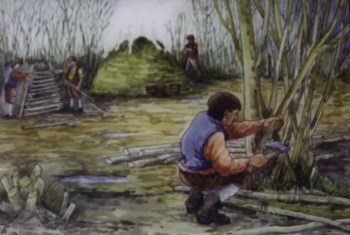
One of the Cadw information sites at Dyfi Furnace showing coppicing and preparation of the stack for manufacturing charcoal

Information signs at the site say that the local woodlands were coppiced to make the wood go further.  This simply involves cutting the wood back very close to the ground every few years so that it regrows on several new trunks from a single root.  This wood was then converted to charcoal by baking it.  Branches were stakced and covered with earth, and then a fire was set.  Once it was burning, air was excluded from the stack and it was allowed to cook for several days.  The resulting charcoal burned at higher temperatures than wood, an essential asset for charcoal blast furnaces.  A single mature tree could provide sufficient fuel to manufacture two tons of iron.  Records show that charcoal was also shipped into Aberdovey from Barmouth, and this is thought to be have been destined for the Dyfi furnace, to supplement its own supply.  Pig iron was sent to Vernon and Kendall forges mainly in Cheshire and Staffordshire via Aberdovey but also to Barmouth.  Other pig iron was sent to the local Glanfred forge on the River Leri in Ynyslas (SN643880), presumably transported by river vessel down the river Dovey and then up the Leri.

My understaning is that the furnace-master’s house has also been preserved,  called Ty Furnace (translating as Furnace House), but I was unable to actually see that. It is, however, shown in both the drawings on this page.
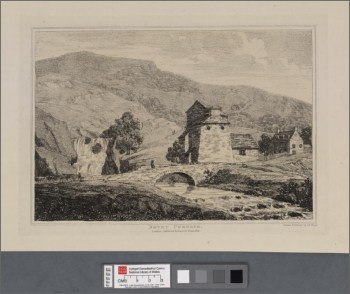
Dovery Furnace. Etching by J.G. Wood, 1813, from his book The Principal Rivers of Wales. Source: National Library of Wales

The Dyfi Furnace was one of the last charcoal blast furnaces to be built in Britain, and is contemporary with some other well known charcoal blast furnaces including Bonawe (Argyll, Scotland), Conwy (north Wales) and Craleckan (Argyll, Scotland), all isolated areas that had good access to coastal trade routes. Richards suggests that very rural locations were selected because of their distance from Naval shipbuilding centres in the south and east of England, where shortages of shipbuilding timber were causing anxiety in the Admiralty, and competition for wood with charcoal-burning  furnaces may have been suppressed.

Saw Mill

There is very little information about the sawmill.  It was probably established at Dyfi Furnace at some point between 1810 and 1887, according to Dinn, although there was a period of disused after the furnace closed, marked by the collapse of the cast house roof.  A refurbishment and reorganization of the furnace building seems to have taken place a little later.
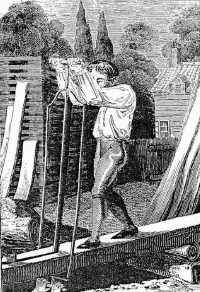
An early sawmill showing two men creating planks with a straight whipsaw.  Source: Cooney 1991

Sawmills were an innovation that simply did what the name implies.  Before mechanization, sawing had been achieved by two men with a long whipsaw, one man on top of the wood being sawed, the other man below, each man pulling his end of the saw in turn.   It was a highly skilled and physically demanding job, particularly for the man at the top of the saw.  The sawmill replaced man power with water power.  A water wheel was attached to the mechanism that did the sawing via a “pitman” (or connecting rod) that converted the circular motion of the wheel into the push-pull of the saw mechanism.  How the wood was loaded and unloaded is not discussed in any of the publications that I have found to date.  Given the lack of any additional structures described in the excavation reports it seems likely that loading the wood and removing it once processed were entirely manual, although mechanized systems were introduced at other sawmills.   According to E.W. Cooney’s fascinating paper, although sawmills had been established much earlier in Europe, the sawmill was a relatively late phenomenon in Britain, the first ones established in the late 18th Century but not really taking off until the arrival of steam-powered sawmills in the mid 19th Century, and this appears to have been partly due to pressure from professional manual sawyers but also from doubts about the benefits of new technologies.  Water power was gradually replaced by steam power, and during the 19th Century the number of water-powered sawmills declined very rapidly.

It was quite usual for a water mill that had formerly used for an entirely different task to be adapted for use as a sawmill, and often former corn mills were converted, so the re-use of a blast furnace as a sawmill was not surprising.  The water wheel that remains today is 9m (nearly 30ft) in diameter, but this may belong to a later phase than the initial conversion of the building to a saw mill and it may have been liberated from Ystrad Einion lead mine in the early 20th Century, which had a wheel of exactly the same size.  It is an overshot water wheel manufactured by  Williams and Metcalfe of the Rheidol Foundry, Aberystwith.  The Cast House pit may have been used for tanning from the park produced at the sawmill, as happened at Bonawe. A period of disuse seems to have been followed by the demolition of the Cast House and adjacent building in around 1880, and again a sawmill appears to have been the intended use.  Dinn says that it ceased to function in the 1920s.
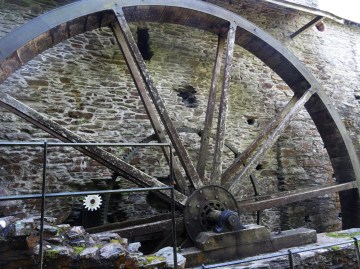
The Dyfi water-powered sawmill was by now in a rather more populated area than the furnace had been.  Samuel Lewis, writing in 1849, recorded that “the immediate neighborhood is well wooded and agreeable, and some respectable residences are scatted over the township,” which is “conveniently situated near smelting houses and refining mills.”  He said that the river Dovey was navigable to the point where the river Einion met the Dovey for vessels up to 300 tons.  Nearby Eglwysfach was a bigger settlement with an Anglican church, a Calvinist and a Wesleyan Methodist chapel and two Sunday Schools.

Dinn’s report states that the sawmill only stopped operating in around 1920, but he does not mention how it was powered at that time, and it is possible that it was still water-powered.

After the Sawmill

The main furnace buildings were adapted for uses as an agricultural store, and a flagged floor was laid down for this new role in the Blowing House.  The Furnace stack was converted into a root vegetable store, with a slate floor.  Subsequent use of the site was limited.


The Site today and visitor Information
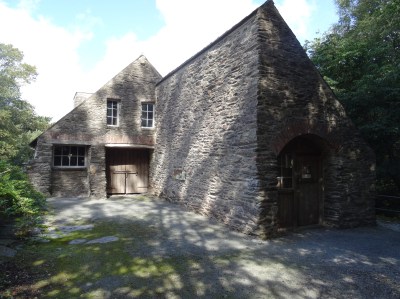
The top level at Dyfi Furnace,. The charging room where the furnace was loaded with raw materials for the transformation into pig iron.

The journey from Aberdovey to Furnace took about 30 minutes.  There is a decent sized carpark to the right of the road as you head south, immediately opposite the furnace itself .

When you have parked you just need to be careful (very careful) as you cross the busy A487.

Today the site is in beautiful condition thanks to renovations in 1977-8 and again in 1984.  The site is on two levels, with a set of easy steps with a handrail from one level to the other.  At the top of the steps you can see the top part of the builing’s structure and take a very short walk to the waterfall.

The interior is not accessible but open grills allow you to see all you need to inside the building at ground level.  The interior of the charging house at the top is closed due to horseshoe bats roosting there in the summer months.  The site is free to access and there are plenty of really excellent information boards to let you know what is happening at each part of the site.  On each notice board there is also a puzzle for children to explore.

Should you fancy a bit of a walk, there are a number of options that lead up the Einion valley from the waterfall, which you can find in a number of walking guides, or you can check out the ViewRanger website where there’s a short walk or a much longer one.  Alternatively, if you are in the mood for a different type of experience after your visit, you might take in the bird sanctuary at Ynys Hir, a short drive away, or the nature reserve at Ynyslas, a 15 minute drive away.

If you have any more information about the site and its history, it would be great to hear from you, so please let me know.


References

Primary references used in this post (all references cited above and below are listed in the website Bibliography):

First, many thanks to my father, William Byrnes, for writing the section “How a Blast Furnace Works.”

Cooney, E.W. 1991. Eighteenth Century Britain’s Missing Sawmills.  A Blessing in Disguise? Construction History 7, 1991, p.29-46.
https://www.arct.cam.ac.uk/Downloads/chs/vol7/article2.pdf
Daff, T. 1973. Charcoal-Fired Blast Furnaces; Construction and Operation. BIAS Journal 6
Dinn, J.  1988.  Dyfi Furnace excavations 1982-1987.  Post-Medieval Archaeology 22:1, p.111-142
Eyre Evans, G. 1915.  The Royal Mint, Aberystwyth. Transactions of the Cardiganshire Antiquarian Society, Vol 2 No 1, (1915) p.71 http://www.ceredigionhistoricalsociety.org/trans-2-mint.php
Goodwin, G. 1894. Myddleton, Hugh.  Dictionary of National Biography, 1885-1900, Volume 39.  https://en.wikisource.org/wiki/Myddelton,_Hugh_(DNB00)
Lewis, S. 1849.  A topographical history of Wales.https://www.british-history.ac.uk/topographical-dict/wales
Richard, A.J and Napier, J. 2005.  A tale fo two rivers:  Mawddach and Dyfi.  Gwasg Garreg Gwalch.
Sandbach, P. 2017. Dyfi Furnace and Ystrad Einion 21st October 2016. Newsletter of the Cumbria Amenity Trust Mining History Society.  February 2017, No.16,p. 17-21.
www.catmhs.org.uk/members/newsletter-126-february-2017
Walker, R.D. Iron Processing. Encylopedia Britannia. January 27, 2017 https://www.britannica.com/technology/iron-processing#ref622837


A history of Cambrian News, established 1860

I was in the Aberdyfi Village Stores a couple of days ago and asked if there was such a thing as a local newspaper.  I came away with the Cambrian News (www.cambrian-news.co.uk) for the Meirionnydd district, which is absolutely bursting with information about Meirionnydd (or Merioneth in English).

Meirionnydd is the southernmost part of Gwynedd and used to be a separate cantref, lying between the River Dyfi to the south and the River Mawddach in the north.  In 1889 it was officially renamed Merionethshire and in 1284 assimilated the cantrefs Penllyn and Ardudwy to its north.  In 1974 it was amalgamated with Caernarfon and Angelsey to become Gwynedd.  However, Meirionnydd is still considered to be an entity in its own right, and this is the area served by Meirionnydd version of Cambrian News, although the newspaper has issues for other districts as well, taking in much of Gwynedd and Ceredigion.

The Cambrian News itself has both heritage and pedigree,  celebrating its 150th anniversary in 2010.  It first appeared in October 1860, at that stage just a four-page supplement in The Oswestry Advertiser, and was called The Merioneth Herald.  It developed into a newspaper in its own right, still in Oswestry, and in 1864 became The Merionethshire Standard and Mid-Wales Herald.  It was only in 1864, that the name Cambrian entered the name, when it became the Cambrian News and Merionethshire Standard. At times it also included The Welsh Farmers’ Gazette.

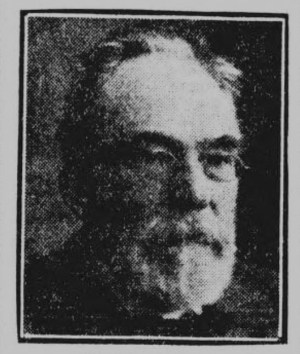
Sir John Gibson. Source: The Western Mail, Monday 19th July 1915, p.7

In 1873 it was put under the management and editorship of a John Gibson (1941-1915), and was moved to Aberystwyth as The Cambrian News.  Gibson was clearly a force to be reckoned with.  He was the son of a Lanaster hatter who, according to John Gibson’s obituary in the Western Mail (19th July 1915) made the first silk hat in Lancaster.   Gibson started out as an errand boy in the newspaper trade and went to the Oswestry Advertiser first as a printer and then as a journalist.  In 1879 Gibson published Agriculture in Wales.   His obituary in the Western Mail says that “his outspoken and negative criticism occasioned great commotion in town and district and gave rise to considerable opposition.” In 1880 his outspoken remarks resulted in a number of libel actions against the newspaper, and rather than apologize he resigned.  However, in the same year a consortium of Gibson’s friends and supporters formed a consortium to purchase the newspaper, and reappointed him.  He eventually became the newspaper’s proprietor.   He had strong views on political and social issues, which permeated the newspaper.  In a column in the newspaper on the 26th October 1885 he  stated that women were “either slaves or are legally, socially and politically non-existent,” and followed this up in 1891 with a book entitled The Emancipation of Women, a treatise that came down very strongly in support of women’s suffrage.  An article on Wales Online describes how in the first decade of the 20th Century he was strongly opposed to the establishment of the newly proposed Welsh National Agricultural Society and its Royal Welsh Show, arguing vociferously that it would lead to the demise of the North Cardiganshire show and other similarly long-established events.The Welsh National Library’s Dictionary of Welsh Biography says that under Gibson’s supervision, “and through his vigorous personality and fearless independent views on local and national affairs, the Cambrian News became one of the most influential weekly newspapers in Wales.”

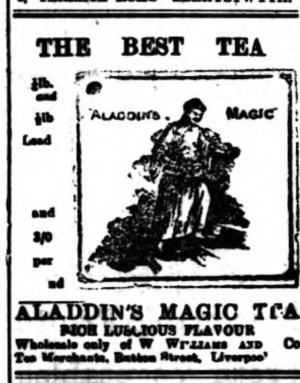
Advert from the 30th December 1910 edition, Cambrian News page 2

A measure of its success under Gibson is provided by a piece in the Cambrian Times of 11th July 1874, where a column describes how the Cambrian News and Aberystwyth Times had steadily increased over the previous few years throughout the district.  In 1873 there were 1590 more advertisements placed than in 1872 and in 1874 there were 1721 more than in 1873.  This is explained in the column by the standards to which the newspaper was held by its editor:  “The Cambrian News is characterized by the independent tone of its articles and the fearless spirit in which public affairs of local and general interest are criticized.  It is full of impartial reports, local sketches, nearly two columns of markets and general intelligence etc, and the proprietors do not spare expense in making it a good family, commercial and general newspaper.”  Advertisements were more expensive than other local newspapers, and this was discussed in the July 23rd 1909 issue of the Cambrian News and Welsh Farmers’ Gazette on page 3:  “We are frequently told that charges for advertisements in this paper are higher than those made by other local papers.  This is true.  We publish two editions every week in order to give al the news of the district, and our price for advertisements is high in order to keep space for news.  If reckoned by so much per thousand copies sold, advertisements should be included in the ‘Cambrian News’ will be found to be worth all that is paid for them.”

The tone of the Cambrian News under John Gibson was, to say the least, forthright.  On December 30th 1881 in the Almanac for the Year 1882, just beneath the newspaper’s header, the following statement was printed: “The Cambrian News aims at being all that a pure, honest and upright family newspaper should be.  Impure advertisements and reports are rigorously excluded.  The reports are impartial, the criticism is just and the politics Liberal.” It goes on to say that it gives “special attention” to agricultural subjects and that as well as a wide regional circulation it had agents in London, Birmingham, Manchester and Liverpool.  By 1909 two editions were going out per week.

John Gibson was knighted in the same year in which he died, becoming Sir John Gibson, not a bad achievement for the son of a Lancaster hatter.  He died on Saturday 17th July, aged 74.  In his will be specified that his funeral his funeral “should be of the simplest form and no mourning worn at it or afterwards” (Cambrian News, 20th November 1915, page 6).  He was buried in Llangarwen churchyard.

Today the weekly Cambrian News is  owned by Tindle Newspapers Ltd.  It is full of local stories and has an active letters page.  It is a great way to find out about local government issues, problems with services and transport, innovations made by local businesses, upcoming and previous events and the outcomes of recent sports fixtures.  I had no idea, for example, that there are plans afoot to put a new bridge over the River Dyfi, that there is a Merioneth County Show (very sorry to have missed that), that there is a shortage of both firefighters and train drivers in the area, that there is a move to set up a Dyf Valley palliative care service, or that Tywyn has a netball team.  I also enjoyed the piece about the life of Marguerite Jervis who lived intermittently at The Lodge of Plas Pentedal near Aberdovey.  The newsaper is very people-focused, with a strong emphasis on human interest stories.   Its website says that Cambrian News is the biggest-selling weekly newspaper in Wales with six editions that cover Aberystwyth, south Ceredigion, Cardigan & Newcastle Emlyn, Montgomeryshire, Meirionnydd and Arfon/Dwyfor, spanning five Welsh counties.  Cambrian News was voted Welsh Weekly Newspaper of the Year for 2015 and has been awarded the title of BT Welsh Weekly Newspaper of the Year twice.  The price has just risen from 80p to £1.00.  Worth every penny.

The story behind the memorial to 3 Troop 10 (1A) in Penhelyg Park

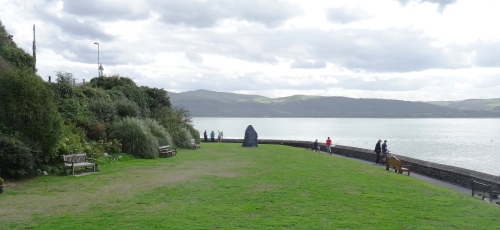
I went in to the Aberdyfi Literary Institute today to become a member, and picked up a number of leaflets, one of which was entitled “The Story behind the Monument.  Penhelyg Park Aberdyfi.”  There is no author cited so I cannot credit him or her, but it is an excellent account of the history behind the monument. The monument, shown right, reads:

FOR THE MEMBERS OF
3 TROOP 10 (1A)
COMMANDO
WHO WERE
WARMLY WELCOMED
IN ABERDYFI
WHILE TRAINING
FOR SPECIAL DUTIES
IN BATTLE
1942-1943
TWENTY WERE
KILLED IN ACTION

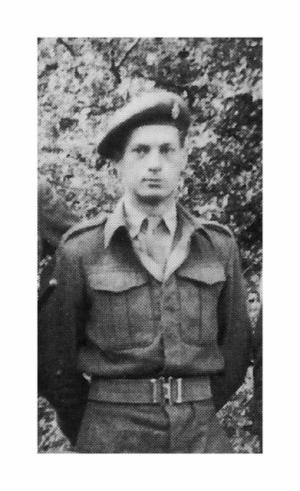
The main thrust of the story is that the Number 10 (Inter-Allied) Commando unit, with its headquarters at Harlech, was made up of a number of volunteer troops, each representing a different European nationality, all dedicated to Allied interests, with each based at a different place in Britain.  Most remarkable of them all, however, was No.3 Troop, which was formed in 1942 and was made up of of German and Austrian nationals, “enemy aliens” as well as others who were either European (mainly Czech and Hungarian) or stateless, mainly Jewish, all of whom had fled the Nazi regime as it began to gain strength.  The members of the troop, once trained, were used for reconnaissance and intelligence gathering, affiliated to other troops either on the front line or behind enemy lines.  The Troop never fought as a unit.  The idea was the inspiration of the Chief of Combined Operations, Earl Mountbatten.   3 Troop came to Aberdovey to be trained.  Whereas other troops were given the name of their nationality (e.g. No.2 Dutch Troop) No.3 was named X Troop by Winston Churchill, the X standing for an unknown quantity, a reflection of how bold the idea was considered to be.

Captain Brian Hilton Jones. Source: The Commando Veterans Association

Over 350 refugees volunteered for 3 Troop, of whom 86 were selected in the first intake.  Eventually around 130 men served in 3 Troop 10 (1A).  As well as being completely fluent in German, they had to be capable of achieving the highest Commando skills.  Most were aged between 18 and 25, many had been resident in Britain for some time, and some of them had served in the unarmed Pioneer Corps, which focused mainly on light engineering work.  There was no fanfare accompanying their arrival.  Their role was a secret one.  Each individual had taken a British name as a nommes de guerre and been given an identity backed up by all the necessary documentation.  Only the policeman was informed of the true purpose of the Troop, and they were billeted in private homes and integrated with village society.  Two of 3 Troop married local girls. Initially none of them were eligible to become officers, a restriction that was removed after they had proved themselves, in 1944, after which 18 became officers.  Their Commanding Officer was Bryan Hilton-Jones from Caernarfon who was a graduate in Modern Languages from Cambridge, and rated as a good leader of men.  The leaflet says that he was a fitness fanatic, and saw to it that their training was incredibly wide-ranging, everything from physical aptitude, weapons training and intelligence to housebreaking, lock-picking and demolition.

3 Troop members had been involved in numerous fighting, the invasions of Normandy and Sicily, small raids, and various other campaigns.  Twenty were killed in action and twenty two were wounded or disabled.  An article on the BBC website, which is also well worth a read, lists the honours that were awarded to 3 Troop:  one MC, one MM, one Croix de Guerre, one MBE, one BEM, one Certificate of Commendation and three Mentioned in Despatches. He goes on to say that “the number of awards are derisory considering their exploits and the inevitable death sentence they faced if captured – not to mention the danger to any of their surviving relatives in Nazi Europe. Many details of the men were known to the Gestapo and reprisals would have been immediate.”  This was probably because, fighting as individuals alongside other units, they never fought as a unit and were therefore not in a position to be put forward for honours by their own Commanding Officer.

The English version of the memorial plaque in the sea wall of the park

The monument was installed in 1999, unveiled by the former Lord Lieutenant of Gwynedd, Mr Meuric Reese CBE, in the presence of twenty eight 3 Troop survivors, on 15th May of that year.   It was designed, carved and inscribed by John Neilson letter carver, lettering designer and callipgrapher of Pentrecwn, Oswestry.  With his skill at incorporating letters into works of art, he was the perfect choice for this particular memorial.  For more examples of his work see the Arts Connection / Cyswllt Celf website.

For anyone who would like to read the full version of the leaflet, together with its recommended further reading, there are copies in the Aberdyfi Literary Institute, or you can download the PDF: 3 Troop 10 leaflet entire.

You may also be interested in the transcript of a speech delivered by Colin Anson, formerly Claus Leopold Octavio Ascher, on the 4th September 2007 at the Imperial War Museum.  The speech described his experience as a member of No 10 (IA) Commando 3 troop, given when he attended a reunion of refugees from Nazism who served in the British Forces in WW2. It gives insights into some of the work he carried out as part of 3 Troop.   The transcript is on the Commando Veterans website.

More very useful information about training and deployment of 3 Troop 10 is given in the book Leadership, Management and Command: Rethinking D-Day By K. Grint , the relevant section of which is available on Google Books.

Update, 30th June 2020, from Martin Sugarman , Archivist of The Assocation of Jewish Ex-Servicemen and Women of the UK, AJEX, and the Jewish Military Association (JMA) of the UK

The men of No 3 Troop were all Jewish except 2 and when the Commando Veterans web site gives their background, and omits saying many were Jews, they do not understand that many of the men on enlistment, attested as Christians in case they were captured; it was to protect themselves and their families who they believed were still alive in Europe. so, because their attestation is ‘official’ and ‘carved in stone’ on their military records, the web site writers do not realise that they are quoting wrong information.

It would therefore be appropriate for anyone wishing to offer thanks at the memorial to obtain Star of David British Legion pegs rather than Crosses for placing at the base.


Penhelyg Park with the memorial at the far end

Penhelyg Park with the memorial at the far end

The legend of Cantre’r Gawelod and the bells of Aberdovey

The bells of Aberdovey are the most famous actors in a number a number of local legends.  The legends are captured in poems and songs, and will be very familiar to any regular visitors to Aberdovey.  They concern a piece of very fertile low land that was said to be several miles out from the shoreline of Cardigan Bay, and was swallowed by the sea.

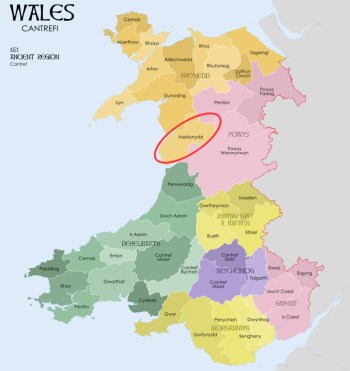
The most common of the legends, the one favoured today, tells the story of the bells that belonged to wealthy towns that stood in rich, fertile land that was protected by sea walls but was eventually drowned by the sea.  In the tradition, the land, called Maes Gwyddno (Maes, meaning land or plain; Gwyddno, meaning of Gwyddno), was part of the kingdom of Meirionydd and ruled by Gwyddno Garanhir (Garanhir, meaning long limbs or Longshanks).  Meirionnydd was a kingdom and then cantref, the southern part of what is now Gwynedd, between the Mawddach river at Barmouth in the north and the Dfyi at Aberdovey in the south.

Meirionnydd in mid west Wales (Source: Map of cantrefi of Wales by XrysD CC-BY-SA-4.0)

Aberdovey is supposed to the be the nearest place on dry land to the former location of Maes Gwyddno.  The legend refers to Maes Gwyddno as Cantre’r Gawelod, which translates as The Bottom Hundred, or Lowland Hundred. The translation “hundred” comes from the word cantref itself, which was a way of dividing up the land for administrative purposes, like counties.  Cantref is a concatenation of two words, cant (meaning hundred) and tref (meaning town).  A hundred in English is also an administrative area.  The term is first recorded in the 10th Century, but the etymology of the word is unclear and the Oxford English Dictionary sits firmly on the fence in this matter.

The best known story is that the low land of Maes Gwyddno, or Cantre’r Gawelod,  with its 16 wealthy towns or villages, the most prestigious of which was Manua, was protected by dykes or sea walls.  The land was drained at low tide by opening sluice gates.  The sluice gates were closed as the tide began to rise, a task overseen by a watchman.  One night the spring tide was whipped into a frenzy by a bad storm and beat against the sea walls.  Instead of tending the open sluice gate the appointed watchman, the King’s knight Seithennin/Seithenyn, was attending revels in the King’s palace, also protected by the sea wall.  This dereliction of duty doomed the land.  As the sea rushed in, the King escaped with some of the revellers along the Sarn Cynfelyn causeway, which remains today (sarnau, meaning stones, are remnants of glacial moraines, now only visible at low tide), and the farmers and villagers were driven away from their rich lands into the far poorer fields and hills behind Cardigan Bay.

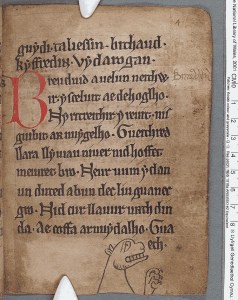
A page from the Black Book of Carmarthen (Source: National Library of Wales)

Another version, captured in the poem Boddi Maes Gwyddno (The Drowning of the Land of Gwyddno) is captured in the 13th Century Black Book of Carmarthen, which is the earliest known collection of Welsh verse, bringing together many earlier poems and legends, agrees that Seithennin was at the King’s palace at the time of the storm, but that it was a girl named Mererid who was in charge of the sluice gates.  Seithennin seduced Mererid who failed to close the sluice gates, causing the lands to be submerged beneath the sea.

A different legend says that a fairy well was located near the land, tended to by a priestess.  For reasons unknown, she decided to allow the well to overflow, with the same consequences.

Finally, another tradition has it that a giant called Idris Gawr, whose throne was Cadair Idris (cadair meaning chair) roamed the hills around Aberdovey carrying a massive bell.  Like most of us, he liked to paddle and he sometimes left his mountain eyrie to stride in the waters of the River Dyfi.  One day he was surprised by a great storm and drowned, but his bell continues to ring to this day.

All versions of the legend agree that if you listen carefully, particularly on a quiet night, a Sunday morning or in times of danger, the bells of Cantre’r Gawelod can still be heard from Aberdovey and Ynys-las ringing under the sea.

The English version of Boddi Maes Gwyddno (The Drowning of the Land of Gwyddno) poem is reproduced here, copied from the Cantre’r Gwaelog website, where it is also printed in original and modern Welsh.  I don’t read or speak Welsh but I found the English version incredibly powerful:

Seithennin, stand forth
And behold the seething ocean:
It has covered Gwyddno’s lands.

Cursed be the maiden
Who let it loose after the feast,
The cup-bearer of the mighty sea.

Cursed be the girl
Who let it loose after battle,
The cup-bearer of the desolate ocean.

Mererid’s cry from the city’s heights
Reaches even God.
After pride comes a long ending.

Mererid’s cry from the city’s heights today,
Implores God.
After pride comes remorse.

Mererid’s cry overcomes me tonight,
And I cannot prosper.
After pride comes a fall.

Mererid’s cry from strong wines;
Bountiful God has made this.
After excess comes poverty.

Mererid’s cry drives me
From my chamber.
After pride comes devastation.

The grave of high-minded Seithennin,
Between Caer Genedr and the sea:
Such a great leader was he.

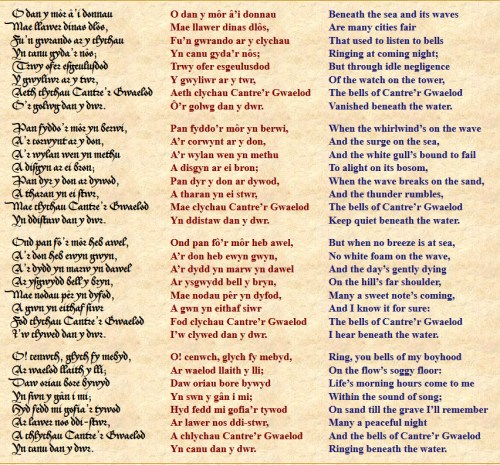
The poem Clychau Cantre’r Gwaelod (The Bells of Cantre’r Gwaelod) shown here is taken from the the Glaemscrafu website, where the following details are given: “Clychau Cantre’r Gwaelod (The Bells of Cantre’r Gwaelod) is a poem of John James Williams (1869-1954), J. J. by his bardic name. A pastor and a poet, he composed secular poems, many hymns and two scriptural plays. He competed in the poetry contest of the Eisteddfod Genedlaethol Cymru (National Eisteddfod of Wales), the most important of the yearly festivals of Welsh culture, and won the chair awarded to the best bard in 1906 and 1908.”  Interesting that the story was interpreted by The Guardian as one of a series of 21 poems that speak to issues of climate change.

The poem Cantre’r Gwaelod shown here is taken from the the Glaemscrafu website at https://www.jrrvf.com/glaemscrafu/english/cantrergwaelod.html

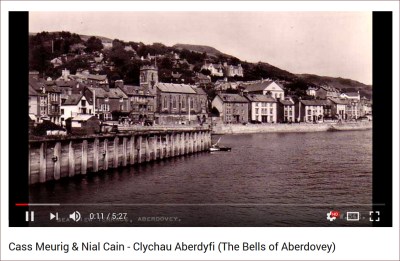
The probably better known love song The Bells of Aberdyfi (Clychau Aberdyfi), beginning “If to me you can be true, Just as true as I to you, It’s one, two, three, four, five and six Sing the Bells of Aberdovey” is often cited as a Welsh poem, but its origins lie in the 18th Century English theatre.  In the New Grove Dictionary of Music and Musicians, folk music expert Frank Kidson wrote: ” Charles Dibdin, who, writing a song for it in broken Welsh, used it in his opera Liberty Hall (1786). Miss [Jane] Williams, hearing it traditionally, published a version of it in her collection of 1844, and from that time onward it has been accepted as genuine Welsh. There is certainly no evidence to show that Dibdin used an existing tune (it was quite opposed to his practice), and no copy can be found except Dibdin’s of a date prior to 1844.”  The lyrics are available in both English and Welsh on the Musica International website, and the song can be heard on YouTube, a beautifully sung gentle and lyrical version in Welsh by Cass Meurig and Nial Cain at https://www.youtube.com/watch?v=d2knRU0–dQ.  Here are the English lyrics:

If to me you can be true,
Just as true as I to you,
It’s one, two, three, four, five and six
Sing the Bells of Aberdovey.
One, two, three, four, five and six
It’s one, two, three, four, five and six
Sing the bells of Aberdovey.
Boys do love to be in love,
And girls do love to marry.
But my love’s for only one,
For Bess of Aberdovey.
If your love is just as true
As this love I have for you,
It’s one, two, three, four, five and six,
From the bells of Aberdovey.

Bold with love I’m back once more
Just to camp against your door.
It’s one, two, three, four, five and six
Sing the Bells of Aberdovey.
One, two, three, four, five and six
It’s one, two, three, four, five and six
Sing the bells of Aberdovey.
Here’s and end to all faint hearts,
Till truth it is you’re pleading.
If you just meet be half way,
It wil be all I’m needing.
If your love is half as true
As this love I have for you,
It’s one, two, three, four, five and six,
From the bells of Aberdovey.

The legends of the bells of Aberdovey have become part of the literary and folk music landscapes of Wales, and a fine tradition it is too.

A Background to Shipping and Shipbuilding in Aberdovey

Introduction

I will be talking about shipping, shipbuilders and individual ships over the next weeks and months, and in order to put these topics into context, I have been looking at how a maritime tradition developed not merely in Aberdovey but in west Wales as a whole. The following summary, amalgamating information in a number of secondary resources, is brief but hopefully provides sufficient information to introduce shipping and shipbuilding in the Aberdovey area. For those who would like to read more, I have listed the books and papers I used at the end of the post.

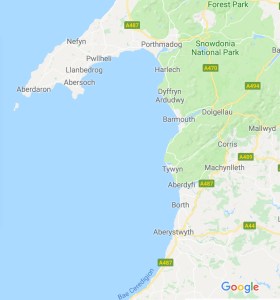
Mid-West Wales showing the locations of Aberdyfi (or Aberdovey), Tywyn, Borth, Machynlleth, Aberystwyth, Corris and Barmouth, key places in the story of coastal and deep sea trade and boat- and shipbuilding. Google Maps.


The 900-mile Welsh coastline, includes many river estuaries and natural harbours.  Mid Wales sits within Cardigan Bay, a sweeping arc at the east of the Irish Sea, extending from the Llyn peninsula in the north to St David’s peninsula in the south.  As Moelwyn Williams says:  “the small ports and creeks along the coastline were focal points in the economic life of the Welsh people: they formed a kind of network of commerce and trade.”  Often largely cut off from the interior due to the absence of roads, and excluded from land-based trade networks, it may have seemed inevitable that the Welsh coastal inhabitants would take to the sea, but in fact up until the 18th Century the vast majority of the ships exporting Welsh goods and supplying Welsh ports with Welsh, Irish and English goods were either English or Irish.

The Middle Ages

During the Middle Ages natural harbours became important for provisioning of military bases established by foreign invaders to fend off attempts to oust them.   This means that most shipping engaged in trade at that time was not Welsh but Norman.  J. Geraint Jenkins describes how wine and fruit imports could come from as far away as France and Spain, giving the example of Edward III who gave Tenby a grant to build its first landing stage in 1328, enabling it to import wine from France.  Wales in return exported agricultural produce, animal hides and wool.  Other traders came from nearer to home, particularly from ports along the Bristol Channel, exchanging a wide variety of imports in return for agricultural produce.  An important fishing industry also developed during the Middle Ages, taking advantage of the rich herring shoals, both for local consumption and, salted, for export.  The salt for preserving the herring was imported from Ireland, Cheshire and Lancashire.  Irish vessels carried most of the salted fish for export, and most other ships came not from Wales but ports like Liverpool and Deeside.  Piracy and smuggling were both common, with Irish salt the most commonly smuggled import due to its importance for preserving fish for export and the high duty imposed on it since 1693.  Smuggling of salt only ceased when the duty was dropped in 1825.

The 17th and 18th Centuries

After the conflicts of the Middle Ages a wide range of commodities and industrial products were transported along the coastline.  As J. Geraint Jenkins says “Much Welsh export was transported in the veritable armada of ships owned by local people who traded the entire length of the Welsh coast.”   This highlights two important points.  Ships were owned by local people, sometimes by individuals who owned only one ship, usually by locals who combined their resources to purchase shares in a ship, and only more rarely by ship owners who could afford more than one ship, sometimes extending to a small fleet.  The second point is that whilst much of the trade was local, in the sense that it was focused on moving commodities from one part of Wales to another, an eternal revolving door of commercial activity, some ships were also travelling regularly to Ireland and Europe, exchanging local Welsh products like wood, wool, coal, fish, wheat and beer for commodities like wine, different agricultural produce, fruit and kitchen wares.

Map of Aberdovey and its harbour in 1801. By William Morris and Lewis Morris. (National Library of Wales. Used under terms of license)

In the 18th Century, Wales was swept into the Industrial Revolution and goods like lime, coal, granite, bricks, slate, tin, lead and copper joined the export trade, and it seems to have been this that gave Welsh coastal inhabitants the impetus to take to the sea.  As these new materials acquired increasing importance, so did the Welsh coastline, with investment both into improvements at existing ports, harbours and wharves and into new ports to serve specific industries.  At the same time, small flat-bottomed boats continued to land on beaches to unload their cargoes, requiring no specialized facilities.   Passengers, too, increasingly required transportation between commercial centres.   Coastal work dominated, but long distance trade also continued to have an important role, not merely to Europe but across the Atlantic and elsewhere, facilitated by both local and foreign shipbuilders who were now building the larger ships required for such enterprises.  Moelwyn Williams says that by 1768 there were around 60 ports and cargo handling creeks in Wales from Chepstow in the south to Chester in the north.  In the early days of its maritime tradition, many sailors were also engaged in land-based trades, spreading the risk.  By the 19th Century, however, sailors were engaged in the maritime trade full time.

The 19th Century

The High Street of Cardigan in 1855 by Joseph Clougher (Source: National Library of Wales. Used under license)

It was only in the 19th Century that Welsh ports developed into more prosperous and organized enterprises, hubs for longer distance and sometimes international trade, building on the 18th Century trades and reinforcing it with new produce.  Exports included slate, lead, copper, oak poles and planks, wooden furniture, bark, trenails (wooden pegs), butter, cheese, wheat, malt  animal hides, dried salmon and wool were exported.  Williams says that imports included goods from Liverpool, including bricks, tiles, boards, fir timber, potatoes, turnips and clover seeds as well as foreign commodities such as tea, sugar, tobacco, raisins, Spanish wines and spirits.  Competition opened up between ports, both under sail and under steam, as trans-Atlantic trade and passenger travel took off.  Steam began to make its presence felt in Wales from the first half of the 19th Century, but as Williams and Armstrong discuss, sail still dominanted for heavy cargoes, partly because steamers were most appropriate for rivers and lakes rather than the open sea, fuel costs for carrying the heavy industrial cargoes were prohibitive, and they were unsuitable for bulk cargoes due to the size of the coal bunkers that they carried.  For most of the 19th Century sail and steam worked together in harmony, each suitable for different roles.  Competition with the railways, spreading remorselessly into even the most remotest parts of England, Scotland and Wales, undermined coastal shipping, but provided some ship owners with the motivation to engage in more ambitious trading enterprises in the long distance deep sea trades.  These ships were usually not based in Wales, and did not export Welsh goods, but many of them were owned by Welsh individuals and companies who were themselves based in Welsh villages and many were crewed by Welsh sailors.  Local shipbuilders now had to compete with the Canadian counterparts for business.  Many of the big ships owned in Wales were built by  famous clipper and schooner shipbuilders in Canada used to designing ships that could tackle the dreadful conditions around Cape Horn.  Both American and Canadian ships were larger than most British ships.  In spite of the benefits of size and short-term durability, they were built of softwoods, which had a much shorter lifespan than the durable hardwoods preferred by British shipbuilders.  Welsh sailors were soon to be found on ships travelling all over the world on ships that could be away from Britain for many months at a time, travelling west from ports like Liverpool, London, Bristol and Cardiff to Europe, New York, round Cape Horn to Peru and California and east as far as China, Japan and Australia.  The main exports from Wales were slate and coal, with ships returning from Canada with salted dried cod for the Mediterranean, from America with copper ore, from Peru with guano, from Chile with copper ore, from the China and Japan with tea, from Australia with wool, from the Mediterranean with wine, oil, fruit, iron ore and zinc, and from eastern Europe with grain for western Europe and timber for Britain.  All destined for the major British ports including Liverpool, London, Newcastle, Bristol and Cardiff.  Iron ore and copper ore were of particular importance to south Wales where the tin and steel trades were developing towards the end of the 19th Century.

Cardiff from the South by Paul Sandby in 1776, showing two sloops on the River Taff (Source: MeisterDrucke https://www.meisterdrucke.uk/artist/Paul-Sandby.html

Cardiff became the biggest port in Wales and in the north Holyhead on Anglesey was dominant due to its connections with Ireland.  In mid-west Wales Cardigan was an important port until the late 18th Century, when Aberystwyth, which had started to become a successful port during the late 18th Century began to overtake it.  Liverpool dominated west coast trade in the northwest.   There were many attempts to establish mid-Wales terminals for either crossing between Britain and Ireland, or as bases for trans-Atlantic passenger liners.  Porthmadog, on the northwest Welsh coast, became important due to the demand for slate in the early 19th Century.  Unlike Cardigan, which grew up over the centuries, it was the brainchild of William Maddocks who in 1810 created a sea wall and diverted a river in order to reclaim land for agricultural use, which led to the river carving out a natural harbour at Porthmadog, making it an ideal location for exporting slate.  Four narrow gauge railways descended into the town, which became an important port and an important shipbuilding centre, producing famous schooners.

The Charlotte of Aberdovey. (Source: “My Welsh Ancestry” website by Alan Jones at http://www.mywelshancestry.co.uk/John%20Jenkins/John%20Jenkins%20Story.html)

Shipbuilding was a natural match for a country with an important export trade and a poor inland transport infrastructure.  As trade grew, so did the demand for new ships, the men to sail them, and all the crafts associated with the shipbuilding industry.  Wood and metalworking, rope-making, sail-making, anchor manufacture, mast-makers and other craft specialists, all provided work for local craftsmen who benefited from the business.  Building wooden sailing ships was surprisingly low-tech.  It did not require, for example, the construction of dry docks or the provision of cranes.  All that was needed was a flat piece of land, preferably a beach or close by, the supply of timber, particularly oak, a saw pit and something to act as a mould loft (a sort of design studio) where the ship plan is laid out, and and men with the requisite skills to create scaffolding, work wood and finish a ship.  Porthmadog was famous for its beautiful schooners, but a lot of other Welsh ports produced ships, including most notably Barmouth and Pwllheli, and the river Dyfi was a smaller base for shipbuilding at Aberdovey, Penhelig, Morben and  Derwenlas.   Some of the vessels produced were small sailing ships, with no more than one mast, like sloops, smacks, snows and ketches, but many were more ambitious including two-masted schooners such as the 84 ton 75ft Frances Poole, the 112 ton 83ft Acorn and the Jane Owens, both built by John Jones of Aberdovey, brigantines such as the 148 ton 88ft Charlotte built in Barmouth for Aberdovey owner Thomas Daniel, and square rigged brigs, including the substantial two-masted 208 ton 101ft Rowland Evans, built at Derwenlas and even three-masted barques like the Mary Evans.  The bigger ships, particularly the square-rigged ships, travelled all over the world, as demonstrated by Alan Jones’s description of the career of John Jenkins, born and raised in Borth in the 1800s, who sailed on several Aberdovey-built ships.  Churches and chapels for different denominations grew up,  support services for locals and visitors developed and an entire social infrastructure, including schools, pubs, hotels, shops and ferry services evolved to serve the needs of these growing communities.  Local railways serving quarries and mines improved the connection between industries and ports and even the roads eventually improved.

Ships were financed by local investors, each of whom owned one or more of 64 shares.  These included the ship’s captain, farmers, quarry owners, merchants and similar businessmen with who had need of ships for their own business ventures, as well as craftsmen who worked on the ships, the ship’s and ordinary people from the local community who saw them as an opportunity for profit or to expand meagre incomes.  When larger enterprises developed with two or more ships, the most common model for ship ownership was the Single Ship Company, in which the manager or owner takes a portion of the gross earnings of the ship rather than a share of its profits, thereby benefiting from its successes without suffering from its losses.  An alternative with the Limited Joint Stock Company, an innovation of the 19th Century in which an individual could invest in a company without risking his personal fortune.

The S.S. Countess of Lisburne (Source: National Museum of Wales at https://museum.wales/industry/images/?action=show_item&item=3188)

As steam began to replace sail on all but the most remote parts of the globe, where steamers were unable to carry sufficient coal for the long legs between coaling stations, the Welsh shipbuilding industry began to go into decline.  The Welsh coastal ports never invested in the development of a steam shipbuilding industry, and the shipbuilding industry died out when steam largely replaced sail during the late 19th Century.  With a busy coastal trade based on steam, Welsh boys and men continued to go to sea, in spite of low salaries and uncomfortable conditions, finding it a viable alternative to work available in small farming communities and the hinterland beyond.  Even with the advance of rail, much of west Wales still offered limited opportunities for young men who did not want to work on the land or leave to find work in other areas.  Jenkins says that in the big ports, steamship owners “preferred sailors from rural Wales because they know how to handle a ship in difficult situations on a rugged coastline” and that on many ships sailing from Cardiff, Welsh was the first language.

Shipping and Shipbuilding in Aberdovey

Aberdovey was located in the Ynysymaengwyn estate, in the parish of Tywyn, at the far south of Meirionnydd (formerly Merionethshire).  It is a good example of a small fishing village, specializing in herring, that grew into a small but important port as its own natural resources became desirable elsewhere. Lewis Lloyd, in his admirable book “A Real Little Seaport” (1996), describes how, in its hey-day “Aberdyfi was a great deal more than a coasting port with a modest fleet of locally built smacks and schooners . . . . Aberdyfi possessed a number of deep-water or ocean-going vessels which sailed to distant places and Aberdfyi’s larger schooners, especially those built at Aberdyfi by Thomas Richards, sailed to St John’s Newfoundland, and to Labrador along with Porthmadog’s famous 3-masted schooners. . . Aberdyfi was, in short, a complete and diversified small port.”  Aberdovey started from modest beginnings, and there are almost no traces of its shipbuilding and shipping past now, but it is still possible, via the work of a number of authors, to trace the history of Aberdovey and to locate some of the long-buried centres of activity on the ground today.

Williams says that the first official reference to Aberdovey as a port was in 1565, coming to life only during the herring season, when it was described as “a wonderful great resort of fishers assembled from all places within this Realm with Shippes, Boats and Vessells.”  Just two years later, however, the official port books show that a substantial amount of cargo was being offloaded at Aberdovey, and the same records show that lead ore was the chief export. By the end of the 16th Century Aberdovey was a busy maritime location.  Aberdovey became both the region’s registry throughout the 16th and 17th Centuries, and it was the most important herring port in Cardigan Bay.  Herring fishing took place in autumn and winter, and during the spring and summer the same vessels engaged in carrying coastal cargoes.  A Custom House had been established from at least the 17th Century, and J. Geraint Jenkins quotes a 1704 report from a local newspaper quoted by Jenkins that says that customs officers from the Aberdovey office caught three boats smuggling salt that was ready to be loaded on horses, around 200 of them, In New Quay.

Aberdovey in 1834 (National Library of Wales. Used under terms of license)

A significant source of work for Aberdovey came from its with Derwenlas.  Derwenlas, at the last navigable point on the River Dyfi, was the major port serving Machylleth, a thriving wool manufacturing centre based on the unnavigable part of the Dyfi, 2 miles inland from Derwenlas.  Industries like the 17th Century silver mill and Royal Mint at Furnace (Ffwrnais) and the subsequent lead smelting furnace on the same site in the 18th Century depended on the sea to send and receive cargoes.  Sea vessels were too large to navigate the river Dfyi, and river vessels were too small to tackle coastal waters, so all cargoes were trans-shipped at Aberdovey, making the port a hub for local trade.  Furnace is the subject of another post on this blog.  Machynlleth’s position at the meeting point of Montgomeryshire, Cardiganshire and Merionethshire at the border between north and south Wales was significant, and provided Aberdovey, as the main port for the Dyfi valley and beyond with, as Lewis Lloyd puts it, a certain “hybrid vigour.”  In 1770 the Custom House moved to Aberystwyth, taking with it some of Aberdovey’s status, but not its business. In 1776 a bigger blow was the establishment of the statutory registers of shipping, in which Aberdyfi was subordinate to Aberystwyth, which firmly established Aberystwyth as the dominant port in mid Wales.

In the 19th Century trade expanded and Aberdovey the relationship between Derwenlas and Aberdovey continued to be symbiotic, whilst Aberdovey began to develop in its own right.  Slate exports became Aberdovey’s main source of income from at least the 1850s, with other cargoes supplementing this trade.  Williams gives details of the cargo shipped down the river for export including slates, bark and timber, whilst imports included rye, wheat, limestone, and English and foreign hides.  Most of the area’s wool exports went out from Barmouth.  Jenkins describes how Corris slate was conveyed via tramway to Derwenlas and lead ore was was brought from Dylife in horse and cart. Samuel Lewis, writing in 1883, adds that tree bark, oak timber and oak pole for collieries were also loaded into river boats at Derwenlas.  Imports offloaded at Derwenlas included rye, wheat, coal, culm (a form of coal), limestone, hides and shop goods including groceries.   All products into and out of Derwenlas had to be carried by river, so Aberdovey functioned as the major hub for transferring cargoes to and from river boats  to and from seagoing ships.  Even cargoes destined for Aberystwyth from America were often trans-shipped at Aberdovey into barges from the 1840s, because Aberystwth’s harbour was too shallow to handle the the big deep-drafted trans-Atlantic vessels.  In 1852 a marine insurance society was formed in Aberystwyth, but Aberdovey never formed one, which, as Lloyd points out, underlines the secondary nature of Aberdovey at this time.

The largest ship ever built on the Dyfi, at Derwenlas, the 258-ton barque The Mary Evans built by John Evans in 1867 (Source:  Dyfi Osprey Project on Faceook at https://bit.ly/2N9YecU)

Shipbuilding took place all along the river Dyfi, at Aberdovey, Penhelig, Aberleri, Morben Isaf (now a caravan park) and Derwenlas.  D.W. Morgan says that in the mid 19th Century around fifty five schooners were built on the Dyfi, as well as a barque, two brigantines, three brigs and fourteen sloops.  Some of these larger ships were specifically built to serve the trans-Atlantic trade, where size and speed were in demand for carrying woollen goods.  The best known of the shipbuilders was Thomas Richards who built ships in Aberdovey. Ship’s crews came from the the parish of Tywyn, the Dyfi valley and its hinterland, with a remarkable number coming from Borth, on the other side of the river in Ceredigion, at that time Cardiganshire.

In the 1860s the railway connected Machynlleth and Aberystwyth, undermining Derwenlas, and the construction of a railway bridge to extend it up the coast cut off traffic upriver.  The railway arrived in Aberdovey in 1867, marking an end to the shipbuilding yard at Penhelig, which was already suffering from competition from experienced shipbuilders in the north-east and Canada.   Jenkins says that the last ship to be built on the Dyfi was the 1869 76-ton 75.2ft schooner/ketch Catherine built at Pennal.    It had been the same story in Borth, across the estuary, and Barmouth to the north. In both cases, when the Aberystwyth and Welsh Coast Railway arrived in the 1860s maritime trade went into decline and together with the shipbuilding industry.  This was just a year before the last sailing ship, the 1870 794-ton tea clipper Lothair, was built at Rotherhithe on the Thames, demonstrating that although the new Dyfi railway bridge, the west coast railway itself and Canadian-built ships were challenges to shipbuilding and maritime trade in the Aberdovey area, there was a bigger threat.

Steam power was slowly taking over the sea, and many steamships and long distance sailing ships were now iron-hulled.  Whilst some shipyards on the Thames began to make steamers, Wales never got to grips with building steamships, an industry that became concentrated in north-east England and, most importantly, in Scotland on the Clyde.  Steam, however, held out considerable hope for the future prosperity of Aberdovey, capitalizing on the proximity of Aberdovey to the Midlands and improving trade links along the coast. In 1834 the Cardigan Bay Steam Navigation Company began to provide a service between Aberystwyth and Pwllheli with the S.S. Vale of Clwyd, stopping at Barmouth, Aberdovey, Aberaeron and New Quay.  It carried passengers in the summer but also carried cargo in the winter, including livestock, and agricultural produce.  In 1880 the Waterford and Aberdovey Steamship Company was established to connect the Midlands to Ireland for carrying livestock and passengers, but this was short-lived. In 1892 the Aberdovey and Barmouth Steamship Company Ltd., financed mainly by Liverpool wholesale grocers,.sailed most weeks between Liverpool and Aberystwyth with three ships, the S.S. Countess of Lisburne, the S.S. Dora and the S.S. Grosvenor.

The decline in maritime trade was not the end of Aberdovey’s prosperity in the short term.  Slate was carried on the Talyllyn railway into Tywyn, where it was trans-shipped to Aberdovey and then loaded on to the mainline railway.

Crowds at the Aberdovey wharf at a regatta in c.1885. (National Library of Wales. Used under terms of license)

In the 1880s the slate trade went into a slump, but in 1882 new wharves, animal pens and warehouses were built, handling imports of timber, corn, livestock and fuel for distribution both locally and throughout Britain, and it continued to handle diminished exports of local slate and agricultural produce.  As steam took over from sail, the character of the town changed.  Although hopes of becoming a port between Ireland and the Midlands was sustained for some time, these were doomed to failure because Holyhead in the north and first Neyland and then Fishguard in the south dominated shipping across the Irish Sea, both thanks to excellent rail connections with London.   Sadly, hopes of a trans-Atlantic steamer service also came to nothing.  Trade, like shipbuilding, began to suffer in the late 19th Century, in spite of the railway.  Jenkins describes how the lead and slate industries went into decline and the wool trade came to a close.  Timber continued to be imported, and the Melin Adrdudwy steam flour roller mill continued to be productive in the late 19th Century, but by 1914 the main form of income was tourism.

Future posts will look at some of the above topics in more detail, with reference to specific examples from Aberdovey and the surrounding area.

References

The main sources for this post are as follows, with full details listed in the Bibliography:
Fenton, R. 1989
Gwynedd Archaeological Trust 2007
Jenkins, J.G. 2006
Jones, A. 2010
Lewis, S. 1833
Lloyd, L. 1996, volume 1
Morgan, D.W. 1948
Williams, D.M. and Armstrong, J. 2010
Williams, M. I. 1973

The Salt Association website

A squirrel visitor – and a short history of the grey squirrel in Britain

I had a visitor today, trying to find a way into my squirrel-proof bird feeder.  A friend of mine refers to squirrels as rats with tails, but they have supporters because of their endearing features, the bushy tail and their gymnastic abilities. They are often audacious, quite tame and can be very entertaining to watch.  Their detractors consider them to be vermin, with good reason. They steal bird eggs and eat baby birds, dig up and eat spring and summer bulbs and new shoots, and they chew through tree bark, leaving the tree vulnerable to disease. They also carry squirrelpox (to which they are themselves immune, but to which red squirrels are vulnerable), and they replaced the far less destructive red squirrel, which is now confined to more marginal areas.

The American grey squirrel was brought to England deliberately in 1876 by a Cheshire landowner. It was hunted and eaten in the U.S. and was probably introduced into England for that purpose (they are still eaten in the US). There were so many in Woburn Abbey’s grounds that between 1905 and 1907 they were released into Regent’s Park, from where they spread to London’s green areas. Their apparent impact on the red squirrel and the damage to trees, bulbs and new shoots was very unwelcome and between 1917 and 1937 four thousand grey squirrels were shot in Kew Gardens alone. By the 1930s it was already considered to be a pest and had spread over a big distance. Between 1945 and 1955 a reward of a shilling a tail was paid in some rural areas and squirrel shooting clubs began to grow in number.

By the 1940s the grey squirrel had completely replaced the red in most areas. The Guardian quotes a 1995 report which says that red squirrel populations in the UK (1995) revealed that there were 161,000 in the UK, with 121,000 in Scotland; 30,000 in England and 10,000 in Wales. Things have changed since then, the grey squirrel is more efficient on British soil, better at finding food supplies and carries a deadly disease (called squirrelpox virus) that it is immune to, but kills red squirrels. It is estimated that grey squirrels outnumber reds by more than 60 to one in England. But there are still red squirrel strongholds on islands (Isle of Wight, Brownsea in Poole Harbour, Anglesey) and in the north of England and Scotland.  Although there are a number of well-aired urban myths on how this replacement took place (which typically takes between 15 and 20 years), academic research projects have actually failed to identify the process by which the red squirrel is ousted in favour of the grey. There is one theory that they abandoned the struggle mainly because the areas in which grey squirrels survive is not their favoured habitat anyway. Whilst grey squirrels prefer deciduous parkland, the red squirrels are far better adapted to coniferous woodland. It is thought that the above-mentioned virus may have contributed significantly the demise of the red squirrel. It could be that it was it was not one circumstance but a number of different ones that saw the retreat of the red squirrel and the diminishment of their numbers in favour of the American interloper.

The Forestry Commission have advice on how to control grey squirrel damage to woodland on their website (in PDF format).

If you want to know more about the red squirrels then the Friends of the Anglesey Red Squirrels website is a good place to start.

Finally, there are grey squirrel support sites too, including squirrels.info.