Category Archives: Living

Vintage postcards #5: Terrace Road in the moonlight

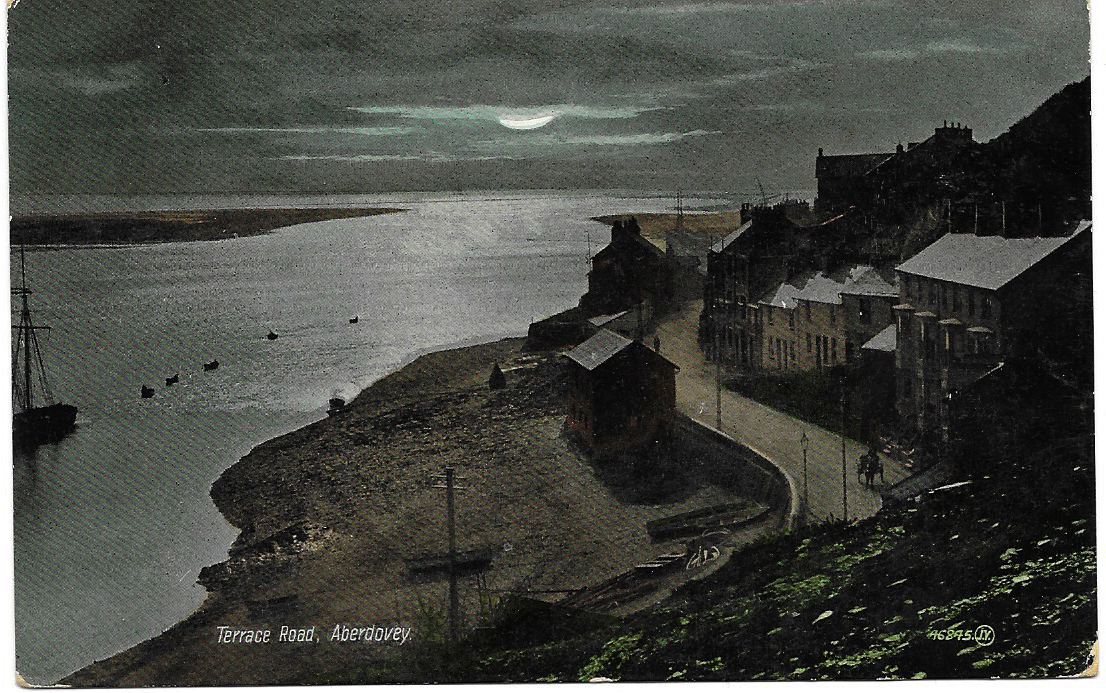
I love this postcard.  It shows Terrace Road in Aberdovey by moonlight, with a slightly overcast sky, the silver sheen reflecting off slate roofs and casting a bright glow over the estuary.  The most prominent building in the picture is the little structure on the beach, a purpose-built lifeboat house to provide a home for the village’s first lifeboat, Victoria, in 1837 and now called Traeth Dyfi (Dovey Beach), it had an entrance for the lifeboat under the west gable and a pedestrian entrance opening out on to the road. Victoria was replaced with two newer and bigger vessels in 1856 and 1865, each kept in the same building, but it went out of use as a lifeboat house when a bigger lifeboat was needed in 1886.  A slipway, which does not appear in the above postcard, was added on this side of the old lifeboat house in 1903 and can still be seen today, although the lifeboat now has its own dedicated building that it shares with the yacht club near the jetty. After the lifeboat moved, Traeth Dfyi became a cake shop and tea room and in the 1960s was converted for residential use.  It is currently available as a holiday let, with pictures on the website of the modern interior, and a history of the building (from which most of the above details are taken) for those interested in more information.  The building seen as a silhouette in side view in the postcard and, in the photograph, as a white-painted building beyond the old lifeboat house is the three-storey Georgian house Plas Dyfi, which is currently for sale.

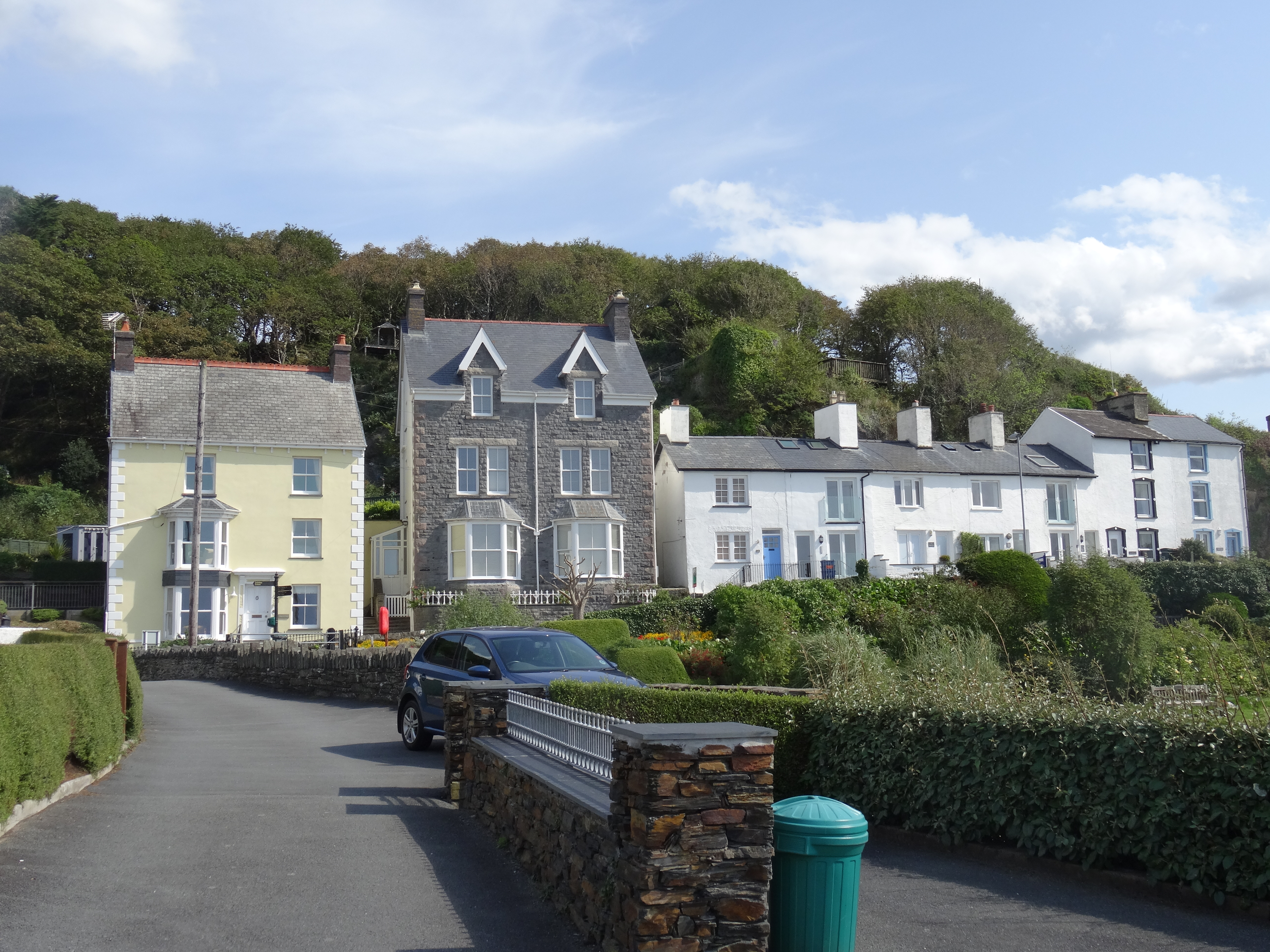
The above photograph shows the view as it is today, taken on 17th November 2019.  It attempts to reproduce the viewpoint but I couldn’t get the elevation.  The picture was clearly taken from the hillside.  The yellow building on the beach is the old lifeboat house, and the four-bay white house to the right is Cliffside.

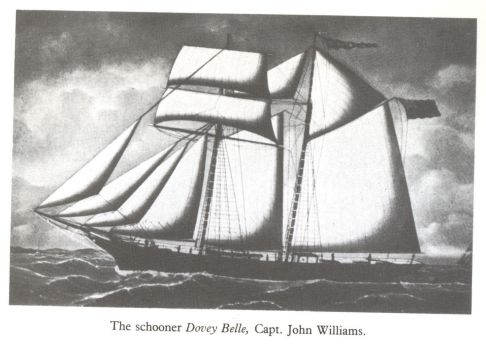
The Dovey Belle topsail schooner. Source:  Lewis Lloyd 1996, A Real Little Seaport, volume 2 (plate between pages 120 and 121)

Cliffside is also at the far right of the postcard, a terrace of four very fine four-storey houses.  Before the construction of Cliffside, in the mid 1880s, the site was the site of a lime kiln, employed to turn imported limestone into powder for spreading on lime-starved land.  In 1901 no.2 Cliffside was home to Master Mariner Captain John Williams (1865-1937).  Captain Williams was born in Aberdovey and had served on his father’s ship, eventually becoming Master of the Aberdovey-built Dovey Belle.  He had lived at No.35 Copper Hill Street in 1900 when he was aged 35, but in c.1901 seems to have moved to Cliffside. He became Master of the schooner 1867 Aberdovey-built topsail schooner Dovey Belle, built by Thomas Richards at Aberdovey registered No. 9 in 1867 at Aberystwyth.  According to the well-researched Williams Family Tree website “she became the last locally built sailing vessel to ply to and from Aberdovey on a regular basis.”  No.4 Cliffside was the home of Hugh M. Lewis M.B.E., who lived his entire life in Aberdovey, wrote several memoirs of the village and was awarded an M.B.E in 1993 for his service to the community.

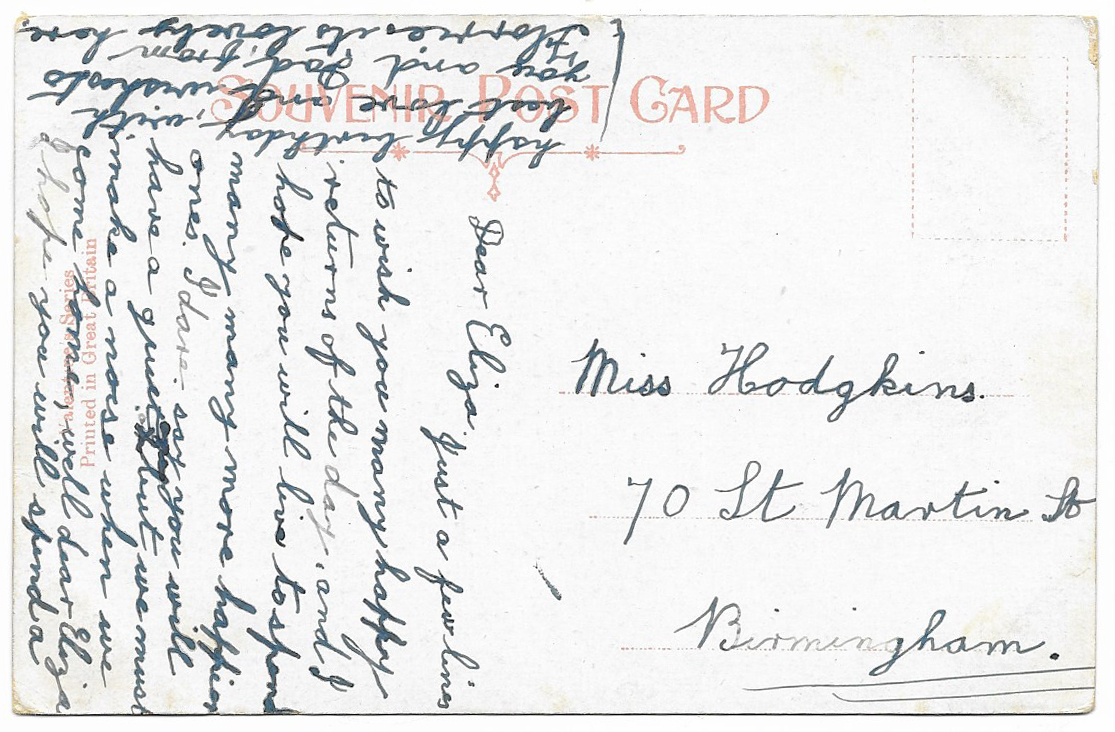
There’s no stamp or postage mark, even though there is a message and a Birmingham address, apparently ready for posting.  It was sent in lieu of a birthday card, and I hope it brought a lot of pleasure to the recipient, Miss Eliza Hodgkins, if she ever received it.  Out of curiosity I looked up the postal address but although St Martin’s Road still exist, half the road is a building site and the other half is dominated by a huge multi-screen cinema and other modern block-like structures.

I can’t read the print under the handwriting.  There is a code on the front of the card, (46845 J.V.), which could indicate that this was manufactured by James Valentine.  If so, the Valentine postcard dating page on the Historic Coventry website puts that code at 1905.  In the picture masted ships are shown just round the corner, there is gas lighting (installed in 1868; electricity was not installed until 1945) and a horse pulls a small cart.  These are all consistent with 1905 being a plausible date but the design and colour printing on the back seem more modern.  It is possible that a newer printing run used an older image.  It would be good to get an idea of a possible date range from other postmark or  from other cards, so I’ll keep an eye open.


Vintage Postcards #4: The Roman Road

The Roman Road as it is today from a similar viewpoint to the first postcard, with Trefri in the background

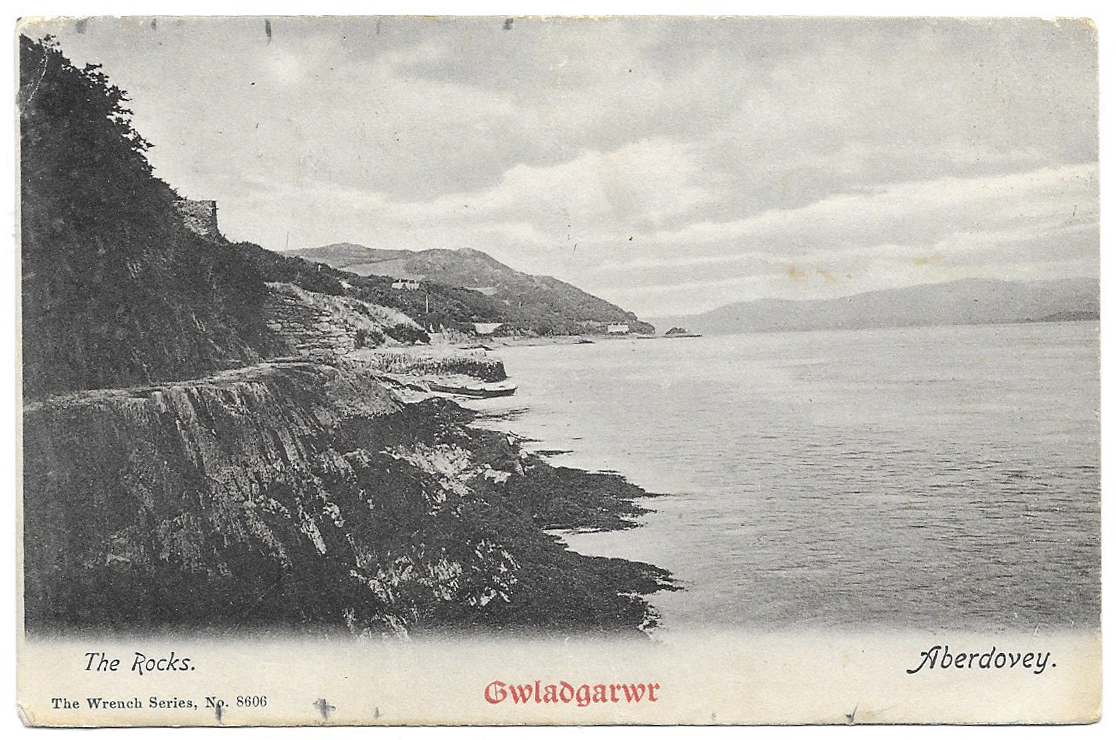
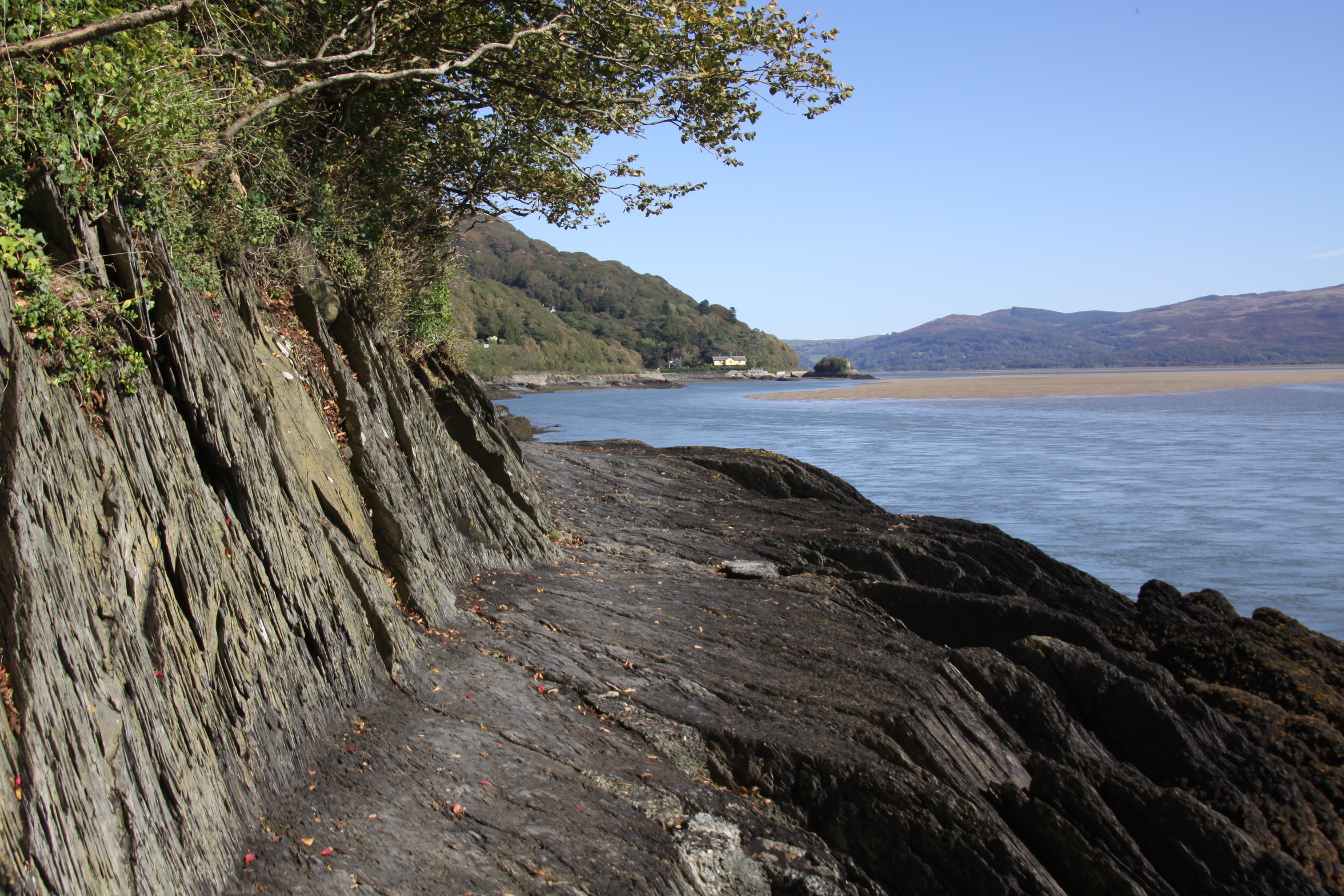
The Roman Road is a nice local myth.  It forms part of a popular low-tide walk along the estuary to Picnic Island (which I have written about here) and is a truly remarkable sight, cut out of the black Aberystwyth series shales, which in places are so smooth that the rock looks polished and glistens in the sun.

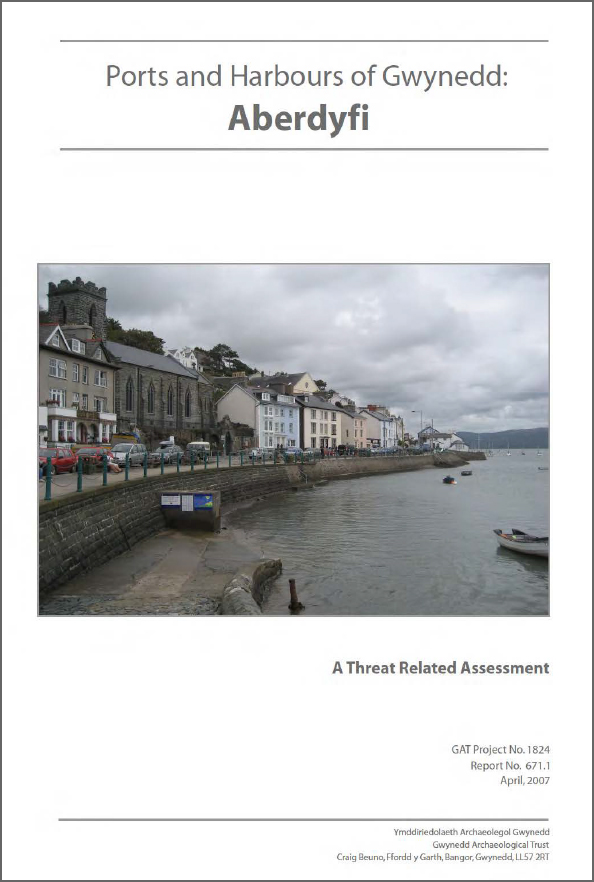
Although there is a Roman fortlet at Pennal 11km away, there are very few indications that the Romans did anything more than pass through Aberdovey, if they even did that.  Trying to find out what it was built for I first looked to Hugh M. Lewis, who wrote several histories of the village, but he was unable to shed any light on the subject.  My original guess was that it was built in the 1860s, part of the works for the building of the railway, but that failed to address the question of the purpose of such a track.  In his description of a 6-mile walk that incorporates the road, the author David Roberts, an Aberdovey resident, states that the track was built in 1808 for horse and carriage, but he doesn’t expand on this observation.  I then found a publication by the Gwynedd Archaeological Trust (GAT Ports and Harbours of Gwynedd, 2007) that contains the following statement, and which appears to confrim what David Roberts says and provides sources for identifying this as a road designed to connect to a stretch of road that already linked Pennal to Machynlleth:

Fenton remarks in 1808 that a new road was under construction from Aberdyfi to Machynlleth but implies that the section from Pennal to Machynlleth was already in being, that an extension west and north to Tywyn ‘by way of the sands’ was contemplated if not actually under construction. This road, known as ‘hen ffordd Corbet’ was not a success, being built so low that it was frequently covered by the tides. Its course is marked on the plans for the replacement road dated 1823 and prepared by Thomas Penson (DRO: Z/CD/168).  This is probably Thomas Penson junior (1790-1859), county surveyor of Montgomeryshire, a versatile and able architect-engineer, rather than his father. Lewis states that this road was completed in 1827

I am still unsure if this is the correct answer, as the track barely seems wide enough for horse-drawn vehicles, and in places would have been lethal underfoot for horses.  One would need to see Penson’s plans for the replacement road mentioned by the Gwynedd Archaeological Trust’s report.  Whatever its original purpose, it is invaluable today as a ready-made footpath for walkers.  The note about the road being unpopular due to being submerged by tides holds true today.  The walk is impossible without wading through water at high tide.  I note that the second of the two postcards does not commit itself on the subject and states merely that the scene shows “The Rocks.”

The first postcard was unused, so there are no helpful postmark or stamp details to give an indication of date.  It was manufactured by Lilywhite Ltd of Triangle, Halifax.  Lilywhite was set up by Arthur Frederick Sergeant (1882-1952) in around 1910 and produced postcards at least until 1931 when their factory burned down, destroying both prints and negatives.  They took over Arrow Series Postcards in the 1920s and as well as retaining the Arrow name for some of their postcards, re-released some earlier Arrow postcards under the Lilywhite name.  I’ll keep an eye open for a used version of this postcard to see if I can find a date or at least a date range.

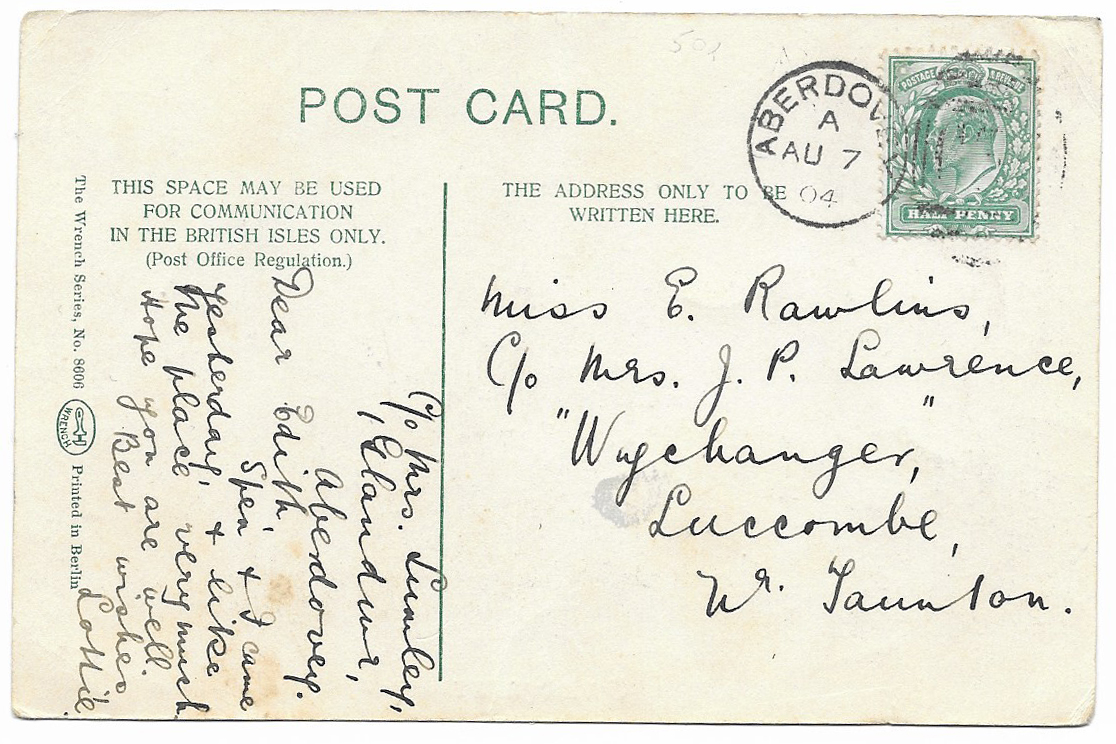
The second postcard has a Edward VII stamp and an Aberdovey postmark dated August 7th 1904.  Edward VII reigned from 1902-1910, and this particular shade of blue-green was issued between 1902 and 1904.

I loved the brevity of the message, which also contained the brilliant information that the sender had been staying at Glandwyr in Aberdovey. 115 years later it is owned by a very nice local holiday company, Dyfi Cottages, that lets out properties in the village and also runs the Visit Aberdovey Facebook page.  There’s a lovely sense of continuity in those details.  I suppose that postcards were, and still are, a form of social media, a way of maintaining communication with people far away.  The postcard was sent to the beautiful village of Luccombe, which now lies in Exmoor National Park in Somerset.  The house to which it was sent, Wychanger, was a manor house now Grade 2 listed and converted to semi-detached homes.  It is fun to have the full breadcrumb trail.

Photograph showing the location of Glandwr, used with permission, copyright Dyfi Cottages and Aberdyfi Holidays

Evelyn Wrench, from an article in
‘The Pictorial Magazine’, January 2nd 1904. Ref: Wr D 48/65.  Source: The University of Nottingham’s Manuscripts and Special Collections blog

The 1902 Post Office regulations are provided as simple instructions on each half of the back of the card, leaving no room for any confusion!  The title Gwladgarwr at the front of the card is a puzzle, appearing on a lot of Wrench’s Welsh postcards.  It means “patriot” and was the title of a Welsh language newspaper (Yr Gwladgarwr), but the newspaper appears to have no connection with the postcard manufacturer.  The card is in the Wrench Series, no.8006, and was printed in Berlin.

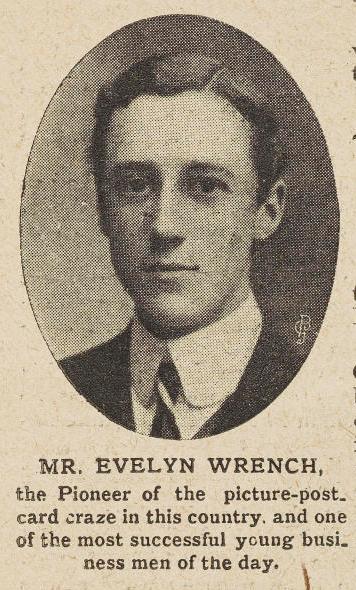
Sir John Evelyn Leslie Wrench (1882-1966) was a British author and journalist.  While in Germany after leaving school, Wrench was impressed with the popularity and high quality of German postcards and decided to shelve his plans to become a dimplomat and instead set up a British business producing high quality postcards in sepia, black and white, and colour.  He had his resort postcards printed in Dresden (Saxony) and Berlin from where they were shipped in bulk to London.  Although it remained in business for only a few years, the postcard company was a initially a phenomenal success and Wrench himself became something of a media darling.  Based in Haymarket in London Wrench’s postcard company had over 100 employees and sold in the region of 50 million cards, all before he had reached 21 years of age.  Wrench went out of business in 1904, having sunk too much capital into the company, leaving him unable to repay loans but he went on to have a very successful career.  He was founder of the Royal Over-Seas League, became editor of The Spectator and was knighted by George V in 1932.

Vintage postcards #3 – Penhelig Beach

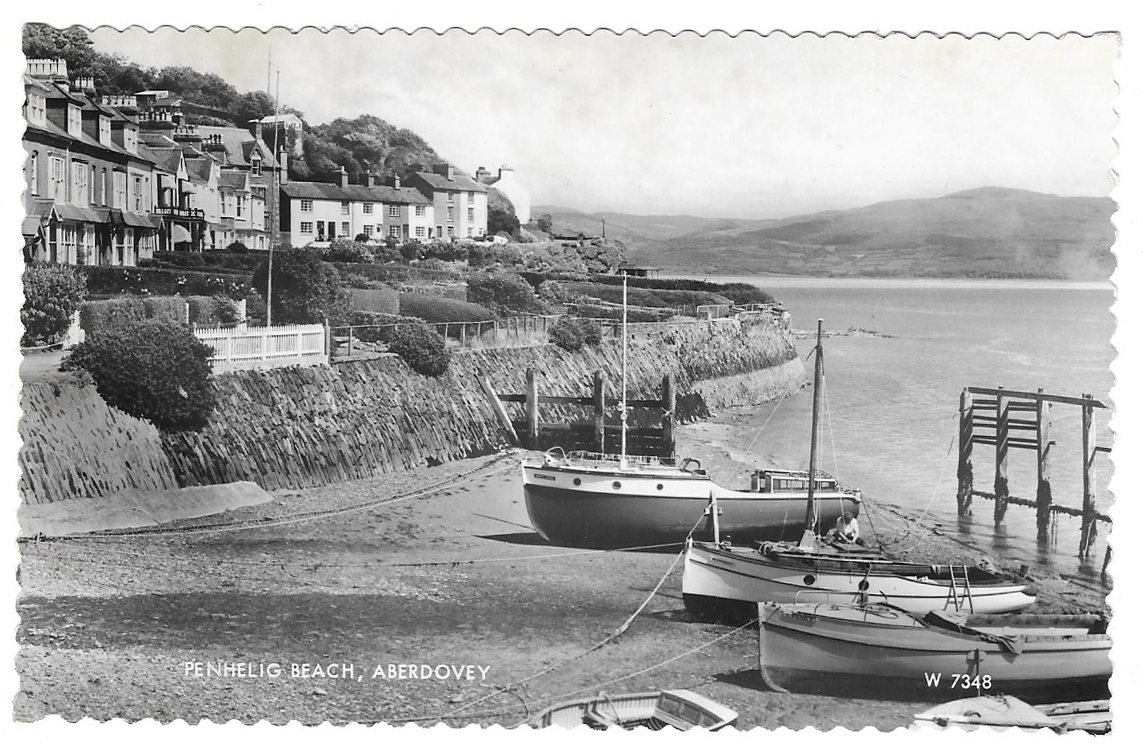
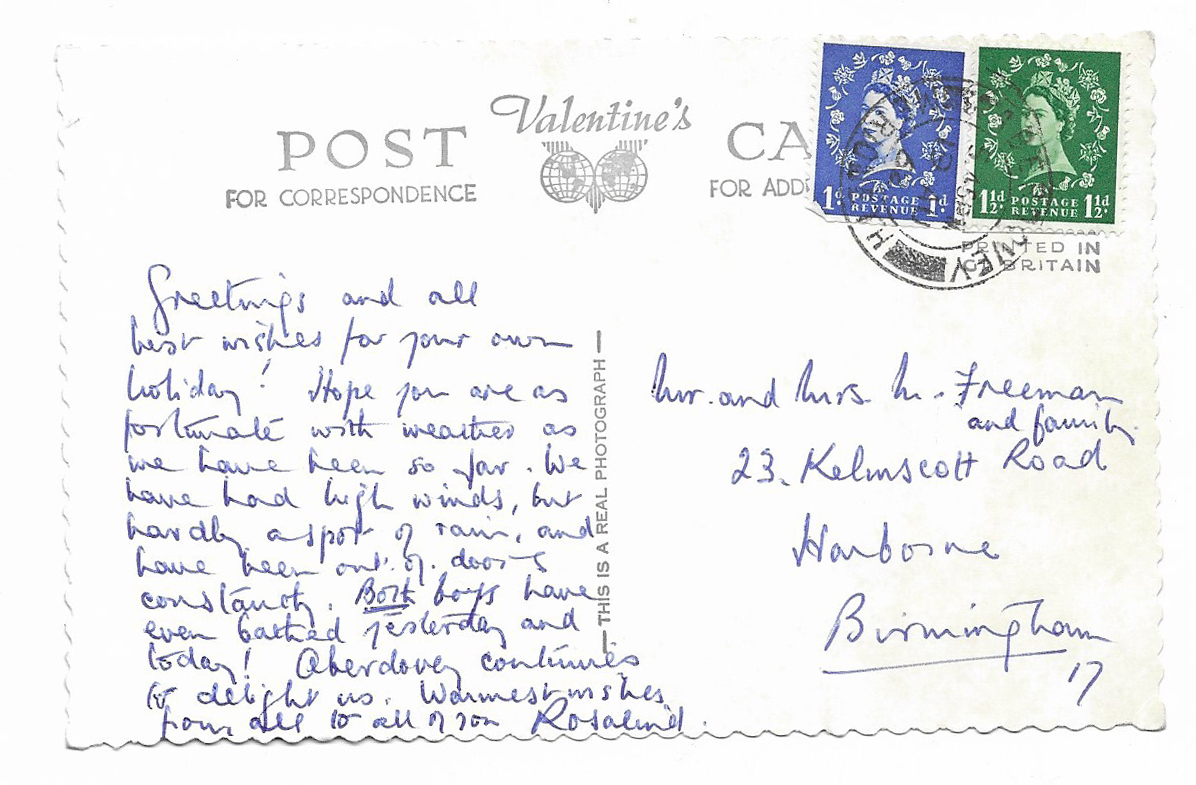
Not quite as vintage as postcard #1 and postcard #2, which were dated to 1910 and 1903 respectively, this view of Penhelig Beach has an Aberdovey Merioneth postmark dated 19th August 1962 and features two Queen Elizabeth II stamps (a blue 1 penny and a green 1 1/2 penny).  Elizabeth had been on the throne for 10 years when this postcard was sent to Harborne in southwest Birmingham.  The big carpark on the sea front and the modern developments at the top of Copper Hill Street, along Mynydd Isaf and Maes Newydd and related roads had not yet been built and the village must have had a very different character.

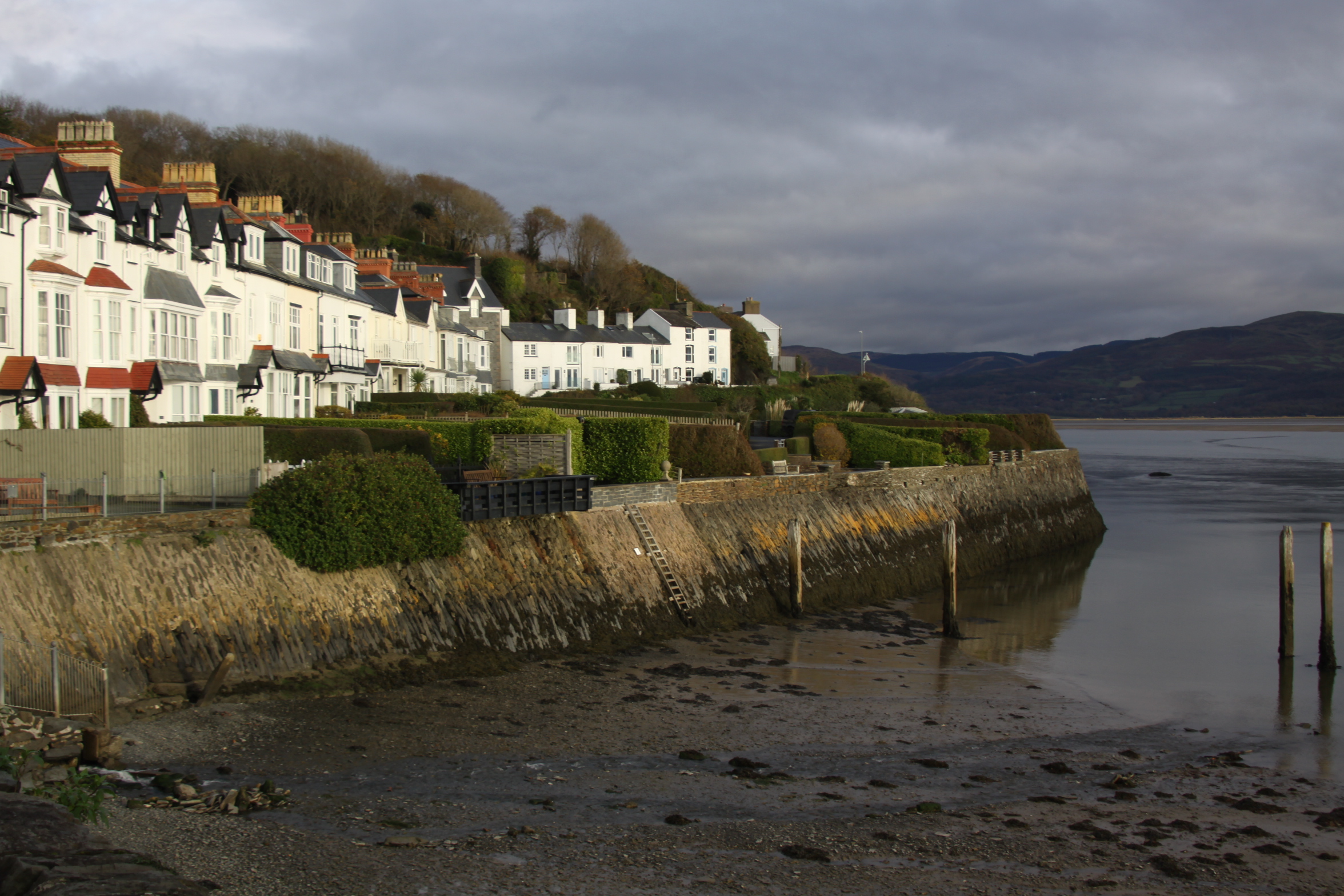
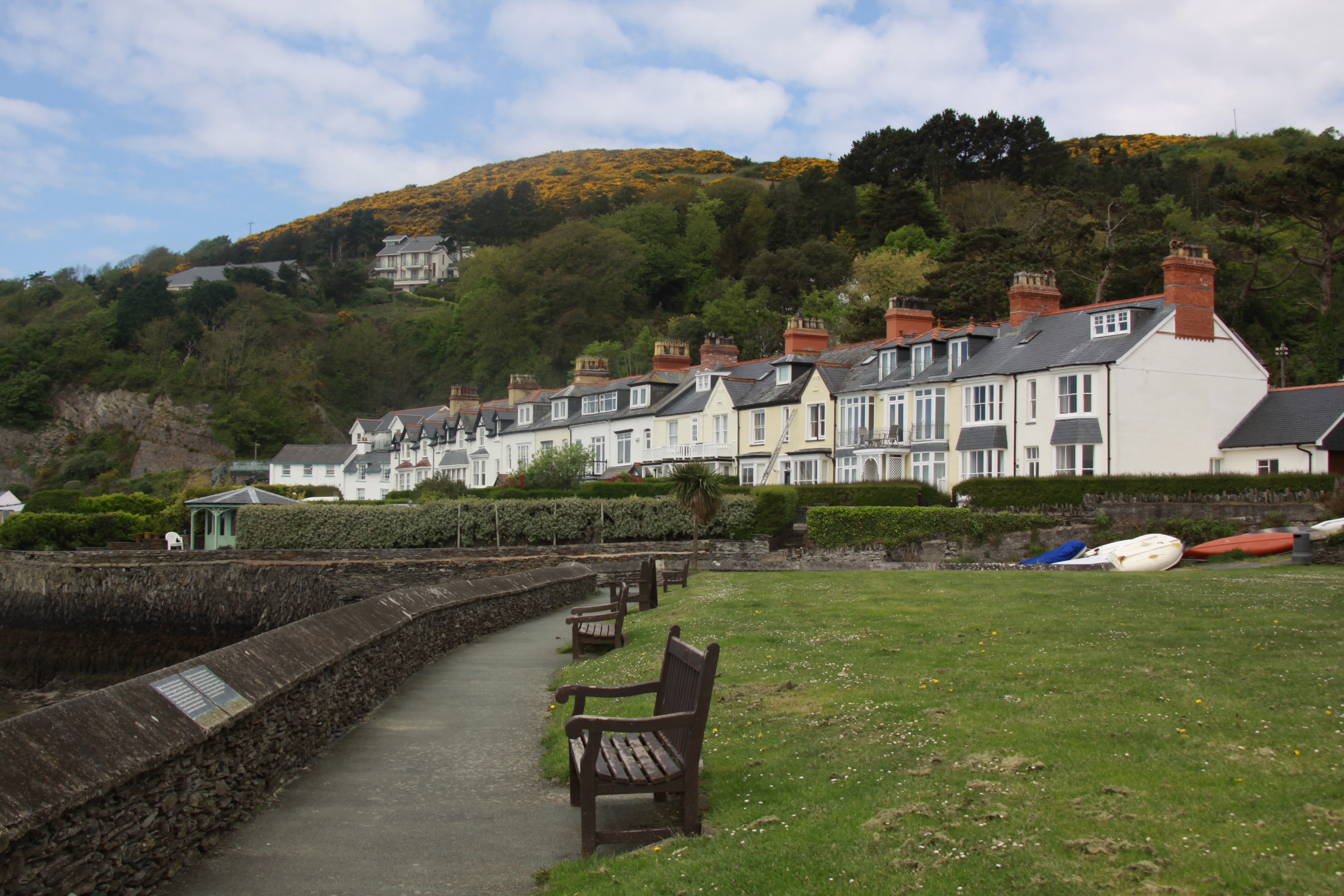
A view of Penhelig today taken from a very similar viewpoint:

Unlike the 1903 and 1910 postcards, this is immediately recognizable and familiar, and apart from the boats, which immediately indicate that this is not a modern photograph (I particularly like the one furthest from the camera), it looks much the same as it does today.  Penhelig Terrace, immediately behind the beach, was built on the spoil-heap from the tunneling works for the railway in 1864,  which was routed round the back of the village to prevent it impinging on tourism and ship-building activities.

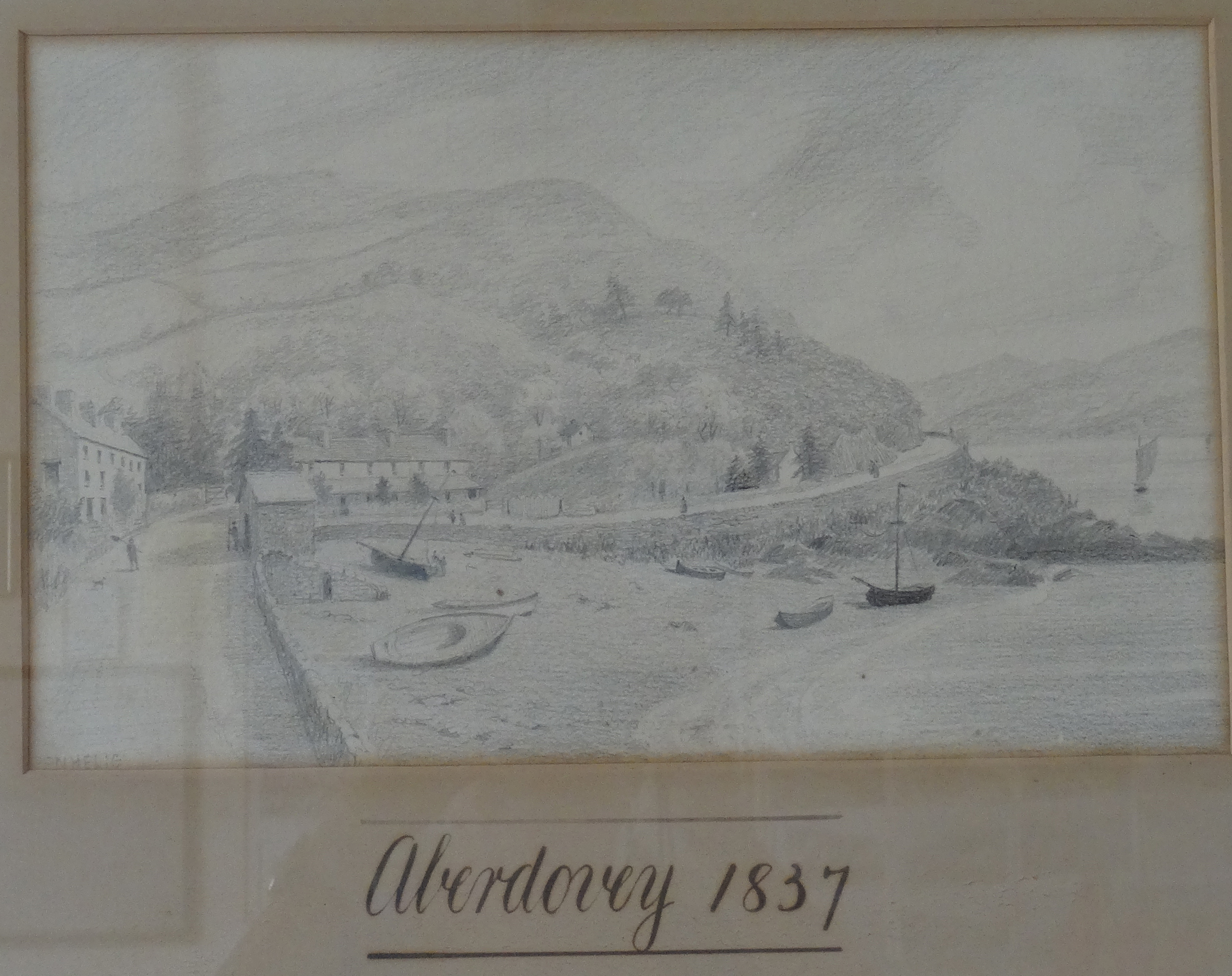
A picture hanging in Aberdovey’s Literary Institute shows the same scene in 1837 before either the railway or Penhelig Terrace were built, with the Penhelig Arms visible at the far left. In this view the low and long Penhelig Lodge (about which I have posted) dominates the scene and looks out over the beach.  It was probably still fishermen’s cottages at this time, although it had various roles afterwards, including a stint as an exlusive school for young ladies.  Penhelig Lodge is now a row of three cottages on a busy bend where the railway crosses the road, hidden behind Penhelig Terrace and the railway, on the edge of Nantiesin car park and overlooked by Penhelig Station, but as a building it has lost none of its charm.

Aberdovey 1837. Source: Photograph of picture hanging in the Literary Institute.

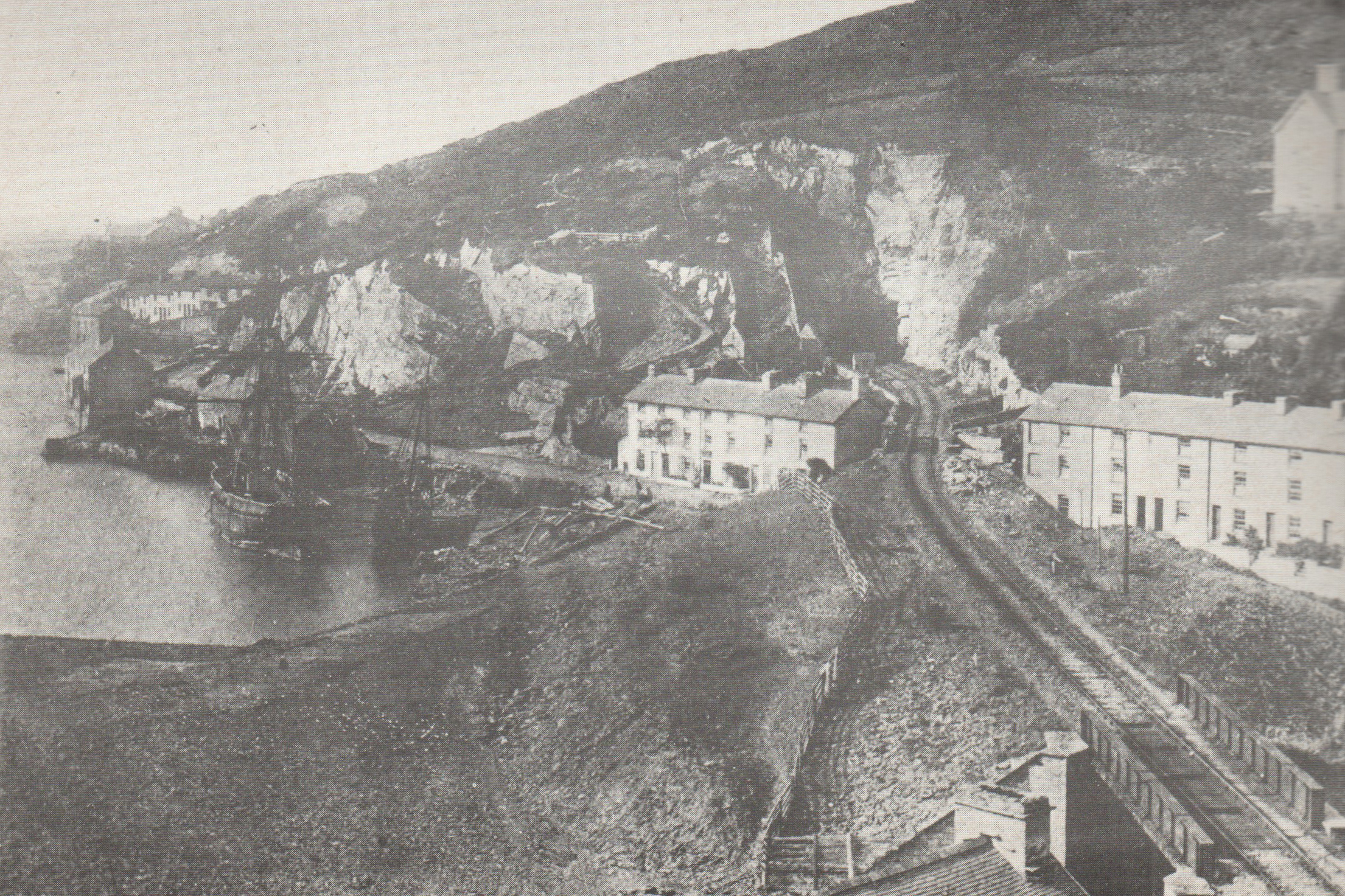
A photograph from Hugh M. Lewis’s book Aberdyfi, A Glimpse of the Past, below, shows Penhelig as it was just after the railway was established and just before the terrace was built in the mid-1860s, with a large vessel moored on a high tide in the days when the beach was a shipyard, with Penhelig Arms just behind it.  In the above postcard Penhelig Arms is out of sight, a few houses to the left and across the road.

Penhelig shortly after the railway was laid, and before Penhelig Terrace was built, showing the railway tunnel and the shipyard just in front of the Penhelig Arms. It is clear that at least two houses were taken down to route the railway round the back of Aberdovey.  Penhelig Station was added in 1833 Penhelig Station was added in 1933, by which time the railway was operated by the Great Western Railway, which absorbed Cambrian Railways in 1922, and was equipped with a single platform and an attractive little wooden shelter that remain today.  Source: Hugh M. Lewis’s book Aberdyfi, A Glimpse of the Past

The row of houses behind the memorial park to the right of Penhelig Terrace on the main road through Aberdovey has changed dramatically since the 1860s photo in Hugh M. Lewis’s book, but not much since the 1962 postcard.

The row of houses behind the memorial park to the right of Penhelig Terrace on the A493.

Penhelig Terrace today, seen from the memorial park

The postcard producer, Valentine’s (J. Valentine and Co.), opened in 1866 in Dundee, at first specializing in photographs of Scotland, and continued to make postcards for a century.  According to the Jisc Archives Hub, “much of the collection contains views associated with the leisure market, subjects such as fishing were regarded as attractive, agriculture less so, and industry was rarely portrayed. The main features are stately homes, historic ruins, great open spaces, beaches, the grandeur and curiosity of nature and great engineering feats.”  The company stopped producing postcards in 1967 because they failed to make the switch to colour printing for postcards soon enough to be competitive, and they had found that greeting cards were more lucrative anyway.

Vintage Postcards #2: Sheep herding on Trefri Road in 1903

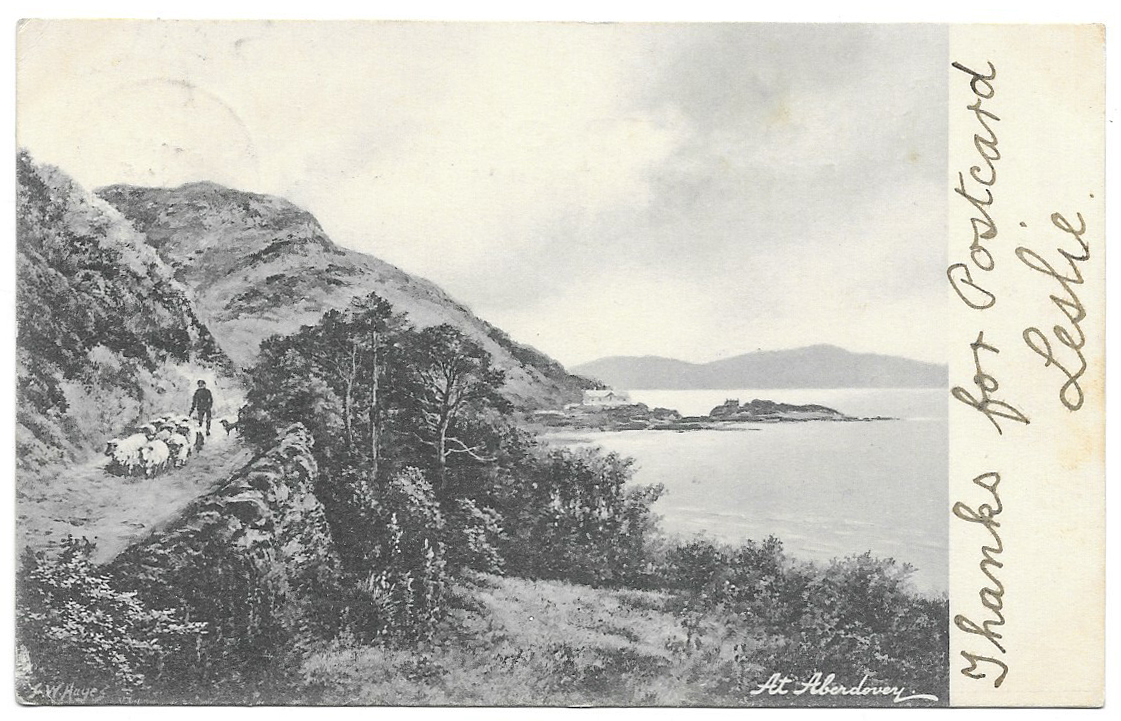
Like the postcard #1, which was a 1910 sepia photograph, this 1903 scene really throws one back to a previous era where the threat of being run over by one of the hundreds of cars that use the A493 estuary road simply didn’t exist.  The mid-1850s Trefri Hall is again visible in the background, but this postcard gives a real sense of rural isolation.  This sense of isolation is, however, quite misleading.  An east-west turnpike was built following the Merioneth Turnpike Act of 1775, which ran from near Pennal through Cwm Maethlon (Happy Valley) towards Tywyn, and although it bypassed Aberdovey it was still an important link between the coast and the interior of mid Wales.  Most importantly, the railway was established in 1864, connecting Tywyn, Aberdovey and Machynlleth with other parts of north Wales and England.  The industrial revolution and the demand for raw materials such as copper, silver and lead, as well as the slate trade had made Aberdovey an important port and shipping was a major activity, both via river and sea, and the tourist industry was becoming increasingly important.  By the turn of the century, Aberdovey had at least six places of worship, at least one pub, a literary institute and several hotels.

1903 postcard

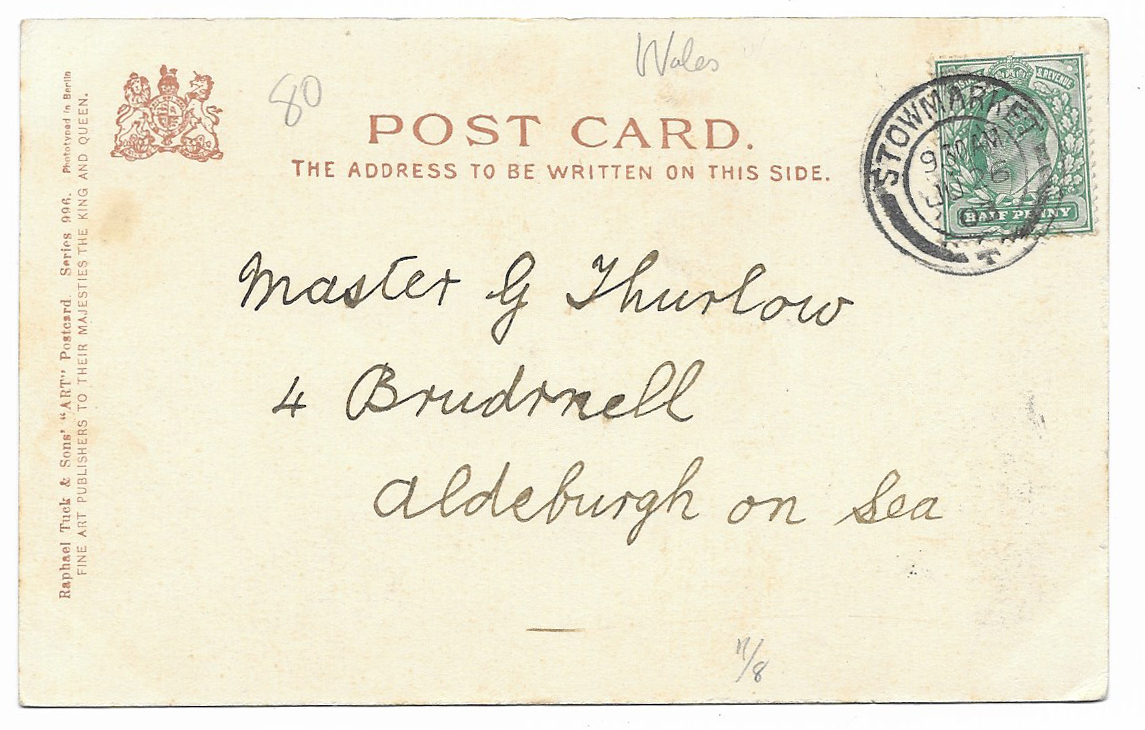
The stamp shows Edward VII who reigned from 1902-1910, and this particular shade of blue-green was issued between 1902 and 1904.  The stamp is postmarked Stowmarket and is dated 9.30AM, June 26th 1903.  Perhaps the purchaser bought it in Aberdovey and took it home to post.

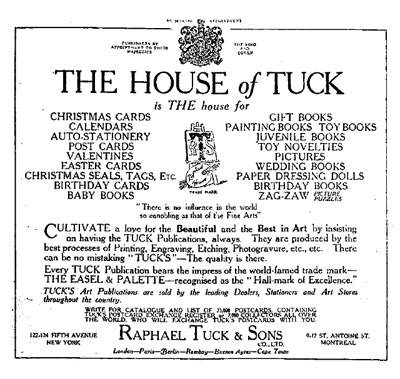
The postcard was produced by Raphael Tuck and Sons, “fine art publishers to their majesties the King and Queen” in their “Art” series.  Queen Victoria had granted them the Royal Warrant in 1883.  According to the TuckDB website, Raphael Tuck was a Prussian who had trained as a graphic artist and started his picture frame and graphic design business with his wife Ernestine in Bishopsgate (London) in 1866.  It became one of the world’s biggest postcard producers, all based on art works, but produced a number of other products as well, as shown on the 1901 advert below.  Most of the postcards were printed in Germany up until the First World War, and this card is marked “Printed in Berlin.”  The Aberdovey card, by artist Frederick William Hayes, was sold as one of a set of six Welsh scenic views, the others showing Cader Idris, Bala, Harlech, the Dolgellau Precipice Walk and  Llyfnant Valley, Aberystwyth (all of which you can see here, on the TuckDB website).  Later, the a postcard was issued showing the same painting in full, extremely bright colour.

The artist, Frederick William Hayes (1848-1918), was born on the Wirral, trained first as an architect and then as a painter in Liverpool and London before returning to Liverpool where he established a watercolour society.  He was an Associate of the Royal College of Art.  Hayes exhibited at the Royal Academy of Arts between 1872 and 1891.  He was a prolific painter, working in pencil, watercolour and oil.  His paintings are usually very picturesque in theme, and he painted a lot of landscape and seascape scenes in Wales and Scotland.

The House of Tuck – an advert from 1901. Source: TuckDB website.

Trefri Hall today. I lacked the courage to dodge the cars in any attempt to reproduce the exact viewpoint in the postcard!


Vintage postcards of Aberdovey #1 – Trefri

I was looking on eBay for something completely unrelated and noticed a small job-lot of vintage sepia and black-and-white postcards of Aberdovey for a bargain price, so I bought them.  It is fascinating to see past views of the village.  Some of the buildings look so crisp and fresh and it is truly interesting on the one hand to see the changes and, on the other, to be surprised at how much remains the same.  The subject matters that were offered by the postcard companies, and which people chose to buy, are often quite different from those that one can buy in the village today.  It feels like invading the privacy of past visitors to read the messages that they wrote to friends and family, but it is also a rather nice way of connecting with the past.  Separately, I bought a page from a book dating to 1895, which is a real treasure.  I thought that others might be interested in this little haul, so as I scan them I’ll post them here.  You can click on the images to see a bigger version.

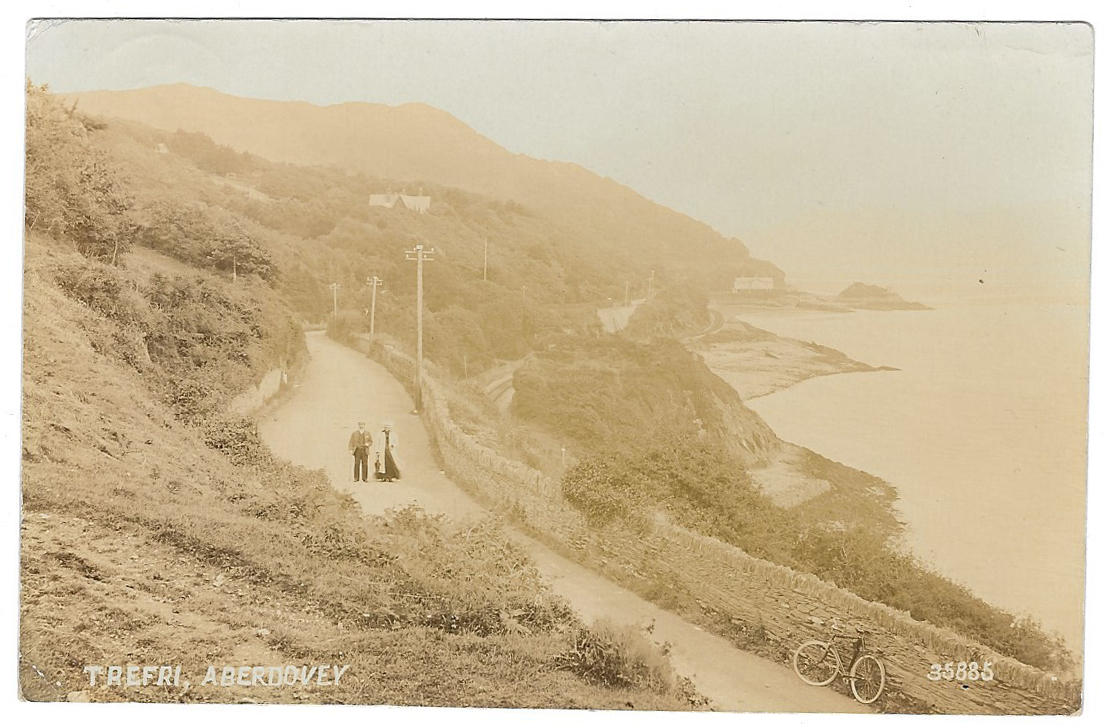
Postcard of Trefri, Aberdovey

The picture on the card shows Trefri, the area just outside Aberdovey which includes the mid 19th Century Trefri Hall right on the edge of the estuary with its own island, currently painted English-mustard yellow.  I don’t know the house on the hill, but I am sure that other residents will recognize it.  If it still stands, it is no longer in splendid isolation.  Aberdovey has spread both out and up.  The 1864 railway is clearly visible and telegraph polls indicate that Aberdovey had been connected to the rest of Britain in more ways than one.  Today one wouldn’t take one’s life in one’s hands by walking down the middle of that stretch of road, and it is difficult to visualize an Aberdovey where bicycles were more numerous than cars.

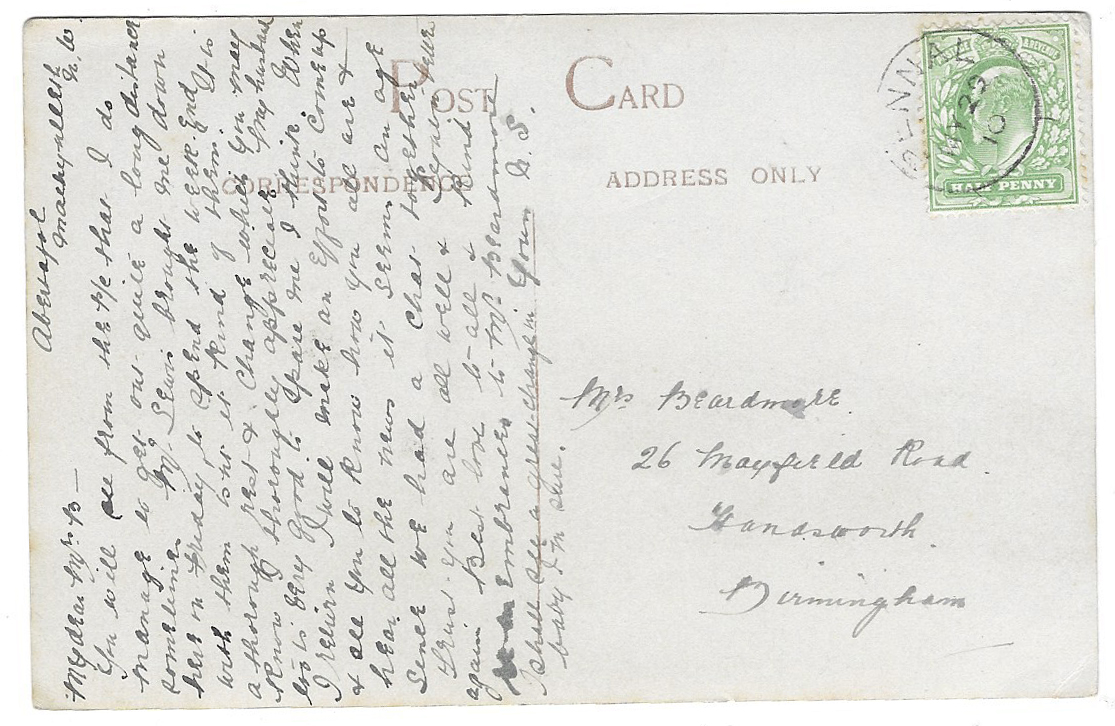
Reverse side of Trefri postcard sent in 1910

The postmark says that the postcard was sent from Pennal on May 22nd 1910, and the address indicates that it was going to Birmingham, then as now the main source of tourists for the mid-Welsh coast.   The green half penny stamp, which was issued between 1902 and 1910, shows Edward VII, who died on 6th May 1910, and was succeeded by George V.

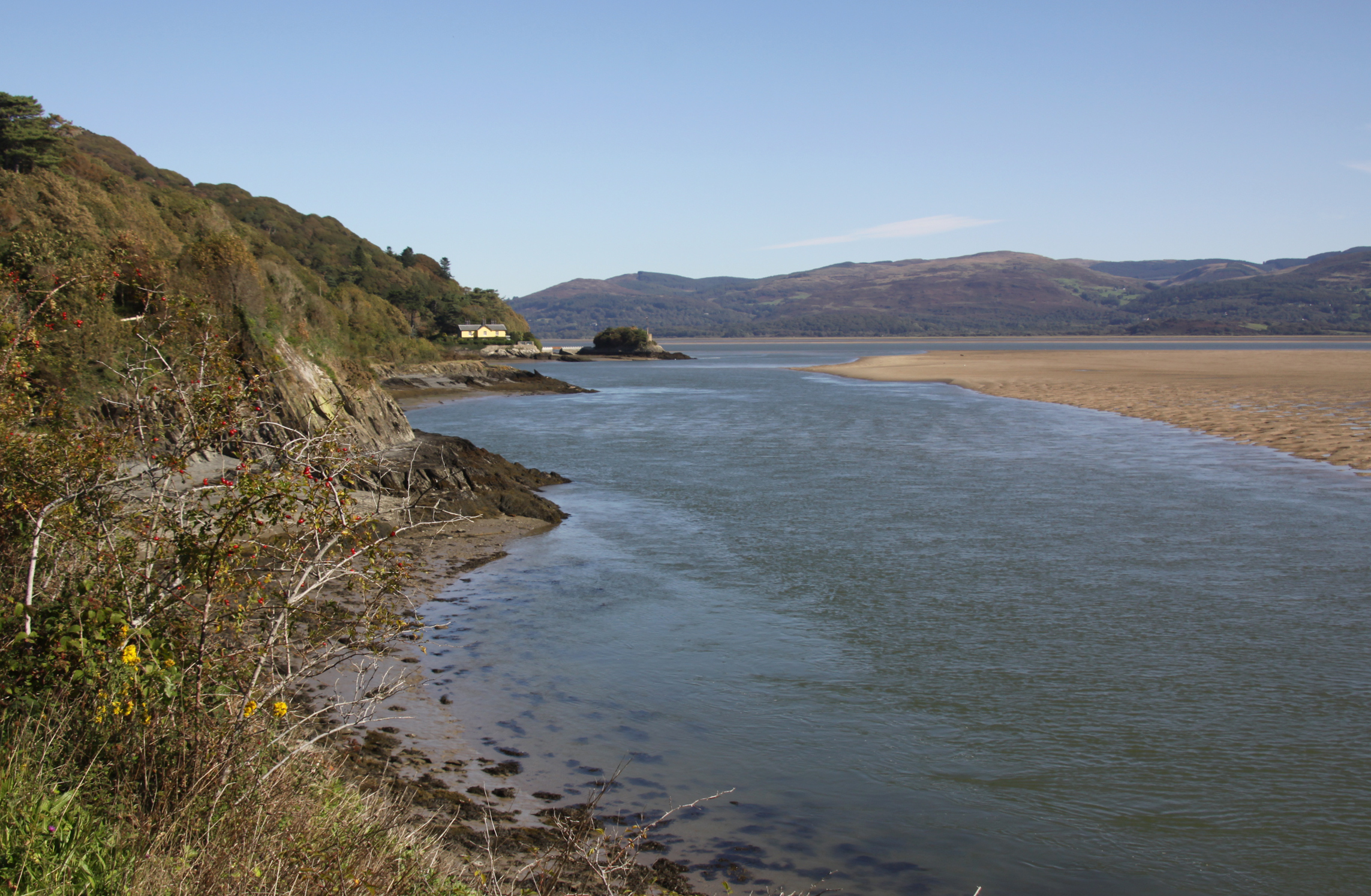
Trefri Hall today

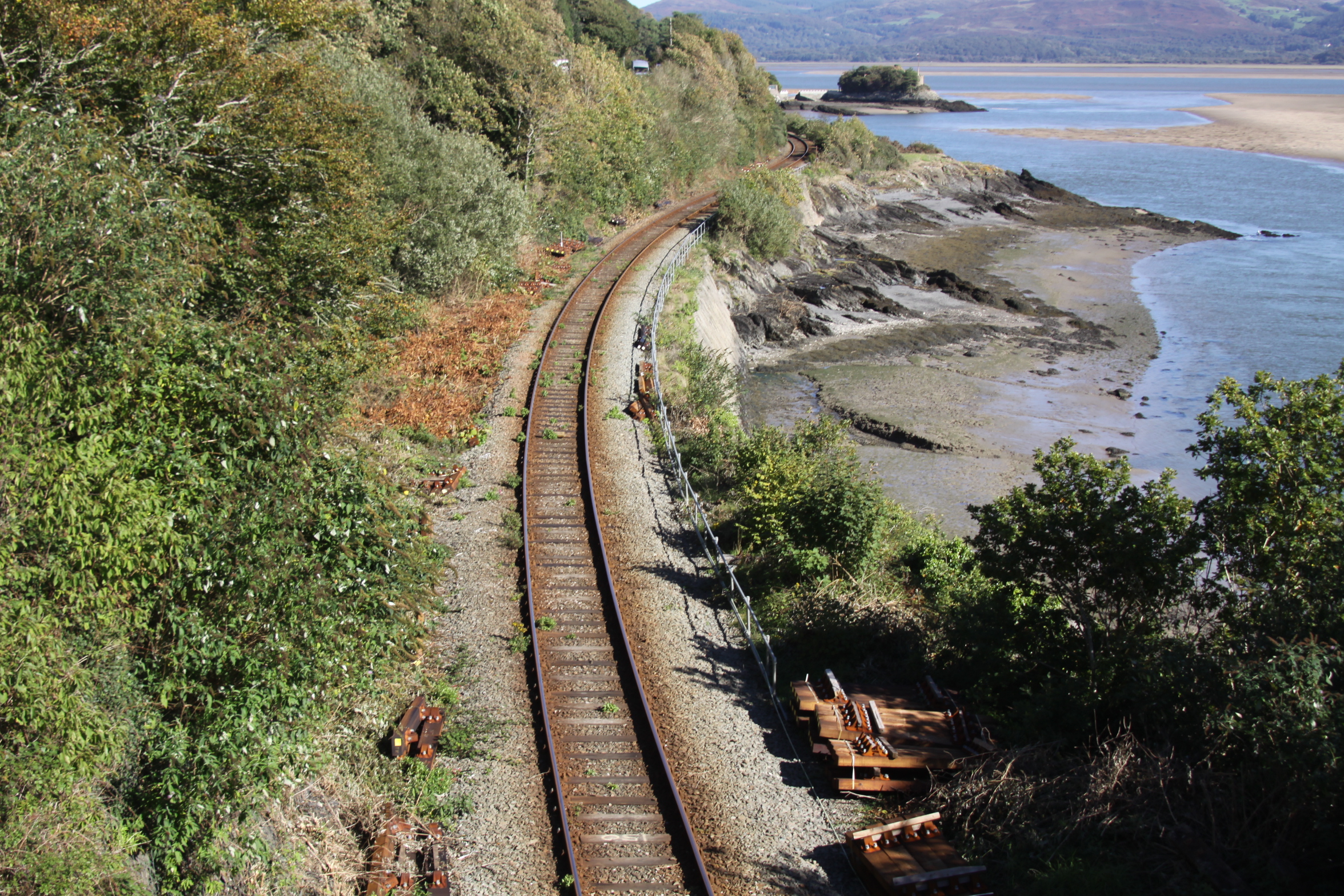
Railway track as it leaves Aberdovey for Machynlleth, with Trefri Hall’s island visible where the rails vanish around the bend


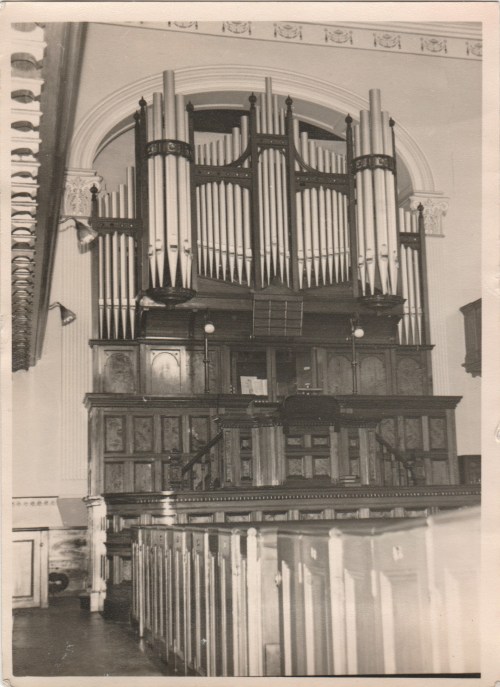
View of the interior of the Calvinist Tabernacl of 1864 on Sea View Terrace

With many, many thanks to Dai and Helen Williams for getting in touch and lending me this superb photograph of the interior of the Calvinist Methodist Tabernacl on Sea View Terrace, built in 1864 to replace their earlier chapel in Chapel Square.  I have updated my earlier post about the chapel with this photograph, but for those who have already read it, it seemed a good idea to post the photograph separately as well.  It shows not only the organ and the pews, as well as some of the decorative features, but also, to the left, the gallery.  It quite clearly had a magnificent interior, now converted to apartments.

Calvinistic Methodist Tabernacl, 1864

The Royal National Lifeboat Institution (RNLI) in Aberdovey in 2018

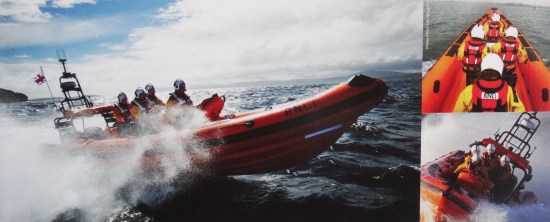
Pictures of the Atlantic 85 in-shore lifeboat in action (photograph of part of a poster on display in the Aberdyfi Boat House).

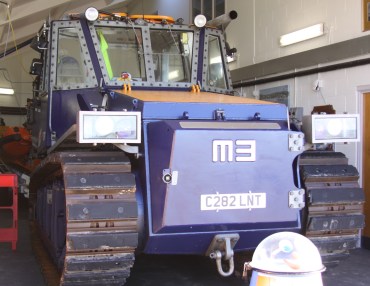
The RNLI is a vital national emergency service dedicated to saving human life, comparable to the NHS Ambulance service, with the fundamental difference that its boats are manned largely by unpaid volunteers, its shops are manned wholly by unpaid volunteers and it is funded mainly by private donations, legacies and its own fund-raising efforts.  The RNLI was established on 4th March 1824 as the National Institution for the Preservation of Life from Shipwreck, it was granted a Royal Charter in 1860, its Patron in Queen Elizabeth II and it has over 238 lifeboat stations and 445 lifeboats in England, Wales, Scotland, Ireland and the Isle of Man.   In Aberdovey alone the lifeboat goes out between 20 and 30 times a year, dragged to and from its home in the boat-house on the wharf by a giant, custom-designed caterpillar-tracked tractor.

The RNLI has a long and really fascinating history, and much of that will be explored in later posts, with special reference to the RNLI presence in Aberdovey since 1837, but here I want to start with what the RNLI does in Aberdovey today, how it works and what it means to sailors, people and animals in distress and the community as a whole.

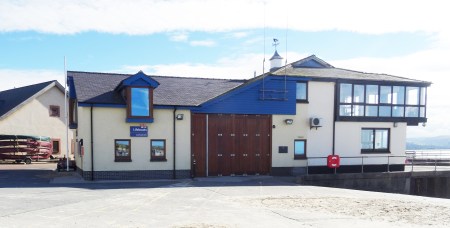
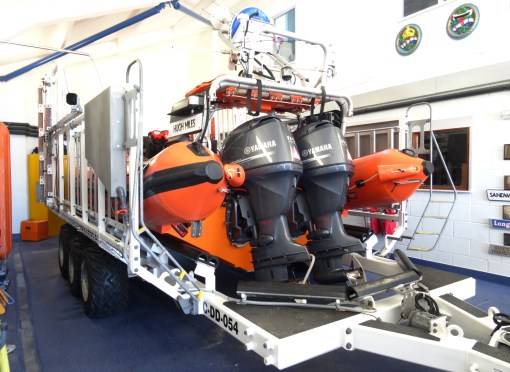
Let’s begin with the guided tour of the facility that was given to me by Dai Williams, Volunteer Shop Manager at the RNLI.   The lifeboat house in Aberdovey has moved around a lot since its establishment in 1837.  However, in 1991 the Yacht Club and the RNLI combined resources to extend the clubhouse and accommodate a new lifeboat on the wharf.  Most recently the wharf buildings were reconfigured in 2016 to allow the RNLI Lifeboat Station to expand, placing its new rescue boat the The Hugh Miles and its tractor under cover, improving the changing facilities for the lifeboat crew and moving the shop into a new location so that it is visible from the road and can benefit from passing footfall.  Funding from private donors was central to the modifications to the premises, and the new RIB was enabled by a donation from The Miles Trust.  The tractor is a massive and impressive beast on caterpillar tracks, a necessary adjunct to the boat due to the difficult recovery conditions at low tide.

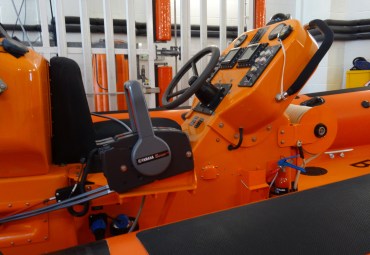
The Hugh Miles, operating number B-896, is a fast inshore rescue craft, an Atlantic 85 rigid inflatable boat (RIB), replacing the previous Atlantic 75, Sandwell Lifeline.  The RNLI has two main categories of lifeboat: all-weather lifeboats and inshore lifeboats, each of which are suited to different conditions.  For the full range of lifeboat types employed by the RNLI see their “Our Lifeboat Fleet” web pageThe Hugh Miles is a specialized inshore lifeboat, one of the fastest in the RNLI fleet, powered by two Yamaha 4-stroke outboard 115hp engines, reaching top speeds of 35 knots.  It can go to sea in a force 7 wind during daylight hours and during a force 6 at night.  It cost £214,000 and, at nearly a meter longer than its predecessor, has the capacity for an extra crew member, bringing the total to four, although it can operate with three, and far more kit.  It is stored in a carriage, a cage on wheels, from which it is launched.  The RIB has a solid bottom and flexible sides, which makes it both strong and relatively light-weight.  The concept was originally developed in the Atlantic College, Vale of Glamorgan, south Wales during the 1960s and early 1970s.  Watersports were a big part of the boarding school agenda, and the college had its own in-shore lifeboat station.  They soon realized that the inflatable boat they were using could be improved upon and used marine plywood and rubber tube to create the templates on which the modern RIB is based.  The RNLI recognized the idea and created a glass-reinforced fibre model, which was a B-Class Atlantic 21 that came into service in 1972, its name commemorating the role of the college for this and future B-type RIBs.

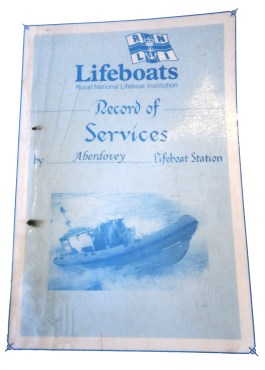
Flicking through the Record of Service book in the life boat house there were a hair-raising number of minor and major incidences where the lifeboat was called out.  These involved yachts and other sailing vessels, power boats including a fishing boat, canoes, inflatable dinghies, kite boards, sail boards, jet skis, an inflatable toy, and swimmers in trouble.  Here are three examples of call-outs in 2018, all noted on the Aberdyfi Lifeboat’s Facebook page.  In July, the lifeboat was called out to the assistance of swimmers in difficulty at Tywyn.  On arrival, one casualty had been recovered but the second was still missing and the crew began a search, receiving information from the Coastguard that the swimmer had been spotted on the lifeboat’s exact course. The lifeboat proceeded as fast as was safe to the location where the helm manoeuvred the boat skilfully in the surf and shallow water to be able to put a crew member into the surf to recover the casualty with two members of the public who had waded in, recovered the second casualty.  First aid was delivered and a second  crew member from the lifeboat entered the surf with vital kit such as oxygen.  It should be noted that whilst the second casualty survived, the first one died later in hospital, a tragic reminder of the importance of the work of the RNLI.  One night in August at past 9pm, with the light fading and on an outgoing tide, the Aberdyfi Lifeboat was called out to a broken-down yacht.  The lifeboat reached the yacht and the crew were able to  secure a tow, bringing it back into the estuary and placing it on a mooring.  The lifeboat was returned to its station by 11pm.  At 1645 on an evening in September, the Aberdyfi Lifeboat was called out to aid a boat with eight people on board, which was experiencing engine problems and was aground just south of the Aberdyfi Bar.  The Borth lifeboat was already on scene and had managed to tow the vessel into deeper water, and from there they handed the rescued boat over to The Hugh Miles, which took most of the boat’s crew on board and set up a tow to bring them back to the Dyfi estuary.

David Williams, not to be confused with Dai Williams, is the Volunteer Lifeboat Operations Manager (LOM) at the RNLI in Aberdovey, leading the operation team.  He is responsible for authorizing the launch of the lifeboat and ensure that the lifeboats and all associated gear are maintained and in a constant state of readiness for action.  David Williams grew up in Tywyn and also volunteers with Mountain Rescue.  In the event of his absence there are also four Deputy Launching Authorities who can stand in for him.  The in-shore boat crew is headed by the Senior Helm (the equivalent of a coxswain on an the bigger all-weather boats), currently Will Stockford, who is also the Harbour Master and doubles up as boat mechanic.  Next in seniority is the Helm, who must be on board if the Senior Helm is unavailable.  The helm is trained in a variety of skills including navigation, search and rescue and casualty care, has many years experience as a volunteer and is in charge of leading any rescue.  Three other crew members may or may not be trained to steer and navigate the boat but all receive their initial training in Poole in Dorset at the RNLI.  As well as being on call for emergencies, the crew undergo practice drills and training on a weekly basis, usually on a Sunday morning.  The tractor drivers are usually former crew members who have retired.

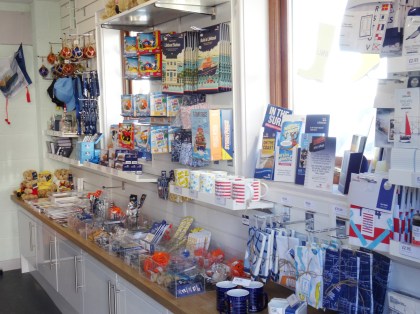
Dai Williams is the Volunteer Shop Manager, currently with a team of six shop volunteers helping customers in the shop.  The RNLI shop on the wharf not only generates important funds for the charity but raises awareness of the RNLI and its activities, its staff acting as ambassadors for the lifeboat station, explaining its role and answering the many questions from the public.  The new merchandise in the shop is bright, modern and eclectic, offering everything from games and toys to calendars and diaries, as well as souvenir tea towels, mugs and clothing is provided by the RNLI.  Nautical themes dominate, of course, and many are by designer names.  There are also shelves outside selling second hand books, jigsaws and DVDs donated by the public. Having spent some time in the shop over the last month, it has been great to see the range of people who visit and buy products in support of the RNLI.  Small children with their parents, buying nets, shovels and buckets for crabbing are very happy contributors to RNLI funding.  I have been buying RNLI Christmas cards online for years, but it’s much better to be able to go and buy them in person.  And just about everyone is getting an RNLI tea towel in their stockings this year!

As well as the shop there is also an important fund-raising group based locally, the Aberdyfi Lifeboat Guild, which puts on events throughout the year.  Many terrific visitor activities take place, particularly during the course of the summer, which get everyone involved, from crew to visitors, from young to old.  Events have included Flag Day when there was a duck race (500 plastic ducks are launched and then retrieved!), the Abergynolwyn Silver Band played, there was a raft race and an afternoon tea was organized.  Other events have included a quiz night, a Crabby Competition, a barbecue, the Dysynni Male Voice Choir and a Fun Run.  There was even a stand at the Food Festival in August, demonstrating water health and safety procedures and equipment, and the Lifeboat Station has a stall at the Christmas Fair (this year on the 1st December, 10am – 4pm).

Aberdyfi Lifeboat Station and Shop

Donations from the public continue to be critical to the operations of the RNLI.  The donations that enabled the modernization of the Aberdovey RNLI base says a lot about the sort of people who help the RNLI not merely to continue operating, but to continue updating their technology and improving their services.  The Miles Trust, which funded the new boat, was set up in memory of Hugh Miles.  Hugh Miles, the only child of the late Herbert and took great pleasure in RNLI activities around South Wales and after his death his mother bequeathed her estate to the RNLI, part of which was to be used to fund a rescue boat for the Welsh coast.  The Aberdovey’s The Hugh Miles Atlantic 85 RIB is that boat.   The modification for the boathouse was funded by the Derek and Jean Dodd Trust and a legacy left to the charity by RNLI supporter Desmond Nall. Derek and Jean Dodd moved near Aberdovey, where Derek was able to kayak into his 80s.  Desmond Nall was an RNLI enthusiast from Solihull, who, together with his brother, Godfrey volunteered  on the RNLI’s stand at the Birmingham Boat Show for a number of years and funded two inshore lifeboats.

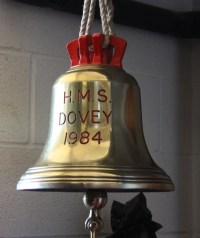
The Aberdyfi lifeboat station has a rather special and unique feature:  the bell from the HMS Dovey.  It is on loan from the Royal Navy.  Should another HMS Dovey be built, the bell will have to be returned, but at the moment it is a much loved and admired resident of the lifeboat station.  The HMS Dovey was the river class minesweeper M2005 commissioned in 1984 and sold to Bangladesh in 1994 for use as a patrol ship.

If you are a visitor to Aberdovey, do visit the lifeboat station and the shop.  You will find a very warm welcome.

Contact details:
Aberdovey Lifeboat Station
The Wharf
Aberdyfi
LL35 0EB
01654 767695 (If you see someone in trouble at sea dial 999 and ask for the Coast Guard).
The shop is open from Easter to October 10am–4pm Saturday and Sunday, and on some Saturdays in November and December.  During the summer it is open for some days during the week (opening times are shown in the shop door)
Facebook page

As well as the RNLI, local emergency services that receive no direct government funding and rely on their charity status and fundraising activities for their income are Trinity House (vital shipping and seafaring charity), the Wales Air Ambulance service and Aberdyfi Search and Rescue.

Many thanks to Dai Williams for correcting the mistakes and plugging the gaps in my first draft.  Helen Williams tells me that no matter how much you find out about the lifeboat station, there is always more to know and I believe her!

References

Aberdyfi Lifeboat Facebook page
https://bit.ly/2OXFbqx

Dermody, D. 2011.  Atlantic College students’ RIB sea safety revolution. BBC 15/05/17. https://www.bbc.co.uk/news/uk-wales-south-east-wales-13377377

RNLI News Release 2016. Farewell to Sandwell Lifeline as Aberdyfi RNLI welcomes new lifeboat. RNLI 02/12/16. https://rnli.org/news-and-media/2016/december/02/farewell-to-sandwell-lifeline-as-aberdyfi-rnli-welcomes-new-lifeboat

RNLI News Release 2017. Double celebration ahead for Aberdyfi RNLI. RNLI 25/07/17.
https://rnli.org/news-and-media/2017/september/25/double-celebration-ahead-for-aberdyfi-rnli

RNLI News Release 2018. Aberdyfi and Barmouth RNLI Lifeboats involved in Tywyn rescue. RNLI 1/08/18. https://rnli.org/news-and-media/2018/august/01/aberdyfi-and-barmouth-rnli-lifeboats-involved-in-tywyn-rescue

A visit to St Peter Ad Vincula Church, Pennal

There are six churches in the Bro Ystumanner Ministry Area, which covers the Dyfi Estuary and Dysynni Valley.  I intend to write about all six of the churches, which include St Peter’s in Aberdovey and St Cadfan’s in Tywyn, but am starting with St Peter ad Vincula in Pennal.  The story of St Peter ad Vincula comes in three parts:  1) as a piece of architectural and ecclesiastical heritage in its own right, 2) as the site at which Owain Glyndŵr’s Llythyr Pennal (Pennal Letter) was signed, and 3) as a modern, fully functioning community church.  I was lucky enough to be given a full tour of the church by church warden Hugh Ramsbotham, to whom my sincere thanks.

The unusual name of the church refers to a story in the Acts of the Apostles XII.  St Peter ad Vincula translates as St Peter in Chains and refers to an event when St Peter was jailed in Jerusalem by Herod.  The night before his trial he was asleep, flanked by two soldiers and chained in irons, awaiting trial for preaching about Jesus.  An angel is said to have woken him on the night before his trial, releasing him from his chains with a touch, guiding him out of the prison past unseeing guards.  Today, the chain is kept in a reliquary under the main altar of the Basilica di San Pietro in Vincoli (Rome), which was built in the 5th Century to house the chains.
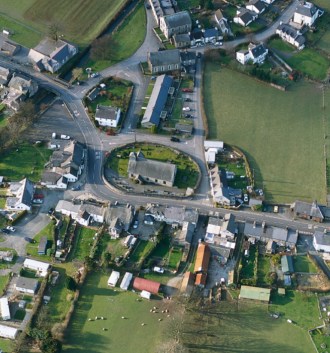
Aerial view of Pennal, with the church of St Peter ad Vincula surrounded by an oval wall. Source: Coflein website

The village of Pennal lies on the River Pennel, which runs into the River Dyfi, and it is probable that this was the main Dyfi river crossing throughout the Roman and Mediaeval periods.  The village was occupied from at least the Roman period, if not earlier, with a small fort, Cefn Gaer, established near to the river.  The site of the church itself had probably been occupied by a pre-Christian structure, suggested by the oval perimeter wall of the churchyard.  Oval and circular churchyard walls are often associated with a number of early structures including Roman era churches that survived the departure of the Romans, early burial grounds, pre-Christian shrines and Anglo-Saxon defended sites.  Such circular and oval churchyards are common in Wales.

The first church was established in around the 6th Century by Saint Tanwg and Saint Eithrias, missionaries from Armorica (modern Brittany).  There are no signs of either that wooden structure or any that followed it.  Pennal was the site of one of 21 llysoedd, or royal court compounds, and the motte that stands some 300m to the south-west of the church may have been part of the contemporary complex.  The church was re-dedicated at the end of the 11th Century by the Normans and it is possible that it was first rebuilt in stone during the 1130s when Gruffydd ap Cynan initiated a programme to rebuild ancient churches of Gwynedd.  Throughout the Mediaeval period it was located within the cantref (similar to a county) of Meirionnydd and the smaller administrative unit of the cwmwd (commote) of Ystumanner.  Throughout the Middle Ages the church  was one of three Chapels of Ease (subsidiary churches) under St Cadfan at Twywyn, along with Llanfinhangel-y-Pennant and Llanfair (Tal-y-Llyn).   The church is recorded as having served several of the Welsh tywysogion (princes) and is mentioned in the Norwich Taxatio (records of assessments of English and Welsh ecclesiastical wealth) of 1253.  It is probable that it was designated a Chapel Royal of the Princes of Gwynedd under Owain Glyndŵr. In the 1284 in the Statute of Rhuddlan the cantref of Merionnydd was combined with other cantrefs to form Merionethshire.
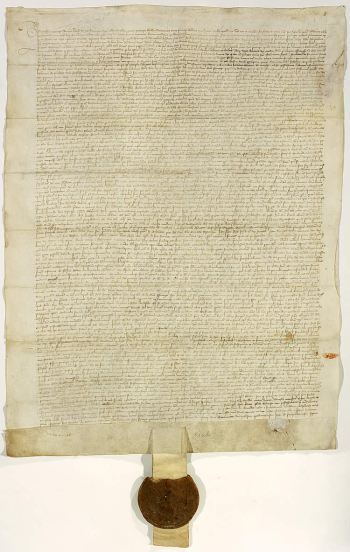
The Pennal Letter. Source: British Library. Archives nationales de France, J//516/A/29 J//516/B/40. Copyright © Archives nationales de France

The presence of a llys here partially accounts for the presence of Owain Glyndŵr in the early 15th Century.  The connection with Owain Glyndŵr concerns an important moment in Welsh history, which could have turned the tide in favour of Welsh independence from England. In 1404 Glyndŵr held a Parliament at Machynlleth where he was, according to tradition, crowned Prince of Wales, having organized the previously very fragmented opposition to Henry IV.  At the time he had backing from Scotland and Northumbria, but by the end of 1405 this support had been eroded by Henry’s armies.  In 1406 Glyndŵr assembled a formal meeting of his nobles and clergy at Pennal, including the Archdeacon of Meirionnydd Gruffydd Young, to discuss the options for making a strategic alliance with Charles VI of France.  During this period there were two papacies, the traditional papacy base in Rome and a new breakaway papacy in Avignon, France.  Charles VI was loyal to the Avignon papacy, whilst the English king Henry VI was loyal to Rome.  Glyndŵr hoped to take advantage of the breach within the Roman Catholic Church as a bargaining chip to gain the support of Charles VI.  As a result, a letter was written by Glyndŵr in Latin to Charles VI offering allegiance to Pope Benedict XIII in return for military support.  It was signed by Glyndŵr and provided with his great seal, which was probably done at the church.  Although the hoped-for support never arrived, the letter remains a vital historical document recording Glyndŵr’s intentions, a strategy for the future of Wales, which included the development of a Welsh church with its own Archbishopric at st David’s, an independent Welsh government and the establishment of two universities.  The letter is preserved today in France at the Archives Nationales de France in Paris, and a copy is on display in the church at Pennal.  A translation of the letter is available in English on the Canolfan Owain Glyndŵr website.  The letter was carried to France by Hywel Eddoyer and Maurice Kelly.  A 1996 painting by Ceredigion artist Aneurin Jones (1930 – 25 September 2017) that reconstructs the assembly hangs in the church, showing members of the parish at the time it was painted.

The Aneurin Jones reconstruction of Glyndŵr’s assembly at Pennal
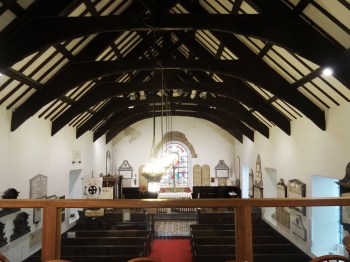
The earliest of the clearly dated parts of the building belong to the 16th Century, with Roman red sandstone brickwork from the fort incorporated into the walls of the church and churchyard walls, which were otherwise built of locally sourced stone.  The church was a chapel of ease in the Tywyn parish in the Middle Ages, but became a parish church in 1683 under its first rector, Maurice Jones.  The 19th Century renovations were radical, but incorporated aspects of the 16th and later century features into the structure.  16th Century survivors include roof timbers that were incorporated into the new roof, oak pews, the oak altar and possibly the carved pulpit.

The church was rebuilt in 1700 and 1761.  In the 18th Century Pennal acquired particular importance when an east-west turnpike was built following the Merioneth turnpike act of 1775, which ran from near Pennal through Cwm Maethlon (Happy Valley) to Tywyn, completely bypassing Aberdovey.  By the mid 19th Century the wharf at Pennal became important for transporting slate downriver to Aberdovey for loading onto coastal vessels and in 1865 the Cwm Ebol slate slab quarry, about a mile to the northwest of Pennal, built a tramway to the village after several years of using horses to transport the slates.
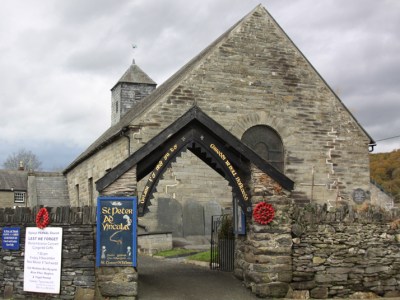
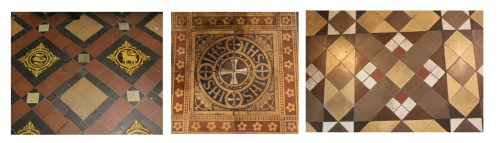
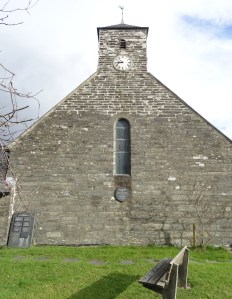
During the 19th Century the church was again rebuilt in 1810 and 1872-3.  It is to the 19th Century that most of the current form and character of the church belongs.  St Peter ad Vicula is Grade II listed (listing number 23314, listed on 25th May 2000).  The interior layout of the church is a single unit incorporating both chancel and nave with a slate roof. There is also a south porch added in 1880 and made of stone from Llugwy Quarry, a north vestry added in 1890 and short square bell tower with two bells at the east end, with a fully functioning clock is set into the exterior just below the tower.  The original gallery was removed in 1873 (and was replaced with a modern version in 2010).  The internal floor area was lowered by two feet and six inches c.1901.  Wonderful 19th Century quarry tiles cover the floor of the chancel and the step leading up to it, as well as the floor of the vestry.  The modern slate floor at the west end replaced more quarry tiles, of which only one tiny patch survives.  The roof is a very nice open tie-beam arrangement, with re-used older timbers as well as contemporary Victorian ones.
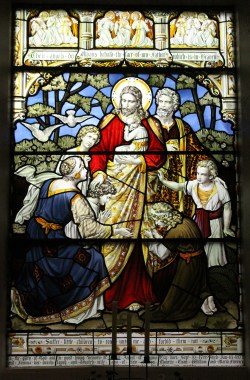
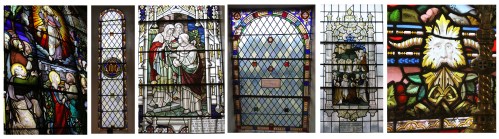
The church has five lovely stained glass windows, all dating to the late 19th and early 20th Centuries.  The earliest belongs to 1872 (by Holland and Holt of Warwick) and the latest, which replaced 1872 windows in the nave, date to the early 1920s and commemorate members of the community.  The themes are The Ascension (1872 by Holland and Holt); the IHS monogram, the abbreviation of the Greek spelling of Jesus, “ΙΗΣΟΥΣ” (1872, by Holland and Holt); Christ Blessing Children Brought by the Mothers (1893, Ward and Hughes); The New Jerusalem (c.1923, by Powell and Sons, designed by Ernest Penwarden), and Charity (1928).  The Ascension, which dominates the church at its eastern end, is a particularly colourful and lively piece, with a depiction of the the Green Man presiding over fruit and vegetable at its base, the only known representation of the Green Man on stained glass known in Wales.  The Green Man is usually a sculpture, either surrounded by or made of leaves, probably pagan in origins but frequently depicted in church sculptures, perhaps connected with ideas of earth-bound seasonal renewal and the harvest.  Most of the windows are commemorative, some with inscriptions below the them, or within the glass itself.  The Ascension window, for example, was dedicated to the memory of William Hodson Lloyd, who died in 1871.
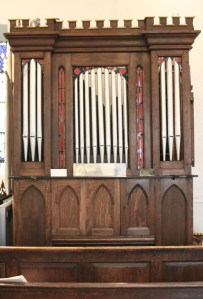
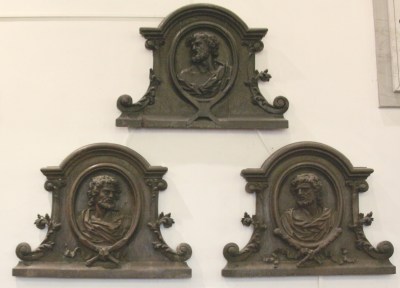
The provenance of the three striking Flemish oak plaques showing the martyrs St Jude, St Andrew and St Paul on the north wall is unknown.  There used to be four of them, all dating to around 1700, but one was stolen.  A brass plaque, a rare example dating to the mid 19th Century, commemorates three Thruston sisters, one of whom held the first school in Pennal in the church’s gallery.  The date of the fretwork pulpit is uncertain.  The lovely little organ was built by John Smith of Bristol, c.1840 and still plays perfectly.  Underneath the altar, church documents record that Lleucy Llwyd (Lucy Lloyd) was interred following her tragic death.

The story of Lleucy Llywd belongs to the mid-14th Century, but is more legend than history.   Lleucy lived on Dolgelynnen Farm near the Dyfi river and fell in love with a young court poet called Llywelyn Goch.  Lleucu’s father refused to let them marry, and kept the two apart.  When Llywelyn Goch had to go away for a period of time, promising to return, Lleucy’s father told her that Llywelyn had married another woman. Lleucu died of a broken heart and Llywelyn returned to her on the day of her funeral. The story has been immortalized in Llywelyn Goch’s famous Welsh elegy Marwnad Lleucu LLwyd.  Copies are available online in Welsh (e.g. on Wikisource), but I have been unable to find an English translation – please get in touch if you know of one!
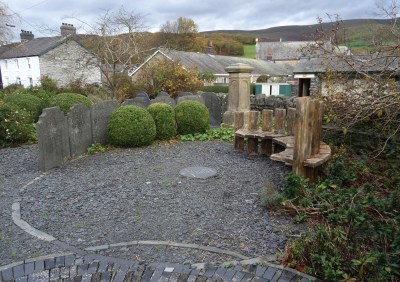
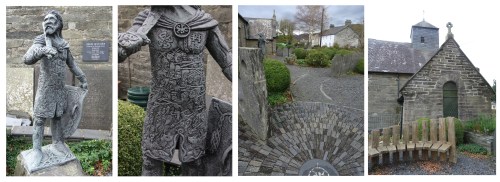
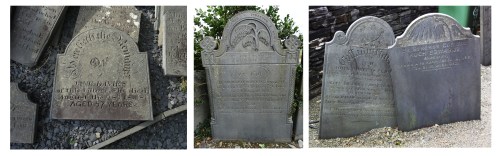
In 1991 a road widening scheme removed part of the churchyard, to the south. It was done sympathetically, so that the sense of the space being a clearly defined oval is retained.  The graves were moved to a new site outside the village, and ninety one tomb stones were recorded and moved to lean against the walls within the churchyard.  Unsurprisingly, some Roman tiles were found at the same time.  The churchyard was converted into a Heritage Garden in 2004 to commemorate the 600th anniversary of Owain Glyndŵr’s Parliament and this incorporated many of the headstones into its design.  It was designed by Peter Styles and was constructed by a Pennal, William Rees, with funding from Cyngor Gwynedd,with funds from the EU and the Welsh National Assembly, the Snowdonia National Park fund for sustainable development (CAE) and numerous local supporters.  Its aim was to provide a place of peace and tranquillity, incorporating native species of tree, shrub and flower, including some lovely pieces of topiary, emulating monastic gardens.  The dominant theme is of repeated curvilinear motifs, reminiscent of Welsh stone circles and Celtic themes.  Key features are memorial plaques, a statue of Owain Glyndŵr by sculptor David Haynes and circular oak benches that act as a textural bridge between the grey stone that makes up most of the garden and the delightful shrubbery that sits within it.  The sculpture, about 4ft tall, shows a man ready for action, a cloak held in place with a dragon clasp, and a suit of armour showing the faces of men who lost their lives, their bereft mothers and widows, and themes that bring Wales to mind, like buzzard, hare, oak tree, raven and harp.
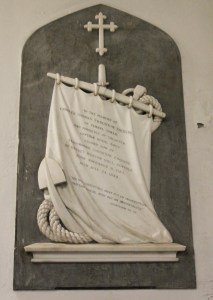
Memorial to Charles Thomas Thruston of Pennal Tower

It is easy to think of churches merely in terms of their physical architecture and history, but of course churches were built by people for their communities.  Perhaps more than any other church I can remember visiting in the last couple of years, St Peter ad Vincula gives the sense of how it has been tied up with village life and the key families who helped to support and maintain it.  The monumental inscriptions on the walls, the earliest of which dates to 1717, all commemorated key contributors to the church, and captured some of the sense of pride and involvement that these people had invested in the community and in their country.  The number of memorials to those who died in wars alone is remarkable.  All these families, the Anwyls, Thrustons, Edwards, Talgarths and Rucks have died out now in the Pennal area, but there is a sense of continuity between them and the church’s current guardians.  Each of these family histories merit research in their own right as mirrors of local heritage.
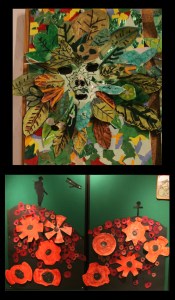
Today the church is one of six in the Bro Ystumanner Ministry Area in the Archdeaconry of Meirionnydd and the Diocese of Bangor.  The other churches in the Ministry Area are St Cadfan in Tywyn, St Peter in Aberdovey, St David in Abergynlowyn, St Michael in Llanfihangel-y-Pennant and St.s Mary and Egryn in Llanegryn.  The Reverend Ruth Hansford presides over the Ministry Area, supported by both clerics and lay personnel.  The village is tiny and being sandwiched between Tywyn and Aberdovey in the west and Machynlleth in the east does not have a vast catchment area, and of course congregations fluctuate throughout the year as locally-based holiday visitors come and go, but the church still manages to hold a congregation at 9.30 every Sunday and holds commemorative services, concerts and festivals, with song a running theme through all their activities.  The gallery upstairs is a space for meetings, social gatherings, small events and quiet contemplation, whatever your denomination.  Involvement with the local school, with its 18 pupils, is important, and evinced in the Remembrance Day exhibit at the west end of the church, and in an earlier project to interpret the Green Man, upstairs in the gallery.  The church is full of charm and interest, and above all warmth, with dozens of community stories embedded in every feature.
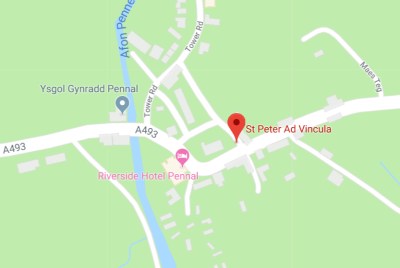
Location of St Peter ad Vincula in Pennal. Courtesy Google Maps.

The church is literally on the A493 that links Aberdovey in the west to Machynlleth in the east.  It is a small village, and parking may be difficult during the summer but is easy out of season.  Through the main door and to the left you will see a small metal box on the wall above a table with leaflets about the church’s history.  Feed a pound coin into it and it turns on all the lights for 20 minutes, transforming the interior.  Such a great idea.

Address:
Church of St Peter ad Vincula
Pennal
Machynlleth
SY20 9DW
Contact details are on the Church of St Peter ad Vincula website at: http://pennalchurch.org.uk

My many thanks again to Hugh Ramsbotham for the excellent guided tour, as well as to David Inman for introducing us.

References
British Listed buildings. Church of St Peter ad Vincula.
https://britishlistedbuildings.co.uk/300023314-church-of-st-peter-ad-vincula-pennal#.VwbTR3arSM8
Canolfan Owain Glyndŵr.  Pennal Letter.
http://www.canolfanglyndwr.org/pennal-letter.php
Gwynedd Archaeological Trust 2007. Ports and Harbours of Gwynedd: Aberdyfi. A Threat Related Assessment. GAT Project No.1824, Report No.671.1, April 2007
http://www.walesher1974.org/her/groups/GAT/media/GAT_Reports/GATreport_671.1_compressed.pdf
Gwynedd Archaeological Trust 2011.  Conservation Area Appraisal: Aberdyfi, Gwynedd. GAT Project  No.2155, Report No.956, June 2007.
http://www.walesher1974.org/her/groups/GAT/media/GAT_Reports/GATreport_956_compressed.pdf 
Leighton, D. 2015. Cym Ebol slate/slab works. RCAHMW, 26 January 2015
http://www.coflein.gov.uk/en/site/286681/details/cwm-ebol-slate-quarrycwm-ebol-slab-works
St Peter ad Vincula Church Leaflet: A Guide to the Church.
St Peter ad Vincula Church Leaflet: The Heritage Garden at Pennal.
Stained Glass in Wales. Church of St Peter ad Vincula, Pennal, Gwynedd. http://stainedglass.llgc.org.uk/site/284 
Visit Mid Wales.  Local Legend – Lleucu Llwyd at Dyfi Valley and Coast.
http://www.visitmidwales.co.uk/Machynlleth-Local-Legend-Lleucu-Llwyd/details/?dms=3&feature=1002&venue=1124365 
Vousden, N. 2012. St Peter ad Vincula.  RCAHMW, April 2012
http://www.coflein.gov.uk/en/site/415/details/st-petersst-peter-ad-vinculas-church
A three day fish-fest thanks to Dai’s Shed and my freezer

On Wednesday I floured and pan-fried a terrific chunk of Dai’s seabass that I had in the freezer from a couple of weeks ago. Seabass freezes beautifully for short periods and this was a gorgeous piece of fish, in terms of both texture and flavour.  I served it very simply with a sauce made of capers, diced tomato, finely diced banana shallot and finely chopped herbs (Thai basil, thyme, ordinary basil, parsley, oregano, lovage and just a little mint) in virgin olive oil and lemon juice, served with griddled courgette discs, sautéed potatoes and accompanied by lemon slices. It is super to be able to use herbs from the garden whilst they last, and the Thai basil, a new addition to my outdoor herb collection, came over particularly well.  It is amazing how long the herbs are lasting – I was expecting most of them to be well on their way out by now.  I will particularly miss the lovage, which I use in huge quantities in salad and fish sauces, as it is simply unavailable even in big supermarkets.
Yesterday the flavours in my fish tagine were a bit more complicated but it was also a doddle to prepare.  Again from the freezer, I had a piece of huss that I cut into chunks, that I marinated in a mix of fresh coriander from my garden, paprika, cumin, cayenne, lemon and olive oil.  This was then cooked, complete with the marinade, in puréed fresh tomato, cumin, garlic, onion, with fresh chillis and parsley (both from my garden), grated carrot, preserved lemons and okra, with a little home made fish stock.  I sprinkled mint over the top and served it with lime and coriander cous cous.  The latter was a cheat – a pack from Ainsley Harriott, but it is so good that I never feel guilty about not making it myself.  Huss is brilliant for this type of cooking because it retains its shape, and has enough flavour of its own to stand up to all the herbs and spices.  Like the seabass, it is a good choice for the freezer, and it is blissfully easy to fillet.  I make the tomato, onion and garlic base in huge batches for the freezer, partly for convenience but mainly because I absolutely detest peeling tomatoes and prefer to confine the suffering to single large sessions.  As I really don’t like the harsh sweetness of tinned toms (I’m a bit of a fussy eater) it is seriously worth the effort.

Today I was at the excellent community lunch, about which more on a future post, so there was no need for an evening meal, but I used some fish stock that I made yesterday from a freezer bag of fish bits (heads, tails, bones etc) left over from preparing and filleting fish to make myself a fish soup.  To give it a bit of body and flavour I recruited some onions, some fennel that needed using up, garlic cloves, chilli from the garden and skinned fresh toms, all whizzed up in the blender.  In a somewhat extravagant mood I lobbed in rather a lot of saffron for that extra bit of Mediterranean luxury, seasoned it with sea salt and pepper and sprinkled over a bit of coarsely chopped parsley.  It was supposed to be basil but I wasn’t about to go outside to pick some in pouring rain and a gale (thanks Storm Callum) when I had some parsley in the fridge!  Grabbed a spoon and bowl and it was Job done. There was loads left over for the freezer, a blessed fall-back for when I don’t feel like cooking.

The Aberdovey Second World War pillbox

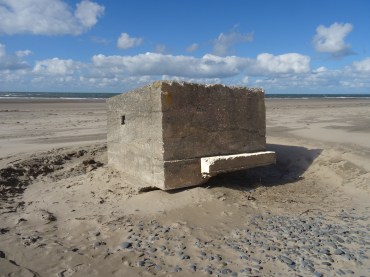
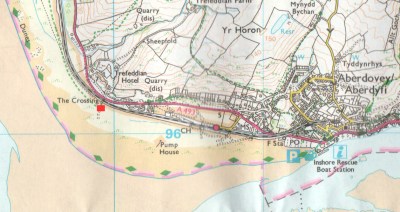
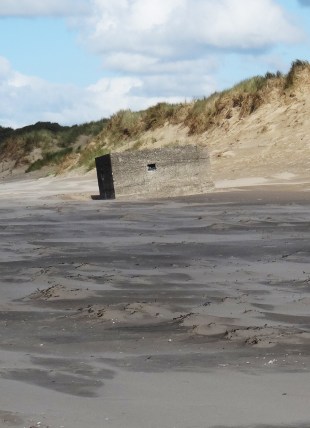
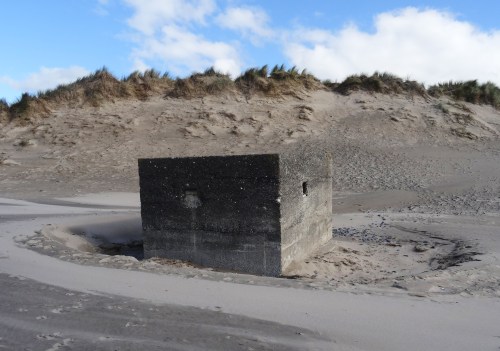
Walking towards Tywyn from Aberdovey you will come across a Second World War pillbox, an ugly concrete box with a small square hole in each side.  It has subsided unevenly into a dip in the beach at the foot of the dunes, an incongruous contributor to the area’s heritage.  It can be reached easily along the beach from Aberdovey.  It’s a fairly short walk from the car park, a little way beyond the Trefeddian Hotel, which is visible through a dip in the sand dunes.  If you prefer a short-cut there is a public footpath from a big lay-by on the A493 that takes you across the sand dunes and drops you very close to it.  Not that it’s a tourist destination, but it is certainly a local landmark, and sitting in an unspoiled stretch of eternal pale yellow sands with the rich blue sea beyond, it has an emphatic presence all of its own.  It is at grid reference SN59549635, at the end of the footpath known as The Crossing.

The pillbox is marked as a red box by The Crossing. Source: OS Explorer, Cadair Idris and Llyn Tegid. OL23. Ordnance Survey 2015

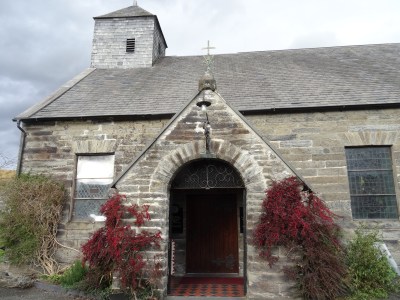
There are two war memorials in Aberdovey.  There’s a lovely 1999 memorial to 3 Troop 10(1A) who were stationed at Aberdovey during the war for their training (see my earlier post about this) and there’s a little shrine and plaque listing the dead from form both wards inserted into the wall of St Peter’s Church.

In some ways, the pillbox is an even more substantial monument to the bitter truth of war, mute but evocative.   The fact that it sits there, so out of place, so thoroughly ugly, is an appropriate shock to the system.  As detritus of war, it is something that demands a response and forces an  acknowledgement of the realities of the past in a way that a conventional memorial, however heartfelt, does not.  Although it was a lovely day for a walk, the sands endlessly beautiful and full of light, when I arrived at the pillbox it was just as dismal as I remembered.  Ugly, lop-sided, surreal, a scar on the landscape, a slap around the face.  A savage, palpable war memorial.

Pillboxes were part of a network of small defences that were put in place along the coastline, at road junctions and on canals to counter threats of Nazi attack on Britain.  The network consisted of a number of measures including offshore minefields; beach and manned seafront obstacles like barbed wire and landing craft obstructions, pillboxes and minefields; and cliff-top and dune defences including pillboxes and anti-glider obstructions.  The pillboxes, 28,000 of them, were sometimes round or hexagonal to avoid blind spots, but there were were seven different types in total (Types 22-28), with variants.  The Aberdovey one is a Type 26 prefabricated square with an embrasure in each wall and a door, now slightly subsided into a slight dip in the sand, 3ft or so deep.  Some pillboxes were brick- or stone-built but many, like this one, were made of concrete that was sufficiently thick to be bullet proof.   My thanks to the Pillbox Study Group for this excerpt, which explains the thinking behind pillboxes and other defence structures that were put in place in WWII:

On 25th June 1940, General Paget, Chief of Staff to the Commander-in-Chief Home Forces submitted General Ironside`s anti-invasion plan to the War Cabinet in the form of Home Forces Operation Instruction No.3.

SECTION 13 of the Instruction stated: “The general plan of defence is a combination of mobile columns and static defences by means of strong-points and stops. As static defence only provides limited protection of the most vulnerable points, it must be supplemented by the action of mobile columns. However mobile such columns may be they cannot be expected to operate immediately over the whole area in which it is possible for the enemy to attempt invasion by sea or air. It is therefore necessary to adopt measures for confining his actions until such time as mobile columns can arrive to deal with him. This will be done by means of stops and strong-points prepared for all round defence at aerodromes which are necessary to prevent the enemy obtaining air superiority, at the main centres of communications and distributed in depth over a wide area covering London and the centres of production and supply. This system of stops and strong-points will prevent the enemy from running riot and tearing the guts out of the country as had happened in France and Belgium.”

In total there were 6 pillboxes every 500m from south of the river Dyffryn Gwyn, which flows into the sea just south of Tywyn, to the entrance of the river Dovey.  Prefabricated pillboxes were built of concrete panels and were then bolted into place on site.  The pillboxes to the north of this one are badly damaged, perhaps in an attempt to destroy and remove them.  Aberdovey had an Observer Corps, a Home Guard and a Coastguard Station during the Second World War.

References: