A brief history of 1-3 Penhelig Lodge Cottages, Penhelig

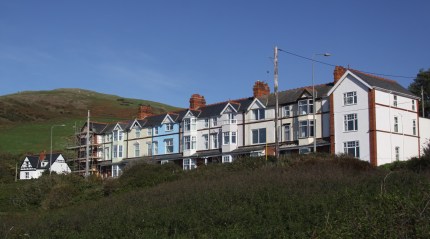
One of the oldest 19th Century buildings remaining in Aberdovey, resembling earlier 18th Century vernacular architecture, is the lovely little row of homes now known as Penhelig Lodge, on the left after you pass the Penhelig Arms public house and walk under the railway bridge on the way out of Aberdovey towards Machynlleth (grid reference SN6211696171).  It all looks to be in excellent condition, much-loved, and has been grade 2 listed since 1994 (Cadw 14963).
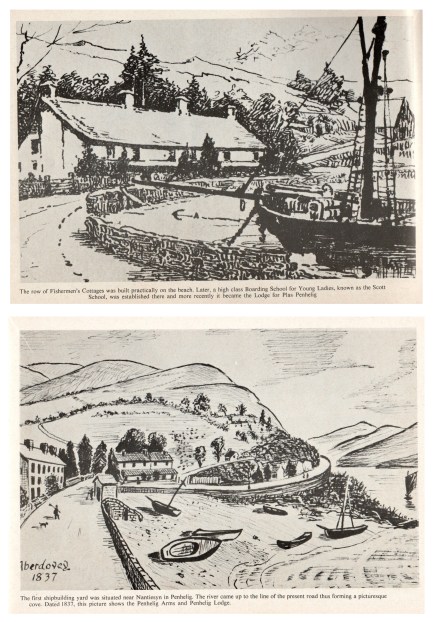
Penhelig Lodge, both around 1837. Source: Hugh M. Lewis M.B.E. Aberdyfi. A Glimpse of the Past.

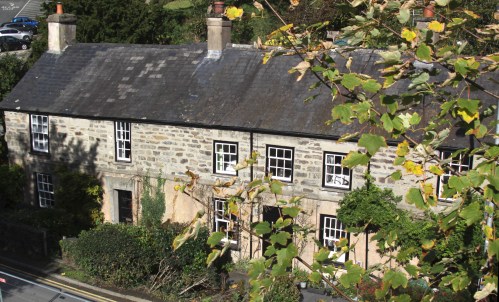
Engravings of Penhelig Lodge survive dating to around 1837, some twenty five years years before the coming of the railway, which transformed both the appearance and the economy of Aberdovey and Penhelig.  Hugh M. Lewis says that it was originally fisherman’s cottages.  When it was built it comprised three terraced houses.  The engravings show a low, long two storey building with four chimneys, the lower storey protruding out onto the very edge of the road itself.  Made of local stone with a slate roof, It is thought that the three small windows retained in the central terrace  were the original design, the middle one set immediately over the front door, whereas the more obviously Georgian taller sash windows in the flanking homes that reach into the eaves were later 19th Century replacements.   There appear to have been three of these taller windows on the left hand building (no.1), but the central one was bricked up at some time in the past, perhaps to avoid the 1696-1851 window tax.  No.3, at the right end only ever seems to have had two.  Looking at the 1837 engraving, there is a clear delineation between no.2 and no.3, perhaps suggesting that no.3 was in fact a later addition and that the original building only consisted of the two homes. This needs checking against other engravings of this part of Penhelig, if there area any.  At this time Aberdovey and Penhelig were closely related but still maintained their own identities.  The three terraced houses overlooked a sloping beach that became a shipyard.  The beach came right up to the road, which was only changed when work on the railway began in the early 1860s.

In 1844 the leader of the local branch of Plymouth Brethren, Dr John Pughe (Ioan ap Hu Feddyg), came to stay in the terrace, convenient for assembling in their chapel on the beach, the former bath house, which in turn became the Aberdyfi Literary Institute in 1882.  I’ll add more about Dr John Pughe when I have found out more about him.
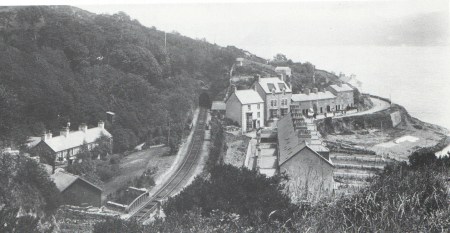
Penhelig Lodge is to the left of the railway track, in about 1865, now separated from the sea by the railway and the newly built Penhelig Terrace, which is end on in this photograph.  Source:  Hugh M. Lewis, Pages of Time.

The arrival of the railway in the late 1850s and early 1860s, eventually opening fully in 1867, cut Penhelig Lodge off from the beach and the shipyard that operated there, inserting a raised railway embankment between the road and the beach.  On the other side of the railway a new set of houses began to be built in 1860 on part of the shipyard and using quarrying refuse from the tunnelling for the railway as a base.  This new row of houses is now known as Penhelig Terrace and the shipbuilding yard became a ship repair yard instead, a common fate for shipbuilding premises from the early 1850s onwards, as steam took over from sail and rail took over from shipping.  If you click on the photograph and look at Penhelig Lodge, you can see that the upper storey of Penhelig Lodge has had half-timbering applied to the outside walls, giving it a mock Tudor appearance, presumably to make it look older than it actually is.  If you look at the railway tracks, you will not that there is no station here at this stage.  Penhelig station was only added in 1933.

In 1882 the terrace became an exclusive boarding school for young ladies, set up and run by Mrs Sarah Scott.  In his booklet Pages of Time Hugh M. Lewis quotes its mission statement, which says that its aim was to “impart sufficient culture, etiquette and deportment to the public to enable them to assume their proper places in society.”  Presumably in such a remote area its emphasis there was little opportunity to but these skills into practice locally.  The school apparently endured for two decades and there is a memorial to Mrs Scott in St Peter’s Church.   I will add a photograph of this when I have had chance to visit the church.
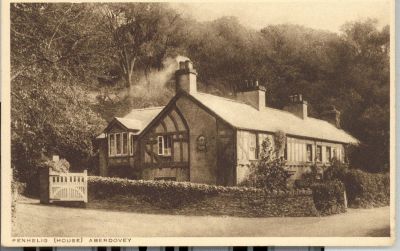
Penhelig Lodge in the early 20th Century. Source: Coflein. “Digitised postcard image of 1, 2 and 3 Penhelig Lodge, Aberdovey, G. Williams, London House, Aberdovey. Produced by Parks and Gardens Data Services, from an original item in the Peter Davis Collection at Parks and Gardens UK. We hold only web-resolution images of this collection, suitable for viewing on screen and for research purposes only.”

In the early 20th Century it became the lodge for Plas Penhelyg (Penhelig House), built in 1903-6, and was occupied by the head coachman and head gardner.   Thanks to Dai and Helen Williams for telling me that Plas Penhelyg used to be a hotel but is now in private ownership.  This photograph shows it in the early 20th Century with the half-timbering still in place.  The extension to no.1 was already added in the above 1837 engraving, but appears to have had a prominent bay window added, which survives today.

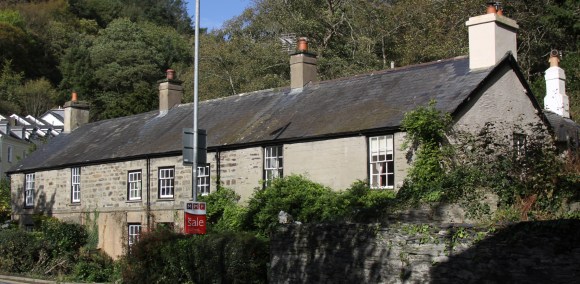
Today 1, 2 and 3 Penhelig Lodge has been restored to three terraced houses.  It is lucky to have maintained much of its original appearance, although as discussed above the windows have clearly been altered over the years.  In at least one of the houses, no.3 Penhelig Lodge, the room used today as a kitchen has natural bedrock exposed as part of the rear wall of the building.

The Coflein website describes its current appearance as follows:

The terrace is two storeys, with a band course between floors and a slate roof with 4 small rendered chimneys. The left house has two windows with small-pane sashes set at the eaves. The central house has, on the first floor, three 9-pane hornless sash windows; and a central doorway flanked by small-pane sash windows. The right house has two windows with first floor small-pane sashes set at eaves; the ground floor has 2 tripartite casement windows to the front. To rear of the left house, there is an extension with a gabled half-timbered oriel window.

Horns, if you are unfamiliar with the term, are the bits of wood that extend down from the top piece of many two-part Georgian sash windows.

It bears a remarkable resemblance to Yr Ysgwrn, farmhouse and home to Welsh poet Hedd Wyn (the bardic name of Ellis Humphrey), a mile to the east of Trawsfynydd.  It is now owned by the Snowdonia National Park and preserves the interior as a museum.  You can see a photograph here.

An advert for the sale of 3 Penhelig Lodge on 15th November 2018 shows a view of the house and the interior with the exposed bedrock in the kitchen, which is absolutely superb.

Estate Agent Advert for 3 Penhelig Lodge in Cambrian News 15/11/2018

If you know more about this building, wish to make corrections, or have photographs that you would not mind sharing, I would love to hear from you.
References:

Aberdyfi Chamber of Trade 2018.  Aberdyfi Aberdovey Walks.
British Listed Buildings website
Coflein (National Monuments Record of Wales) website
Gwynedd Archaeological Trust 2007.  Ports and Harbours of Gwynedd: Aberdyfi. A Threat Related Assessment.  GAT Project  No.1824, Report No.671.1, April 2007
Gwynedd Archaeological Trust 2011.  Conservation Area Appraisal: Aberdyfi, Gwynedd. GAT Project  No.2155, Report No.956, June 2007
Lewis, H.M. 1989.  Pages of Time.
Lewis, H.M. Aberdyfi. n.d. A Glimpse of the Past.

A three day fish-fest thanks to Dai’s Shed and my freezer

On Wednesday I floured and pan-fried a terrific chunk of Dai’s seabass that I had in the freezer from a couple of weeks ago. Seabass freezes beautifully for short periods and this was a gorgeous piece of fish, in terms of both texture and flavour.  I served it very simply with a sauce made of capers, diced tomato, finely diced banana shallot and finely chopped herbs (Thai basil, thyme, ordinary basil, parsley, oregano, lovage and just a little mint) in virgin olive oil and lemon juice, served with griddled courgette discs, sautéed potatoes and accompanied by lemon slices. It is super to be able to use herbs from the garden whilst they last, and the Thai basil, a new addition to my outdoor herb collection, came over particularly well.  It is amazing how long the herbs are lasting – I was expecting most of them to be well on their way out by now.  I will particularly miss the lovage, which I use in huge quantities in salad and fish sauces, as it is simply unavailable even in big supermarkets.

Yesterday the flavours in my fish tagine were a bit more complicated but it was also a doddle to prepare.  Again from the freezer, I had a piece of huss that I cut into chunks, that I marinated in a mix of fresh coriander from my garden, paprika, cumin, cayenne, lemon and olive oil.  This was then cooked, complete with the marinade, in puréed fresh tomato, cumin, garlic, onion, with fresh chillis and parsley (both from my garden), grated carrot, preserved lemons and okra, with a little home made fish stock.  I sprinkled mint over the top and served it with lime and coriander cous cous.  The latter was a cheat – a pack from Ainsley Harriott, but it is so good that I never feel guilty about not making it myself.  Huss is brilliant for this type of cooking because it retains its shape, and has enough flavour of its own to stand up to all the herbs and spices.  Like the seabass, it is a good choice for the freezer, and it is blissfully easy to fillet.  I make the tomato, onion and garlic base in huge batches for the freezer, partly for convenience but mainly because I absolutely detest peeling tomatoes and prefer to confine the suffering to single large sessions.  As I really don’t like the harsh sweetness of tinned toms (I’m a bit of a fussy eater) it is seriously worth the effort.

Today I was at the excellent community lunch, about which more on a future post, so there was no need for an evening meal, but I used some fish stock that I made yesterday from a freezer bag of fish bits (heads, tails, bones etc) left over from preparing and filleting fish to make myself a fish soup.  To give it a bit of body and flavour I recruited some onions, some fennel that needed using up, garlic cloves, chilli from the garden and skinned fresh toms, all whizzed up in the blender.  In a somewhat extravagant mood I lobbed in rather a lot of saffron for that extra bit of Mediterranean luxury, seasoned it with sea salt and pepper and sprinkled over a bit of coarsely chopped parsley.  It was supposed to be basil but I wasn’t about to go outside to pick some in pouring rain and a gale (thanks Storm Callum) when I had some parsley in the fridge!  Grabbed a spoon and bowl and it was Job done. There was loads left over for the freezer, a blessed fall-back for when I don’t feel like cooking.

A proper seaside walk – the beach, the sea, the waves, sun and even a sandcastle

Sunshine, sand, sea and almost no-one on the beach but me.  Idyllic.  When I woke up this morning it was cold and grey, but by noon the day had clearly decided to fall in line with the weather forecast and blossomed into a glorious autumn afternoon.  I had stuff I needed to do but I was done by 2pm and drove to the lay-by on the road to Tywyn, opposite the line of houses on the other side of the Trefeddian Hotel.   A path crosses the golf course, wends its way through the dunes and drops you by the Second World War pillbox.  From there Tywyn is clearly visible in the distance.  The tide was out, just on the turn, so it took a couple of minutes to reach the water’s edge, although the roar from the waves had been clearly audible from the road.

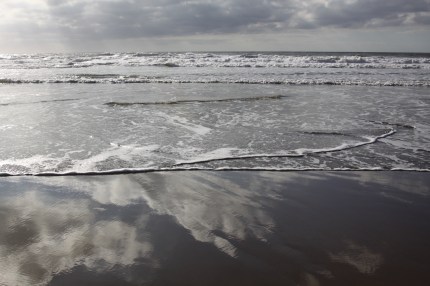
The beach was spectacular, the damp sand reflecting blue sky and white clouds, with deep dips holding pools of water like liquid silver and white-topped blue waves thundering as crests broke, chaotic shapes forming and reforming.   The main strandline was up by the dunes, clumps of dark weed, but there were long strands of weed shimmering in the sunshine, some floating in pools some strewn along the sand.  I took a few photos and a couple of videos as I walked towards Tywyn, got wet feet, and generally had a great time.  It really was a spectacular afternoon.  A lady on the checkout at the Co-op in Tywyn, who also moved here from London, told me that the novelty lasted six months with her, but I really don’t see it ever wearing off for me.  Mind, I haven’t survived an Aberdovey winter yet.

Crossing the sand dunes.  Close to the beach they are stablized by marram grass.

The first and last photos are burnet roses, small and delicate, that are usually found in sand dunes. The pink petals belong to a blackberry bramble and the blue berries are blackthorn, also common in sand dunes.

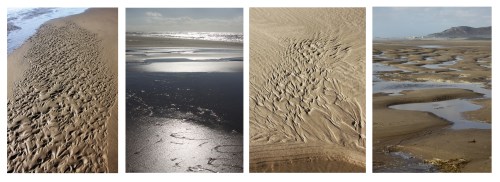
Lovely shapes and light on the wet sand

Ecofacts. The shells are a limpit with a beautiful yellow shell, an elegant variegated scallop, a saddle oyster and a purple-black common muscle. An articulated crab claw has become detached from its owner. This was the first cuttlefish bone that I have found on the Aberdovey beach, beautifully laminated. Within the calcium-rich shell there are chambers that that fill with gas or water allowing the cuttlefish to rise or sink.

Here are two of the videos.  I am still trying to get the hang of this whole video thing.  The autofocus on the little camera that I use for video was having trouble today, unsurprisingly, and it was having trouble with the shifting light too.  And of course, it was absolutely not all the camera’s fault that these are anything but perfect.  This was my first time trying to video the sea, and the learning curve shows rather acutely!  Huge fun though, and I’ll get there eventually.

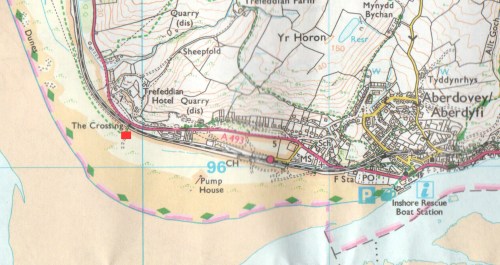
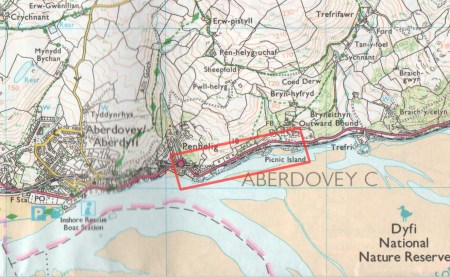
The lay-by to park for this stroll on the beach is at The Crossing, just where the A493 goes around a slow but definitive bend. It is opposite a very fine terrace of tall houses. The footpath is a track on the left of the lay-by and takes you over two stiles across the railway. You then cross the golf course to walk along the path through the dunes and down on to the beach by the Second World War pillbox, marked on the above map with a red rectangle.


Speed-eating: close-up of a blue tit feeding

The robin and the sparrows are quite happy to feed close to the house, but the coal tits, great tits and blue tits are much more cautious, except for one individual which has decided that the fat balls are worth the risk.   In this short video, only a few feet from the camera, you can clearly see the blue tit digging into the fat balls through the holes in the feeder.  I have never seen food go down so quickly – amazed that he/she didn’t get hiccoughs!  The avian equivalent of fast food.  Don’t be put off by the fuzzy preview on the image below – it’s all super-sharp.


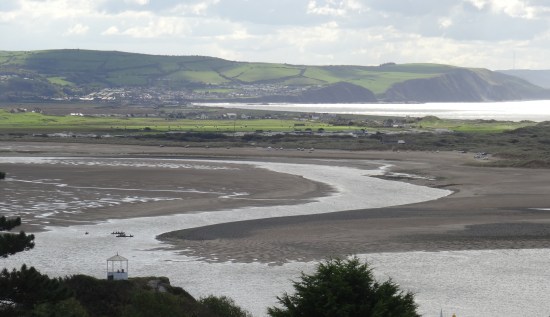
Low Tide at 1356 on Saturday 6th October 2018

Low tide yesterday was at 1344 and this shows it just a few minutes afterwards at 1356.  At that time it was only at 1.55m above chart datum (data from tidetables.org.uk) and was one of the lowest tides that I have noticed since I arrived.  The kayaks really put it into perspective, showing how narrow the channel had become.


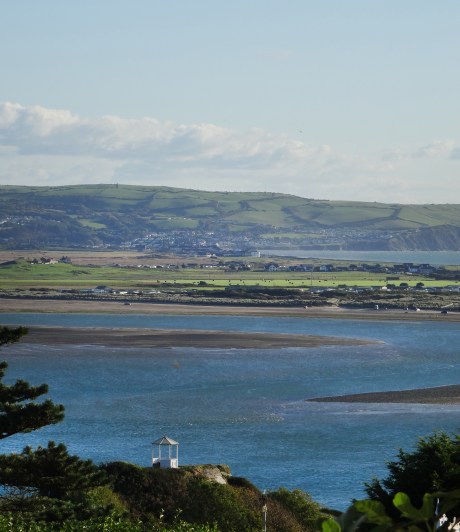
For comparison, the following high tide was at 1902, at 4.60m.  It was getting dark by 1902 so this photo was taken at 1711, as the tide was coming in, at c.3.80m.

A walk along the “Roman Road” to Picnic Island and beyond

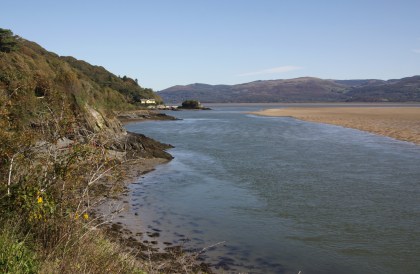
If you are looking for a short walk with some lovely views over the river estuary and the hills beyond, this is a nice one.  If you want to go all the way to Picnic Island, a walk of just 30 minutes or so, you will need to be prepared to pick your way along some jagged rocks, but if you only want to go as far as the beach beneath the footbridge over the railway line, it’s a simple walk along well worn paths.  You can also turn it into a much longer 6 mile walk by crossing the footbridge and going up the hill and circling back into Aberdovey. I’ve added a PDF at the end of this post.  Patches can be a bit muddy after rainfall and on the rock this can be slippery, so suitable footwear is recommended.  Before you set out, check the tides.  You will need to avoid high tide, because part of the walk is cut off by water.  If you do find yourself returning along the path to meet with an unpassable section you will need to cross the bridge over the railway and return along the road, but this is a busy road with no footpath so is much best avoided.
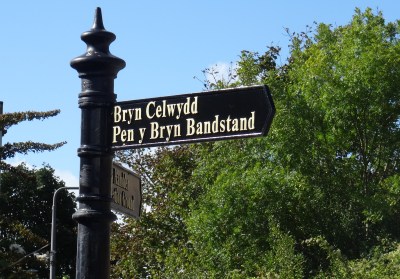
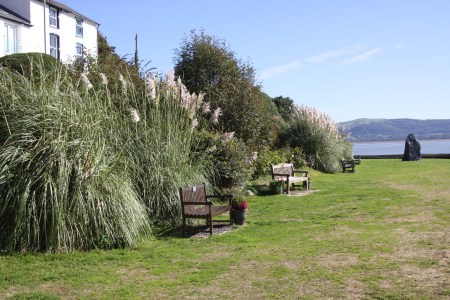
The walk is all about beautiful views over the estuaries and to the hills beyond.  It starts in the Memorial Park at Penhelig.  Either go under the railway bridge or cut off that rather dangerous corner on the road by taking the private road in front of the houses known as Penhelig Terrace.  The Memorial Park is on the other side.  It is a lovely little park with great views over Aberdovey’s sea front.  It contains a memorial and a plaque in English and Welsh to mark the achievements of the 3 Troop 10, a group of German nationals who worked on behalf of the Allies during the Second World War, and who were stationed in Aberdovey for their training (which I have described on an earlier post).  There is also a little shelter, slightly unkempt at the time of writing, to the memory of Mr Richard Roberts “in recognition of his munificent gift for improvements at Aberdovey 1930.”

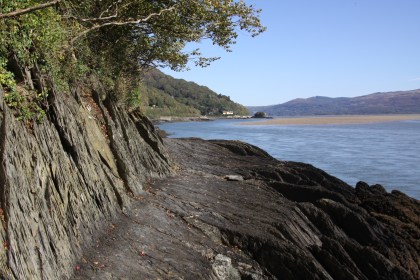
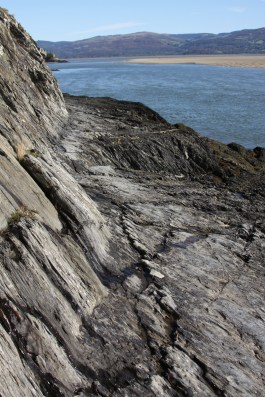
At the far end of the park let yourself through the gate and onto the Roman road.  The so-called Roman road is neither Roman nor, in modern terms, a road.  It is a path carved out of the local mudstone, a remarkable feat that even the Romans, accomplished civil engineers, would have found a difficult task without the help of explosives.  And why would they have gone to the trouble?  The nearest Roman military structure was Cefn Caer at Pennal, 11km to the east along the Dyfi.  There is no obvious benefit for a permanent stone-built pathway to Aberdovey, even if there was any sign elsewhere between Aberdovey and Pennal of a long-term Roman presence, which there isn’t.  My guess was that it was built in the 1860s, part of the works for the building of the railway, but again that fails to address the question of the purpose of such a track, given that there was a perfectly good coast road at that time.  In his description of the 6-mile walk, below, the author David Roberts, an Aberdovey resident, states that the track was built in 1808 for horse and carriage, but he doesn’t say where these were headed and why such a road would be required.  Even Hugh M. Lewis, who was born in 1910, and grew up and lived in Aberdovey was unable to shed any more light on the subject.

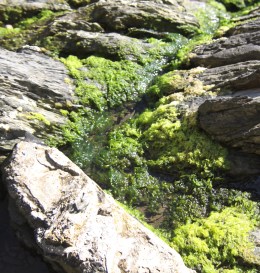
Whenever it was built and whatever it was used for, it is invaluable today as a ready-made footpath for walkers.  The path has two small bridges that cross little natural outlets for fresh water that pours down the hill into the estuary.  In these places the fresh water-loving gut weed grows, a livid, bright green that contrasts dramatically with the black stone and the brown seaweeds.  The estuary is incredibly peaceful on a sunny day as the tide retreats, the waters flat and sparkling, making a pleasant sound lapping gently at the rocks as they travel at a considerable pace to the west. The hills beyond, in Cerdigion, fresh and green, are the perfect backdrop.

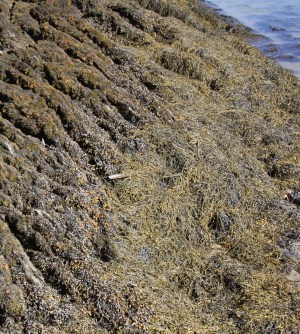
The ubiquitous mudstone, into which the path is carved, slopes gently down into the waters, and is covered with some of the seaweeds that I described on my strandline walk, fascinatingly three types forming three bands as they approach the water, with those most equipped to survive out of the water for longest at the top, and the least drought tolerant at the bottom.  Sea oak is at the top, bladder wrack in the middle and egg wrack at the base. some of it remaining submerged even at low tide.  Unlike my strandline walk, where all the seaweeds had been detached from their rock bases, it was possible to inspect the seaweeds in situ, so I could see the holdfast with which they attach themselves to rocks, a surprisingly tiny little mass of highly tenacious material.

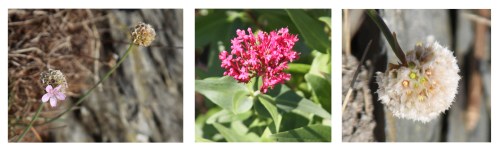
On the rock face above the level of the path, two plants in particular make the best of the most implausible nooks and crannies to grow: red valerian and sea thrift.  Both are drought resistant, saline tolerant, prefer sandy and low-fertility soils and need full sun, so are frequently found in south-facing coastal areas.  When the sea thrift goes over, which most of them have by late September, the fallen petals leave attractive skeletal globes. Watch out for sea thrift and red valerian in cracks in vertical planes of the rock to the left as you walk towards Picnic Island.  Where the rock splits it reveals trapped minerals that are often beautifully coloured providing a perfect canvas for the flowers.

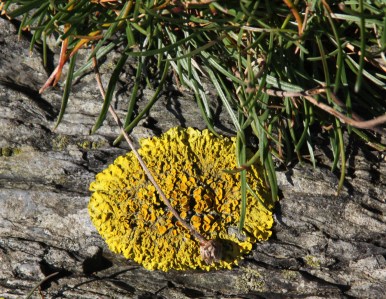
At all levels above the waterline are a variety of lichens dominated by yellow scales (shown to the right), which is prolific, followed by black shields and map lichen.  Lichens are not single organisms but are symbiotic, depending for their survival on “photobionts” (algae and/or cyanobacteria), which provide them with the carbon that they need.  The photobionts use the process of photosynthesis to manufacture their own food source, whereas the fungal component of the lichens need an external food source.  This ecological strategy has obvious benefits for the fungus, which is essentially parasitic on the photobionts, but it is thought that the photobionts might benefit too, due to the provision by the fungus of a stable environment in which they can develop.  There’s a lot more information on the British Lichen Society website.

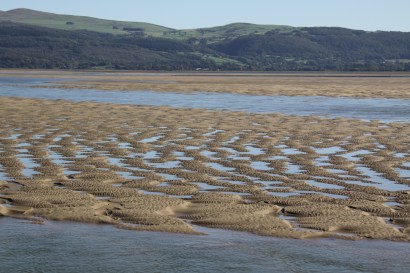
The Roman road runs out and is replaced by a well maintained footpath that runs parallel to the railway line, taking a route several feet above the estuary, again with wonderful views across the estuary.  At low tide the sands in the middle of the estuary are revealed, a shifting chiaroscuro of colours and deep shadows framed by the speeding waters of the retreating tide.  There is rich vegetation along the footpath – blackberry and rose brambles, ferns, berberis, purple thistles, red valerian, buddleia, holly, wild oregano and much more.   In autumn there are few flowers, mainly the last of the red valerian, but there is a profusion of red and orange berries.

A fork in the path offers a choice.  The left fork leads up to Picnic Island and the footbridge over the railway into a lay-by and, 100m down the road, the continuation of the walk for those who want to pursue the 6 mile option.  Picnic Island is not an island, just a small promontory cut off from the hillside by the railway, but it has wooden seating and is a pleasant green area with excellent views south over the estuary.  It’s original name is Bryn Lestair (obstruction hill).

The right fork leads down steps to a small pebble beach, and the continuation of the Roman road for a short span, before it runs out again.  The beach was the site of a shipbuilding business, some of its walls still surviving, but the site was largely destroyed by the railway.  From the beach, facing the sea look left and you will see that the Roman road resumes.  Follow this for a short distance and then it’s a matter of picking your way down the rocks to the beach, and along the foot of the retaining wall behind which the railway runs.  This is invariably wet, with hillside water pouring from under the wall.  There were almost no shells on the beach sections, only very fragmented muscles and barnacles.  The barnacles were on loose bits of slate, so they were probably detached from rocks elsewhere and brought in on the tide.  This is probably because the waters are brackish, combining freshwater pouring out of the river Dovey and salt water coming in on the tide.

On the other side of this small beach is another promontory with views over the estuary and east towards the Georgian Trefri Hall with its own island complete with crenellated folly.  Before it was painted mustard yellow it was my favourite house in the area – that wonderful location, those stunning views, a private tidal beach and that super folly!  In 2016 it came on the market and was featured in an article on the Wales Online website – for sale for a cool 1.7 million pounds.  Rather more than I had in my piggy bank on the day.

The walk back into Aberdovey is simply a matter of retracing your footsteps.

If you are interested in the 6-mile walk that takes you up into the hill behind the estuary, here’s a PDF to download:  6 mile circular walk Picnic Island and hill.  It is the BBC Weatherman Walking map and guide by local resident David Roberts (eight pages with photographs).  I haven’t done it yet, but it looks splendid and it’s on my to-do list.

Bass and Mullet from Dai’s Shed. Happy.

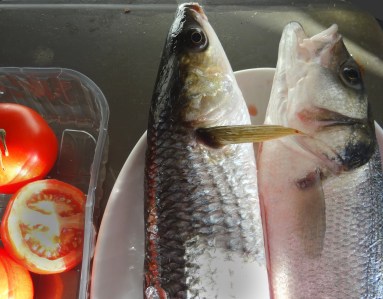
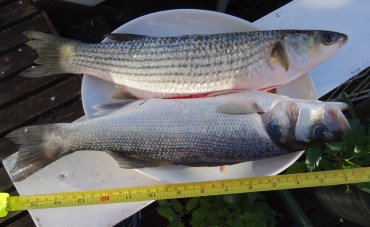
Oh the multiple joys of the dry weather!  A gloriously sunny day yesterday.  A long, lazy walk down the estuary was followed by a trip to Dai’s shed to see what he might have available. The blackboard said bass and mullet.  Woo hoo!  Jill was in charge, as Dai was bringing in the lobster pots.  I asked for one of each, and was staggered at the size of them!  Super fresh.  Each over a foot long, bright of eye, and beautifully silver-grey, stunning.  She only had two mullets left, so I was lucky.  I hate de-scaling fish – I always end up covered in scales – but Jill did the job in double-quick time and gutted them both for me as well.  As I watched the process with envy at her speed another customer arrived.  A nice little exchange:
[Clock showing 3.20pm].
Customer:  “What time do you close?”
Jill, smiling and looking at the clock: “2 O’clock!”
Customer, also laughing:  “I better not come back a bit later then!”

When I left, he was still waiting patiently in line and I hope that he enjoyed his fish as much as I enjoyed mine.  Whilst I was there, the owners of Proper Gander came in to pick up seafood for the restaurant as Dai returned with his lobster pots and the day’s catch.  Couldn’t have been fresher!

Mullet at top, bass at bottom. Heaven on a plate.

The ideal way to serve the fish would have been whole, but even if I starved myself for a couple of days that wasn’t going to work :-).  I’ve never tried filleting a raw fish, so I cut the fish into chunks when I got home, the first chunk for last night, the others put in the freezer, with heads and tails also frozen for a future fish stock.

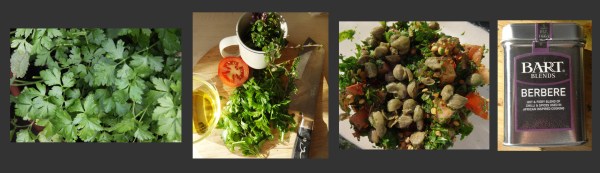
I have been indulging in a bit of a North African and Middle Eastern phase, having been reunited with my tagine and my spice collection, but I chose to keep things perfectly simple.  I floured my piece of mullet, fried it in a mix of butter and olive oil and served it with something mid way between chermoula and a sauce vierge.  It was composed of fine-diced tomato, capers and banana shallot, finely chopped mint, parsley, lovage, and oregano in a virgin olive oil and a big squeeze of lemon juice, with some minced garlic thrown in for fun, livened up with with a punch of Berbere spices (a blend that I found in the Co-op pin Tywyn).  I also sautéed some spuds and threw a couple of baby courgettes on the griddle.  The herbs all came from my garden except for the oregano that I spotted growing all along the estuary walk – a nice, bijou little forage!  I do wish that I could grow coriander, but it goes straight to seed.

Mullet turns out to be a stunning fish.  I had never had it before and was told that if caught in estuary waters it could taste very muddy but this was caught out at sea and was anything but muddy.  It had a clean, fresh taste, beautifully white and full of flavour.  It is often compared with sea bass, but of the two I prefer the mullet.  It has better flavour and a much better texture.  The fresh and clean flavours of the fish, the herbs and the spices all worked well together.

Dai’s Shed is open til the end of October, so if you’re hoping for some excellent locally caught fish, you need to get your skates on.

Where was Aberdyfi Castle?

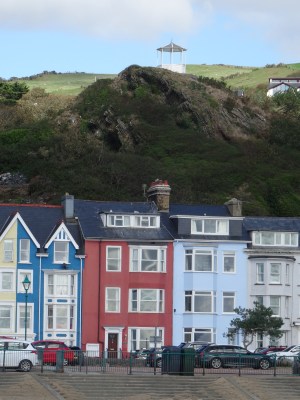
Glan-Dovey Terrace with Pen-y-Bryn behind and the white 19th Century shelter on top.

Overlooking Aberdovey’s sea front is a little white shelter on a small hillock, a popular destination with tourists and dog walkers known in the 19th Century as Pen-y-Bryn, which translates as Head of the Hill.  The original name of the hill may have been Bryn Celwydd, Hill of Lies, which is recorded on a chart of the Dyfi Estuary dating to 1748.   A number of guides to Aberdovey place Aberdyfi Castle on that spot.  For example, in Aberdyfi: The past Recalled by Hugh M. Lewis has a page describing the castle, “possibly a motte and bailey castle or more probably a castle of wattle and daub which was defended by a stockade,” locating it at Pen-y-Bryn.  However, although it is recorded that certain historical events clearly took place at a castle of this name, and it receives particular mention in the late 12th-early 13th Century Brut-y-Tywysogion (Chronicle of the Princes) compiled at Strata Florida abbey, the identification of the castle with the bandstand hill, and even with Aberdovey itself, is very doubtful.

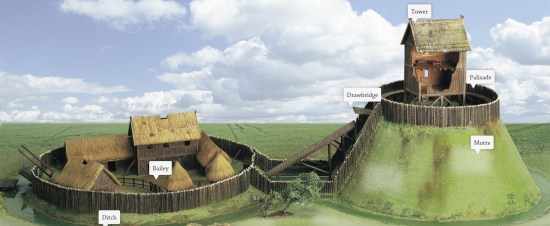
To begin with, Pen-y-Bryn always seemed to me a most improbable as the site of a castle, even a small one, even allowing for substantial alteration of the profile of the hill over time.  In a motte and bailey arrangement a fortification sits on a natural or artificial mound with an accompanying settlement in a walled/fenced area at its foot, sometimes surrounded by a moat or ditch.  Pictures of ruins and artistic reconstructions based on excavations indicate that the motte might support a fortification that was little more than an elaborate shed, as this reconstruction from the Dorling Kindersley Find Out website suggests.  That nothing substantial could have been built on the Pen-y-Bryn site does not rule it out of being Aberdyfi castle, but the events that are described below would indicate that a large structure would have been required to defend an important fortified settlement, particularly one selected for the vital political assembly that established the primacy of a Welsh prince as ruler of most of Wales.

Dorling Kindersley reconstruction of a motte and bailey castle showing the main features. Fortifications could be very small. Source: Dorling Kindersley Find Out website.

The Aberdyfi Castle was twice used as a base for important documented meetings of Welsh rulers, first in the 12th and then in the 13th Century, but the name is also connected with a much less secure event that allegedly took place in the 6th Century.  A rather more plausible alternative to Pen-y-Bryn for the castle is the site of Dolmen Las on the south bank of the Dyfi at Glyndyfi in Ceredigion, suggested by a number of authors.

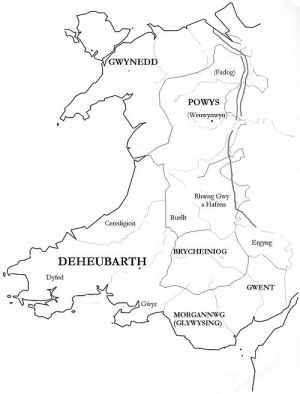
What is clear is that wherever the castle was located, it was a Welsh one, rather than an English one captured by the Welsh.  The Norman invaders were innovators of the use of castles in Wales, but it was not long before Welsh leaders, observing and suffering the effects of this new powerful strategic device, were able to learn from it and build their own versions.  Rhys ap Gruffudd the powerful 12th century ruler of Deheubarth was amongst the first to take to castle building, and in his biography of Rhys, Turvey suggests that this castle was one of his.

Aberdyfi is first connected with Maelgwyn Fawr (Maelgwyn the Great, Maglocunus in Latin), descendant of Cunedda, and ruler of Gwynedd.  This is mentioned by Davies who says that “according to tradition it was at Aberdyfi that the suzerainty of Maelgwyn Fawr had been recognized seven hundred years earlier.”   This apparently endowed Aberdfyi with a certain status as a place associated with the triumph of a Welsh ruler in achieving a status approaching that of a king.

Effigy of Rhys ap Gruffudd from St David’s Cathedral. Source: Wikipedia

According to Turvey, Aberdyfi Castle itself seems to have been founded by Rhys ap Gruffydd (1132-1197) in 1156, the ruler of Deheubarth, the second most important region in Wales, in order to counter the expansionist policies of  Owain Gwynedd (or Owain ap Gruffudd, 1100-1170), ruler of the most important region at the time, Gwynedd.  Rhys and his brothers had invaded Ceredigion in  1153, having already consolidated their position in Dyfed and Ystrad Tywi, and by the time Henry II came to power, John Davies says that Owain Gwynedd’s realm “extended almost to the walls of Chester,” taking in much of the earldom of Chester and the kingdom of Powys.  The northern frontier of Deheubarth and the southern border of Gwynedd met at the river Dovey, making the river strategically significant.  Rhys was continually at war with the Norman Marcher lords to the east, and in 1158 Roger de Clare captured the castle in but was ousted by Rhys in the same year. 

Llywelyn the Great with his two sons, by the Benedictine monk Matthew of Paris (1200-1259). Source: Wikipedia

In 1216 an important meeting took place at Aberdyfi Castle, 15 years after the death of Rhys.  Its purpose was to formalize the position of Llywelyn ab Iorwerth (c.1173-1240), grandson of Owain Gwynedd who became known as Lywelyn Fawr (Llwelyn the Great), to receive the homage of other Welsh rulers and to divide Deheubarth among the descendants of Rhys ap Gruffudd.  Llywelyn ab Iorwerth was born in Gwynedd, which throughout the early Middle Ages had shown the most promise for becoming the leading territory in Wales and a unifying force for the various regions that made up Wales.  The assembly was intended to reinforce the position of Llywelyn as pre-eminent ruler in Wales.   At the Aberdyfi castle gathering minor rulers of the Deheubarth territory confirmed their homage to Llywelyn, and in return Llywelyn divided Deheubarth amongst the descendants of its deceased ruler Rhys ap Gruffudd.   Aberdyfi Castle was probably chosen for the meeting partly because of the Maelgwyn Fawr connection, lending historical gravitas and integrity to the event.

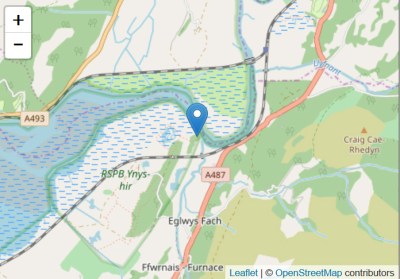
The location of Domen Las

So where was Aberdyfi Castle?  Even though it has been claimed that there may have been a Welsh fortification on the bandstand site, it is clearly not a suitable venue for the types of assembly described above.  Instead, a far more probable venue is Domen Las, which appears to be the remains of a motte at Ysgubor y Coed near Glandyfi (translating as bank of the river Dyfi) on the south side of the river Dyfi in Ceredigion, map reference SN68729687.  This fits in with the identification of Rhys as its builder and its location in his Ceredigion territory in Deheubarth.  The name Aberdyfi simply means “mouth of the Dyfi” and although Glandyfi is not at the mouth of the estuary, it is located at the point at which the river begins to open out into the estuary and may have been a crossing place. More significantly, Domen Las faced the mound of Tomen Las near Pennal in Gwynedd (SH697002), which may have been a motte established by one of the Gwynedd rulers, and possibly in use at the time that Aberdyfi Castle was built.  In addition, from Owain Gwynedd’s point of view, there would have been an obvious strategic link between Gwynedd and Deheubarth.  Dividing up Deheubarth from a point within Deheubarth but just over the border from Gwynedd and in sight of it would have been a powerful message to the descendants of Rhys.  Finally, although the 6th Century Maelgwn association with Aberdyfi pre-dates Rhys’s castle by five centuries, it may have had something to do with the castle’s name.

Domen, meaning mound, and las meaning green in old Welsh (blue in modern Welsh) describes the site perfectly.  It is an overgrown mound on the edge of the river Dyfi.  John Wiles describes it as follows on the excellent Coflein (The online catalogue of archaeology, buildings, industrial and maritime heritage in Wales) website:

The medieval castle of Domen Las is represented by a castle mound or motte. This is notable for the way that it is fitted into the natural topography and for the remarkable configuration of its ditch.

The castle faces north-east across the upper Dyfi estuary towards Pennal, the court of the Princes of Gwynedd in Merioneth (see NPRN 302965), and was built in 1156 to counter those Princes’ ambitions in Ceredigion. It may then have been the sole castle in Geneu’r-glyn commote, as Castell Gwallter at Llandre is not heard of after 1153 (see NPRN 92234). Domen Las is probably the castle of Abereinion mentioned in 1169 and 1206.

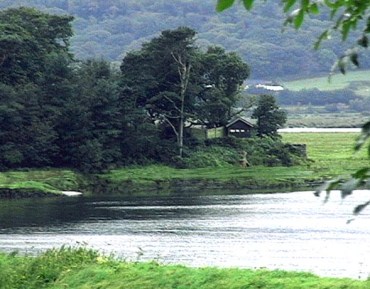
Domen Las in the bird sanctuary Ynys Hir. The small wooden building is a bird hide. Source: Castles of Wales website. Photograph by John Northall, copyright John Northall

The castle mound is set near the northern tip of an isolated straggling rocky ridge rising from the marshes. It is a circular flat-topped mound roughly 34m in diameter and 5.0m high. It is ditched around except on the south-east, where the ground falls steeply into the marsh. On the west side a rocky ridge serves is co-opted as a counterscarp. On the north side the ditch has the appearance of a regular basin, closed on the east side by a wall of rock pierced by a narrow gap. This could be a pond or cistern, and is surely an original feature.

There are no traces of any further earthworks. The castle mound was probably crowned by a great timber-framed tower and it is likely that a princely hall and associated offices stood nearby. These could have occupied the irregular platform on the northern tip of the spur above the river, although there is a more a more amenable location on the south side of the motte, where a level area is sheltered by the rocky ridge. A little to the south a small bank cuts across the ridge. This was probably a hedge bank and may be comparatively recent.

The identification of Domen Las as Abereinion castle by Wiles and others is interesting and muddies the waters more than somewhat.  The River Einion flows into the Dovey very near Domen Las but there is also a River Einion to the south, and in The Welsh Chronicle it is listed as having been built by Malgwn in 1205 and is sometimes identified with the mound at Cil y Graig in Cardigan as Abereinion Castle.  It is entirely possible, of course, that both names were applied to the same castle.  If that were the case, the Domen Las site is the most plausible location as it is both at the mouth of the river Dovey, where it spreads into the estuary, and at the mouth of the river Einion, where it joins the Dovey.

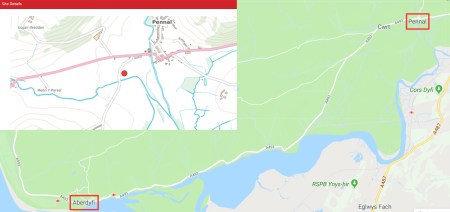
Location of Tomen Las (click to expand the image). Sources: Main map from Google Maps; Insert from the Coflein website.

Another candidate for Abyerdyfi Castle is Tomen Las near Pennal.  This is actually within Gwynedd with clear views over the estuary to Ceredigion and to Domen Las.  At the south of Gwynedd, near the borders with Deheubarth, this is yet another plausible site.  The Coflein website suggests that it was a former court (llys) of the princes of Pennal and describes the surviving remains as a circular mound 26m in diameter that rises 3.0m from the traces of its ditch with a level summit 15-17m across. There are no traces of further earthworks.

The short answer to the question posed in the title of this post is that there is no definitive location for Aberdyfi Castle. I have searched for but failed to find any records that the Pen-y-Bryn or Domen Las sites have been excavated, but it would certainly be interesting if future research into the question were to extend beyond analysis of the late Medieaval texts and into the field.  If I had to put money on it, I would go for the Domen Las site, mainly because of the political significance of the location just over the border of Gwynedd in Ceredigion, a good location from which to make a statement about the dominance of  Llewelyn ab Iowerth over both Gwynedd and the Deheubarth territories to its south.

Finally, returning to Pen-y-Bryn, a booklet by the Aberdyfi Chamber of Trade says that the castle on the hill was built by Rhys ap Gruffydd in 1151, when it was called Bryn Celwydd and was destroyed in 1157 by the Norman Earl Robert de Clare.  The little shelter at its top was a gift from a local landowner in 1897.  It can be approached from a footpath on the left as you head up Copper Hill Street, or from the seafront road just on the town side of the railway bridge, along a track that has recently been restored after several years of closure.  It looks as though you are heading into someone’s garden, but the steps that lead up on the far right are part of the footpath.  From the shelter there are beautiful views over the Dovey estuary and Cardigan Bay.

References

Aberdyfi Chamber of Commerce 2003.  Aberdyfi Aberdovey Walks.
Davies, J. 2007 (revised edition of the 1990 and 1992 editions). A History of Wales.  Penguin
Jenkins, G.H. 2007.  A Concise History of Wales.  Cambridge University Press
Lewis, H. M. 2001. Aberdyfi: The past Recalled. Dinas
Turvey, R. 1997. The Lord Rhys: Prince of Deheubarth. Gomer.
Wiles, J. 2008.  Domen Las or perhaps Abereinion Castle. Coflein. http://www.coflein.gov.uk/en/site/303600/details/domen-las-or-perhaps-abereinion-castle

A splendid afternoon beachcombing at Aberdovey

The strandline

When is a potato not a potato?  When it’s a sea potato.  When I moved here eight weeks ago I bought a book (a lot of the best bits in my life start with the phrase “I bought a book”) about beachcombing and the strandline (also referred to as the wrackline or driftline).  The strandline is that trail of debris that marks where the tide last deposited its load.  In London I lived a three minute walk from the Thames in a section of the river that had been used from the 17th Century until the mid 19th Century for shipbuilding.  A favourite walk at low tide (there is a 7m difference between the Thames at low and high tide) it was a rich source of objects, telling a partial and fragmented story about how the foreshore had been used and what the river carried and dropped on its travels.  But at Aberdovey, apart from collecting the occasional shell or decorative pebble, I had never paid much notice of what was at my feet at on the beach.  I was too busy enjoying the dune vegetation, the rolling waves and the gorgeous views.   At Aberdovey my invariable habit has always been to walk one way along the top of the sand dunes and then back along the water’s edge, fastidiously avoiding those dark, unappealing fly-covered lumps of festering decay.  Today, however, they were my goal, and to my amazement they were a wonderful treasure trove.

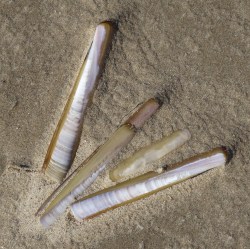
Common otter shell (Lutraria lutraria), 12cm long, which burrows to depths of up to 30cm.

I had been feeling almost housebound due to the gales and the torrential rain brought by Storm Bronagh.  I am glad that the weather front was provided with a name, as it gave me something specific to have a real grumble about.  On Sunday, however, I woke up to glorious sunshine and immediately decided to abandon all the outdoor DIY and gardening that I ought to be getting on with and head for the beach.  There was a lot of wind and big patches of fluffy white cloud, but mainly big blue skies and a beautiful autumn sun the colour of electrum.   I threw my cameras, spare batteries and a lightweight waterproof into my ruck sack, mainly to block the wind, hauled on my fiendishly ugly hiking trainers and checked the tide tables – low tide at 3pm, hallelujah.  I took the car in case the weather turned and I needed a rapid escape from rain, parked opposite the fish and chip shop and set out optimistically for my first lump of black gunge.

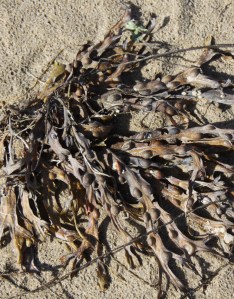
The strandline is primarily made up of seaweed, which is at the heart of the local marine ecology.  What washes up with the tide is what grows in the vicinity and tells you something about what’s going on out there, and it is home to a wide range of creatures.  When it washes up on the seashore it also acts as a host to other forms of life, including insects and birds.  Seaweed is an algae and an autotroph, meaning that it makes its own food from sunlight, carbon and water.  Unlike plants, seaweed does not have roots, absorbing water through its leaves instead.  Photosynthesis, the which captures energy from the sun, is achieved via pigments, chemical compounds.  Green seaweeds contain mainly or entirely chlorophyll, whilst brown and red seaweeds contain other pigments as well.  Although all seaweeds require water, most spend a significant amount of time out of the water during low tides.  Seaweeds generally attach themselves to rocks or the seabed and stay attached via a “holdfast,” a clump at the base of the plant and can pulled free either due to storms or when they die.  I could only identify around half of the seaweeds from my books because in the general chaos of the standline masses, it was very difficult to pick them out.  There were miles of long, black spaghetti-like weeds that could have been either one of two species, but I couldn’t work out which from the photographs.

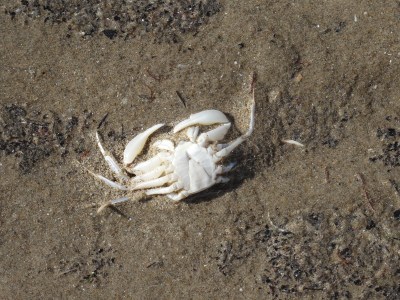
Crab

Embedded in the seaweed itself or simply sharing the strandline are all sorts of interesting ecofacts, as well as man-made objects.  Shells dominate at Aberdovey, with cockle shells littered everywhere, and some clam shells, including a dense patch of razor shell clams, quite a few oyster shells, some mussell shells and bits of crab claw and carapace.  Drift wood was conspicuous, as well as fresh wood and branches presumably thrown into the river and estuary by the storm.  One of the seaweeds turned out not to be seaweed at all, but is in fact an invertebrate called Hornwrack.  Another find that surprised me was the sea potato, of which I had never heard before.  There were remarkably few man-made intrusions.  There were some bits of nylon rope and a giant piece of “high pressure gas pipeline,” according to the label, but other than that there was none of the plastic that has plagued beaches around the country.

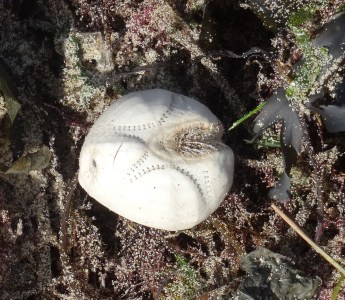
Sea potato (Echinocardium cordatum)

The sea potato (Echinocardium cordatum) was a curious thing.  It was clearly an exoskeleton and at first I thought it was a sea urchin, but on closer inspection, it clearly wasn’t quite the same thing.  I brought one home with me, and it was incredibly fragile, the shell immensely thin a piece breaking off almost immediately when I tried, very gently, to wash it.  One of the several that I photographed appeared to have spines attached, and when I delved into my books it turns out that Echinocardium cordatum does indeed have spines, but unlike those on sea urchins, these lie flat, facing backwards on the surface of the shell (called a test) and look like coarse fur.  Like other echinoderms (spiky skinned) the patterning on its surface is divisible by five (called pentameral symmetry).  Also known as a heart urchin, it lives buried in the seabed, into which it burrows and use tube feet to pass food to their mouths. Apparently they are quite common.

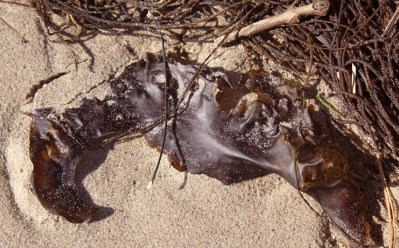
Hornwrack s not a seaweed, but an invertebrate (an animal without a backbone) colony

Hornwrack (Flustra foliacea) is not a seaweed, although the word “wrack” in its name might imply that it is.  It is actually an invertebrate (an animal without a backbone) colony belonging to the bryozoan group, commonly known as moss animals.  It looks just like a seaweed.  It is a common strandline find, each frond an exoskeleton containing  tiny boxes which contain an individual animal called a zooid, making up a colony of inter-dependent creatures.  Annual growth lines can sometimes be seen on the fronds, because it stops growing in winter.  It lives offshore attached to shells and stones, filters food particles, and has a slight lemony scent when fresh and wet.  Utterly fascinating.

Laver

Laver, as anyone who lives in Wales will know, is an edible seaweed that tastes delicious in all sorts of things.  There are five related species, the principal one of which is Porphyra umbilicalis, a purple-coloured weed.  A traditional Welsh recipe involves using oats to make laverbread (cooked laver) into cakes.  Before you head out to collect it, do be aware that it requires cooking for eight hours before it is usable!  Easier to buy it in tins from most of the food stores in Aberdovey, including the butcher (who, incidentally, makes the most terrific pork and laverbread sausages).

The second most common type of seaweed on the beach was the wrack (Fucus), of which there are multiple varieties.  Channelled wrack is shown near the top of the page, the picture here is bladder wrack.There was also serrated wrack and spiral wrack on the beach.   When I was a child, the air bladders used to fascinate me, and they are used by the seaweed for helping it to stand vertically in the water to improve its chances of reaching sunlight for photosynthesis.  Bladder wrack has small air bladders arranged in pairs.  Egg wrack has single large ones arranged in a row along each frond.  Channelled wrack has a curled frond  that forms a channel to retain moisture.  Serrated wrack has no air bladders at all.

Egg wrack and serrated wrack

Seaweeds are generally classed by colour, and there are several green ones listed in books, but I only found one on the strandline, which was gutweed (Ulva intestinalis).  It was spread across a piece of driftwood, absolutely lurid against the wood and against an otherwise muted backdrop of weed and sand.  It likes estuaries and brackish water, but was a bit off the beaten track where I found it, which was beyond the estuary and on a part of the beach that overlooks open sea.  It consists of thin hollow tubes which, when it is alive, are filled with oxygen.  It is edible and said to be delicious.  It is lying against a bed of either Mermaid Tresses or Thongweek, which was the most common of the seaweeds that had washed up on the strandline in clumps.

Sea oak (Halidrys siliquosa), also known as pod weed for obvious reasons, is another common seaside seaweed, which has mutiple branches and rather flattened swollen bladders at the tips of its fronds.  The bladders have internal divisions that are clearly visible.

Sea oak

Razor clams were dotted around the beach, but at one point on the beach it was a positive graveyard with dozens of them concentrated in a small area.  As far as I could tell they were all of the same type, the straight edged bivalve (double shell) pod razor clam, Enis siliqua, with an outer coating called a periostracum.  They live buried, aligned vertically, in the sand of the seabed and feed by extending a tube (siphon) above the sand into the sea to extract nutrients.  When the tide is out they burrow into the saturated sand, and retreat further in response to vibration.  As they borrow they eject water, which leaves a keyhole shape on the surface.  I ate rather a lot of them when on holiday in the Algarve, Portugal, and they are delicious.

The common or native oyster (Ostrea edulis) is scattered across the beach in the form of single shells.  The photo here shows the typical concentric scaly ridges on the outside of the shell, which is thick. Oysters were a mainstay of the diet in the 18th and early 19th Centuries, cheap nutrition, but were over-harvested during the late 19th Century, when prices went through the roof, and are still seriously depleted and now considered to be a delicacy.  The most common strandline finds have grey shells with blue bands, but grey and brown ones are also found, and at Aberdovey the majority I found on Sunday were brown.

There were a couple of seagulls, but the only other feathered friend I shared the beach with was a beautiful pied wagtail (Motacilla alba yarrellii), his tail flicking up and down in the characteristic way that gave it its name.  Like me, he was beachcombing, but for rather different ends, foraging for small molluscs, insects (particularly the flies that settle on the decaying seaweeds) and seeds.  They don’t look like natural seashore foragers, but are sometimes called the water wagtail because of their affinity to streams and open water, and they are always on the beach in Aberdovey in the autumn and winter, hopping from one promising site to the next.  He kept a wary eye on me and as I moved nearer he flew a little further on, always at the absolute limit of the range of my camera lens, meaning that the photo is very fuzzy.

References:

Plass, M. 2013. RSPB Handbook of the Seashore. Bloomsbury
Reader’s Digest 1981.  Field Guide to the Birds of Britain. Reader’s Digest Association.
Sherry, P. and Cleave, A. 2012.  Collins Complete guide to British Coastal Wildlife. Collins
Trewhella, S. and Hatcher, J. 2015.  The Essential Guide to Beachcombing and the Strandline. Wild Nature Press


Fabulous sand drifts travelling over the beach at Aberdovey

On my walk along the beach yesterday it was gloriously sunny, with cerulean blue skies and a sapphire sea, but it was very windy.  As I turned to walk back into Aberdovey having visited the pillbox, the wind lifted dry sand off the surface of the beach, carrying it in airborne rivulets that combined and recombined, forming wonderful shifting patterns at immense speed down the beach, north to south. The mutating patterns of millions of pale granules caught in the autumn sun were simply stunning, less sand drift than mass migration.  So far my attempts at video have been confined to birds on the garden feeders, and neither my video skills nor the video function on my little camera were really up to the job of capturing something so magnificent, but in these three very short videos I have given it my best shot.  The roaring sound is the wind: