A history of Cambrian News, established 1860

I was in the Aberdyfi Village Stores a couple of days ago and asked if there was such a thing as a local newspaper.  I came away with the Cambrian News (www.cambrian-news.co.uk) for the Meirionnydd district, which is absolutely bursting with information about Meirionnydd (or Merioneth in English).

Meirionnydd is the southernmost part of Gwynedd and used to be a separate cantref, lying between the River Dyfi to the south and the River Mawddach in the north.  In 1889 it was officially renamed Merionethshire and in 1284 assimilated the cantrefs Penllyn and Ardudwy to its north.  In 1974 it was amalgamated with Caernarfon and Angelsey to become Gwynedd.  However, Meirionnydd is still considered to be an entity in its own right, and this is the area served by Meirionnydd version of Cambrian News, although the newspaper has issues for other districts as well, taking in much of Gwynedd and Ceredigion.

The Cambrian News itself has both heritage and pedigree,  celebrating its 150th anniversary in 2010.  It first appeared in October 1860, at that stage just a four-page supplement in The Oswestry Advertiser, and was called The Merioneth Herald.  It developed into a newspaper in its own right, still in Oswestry, and in 1864 became The Merionethshire Standard and Mid-Wales Herald.  It was only in 1864, that the name Cambrian entered the name, when it became the Cambrian News and Merionethshire Standard. At times it also included The Welsh Farmers’ Gazette.
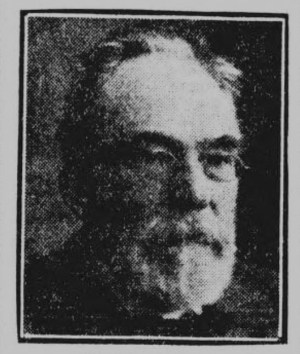
Sir John Gibson. Source: The Western Mail, Monday 19th July 1915, p.7

In 1873 it was put under the management and editorship of a John Gibson (1941-1915), and was moved to Aberystwyth as The Cambrian News.  Gibson was clearly a force to be reckoned with.  He was the son of a Lanaster hatter who, according to John Gibson’s obituary in the Western Mail (19th July 1915) made the first silk hat in Lancaster.   Gibson started out as an errand boy in the newspaper trade and went to the Oswestry Advertiser first as a printer and then as a journalist.  In 1879 Gibson published Agriculture in Wales.   His obituary in the Western Mail says that “his outspoken and negative criticism occasioned great commotion in town and district and gave rise to considerable opposition.” In 1880 his outspoken remarks resulted in a number of libel actions against the newspaper, and rather than apologize he resigned.  However, in the same year a consortium of Gibson’s friends and supporters formed a consortium to purchase the newspaper, and reappointed him.  He eventually became the newspaper’s proprietor.   He had strong views on political and social issues, which permeated the newspaper.  In a column in the newspaper on the 26th October 1885 he  stated that women were “either slaves or are legally, socially and politically non-existent,” and followed this up in 1891 with a book entitled The Emancipation of Women, a treatise that came down very strongly in support of women’s suffrage.  An article on Wales Online describes how in the first decade of the 20th Century he was strongly opposed to the establishment of the newly proposed Welsh National Agricultural Society and its Royal Welsh Show, arguing vociferously that it would lead to the demise of the North Cardiganshire show and other similarly long-established events.The Welsh National Library’s Dictionary of Welsh Biography says that under Gibson’s supervision, “and through his vigorous personality and fearless independent views on local and national affairs, the Cambrian News became one of the most influential weekly newspapers in Wales.”
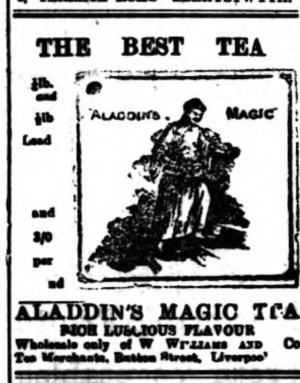
Advert from the 30th December 1910 edition, Cambrian News page 2

A measure of its success under Gibson is provided by a piece in the Cambrian Times of 11th July 1874, where a column describes how the Cambrian News and Aberystwyth Times had steadily increased over the previous few years throughout the district.  In 1873 there were 1590 more advertisements placed than in 1872 and in 1874 there were 1721 more than in 1873.  This is explained in the column by the standards to which the newspaper was held by its editor:  “The Cambrian News is characterized by the independent tone of its articles and the fearless spirit in which public affairs of local and general interest are criticized.  It is full of impartial reports, local sketches, nearly two columns of markets and general intelligence etc, and the proprietors do not spare expense in making it a good family, commercial and general newspaper.”  Advertisements were more expensive than other local newspapers, and this was discussed in the July 23rd 1909 issue of the Cambrian News and Welsh Farmers’ Gazette on page 3:  “We are frequently told that charges for advertisements in this paper are higher than those made by other local papers.  This is true.  We publish two editions every week in order to give al the news of the district, and our price for advertisements is high in order to keep space for news.  If reckoned by so much per thousand copies sold, advertisements should be included in the ‘Cambrian News’ will be found to be worth all that is paid for them.”

The tone of the Cambrian News under John Gibson was, to say the least, forthright.  On December 30th 1881 in the Almanac for the Year 1882, just beneath the newspaper’s header, the following statement was printed: “The Cambrian News aims at being all that a pure, honest and upright family newspaper should be.  Impure advertisements and reports are rigorously excluded.  The reports are impartial, the criticism is just and the politics Liberal.” It goes on to say that it gives “special attention” to agricultural subjects and that as well as a wide regional circulation it had agents in London, Birmingham, Manchester and Liverpool.  By 1909 two editions were going out per week.

John Gibson was knighted in the same year in which he died, becoming Sir John Gibson, not a bad achievement for the son of a Lancaster hatter.  He died on Saturday 17th July, aged 74.  In his will be specified that his funeral his funeral “should be of the simplest form and no mourning worn at it or afterwards” (Cambrian News, 20th November 1915, page 6).  He was buried in Llangarwen churchyard.

Today the weekly Cambrian News is  owned by Tindle Newspapers Ltd.  It is full of local stories and has an active letters page.  It is a great way to find out about local government issues, problems with services and transport, innovations made by local businesses, upcoming and previous events and the outcomes of recent sports fixtures.  I had no idea, for example, that there are plans afoot to put a new bridge over the River Dyfi, that there is a Merioneth County Show (very sorry to have missed that), that there is a shortage of both firefighters and train drivers in the area, that there is a move to set up a Dyf Valley palliative care service, or that Tywyn has a netball team.  I also enjoyed the piece about the life of Marguerite Jervis who lived intermittently at The Lodge of Plas Pentedal near Aberdovey.  The newsaper is very people-focused, with a strong emphasis on human interest stories.   Its website says that Cambrian News is the biggest-selling weekly newspaper in Wales with six editions that cover Aberystwyth, south Ceredigion, Cardigan & Newcastle Emlyn, Montgomeryshire, Meirionnydd and Arfon/Dwyfor, spanning five Welsh counties.  Cambrian News was voted Welsh Weekly Newspaper of the Year for 2015 and has been awarded the title of BT Welsh Weekly Newspaper of the Year twice.  The price has just risen from 80p to £1.00.  Worth every penny.

The Panorama Walk on a sunny day

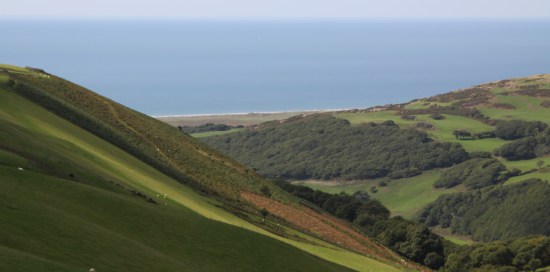
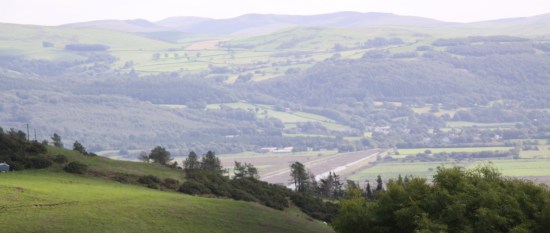
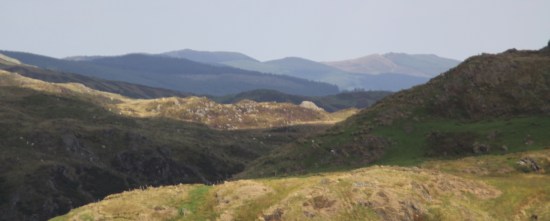
Yesterday was the perfect autumn day, with blue skies, a golden sun and a light breeze.  Idyllic.  I took a shoulder bag with a bottle of water and my much-loved camera and headed up to the top of Aberdovey, walking past Tyddyn Rhys Y Gardair Farm and turning on to the Panorama Walk, part of the Wales Coast Path.  It was one of those days that makes you feel good to be alive.  The walk has many beautiful views, with contrasting landscapes to north and south, over Happy Valley and the Dyfi Estuary.  It’s a very popular walk along a metalled road, which after about a 45 minute walk turns into a good track for the walk to the Bearded Lake.
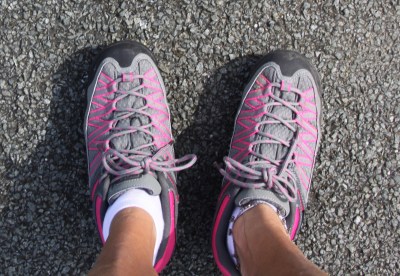
I set out in the ugliest but most comfortable hiking trainers ever.  They are designed for road work and tracks, not rough terrain, and as hideous as they are, they are seriously suited for the job.  It was never my intention to go as far as Bearded Lake / Llyn Barfog, and I only walked to the turn off for the Happy Valley car park, about an hour each way if I hadn’t stopped to pick blackberries at the start and end of the walk, as well as stopping frequently to take photos. In the event it took  me two and a half hours there and back.  I am up to my ears in DIY and had done a couple of hours in the morning and wanted to be back in time to do another batch in the afternoon.  The bliss of living just 2 minutes from the start of the walk means that I can just drop everything and go.  The circular panorama walk that takes in Bearded Lake is next on my list, but the walk to the end of the road and back was absolutely stunning, simply wonderful.   I had it almost to myself.  I ran into two small groups of walkers, and a lady who was giving her daughter a shoulder-ride, which looked like hard work, and four or five cars passed me, but other than that I was in splendid isolation.

The blackberries are in the fridge.  My father is coming to visit, so I have bought dressed crab from Dai’s Shed and some inch-thick lamb chops from the Aberdovey Butcher, and we are having the chops with a blackberry sauce, whatever vegetables he brings from his garden, and sautéed potatoes.  I find spring lamb fairly tasteless, but the big flavourful lamb at this time of year is delicious.

Panorama Walk

To enjoy the Panorama Walk using Aberdovey as a starting point, turn into Chapel Square, go straight up Copper Hill Street, take the second turn on the right, which takes you into Mynydd Isaf.  At the top of the road turn left and follow the road to a junction, and turn right.  From there follow the single track lane all the way.  The path is clearly marked.  You can walk or drive.  You will cross several cattle grids, and if you are driving you will need to stop to open a gate at one point.  Other than that, keep an eye open for passing places and when you reach the end of the metalled road you can either park and do the walk to Bearded Lake, or turn around and go back.  If you are walking, don’t forget to look behind you at the views over Cardigan Bay and the estuary, and do look out for wild flowers in the hedges and verges.   You can also start from a Snowdonia National Park car park in Happy Valley.

Videos: A round-up of some of the garden birds this week

Taking videos of birds has been an eye-opener.  They never stop.   There are all sorts of performances that surround eating, all of which look terribly energy consuming for such small creatures, which seems rather to defeat the object.  Some of it has to be concerned with keeping a look-out, but some of the moving around is difficult to explain.  The great tit video isn’t the best, but it’s the first time I’ve seen one this year, so is included for the sake of completeness.  The blue tit is a new and welcome addition.  They are all endlessly super to watch, and shocking time-wasters.

Lovely to see the robin enjoying himself in the bath on a regular basis, now that I have cleaned it and keep it stocked up with fresh water:

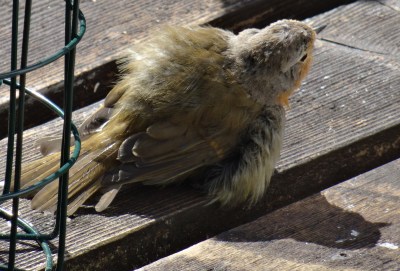
This morning he ruffled out all his feathers after a good old splash and sat in the sun, looking hopelessly untidy and somewhat squashed.


The female house sparrow has been working around the aggression of the robin, and has found plenty of opportunity to eat at the feeder, moving around between courses, and at one stage flying up and around the feeder:

The great tit was here only briefly, but was engaging whilst he was here.

I moved the big bird feeder with the anti-crow device onto the cherry tree, where it has been a hit.  Coal tits are the messiest feeders, with much of it going on to the ground, but I am spared having to wonder what to do about it by a pair of doves, which are picking up all the dropped seeds.  A newcomer this morning was a blue tit, a very welcome addition.  A blue tit taking the business of eating seed very seriously. There was a lot of beak work with whatever it was holding in its feet.


The story behind the memorial to 3 Troop 10 (1A) in Penhelyg Park

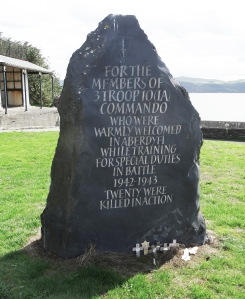
I went in to the Aberdyfi Literary Institute today to become a member, and picked up a number of leaflets, one of which was entitled “The Story behind the Monument.  Penhelyg Park Aberdyfi.”  There is no author cited so I cannot credit him or her, but it is an excellent account of the history behind the monument. The monument, shown right, reads:

FOR THE MEMBERS OF
3 TROOP 10 (1A)
COMMANDO
WHO WERE
WARMLY WELCOMED
IN ABERDYFI
WHILE TRAINING
FOR SPECIAL DUTIES
IN BATTLE
1942-1943
TWENTY WERE
KILLED IN ACTION

The main thrust of the story is that the Number 10 (Inter-Allied) Commando unit, with its headquarters at Harlech, was made up of a number of volunteer troops, each representing a different European nationality, all dedicated to Allied interests, with each based at a different place in Britain.  Most remarkable of them all, however, was No.3 Troop, which was formed in 1942 and was made up of of German and Austrian nationals, “enemy aliens” as well as others who were either European (mainly Czech and Hungarian) or stateless, mainly Jewish, all of whom had fled the Nazi regime as it began to gain strength.  The members of the troop, once trained, were used for reconnaissance and intelligence gathering, affiliated to other troops either on the front line or behind enemy lines.  The Troop never fought as a unit.  The idea was the inspiration of the Chief of Combined Operations, Earl Mountbatten.   3 Troop came to Aberdovey to be trained.  Whereas other troops were given the name of their nationality (e.g. No.2 Dutch Troop) No.3 was named X Troop by Winston Churchill, the X standing for an unknown quantity, a reflection of how bold the idea was considered to be.

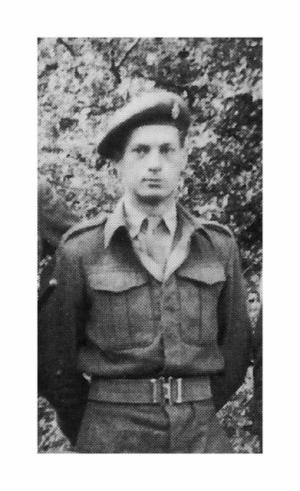
Captain Brian Hilton Jones. Source: The Commando Veterans Association

Over 350 refugees volunteered for 3 Troop, of whom 86 were selected in the first intake.  Eventually around 130 men served in 3 Troop 10 (1A).  As well as being completely fluent in German, they had to be capable of achieving the highest Commando skills.  Most were aged between 18 and 25, many had been resident in Britain for some time, and some of them had served in the unarmed Pioneer Corps, which focused mainly on light engineering work.  There was no fanfare accompanying their arrival.  Their role was a secret one.  Each individual had taken a British name as a nommes de guerre and been given an identity backed up by all the necessary documentation.  Only the policeman was informed of the true purpose of the Troop, and they were billeted in private homes and integrated with village society.  Two of 3 Troop married local girls. Initially none of them were eligible to become officers, a restriction that was removed after they had proved themselves, in 1944, after which 18 became officers.  Their Commanding Officer was Bryan Hilton-Jones from Caernarfon who was a graduate in Modern Languages from Cambridge, and rated as a good leader of men.  The leaflet says that he was a fitness fanatic, and saw to it that their training was incredibly wide-ranging, everything from physical aptitude, weapons training and intelligence to housebreaking, lock-picking and demolition.

3 Troop members had been involved in numerous fighting, the invasions of Normandy and Sicily, small raids, and various other campaigns.  Twenty were killed in action and twenty two were wounded or disabled.  An article on the BBC website, which is also well worth a read, lists the honours that were awarded to 3 Troop:  one MC, one MM, one Croix de Guerre, one MBE, one BEM, one Certificate of Commendation and three Mentioned in Despatches. He goes on to say that “the number of awards are derisory considering their exploits and the inevitable death sentence they faced if captured – not to mention the danger to any of their surviving relatives in Nazi Europe. Many details of the men were known to the Gestapo and reprisals would have been immediate.”  This was probably because, fighting as individuals alongside other units, they never fought as a unit and were therefore not in a position to be put forward for honours by their own Commanding Officer.

The English version of the memorial plaque in the sea wall of the park

The monument was installed in 1999, unveiled by the former Lord Lieutenant of Gwynedd, Mr Meuric Reese CBE, in the presence of twenty eight 3 Troop survivors, on 15th May of that year.   It was designed, carved and inscribed by John Neilson letter carver, lettering designer and callipgrapher of Pentrecwn, Oswestry.  With his skill at incorporating letters into works of art, he was the perfect choice for this particular memorial.  For more examples of his work see the Arts Connection / Cyswllt Celf website.

For anyone who would like to read the full version of the leaflet, together with its recommended further reading, there are copies in the Aberdyfi Literary Institute, or you can download the PDF: 3 Troop 10 leaflet entire.

You may also be interested in the transcript of a speech delivered by Colin Anson, formerly Claus Leopold Octavio Ascher, on the 4th September 2007 at the Imperial War Museum.  The speech described his experience as a member of No 10 (IA) Commando 3 troop, given when he attended a reunion of refugees from Nazism who served in the British Forces in WW2. It gives insights into some of the work he carried out as part of 3 Troop.   The transcript is on the Commando Veterans website.

More very useful information about training and deployment of 3 Troop 10 is given in the book Leadership, Management and Command: Rethinking D-Day By K. Grint , the relevant section of which is available on Google Books.

Update, 30th June 2020, from Martin Sugarman , Archivist of The Assocation of Jewish Ex-Servicemen and Women of the UK, AJEX, and the Jewish Military Association (JMA) of the UK

The men of No 3 Troop were all Jewish except 2 and when the Commando Veterans web site gives their background, and omits saying many were Jews, they do not understand that many of the men on enlistment, attested as Christians in case they were captured; it was to protect themselves and their families who they believed were still alive in Europe. so, because their attestation is ‘official’ and ‘carved in stone’ on their military records, the web site writers do not realise that they are quoting wrong information.

It would therefore be appropriate for anyone wishing to offer thanks at the memorial to obtain Star of David British Legion pegs rather than Crosses for placing at the base.


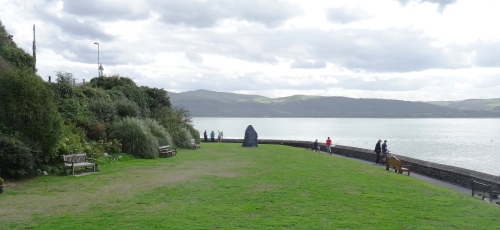
Penhelyg Park with the memorial at the far end

Penhelyg Park with the memorial at the far end

Video: Coal tit at the hanging bird feeder

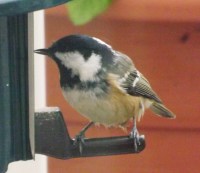
Absolutely fascinating to watch the coal tit processing seed at the bird feeder, chucking things everywhere!  I thought at first that it was a great tit, but the little black flick of colour from the crown, the lack of a stripe on the chest and a slender beak are key differentiators from the great tit, as is the smaller size.  Although there have been some impressive aerobatics over the last few days there was none of that today – the focus was all on the seeds. I know when they are around because of the high-pitched “peep” that they utter whenever they are in the vicinity.

According to one of my books, the Reader’s Digest Field Guide to Birds, in old Icelandic the word tittr meant a small bird or anything small, and tit is a corrupted survivor of that word.


Experimenting with Glamorgan sausages

I’ve never made Glamorgan sausages before, and there’s a good argument for saying that I haven’t made them today either.  I walked down into Aberdovey, expecting the Bank Holiday Monday to be bedlam, but at 1045 it was surprisingly quiet, perhaps because the weather was unencouraging, but perhaps because a lot of people were driving back home after their holiday.  I had a look around the craft fair, which was in the marquee by the Information Centre, and then went to do some odds and ends of shopping.

My first port of call was the lovely Aberdovey Butcher where I bought a lamb steak for the stew that I was planning, and then went to collect what I needed for my Glamorgan Sausages.  Having sourced a leek earlier in the week, I walked with great confidence into the delicatessen, Coast Deli and Dining, on the corner of Copper Hill Street and Sea View Terrace, and stopped dead.  Disaster!  The cheese counter had gone!  No Caerphilly for the Glamorgan sausages, and no Perl Wen for me (but the lunches looked seriously wonderful, so I’ll be back!).  This meant that my Glamorgan sausages were destined to be stuffed with cheese leftovers from the fridge, including Cheshire, Cheddar and fresh flaked Parmesan.  I also, unaccountably, had no English mustard, so used wholegrain French instead.

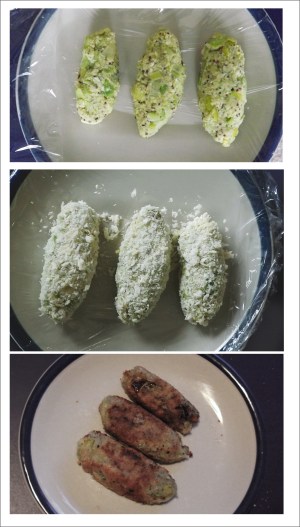
I read several recipes and took what I wanted from them, adding an extra stage to all of them.  Whilst some recipes went straight from manufacture to rolling in egg and breadcrumbs and then straight into a pan of hot oil or butter, others added a 30 minute period in the refrigerator after rolling and before cooking.  I added an additional 30 minute period in the fridge between making the sausages and rolling them, because mine were rather on the wet side.  The 30 minutes did the trick delightfully.  I rolled them in the egg and then the breadcrumbs, and put them back in the fridge until they were needed.  The photos show the three stages in the process of completion:

  • top – the newly manufactured sausage;
  • middle – 30 minutes later rolled in egg and breadcrumbs;
  • bottom – cooked after another long spell in the fridge and then left out to reach room temperature.

They were far too big to eat three, so one ended up on my plate and I’ll experiment with reheating the other two, seeing if they are viable cold and finding out whether they can be reheated whole or mashed into potato.

The ersatz Glamorgan sausage  was accompanied by chopped lamb steaks from the Aberdovey Butcher, who raises his own sheep, which I had cooked for an hour in a pan with carrots, shallots and mushrooms, some home made lamb stock, a slosh of red wine to add richness rather than flavour, and a lot of fresh thyme.  Some tender stem broccoli finished the plate.  Great fun.  Having eaten the local lamb many times before, I knew that that would be excellent and it was.  The sausages were rather strongly flavoured in the cheese department, unsurprisingly given the Cheddar and Parmesan, but they worked well enough, although for some reason they were a little angular rather than tubular!  Next time, it will definitely be Caerphilly, which will give them just the right balance between flavour and subtlety.

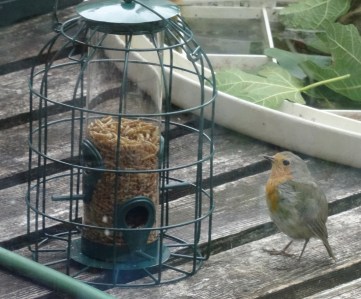
Video: The robin in my garden

This is my first attempt to use one of my cameras to shoot a video of anything in motion, and it’s all very amateurish.  The camera is a little Fuji, not designed for anything very ambitious, but it hasn’t done a bad job.  Apologies for the wobble and the clunky zooming in!  I want to do some videos in and around Aberdovey, so I am practising on the bird life in my garden.  The robin visits every day, and gives me endless pleasure whilst he eats at my bird feeder. As with many small birds at this time of year, his plumage has been a disgrace for several weeks (for reasons explained in an earlier post), but it is slowly beginning to sort itself out.  Two house sparrows and two coal tits have also become regular visitors, one presumably juvenile sparrow with a permanently bad feather day, but it’s the robin that has made the bird feeder a second home.  Robins are highly territorial and usually see off other birds.  This one was willing to share the bird feeder with a couple of sparrows for a few days, but things have become rather more tense in the last few days and there have been a couple of scuffles.  The sparrows are not deterred, but they keep a wary eye on the robin.

Apparently the male sings throughout the winter, except during the current moulting time.  I’ll have to wait and see whether mine eventually bursts into song.  I learned today that the robin became Britain’s National Bird in 1960.

Just click the arrow to  play.  The noise in the background is my printer.

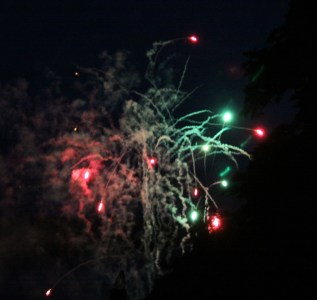
Fireworks two nights in a row! This time from Borth

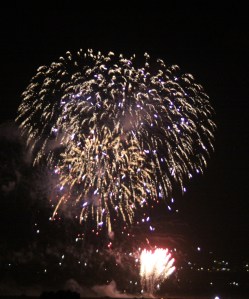
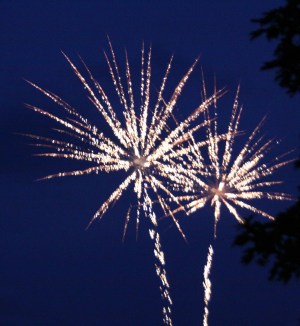
I love fireworks so I was very spoiled last night when I heard the first bang and saw a gorgeous explosion of colour from the other side of the estuary.  Gorgeous.  Great that the two villages decided to do their displays on different nights.


The legend of Cantre’r Gawelod and the bells of Aberdovey

The bells of Aberdovey are the most famous actors in a number a number of local legends.  The legends are captured in poems and songs, and will be very familiar to any regular visitors to Aberdovey.  They concern a piece of very fertile low land that was said to be several miles out from the shoreline of Cardigan Bay, and was swallowed by the sea.

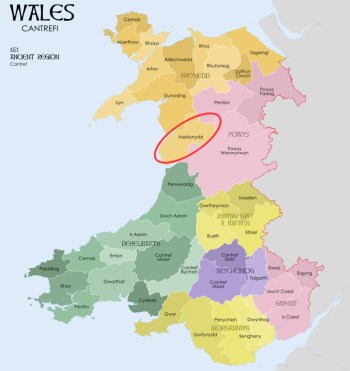
The most common of the legends, the one favoured today, tells the story of the bells that belonged to wealthy towns that stood in rich, fertile land that was protected by sea walls but was eventually drowned by the sea.  In the tradition, the land, called Maes Gwyddno (Maes, meaning land or plain; Gwyddno, meaning of Gwyddno), was part of the kingdom of Meirionydd and ruled by Gwyddno Garanhir (Garanhir, meaning long limbs or Longshanks).  Meirionnydd was a kingdom and then cantref, the southern part of what is now Gwynedd, between the Mawddach river at Barmouth in the north and the Dfyi at Aberdovey in the south.

Meirionnydd in mid west Wales (Source: Map of cantrefi of Wales by XrysD CC-BY-SA-4.0)

Aberdovey is supposed to the be the nearest place on dry land to the former location of Maes Gwyddno.  The legend refers to Maes Gwyddno as Cantre’r Gawelod, which translates as The Bottom Hundred, or Lowland Hundred. The translation “hundred” comes from the word cantref itself, which was a way of dividing up the land for administrative purposes, like counties.  Cantref is a concatenation of two words, cant (meaning hundred) and tref (meaning town).  A hundred in English is also an administrative area.  The term is first recorded in the 10th Century, but the etymology of the word is unclear and the Oxford English Dictionary sits firmly on the fence in this matter.

The best known story is that the low land of Maes Gwyddno, or Cantre’r Gawelod,  with its 16 wealthy towns or villages, the most prestigious of which was Manua, was protected by dykes or sea walls.  The land was drained at low tide by opening sluice gates.  The sluice gates were closed as the tide began to rise, a task overseen by a watchman.  One night the spring tide was whipped into a frenzy by a bad storm and beat against the sea walls.  Instead of tending the open sluice gate the appointed watchman, the King’s knight Seithennin/Seithenyn, was attending revels in the King’s palace, also protected by the sea wall.  This dereliction of duty doomed the land.  As the sea rushed in, the King escaped with some of the revellers along the Sarn Cynfelyn causeway, which remains today (sarnau, meaning stones, are remnants of glacial moraines, now only visible at low tide), and the farmers and villagers were driven away from their rich lands into the far poorer fields and hills behind Cardigan Bay.

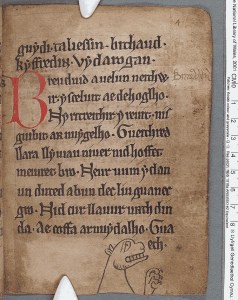
A page from the Black Book of Carmarthen (Source: National Library of Wales)

Another version, captured in the poem Boddi Maes Gwyddno (The Drowning of the Land of Gwyddno) is captured in the 13th Century Black Book of Carmarthen, which is the earliest known collection of Welsh verse, bringing together many earlier poems and legends, agrees that Seithennin was at the King’s palace at the time of the storm, but that it was a girl named Mererid who was in charge of the sluice gates.  Seithennin seduced Mererid who failed to close the sluice gates, causing the lands to be submerged beneath the sea.

A different legend says that a fairy well was located near the land, tended to by a priestess.  For reasons unknown, she decided to allow the well to overflow, with the same consequences.

Finally, another tradition has it that a giant called Idris Gawr, whose throne was Cadair Idris (cadair meaning chair) roamed the hills around Aberdovey carrying a massive bell.  Like most of us, he liked to paddle and he sometimes left his mountain eyrie to stride in the waters of the River Dyfi.  One day he was surprised by a great storm and drowned, but his bell continues to ring to this day.

All versions of the legend agree that if you listen carefully, particularly on a quiet night, a Sunday morning or in times of danger, the bells of Cantre’r Gawelod can still be heard from Aberdovey and Ynys-las ringing under the sea.

The English version of Boddi Maes Gwyddno (The Drowning of the Land of Gwyddno) poem is reproduced here, copied from the Cantre’r Gwaelog website, where it is also printed in original and modern Welsh.  I don’t read or speak Welsh but I found the English version incredibly powerful:

Seithennin, stand forth
And behold the seething ocean:
It has covered Gwyddno’s lands.

Cursed be the maiden
Who let it loose after the feast,
The cup-bearer of the mighty sea.

Cursed be the girl
Who let it loose after battle,
The cup-bearer of the desolate ocean.

Mererid’s cry from the city’s heights
Reaches even God.
After pride comes a long ending.

Mererid’s cry from the city’s heights today,
Implores God.
After pride comes remorse.

Mererid’s cry overcomes me tonight,
And I cannot prosper.
After pride comes a fall.

Mererid’s cry from strong wines;
Bountiful God has made this.
After excess comes poverty.

Mererid’s cry drives me
From my chamber.
After pride comes devastation.

The grave of high-minded Seithennin,
Between Caer Genedr and the sea:
Such a great leader was he.

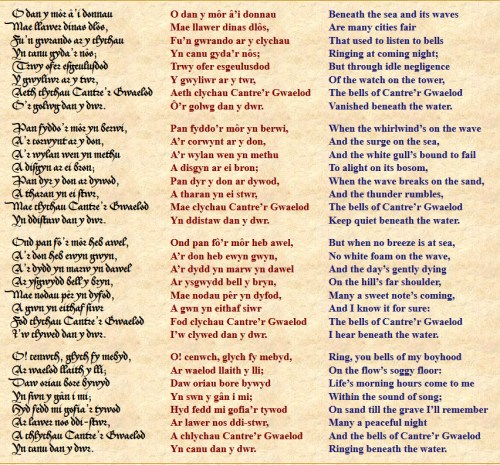
The poem Clychau Cantre’r Gwaelod (The Bells of Cantre’r Gwaelod) shown here is taken from the the Glaemscrafu website, where the following details are given: “Clychau Cantre’r Gwaelod (The Bells of Cantre’r Gwaelod) is a poem of John James Williams (1869-1954), J. J. by his bardic name. A pastor and a poet, he composed secular poems, many hymns and two scriptural plays. He competed in the poetry contest of the Eisteddfod Genedlaethol Cymru (National Eisteddfod of Wales), the most important of the yearly festivals of Welsh culture, and won the chair awarded to the best bard in 1906 and 1908.”  Interesting that the story was interpreted by The Guardian as one of a series of 21 poems that speak to issues of climate change.

The poem Cantre’r Gwaelod shown here is taken from the the Glaemscrafu website at https://www.jrrvf.com/glaemscrafu/english/cantrergwaelod.html

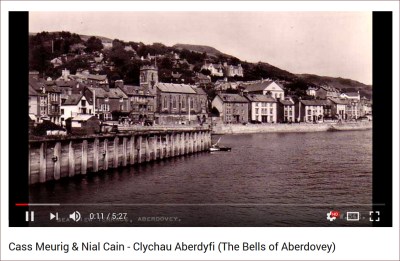
The probably better known love song The Bells of Aberdyfi (Clychau Aberdyfi), beginning “If to me you can be true, Just as true as I to you, It’s one, two, three, four, five and six Sing the Bells of Aberdovey” is often cited as a Welsh poem, but its origins lie in the 18th Century English theatre.  In the New Grove Dictionary of Music and Musicians, folk music expert Frank Kidson wrote: ” Charles Dibdin, who, writing a song for it in broken Welsh, used it in his opera Liberty Hall (1786). Miss [Jane] Williams, hearing it traditionally, published a version of it in her collection of 1844, and from that time onward it has been accepted as genuine Welsh. There is certainly no evidence to show that Dibdin used an existing tune (it was quite opposed to his practice), and no copy can be found except Dibdin’s of a date prior to 1844.”  The lyrics are available in both English and Welsh on the Musica International website, and the song can be heard on YouTube, a beautifully sung gentle and lyrical version in Welsh by Cass Meurig and Nial Cain at https://www.youtube.com/watch?v=d2knRU0–dQ.  Here are the English lyrics:

If to me you can be true,
Just as true as I to you,
It’s one, two, three, four, five and six
Sing the Bells of Aberdovey.
One, two, three, four, five and six
It’s one, two, three, four, five and six
Sing the bells of Aberdovey.
Boys do love to be in love,
And girls do love to marry.
But my love’s for only one,
For Bess of Aberdovey.
If your love is just as true
As this love I have for you,
It’s one, two, three, four, five and six,
From the bells of Aberdovey.

Bold with love I’m back once more
Just to camp against your door.
It’s one, two, three, four, five and six
Sing the Bells of Aberdovey.
One, two, three, four, five and six
It’s one, two, three, four, five and six
Sing the bells of Aberdovey.
Here’s and end to all faint hearts,
Till truth it is you’re pleading.
If you just meet be half way,
It wil be all I’m needing.
If your love is half as true
As this love I have for you,
It’s one, two, three, four, five and six,
From the bells of Aberdovey.

The legends of the bells of Aberdovey have become part of the literary and folk music landscapes of Wales, and a fine tradition it is too.

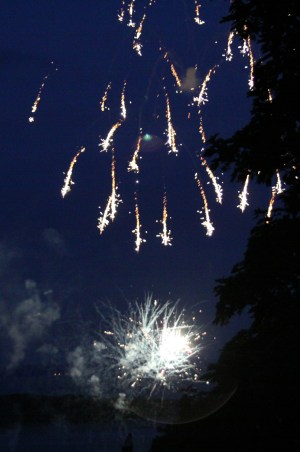
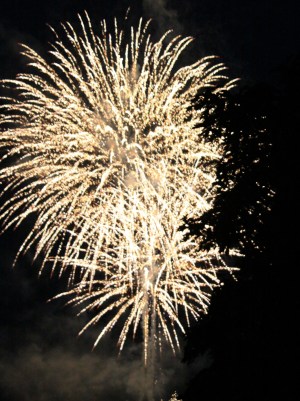
A splendid Aberdovey Bank Holiday fireworks display

Splendid to see the DoveyFest Bank Holiday firework display tonight.  Although it has been a lovely day I didn’t venture down into the village because I knew that it would be bedlam, but I was really looking forward to the fireworks.  What a super way to celebrate the last summer Bank Holiday of the year.  It was a lovely display, full of bright, wild colours and splendid patterns, bursts of vibrant light on the backdrop of a truly balmy night.  Congrats to Bright Works Fireworks Displays for such a great show.