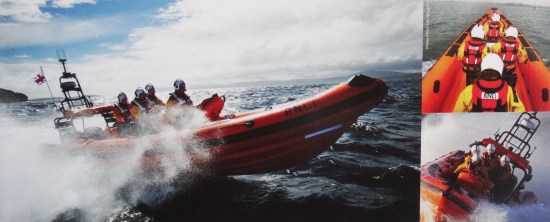
Pictures of the Atlantic 85 in-shore lifeboat in action (photograph of part of a poster on display in the Aberdyfi Boat House).
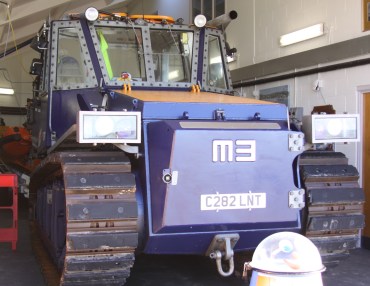
The RNLI is a vital national emergency service dedicated to saving human life, comparable to the NHS Ambulance service, with the fundamental difference that its boats are manned largely by unpaid volunteers, its shops are manned wholly by unpaid volunteers and it is funded mainly by private donations, legacies and its own fund-raising efforts. The RNLI was established on 4th March 1824 as the National Institution for the Preservation of Life from Shipwreck, it was granted a Royal Charter in 1860, its Patron in Queen Elizabeth II and it has over 238 lifeboat stations and 445 lifeboats in England, Wales, Scotland, Ireland and the Isle of Man. In Aberdovey alone the lifeboat goes out between 20 and 30 times a year, dragged to and from its home in the boat-house on the wharf by a giant, custom-designed caterpillar-tracked tractor.
 The RNLI has a long and really fascinating history, and much of that will be explored in later posts, with special reference to the RNLI presence in Aberdovey since 1837, but here I want to start with what the RNLI does in Aberdovey today, how it works and what it means to sailors, people and animals in distress and the community as a whole.
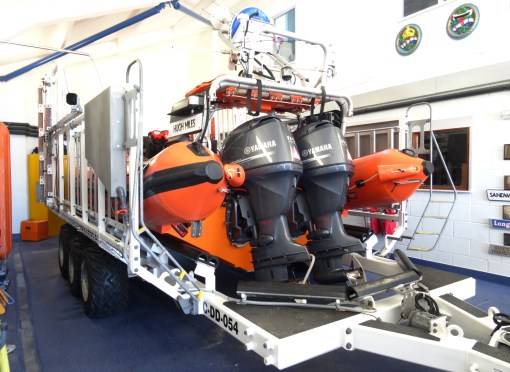
Let’s begin with the guided tour of the facility that was given to me by Dai Williams, Volunteer Shop Manager at the RNLI. The lifeboat house in Aberdovey has moved around a lot since its establishment in 1837. However, in 1991 the Yacht Club and the RNLI combined resources to extend the clubhouse and accommodate a new lifeboat on the wharf. Most recently the wharf buildings were reconfigured in 2016 to allow the RNLI Lifeboat Station to expand, placing its new rescue boat the The Hugh Miles and its tractor under cover, improving the changing facilities for the lifeboat crew and moving the shop into a new location so that it is visible from the road and can benefit from passing footfall. Funding from private donors was central to the modifications to the premises, and the new RIB was enabled by a donation from The Miles Trust. The tractor is a massive and impressive beast on caterpillar tracks, a necessary adjunct to the boat due to the difficult recovery conditions at low tide.
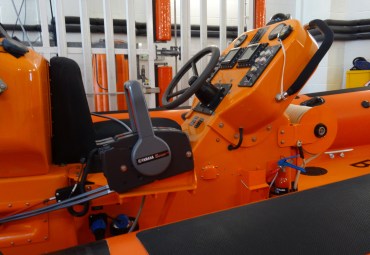 The Hugh Miles, operating number B-896, is a fast inshore rescue craft, an Atlantic 85 rigid inflatable boat (RIB), replacing the previous Atlantic 75, Sandwell Lifeline. The RNLI has two main categories of lifeboat: all-weather lifeboats and inshore lifeboats, each of which are suited to different conditions. For the full range of lifeboat types employed by the RNLI see their “Our Lifeboat Fleet” web page. The Hugh Miles is a specialized inshore lifeboat, one of the fastest in the RNLI fleet, powered by two Yamaha 4-stroke outboard 115hp engines, reaching top speeds of 35 knots. It can go to sea in a force 7 wind during daylight hours and during a force 6 at night. It cost £214,000 and, at nearly a meter longer than its predecessor, has the capacity for an extra crew member, bringing the total to four, although it can operate with three, and far more kit. It is stored in a carriage, a cage on wheels, from which it is launched. The RIB has a solid bottom and flexible sides, which makes it both strong and relatively light-weight. The concept was originally developed in the Atlantic College, Vale of Glamorgan, south Wales during the 1960s and early 1970s. Watersports were a big part of the boarding school agenda, and the college had its own in-shore lifeboat station. They soon realized that the inflatable boat they were using could be improved upon and used marine plywood and rubber tube to create the templates on which the modern RIB is based. The RNLI recognized the idea and created a glass-reinforced fibre model, which was a B-Class Atlantic 21 that came into service in 1972, its name commemorating the role of the college for this and future B-type RIBs.
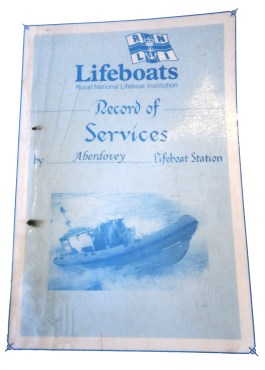 Flicking through the Record of Service book in the life boat house there were a hair-raising number of minor and major incidences where the lifeboat was called out. These involved yachts and other sailing vessels, power boats including a fishing boat, canoes, inflatable dinghies, kite boards, sail boards, jet skis, an inflatable toy, and swimmers in trouble. Here are three examples of call-outs in 2018, all noted on the Aberdyfi Lifeboat’s Facebook page. In July, the lifeboat was called out to the assistance of swimmers in difficulty at Tywyn. On arrival, one casualty had been recovered but the second was still missing and the crew began a search, receiving information from the Coastguard that the swimmer had been spotted on the lifeboat’s exact course. The lifeboat proceeded as fast as was safe to the location where the helm manoeuvred the boat skilfully in the surf and shallow water to be able to put a crew member into the surf to recover the casualty with two members of the public who had waded in, recovered the second casualty. First aid was delivered and a second crew member from the lifeboat entered the surf with vital kit such as oxygen. It should be noted that whilst the second casualty survived, the first one died later in hospital, a tragic reminder of the importance of the work of the RNLI. One night in August at past 9pm, with the light fading and on an outgoing tide, the Aberdyfi Lifeboat was called out to a broken-down yacht. The lifeboat reached the yacht and the crew were able to secure a tow, bringing it back into the estuary and placing it on a mooring. The lifeboat was returned to its station by 11pm. At 1645 on an evening in September, the Aberdyfi Lifeboat was called out to aid a boat with eight people on board, which was experiencing engine problems and was aground just south of the Aberdyfi Bar. The Borth lifeboat was already on scene and had managed to tow the vessel into deeper water, and from there they handed the rescued boat over to The Hugh Miles, which took most of the boat’s crew on board and set up a tow to bring them back to the Dyfi estuary.
 David Williams, not to be confused with Dai Williams, is the Volunteer Lifeboat Operations Manager (LOM) at the RNLI in Aberdovey, leading the operation team. He is responsible for authorizing the launch of the lifeboat and ensure that the lifeboats and all associated gear are maintained and in a constant state of readiness for action. David Williams grew up in Tywyn and also volunteers with Mountain Rescue. In the event of his absence there are also four Deputy Launching Authorities who can stand in for him. The in-shore boat crew is headed by the Senior Helm (the equivalent of a coxswain on an the bigger all-weather boats), currently Will Stockford, who is also the Harbour Master and doubles up as boat mechanic. Next in seniority is the Helm, who must be on board if the Senior Helm is unavailable. The helm is trained in a variety of skills including navigation, search and rescue and casualty care, has many years experience as a volunteer and is in charge of leading any rescue. Three other crew members may or may not be trained to steer and navigate the boat but all receive their initial training in Poole in Dorset at the RNLI. As well as being on call for emergencies, the crew undergo practice drills and training on a weekly basis, usually on a Sunday morning. The tractor drivers are usually former crew members who have retired.
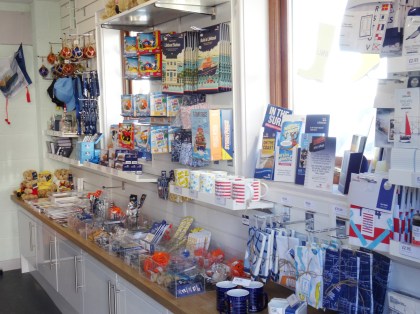 Dai Williams is the Volunteer Shop Manager, currently with a team of six shop volunteers helping customers in the shop. The RNLI shop on the wharf not only generates important funds for the charity but raises awareness of the RNLI and its activities, its staff acting as ambassadors for the lifeboat station, explaining its role and answering the many questions from the public. The new merchandise in the shop is bright, modern and eclectic, offering everything from games and toys to calendars and diaries, as well as souvenir tea towels, mugs and clothing is provided by the RNLI. Nautical themes dominate, of course, and many are by designer names. There are also shelves outside selling second hand books, jigsaws and DVDs donated by the public. Having spent some time in the shop over the last month, it has been great to see the range of people who visit and buy products in support of the RNLI. Small children with their parents, buying nets, shovels and buckets for crabbing are very happy contributors to RNLI funding. I have been buying RNLI Christmas cards online for years, but it’s much better to be able to go and buy them in person. And just about everyone is getting an RNLI tea towel in their stockings this year!
As well as the shop there is also an important fund-raising group based locally, the Aberdyfi Lifeboat Guild, which puts on events throughout the year. Many terrific visitor activities take place, particularly during the course of the summer, which get everyone involved, from crew to visitors, from young to old. Events have included Flag Day when there was a duck race (500 plastic ducks are launched and then retrieved!), the Abergynolwyn Silver Band played, there was a raft race and an afternoon tea was organized. Other events have included a quiz night, a Crabby Competition, a barbecue, the Dysynni Male Voice Choir and a Fun Run. There was even a stand at the Food Festival in August, demonstrating water health and safety procedures and equipment, and the Lifeboat Station has a stall at the Christmas Fair (this year on the 1st December, 10am – 4pm).
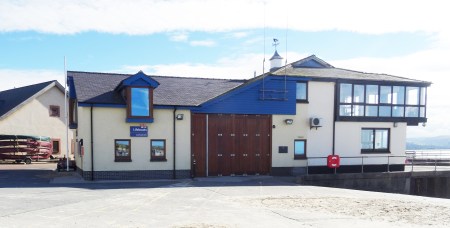
Aberdyfi Lifeboat Station and Shop
Donations from the public continue to be critical to the operations of the RNLI. The donations that enabled the modernization of the Aberdovey RNLI base says a lot about the sort of people who help the RNLI not merely to continue operating, but to continue updating their technology and improving their services. The Miles Trust, which funded the new boat, was set up in memory of Hugh Miles. Hugh Miles, the only child of the late Herbert and took great pleasure in RNLI activities around South Wales and after his death his mother bequeathed her estate to the RNLI, part of which was to be used to fund a rescue boat for the Welsh coast. The Aberdovey’s The Hugh Miles Atlantic 85 RIB is that boat. The modification for the boathouse was funded by the Derek and Jean Dodd Trust and a legacy left to the charity by RNLI supporter Desmond Nall. Derek and Jean Dodd moved near Aberdovey, where Derek was able to kayak into his 80s. Desmond Nall was an RNLI enthusiast from Solihull, who, together with his brother, Godfrey volunteered on the RNLI’s stand at the Birmingham Boat Show for a number of years and funded two inshore lifeboats.
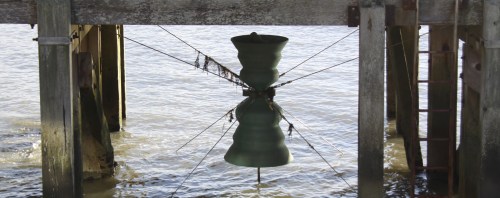
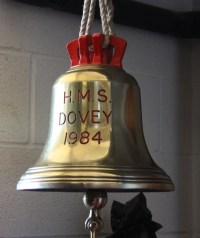 The Aberdyfi lifeboat station has a rather special and unique feature: the bell from the HMS Dovey. It is on loan from the Royal Navy. Should another HMS Dovey be built, the bell will have to be returned, but at the moment it is a much loved and admired resident of the lifeboat station. The HMS Dovey was the river class minesweeper M2005 commissioned in 1984 and sold to Bangladesh in 1994 for use as a patrol ship.
If you are a visitor to Aberdovey, do visit the lifeboat station and the shop. You will find a very warm welcome.
Contact details:
Aberdovey Lifeboat Station
The Wharf
Aberdyfi
LL35 0EB
01654 767695 (If you see someone in trouble at sea dial 999 and ask for the Coast Guard).
The shop is open from Easter to October 10am–4pm Saturday and Sunday, and on some Saturdays in November and December. During the summer it is open for some days during the week (opening times are shown in the shop door)
Facebook page
As well as the RNLI, local emergency services that receive no direct government funding and rely on their charity status and fundraising activities for their income are Trinity House (vital shipping and seafaring charity), the Wales Air Ambulance service and Aberdyfi Search and Rescue.
Many thanks to Dai Williams for correcting the mistakes and plugging the gaps in my first draft. Helen Williams tells me that no matter how much you find out about the lifeboat station, there is always more to know and I believe her!
References
Aberdyfi Lifeboat Facebook page
https://bit.ly/2OXFbqx
Dermody, D. 2011. Atlantic College students’ RIB sea safety revolution. BBC 15/05/17. https://www.bbc.co.uk/news/uk-wales-south-east-wales-13377377
RNLI News Release 2016. Farewell to Sandwell Lifeline as Aberdyfi RNLI welcomes new lifeboat. RNLI 02/12/16. https://rnli.org/news-and-media/2016/december/02/farewell-to-sandwell-lifeline-as-aberdyfi-rnli-welcomes-new-lifeboat
RNLI News Release 2017. Double celebration ahead for Aberdyfi RNLI. RNLI 25/07/17.
https://rnli.org/news-and-media/2017/september/25/double-celebration-ahead-for-aberdyfi-rnli
RNLI News Release 2018. Aberdyfi and Barmouth RNLI Lifeboats involved in Tywyn rescue. RNLI 1/08/18. https://rnli.org/news-and-media/2018/august/01/aberdyfi-and-barmouth-rnli-lifeboats-involved-in-tywyn-rescue


 Aberdovey Londoner