Category Archives: Aberdyfi

Walking from Aberdovey towards Tywyn along the beach

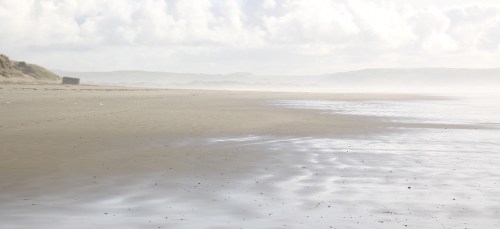
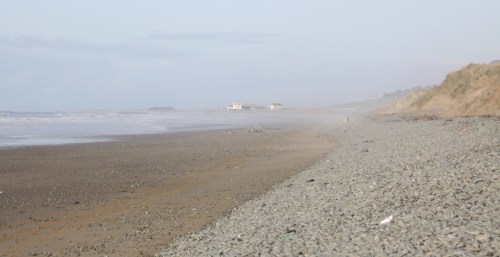
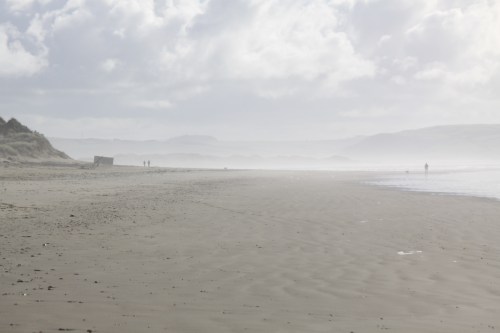
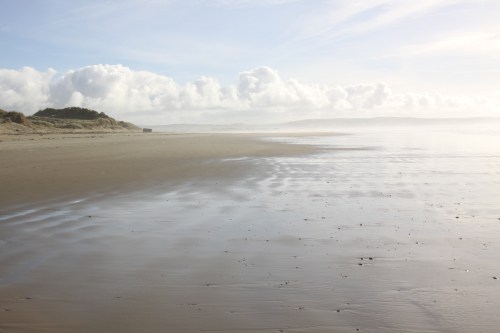
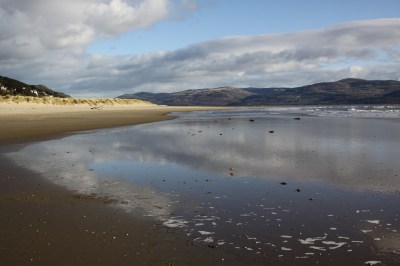
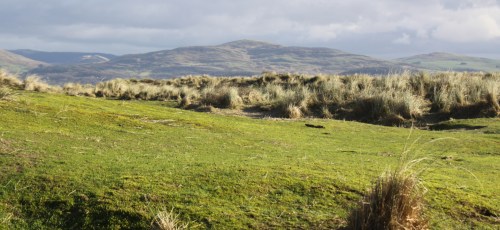
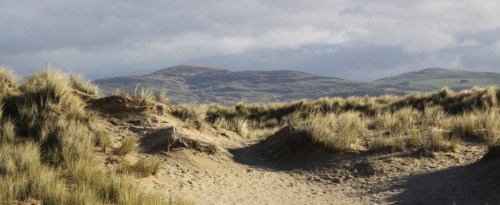
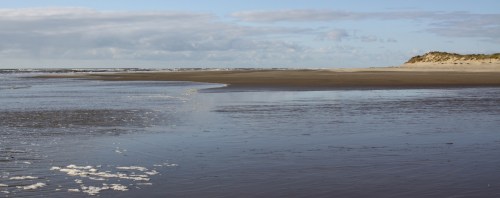
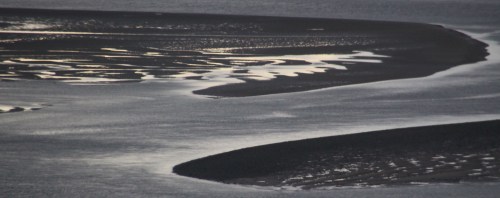
Yesterday’s walk along the beach was extraordinary.  I had intended to park by the cemetery, but by accident parked opposite the row of houses at the foot of the road from the Trefeddian Hotel, crossed the golf course and emerged from the dunes at the Second World War pillbox.   The sun was hazy and incredibly pale, but at the same time reflected off the wet sand, creating some beautiful colour and light combinations.  I walked for far longer than intended, and it nearly became a case of walking into Tywyn and getting a bus or taxi back to my car!  Instead I retraced my steps, and because of the light it was like doing an entirely different walk.  It was lovely to see a pair of oyster catchers, obstinately refusing to do anything other than stand, preening in the sun!  They are in the video at the end of this post.


The challenges of grabbing a bite to eat in an Aberdovey garden in the winter

It has been remarkable watching the birds in the garden as they rush around to stock up on calories in this cold weather.  Even the blackbirds have ventured really close to the house to take advantage of a bowl of mealworms.

In a heavy wind, the goldfinches hold on for dear life to collect nyjer seeds, but are not to be deterred, as this one individual demonstrates.

I have no idea why these two blue tits tried, tried again and failed to collect peanuts from this feeder!  Fabulous to watch their quick dashing movements.  I love the bit where one of them decides that if the holes won’t work, he’ll drill through the plastic with his beak!  I went and had a look at the feeder, and although I could see nothing wrong I gave it a good shake and matters seemed to resolve themselves after that, and the peanuts began to be extracted in good order.

And this little visitor, not seen before or since, was quite a character.  I had to move the peanut feeder onto an upturned flower pot because it was quite clear that the mouse was going to carry on taking and collecting peanuts until it had enough to see out the winter!  He knew that they were there but couldn’t reach them.  He reverted to the tray of seeds had been put down for the robin, sparrows, dunnock and the blackbird.

The pheasants have no difficulty helping themselves to a bit of everything.  There were seven of them this morning, two males and five females, which is the greatest number I’ve seen in one go.  I feed them twice a day and they are quite happy to help themselves to whatever the other birds are eating, but in spite of their apparent greed, they are big birds and must need quite a lot of food to sustain themselves.


St Peter’s Church, Aberdovey (built 1842)

St Peter’s Church

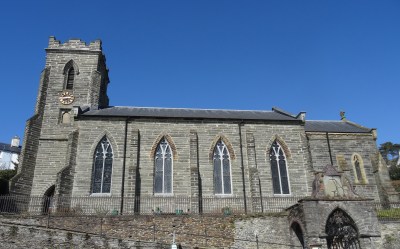
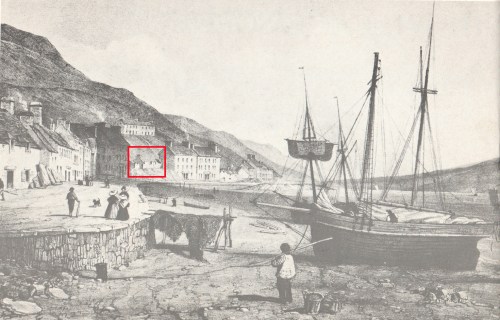
St Peter’s Church is the Anglican Parish Church (Church in Wales / Yr Eglwys yng Nghymru).  It was built in 1842.  According to Hugh M. Lewis (Aberdyfi: Portrait of a Village) it was established on the site of a preceding Chapel of Ease, built in 1837.  A wooden sign has been retained at the base of the tower of St Peter’s which says that the Chapel of Ease could seat 372 people, and that 186 places were “appropriated free sittings,” meaning that they were not allocated to any one family or business, and were exempt from any rental of pews that might be paid for the upkeep of the church and its clergy.  The church was built on the site of a row of former thatched cottages called Tai Pen Shelff, which were in the process of demolition by the time they were shown in the following 1834 sketch (from the Hugh M. Lewis booklet Aberdyfi, A Glimpse of the Past). The main entrance of the church faces out over the mouth of the Dyfi estuary on Sea View Terrace, and can also be accessed via Church Street to its rear, through the churchyard. 

Aberdovey in 1834, the site of St Peter’s (Source: A Pictorial History of Aberdyfi by Hugh M. Lewis 1989)

St Peter’s Church Interior

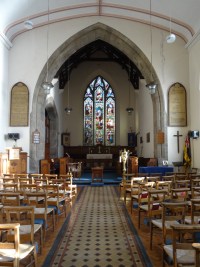
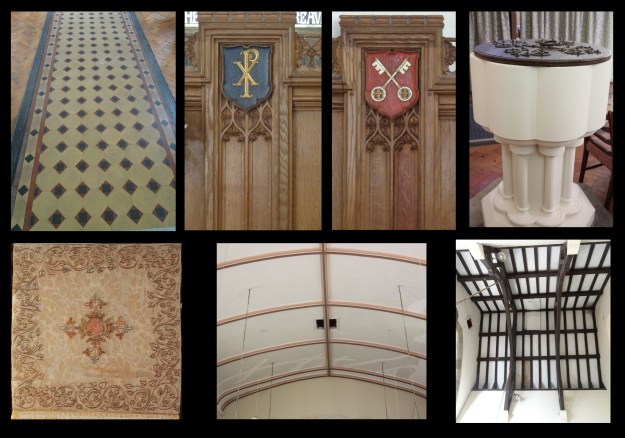
St Peter’s has an instantly recognizable appearance typical of Anglican churches in England and Wales, with a square bell tower topped with crenellations, a chancel, simple lancet windows along each side, a big arched stained glass window at the east end in the chancel with three others on the south side of the church, and a slate roof.  Set on a site above the road, it has a very prominent position in the centre of the village, with the main churchyard extending in a slope at the rear of the church towards a gateway on Church Street. The style is Gothic Revival and it is made of local stone with bathstone dressings. The interior layout is straight forward with a west tower, a simple nave, a rather fine tiled aisle along the nave, and a vestry incorporated into the north side. The bell tower was fitted with two bells, the largest of which was inscribed to the Reverend Richard Scot, BD. The smaller was simply inscribed with the year 1838. The church is Grade 2 listed. 

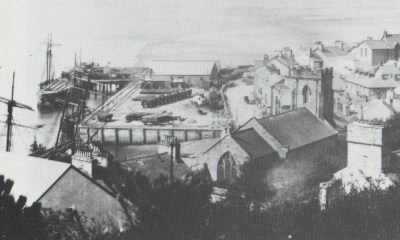
The view from St Peter’s Church over the busy wharf in 1850 (Source: A Pictorial History of Aberdyfi by Hugh M. Lewis 1989)

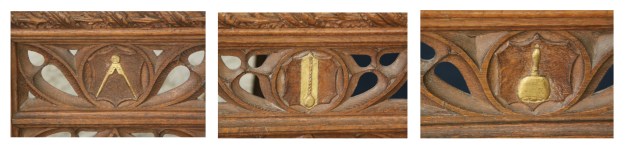
The new church, with its own newly appointed vicar, substantially altered the character of the sea front, unlike the earlier Calvinistic Methodist and Wesleyan Methodist chapels, which were set back from the road in Chapel Square (at that date Copperhill Square).  The view to the right shows St Peter’s in relation to the busy heart of Aberdovey, its wharf and jetty.  Increasing import and export activity translated into growing demand from an expanding population and a growing number of visitors, which resulted in the addition of the new chancel with a hammer roof and and two stained glass windows in 1890.  The chancel has a very Victorian feel to it, with plenty of wood carving and the incorporation of ecclesiastical symbolism including the crossed keys symbolizing St Peter and the chi-rho representing the first two letters, in the Greek alphabet, of ΧΡΙΣΤΟΣ, Christ.  The wooden altar rail features a set of motifs picked out in gold.

Altar Rail

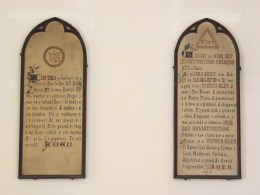
The Creed and Paternoster

The main entrance to the church is a doorway in the south side of the west tower, overlooking the sea.  A flight of stairs in the tower leads up to the bell chamber, and the commemorative wooden plaque that was installed when the Chapel of Ease was built is preserved on the wall at the foot of the stairs.  Entering the nave, above the west doorway, on each side, are the Creed and the Paternoster, both written in Welsh. The interior is relatively plain, but has a number of features of note.  At the east end of the church, The Ten Commandments are displayed in Welsh either side of the the rood arch that separates the the nave from the chancel.

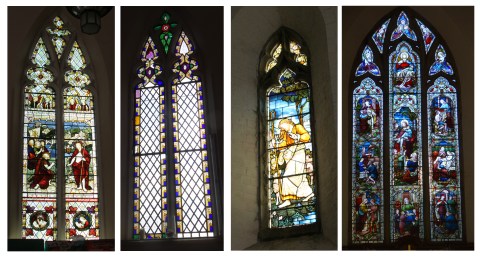
St Peter’s statined glass

There are four stained glass windows, of which only one dates to the original construction.  The window to the right of the door, depicts John 21:15 “Feed my lambs,” made by Ward and Hughes, in 1873.  At the far end of the nave, also on the right, is an original window from 1837 by David Evans, with a  simple but very attractive pattern framing plain glass.  On the south side of the chancel there is a small window with another finely coloured scene showing the the Good Shepherd, by James Powell and Sons and designed by Frank Mann.  At the far end, above the altar and dominating the church, is a window by James Powell showing a series of narratives, dominated by Matthew 19:14 “Suffer little children, and forbid them not, to come unto me: for of such is the kingdom of heaven,”  which was installed in 1890 and bears at its base the inscription “In Loving Memory of Maria Jane Pugh of Craigydon Who Died December 15th 1872.”

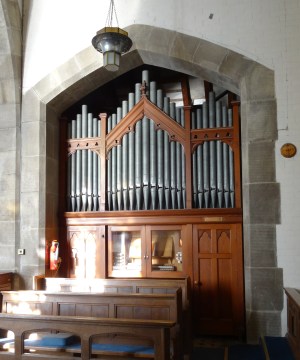
St Peter’s Church Organ

The organ chamber was added in 1907, with an organ built by Brindley & Foster.  Charles Brindley started the business and was joined by Foster in 1854.  Brindley trained in Germany, probably under the renowned organ builder Edmund Schulze.  He went on to set up his first workshop in Sheffield, employing German organ builders.  He was soon joined by organist and voicer (a person who regulates organ pipes) A. Healey Foster, and between them they continued to improve the design, technical sophistication and reliability of the organs that they produced.  At the International Invention Exhibition of 1885 they were awarded a silver medal for excellence.  Charles Brindley retired in 1887 and died in 1893 but was replaced by his son who, with Foster, continued to make improvements, with two major innovations in 1902 and 1904.  From 1885 a total of 18 patents were filed and between 1909 and 1914 they built an organ every month on average, but in the post-World War I years they struggled and the company eventually went into receivership in 1936.  The organ’s electric pump was added in 1934 in memory of Hugh Copner Wynne-Edwards, contributed by his wife.

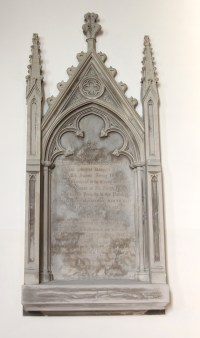
Memorial to Mrs  Scott

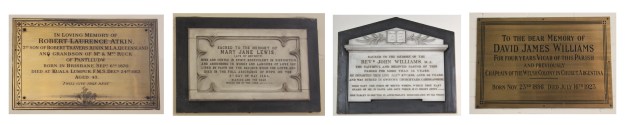
As with most Anglican churches, a number of memorials line the walls of the nave. The ornate Gothic style memorial to Mrs Susan Scott is of particular interest, having been contributed by her pupils.  Over a period of twenty years Mrs Scott ran a boarding school for young ladies to teach them social graces in the building now known as Penhelig Lodge, which has been discussed on an earlier post.  It is difficult to make out the inscription in the adjacent photograph, but as well as listing her parentage it reads: “Died in Penhelig on the XIV day December MDCCCXLII in the LXV year of her age.  In testimony of their admiration of her character, gratitude for her affectionate and maternal care, this tablet is erected by some of her pupils who are sensible that they shall best perpetuate her memory by conforming their lives in her excellent example.”  The size of the memorial and the warmth and sincerity of the message say much about how Mrs Scott was regarded by her pupils.  The rest of the memorials are fairly plain plaques in brass or stone, commemorating people who died elsewhere, former vicars and parishioners, all beautifully kept.

Memorials

In 2014 a conservation project was started to restore the late 19th Century soft furnishings in the church, of which the Celtic cross that hangs from the pulpit is a particularly fine example (see photographs at the end of the post).  The Glorias meet on the first Monday of the month from 2pm-4pm in the church.  Anyone with an interest in sewing or embroidery is very welcome to join.

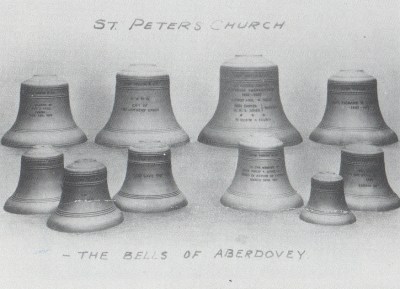
The bells of St Peter’s (Source: Aberdyfi, Portrait of a Village by Hugh. M. Lewis.

At the time of the church’s construction a gallery was installed, but this was removed in 1907, the same year that the organ was installed.  In 1936, ready for the centenary of the establishment of the Chapel of Ease in 1937, the Reverend Alfred Abel placed on order with bellfounders John Taylor for 10 chime bells on which the famous song The Bells of Aberdyfi (described on an earlier post) could be played.  Donations contributed £600.00 (in today’s money approximately £30,397) for the set of bells that are played by a carillon, a keyboard-like device with wooden keys called batons that are connected to individual bells and can be used to produce quite complex tunes.  The bells are each engraved with a dedication.  The smallest is 1ft 3.5ins in diameter, and the largest is 3ft 1in.   They were formally dedicated in a service held on 27th June 1937.

One of the running themes of the church is how important donations were to maintaining and upgrading the church throughout the 19th Century and early 20th Century.  Examples include the furnishing of the new chancel, the stained glass window over the altar, the electric pump for the organ and the new set of bells.  All are indications of both how central the church was to the Anglican members of the community.

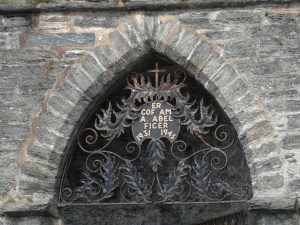
St Peter’s Church porch

The rectangular churchyard is entered via a gate through an archway in a stone porch on Sea View Terrace.  The gate is topped with a lovely curvilinear wrought iron feature with curving leaves and a central circular panel topped with a cross bearing the Welsh words, in gold, “ER  COF AM A. ABEL FICER 1931 -1945,” meaning, roughly, “In memory of A. Abel, vicar 1931-1945”  The porch is topped by a sun dial. 

According to the church website, repair work took place in 2010 following a serious outbreak of dry rot, which had  inflicted damage to the ceiling and walls.  A wooden window near the vestry had to be replaced and lime plaster was stripped from the walls and ceiling around the entrance to the church.  In 2017 the church was awarded £100,000 by the Listed Places of Worship Roof Repair Scheme, to pay for repairs to the tower, which included re-plastering the damaged interior walls.

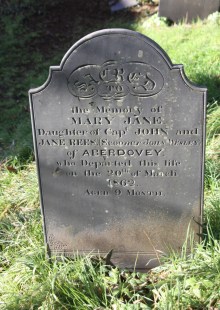
Gravestone of Mary Jane, daughter of Captain John and Jane Rees (Schooner John Wesley) who died in 1862, aged 9.

The churchyard is small.  A small number of graves are at the front of the church, but most are in the churchyard to the rear, where a number of gravestones are still in position, all east-facing.   Most of those that remain date to the early and mid 19th Century.  They are inscribed in either Welsh or English and many of them are reminders of Aberdovey’s connections with the sea and the seagoing trade.  Examples are the gravestones of Jane Lewis, wife of Captain Elias Lewis who died in 1862, age 33; Evan Evans, a boatman who died in 1863; Anne, wife of William Lloyd, timber merchant, aged 39 years; and Mary Jane, daughter of Captain John and Jane Rees (Schooner John Wesley) who died in 1862, aged 9.  As in most graveyards of this period, there are a sad number of child burials, some infants.  The gravestones are all slate, and are all very finely carved.  There are also a small number of tombs, with inscribed lids.

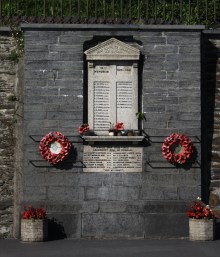
Aberdovey war memorial

Set into its sea-facing wall is a memorial to local men lost in the First and Second World Wars. This was first erected in 1919.  Made of granite, the memorials are set into slate, and as well as providing a focus for Remembrance Day events are a constant and much-needed reminder of the sacrifices made during both wars. You can find official details on the Imperial War Museum (IWM) website.

St Peter’s Church is part of the Bro Ystumanner Ministry Area, which covers the Dyfi Estuary and Dysynni Valley and includes five other churches: St Cadfan in Tywyn, St Peter ad Vincula in Pennal (posted about on this blog), St David in Abergynlowyn, St Michael in Llanfihangel-y-Pennant and St.s Mary and Egryn in Llanegryn.  The Mother Church for the Ministry is St Cadfan’s Church in Tywyn. The Reverend Ruth Hansford presides over the Ministry Area, supported by both clerics and lay personnel.

Reverend Ruth Hansford. Source: Cambrian News

On the departure of the previous Vicar and Ministry Area  Leader, Reverend Richard Vroom, he was temporarily replaced by Associate Vicar Janet Fletcher, who was also appointed acting Ministry Area Leader, and it was Reverend Fletcher who welcomed Reverend Hansford to St Peter’s and the Ministry Area in 2017.  There was considerable interest in the local media, including The Cambrian News, about the appointment of Reverend Hansford, who had been formerly based in Exeter, where she was ordained after a career as a clinical biochemist in the NHS.  Her move to Aberdovey with her family fulfilled her desire to work in rural communities.  She has made significant strides in learning Welsh since her arrival and has enjoyed becoming involved with the community, including braving sailing lessons!  One of her innovations has been the introduction of prayer walks in lovely local places, and she has continued to run the excellent “Messy Church” project that is designed to involve children in the church.  I was particularly amused by the Jason and His Coat of Many Colours poster where children had pinned their dreams.  One read “My dream is for people to be kind to one another,” another dreamed of “peace and justice for everyone in the world,” whilst Oliver, far more prosaically, quite simply dreamed “to have a motorbike” and another hoped for “thousands of dog biscuits.” Great fun, and such a good idea.

The church also holds weddings, has hosted a number of classical concerts by visiting chamber orchestras and is one of the organizers of and contributors to the monthly Community Lunches held in the Neuadd Dyfi (the Aberdovey village hall) during the winter months.  These and other events are announced in the Bro Ystumanner Newyddion newsletter.  More information about the Bro Ystumanner ministry, which also publishes their newsletters, can be found on their website.

Services are held in English every Sunday at 11.15:  the Holy Eucharist on the first and third Sundays, an All Age Worship service, started this year, on the second Sunday of the month, and a sung Matins on the fourth Sunday of each month, but do check their website in case of any changes since this post was published.

More details of St Peter’s Church, Aberdovey

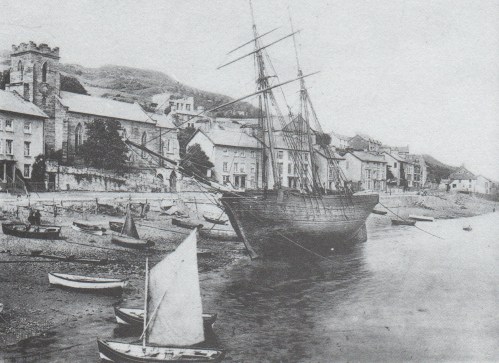
St Peter’s overlooking the foreshore with the schooner Sarah Davies, 1902. Source: Gwyn Briwnant Jones, Picturesque Aberdovey: A Collection of 20th Century Postcard Views. Gomer 2000.


Cefn Caer, Roman auxiliary fort, Pennal

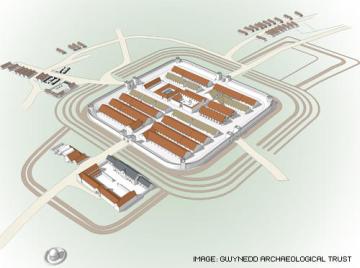
Simplified reconstruction of Pennal Fort by Gwynedd Archaeological Trust: Source: Gwynedd Archaeological Trust

The nearest Roman site to Aberdovey is the fort at Pennal, called Cefn-Caer (which translates roughly as ridge/hillside of the fort), 10.5km (6.7miles) away from Aberdovey.  Although there is a rock-cut track that stretches from Penhelig to Picnic Island along the estuary that is known locally as the Roman Road, this actually dates to 1827.  Cefn Caer at Pennal, however, is the real thing:  a Roman fort 600 yards from Pennal down a small B-road.  It formed part of a network of forts and roads that were key to the Roman plans to subjugate Wales.  When I first started looking into Cefn Caer for this post, it was simply because the site is part of this area’s history and I wanted to include it as a small representatives of Roman activity in Wales.  The word “small” is worth noting here, because I was expecting Cefn Caer to be no more than a very ephemeral way station for travellers (mansio) or a tiny watch-post.  In fact, it is a fairly substantial affair, as demonstrated by the above simplified reconstruction by Gwynedd Archaeological Trust (GAT).  The GAT work at the site reveals an auxiliary fort with all the features associated with a permanent installation, which had an important strategic role.

Pre-Roman Wales. Source: Wikipedia

The Roman Empire first made its presence felt on British shores first under no less a personage than the Emperor Julius Caesar, albeit only briefly in 55BC and 54BC.  Under the Emperor Claudius matters were taken far more seriously in AD 43 and there was to be no retreat, and after the invasion most of Britain was incorporated in the Roman Empire for for the best part of 400 years. The period of the Roman occupation of Britain is known as the Romano-British period (AD 43 to 410).

Iron Age Britain immediately prior to the invasion was divided into six main tribal areas, recorded in Roman documents, which were organized in social hierarchies that were based on lineage, status and military aptitude “cemented by the distribution of favours and hospitality; consequently equipment for eating looms large in the archaeological record” (Davies and Lynch 2000).  Parade gear, with a particular focus on horses and chariots, is also dominant in the archaeological record.  Subsistence practices depended very much upon geography, but combined herding of domesticated animals (cattle, sheep, goat and pigs) with the cultivation, where possible, of emmer wheat and barley.  Hillforts are generally thought of as synonymous with the Iron Age, as places where political power was centred, but in mid-west Wales, where there are very few hillforts, suggesting that political power was more fragmented, and consisted of scattered farmsteads.  Although the Tal y Llyn hoard (covered on an earlier post) found at Cader Idris is very rich, it is entirely possible that it was hidden by someone travelling through the area, rather than a local resident.  Although in some areas life went on without disruption for some time, in the areas where the invaders first settled, they introduced substantial change very quickly.
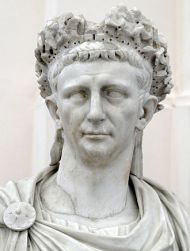
The Emperor Claudius, Naples Archaeological Museum.

When Aulus Plautius, the chosen commander of the Emperor Claudius, led an invasion force to Britain and  landed in the southeast, he found the prosperous and sophisticated Catuvellauni tribe dominant, their territory extending from Essex to Surrey under the leadership of Caratacus and his brother Togodummus.  Caratacus and Togodummus were defeated when confronted with the 40,000 men in four legions and supporting auxiliary forces.  Caratacus abandoned his family and fled to the Silures tribe in southeast Wales to rethink his strategy.  Caratacus realized that the partially low-lying territory of the Silures was vulnerable and created an alliance with the Ordovices, which had highland areas in its territory, to organize resistanc,.  The Ordovices were the main tribe occupying most of Gwynedd and Ceredigion, and “by creating a multi-tribe resistance he [Caratacus] offered the most effective bulwark against the Roman invasion to date” (de la Bédoyère 2003).

Cefn Caer, showing farm buildings with traces of the Roman fort in the field to its right. Source: RCAHMW (on the Coflein website) Catalogue Number C872327, File Reference : AP_2009_1671. By Toby Driver

It was not until AD 47 that the Romans felt the need to turn their attention to the tribal areas of what is now known as Wales.  Wales had many benefits from a Roman point of view, including rich mineral resources, fertile valleys and a long coastline.  It would also have been a good source of manpower via voluntary enlistment or conscription.  Perhaps most important, strategically, without peace in rebellious Wales, all Roman-controlled land to its east was potentially under threat.  The first period of military hostilities between Rome and Wales lasted between AD 47 and AD 60, with multiple campaigns against the Marches and Welsh communities, starting in the southeast.  A significant event was the Battle of Caer Caradoc in AD 50, where Caratacus led armies composed of the Ordovices and Silures against the Roman military.  In spite of the strategic advantage of Caratacus and his armies, holding the high ground, the Roman forces under the governor Publius Ostorius Scapula had weaponry, body armour and military experience that outclassed Silurian and Ordovician resources.  Caratacus was defeated and ultimately taken into custody and carried to Rome where the Roman senate were sufficiently impressed by his speech that he earned a pardon from Claudius and lived out his life in Rome.  In his book “Defying Rome,” de la Bédoyère comments that Caratacus “failed to appreciate that he was on the whole a dinosaur.  While he maintained his resistance he found the only place he could do so was amongst people who had no idea what Rome amounted to.”   The Romans did not have it all their own way, but although the Silures went on to defeat a Roman legion in AD 52, it was only a matter of time before Wales was brought under Roman control.  There was a brief respite when the Boudiccan rebellion in East Anglia in AD 60 required the redeployment of troops.  Full-scale invasion was temporarily abandoned and a strategy of containment was practised in Wales, with all of the only permanently occupied military bases lying along the border.

Wroxeter (Viroconium Cornoviorum). Source: Wikpedia. Photograph by Alastair Rae

In AD 73 under the Emperor Vespasian, Sextus Julius Frontinus was appointed Governor of Britain (AD 73-77) , and it is during his tenure that Wales was fully conquered.  Three legionary fortresses were established as campaign bases, at Caerleon (Isca Silurum), Wroxeter (Viroconium Cornoviorum) and Chester (Deva Victrix), and temporary camps were set up within Wales itself, setting the scene for “a network of garrison posts, incorporating fortlets and watchtowers, eventually linked by an all-weather road system” (Arnold and Davies) which were used to maintain control over the rural and often highland zones.

Information about Iron Age and Romano-British exploitation of the western areas of west of mid Wales is particularly sparse, but it would be surprising if such rich natural resources as the Dyfi and particularly Dysynni valleys were not employed for cattle herding and some cultivation, with the surrounding highlands excellent for sheep herding.  It is by no means clear if the Ordovices occupied the whole area, as the boundaries of tribal areas are not known, and it is thought that other smaller and less dominant communities also occupied parts of Wales, but it seems clear that whatever happened to the Ordovices would have had an impact on other small communities in the area.  After their defeat under the leadership of Caratacus in AD 50, the Ordovician tribe again rebelled in AD 77-78 and was put down uncompromisingly by the British governor, Gnaeus Julius Agricola.  Agricola went on to establish forts at Caernarfon, Caersws, Pen Llystyn (Bryncir),  Tomen y Mur (Trawsfynydd), Caer Gai (Penllyn) and Cefn Caer (Pennal), most of them in river valleys or estuaries.  Other sites in the mid Wales area established in this period were the fortlets at Erglodd in Ceredigion and Brithdir in Merionnydd.

Military installations c.AD 70-80. Source: Arnold and Davies 2000, p.16

The Roman architectural infrastructure in Wales took the same form as it did elsewhere, a hierarchy of military installations.  The most important in strategic, organizational and to an extent administrative terms were the legionary fortresses at Chester (Deva), Wroxeter (Viroconium Cornoviorum) and Caerleon (Isca Silurum).  These were, however, in a minority, and the main control over Wales was exercised by a large number of auxiliary forts dotted at strategic positions throughout Wales, often on rivers and estuaries, supplemented at intervals by small fortlets and watch towers.  Legionary and auxiliary forts each refer to the type of garrison stationed there.  Legions were the elite army of the Roman Empire, composed of c.5000 men, divided into ten cohorts.  They served for twenty-five years and were rewarded on retirement with a choice of land or a payment.  Auxiliaries were composed of non-Roman citizens, men who entered the army from throughout the Roman empire sometimes sometimes as volunteers but  sometimes extracted from their homes by force.  They were granted Roman citizenship once they retired.  They were far more numerous than the legionary forces and were essential to the Roman occupation of Britain.  Mid Wales in the Romano-British period  remains poorly understood, which means that wherever a Roman site or a contemporary Iron Age is identified in the area, it is potentially of considerable importance for understanding what was happening in mid Wales at this time.  The Cefn Caer fort was an auxiliary fort, the westernmost of Roman structures in Meirionnydd, established in the AD 70s.

Cefn Caer geophysical survey results. Source: Hopewell 2001

There are few visible features of Cefn Caer on the ground.  The ramparts to the southwest and northwest can be made out, but elsewhere they are low banks that cannot always be seen.  Before it was torn down and rebuilt in 1769  the church in the village of Pennal was reported to include a large number of Roman brick in its walls, and remaining obstructions to cultivation were probably moved in the distant past, and the land continues to be used by the local farm for cultivation.   The farm buildings, including a sub-Medieval farmhouse (which can be visited), sit within the west corner of the fort and the northern corner of the fort is crossed by a small B-road  Although the 1967 History of Merioneth provided dimensions derived from previous surveys of the fort, detailed knowledge of the scale and structure of the fort comes from more recent analysis of aerial photographs, the use of geophysical survey and field excavations, the latter only sampling certain parts of the site. The history of the archaeological work can be summarized as follows.  The site was first noted by Robert Vaughan in his Survey of Merioneth in the mid 17th Century, and in a late 17th Century letter by the rector of Dolgellau, Maurice Jones.  Amongst the 17th Century finds were a silver coin inscribed with the name of the Emperor Domition.  Subsequent visits to the site reported ditches, coins, bricks, a hard paved road, pottery and a tile relating to II Augustian Legion.   The main sources of information are the initial detailed report by Professor R. C. Bosanquet in 1921, which was further studied and commented upon in 1957 by H.C. Irvine in BBCS Volume XVII part 2, and these were the best sources of information on the subject prior to the work by Gwynedd Archaeological Trust (GAT).  GAT used conventional survey, geophysical survey,  and excavated some sample trenches to investigate further (Hopewell 2001, 2003).

Cefn Caer was a small auxiliary fort (castellum) with traces of a ditch still visible at the northwest, outside the rectangular bank that encloses the fort.  It was built in AD 70s. It is more than 1.68ha (5 acres) in area, measuring 140m x 120m (c.550ft x 425ft) northeast to southwest with rounded corners.  An earlier site of c.2.4ha appears to have predated it, which may have been the temporary fort established before the construction of the permanent site.  The fort was located at the west end of a ridge or spur that rises 15m (50ft) above the floodplain north of the river Dyfi, c.10km (c. 6 miles) from the mouth of the estuary.  This offered it the dual benefits of having something of a view over the surrounding area, and in particular the river crossing.  It was only 100m (328ft) northeast of the marshy Dyfi floodplain and 1.6km (half a mile) from the river itself, where “tongues of the land extend opposite each other to both banks of the river” (History of Merioneth) providing an ideal place for fording the river, and where coastal vessels could unload.   Roman forts were built to a fairly standardized template, meaning that they could be built rapidly without resorting to labour beyond the personnel they had to hand, and Cefn Caer does not deviate from this basic form.  For comprehensive details see Hopewell 2003 (available to download – link also at the end of this post) but here are some of the key features that Hopewell describes, with numbers in the text referring to the site plan, copied here.
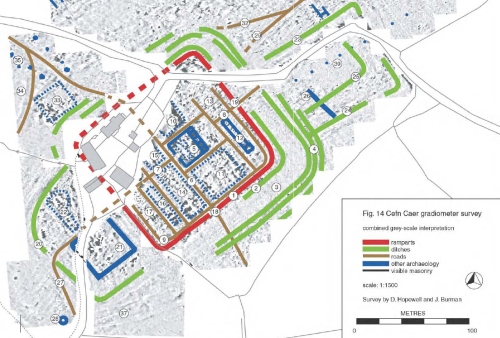
Resuilts of the GAT geophsyical survey at Cefn Caer. Source: Hopewell 2003, Gwynedd Archaeological Trust

Cefn Caer was arranged around two main axes that crossed the fort at right-angles to each other, one on a northeast to southwest axis, the other crossing it on a northwest to southeast axis, and the whole fort was surrounded by defensive ditches. At its centre, on a natural rise, were the fort’s stone-founded headquarters, the principia (principal buildings – no.5 on the above plan) measuring 25m x 28m.  Several other buildings also appear to have had stone foundations.  The entrance to the principia is on the south-west side, and “leads into a courtyard with a portico on four sides bounded by a cross hall at the rear. At the rear of the building stand a set of five rooms comprising a central shrine room (sacellum) with offices to either side” (Hopewell 2003).  There are two buildings either side of the via principia. GAT interprets the building to the north-west (10) as the praetorium (commander’s house).  In the retentura (rear part of the fort) one block of centuriae (military barracks) (12 on the above plan) can clearly be seen.  The officer’s quarters stand towards the corner of the fort. Part of the space in the praetentura (the front part of the fort) appears to be taken up by two ranges of centuriae.  Part of the big building complex (14) may be a stable block with the stalls.  Within the fort are a number of roads, which are standard for an auxiliary fort, as follows:

  • The via principalis (6 on the above plan), running from north-west to the south-east across the centre of the fort.
  • A short length of the via praetoria (7) runs at right angles to the via principalis under the farmyard
  • The via decumana (8) runs from the rear of the principia to the north-eastern gate
  • The via sagularis (9) runs around the inside of the ramparts

Beyond the main limits of the fort a vicus developed to the northeast and northwest.  A vicus is a small settlement associated with an auxiliary fort, a community of traders and their families, who supplied good to the garrisons within, but its inhabitants were rarely local, and were just as much outsiders as those within the fort.  Marriage was forbidden to Roman soldiers, but there is little doubt that less formal arrangements existed, and that families of soldiers also resided within the vicus.   The presence of a vicus next to the fort is indicative of its permanence and relative longevity.  Below the southwestern annex there was a small circular building that was probably a small temple, shrine or tomb.  A large rectangular building (33 on the above plan) measuring 34 x 22m may be a mansio (travellers’ way station).  A mid 19th Century visit by the Cambrian Archaeological Association mentions the remains of a hypocaust (sub-floor heating, sometimes associated with bath complexes), and this appears to have been located in an annex to the northwest of the fort (22) where there is plenty of Roman tile on the surface.

Cefn Caer site plan. Source: History of Merioneth, page 239, figure 102.

The fort has four entrances, one in the centre of each side, and there have been some efforts to determine where the roads that terminated here linked to locally.  A small B-road cuts across the north corner of the site, shown in the plan from History of Merioneth to the left, and the History of Merioneth suggests that the sudden kink in the road indicates that for a short span it follows the Roman road that emerged from the site.  Evidence of the same Roman road a little further on appears to run along a nearby ridge.  There was also an earlier indication that portions of a road led from the southwest gate led down to the river.  The History of Merioneth suggests that this may have led to a quay at Llyn y Bwtri.  The southeast gate would have faced the river crossing. Cefn Caer appears to be linked to a number of national routes as follows.

  • Via the fortlet at Brithdir towards Tomen y mur (to the northeast of Llyn Trawsfynydd. Tomen y Mur is considered to have been the most important Gwynedd fort due to its strategic position, its size and its complex layout, with an amphitheatre, bath house, vicus, mansio and related structures, including a possible aqueduct.  Although the roads connecting it are not completely mapped, it is clear that it was an important link between mid (and south) Wales with the important sites of Caernarfon and Canovium (Caerbun) to the north, which were in turn connected to the regional capital at Chester.
  • Via the fortlet at Brithdir northeast towards the important fort of Chester), via smaller forts at Caer Gai and Llanfor.
  • Cefn Caer probably linked to another route, this time west to another ciwitas captial at Wroxeter via the fortlet at Pen y Crogbren and the forts at Caersws and Forden Gaer.
  • It was also clearly connected with sites to the south of the river Dyfi, in the first instance the fortlet at Erglodd and, in turn, the forts at Pen Llwyn and Cae Gaer.  These were on routes to the important southern Welsh fort Caerleon.

These are all shown on the map of Roman Wales above and although the road network cannot currently be completed, the map indicates how Pennal was linked to other sites in the area, providing an important intersection at the river Dyfi between north and south parts of west Wales.

Brithdir fortlet from the air. Source: RCAHMW colour oblique photograph of Brithdir Roman fortlet. Taken by Toby Driver on 11/12/2007. Published on the Coflein website.

Another Meirionnydd fort at Brithdir, 3 miles east of Dolgellau, was found in the early 1960s and is clearly connected by a contemporary road to Cefn Caer at Pennal.  It measured c.184x184ft (54m sq), so was much smaller than the Cefn Caer fort.  It has not been excavated and there are no extant remains, but it shows up very clearly in aerial photographs like the one at left, and in the early 1990s geophysical survey was carried out at the fortlet.  When a new housing estate was under construction nearby in the 1970s the opportunity was taken to excavate, and the results of these combined sources show a complex history at and around the site.  At least two and possibly three, ditches surrounded the fort, and there are indications that a bathhouse and workshops were present.  Brithdir was considered to have been built to guard an important intersection of a number of routes.

The fortlet at Erglodd in Ceredigion.  Source: Gwynedd Archaeological Trust

Looking to the south of Cefn Caer, the nearest site on the other side of the river was the fortlet at Erglodd, to which it was presumably connected by a road to the Dyfi ford.  You can read more about the results of the geophysical survey in the Gwynedd Archaeological Report on the subject (Hopewell 2007).

Unlike the other parts of England and Wales, there is no evidence for towns developing or villas being built in Mid Wales.  Arnold and Davies say that this “may be a silent commentary not just upon native resistance but upon the inability of the agrarian base to produce the necessary surplus.  Together with geographical constraints, this inhibited political co-operation and fostered continuation of highly segmented societies.”

In the period AD 78-83, again in AD 98-119 and then again in AD 125-6 troops were required in the north of Britain (eventually resulting in Hadrian’s Wall and Antonine Wall) and overseas, when some troops were again withdrawn from Wales.  Some forts were abandoned whilst others, like Tomen-y-Mur at Trawsfynydd, were resized and operated with less manpower.  By AD 140 very few auxiliary forts were occupied in Wales and it is probable that Cefn Caer was abandoned either at this stage, or during the 3rd Century, when most of Wales was abandoned.

A lot of unanswered questions may be tackled in the future.  Gwynedd Archaeological Trust’s Roman Fort Environs Project funded by Cadw is researching the environs of a number of forts using fluxgate gradiometer survey, which should help to develop an understanding not only of the forts but of their ancillary structures, roads and supporting settlements.  Gwynedd Archaeological Trust has so far carried out surveys at Canovium (Caerhun), Caer Gai (Llanuwchllyn), Caer Llugwy (Capel Curig), Cefn Caer (Pennal) and Pen Llystyn (Bryncir).  These findings will be published in the future.  At the same time, a number of GAT and independent projects are looking for the remains of Roman roads in areas where the linkages are known only from small sections, in order to fill the gaps in knowledge about the roads between forts and the routes they followed.  Research by Hugh Toller, for example, is thought to have uncovered a number of previously unknown sections of the RRX96 road between Pennal and Brithdir.

Main sources:
Arnold, C.J. and Davies, J.L. 2002.  Roman and Early Medieval Wales.  Sutton Publishing
de la Bedoyere, G. 2003.  Defying Rome. The Rebels of Roman Britain. Tempus
Bosanquet, R.C. 1921. Cefn Caer – Roman fort in An Inventory of the Ancient Monuments in Wales and Monmouthshire VI. County of Merioneth RCAHM
Bowen, E.G. and Gresham, C.A. 1967.  History of Merioneth.  Volume 1: From the earliest times to the Age of the Native Princes.  The Merioneth Historical and Record Society
Davies, J. 2007 (third edition). A History of Wales.  Penguin
Davies, J. and Lynch, F. 2000. The Late Bronze and Iron Age.  In (eds.) Lynch, F., Aldhouse-Green, S. and Davies, J.L.  Prehistoric Wales.  Sutton Publishing
Gwyn, D and Davidson, A. 2007. Ports and Harbours of Gwynedd: Aberdyfi.  A Threat Related Assessment. GAT Project No. 1824. Report No. 671.1. April,2007. Gwynedd Archaeological Trust
Hopewell, D. 2001. Roman Fort Environs G1632, Report 416. Gwynedd Archaeological Trust 2001.  http://www.walesher1974.org/her/groups/GAT/media/GAT_Reports/GATreport_416_compressed.pdf
Hopewell, D. 2003.  Roman Fort Environs 2002/2003, G1632, Report number 479. Gwynedd Archaeological Reports.  http://www.walesher1974.org/her/groups/GAT/media/GAT_Reports/GATreport_479_compressed.pdf 
Hopewll, D. 2007.  Roman Fort Environs. Geophysical Survey at Trawscoed Roman Fort and Erglodd Fortlet. G1827(2). Report number: 667.  Gwynedd Archaeological Trust.  http://www.dyfedarchaeology.org.uk/projects/07romanergloddgeophys.pdf
Irvine, H.C. 195
7. Bulletin of the Board of Celtic Studies Volume XVII part 2, (p.124-131)

Coflein entry on Cefn Caer:
https://coflein.gov.uk/en/site/300159/details/cefn-caer-roman-fortpennal-roman-fort
Coflein entry on Brithdir fortlet:
https://coflein.gov.uk/en/site/95480/details/brithdir-roman-site

New strandline discoveries

Monday’s walk along the beach produced some more interesting strandline finds to add to those found on my previous strandline expeditions.  The sea was nearly at high tide, so the strandline was shifting all the time, wet weed and shells changing position as the waves pushed forward and retreated.  Sunday had been an endless day of really strong gales, complete with Met Office weather warnings, and although I expected this to have stirred things up a lot, I was not expecting to find much at high tide, so it was interesting to see what there was.

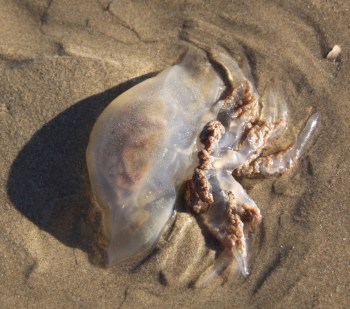
Barrel Jellyfish, Aberdovey shoreline

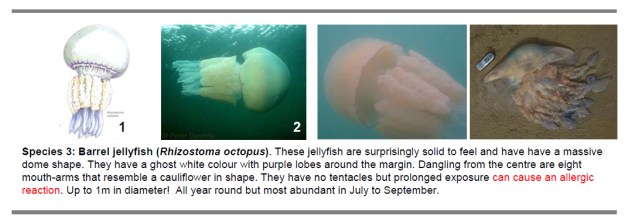
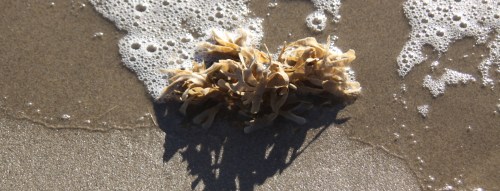
The most anomalous find was a dead barrel jellyfish (Rhizostoma pulmo), a common enough sight in warm summer months, but the first I have ever seen in winter.  The barrel jellyfish is distinguished by a thick rubbery bell and “arms” rather than tentacles, which have a distinctive frill along their edges. This is a  small one, but they can reach up to 1m in diameter and are the largest of jellyfish to be found in UK waters.  They have a mild sting.   The Marine Conservation Society collects sightings of jellyfish (and turtles, crawfish and basking sharks) throughout the year, so if you see one it is worth going to the MCS’s sightings page and filling in their online form.  There’s a good jellyfish identification guide on the IWS website, from which the following is taken:

Barrel jellyfish details

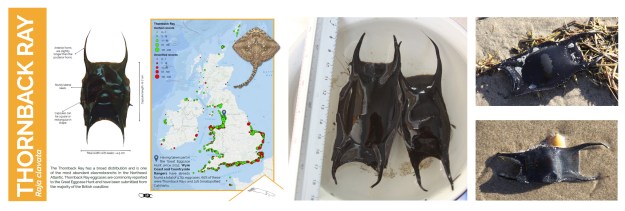
I also found two new eggcases.  If you are new to eggcases, have a look at my post on the subject, where I go into some detail.  These were very unlike the nursehound case that I found on the beach that day, but very distinctive.  Using the Shark Trust’s identification guide, it was possible to narrow them down to a Thornback Ray (Raja clavata) and a Spotted Ray (Raja montagui).  My photos of the two cases are below, together with the Thornback Ray  relevant page from the Shark Trust’s identification guide.

A page from the Shark Trust’s identification guide, accompanied by photos of the two eggcases found today.

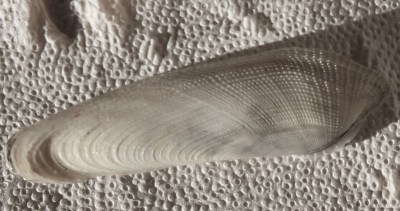
Common piddock (Pholas dactylus)

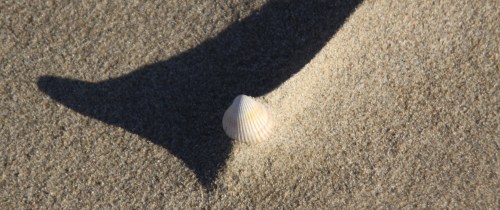
The bivalve shell I picked up and kept is neither unusual nor relevant to any conservation programmes, but it is simply very attractive, with a wonderful textured surface, and I had never seen one before.  It’s a common piddock (Pholas dactylus), one of four species of piddock found mainly in the south and wet of Britain, all white. They are specialist borers, using the ridges for drilling into hard substrates to create burrows.  They have feeding siphons which reach out from the burrow into the sea to collect nutrients, and in the case of the common piddock the siphons are bioluminescent and glow green in the dark.  Shells can be up to 12cm long, and this one is exactly 12cm long.

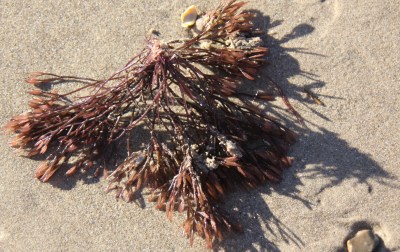
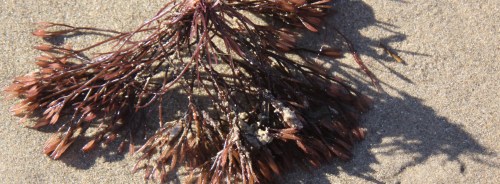
I picked up a piece of seaweed that was a deep pink when I found it, and it turned black when I left it to dry out.  It’s a new one on me so I looked it up:  clawed fork weed (Furcellaria lumbricalis).  It only has the pods at the ends, which are its reproductive structures, in winter.  It tolerates low saline conditions, so will grow even in estuary waters.


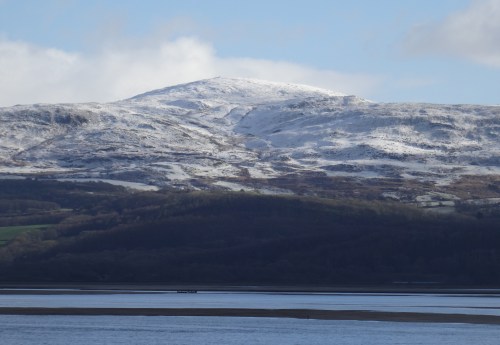
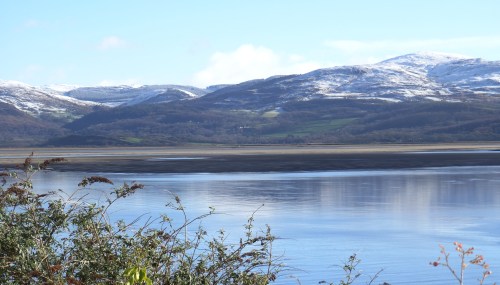
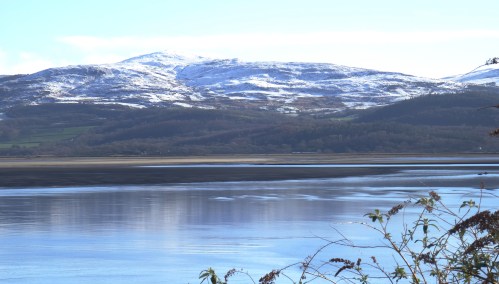
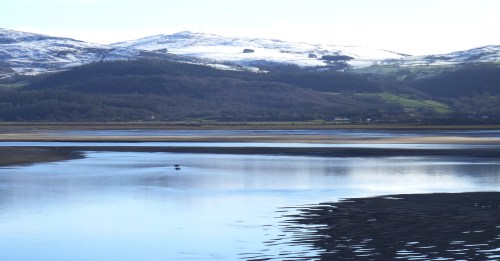
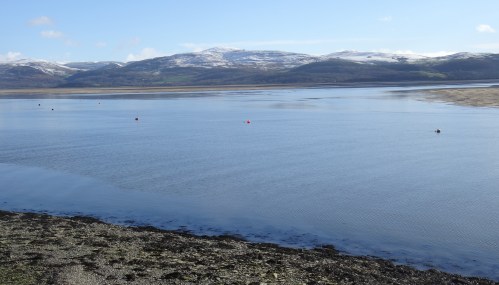
Snow on the hills on the Ceredigion side of the Dyfi estuary

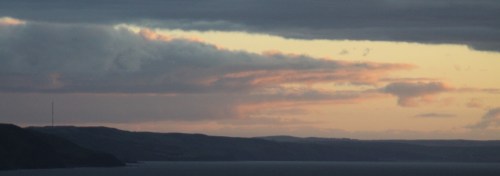
Snapshots today, walking down Balkan Hill for some odds and ends in the village.  Not very sharp, because I was using the tiny camera I keep in my handbag.  I didn’t dare take my good kit because I knew if I had it with me I’d end up walking along the beach for a couple of hours, and I didn’t have time today!  The very short video at the end is just the view over the estuary and Cardigan Bay beyond from my window as the sun went down, with pink smoke!  The days are getting noticeably a little longer, although it seems like a very long haul to get from the shortest day on 21st December to the end of March.


The railway arrives in Aberdovey in 1864

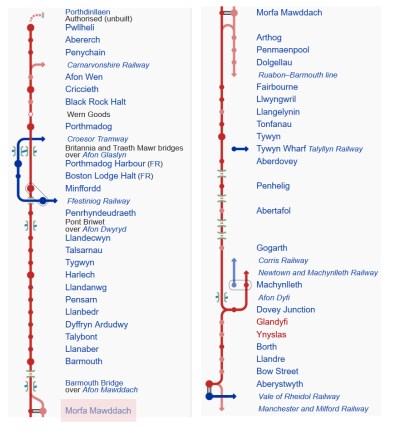
Welsh Coast Line. Source: Wikipedia, where you can see it as a single image, without rather than being split into two, as it is here.

Today the Cambrian Line runs from Shrewsbury (Shropshire) to Pwlleli (Gwynedd) with a branch just after Dovey Junction to Aberystwyth.  The section from Dovey Junction (to the southwest of Derwenlas) to Pwlleli in the north is known as the Cambrian Coast Line.  There are two stops in Aberdovey, one at Penhelig and the other at the far side of the village, behind the bowling club.  The arrival of the railway in the 1860s had a significant impact on Aberdovey, altering the economy and physically reshaping parts of the town.  The excellent legend to the left shows the final form of the railway line, complete with information about which stations remain in use.  I have split it into two to fit on the page, and Morfa Mawddach appears twice as a result.

The Aberystwith and West Coast Railway was authorised by a Private Act of Parliament on 22nd July 1861.  The spelling of Aberystwyth as Aberystwith was the name in which the company was registered.  To put this date into perspective, by the 1860s Aberdovey had a very successful shipbuilding industry, it was an important port for the transhipping of slate exports and was important for the import of grain and other goods.  Copper mines had been established in the hills around the village and a growing tourist industry based on the beach was flourishing even without a railway.  There were two Nonconformist chapels dating from the late 1820s and St Peter’s Church had been established for nearly two decades.

The railway routed around the back of the village, rather than along the seafront as originally planned. Source: Hugh M. Lewis.  Aberdyfi, A Glimpse of the Past.

The railway was intended to link north and mid Wales, to improve efficiencies in the export of local slate and to enable Aberdovey and Aberystwyth to serves as Irish ferry termini, linking Ireland with the Midlands.  These were boom years for Aberdovey, and it must have seemed like more in the way of progress.  Local people were not, however, blinded by the coming of the railway and significant disputes between Aberdovey residents, the owners of the land (the Ynynsymaengwyn Estate in Tywyn) and the representatives of the railway company over exactly where the railway should run and how the harbour would be developed.  The original plan was to send the line along the sea front but extensive disputes with Aberdovey business leaders and villagers, who were concerned about the impacts on shipping, ship building and tourism, lead to it being routed around the back of the village, an expensive compromise that required tunnelling through rock.  The dispute is described in Lewis Lloyd’s account on the subject in A Real Little Seaport.   The need for the tunnels meant that the railway’s contractor Thomas Savin’s estimate for the cost of the railway was unrealistically low, and this contributed to his personal bankruptcy in  1866.

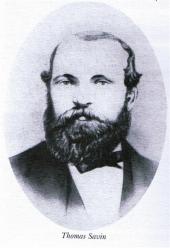
Thomas Savin (1826-1889) was a well known railway engineer,  who built several railways in Wales.  Although the contractors for the new railway are listed as Thomas and John Savin, Thomas was clearly the driving force.  He had multiple business interests and often invested in his railway projects, meaning that he was far from impartial when local interests impacted business decisions, as happened in Aberdovey when villagers contested his plans to run the railway along the sea front and develop the harbour in ways that would have been harmful to local shipping and tourism interests.  Savin represented the railway company in most of his dealings with the villagers. A lot more about Savin can be found on a page dedicated to him on the Llanymynech Community Project website.

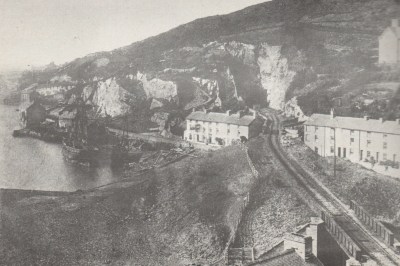
Penhelig shortly after the railway was laid, and before Penhelig Terrace was built, showing the railway tunnel and the shipyard just in front of the Penhelig Arms. Source: Hugh M. Lewis.  Aberdyfi, A Glimpse of the Past.

Savin had originally intended to build a bridge across the Dyfi to connect Aberdovey and Ynyslas by rail, and this remained the plan for some time, but due to the local geomorphology, civil engineers decided that the bridge could not be built and an additional 12 miles of rail had to be laid to go around the estuary, crossing the river just north of Gogarth instead. This meant that until the new stretch was built, southbound passengers had to cross the river by ferry between Aberdovey and Ynyslas, where a line had been built.  All the necessary materials for construction of the railway were carried into Aberdovey by ship, except for the locomotive and carriages that were carried from Ynyslas over the river Dyfi to Aberdovey.  Aberdovey served as the depot for most of the equipment and materials, including plant, sleepers and rails.  The construction work on the Aberystwith and West Coast Railway began at Aberdovey in April 1862, and was built in a number of stages,as follows:

  • By early September 1862 the line reached the river Dysynni and the first locomotive with 10 carriages was launched in South Merioneth and undertook the short trip from Aberdovey, stopping to pick up more passengers, to the river Dysynni and back again, carrying dignitaries and holiday makers.  In the evening a firework display celebrated the achievement.
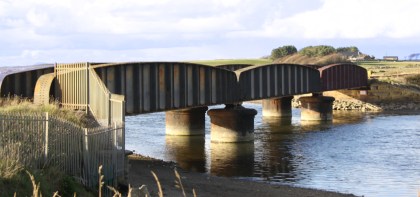
  • In 1863 a track was laid down between Aberdovey and Llywyngwril to the north along the Welsh coast, including the three-span steel plate girder bridge over the Rivery Dysynni. This section of the line connected with the narrow gauge TalyLlyn slate quarry railway at Tywyn.  Before the railway, slates were offloaded from the TalyLlyn single gauge railway, loaded on to the new line and taken to Aberdovey for loading on to ships.
  • Before the section of line was built around the estuary, the s.s. Elizabeth was purchased to carry railway passengers across the river at Aberdovey to Ynyslas.  The Elizabeth was a 30 horse-power Blackwall paddle steamer that was rigged for sail.  She arrived in October 1863, and was captained by a Machynlleth resident Captain Edward Bell who was succeeded by his younger brother Captain John Bell.  But she was not a success.  At c.125ft long she was too long, and small boats had to be used to supplement the ferry service.  The Elizabeth was owned by Thomas Savin, who sold it in 1869 to an agent in Londonderry.
  • The section of railway between Machynlleth and Aberystwyth was completed by July 1864.
  • The stretch from Aberdovey to Pwllheli was completed in August 1867, the delay caused by the building of the viaduct across the estuary at Barmouth.  The line was originally intended to go along the Lleyn Peninsula to Porthdinllaen, but this plan was abandoned and the terminus was established at Pwllheli. This section of the line linked at Afonwen Junction to the Caernarfonshire Line to Caernarfon.
  • In 1867 the railway was also extended along the north bank of the river to Machynlleth.  The line split at Dovey Junction with two branches, one going to Machynlleth and one going to Aberystwyth.

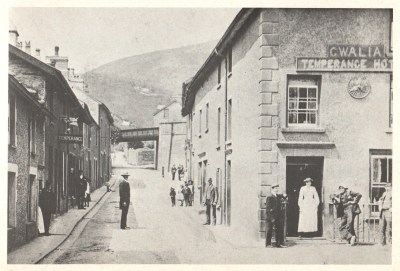
Photograph of the Temperance Hotel in Chapel Square, showing the bridge over Copper Hill Street in the background in 1867. Source: Hugh M. Lewis. Pages of Time.

As the Newtown and Machynlleth Railway had opened at the beginning of 1863 and absorbed into Cambrian Railways the following year, the two lines were now linked.  Newtown was linked to the Oswestry and Newtown Railway (which opened in 1860), which in turn linked at Welshpool to the Shrewsbury and Welshpool Railway (which opened in 1862) and the Shrewsbury and Birmingham Railway (opened in 1847), the Shrewsbury to Hereford line (opened in 1853) and the Newport, Abergavenny and Hereford Railway (also opened in 1853) thereby linking mid and north Wales with the borders, south Wales the Midlands.

In 1866 the line had been integrated with Cambrian Railways under the Cambrian Railways Company, which was created by an Act of Parliament in July 1864 in order to amalgamate a number of companies operating in Wales.  The Aberystwith and West Coast Railway was still under construction at the time of the Act, so was not included in the original amalgamation, but was incorporated two years after the first part opened.  Cambrian Railways was head-quartered at Oswestry, where there is now a heritage museum celebrating the railway, the Cambrian Railways Museum (which has a website here).

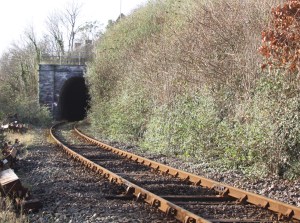
Railway Tunnel on the other side of Penhelig

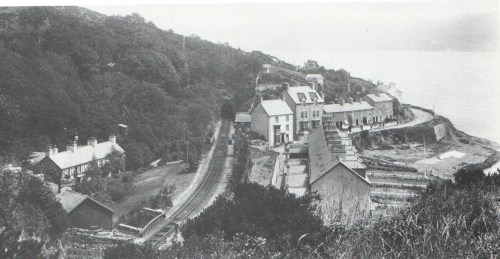
Heading to Aberdovey from Machynlleth, the line enters Aberdovey from the southeast at Penhelig Halt (added in 1933) where it emerges from a tunnel and is then carried over the road and follows a track through the back of the village before crossing the road again at the far end of Aberdovey, to continue along the coast to Tywyn.  The spoil from the tunnelling operation that was required to run the railway at the back of the village was deposited in Penhelig, on land cutting into a former shipbuilding yard, and this was the site of the future Penhelig Terrace, which was built c.1865.  Two tunnels were required to carry the railway through the hillside alongside the estuary, and four bridges were erected to carry it over the coast road  at Penhelig, under Church Street, behind St Peter’s Church, over Copper Hill Street and at the far end of Aberdovey by the modern fire station.  As soon as the line between Aberdovey and Machynlleth opened, the Corris and Aberllefenni slate carried on the Corris narrow gauge railway ceased to be loaded onto boats for transhipping onto seagoing vessels at Aberdovey, and was now transported instead by rail into Aberdovey.  Much of it the Welsh Coast Railway is raised only a few feet above sea level and it follows the coastline very closely for much of its length, making it one of the most scenic coastal railways in the UK.

The GWR Railway advert for Penhelig Halt. Source: Hugh M. Lewis. Aberdyfi, A Glimpse of the Past.

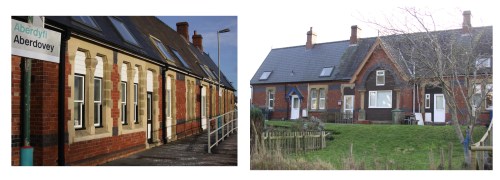
Aberdovey (Aberdyfi) Station was built in a location that was at that time just outside the main village.  It was equipped with two platforms flanking the tracks, and a fairly substantial single-storey railway building that survives in good order, but has been converted for residential use.  It is a charming red brick-built building with a slate roof, finished in stone around its doors and windows.  The front of the station has decorative black engineering bricks around the porch’s archway and in a parallel linear arrangement in the walls.  The porch is also equipped with twin stone columns.  Penhelig Station was added in 1933, by which time the railway was operated by the Great Western Railway, which absorbed Cambrian Railways in 1922, and was equipped with a single platform and an attractive little wooden shelter that remains today.

The railway clearly improved the economic stability of Aberdovey in some ways, but it also had negative impacts.  In its favour, it made it much easier for the evolving tourist industry to develop.  Efficiencies in cargo handling improved, and international trade continued to be important.  Cargoes that were not time sensitive still travelled by local ships, because their freight rates were so much lower, meaning that slate continued to travel by sea.  However, it a number of shipbuilding yards had to be destroyed for the railway to be completed, and over the two decades after the railway arrived the shipbuilding industry went into permanent decline, aggravated by the Great Depression in Britain between 1873 and 1896).  The last locally built ship was launched in 1880.  Derwenlas, which was an important inland port and shipbuilding centre, was cut off from the river by the railway embankment, almost completely closing it down.  Although transhipping to seagoing vessels still took place at Aberdovey for international trade, ships were no longer needed for national transportation.  It was was much more efficient to carry goods and livestock by train than by boat, so the previously coastal trade faded fast. The promised Irish ferry port never arrived, and as the railways expanded and improved, minor ports lost out to big ports with better facilities and connections.

A Cambrian Railway steam engine shunting down at the modernized wharf in 1887. Source: Hugh M. Lewis. Pages of Time.

In spite of the Great Depression, the wharf and jetty were given a major overhaul in the early 1880s, and were provided with a tiny branch track that led into the wharf area and out on to the jetty.  The new wharf and jetty were built on land acquired by Cambrian Railways for the purpose, opening in 1882.  Two large buildings were used for the storage of cargo and building materials, the jetty was around 370ft long and allowed ships to be loaded and unloaded at both high and low tides and animal pens were erected on the foreshore to hold livestock that was offloaded from ships. Railway tracks linked the jetty and wharf to the railway so that the transhipping process was far more fluid than it ever had been before.  Exports included slate from local quarries.  Imports included limestone, coal and cattle from South Wales, potatoes and cattle from Ireland, grain from the Mediterranean, timber from Newfoundland, and phosphates and nitrates from South America.  This will be covered in detail on a future post.
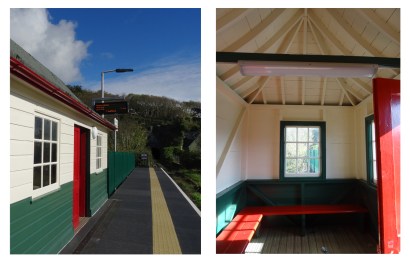
Penhelig Halt as it is today

Both Penhelig and Aberdovey stations remain open today.  Penhelig Station retains its 19th Century wooden shelter in an excellent state of repair, but no other station buildings. The platform is reached by a fairly long flight of steps.  Aberdovey Station is at ground level, retaining the original single-storey long brick structure on the one remaining platform.  It has been converted into three cottages, with the rear facing on to the platform and the front now overlooking the football pitch and adjacent to the golf cub.  The short branch to the harbour that was added in the 1880s was later built over.  Neither of the stations is staffed.  Tickets are purchased on the train itself and there is an electronic display containing information about the next trains due to arrive.  Because the platform is very low, built before platform heights were standardized, in 2009 a raised section made from reinforced glass-reinforced polymer was added.  This type of solution is called a Harrington Hump after the first station to have one installed, and Aberdovey was only the third UK station to receive one, after a period of consultation with local residents.  It was funded by the Welsh Government.  The BBC website says that instead of the usual £250,000 to raise the level of a platform the Harrington Hump costs a mere £70,000.  In 2014 part of the embankment was washed away, with the Daily Post reporting that the track was left hanging in the air.  A photo gallery on the site shows repairs being carried out.

Penhelig Lodge is to the left and below the level of the railway track and the tunnel in about 1865.  The photograph also shows the newly built Penhelig Terrace, which is end-on in this photograph. Source: Source: Hugh M. Lewis. Pages of Time.

The following video was shot in the 1920s and shows a steam train on the Aberdovey section of track:

Main sources:
The main source for information about the railway and its relationship to Aberdovey is Lewis Lloyd’s excellent A Real Little Seaport.  The Port of Aberdyfi and its People 1565-1920. Volume 1, which makes extensive use of local newspaper reports and contemporary records.  For anyone interested in learning more, there is much more information about the disputes, issues and accidents concerning the railway in his section “The Advent of the Coastal Railway” in chapter 7.  Hugh M. Lewis also has some information in his book  Aberdyfi – Portrait of a Village and other invaluable Hugh M. Lewis publications provide super photographic records.  For more general background information two well-researched Wikipedia pages were useful sources: Aberystwith and West Coast Railway and Cambrian Railways.

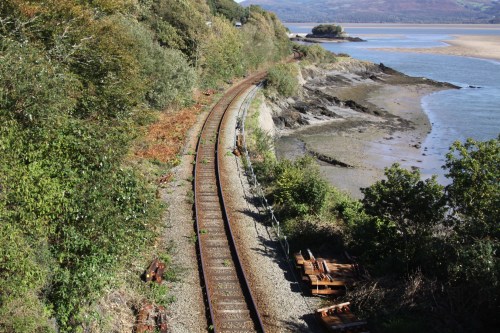
Railway track as it leaves Aberdovey for Machynlleth


Gales and bleak skies yesterday, sunshine today, a mad but wonderful contrast

Yesterday morning my first job was to go and retrieve the blue bins that had cascaded down the hill when their trolley fell over during the night.  I was awake much of the night listening to it.  Today was an amazing contrast.  Things started off a little grey, with sunshine filtering through the clouds, but by the afternoon the sun dominated, and although there were still clouds, they were an attractive gradient from pure white to dark purple and charcoal, the perfect foil for the brilliant cerulean blue.  I had only walked down to go to the Post Office, but somehow found myself cutting through the dunes and striding along the incoming tide on the beach. So happy.

A walk down the Dyfi estuary on a beautiful January day

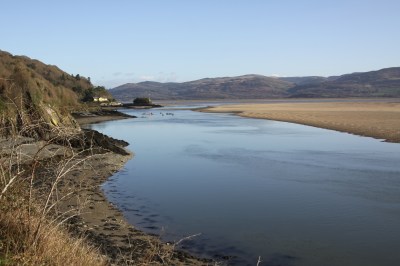
Thursday last week was a beautiful day, all sunshine and blue skies.  A treat.  About as different from today’s gales as possible!  I went down into Aberdovey to take photos of the interior of St Peter’s Church, because I am working on a new post about the church.  Someone told me that it was open every day, but perhaps that was just in the summer, because it was firmly closed.  I took some photographs in the churchyard instead, and then decided to take advantage of the sun and headed down the estuary.  It was an hour past low tide and the sea was coming in, but not fast enough to cover up the sand flats before I had enjoyed seeing them.  At some points in this video there’s some very wobbly footage, but it was such a beautiful day that even with some slightly dodgy camcorder work it seemed a shame not to share it!

The Wesleyan Methodist chapel in Chapel Square, Aberdovey (built 1829, rebuilt 1868)

Wesleyan Chapel

The Wesleyan Chapel, or Capel Bethel, is located in Chapel Square, which was then called Copperhill Square.  It was only a few doors away from the Calvinist Methodist Chapel or Tabernacle that had opened the year before (described on a previous post).  Wesleyan preachers arrived in Aberdovey in November 1804, fourteen years after the Calvinist Methodists first arrived, to hold an open-air meeting in the square, a common device used by early preachers to convey their message and acquire followers.  They were sufficiently successful for a small Wesleyan movement to become established in the village, a real achievement as Calvinistic Methodism had spread much more rapidly throughout Wales.

John Wesley (left), Charles Whitefield (top) and Charles Wesley. Source: Welsh Religious Buildings Trust

I have described the origins of the Wesleyan Methodists on an earlier post about Aberdovey’s first Calvinistic Methodist chapel, and if you read that post you may want to scroll down to the next paragraph as I am repeating some of it here.  Methodism, or Wesleyan Methodism  began at Oxford University, where Charles Wesley (1707-88) and George Whitefield (1714-1770) formed a group to discuss religious ideas and methods, particularly the power of evangelism.  It was joined by Charles’s brother John Wesley (1703-91) and became known as the Holy Group, and later, based on the importance of procedures and methods in their approach, Methodists.  The three went to America in 1735 to  become missionaries, but George Whitefield returned a year later to focus on doing religious work in England, preaching extensively in indoors and out, making himself very unpopular with the established church.

Wesleyan Methodist Chapel in the Nineteenth Century. Source: Photograph in the Literary Institute

John Wesley returned three years after his departure to bring his ideas into the Church of England in an attempt at Anglican reform.  Like Whitefield, he found himself unpopular with the Church of England authorities and was not permitted to preach in Anglican churches, so began preaching out of doors, and began to travel extensively to spread his message and organize those who followed him.  Wesley and Whitefield parted ways in 1741 over Whitefield’s  belief in Calvinist predestination, foreshadowing the later split between the Wesleyan Methodists and the Welsh Calvinistic Methodists.   The key difference was that John Wesley retained the Arminian (as opposed to the Calvinistic) belief that salvation is available to all.  In Wesleyan Methodism, the living of a good, altruistic, and selfless lives and absolute belief in and dedication to God is not a means of winning salvation but is actually a product of salvation.  Salvation is therefore by God’s grace alone, rather than something that can be achieved by human endeavour.  This is one of the core differences between Methodism and the Church of England.  The personal experience of God, and of revelation were also key to his beliefs.  He had, himself, underwent a conversion experience in 1738, when he felt his “heart strangely warmed.”  He also believed in the importance of Scripture, a strong emphasis on the delivering of God’s message far and wide, the pre-eminence of high moral standards, and the need to raise awareness of the dangers of alcohol and gambling.  Wesley organized groups of lay preachers in a “connexion” across Britain, whose members helped to spread the Methodist message, and from 1744 annual conferences of lay preachers helped to formalize their activities.   It was only after John Wesley’s death in 1791 that Methodism withdrew from the Church of England and became a movement in its own right.

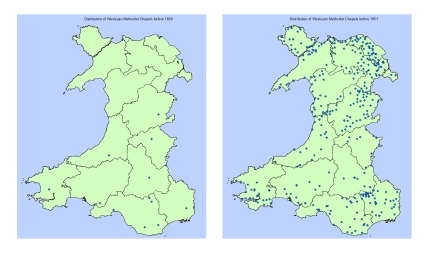
Wesleyan Methodist Welsh Distribution Map, on the left pre-1800 and on the right pre-1851,showing how much they progressed in just 50 years. Source: Welsh Religious Buildings Trust

The Wesleyans made slow progress in Wales during the 18th Century, where Welsh Calvinist Methodists had a foothold.  In spite of 35 visits into Wales, John Wesley was unable to make much of an impact, partly because he and most of his followers spoke no Welsh and Wesleyan Methodism was slow to recruit Welsh speakers.  By the end of the 18th Century they only had  around 600 followers in Wales, none of whom were in Meirionnydd.  In 1800 the British Wesleyan Conference decided to send Welsh-speaking preachers into Wales, resulting in a notable upturn of Welsh-speaking converts, and wherever English Wesleyans settled in the wake of the Industrial Revolution, wherever quarries and mines were to be found, congregations rose.  In the 1851 religious census there were 499 places of worship in Wales and congregations numbering 53,730 individuals.

6 and 7 Copperhill Street

The Wesleyans had no dedicated premises when they first arrived in Aberdovey and gathered at houses in the village, first at numbers 6 and 7 Copper Hill street (formerly called Dan y Graig) opposite today’s Wesleyan chapel, and then a few years later they moved to a house named Tan y Castell (“Below the Castle”) in Prospect Place.  Their final meeting house before the chapel was built was Cegin Arthur (“Arthur’s Inn”), the front room of which served as a drinking establishment and was on the site later replaced by Xanthus House, the building immediately to the left/west of the big 1864 Calvinist Tabernacle on Sea View Terrace.  Hugh M. Lewis describes the disadvantages of this venue:  “This was a most inconvenient and embarrassing for the worshippers, who had to pass through the front room  on their way to the kitchen at the rear of the house.”  In 1828 they rented a piece of land from the Athelstan Maurice Corbet of Ynysymaengwyn Estate on New Street at the top of Chapel Square (then called Copperhill Square) and built their first chapel, the Bethel, in 1829.  The Bethel was located at the top of the upward sloping New Street and now dominated the square, rising above the level local buildings, including the Calvinist Methodist chapel, and was visible from most higher parts of Aberdovey, as shown in the 19th Century/early 20th Century photograph at the end of the post.

Addoldy y Wesleyaid (Wesleyan sanctuary), 1829, 1868

The Bethel, unlike the Congregational Chapel on Glandyfi Terrace or the English Presbyterian chapel on Sea View Terrace, is instantly recognizable as a 19th Century chapel, with the gabled façade, stuccoed features, lancet windows with plain glass and a plaque stating BETHEL ADDOLDY Y WESLEYAID (“Bethel, Wesleayan Place of Worship”) and the two dates of its construction and rebuild, 1829 and 1868.  It is an imposing building, set slightly above the square, in a commanding position.  The Wesleyans rented a piece of land in Chapel Square (at that time Copper Hill Square) in 1828 from Mr Athelstan Corbet of Ynysymaengwyn (the big land-holding estate based just outside Tywyn), and their first chapel was built in 1829, with a congregation of around 30.  It was extended to twice its original size in 1841 to accommodate a growing congregation of around 60 worshippers.   The expanding population again led to the chapel being over-crowded and it was rebuilt in 1868, “a mixed sub-Classical and simple Gothic style of the gable-entry type”  (Coflein website), to accommodate 300 worshippers, at a cost of £704.00, the equivalent to 102 horses/150 cows or, in today’s money, £61,427.73 (National Archives Currency Converter).  An inscription facing the pulpit used to read “COFIWCH-Y-MORWYR” which translates as “remember the seamen,” a reminder to the minister that a large number of families in Aberdovey were attached to the sea in some capacity and should be referred to in the sermon.  Renovations and improvements in 1924 included the installation of a pipe organ, and in 1926 a huge vestry was added on the site of an old bakehouse.

The interior of the chapel is absolutely splendid.  Today entry is via the large 1926 vestry, which is laid out with rows of comfortable chairs facing a podium, and this is used today for many of the chapel’s meetings.  It is a very warm and inviting space.  The 19th Century chapel, reached via a side door, is beautiful.  There are no monuments on the wall, nothing to distract from the structure of the chapel.  Straight wooden pews are organized in three rows facing the pulpit, divided by two aisles.  The pulpit area is an imposing structure with a small stage behind it.   At the front of the pulpit is a large, curved pew, which is very fine indeed, and this was retained for visiting dignitaries.  Flanking this across the aisles are two sets of boxed pews that face across the chapel.  It is a magnificent space, given a lot of light from the tall lancet windows, and the lack of any form of decoration, embellishment or other distraction gives a very real sense that this is about the message from the pulpit, the relationship between the congregation and the preacher.  I was completely taken with it.
Wesleyan Methodist Chapel Interior

The chapel is still very active today, with weekly meetings, weddings and funerals all held on the premises.  There is a Facebook page with details, in both English and Welsh, of services and other activities, which may be in Welsh, English or both.  For security reasons, the chapel is not open outside these times.  I visited by appointment, with my sincere thanks to Ceri Jones for making the arrangements and, together with Gerald Grudgings, for guiding me around the building.  I have been invited to a service to see what the chapel is like when it is doing what it was designed for, and very much look forward to attending.

The Wesleyan Methodist chapel’s Facebook page

Main sources:
Wesleyan Methodism is usefully described on the Welsh Religious Buildings website, the BBC Religion web pages and the Oxford Concise Dictionary of the Christian Church.  Hugh M. Lewis, local resident and collector of Aberdovey information and images, is an invaluable source of information about the pre-chapel history of the Wesleyan Methodists in his book Aberdyfi, Portrait of a Village.  Lewis Lloyd’s A Real Little Seaport was also useful, and Hugh M. Lewis’s Aberdyfi, Pages of Time added some additional information.  My sincere thanks to Ceri Jones and Gerald Grudgings for providing me with many more details about the chapel.