Category Archives: Nature

Videos: A round-up of some of the garden birds this week

Taking videos of birds has been an eye-opener.  They never stop.   There are all sorts of performances that surround eating, all of which look terribly energy consuming for such small creatures, which seems rather to defeat the object.  Some of it has to be concerned with keeping a look-out, but some of the moving around is difficult to explain.  The great tit video isn’t the best, but it’s the first time I’ve seen one this year, so is included for the sake of completeness.  The blue tit is a new and welcome addition.  They are all endlessly super to watch, and shocking time-wasters.

Lovely to see the robin enjoying himself in the bath on a regular basis, now that I have cleaned it and keep it stocked up with fresh water:

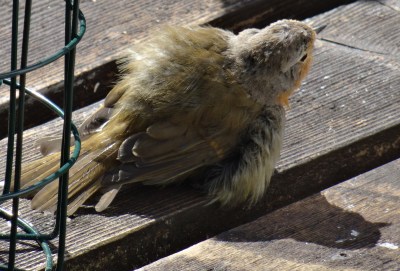
This morning he ruffled out all his feathers after a good old splash and sat in the sun, looking hopelessly untidy and somewhat squashed.


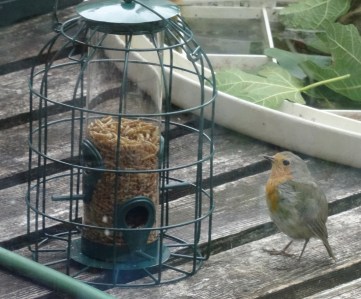
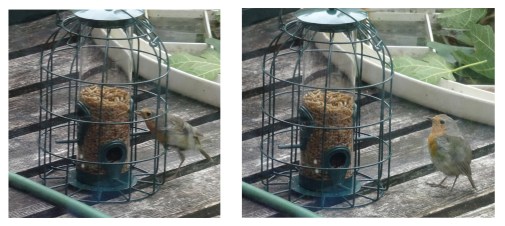
The female house sparrow has been working around the aggression of the robin, and has found plenty of opportunity to eat at the feeder, moving around between courses, and at one stage flying up and around the feeder:

The great tit was here only briefly, but was engaging whilst he was here.

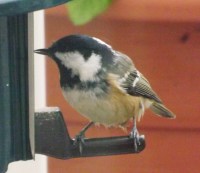
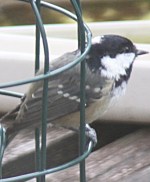
I moved the big bird feeder with the anti-crow device onto the cherry tree, where it has been a hit.  Coal tits are the messiest feeders, with much of it going on to the ground, but I am spared having to wonder what to do about it by a pair of doves, which are picking up all the dropped seeds.  A newcomer this morning was a blue tit, a very welcome addition.  A blue tit taking the business of eating seed very seriously. There was a lot of beak work with whatever it was holding in its feet.


Video: Coal tit at the hanging bird feeder

Absolutely fascinating to watch the coal tit processing seed at the bird feeder, chucking things everywhere!  I thought at first that it was a great tit, but the little black flick of colour from the crown, the lack of a stripe on the chest and a slender beak are key differentiators from the great tit, as is the smaller size.  Although there have been some impressive aerobatics over the last few days there was none of that today – the focus was all on the seeds. I know when they are around because of the high-pitched “peep” that they utter whenever they are in the vicinity.

According to one of my books, the Reader’s Digest Field Guide to Birds, in old Icelandic the word tittr meant a small bird or anything small, and tit is a corrupted survivor of that word.


Video: The robin in my garden

This is my first attempt to use one of my cameras to shoot a video of anything in motion, and it’s all very amateurish.  The camera is a little Fuji, not designed for anything very ambitious, but it hasn’t done a bad job.  Apologies for the wobble and the clunky zooming in!  I want to do some videos in and around Aberdovey, so I am practising on the bird life in my garden.  The robin visits every day, and gives me endless pleasure whilst he eats at my bird feeder. As with many small birds at this time of year, his plumage has been a disgrace for several weeks (for reasons explained in an earlier post), but it is slowly beginning to sort itself out.  Two house sparrows and two coal tits have also become regular visitors, one presumably juvenile sparrow with a permanently bad feather day, but it’s the robin that has made the bird feeder a second home.  Robins are highly territorial and usually see off other birds.  This one was willing to share the bird feeder with a couple of sparrows for a few days, but things have become rather more tense in the last few days and there have been a couple of scuffles.  The sparrows are not deterred, but they keep a wary eye on the robin.

Apparently the male sings throughout the winter, except during the current moulting time.  I’ll have to wait and see whether mine eventually bursts into song.  I learned today that the robin became Britain’s National Bird in 1960.

Just click the arrow to  play.  The noise in the background is my printer.

Multi-species harmony at my Aberdovey bird feeder

My bird feeder is visited daily by two sparrows and a robin.  Today they were joined by a great tit, a beautiful, gymnastic little thing that moves like lightening and performs wonderful acrobatics. It barely settles for long enough to grab a beak full of seed and take off, but hopefully it will become a return visitor.  It’s a little too close to the house (and the floor) for a tit, but all my tree-based feeders are targeted by crows so at the moment it’s this or nothing.

So far, there is no conflict between my visitors and everything is in harmony.  Endlessly distracting, and they are a shocking time-waster!


The Dyfi Osprey Project 2018

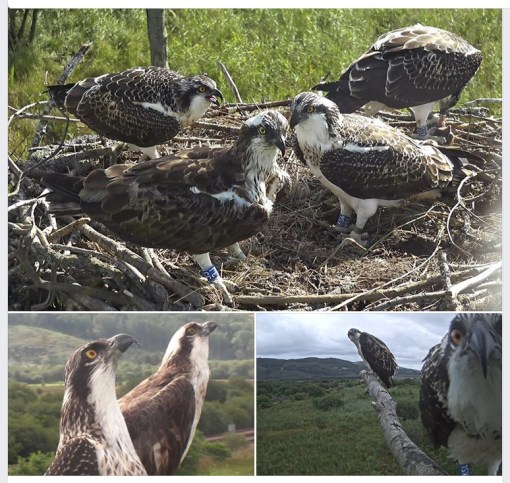
Searching for something else entirely I stumbled across the Dyfi Osprey Project’s Facebook page at https://www.facebook.com/dyfiospreyproject.  What an amazing find!  In the last few weeks there have been some glorious videos posted of a nest of ospreys, charting their progress.  The photographs below are just a tiny sample, but if you are on Facebook do take a look at the page so that you can see the videos.

The main website is also excellent, at http://www.dyfiospreyproject.com, which gives full details about the scope of the project and its aims. The Project is run by Montgomeryshire Wildlife Trust at their Cors Dyfi Reserve near Machynlleth.  The website says that a century ago ospreys in the UK were hunted to extinction. “Forty years later they began to make a come back and since then we have learnt a lot more about them by studying rather than shooting them. The more we learn about this amazing species the more tools we have in the tool box to help them recover from world wide declines.”  The website is all about how the Project is helping to achieve this, and the Facbook page tracks the life of one osprey family.  Really terrific.

Enjoy!

These superb photographs are from the Dyfi Osprey Project’s Facebook page at https://www.facebook.com/dyfiospreyproject.

Explaining the absence of birdlife in my garden

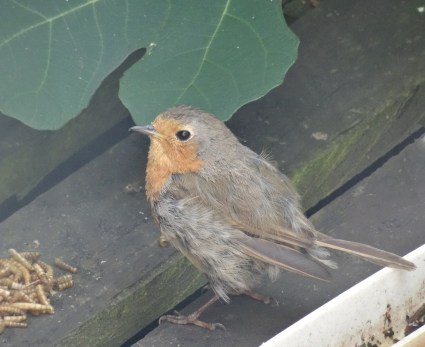
The robin that visits daily, with his plumage in transition.

It was lovely to see the frog the other day, but I have been so disappointed that there were no birds.  Seagulls and crows are around, although not in huge numbers, but there are no small brown jobs.  There were plenty only a month or so ago, including a robin who wouldn’t stay out of the house.  I thought when I raked up the garden cut grass and leaves that that would bring out robins and blackbirds, but not one appeared.  The bird feeder is completely neglected.  I tried putting seed down to lure them in, but nothing appeared.  The BBC provided the answers with a fascinating little article on the Springwatch section of the BBC website.  This informs the reader that birds do vanish at this time of year for a number of reasons, and that they will be back soon:

  • Parents are no longer feeding chicks, and chicks have left for new territories
  • Plenty of fresh berries are available in hedges and fields
  • Moulting takes place at this time of year and the replacement plumage is a huge drain on a bird’s energy, causing them to remain fairly sedentary under safe cover (the moult is visible in my photo of the robin, above)
  • With the need to attract a mate at an end for the summer, male birds no longer need to be visible or to sing their heads off to draw attention to themselves

In spite of that, I have managed to lure a robin onto the decking.  He’s shy, and as I only put down food when I can watch it due to the crows swooping in and consuming whatever they can, it has taken him a while to become confident that I am not going to engage in any swooping of my own.  At first when I appeared with the food he would fly away, but now he simply backs off a little and waits.  He keeps a wary eye on me but he is less nervous every day.  It feels like an achievement, although I am not quite sure why.  A small sparrow has also discovered the feeder, and there is currently a truce in progress but it looks like a somewhat fragile contract.


A squirrel visitor – and a short history of the grey squirrel in Britain

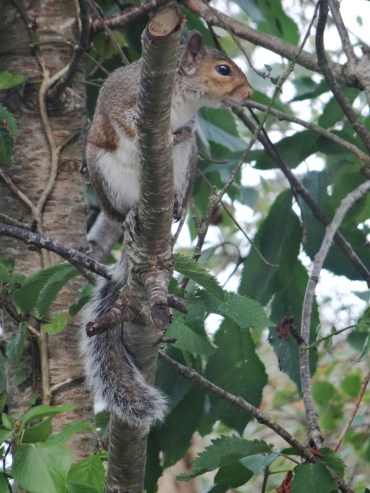
I had a visitor today, trying to find a way into my squirrel-proof bird feeder.  A friend of mine refers to squirrels as rats with tails, but they have supporters because of their endearing features, the bushy tail and their gymnastic abilities. They are often audacious, quite tame and can be very entertaining to watch.  Their detractors consider them to be vermin, with good reason. They steal bird eggs and eat baby birds, dig up and eat spring and summer bulbs and new shoots, and they chew through tree bark, leaving the tree vulnerable to disease. They also carry squirrelpox (to which they are themselves immune, but to which red squirrels are vulnerable), and they replaced the far less destructive red squirrel, which is now confined to more marginal areas.

The American grey squirrel was brought to England deliberately in 1876 by a Cheshire landowner. It was hunted and eaten in the U.S. and was probably introduced into England for that purpose (they are still eaten in the US). There were so many in Woburn Abbey’s grounds that between 1905 and 1907 they were released into Regent’s Park, from where they spread to London’s green areas. Their apparent impact on the red squirrel and the damage to trees, bulbs and new shoots was very unwelcome and between 1917 and 1937 four thousand grey squirrels were shot in Kew Gardens alone. By the 1930s it was already considered to be a pest and had spread over a big distance. Between 1945 and 1955 a reward of a shilling a tail was paid in some rural areas and squirrel shooting clubs began to grow in number.
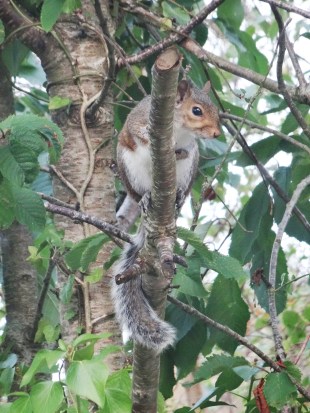
By the 1940s the grey squirrel had completely replaced the red in most areas. The Guardian quotes a 1995 report which says that red squirrel populations in the UK (1995) revealed that there were 161,000 in the UK, with 121,000 in Scotland; 30,000 in England and 10,000 in Wales. Things have changed since then, the grey squirrel is more efficient on British soil, better at finding food supplies and carries a deadly disease (called squirrelpox virus) that it is immune to, but kills red squirrels. It is estimated that grey squirrels outnumber reds by more than 60 to one in England. But there are still red squirrel strongholds on islands (Isle of Wight, Brownsea in Poole Harbour, Anglesey) and in the north of England and Scotland.  Although there are a number of well-aired urban myths on how this replacement took place (which typically takes between 15 and 20 years), academic research projects have actually failed to identify the process by which the red squirrel is ousted in favour of the grey. There is one theory that they abandoned the struggle mainly because the areas in which grey squirrels survive is not their favoured habitat anyway. Whilst grey squirrels prefer deciduous parkland, the red squirrels are far better adapted to coniferous woodland. It is thought that the above-mentioned virus may have contributed significantly the demise of the red squirrel. It could be that it was it was not one circumstance but a number of different ones that saw the retreat of the red squirrel and the diminishment of their numbers in favour of the American interloper.

The Forestry Commission have advice on how to control grey squirrel damage to woodland on their website (in PDF format).

If you want to know more about the red squirrels then the Friends of the Anglesey Red Squirrels website is a good place to start.

Finally, there are grey squirrel support sites too, including squirrels.info.

Dance of the Red Admirals on a beautiful sunny day

Today was the calm after last night’s storm.  The estuary was like a mirror.  I have never seen it so still.  I was sitting outside with a book (The Box by Marc Levinson – a brilliant read), with the robin throwing mealworms and seed around in a reckless manner a few feet away from me, when a red admiral butterfly, its markings quite simply unmistakeable, settled on the balustrade and returned time and time again for the next hour, basking in the sun and warming through.  Every time I moved it took off, so the photograph was not the best I’ve ever done.  Eventually it took off to engage in a spectacularly intricate aerobatic dance with another Red Admiral.  Truly lovely.

Red Admirals appear twice a year – once between May and October and then again between March and April after hibernation.  They lay their eggs on nettles, and even though many are born locally others are, quite remarkably, immigrants from Europe.  The dance that I was watching is a mating ritual, a dynamic, kinetic language of colour, shape and pheromones.

The calm after the storm. Fluffy white clouds remain overhead, lovely against the blue sky, and the water is a shining mirror of light.


A tiny translucent green spider

Most of my books are in storage, including everything I have on insects and arachnids, so I wasn’t able to look up this tiny little chap that visited my garden today.  It landed on the handle of my chimenea, which was fortunately not lit at the time.  He/she was beautiful but even though I’m not scared of spiders, I wasn’t getting too close.  Even though it can’t have been much more than a centimetre or two long, it had attitude!  I don’t have a macro lens, and this was taken with a 28-300mm that happened to be on the camera, so the photo is a bit smudged.  Looking at the “Guide to Garden Spiders” (Field Studies Council) I think that it is almost certainly a comb-footed spider (Paidiscura pallens).

A frog beneath my bay tree

The frog under my bay tree.

Not much sun today but warm and dry.  Got quite a bit done.  The former gardener’s last strimming of the grass resulted in a hayfield and I could bear it no longer so found a fan-rake in the garage and raked it and all the fallen leaves into piles ready for placing in my garden bin.  Looks SO much better.  I disturbed a frog under the giant bay tree.  I couldn’t believe it at first, because what on earth would a frog be doing living half way up a steep hill?  Not a natural place for the accumulation of a water source.  I stopped raking near him/her because it was clearly causing anxiety, and instead whipped out my pocket camera and took a photo.   A pretty little thing and I do hope that it finds its way to a water source eventually.  As I saw a dragonfly later in the day, I assume that someone around here must have a large garden pond.