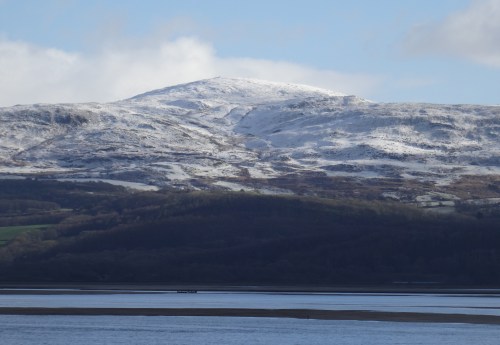
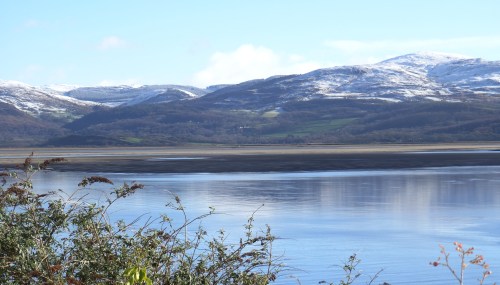
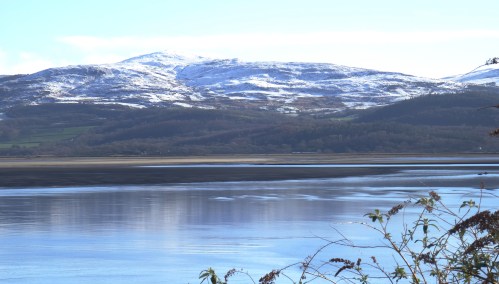
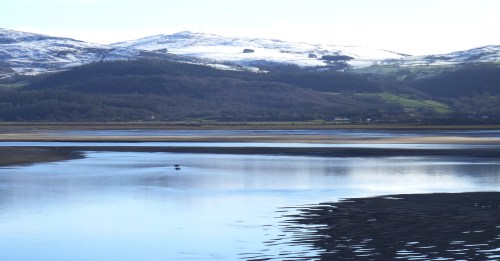
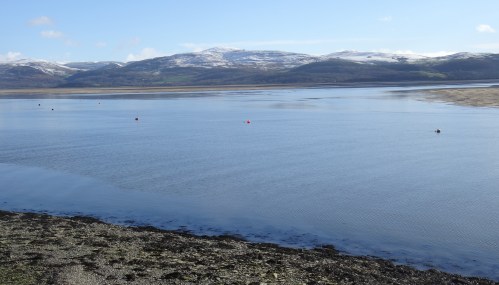
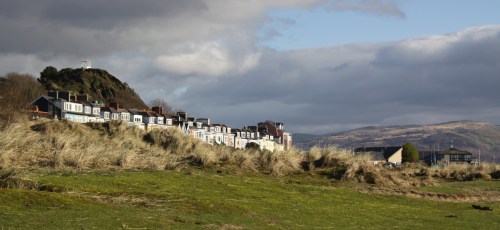
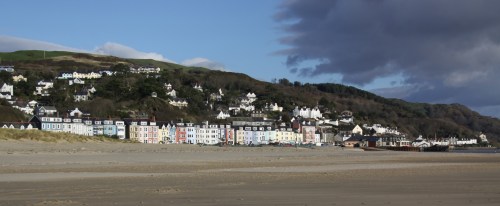
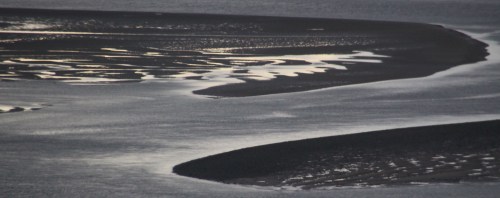
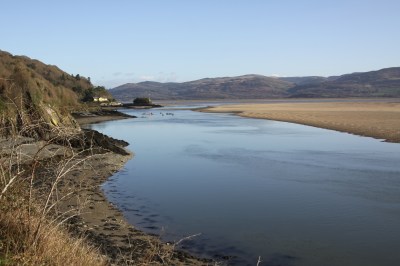
Snapshots today, walking down Balkan Hill for some odds and ends in the village. Not very sharp, because I was using the tiny camera I keep in my handbag. I didn’t dare take my good kit because I knew if I had it with me I’d end up walking along the beach for a couple of hours, and I didn’t have time today! The very short video at the end is just the view over the estuary and Cardigan Bay beyond from my window as the sun went down, with pink smoke! The days are getting noticeably a little longer, although it seems like a very long haul to get from the shortest day on 21st December to the end of March.
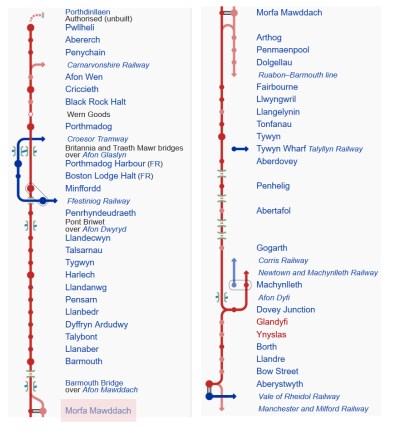
Welsh Coast Line. Source: Wikipedia, where you can see it as a single image, without rather than being split into two, as it is here.
Today the Cambrian Line runs from Shrewsbury (Shropshire) to Pwlleli (Gwynedd) with a branch just after Dovey Junction to Aberystwyth. The section from Dovey Junction (to the southwest of Derwenlas) to Pwlleli in the north is known as the Cambrian Coast Line. There are two stops in Aberdovey, one at Penhelig and the other at the far side of the village, behind the bowling club. The arrival of the railway in the 1860s had a significant impact on Aberdovey, altering the economy and physically reshaping parts of the town. The excellent legend to the left shows the final form of the railway line, complete with information about which stations remain in use. I have split it into two to fit on the page, and Morfa Mawddach appears twice as a result.
The Aberystwith and West Coast Railway was authorised by a Private Act of Parliament on 22nd July 1861. The spelling of Aberystwyth as Aberystwith was the name in which the company was registered. To put this date into perspective, by the 1860s Aberdovey had a very successful shipbuilding industry, it was an important port for the transhipping of slate exports and was important for the import of grain and other goods. Copper mines had been established in the hills around the village and a growing tourist industry based on the beach was flourishing even without a railway. There were two Nonconformist chapels dating from the late 1820s and St Peter’s Church had been established for nearly two decades.
The railway routed around the back of the village, rather than along the seafront as originally planned. Source: Hugh M. Lewis. Aberdyfi, A Glimpse of the Past.
The railway was intended to link north and mid Wales, to improve efficiencies in the export of local slate and to enable Aberdovey and Aberystwyth to serves as Irish ferry termini, linking Ireland with the Midlands. These were boom years for Aberdovey, and it must have seemed like more in the way of progress. Local people were not, however, blinded by the coming of the railway and significant disputes between Aberdovey residents, the owners of the land (the Ynynsymaengwyn Estate in Tywyn) and the representatives of the railway company over exactly where the railway should run and how the harbour would be developed. The original plan was to send the line along the sea front but extensive disputes with Aberdovey business leaders and villagers, who were concerned about the impacts on shipping, ship building and tourism, lead to it being routed around the back of the village, an expensive compromise that required tunnelling through rock. The dispute is described in Lewis Lloyd’s account on the subject in A Real Little Seaport. The need for the tunnels meant that the railway’s contractor Thomas Savin’s estimate for the cost of the railway was unrealistically low, and this contributed to his personal bankruptcy in 1866.
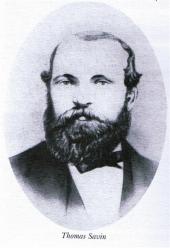
Thomas Savin (1826-1889) was a well known railway engineer, who built several railways in Wales. Although the contractors for the new railway are listed as Thomas and John Savin, Thomas was clearly the driving force. He had multiple business interests and often invested in his railway projects, meaning that he was far from impartial when local interests impacted business decisions, as happened in Aberdovey when villagers contested his plans to run the railway along the sea front and develop the harbour in ways that would have been harmful to local shipping and tourism interests. Savin represented the railway company in most of his dealings with the villagers. A lot more about Savin can be found on a page dedicated to him on the Llanymynech Community Project website.
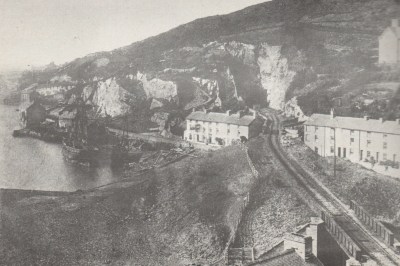
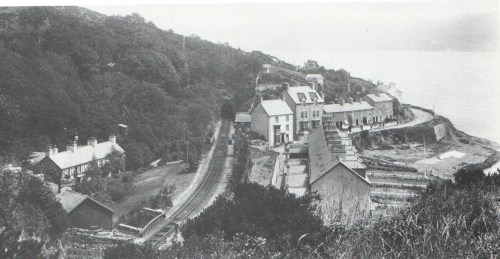
Penhelig shortly after the railway was laid, and before Penhelig Terrace was built, showing the railway tunnel and the shipyard just in front of the Penhelig Arms. Source: Hugh M. Lewis. Aberdyfi, A Glimpse of the Past.
Savin had originally intended to build a bridge across the Dyfi to connect Aberdovey and Ynyslas by rail, and this remained the plan for some time, but due to the local geomorphology, civil engineers decided that the bridge could not be built and an additional 12 miles of rail had to be laid to go around the estuary, crossing the river just north of Gogarth instead. This meant that until the new stretch was built, southbound passengers had to cross the river by ferry between Aberdovey and Ynyslas, where a line had been built. All the necessary materials for construction of the railway were carried into Aberdovey by ship, except for the locomotive and carriages that were carried from Ynyslas over the river Dyfi to Aberdovey. Aberdovey served as the depot for most of the equipment and materials, including plant, sleepers and rails. The construction work on the Aberystwith and West Coast Railway began at Aberdovey in April 1862, and was built in a number of stages,as follows:
By early September 1862 the line reached the river Dysynni and the first locomotive with 10 carriages was launched in South Merioneth and undertook the short trip from Aberdovey, stopping to pick up more passengers, to the river Dysynni and back again, carrying dignitaries and holiday makers. In the evening a firework display celebrated the achievement.
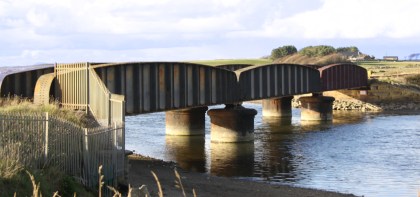
In 1863 a track was laid down between Aberdovey and Llywyngwril to the north along the Welsh coast, including the three-span steel plate girder bridge over the Rivery Dysynni. This section of the line connected with the narrow gauge TalyLlyn slate quarry railway at Tywyn. Before the railway, slates were offloaded from the TalyLlyn single gauge railway, loaded on to the new line and taken to Aberdovey for loading on to ships.
Before the section of line was built around the estuary, the s.s. Elizabeth was purchased to carry railway passengers across the river at Aberdovey to Ynyslas. The Elizabeth was a 30 horse-power Blackwall paddle steamer that was rigged for sail. She arrived in October 1863, and was captained by a Machynlleth resident Captain Edward Bell who was succeeded by his younger brother Captain John Bell. But she was not a success. At c.125ft long she was too long, and small boats had to be used to supplement the ferry service. The Elizabeth was owned by Thomas Savin, who sold it in 1869 to an agent in Londonderry.
The section of railway between Machynlleth and Aberystwyth was completed by July 1864.
The stretch from Aberdovey to Pwllheli was completed in August 1867, the delay caused by the building of the viaduct across the estuary at Barmouth. The line was originally intended to go along the Lleyn Peninsula to Porthdinllaen, but this plan was abandoned and the terminus was established at Pwllheli. This section of the line linked at Afonwen Junction to the Caernarfonshire Line to Caernarfon.
In 1867 the railway was also extended along the north bank of the river to Machynlleth. The line split at Dovey Junction with two branches, one going to Machynlleth and one going to Aberystwyth.
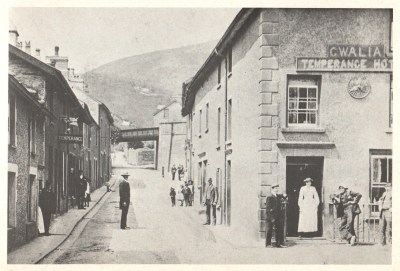
Photograph of the Temperance Hotel in Chapel Square, showing the bridge over Copper Hill Street in the background in 1867. Source: Hugh M. Lewis. Pages of Time.
As the Newtown and Machynlleth Railway had opened at the beginning of 1863 and absorbed into Cambrian Railways the following year, the two lines were now linked. Newtown was linked to the Oswestry and Newtown Railway (which opened in 1860), which in turn linked at Welshpool to the Shrewsbury and Welshpool Railway (which opened in 1862) and the Shrewsbury and Birmingham Railway (opened in 1847), the Shrewsbury to Hereford line (opened in 1853) and the Newport, Abergavenny and Hereford Railway (also opened in 1853) thereby linking mid and north Wales with the borders, south Wales the Midlands.
In 1866 the line had been integrated with Cambrian Railways under the Cambrian Railways Company, which was created by an Act of Parliament in July 1864 in order to amalgamate a number of companies operating in Wales. The Aberystwith and West Coast Railway was still under construction at the time of the Act, so was not included in the original amalgamation, but was incorporated two years after the first part opened. Cambrian Railways was head-quartered at Oswestry, where there is now a heritage museum celebrating the railway, the Cambrian Railways Museum (which has a website here).
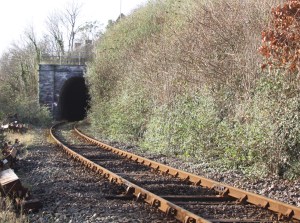
Railway Tunnel on the other side of Penhelig
Heading to Aberdovey from Machynlleth, the line enters Aberdovey from the southeast at Penhelig Halt (added in 1933) where it emerges from a tunnel and is then carried over the road and follows a track through the back of the village before crossing the road again at the far end of Aberdovey, to continue along the coast to Tywyn. The spoil from the tunnelling operation that was required to run the railway at the back of the village was deposited in Penhelig, on land cutting into a former shipbuilding yard, and this was the site of the future Penhelig Terrace, which was built c.1865. Two tunnels were required to carry the railway through the hillside alongside the estuary, and four bridges were erected to carry it over the coast road at Penhelig, under Church Street, behind St Peter’s Church, over Copper Hill Street and at the far end of Aberdovey by the modern fire station. As soon as the line between Aberdovey and Machynlleth opened, the Corris and Aberllefenni slate carried on the Corris narrow gauge railway ceased to be loaded onto boats for transhipping onto seagoing vessels at Aberdovey, and was now transported instead by rail into Aberdovey. Much of it the Welsh Coast Railway is raised only a few feet above sea level and it follows the coastline very closely for much of its length, making it one of the most scenic coastal railways in the UK.
The GWR Railway advert for Penhelig Halt. Source: Hugh M. Lewis. Aberdyfi, A Glimpse of the Past.
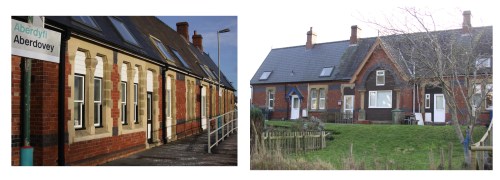
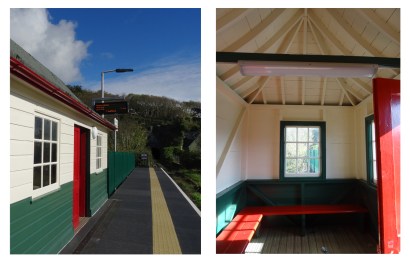
Aberdovey (Aberdyfi) Station was built in a location that was at that time just outside the main village. It was equipped with two platforms flanking the tracks, and a fairly substantial single-storey railway building that survives in good order, but has been converted for residential use. It is a charming red brick-built building with a slate roof, finished in stone around its doors and windows. The front of the station has decorative black engineering bricks around the porch’s archway and in a parallel linear arrangement in the walls. The porch is also equipped with twin stone columns. Penhelig Station was added in 1933, by which time the railway was operated by the Great Western Railway, which absorbed Cambrian Railways in 1922, and was equipped with a single platform and an attractive little wooden shelter that remains today.
The railway clearly improved the economic stability of Aberdovey in some ways, but it also had negative impacts. In its favour, it made it much easier for the evolving tourist industry to develop. Efficiencies in cargo handling improved, and international trade continued to be important. Cargoes that were not time sensitive still travelled by local ships, because their freight rates were so much lower, meaning that slate continued to travel by sea. However, it a number of shipbuilding yards had to be destroyed for the railway to be completed, and over the two decades after the railway arrived the shipbuilding industry went into permanent decline, aggravated by the Great Depression in Britain between 1873 and 1896). The last locally built ship was launched in 1880. Derwenlas, which was an important inland port and shipbuilding centre, was cut off from the river by the railway embankment, almost completely closing it down. Although transhipping to seagoing vessels still took place at Aberdovey for international trade, ships were no longer needed for national transportation. It was was much more efficient to carry goods and livestock by train than by boat, so the previously coastal trade faded fast. The promised Irish ferry port never arrived, and as the railways expanded and improved, minor ports lost out to big ports with better facilities and connections.
A Cambrian Railway steam engine shunting down at the modernized wharf in 1887. Source: Hugh M. Lewis. Pages of Time.
In spite of the Great Depression, the wharf and jetty were given a major overhaul in the early 1880s, and were provided with a tiny branch track that led into the wharf area and out on to the jetty. The new wharf and jetty were built on land acquired by Cambrian Railways for the purpose, opening in 1882. Two large buildings were used for the storage of cargo and building materials, the jetty was around 370ft long and allowed ships to be loaded and unloaded at both high and low tides and animal pens were erected on the foreshore to hold livestock that was offloaded from ships. Railway tracks linked the jetty and wharf to the railway so that the transhipping process was far more fluid than it ever had been before. Exports included slate from local quarries. Imports included limestone, coal and cattle from South Wales, potatoes and cattle from Ireland, grain from the Mediterranean, timber from Newfoundland, and phosphates and nitrates from South America. This will be covered in detail on a future post.
Penhelig Halt as it is today
Both Penhelig and Aberdovey stations remain open today. Penhelig Station retains its 19th Century wooden shelter in an excellent state of repair, but no other station buildings. The platform is reached by a fairly long flight of steps. Aberdovey Station is at ground level, retaining the original single-storey long brick structure on the one remaining platform. It has been converted into three cottages, with the rear facing on to the platform and the front now overlooking the football pitch and adjacent to the golf cub. The short branch to the harbour that was added in the 1880s was later built over. Neither of the stations is staffed. Tickets are purchased on the train itself and there is an electronic display containing information about the next trains due to arrive. Because the platform is very low, built before platform heights were standardized, in 2009 a raised section made from reinforced glass-reinforced polymer was added. This type of solution is called a Harrington Hump after the first station to have one installed, and Aberdovey was only the third UK station to receive one, after a period of consultation with local residents. It was funded by the Welsh Government. The BBC website says that instead of the usual £250,000 to raise the level of a platform the Harrington Hump costs a mere £70,000. In 2014 part of the embankment was washed away, with the Daily Post reporting that the track was left hanging in the air. A photo gallery on the site shows repairs being carried out.
Penhelig Lodge is to the left and below the level of the railway track and the tunnel in about 1865. The photograph also shows the newly built Penhelig Terrace, which is end-on in this photograph. Source: Source: Hugh M. Lewis. Pages of Time.
The following video was shot in the 1920s and shows a steam train on the Aberdovey section of track:
Main sources: The main source for information about the railway and its relationship to Aberdovey is Lewis Lloyd’s excellent A Real Little Seaport. The Port of Aberdyfi and its People 1565-1920. Volume 1, which makes extensive use of local newspaper reports and contemporary records. For anyone interested in learning more, there is much more information about the disputes, issues and accidents concerning the railway in his section “The Advent of the Coastal Railway” in chapter 7. Hugh M. Lewis also has some information in his book Aberdyfi – Portrait of a Village and other invaluable Hugh M. Lewis publications provide super photographic records. For more general background information two well-researched Wikipedia pages were useful sources: Aberystwith and West Coast Railway and Cambrian Railways.
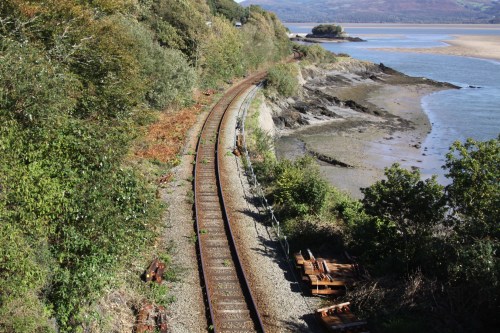
Railway track as it leaves Aberdovey for Machynlleth
Yesterday morning my first job was to go and retrieve the blue bins that had cascaded down the hill when their trolley fell over during the night. I was awake much of the night listening to it. Today was an amazing contrast. Things started off a little grey, with sunshine filtering through the clouds, but by the afternoon the sun dominated, and although there were still clouds, they were an attractive gradient from pure white to dark purple and charcoal, the perfect foil for the brilliant cerulean blue. I had only walked down to go to the Post Office, but somehow found myself cutting through the dunes and striding along the incoming tide on the beach. So happy.
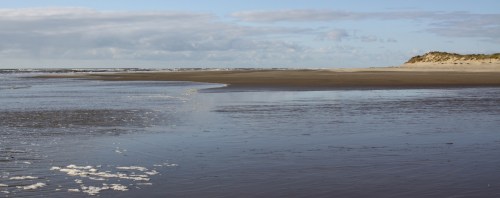
Thursday last week was a beautiful day, all sunshine and blue skies. A treat. About as different from today’s gales as possible! I went down into Aberdovey to take photos of the interior of St Peter’s Church, because I am working on a new post about the church. Someone told me that it was open every day, but perhaps that was just in the summer, because it was firmly closed. I took some photographs in the churchyard instead, and then decided to take advantage of the sun and headed down the estuary. It was an hour past low tide and the sea was coming in, but not fast enough to cover up the sand flats before I had enjoyed seeing them. At some points in this video there’s some very wobbly footage, but it was such a beautiful day that even with some slightly dodgy camcorder work it seemed a shame not to share it!
The Wesleyan Chapel, or Capel Bethel, is located in Chapel Square, which was then called Copperhill Square. It was only a few doors away from the Calvinist Methodist Chapel or Tabernacle that had opened the year before (described on a previous post). Wesleyan preachers arrived in Aberdovey in November 1804, fourteen years after the Calvinist Methodists first arrived, to hold an open-air meeting in the square, a common device used by early preachers to convey their message and acquire followers. They were sufficiently successful for a small Wesleyan movement to become established in the village, a real achievement as Calvinistic Methodism had spread much more rapidly throughout Wales.
I have described the origins of the Wesleyan Methodists on an earlier post about Aberdovey’s first Calvinistic Methodist chapel, and if you read that post you may want to scroll down to the next paragraph as I am repeating some of it here. Methodism, or Wesleyan Methodism began at Oxford University, where Charles Wesley (1707-88) and George Whitefield (1714-1770) formed a group to discuss religious ideas and methods, particularly the power of evangelism. It was joined by Charles’s brother John Wesley (1703-91) and became known as the Holy Group, and later, based on the importance of procedures and methods in their approach, Methodists. The three went to America in 1735 to become missionaries, but George Whitefield returned a year later to focus on doing religious work in England, preaching extensively in indoors and out, making himself very unpopular with the established church.
Wesleyan Methodist Chapel in the Nineteenth Century. Source: Photograph in the Literary Institute
John Wesley returned three years after his departure to bring his ideas into the Church of England in an attempt at Anglican reform. Like Whitefield, he found himself unpopular with the Church of England authorities and was not permitted to preach in Anglican churches, so began preaching out of doors, and began to travel extensively to spread his message and organize those who followed him. Wesley and Whitefield parted ways in 1741 over Whitefield’s belief in Calvinist predestination, foreshadowing the later split between the Wesleyan Methodists and the Welsh Calvinistic Methodists. The key difference was that John Wesley retained the Arminian (as opposed to the Calvinistic) belief that salvation is available to all. In Wesleyan Methodism, the living of a good, altruistic, and selfless lives and absolute belief in and dedication to God is not a means of winning salvation but is actually a product of salvation. Salvation is therefore by God’s grace alone, rather than something that can be achieved by human endeavour. This is one of the core differences between Methodism and the Church of England. The personal experience of God, and of revelation were also key to his beliefs. He had, himself, underwent a conversion experience in 1738, when he felt his “heart strangely warmed.” He also believed in the importance of Scripture, a strong emphasis on the delivering of God’s message far and wide, the pre-eminence of high moral standards, and the need to raise awareness of the dangers of alcohol and gambling. Wesley organized groups of lay preachers in a “connexion” across Britain, whose members helped to spread the Methodist message, and from 1744 annual conferences of lay preachers helped to formalize their activities. It was only after John Wesley’s death in 1791 that Methodism withdrew from the Church of England and became a movement in its own right.
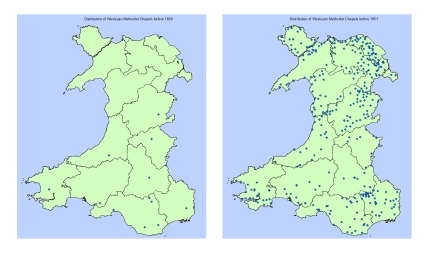
Wesleyan Methodist Welsh Distribution Map, on the left pre-1800 and on the right pre-1851,showing how much they progressed in just 50 years. Source: Welsh Religious Buildings Trust
The Wesleyans made slow progress in Wales during the 18th Century, where Welsh Calvinist Methodists had a foothold. In spite of 35 visits into Wales, John Wesley was unable to make much of an impact, partly because he and most of his followers spoke no Welsh and Wesleyan Methodism was slow to recruit Welsh speakers. By the end of the 18th Century they only had around 600 followers in Wales, none of whom were in Meirionnydd. In 1800 the British Wesleyan Conference decided to send Welsh-speaking preachers into Wales, resulting in a notable upturn of Welsh-speaking converts, and wherever English Wesleyans settled in the wake of the Industrial Revolution, wherever quarries and mines were to be found, congregations rose. In the 1851 religious census there were 499 places of worship in Wales and congregations numbering 53,730 individuals.
6 and 7 Copperhill Street
The Wesleyans had no dedicated premises when they first arrived in Aberdovey and gathered at houses in the village, first at numbers 6 and 7 Copper Hill street (formerly called Dan y Graig) opposite today’s Wesleyan chapel, and then a few years later they moved to a house named Tan y Castell (“Below the Castle”) in Prospect Place. Their final meeting house before the chapel was built was Cegin Arthur (“Arthur’s Inn”), the front room of which served as a drinking establishment and was on the site later replaced by Xanthus House, the building immediately to the left/west of the big 1864 Calvinist Tabernacle on Sea View Terrace. Hugh M. Lewis describes the disadvantages of this venue: “This was a most inconvenient and embarrassing for the worshippers, who had to pass through the front room on their way to the kitchen at the rear of the house.” In 1828 they rented a piece of land from the Athelstan Maurice Corbet of Ynysymaengwyn Estate on New Street at the top of Chapel Square (then called Copperhill Square) and built their first chapel, the Bethel, in 1829. The Bethel was located at the top of the upward sloping New Street and now dominated the square, rising above the level local buildings, including the Calvinist Methodist chapel, and was visible from most higher parts of Aberdovey, as shown in the 19th Century/early 20th Century photograph at the end of the post.
Addoldy y Wesleyaid (Wesleyan sanctuary), 1829, 1868
The Bethel, unlike the Congregational Chapel on Glandyfi Terrace or the English Presbyterian chapel on Sea View Terrace, is instantly recognizable as a 19th Century chapel, with the gabled façade, stuccoed features, lancet windows with plain glass and a plaque stating BETHEL ADDOLDY Y WESLEYAID (“Bethel, Wesleayan Place of Worship”) and the two dates of its construction and rebuild, 1829 and 1868. It is an imposing building, set slightly above the square, in a commanding position. The Wesleyans rented a piece of land in Chapel Square (at that time Copper Hill Square) in 1828 from Mr Athelstan Corbet of Ynysymaengwyn (the big land-holding estate based just outside Tywyn), and their first chapel was built in 1829, with a congregation of around 30. It was extended to twice its original size in 1841 to accommodate a growing congregation of around 60 worshippers. The expanding population again led to the chapel being over-crowded and it was rebuilt in 1868, “a mixed sub-Classical and simple Gothic style of the gable-entry type” (Coflein website), to accommodate 300 worshippers, at a cost of £704.00, the equivalent to 102 horses/150 cows or, in today’s money, £61,427.73 (National Archives Currency Converter). An inscription facing the pulpit used to read “COFIWCH-Y-MORWYR” which translates as “remember the seamen,” a reminder to the minister that a large number of families in Aberdovey were attached to the sea in some capacity and should be referred to in the sermon. Renovations and improvements in 1924 included the installation of a pipe organ, and in 1926 a huge vestry was added on the site of an old bakehouse.
The interior of the chapel is absolutely splendid. Today entry is via the large 1926 vestry, which is laid out with rows of comfortable chairs facing a podium, and this is used today for many of the chapel’s meetings. It is a very warm and inviting space. The 19th Century chapel, reached via a side door, is beautiful. There are no monuments on the wall, nothing to distract from the structure of the chapel. Straight wooden pews are organized in three rows facing the pulpit, divided by two aisles. The pulpit area is an imposing structure with a small stage behind it. At the front of the pulpit is a large, curved pew, which is very fine indeed, and this was retained for visiting dignitaries. Flanking this across the aisles are two sets of boxed pews that face across the chapel. It is a magnificent space, given a lot of light from the tall lancet windows, and the lack of any form of decoration, embellishment or other distraction gives a very real sense that this is about the message from the pulpit, the relationship between the congregation and the preacher. I was completely taken with it.
Wesleyan Methodist Chapel Interior
The chapel is still very active today, with weekly meetings, weddings and funerals all held on the premises. There is a Facebook page with details, in both English and Welsh, of services and other activities, which may be in Welsh, English or both. For security reasons, the chapel is not open outside these times. I visited by appointment, with my sincere thanks to Ceri Jones for making the arrangements and, together with Gerald Grudgings, for guiding me around the building. I have been invited to a service to see what the chapel is like when it is doing what it was designed for, and very much look forward to attending.
The Wesleyan Methodist chapel’s Facebook page
Main sources: Wesleyan Methodism is usefully described on the Welsh Religious Buildings website, the BBC Religion web pages and the Oxford Concise Dictionary of the Christian Church. Hugh M. Lewis, local resident and collector of Aberdovey information and images, is an invaluable source of information about the pre-chapel history of the Wesleyan Methodists in his book Aberdyfi, Portrait of a Village. Lewis Lloyd’s A Real Little Seaport was also useful, and Hugh M. Lewis’s Aberdyfi, Pages of Time added some additional information. My sincere thanks to Ceri Jones and Gerald Grudgings for providing me with many more details about the chapel.
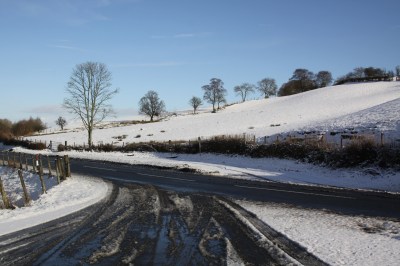
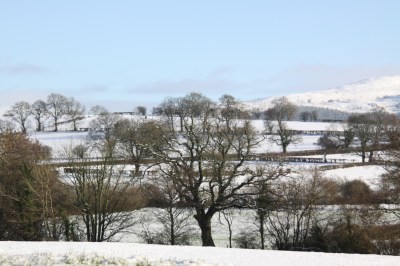
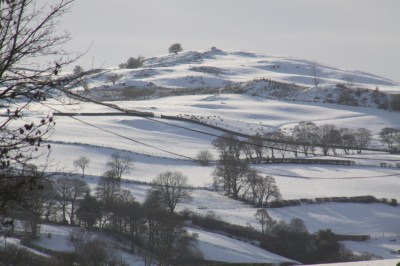
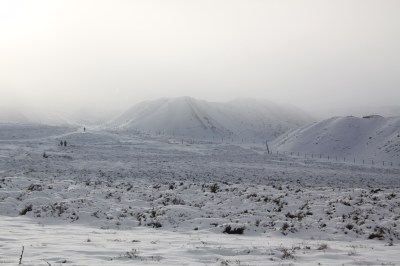
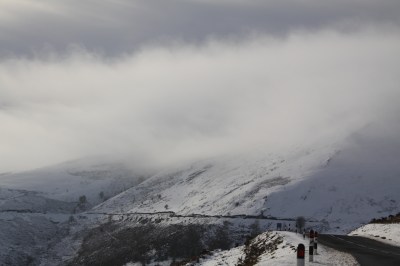
There was a light smattering of snow around Cader Idris, and near Dolgellau at Brithdir, but once I was approaching Bala it thickened up significantly, and in Bala itself cars were under 2 inches of snow. From there to Llangollen via a somewhat curcuitous route along the foot of the Clwydian Range and down the Horseshoe Pass, it was a winter wonderland, very lovely. There aren’t that many places to stop safely to take photos, but I managed a few.
When the Calvinist Methodists left their 1828 premises in Chapel Square, now occupied by Dovey Marine (described on an earlier post together with a brief background to Calvinistic Methodism), they moved into new purpose-built premises in 1864 on Sea View Terrace, which were much more ambitious than their 1828 chapel in Chapel Square, which was somewhat overshadowed by the Wesleyan chapel that had been built in 1829. In its new position it was sufficiently further up the hill to give it a dominant position.
Set back from the sea front, the new chapel was imposing, cut into the side of the hill with a high revetment wall and was reached via a long flight of steps. The new building was much bigger than their former chapel, accommodating a congregation of 650 worshippers. It was on a level with St Peter’s Church, which can be seen in some of the photos below, and one does have to wonder if the desire to put the Tabernacle on a level with the church wasn’t a significant factor in the decision to locate the chapel where it was, up a long flight of stairs that would have made it very difficult for some members of the community to reach.
Instantly recognizable as a Nonconformist chapel, the 1864 Calvinist Methodist building is a gable-entry type chapel with four bays, round-headed windows featuring radiating tracery, and doorways topped with fanlights that echo the design of the windows. It was built from stone and rendered, has a slate roof, and the steps that lead up to the entrance from the seafront are also made of slate. The iron gates at the base of the steps with spearhead finials were manufactured by the Coalbrookdale Company in Shropshire. There are two inscribed tablets on the façade. The one beneath the gable reads Tabernacl Adeiladwyd 1864 (Tabernacle built 1864) and the lower one reads Tabernacl ir Methodistiadd Calfinaidd yn y Flwyddyn 1828 (Calvinist Methodist Chapel established in the year 1828). Before its conversion into flats the interior had a gallery with raked seating supported on cast-iron columns. The organ chamber was preceded by a segmental arch flanked by fluted Corinthian pilasters. The scale of investment involved was quite clearly considerable. The chapel was renovated in 1910 following a religious revival in Wales, which included the addition of heating, ventilators in the roof and the addition of a pipe organ. The photograph below, loaned to me with great kindness by Dai and Helen Williams, shows something of the interior, including the decorative features at the top of the wall above the organ, the organ itself, the pews and the underside of the gallery at the left.
Calvinistic Methodist Tabernacl, 1864
It closed as a chapel in 1988 but the exterior of the building was preserved when it was converted to flats, some of which are rented out for holiday accommodation. The building is Grade 2 listed.
The Calvinist Tabernacle in 1873, nine years after it was built. Source: Hugh M. Lewis 1989, Pages of Time, plate 3.
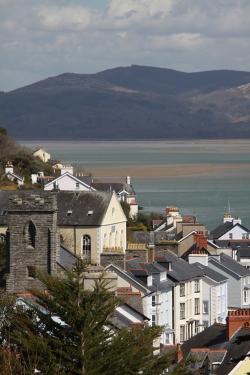
View of the Aberdovey seafront from Ynys Las, showing the prominent position of the Tabernacle, with St Peter’s at the far left and the English Presbyterian church at far right.
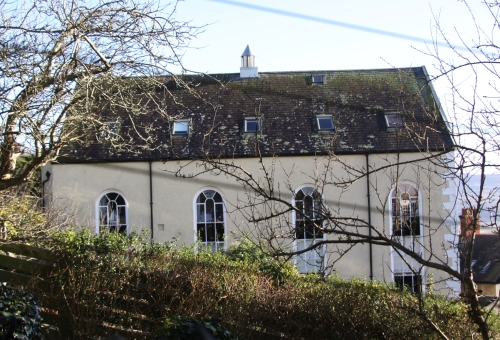
Side view of the Tabernacle from St Peter’s churchyard, showing the rooflights that were added when the church was converted into apartments in the 1980s.
The Calvinistic Methodist Tabernacle is set back from the seafront houses, reached via a steep flight of slate steps
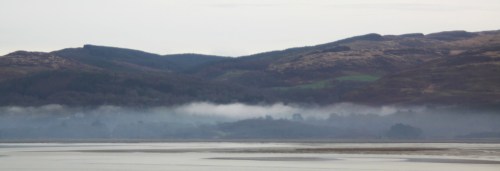
This is a poor photograph, taken through the side window of my car in a mad rush, whilst I was held up at the roadwork traffic lights on the Aberdovey to Machynlleth road, on my way to a dental appointment. My closest friend Cheryll, to whom I emailed it, argues that I should post it in case no-one has been lucky enough to see this particular cloud formation. So here it is, with the cloud in a thin strip hovering just above the floodplain on the opposite bank of the river Dfyi, with apologies for the poor quality. I don’t know what this type of cloud formation is called (if anyone knows, please do let me know), but it happens around here quite often. This, however, was the first time I have driven alongside it along the estuary and river all the way from Aberdovey to Machynlleth. It was an amazing sight. Every time I glimpsed right (south), it was still there in the 20 or so minute drive some time between 1120 and 1145. So here’s the photo, and please remember to blame Cheryll if you don’t like it! By the time I was driving back to Aberdovey it had evaporated completely.
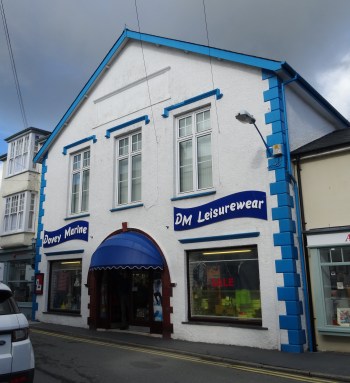
Methodist chapel (now Dovey Marine), Copper Hill Street front entrance
The Calvinistic Methodist Chapel (or Tabernacle) in Chapel Square, now occupied by Dovey Marine, has had a rich history, as did the Calvinistic Methodists who built it. The chapel was their first dedicated premises, before which they used a number of temporary meeting places around the village, their lives made somewhat difficult by anti-Methodist persecution from the important Corbet landowners of Ynysymaengwyn (just outside Tywyn) who owned most of Aberdovey in the 18th Century.
Having arrived in the Aberdovey area in around 1790, it took the Calvinists nearly 30 years to a built a chapel, a significant accomplishment. They were the first denomination to build a chapel in Aberdovey, although the Wesleyan Methodists were only a year behind them. It isn’t the prettiest or most impressive of the chapels in the village, but the Aberdovey Calvinistic Methodists have a very interesting history.
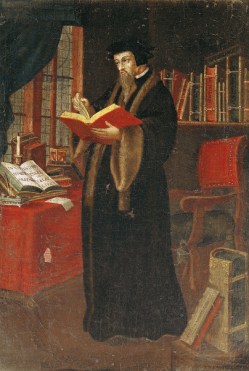
Portrait of John Calvin (1509-64)
The Calvinistic Methodists were a mainly Welsh movement that built on the 18th Century revivals of 17th Century Protestantism. Calvinistic Methodism sounds like a bit of an oxymoron. Methodism, or Wesleyan Methodism, began at Oxford University, where Charles Wesley (1707-88) and George Whitefield (1714-1770) formed a group to discuss religious ideas and methods, particularly the power of evangelism. It was joined by Charles’s brother John Wesley (1703-91) and became known as the Holy Group, and later, based on the importance of procedures and methods in their approach, Methodists. The three, all of whom were ordained, went to America in 1738 to become missionaries, but George Whitefield returned a year later to focus on doing religious work in England, preaching extensively indoors and out, making himself very unpopular with the established church. John Wesley returned three years after his departure to America to bring his ideas into the Church of England in an attempt at Anglican reform. Like Whitefield, he found himself unpopular with the Anglican authorities and was denied preaching access to some churches, so followed Whitefield’s example and began preaching out of doors, and began to travel extensively. Wesley and Whitefield parted ways in 1741 over Whitefield’s belief in Calvinist predestination, foreshadowing the later split between the Welsh Calvinistic and Wesleyan Methodists. It was only after John Wesley’s death in 1791 that Methodism withdrew from the Church of England and became a doctrine in its own right. The key difference was that John Wesley retained the Arminian (as opposed to the Calvinistic) belief that salvation is available to all. In Wesleyan Methodism, the living of a good, altruistic, and selfless lives and absolute belief in and dedication to God is not a means of winning salvation but is actually a product of salvation. Salvation is therefore by God’s grace alone, rather than something that can be achieved by human endeavour. This is one of the core differences between Methodism and the Church of England. In Wales a group of Welsh reformers had very similar ideas
The founders of Calvinistic Methodism. Clockwise from top left: Griffith Jones, Howell Harris, WIlliam Williams Pentycelyn and Daniel Rowland
The reform movement in Wales is thought to have begun in Carmarthenshire with Griffith Jones, the rector of Llanddowror, who was responsible for establishing circulating schools in 1731. These schools taught the Welsh to read by studying the Bible and other Christian scripture. Griffith Jones became something of a legend and an inspiration to other influential early preachers, like Howell Harris (1714-1773), Daniel Rowland (1730-1790) and William Williams Pantycelyn (1717-1791), all of whom had experienced spiritual awakening and became evangelists for a reformed church that had a high level of evangelism and an emphasis on hard work, moral behaviour and education of the poor. William Williams became famous for his hymns, song and prayer being important in the religious practices of Calvinistic Methodism.
When the two groups met up they had so much in common that they initially joined forces under the heading of Methodism. They shared belief in the burden of sin, the need for personal knowledge of God and the ability to feel him, assurance of salvation, recognition when or if sins have been forgiven and the knowledge that this had been felt. They also believed that rebirth on Earth in the form of a better way of living life was fundamental. There was, however, a fundamental point of doctrine on which the two branches differed. Whereas Wesleyan Methodists believed that all people could be redeemed by faith, spreading the word of God and good deeds, the Welsh preachers followed Calvin, the radical French Protestant, who believed that the original sin of Adam made it impossible for people to redeem themselves, and only those who had been selected by God before Christ was sent to redeem them, the elect, would be raised to Heaven. Because they still retained many of the other Methodist ideas about doctrine and felt just as strongly as the Methodists about the way in which religions should be practised, disseminated and organized, the Calvin followers separated from the Wesleyans and became Calvinistic Methodists.
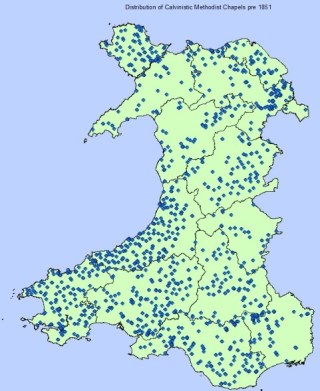
Distribution of Calvinist Methodists pre-1851, showing the low levels of representation in Meirionnydd. Source: Welsh Religious Buildings Trust
Calvinistic Methodists put enormous emphasis on itinerant preaching, either indoors or in the open, considered song and active prayer to be important to developing a personal relationship with God, and believed that God would arise and display his glory. Hard work was a core component of their religion because only by hard work and business success could the elect be known and recognize themselves. By 1750 there were over 400 gatherings of converts who became groups or fellowships known as “seiadau.”
Hugh M. Lewis describes Aberdovey as suffering “a certain amount of religious deprivation” prior to the last decade of the 18th Century. The main centre of social and economic activity in the area was Tywyn, where St Cadfan’s Anglican Church, dating back to the 14th Century, was the main centre of religious life. Even itinerant nonconformist preachers who were very active in other parts of Meirionnydd did not reach Aberdovey. In about 1790, however, a group of Calvinistic Methodists established themselves about a mile outside Aberdovey at a building called Hen Felin, which has since become a ruin. They next moved to lodgings in a building that belonged to the Raven Arms called The Store House on Sea View Terrace, which was used as a warehouse facility and had an upper room that could be used for Calvinistic meetings. Unfortunately, Edward Corbet who “feared them as radicals if not revolutionaries” (Lloyd, A Real Little Seaport) was informed of their activities and evicted them, throwing all their property including benches and bibles out onto the road. The Calvinists were lucky to find a sympathizer in Mr Scott, the owner of the row of three cottages now known as Penhelig lodge, who from 1796 gave them the use of an outbuilding called Ty Coch on the edge of the ravine where there is now a road called Nantiesyn, in Penhelig. In 1811 the Calvinist Methodist movement established its (Yr Hen Gorff – The Old Body) formally, detached itself from the Anglican Church, and became the leading nonconformist Meiryonnydd religion, giving the Aberdovey preachers a solid foundation.
Calvinistic Methodist Chapel, New Street rear entrance
Aberdovey’s population increased in the late years of the 18th Century and the early years of the 19th Century.The discovery of copper and lead in the mid-18th Century and the importance of the port for handling imports of wheat, barley and corn significant contributors to the growth the the village. As Aberdovey prospered, the Calvinist congregation also grew, making it necessary to look for premises that was not owned by the Ynysmaengwyn estate. In 1827, recognizing the growth of Aberdovey, the Turnpike Trust finished a road that linked Aberdovey with Machynlleth, raising its importance, and increasing the number of visitors.
In 1828 a plot of land in what is now Chapel Square was acquired on a 99 year lease, and volunteers built their chapel to seat 124 worshippers in 1828, at a cost of £400.00 (c. £27,120.52 in today’s money, or 26 horses/74 cows, according to the National Archive’s Currency Convertor website). It did so well that in 1855 a gallery was added at a cost of £120.00 (c.£8,136.16). The Coflein website says that the new chapel, which they named Tabernacle, was designed by Reverend Richard Humphreys of Dyffryn. The façades are characterized by large rectangular windows beneath dripstones (mouldings to shelter windows from dripping water), a line of three on the first floor on the Copper Hill Street (front) side and two on the ground floor and two on the first floor at the New Street (rear) side. The arched Copper Hill Street doorway is lined with stone blocks and a keystone. The New Street entrance door has a stucco frame. Stuccoed quoins (masonry corner blocks) are on all four corners of the building and there are wide recessed strips in the gables of both frontages. A plaque reads: “Tabernacl/adeiladwyd ir Methodistiaid Calfinaidd yn y flwyddin 1828” (Tabernacle / built by Calvinistic Methodists in the year 1828). Once they had established their chapel the Calvinist Methodists set up a Sunday school.
Calvinistic-Methodist Chapel of 1864
In 1864 the Calvinists left the building in favour of new, much larger premises on Sea View Terrace, also called Tabernacl, which will be covered on future post shortly. The original 1828 building was immediately adopted as a temporary school whilst a new school was being built. When it was again vacated the former chapel was renamed the Assembly Rooms and became a resource for villagers and a central location for village activities. Shops were later established on the ground floor, the first floor was used for meeting space, and the building became know as the Market Hall. In 1920 it was renamed the Imperial Hall. In 1931 Roman Catholics, who had no premises of their own in the village, used one of the meeting rooms. During the Second World War the building became the headquarters for the Home Guard. Today, the has been occupied for over two decades by the excellent Dovey Marine.
Main sources: Welsh Calvinist Methodism is usefully described on the Welsh Religious Buildings website. Wesleyan Methodism and some of the features that distinguish it from Calvinistic Methodism are described in straight forward terms on the Welsh Religious Buildings website and on the BBC Religion web pages. Hugh M. Lewis, local resident and collector of Aberdovey information and images, is the source of most of the information in this post about the early activities of the Aberdovey Calvinistic Methodists, telling the fascinating story of the establishment of the chapel in his book Aberdyfi, Portrait of a Village (his best book, in my opinion). Lewis Lloyd’s A Real Little Seaport was also useful, and Hugh M. Lewis’s Aberdyfi, Pages of Time added some additional information.

















 Aberdovey Londoner