Category Archives: Aberdyfi

The Congregational Chapel, Aberdovey (established 1880)

The Congregational Chapel, Aberdovey

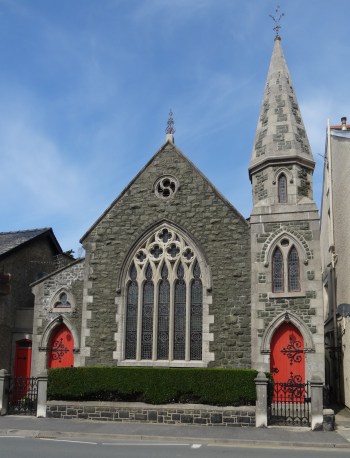
The little Congregational chapel opposite the Snowdonia Tourist Information Centre on Glandyfi Terrace is a bijou little place, quite one of my favourite buildings in Aberdovey.

The Congregationalists (or Independents) arrived in Aberdovey in 1839, and found premises at 6 Evans Terrace where the minister preached their first sermon on 9th March 1840.  From there they moved to 50 Copperhill Street, and where there until 1845 until they established a small chapel called Capel Bach (Low Chapel) on the slopes of Pen y Bryn, the small hill with the folly on top, near today’s Prospect Place.

By the 1870s Aberdovey was becoming prosperous, and in 1882, two years after the chapel opened, the new wharf and jetty were built, improving transport links between sea and the decade-old Cambrian railway for the import of timber, livestock and unprocessed grain and the export of slate and milled grain.  As Aberdovey became more affluent, new people took up residence, both Welsh and English, and their spiritual needs were catered for by a remarkable number of chapels for such a small community.  The chapel was built in the late 1870s, and opened in 1880 to seat a congregation of 250 worshippers.

The chapel has a steeple with its own entrance, an octagonal spire, Gothic Revival clerestory windows, and a large pointed arch window that dominates the stone-dressed façade, featuring attractive traceries with four quatrefoils and stained glass.  The Gwyneth Archaeological Trust states that the unrendered stone is from Penrhyndeudraeth, probably from the Garth quarry in Minffordd, which opened in 1870 and is still in use. the stone dressings and quoins are of Anglesey limestone.  The slender painted iron columns in the interior are absolutely in proportion to the rest of the building, and a very distinctive feature.  The first service was held in the new chapel in 1880, when the village’s first harmonium was introduced.  A few years later the village’s first pipe organ was installed.   The welshchapels.org website indicates that a major renovation took place in 1905, at the cost of £1950.00.  It closed in 1998, when it was purchased and converted for residential use in 1999 by the present owner (with my sincere thanks to him for showing me around the absolutely super interior).
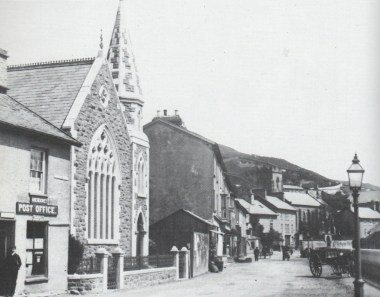
English Presbyterian Church of Wales, Aberdovey c1900. Source: Hugh M. Lewis 1989, plate no.8, Pages of Time

The choice of architectural design is interesting because far more than the other Aberdovey chapels, it borrows directly from the Catholic and Anglican paradigms of church architecture.  A photograph of it in the late 19th Century in Pages of Time by Hugh M. Lewis shows it with the surviving boundary walls and rails and two gateways opening directly onto the road with a gas light opposite, with no pavements (see above).  St Peter’s Anglican Church is clearly visible further down the road.

Congregationalism dates back to the 16th and 17th Centuries. The Congregationalists, together with the Baptists, are two of the oldest Nonconformist religions, and Geraint Evans credits the Congregationalists with being the “seedbed of Welsh Protestant Dissent” in Llanfaches, established in November 1639.  It was given a major boost during the Evangelical Revival of the 19th Century, and in 1832 the Congregational Church of England and Wales was established, a national organization of independent Congregational churches.  Many Congregationalists agree on a number of doctrines, which may include the principle of sola scriptura (the idea that all knowledge required for a spiritual life and to achieve salvation is contained in scripture) and that adult conversion to the faith is a requirement for spiritual salvation.  They all reject the episcopal concept of Holy Orders that are conferred by a religious leader (usually a bishop), adopting professional clergy and an active laity instead.  Finally, Congregationalist churches and chapels are independent of other doctrines, and are self-governing.
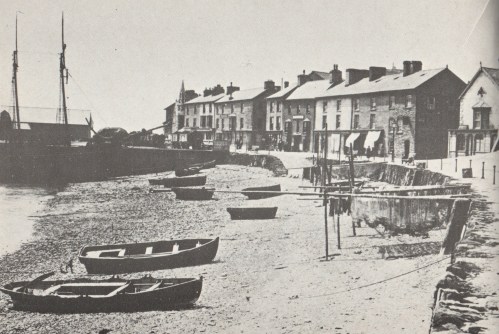
Aberdovey c.1900. Source: Hugh M. Lewis. Aberdyfi: A Glimpse of the Past.

The above photograph, this time from another booklet by Hugh M. Lewis, Aberdyfi: A Glimpse of the Past, shows the village in about 1900, with the chapel at the far end, giving a good impression of the stretch of road from the corner of Copper Hill Street down as far as the chapel.   Fishing nets are out to dry in the foreground, and there is a two-masted ship moored against the jetty, and the architecture along that stretch of road preserves many of the terraces from the 17th Century village.
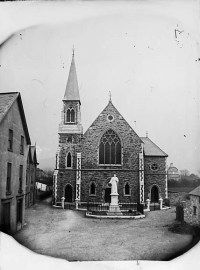
Capel Tegid, Bala. Source: https://tinyurl.com/y6wydxtg

Looking around for anything similar in the area with a view to trying to identify who the architect of Aberdovey’s Congregational Chapel might have been, I stumbled across the larger Capel Tegid at Bala, a Calvinist Methodist church (reconsecrated as a Presbyterian church in the 1930s) that has a lot in common with the Aberdovey chapel, including painted iron columns.  I have no idea if it was built by the same architect, but it is not entirely implausible that William Henry Spaull of Oswestry, who built Capel Tegid and a number of Wesleyan Methodist chapels in  Wales, was also responsible for the Aberdovey Congregationalist chapel.

The 1999 conversion of the Aberdovey Congregationalist Chapel to residential use by a Welsh citizen was absolutely in tune with the existing architecture, retaining all the key features including the wonderful slender painted cast iron columns and the stained glass windows, and all the furnishings complement the original features beautifully.  It is beautifully maintained, inside and out, and is a credit to its owner.  The perfectly manicured hedge in front of the chapel is evergreen myrtle, the leaves of which have a wonderful aromatic scent when rubbed, and it produces a plethora of tiny white flowers in the summer.
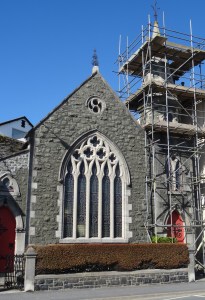
I won’t mention the owner’s name, to preserve his privacy, but when I first moved into the area I had not realized that it had been converted and thought that it was still either in use as a chapel or was empty.  When I saw someone emerging from the building I therefore had no hesitation in asking if it would be possible to see around it at some stage.  He was so kind that he invited me in there and then.  I was expecting dusty recesses and cobwebs, and instead stepped through the door to find that I had invited myself into what was clearly someone’s very beautiful home!  To say that I was mortified barely touches the surface.  But I am so glad that I made that particular mistake, because it was super to see how stunning it is.

Some restoration work was carried out to the steeple in 2018.

It should be noted that although the Coflein website has a photograph of the Congregational Chapel under its entry for the English Presbyterian Church of Wales, this is a case of mistaken identity.  The Presbyterian chapel is the yellow building at the opposite end of the village (and shown in this blog’s header).   Elsewhere on the site, the Coflein website has the chapel listed as an Independent chapel (nebo), the Welsh-speaking term for Congregationalism.  The Coflein website lists many photographic records of the interior prior to its conversion in its catalogue, but these are not currently available online.
The minor miracle of a mermaid’s purse – and The Shark Trust

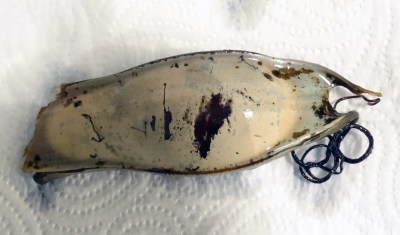
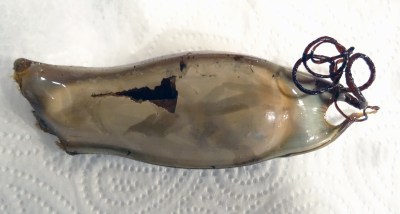
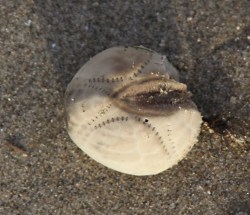
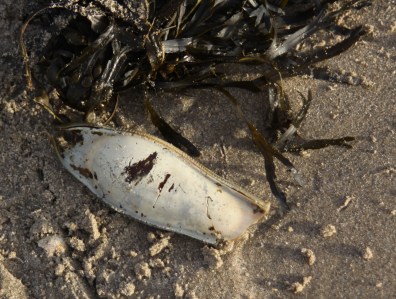
When I first moved to Aberdovey I bought myself two books about what sort of things I could expect to find on the strandline of the beach.  My previous strandline discoveries have been posted here and here.  My books almost promised me that I would find mermaid’s purse of some description on the strandline, but until yesterday I hadn’t seen one.  Yesterday, attached to a bit of bladder wrack seaweed, not far from a nice example of an Echinocardium cordatum (see the end of the post) I found a battered but fairly in tact example of a mermaid’s purse or, more mundanely but more accurately, an eggcase, which turns out to be one of nature’s minor miracles:

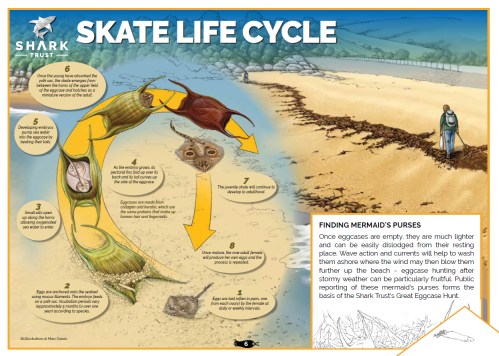
An eggcase is the product of fish of the elasmobranch species – shark, ray and skate, which instead of having bony frames have skeletons made of flexible cartilage, and many lay eggs in pouches or eggcases.  The eggcases are made of collagen, a resilient protein found in vertebrate animal tissues. Some have curly tendrils at one end to attach them to the seabed and seaweeds.  Within the eggcase is a yolk that provides nutrition for the embryo.  As it grows, the embryo wriggles and this pushes stale water out of the hollow horns of the eggcase and pumps in fresh oxygenated water.  When the embryo has reached full size, it swims out of the eggcase, abandoning the empty pouch, a perfectly formed miniature version of its adult parent.

Skate Lifecycle.  Source:  The Great Eggcase Hunt, The Shark Trust (https://www.sharktrust.org/shared/downloads/projects/great_eggcase_hunt_report_2017.pdf)

In the example that I found, the seaweed to which it was attached had worked its way free and washed up on the strandline, with the eggcase firmly attached.  It took me a few moments to unravel it.   When they are washed up on the shore, they lose their flexibility, shrivel and become hard, but not brittle, and they can survive for many years.

I brought the eggcase home and dried it out on a piece of kitchen roll on the radiator before looking it up. This was the wrong thing to do.  According to one of my books (the absolutely excellent The Essential Guide to Beachcombing and the Strandline by Steve Trewhella and Julie Hatcher), what I should have done is soak it in water to rehydrate it so that I could compare it with photographs on the eggcase identification page on fabulous The Shark Trust website, where you can also record your finding.  The Shark Trust has an ongoing Great Eggcase Hunt, which began in 2003, and has now logged over 100,000 eggcases on British shores.  It has identified ten species of skate and three species of shark, and is beginning to get an idea of where favoured egg laying places are located.

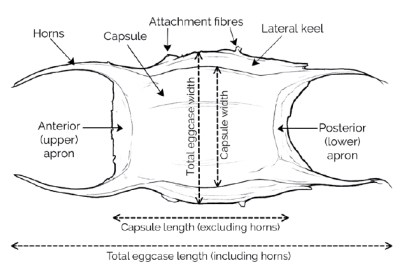
Eggcase morphology. Source:  The Great Eggcase Hunt, The Shark Trust (https://www.sharktrust.org/shared/downloads/projects/great_eggcase_hunt_report_2017.pdf)

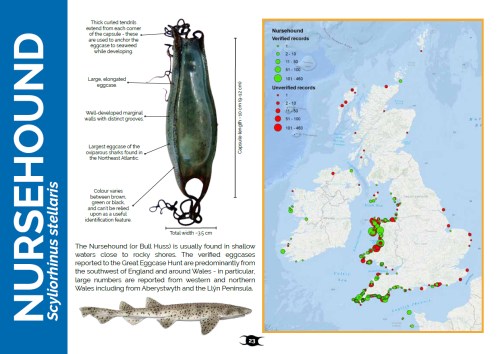
So it was back to the drawing board, by which I mean a saucepan of water.   After the eggcase had soaked overnight I had another poke at, prior to any attempt at identification, and it was just as solid as it had been when it went into the saucepan.  I assume that baking it on the radiator had rendered it immutable.  Checking the solid item against various photographs in books and on The Shark Trust website it was immediately clear that eggcases are either black or a translucent pale gold, information that appeared to narrow things down significantly. Although mine is light in colour, big patches of black suggest that it was originally black all over.  The shape is clearly either Nursehound (or Bull Huss) or Smallspotted catshark, but the smallspotted catshark eggshells are translucent and golden and only reach a maximum of 7cm in length, and mine is 12cm, not counting the tendrils, and 4.5cm wide at its widest.  So even though the colour is debatable, I concluded that mine was probably a Nursehound/huss, which is a common specie in this area (and I bought quite a lot of huss from Dai’s Shed during the summer) but I’ve submitted my guess with photographs so that The Shark Trust people can make their own judgement.

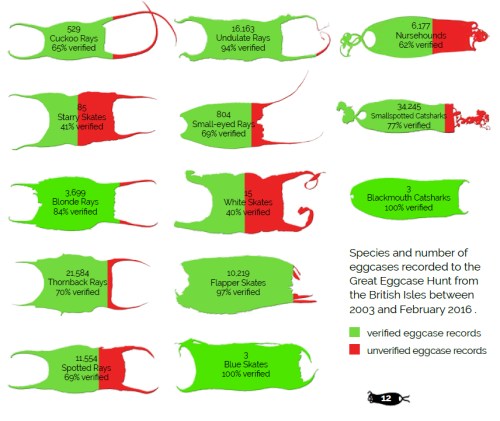
Nursehound eggcase. Source: The Great Eggcase Hunt, The Shark Trust (https://www.sharktrust.org/shared/downloads/projects/great_eggcase_hunt_report_2017.pdf)

Another nice find was an Echinocardium cordatum.  They are not uncommon on the Aberdovey beach, which astounds me as they are so fragile that you are in danger of them shattering as soon as you pick one up.  Also known as sea potato and heart urchin, they are covered with spines that, unlike the more familiar sea urchins, lie flat against their shells (“tests”) and look a bit like an animal pelt.  Also unlike sea urchins, they live burrowed under the sand of the seabed.

A sunny day, a lovely sunset

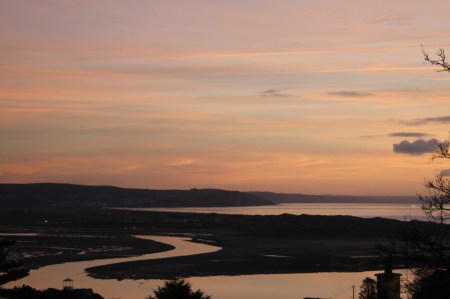
What a lift to the spirits when the sun comes out!  A few snapshots in celebration of a lovely walk on the beach, wrapped up with a really colourful winter sunset.

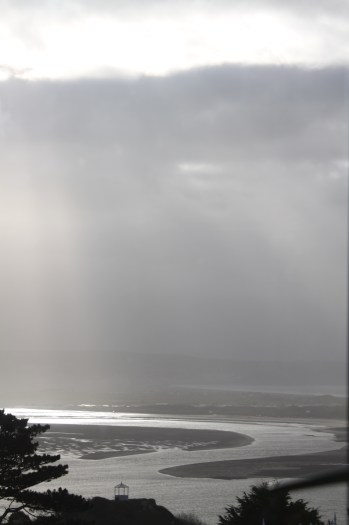
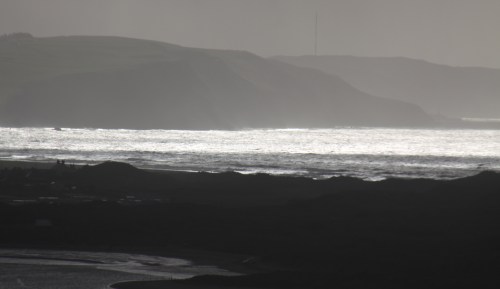
Silver and Black over the Dyfi Estuary

One of those remarkable days where the backdrop is a dull monochrome, but the silver winter sun pierces the clouds, bringing a glorious new dimension to the whole experience:

Goldfinches for the New Year

Goldfinches on the nyjer bird feeder

Aberdovey’s Housebird Central has been a busy place in the New Year. I returned from Christmas in Chester to an absolute hive of avian activity. As well as the usual array of blue tits, coal tits, sparrows, the noisy pheasants, and a new small LBJ (Little Brown Job) that needed identification (a very pretty dunnock), a new community of birds had found the nyjer/niger (Guizotia abyssinica) seeds. I had been about to take the bird feeder down, because it really is the ugliest bird feeder of all time and was always ignored by every bird that visited the garden in favour of the mixed seed, mealworm and peanut feeders.  The chaffinches and bullfinches that it was supposed to attract duly arrived but have been feeding happily on the mixed seed feeder.   It has, however, been transformed by a small army of goldfinches from an eyesore into a thing of wonder.  It’s difficult to count how many goldfinches there are, because there are so many, but there are never more than four on the feeder at a time, and that means that there is the occasional mad and multicoloured flurry of feathers as new arrivals displace incumbents. Unlike the blue tits, which are endlessly shifting gymnasts, the goldfinches fix themselves in one position and eat with small, minimalist movements, staying in one place for as long as they remain undisturbed. With beautiful red, yellow, black and white plumage they are remarkably exotic on a chilly grey January morning. Many goldfinch communities migrate as far south as Spain in the winter, so I am lucky that members of this particular colony have remained to face a Welsh winter.

The blue tits and coal tits are as enchanting as usual, and are having a major peanut fest at the moment:

Don’t forget that the RSPB’s Big Garden Birdwatch is taking place between 26th and 28th January this year (2019), now in its 40th year. You can find out more on the RSPB website here: https://www.rspb.org.uk/get-involved/activities/birdwatch/everything-you-need-to-know-about-big-garden-birdwatch/

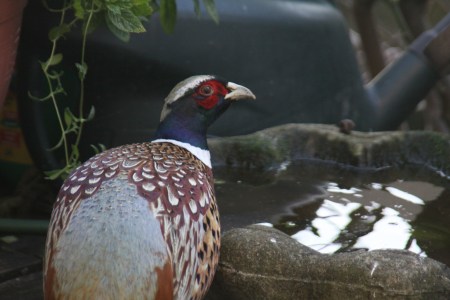
Pheasant at the bird bath

The Royal National Lifeboat Institution (RNLI) in Aberdovey in 2018

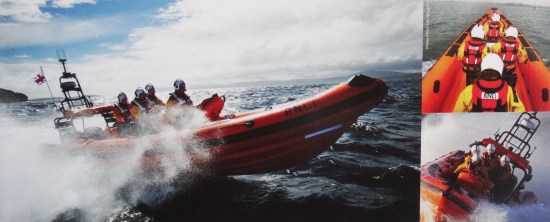
Pictures of the Atlantic 85 in-shore lifeboat in action (photograph of part of a poster on display in the Aberdyfi Boat House).

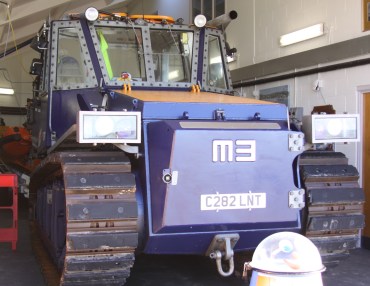
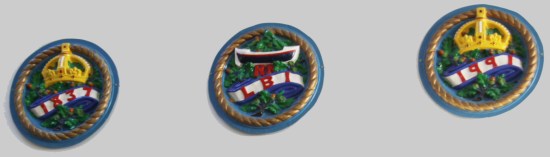
The RNLI is a vital national emergency service dedicated to saving human life, comparable to the NHS Ambulance service, with the fundamental difference that its boats are manned largely by unpaid volunteers, its shops are manned wholly by unpaid volunteers and it is funded mainly by private donations, legacies and its own fund-raising efforts.  The RNLI was established on 4th March 1824 as the National Institution for the Preservation of Life from Shipwreck, it was granted a Royal Charter in 1860, its Patron in Queen Elizabeth II and it has over 238 lifeboat stations and 445 lifeboats in England, Wales, Scotland, Ireland and the Isle of Man.   In Aberdovey alone the lifeboat goes out between 20 and 30 times a year, dragged to and from its home in the boat-house on the wharf by a giant, custom-designed caterpillar-tracked tractor.

The RNLI has a long and really fascinating history, and much of that will be explored in later posts, with special reference to the RNLI presence in Aberdovey since 1837, but here I want to start with what the RNLI does in Aberdovey today, how it works and what it means to sailors, people and animals in distress and the community as a whole.

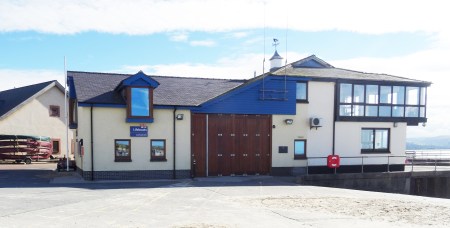
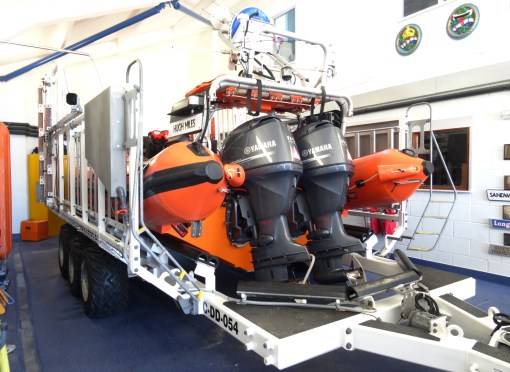
Let’s begin with the guided tour of the facility that was given to me by Dai Williams, Volunteer Shop Manager at the RNLI.   The lifeboat house in Aberdovey has moved around a lot since its establishment in 1837.  However, in 1991 the Yacht Club and the RNLI combined resources to extend the clubhouse and accommodate a new lifeboat on the wharf.  Most recently the wharf buildings were reconfigured in 2016 to allow the RNLI Lifeboat Station to expand, placing its new rescue boat the The Hugh Miles and its tractor under cover, improving the changing facilities for the lifeboat crew and moving the shop into a new location so that it is visible from the road and can benefit from passing footfall.  Funding from private donors was central to the modifications to the premises, and the new RIB was enabled by a donation from The Miles Trust.  The tractor is a massive and impressive beast on caterpillar tracks, a necessary adjunct to the boat due to the difficult recovery conditions at low tide.

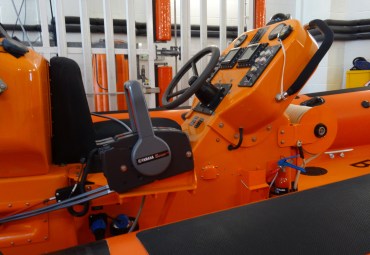
The Hugh Miles, operating number B-896, is a fast inshore rescue craft, an Atlantic 85 rigid inflatable boat (RIB), replacing the previous Atlantic 75, Sandwell Lifeline.  The RNLI has two main categories of lifeboat: all-weather lifeboats and inshore lifeboats, each of which are suited to different conditions.  For the full range of lifeboat types employed by the RNLI see their “Our Lifeboat Fleet” web pageThe Hugh Miles is a specialized inshore lifeboat, one of the fastest in the RNLI fleet, powered by two Yamaha 4-stroke outboard 115hp engines, reaching top speeds of 35 knots.  It can go to sea in a force 7 wind during daylight hours and during a force 6 at night.  It cost £214,000 and, at nearly a meter longer than its predecessor, has the capacity for an extra crew member, bringing the total to four, although it can operate with three, and far more kit.  It is stored in a carriage, a cage on wheels, from which it is launched.  The RIB has a solid bottom and flexible sides, which makes it both strong and relatively light-weight.  The concept was originally developed in the Atlantic College, Vale of Glamorgan, south Wales during the 1960s and early 1970s.  Watersports were a big part of the boarding school agenda, and the college had its own in-shore lifeboat station.  They soon realized that the inflatable boat they were using could be improved upon and used marine plywood and rubber tube to create the templates on which the modern RIB is based.  The RNLI recognized the idea and created a glass-reinforced fibre model, which was a B-Class Atlantic 21 that came into service in 1972, its name commemorating the role of the college for this and future B-type RIBs.
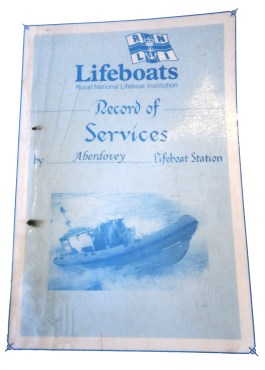
Flicking through the Record of Service book in the life boat house there were a hair-raising number of minor and major incidences where the lifeboat was called out.  These involved yachts and other sailing vessels, power boats including a fishing boat, canoes, inflatable dinghies, kite boards, sail boards, jet skis, an inflatable toy, and swimmers in trouble.  Here are three examples of call-outs in 2018, all noted on the Aberdyfi Lifeboat’s Facebook page.  In July, the lifeboat was called out to the assistance of swimmers in difficulty at Tywyn.  On arrival, one casualty had been recovered but the second was still missing and the crew began a search, receiving information from the Coastguard that the swimmer had been spotted on the lifeboat’s exact course. The lifeboat proceeded as fast as was safe to the location where the helm manoeuvred the boat skilfully in the surf and shallow water to be able to put a crew member into the surf to recover the casualty with two members of the public who had waded in, recovered the second casualty.  First aid was delivered and a second  crew member from the lifeboat entered the surf with vital kit such as oxygen.  It should be noted that whilst the second casualty survived, the first one died later in hospital, a tragic reminder of the importance of the work of the RNLI.  One night in August at past 9pm, with the light fading and on an outgoing tide, the Aberdyfi Lifeboat was called out to a broken-down yacht.  The lifeboat reached the yacht and the crew were able to  secure a tow, bringing it back into the estuary and placing it on a mooring.  The lifeboat was returned to its station by 11pm.  At 1645 on an evening in September, the Aberdyfi Lifeboat was called out to aid a boat with eight people on board, which was experiencing engine problems and was aground just south of the Aberdyfi Bar.  The Borth lifeboat was already on scene and had managed to tow the vessel into deeper water, and from there they handed the rescued boat over to The Hugh Miles, which took most of the boat’s crew on board and set up a tow to bring them back to the Dyfi estuary.
David Williams, not to be confused with Dai Williams, is the Volunteer Lifeboat Operations Manager (LOM) at the RNLI in Aberdovey, leading the operation team.  He is responsible for authorizing the launch of the lifeboat and ensure that the lifeboats and all associated gear are maintained and in a constant state of readiness for action.  David Williams grew up in Tywyn and also volunteers with Mountain Rescue.  In the event of his absence there are also four Deputy Launching Authorities who can stand in for him.  The in-shore boat crew is headed by the Senior Helm (the equivalent of a coxswain on an the bigger all-weather boats), currently Will Stockford, who is also the Harbour Master and doubles up as boat mechanic.  Next in seniority is the Helm, who must be on board if the Senior Helm is unavailable.  The helm is trained in a variety of skills including navigation, search and rescue and casualty care, has many years experience as a volunteer and is in charge of leading any rescue.  Three other crew members may or may not be trained to steer and navigate the boat but all receive their initial training in Poole in Dorset at the RNLI.  As well as being on call for emergencies, the crew undergo practice drills and training on a weekly basis, usually on a Sunday morning.  The tractor drivers are usually former crew members who have retired.

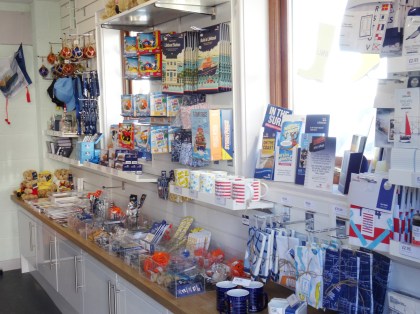
Dai Williams is the Volunteer Shop Manager, currently with a team of six shop volunteers helping customers in the shop.  The RNLI shop on the wharf not only generates important funds for the charity but raises awareness of the RNLI and its activities, its staff acting as ambassadors for the lifeboat station, explaining its role and answering the many questions from the public.  The new merchandise in the shop is bright, modern and eclectic, offering everything from games and toys to calendars and diaries, as well as souvenir tea towels, mugs and clothing is provided by the RNLI.  Nautical themes dominate, of course, and many are by designer names.  There are also shelves outside selling second hand books, jigsaws and DVDs donated by the public. Having spent some time in the shop over the last month, it has been great to see the range of people who visit and buy products in support of the RNLI.  Small children with their parents, buying nets, shovels and buckets for crabbing are very happy contributors to RNLI funding.  I have been buying RNLI Christmas cards online for years, but it’s much better to be able to go and buy them in person.  And just about everyone is getting an RNLI tea towel in their stockings this year!

As well as the shop there is also an important fund-raising group based locally, the Aberdyfi Lifeboat Guild, which puts on events throughout the year.  Many terrific visitor activities take place, particularly during the course of the summer, which get everyone involved, from crew to visitors, from young to old.  Events have included Flag Day when there was a duck race (500 plastic ducks are launched and then retrieved!), the Abergynolwyn Silver Band played, there was a raft race and an afternoon tea was organized.  Other events have included a quiz night, a Crabby Competition, a barbecue, the Dysynni Male Voice Choir and a Fun Run.  There was even a stand at the Food Festival in August, demonstrating water health and safety procedures and equipment, and the Lifeboat Station has a stall at the Christmas Fair (this year on the 1st December, 10am – 4pm).

Aberdyfi Lifeboat Station and Shop

Donations from the public continue to be critical to the operations of the RNLI.  The donations that enabled the modernization of the Aberdovey RNLI base says a lot about the sort of people who help the RNLI not merely to continue operating, but to continue updating their technology and improving their services.  The Miles Trust, which funded the new boat, was set up in memory of Hugh Miles.  Hugh Miles, the only child of the late Herbert and took great pleasure in RNLI activities around South Wales and after his death his mother bequeathed her estate to the RNLI, part of which was to be used to fund a rescue boat for the Welsh coast.  The Aberdovey’s The Hugh Miles Atlantic 85 RIB is that boat.   The modification for the boathouse was funded by the Derek and Jean Dodd Trust and a legacy left to the charity by RNLI supporter Desmond Nall. Derek and Jean Dodd moved near Aberdovey, where Derek was able to kayak into his 80s.  Desmond Nall was an RNLI enthusiast from Solihull, who, together with his brother, Godfrey volunteered  on the RNLI’s stand at the Birmingham Boat Show for a number of years and funded two inshore lifeboats.

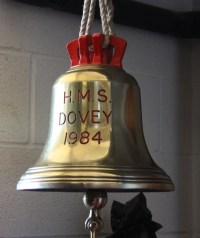
The Aberdyfi lifeboat station has a rather special and unique feature:  the bell from the HMS Dovey.  It is on loan from the Royal Navy.  Should another HMS Dovey be built, the bell will have to be returned, but at the moment it is a much loved and admired resident of the lifeboat station.  The HMS Dovey was the river class minesweeper M2005 commissioned in 1984 and sold to Bangladesh in 1994 for use as a patrol ship.

If you are a visitor to Aberdovey, do visit the lifeboat station and the shop.  You will find a very warm welcome.

Contact details:
Aberdovey Lifeboat Station
The Wharf
Aberdyfi
LL35 0EB
01654 767695 (If you see someone in trouble at sea dial 999 and ask for the Coast Guard).
The shop is open from Easter to October 10am–4pm Saturday and Sunday, and on some Saturdays in November and December.  During the summer it is open for some days during the week (opening times are shown in the shop door)
Facebook page

As well as the RNLI, local emergency services that receive no direct government funding and rely on their charity status and fundraising activities for their income are Trinity House (vital shipping and seafaring charity), the Wales Air Ambulance service and Aberdyfi Search and Rescue.

Many thanks to Dai Williams for correcting the mistakes and plugging the gaps in my first draft.  Helen Williams tells me that no matter how much you find out about the lifeboat station, there is always more to know and I believe her!

References

Aberdyfi Lifeboat Facebook page
https://bit.ly/2OXFbqx

Dermody, D. 2011.  Atlantic College students’ RIB sea safety revolution. BBC 15/05/17. https://www.bbc.co.uk/news/uk-wales-south-east-wales-13377377

RNLI News Release 2016. Farewell to Sandwell Lifeline as Aberdyfi RNLI welcomes new lifeboat. RNLI 02/12/16. https://rnli.org/news-and-media/2016/december/02/farewell-to-sandwell-lifeline-as-aberdyfi-rnli-welcomes-new-lifeboat

RNLI News Release 2017. Double celebration ahead for Aberdyfi RNLI. RNLI 25/07/17.
https://rnli.org/news-and-media/2017/september/25/double-celebration-ahead-for-aberdyfi-rnli

RNLI News Release 2018. Aberdyfi and Barmouth RNLI Lifeboats involved in Tywyn rescue. RNLI 1/08/18. https://rnli.org/news-and-media/2018/august/01/aberdyfi-and-barmouth-rnli-lifeboats-involved-in-tywyn-rescue

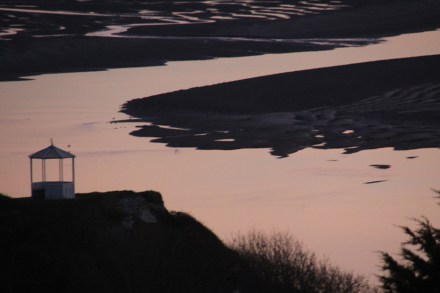
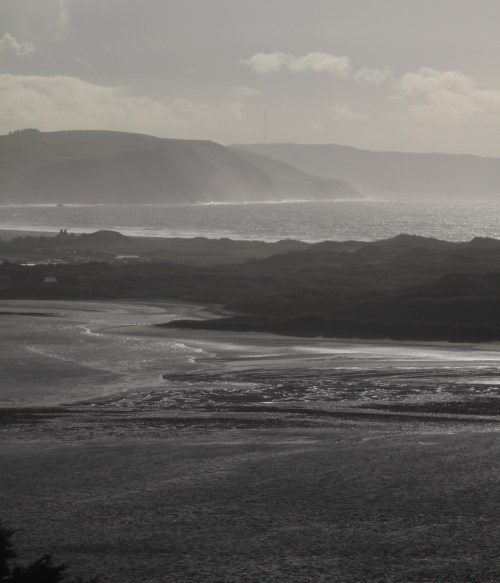
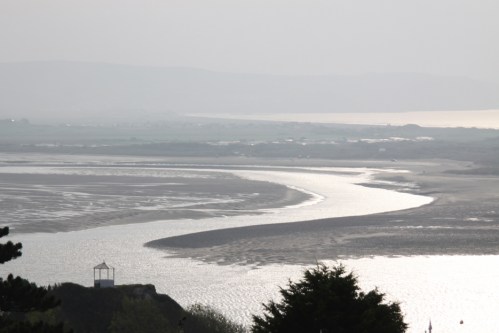
Mid afternoon over the Dyfi estuary towards Ceredigion in early winter

I took these yesterday afternoon (12th November), but have only just got around to taking them off the camera.  Nothing special, just snapshots of remarkable light as the sun begins to go down – slowly, over a two hour period, and so early at this time of year.


Cyanistes caeruleus chaos at the bird feeders

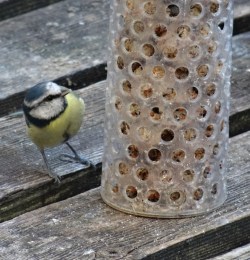
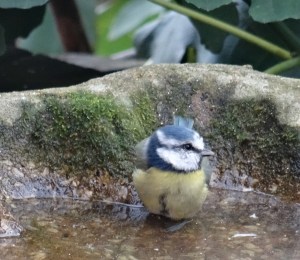
That’s blue tits to most of us.  After a visit to the dentist in Machynlleth today for two fillings (with thanks to Tim Moody and nurse Sarah at Llys Einion Dental Surgery for overcoming the worst of my terrors), what I really needed to lift my spirits was the crazy antics of the blue tits on the bird feeders.  In the tree any attempt to track their constant comings and goings on the seed feeder, swapping of positions and astounding acrobatics is absolutely eye-watering.  It’s like a fractal in motion, pure chaos theory.  My dentist was talking about the failure of physics to align General Relativity with the Standard Model of Quantum Mechanics.  Perhaps the answer lies in the insanely complex interactions and dizzying gymnastics  of the blue tits in my garden.

The blue tits have recently become very confident on the fat ball and mealworm bird feeders on the decking by my kitchen door.  They were put there for the robin and a couple of sparrows, but the blue tits in particular have become addicts in recent weeks, and watching their antics so closely is remarkable, a sort of pared-down version of their performance in the cherry tree, as the following short video demonstrates:

When the blue tits are on the decking, the sparrows that are there much of the time are undeterred, but the robin takes off as soon as the lively gymnasts arrive.  Everything, however,  vanishes when the doves or pheasants arrive.  In the bird world, size matters.

In his book How to be a bad birdwatcher Simon Barnes talks about the hierarchy of tits on bird feeders:  “as you watch, you will notice that the big chaps can chase off the little chaps whenever they want to.  If a blue tit wants a peanut, it has to wait for a great-tit-free minute, and then fly in and be quick and skilful.  And by good fortune, or good evolution, quick and skilful is exactly what blue tits are.”  That interplay between the tits is observable every day.  The great tits take precedence over the blue tits and the blue tits take precedence over the coal tits.  But the blue tits seem to win by sheer force of numbers.  There are so many of them!   Barnes points out that this highly competitive behaviour is restricted to the bird feeder – such competition does not take place elsewhere in their lives because in nature each has its own preferred niche, away from these challengers.  I particularly love the symbiosis between those in the tree and those on the ground.  As the tits chuck half of their food on the floor in amongst the roses, the pheasants and doves form a collection posse, scooping up all the rejects.  Everyone wins.

The bird seed in the tree was empty and had to be refilled on my return.  I will be in serious trouble with Housebird Central if I let my standards slip in this shocking way!

Two new visitors to the garden

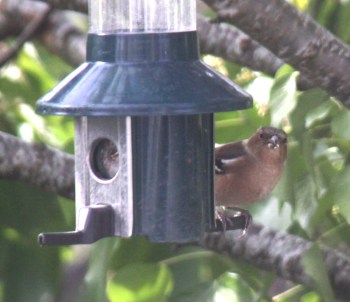
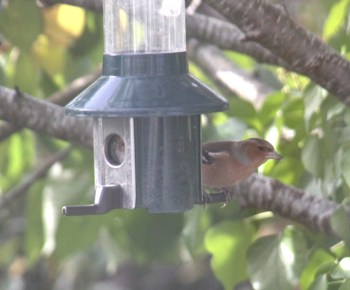
Last week I noticed a splash of colour in motion out of the corner of my eye, a dash of dusky red on the bird feeder in the cherry tree.  It turned out to be a male chaffinch.  In spite of trying to attract them with a special feeder stuffed with nyger seeds, it is the blue tits who have used that feeder, and the chaffinch was on the all-purpose feeder.  He have visited a couple of times since, but unlike the blue tits, which form a semi-permanent cloud of activity, he’s only an occasional visitor to the tree, although he may well be hoovering up fallen seeds on the floor, which the pheasants and the doves also eat.  The tits, particularly the great tits and coal tits, are really messy eaters, and throw seeds everywhere, so there is always plenty on the ground.


Another new visitor is a female blackbird.  She hops around the decking, and when the tits are on the decking at the same time, as shown in this video below, she looks absolutely huge!   She is a very occasional visitor, but when she arrives she is like a cat amongst pigeons. The blue tits are completely put out by her presence and don’t quite know what to do about her.  The robin puts in a brief appearance, but takes off as usual when the blue tits arrive in force.  The video was taken through the glass of the window, so it’s a tad murky, but still fun.